A colony-level response to disease control in a
leaf-cutting ant
12
3 4
5
6 7 8 9 10
11 12 13
14
Adam G Hart
1, ANM Bot
2, Mark JF Brown
31
Department of Animal and Plant Sciences, University of Sheffield, S10
2TN, UK.
Smithsonian Tropical Research Institute, Panama City, Panama
2
Department of Genetics and Ecology, University of Århus, 8000 Århus,
Denmark
3
Author for correspondence. Department of Zoology, Trinity College
Dublin, Dublin 2, Ireland. E-mail:
[email protected]
15Abstract
17 18 19 20 21 22 23 24 25 26 27 28 29 30
Parasites and pathogens often impose significant costs on their hosts. This is particularly true for social organisms, where the genetic structure of groups and the accumulation of contaminated waste facilitate disease transmission. In response, hosts have evolved many mechanisms of defence against parasites. Here we present evidence that Atta colombica, a leaf-cutting ant, may combat Escovopsis, a dangerous parasite of Atta’s garden fungus, through a colony-level behavioural response. In Atta colombica, garden waste is removed from within the colony and transported to the midden – an external waste dump - where it is processed by a group of midden workers. We found that colonies infected with Escovopsis have elevated numbers of workers on the midden, where Escovopsis is deposited. Further, midden workers are highly effective in dispersing newly deposited waste away from the dumping site. Thus, the colony-level task allocation strategies of the Atta superorganism may change in response to the threat of disease to a third, essential
Introduction
31 32 33 34 35 36 37 38 39 40
41 42 43 44 45 46 47 48 49 50 51 52
Waste disposal strategies have to be implemented at all levels of biological organisation. This is particularly true for social organisms, where waste can act as a disease reservoir and thus impose a significant cost on social life (e.g., Snow 1855). When social groups are small, waste may not accumulate sufficiently to pose a serious disease threat. However, as groups become larger, waste and associated diseases pose an increasing threat to sociality. Unless strategies are in place to deal with the hazards posed, sociality may breakdown completely as the costs imposed by waste accumulation overcome the benefits of social life.
53 54
55 56 57 58 59 60 61 62 63 64 65 66
67 68 69 70 71 72 73 74
investigate the potential for a colony-level response to waste-related disease risk in the leaf-cutting ant, Atta colombica.
Leaf-cutting ants (Atta and Acromyrmex) culture a basidiomycete fungus on harvested leaves, on which fungus they are completely nutritionally reliant (Weber 1972). Consequently, they must combat both direct disease-risks to themselves, and diseases that attack their fungal food-source. The main disease threat faced by the symbiotic fungus of leaf-cutting ants is Escovopsis, a virulent and potentially fatal fungal parasite (Currie et al. 1999a,b). Escovopsis invades the fungus gardens of leaf-cutting ant colonies and in extreme cases can overgrow these gardens, leading to colony starvation and death (Currie 2001). To counter the effects of this pathogen, leafcutting ants have entered into another symbiosis with an actinomycete bacterium that lives on the ant cuticle and produces antibiotics against Escovopsis (Currie et al. 1999a). However, despite this defence, the pathogen may still succeed in destroying a colony (Currie et al. 1999b, AG Hart pers. obs.).
the threat posed by Escovopsis to the colony, and only be employed when that threat exceeds a certain level.
75 76
77 78 79 80 81 82 83 84 85 86 87 88 89 90 91 92 93 94 95 96
Here we ask whether allocation of workers to midden work by A. colombica colonies is related to the current threat posed by Escovopsis. We also investigate the functional role midden workers play in waste management. Together, the answers to these questions allow us to determine whether behaviour and patterns of task allocation may be effective strategies in controlling diseases.
Methods
Midden workers and Escovopsis presence
97 98 99 100 101 102 103 104 105 106 107 108 109 110 111 112 113 114 115 116 117 118
2001). Midden worker numbers were then divided by the number of foraging entrances prior to analyses. The means of these corrected scan counts were used for analyses.
Functional role of midden workers
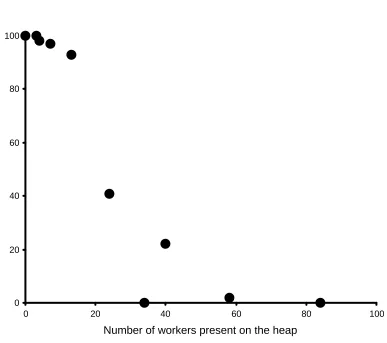
To determine the role played by midden workers in distributing waste around the midden we soaked sheets of paper overnight in the waste of each of 10 colonies with different numbers of midden workers. These colonies were a subset of the experimental colonies above, chosen for ease of access and to represent a wide range of midden worker numbers, but without respect to their current infection status. One hundred 3mm squares of paper were cut from each sheet and put on the midden of the colony in whose waste the paper had been soaked. The pieces were put at the site where workers were dumping waste, in an area less than 5cm square. The distance each piece had moved after 2 hours was measured. The number of workers on the midden at the time of the experiment was counted with 3 scan counts.
Results
Midden workers and Escovopsis presence
119 120 121 122 123 124 125 126 127 128 129 130 131 132 133 134 135 136 137 138 139 140
workers in infected colonies and the degree of infection (Spearman’s rank correlation, r = -0.2, P > 0.6; number of pieces infected ranged from 1 to 7).
Functional role of midden workers
Midden workers strongly influenced the distribution of the experimental waste around the midden (Figure 2). On middens with more than 20 workers, most of the paper pieces were moved further than 10cm from the dumping site within two hours (mean = 87 pieces, s.d. = 18.2 pieces), whereas on middens with less than 20 workers few pieces were moved (mean = 2.4 pieces moved further than 10cm, s.d. = 2.9 t = 10.27, d.f. = 8, p < 0.001).
Discussion
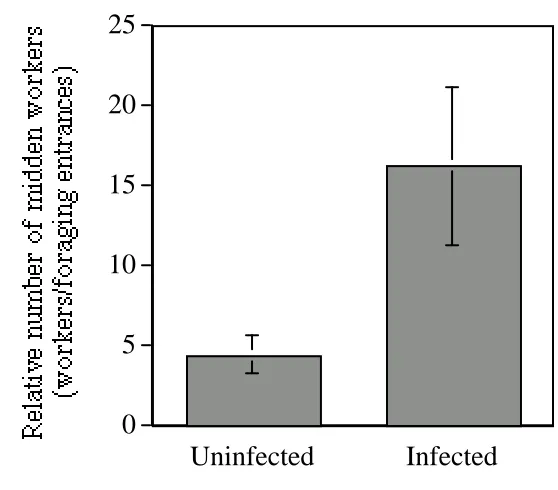
Colonies which are infected with Escovopsis also have higher numbers of workers on the midden, where Escovopsis is deposited. These midden workers, when present in such numbers, are effective in dispersing newly deposited waste away from the dumping site. Together, these results suggest that Atta colombica colonies use a behavioural strategy of disease control, i.e., increasing allocation of workers to midden tasks is an attempt to prevent re-infection by the potentially deadly parasitic fungus Escovopsis.
seen in Escovopsis infected colonies, new waste gets rapidly moved away from dumping sites. The absence of a correlation between the degree of infection and the number of midden workers may reflect either an “all-or-nothing” response to infection, or a lack of power in the test. The low number of midden workers on middens free of Escovopsis suggests that there may be significant costs associated with midden work. Workers suffer high mortality when they are kept in close contact with waste irrespective of whether Escovopsis is present (Bot et al. 2001). Thus, allocating workers to middens is likely to
reduce both life span (a demographic cost) and the number of workers available for other tasks (an ergonomic cost). Consequently, resource allocation strategies within the Atta colony may change in response to the threat of disease, only investing in costly midden work when it is essential to colony survival. Task allocation in social insects responds to environmental perturbation (Gordon 1996), and recent work by Starks et al. (2000) showed that honey bee colonies respond to infection by inducing ‘fever’ conditions. Functionally analogous changes in behavioural responses to the direct threat of disease have been demonstrated in groups of termites (Rosengaus et al. 1998, 1999a). Here, we show that colonies may respond, via task allocation strategies, to a disease threat to a third party, in this case the garden fungus of the ants. Such strategies, together with physiological immunity (e.g., Rosengaus et al. 1999b), may result in a disease-response that is integrated across the different organisational levels of social insect colonies.
142 143 144 145 146 147 148 149 150 151 152 153 154 155 156 157 158 159 160 161 162 163 164
allocation to midden work. Further studies, where the presence of Escovopsis is manipulated, are required to substantiate the causal link between pathogen and response suggested by our results. Atta colombica, with external waste middens and a well-characterized pathogen, is an ideal model system to investigate aspects of disease- and waste-management in a complex social system and this study is a start to characterizing some of the more subtle responses of social insects to the ever-present threat of disease (Schmid-Hempel 1998).
165 166 167 168 169 170 171 172 173 174 175 176 177 178 179 180 181 182 183 184 185 186
Acknowledgements
This study would not have been possible without financial and logistical support from STRI and the EU-TMR Social Evolution network. We would especially like to thank Koos Boomsma for organising the visits of AMNB and MJFB to Panama. AGH was supported by a grant from Sheffield University and the Smithsonian Tropical Research Institute, Panama. AMNB was supported by an EU-Marie Curie (B20) fellowship. MJFB was supported as an EU-TMR Postdoctoral Fellow by a grant from the Swiss National Science foundation through the BBW to Paul Schmid-Hempel (nr. 95.0575). The manuscript was greatly improved by comments from three anonymous reviewers.
References
187 188 189 190 191 192 193 194 195 196 197 198 199 200 201 202 203 204 205 206 207 208 209
Currie CR (2001) Prevalence and impact of a virulent parasite on a tripartite mutualism. Oecol 128:99-106
Currie CR, Mueller UG, Malloch D (1999a) Fungus-growing ants use antibiotic-producing bacteria to control garden parasites. Nature 398:701-704
Currie CR, Mueller UG, Malloch D (1999b) The agricultural pathology of ant fungus gardens. PNAS 96:7998-8002
Currie CR, Stuart AE (2001) Weeding and grooming of pathogens in agriculture by ants. Proc Roy Soc Lond B 268:1033-1039
Gordon DM (1996) The organization of work in social insect colonies. Nature 380:121-124
Rosengaus RB, Maxmen AB, Coates LE, Traniello JFA (1998) Disease resistance: A benefit of sociality in the dampwood termite Zootermopsis angusticollis (Isoptera: Termopsidae). Behav Ecol Sociobiol 44:125-134
Rosengaus RB, Jordan C, Lefebvre ML, Traniello JFA (1999a) Pathogen alarm behavior in a termite: a new form of communication in social insects. Naturwiss 86:544-548 Rosengaus RB, Traniello JFA, Chen T, Brown JJ (1999b) Immunity in a social insect.
Naturwiss 86:588-591
Rothenbuhler WC (1964) Behavior genetics of nest cleaning honeybees I. Responses of 4 inbred lines to disease-killed brood. Anim Behav 112:578-583
Schmid-Hempel P (1998) Parasites in social insects. Princeton University Press Princeton Snow J (1855) On the Mode of Communication of Cholera. John Churchill London Starks PT, Blackie CA, Seeley TD (2000) Fever in honeybee colonies. Naturwiss
211 212 213 214 215 216 217 218 219 220 221
Figure legends
Figure 1. The mean and standard error for the number of midden workers (corrected for colony size, see Methods) on colonies uninfected and infected by the fungal parasite Escovopsis. There were significantly more workers on the middens of infected colonies
(see Results for statistical analyses).
222
[image:13.612.91.370.125.370.2]223
Figure 1
0
5
10
15
20
25
224
[image:14.612.128.515.105.448.2]225
Figure 2
0 20 40 60 80 100
0 20 40 60 80
Number of workers present on the heap