NONHUMAN PRIMATES
Deborah M. Custance
A Thesis Submitted for the Degree of PhD
at the
University of St Andrews
1995
Full metadata for this item is available in
St Andrews Research Repository
at:
http://research-repository.st-andrews.ac.uk/
Please use this identifier to cite or link to this item:
http://hdl.handle.net/10023/15076
HUMAN AND NONHUMAN PRIMATES
Deborah M. Custance
Thesis submitted for the degree of Doctor of Philosophy, University of St, Andrews, 1994
All rights reserved INFORMATION TO ALL USERS
The quality of this reproduction is dependent upon the quality of the copy submitted. In the unlikely event that the author did not send a com plete manuscript and there are missing pages, these will be noted. Also, if material had to be removed,
a note will indicate the deletion.
uest
ProQuest 10166947
Published by ProQuest LLO (2017). Copyright of the Dissertation is held by the Author.
All rights reserved.
This work is protected against unauthorized copying under Title 17, United States C ode
Microform Edition © ProQuest LLO. ProQuest LLO.
789 East Eisenhower Parkway P.Q. Box 1346
I, Deborah M a ^ Gustance, hereby certify that this thesis has been composed by myself, that it is a record of my own work, and that it has not been accepted in partial or complete fulfilment of any other degree of professional qualification.
Signed.. ..D a te --- . . .
(b)
I was admitted to the Faculty of Science of the University of St. Andrews under Ordinance General No. 12 in October 1990 and as a candidate for the degree of Ph.D. in October 1990.
S igned.. . . . . . D a te ..
(c)
I hereby certify that the candidate has fulfilled the conditions of the Resolution and Regulations appropriate to the degree of Ph.D.
Signature of supervisor ; Date.
u
(d)
In submitting this thesis to the University of St. Andrews I understand that I am ■ giving permission for it to be made available for use in accordance with the
I would like to extend my grateful thanks to:
Dr. Andrew Whiten, who has been the most diligent, supportive, and conscientious of supervisors.
Dr. Kim Bard, who gave me the opportunity to work with Scott and Katrina in the Yerkes Regional Primate Research Center. Kim has been an invaluable friend - always supportive, and enthusiastic. If it had not been for Kim’s encouragement, I am not sure I would have seen my PhD through to its completion.
The research at Yerkes was supported in part by NIH Grants RR-00165 to Yerkes Regional Primate Research Center from the National Research Resources, RR-03591 to R.B. Swenson of the Yerkes Center and RR-06158 to K. A. Bard. The Yerkes Center is fully accredited by the American Association for Accreditation for Laboratory Animal Care.
Caroline Fort and Kathy Gardener, who helped with the practical side of the foraging box and gestural imitation experiments while I was at Yerkes. Caroline also gave me a place to live when I first arrived in Atlanta and introduced me to the "delights" of Southern fried food.
The Veterinary Staff and Animal Care Staff at Yerkes.
Dr. Juan Carlos Gomez, who gave me the opportunity to work with the chimpanzees at Madrid Zoo. Juan Carlos is always generous with his time, friendship and expertise. Patricia Texidor. No-one has "chimp skills" better than Patty. The work in Madrid would have been impossible without her. Patty also undertook the mammoth task of coding the gestural imitation video tapes.
Alithea who acted as companion to the chimpanzees at Madrid Zoo during the foraging box trials, and who was most patient with my appalling Spanish.
To the director, veterinary and care staff at Madrid who allowed and helped me with my work at the zoo.
Dr. Dorthy Fragaszy, who gave me the opportunity to work with her capuchins at the University of Georgia Primate Laboratory. I am grateful to Doree for showing such an interest in my work and introducing me to such a fascinating and charming specie of monkey.
All my video coders, Patricia Texidior, Julie Brown, Freddy Chen, Faye Zobrist and Nigel Mann.
My good friend Nigel Mann for proof reading the last two chapters, and helping me with the references.
Kate Harrison who provided invaluable practicle (in terms of proof-reading) and more importantly emotional support during the last 6 months of writing up. I could never want for a more caring and considerate friend.
Frances Marsh and Mike Oram for helping me through the winter of 1993.
Mr, Roly Jack and Peter who, made the two beautiful foraging boxes and other test objects.
Dr. Barry Spurr who gave me advice on statistics.
Dr. Val Morrison for helping me with the phraseology related to expressing statistical results, and how best to set out tables and figures.
All the Psychology Secretaries for their help with keys, administration, office supplies and especially Venessa who has been punching references into the "Endnote" program. My Grandmother for her endless love and support. I know that sometimes I have been a bear to live with, but she has never complained and always supplied a sympathetic ear.
My mother and father. They have always been my greatest champions and most diligent supporters. I cannot express how grateful I am to them both.
The rest of my family, especially Nana B and Fiona, who are my greatest cheer-section. And last, but by no means least, many thanks to my SUBJECTS - the hairy and not so hairy kind.
I would especially like to mention two special chimpanzee friends: Pelona and Lewis. Pelona was taken illegally from Africa and was rescued by the Spanish authorities before she came to Madrid Zoo. Tragically, at the age of 7, she contracted T.B. from which she never recovered. She was always loving, especially to the younger
Most people assume that monkeys and apes can imitate, but recently,
several researchers have suggested there is little convincing evidence of imitation in any nonhuman species. The purpose of the present thesis is to compare the
imitative abilities of human and non-human primates.
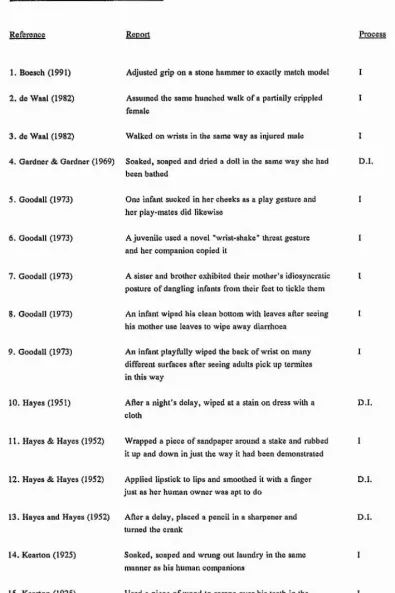
Some of the most convincing evidence for imitation comes from anecdotal reports of imitative behaviour in great apes. A survey of the literature was performed and a database of imitative episodes in chimpanzees, gorillas and orangutans was compiled (using a similar approach to Whiten & Byrne's 1988a tactical deception database). Each report was subjected to a strict evaluation, and it was deemed that 23 reports from chimpanzees, 3 from gorillas and 4 from orangutans provided relatively convincing evidence of imitation.
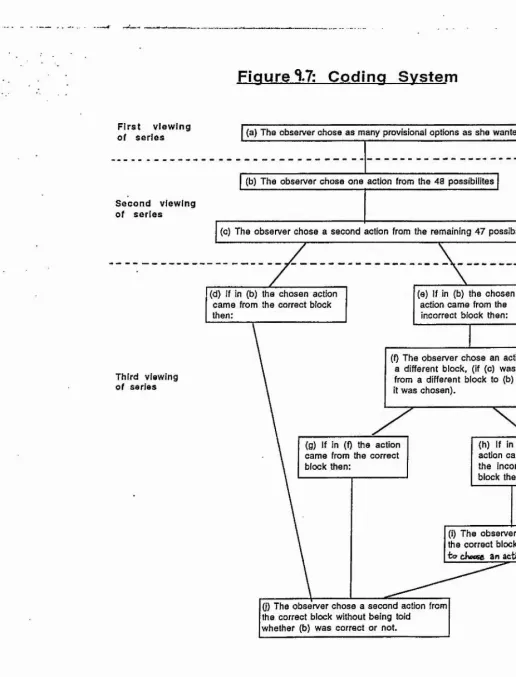
An experiment was conducted to test if chimpanzees can imitate as the anecdotal data suggests. Two chimpanzees were taught to reproduce 15 arbitrary gestures on the command "Do this". Next they were presented with 48 novel items. They imitated 13 and 20 novel gestures respectively. Using a rigourous coding system, two independent observers correctly identified a significant number of the chimpanzees' imitations (P <0.0001). These results show that chimpanzees are capable of the complex in ter modal visual-motor co-ordination and control necessary for imitation.
Preface Chapter 1:
Chapter 2: Chapter 3; Chapter 4: Chapter 5: Chapter 6: Chapter 7: Chapter 8: Chapter 9:
Chapter 10:
Chapter 11: References
Historical Background G. J. Romanes E. L. Thorndike J. M. Baldwin C. L. Morgan Defining Imitation
General Categories of Imitation
Two Approaches to Studying Imitation Imitation
Methodologies for Studying Imitation Anecodotes
Systematic Observations Experiments
Imitation in Apes
Uncontrolled Observations of Imitation in Great Apes
Experiments on Imitation and Social Learning in Great Apes
Imitation in Monkeys
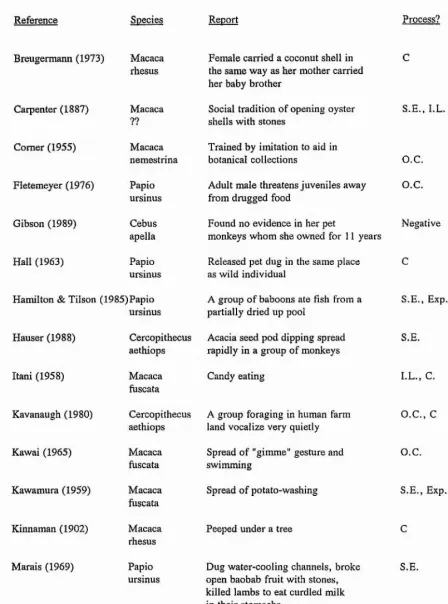
Uncontrolled Observations of Imitation in Monkeys
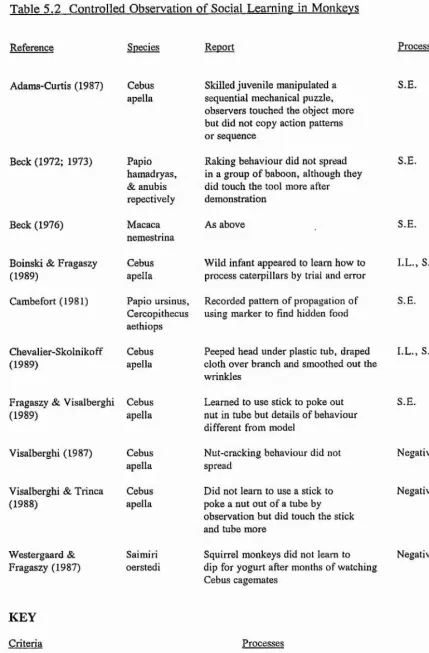
Controlled Observations of Imitation in Monkeys
Experiments on Imitation in Monkeys Imitation in O ther Animals
Social Traditions and Culture Social Traditions Non-human Culture?
Underlying Cognitive Mechanisms and Functions of Imitation
Cognitive Processes Underlying Imitation The Function of Imitation
Can Young Chimpanzees Imitate Arbitrary Actions? Hayes & Hayes (1952) Revisited
Can Children, Chimpanzees or Capuchin Monkeys Imitate the Actions Used to Open a Perspex
For over one hundred years comparative psychologists have grappled with the question of whether or not non-human species can imitate. Imitation is thought to be an intelligent ability which requires complex cognitive processing (see Bruner 1972,
Whiten & Ham 1992, Heyes 1993, and Tomasello et al, 1993). Yet, there has been little agreement on how to define imitation or what constitutes a proper experimental methodology for demonstrating the ability. Recently, several researchers have argued that there exists, as yet, little convincing evidence of true imitation in non-human animals (Galef 1988, Mitchell 1989, Whiten & Ham 1992).
It is commonly assumed that at least one group of animals, the primates, can imitate very well.
"Scimmiottare in Italian, singer in French, macaquear in Portuguese, nachaffen in German, majmuna in Bulgarian, obezjanstvovat in Russian, majmol in Hungarian,
mapowac in Polish, and "to ape" in English - each of these verbs is derived from a linguistic root that in particular languages label primates. Across different languages and cultures, these verbs consistently mean "to imitate." The convergence across different cultures of the terms denoting monkeys and imitation reflects the common view thaï monkeys are excellent imitators (Visalberghi & Fragaszy 1990, p.247).
Whiten and Ham (1992) have shown that scientific textbooks have concurred with this view. Yet, even the imitative ability of monkeys (e.g., Beck 1974, Fragaszy &
HISTORICAL BACKGROUND
In order to understand the controversy related to the definition of and the experimental approach to the study of imitation, it is important to consider the work of some of the first comparative psychologists. Four researchers, Romanes, Thorndike, Baldwin and Morgan, profoundly influenced the nature and direction of the scientific enquiry into social learning. I shall, therefore, discuss each of their work in turn (see Galef 1988, Mitchell 1987 and Whiten & Ham 1992, for similar reviews).
Galef (1988) explains why early comparative psychologists were interested in imitation:
"The major impetus for the 19th-century discussion of imitation arose out of
disagreement among leading scientific figures of the period concerning the origins of the Mgher mental faculties of man. Darwin and Wallace, co-formulators of
evolutionary theory, differed profoundly over the possibility of employing the principle of evolution, of descent with modification, to understand the development of the human mind. As a contemporary, George Romanes (1884), stated the issue:
"... the great school of evolutionists is divided in two sects; according to one the mind of man has been slowly evolved from the lower types of psychical
existence, [e.g., Darwin, Romanes, Baldwin and Morgan] and according to the other the mind of man, not having been thus evolved, stands apart, sui generis
from all other types of existence [e.g., Wallace and Thorndike]." (p. 9)
... there was some consensus as to evidence that would decide the issue: indication that animals had humanlike emotions such as shame, remorse, jealousy, and benevolence, that could use tools or act deceitfully, that they were able to solve complex problems or imitate complex acts" (p.4).
Romanes was a student of Darwin's, and as such, he was one of the staunchest proponents of the so-called Reasoning Theory. He argued that human mental faculties have gradually evolved, and that more simple and phylogentically earlier forms of reasoning can still be found in other species. Darwin encouraged Romanes to attempt to establish a similar legacy in the field of comparative psychology as Darwin himself had achieved in the biological sciences.
Unfortunately, Romanes lacked Darwin's rigourous scientific approach. Romanes's "scientific" evidence of intelligence and imitation in animals consisted exclusively of anecdotal reports of their behaviour. Many of the anecdotes he discussed came from newspapers and letters sent to him from devoted pet owners. He performed no controlled experimental studies of his own. Today, the importance of Romanes's work lies mainly in the fact that it came to represent the standard against which the majority of future researchers rallied.
Romanes did not provide a formal definition of imitation, "to him the word was a perfectly ordinary everyday expression" (Whiten and Ham 1992, p.240). He claimed an imitative ability in species as diverse as honey bees, cats, dogs and monkeys. His general approach was to relate an anecdote about the remarkable feat of someone's pet, and then to discuss the underlying cognitive process involved in terms of a rich internal dialogue.
For the purpose of illustrating Romanes' method let us consider an anecdote he discussed in which his coachman's cat had learned to operate the thumb-latch on a door:
"Walking up to the door with a most matter-of-course kind of air, she used to spring at the half-hoop handle just below the thumb-latch. Holding on to the bottom of this half hoop with one fore-paw, she then raised the other to the thumb-piece, and while depressing the latter, finally with her hind legs scratched and pushed the door-posts so as to open the door. Precisely similar movements are described by my correspondents as having been witnessed by them.
by this idea, she makes the first trial" (Romanes 1882, pp.420-422).
Romanes has ascribed a highly intelligent imitative ability to his coachman's cat; through observation it learned not only what actions to reproduce but it also came to appreciate the causal properties of the mechanisms of the door. Romanes did not actually observe the whole process by which the cat learned to open the door. He argues it is highly improbable that the cat learned it through chance or trial and error because the whole operation was too complicated. Yet, Thorndike (1901) was to show that cats can learn to operate very complicated latches through a process of gradual operant conditioning rather than reasoning. If the complete ontogeny of a behaviour is not observed, one cannot be completely sure what learning process is involved (Mitchell 1987, Whiten and Ham 1992).
Romanes sums up his views on imitation as follows:
" ... it may be said in general that, as the faculty of imitation depends on observation, it is found in greatest force, as we should expect, among the higher or more intelligent animals - reaching its maximum in the monkeys where, as is well known, it passes into ludicrous extremes" (1883, p. 224).
Elsewhere he notes:
" ... it is remarkable as well as suggestive that it [imitation] should be confined in its manifestations to monkeys and certain birds among animals and to the lower levels among men. As Mr. Darwin says:
"The principle of imitation is strong in man, and especially, as I myself observed in savages. In certain morbid states of the brain, this tendency is exaggerated to an extraordinary degree; some hemiplegic patients and others, at the
commencement of inflammatory softening of the brain, unconsciously imitate every word that is uttered, whether in their own or in a foreign language, and every gesture or action which is performed near them."
"The same sort of tendency is often observable in young children, so that it seems to be frequently distinctive of a certain stage or grade of mental evolution, and especially in the branch of Primates. Other animals, however, certainly imitate each other's actions to a certain extent" (1882, pp. 477-478).
E. L. THORNDIKE
Thorndike (1901) was one of the first researchers, among many, who dismissed Romanes's work as unscientific. Thorndike advocated a strictly experimental approach to the study of animal intelligence and imitation. Some of his most famous experiments have direct relevance to Romanes's anecdotes about cats operating door latches.
Thorndike designed a lattice-sided wooden box with a door in the front that could be locked with a series of different latches. An experimentally naive cat was placed in the box, and Thorndike recorded its general behaviour and how long it took to operate the latch mechanisms and escape from the box. He found no evidence of the kind of reasoning powers Romanes had attributed to cats. Instead, the cats tended to scrabble wildly when placed in the box and hit upon the solution by chance.
Thorndike tested for imitation using a similar method. He defined imitation as, "learning to do an act by seeing it done" (Thorndike 1898, p. 50). He used a box divided into two compartments, separated by a wire-mesh screen. The larger area had a door in the side that could be opened by clawing or biting at a length of string stretched over the top of it. First, an experimentally naive cat was habituated to the smaller observation compartment. Next, an experienced cat acted as the model and opened the door by pulling on the string, thus gaining access to a bowl of fish placed outside. Finally, the observer cat was placed in the test compartment. Thorndike took notes on the degree of similarity between the actions used by the model and observer, and he timed how long it took the observer to escape. Neither measure indicated an imitative ability in the cats: the observer cats did not exhibit similar action patterns to the model, nor did they escape any faster than non-observers.
(if the process may be dignified by that name) that what gives another food will give it to them also" (Thorndike 1901, p.74).
Thorndike's response to the suggestion that animals might be capable of some kind of "reasoning" was positively scathing.
"I may add that my observations of all the conduct of all these animals during the months spent with them, failed to find any act that even seemed due to reasoning. I should claim that this quarrel ought now to be dropped for good and all, - that investigations ought to be directed along more sensible and profitable lines. I should claim that the psychologist who studies dogs and cats in order to defend this reason theory is on a level with a zoologist who studies fishes with the view to supporting the thesis that they possessed clawed digits" (Thorndike 1901, p.75).
There are several problems with Thorndike's experiments. First, the subjects could not see all the mechanisms or workings of the latches, since many of them were located on the outside of the box. It was impossible for any animal placed inside the box to figure out the significance of the door-opening mechanisms, assuming that it might possess such powers of reasoning. Also, it is not surprising that all that Thorndike observed from the cats was random scrabbling, since as Morgan (1896) points out, the "conditions are abnormal and cramped" (p. 187). Anyone who has tried to place a cat into a confined space knows that such conditions are not at all conducive to calm cognitive processing. The task itself promotes mindless random action.
Therefore, despite Thorndike's conviction, the book is certainly not closed on imitation in cats after his rather limited experimental investigations (see John et al. 1968; Chester 1969).
In addition to his experimental investigations, Thorndike made important
contributions to the theoretical debate about the nature of social learning. He identified a number of different (psuedo-imitative) processes which can also cause individuals to behave in a similar manner.
"Thorndike is the first to offer a clear alternative to the view that various types of "semi-imitative phenomena" he described are simple forms of the "general imitative faculty which we find in man". Thorndike's distinction between pseudo-imitative and imitative behaviours suggests that the process of social learning seen in man and in animals may be different in kind rather than in degree, that there is not a single
imitative capacity that appears in various guises in animals possessing nervous systems of varying complexity" (Galef 1988, p. 10).
I discuss some of the different pseudo-imitative processes in Chapter 2.
J. M. BALDWIN
Baldwin (1896) proposed one of the first comparative-developmental "stage" theories of imitation. He had a very broad conception of imitation which he divided into two main categories: 1. organic, and 2. conscious or mental imitation.
Baldwin argues that "there is an essentially imitative quality to all adaptation by process of selection, because this involves a certain replication of previous states: thus "we may say that all organic adaptation in a changing environment is a phenomenon of biological or organic imitation" (p. 278)" (Whiten & Ham 1992, p.241). According to Baldwin (1896), conscious imitation develops from organic imitation, which serves "for the accumulation of material for conscious and voluntary actions" (p. 351). Conscious imitation is divided into two further sub-categories: simple and persistent imitation.
them, and is voluntary" (Mitchell 1987, p. 187).
One example of simple imitation that Baldwin discusses is vocal imitation in young children:
"The child repeats it prattle over and over, ... simply from vigour, not from desire, nor from effort, least of all with deliberation. The sounds he makes are accompanied by sensations in his vocal organs, and what he hears he makes again, and so on, simply because his machinery works that way - works easily and gives him the pleasure of exercise and rhythm" (Baldwin 1896, p. 378, cited by Mitchell 1987, p. 187).
The vocal imitation described by Baldwin above, actually involves the child imitating or repeating its own vocalizations rather than another individual's. Such behaviour is not usually considered as imitation.
A second example of simple imitation described by Baldwin is that of a parrot reproducing human vocalizations. He states that:
" ... my parrot has just learned to say "Hulloa" imitatively. He learns to pronounce this word just as an intelligent child would learn to do it; but he cannot vary, modify, or inhibit it, nor exercise selection in the manner of his doing it" (Baldwin 1902, p.28, cited by Mitchell 1987, p. 187).
Baldwin treated the vocal imitation performed by the parrot and child as if they were based on the same process. Yet, they actually seem very different in nature; the parrot learned to eventually produce a rather hard-wired imitation of the modelled
vocalization, while the child repeated his own vocalizations and was not adapting to some external agent.
p.378).
Baldwin distinguishes between two kind of persistent imitation: external and internal. External persistent imitation involves immediately attempting to reproduce modelled sounds or actions. Internal involves the imitator performing some kind of internal refection or processing upon the observed and mentally encoded behaviour. Hence, an example of internal persistent imitation would be delayed imitation where the resultant behavioural replication is based on a long term memory of the model's actions. What distinguishes Baldwin's persistent imitation from the simple vocal imitation
performed by parrots is the degree of control the imitator has over his or her responses. The imitator is deliberately or consciously directing his or her behaviour to reproduce the model.
Baldwin’s conceptualization of imitation was to have far reaching effects on future theory. Many of his ideas are clearly reflected in the writings of Piaget (1951). The one area of his theory which has not survived the test of time is that of "organic imitation". "Although the breadth of this conception of imitation was soon challenged by Morgan (1900, pp. 179-183), imitation could never again be seen as an inherently narrow and easily circumscribed phenomenon" (Whiten & Ham 1992, p. 241).
C. L. MORGAN
Morgan's (1900) approach to imitation was similar to Baldwin's except that he rejected the concept of organic imitation. Morgan agreed that not all behavioural similarity directly implies complex cognitive processing. Like Baldwin, he proposed a stage theory in which he described three stages of imitation: 1. instinctive or biological, 2. intelligent, and 3. reflective.
Thorpe (1963) defined as a process where, "the performance of a more or less instinctive pattern of behaviour by one will tend to act as a releaser for the same behaviour in another or in others" (p. 133). Morgan describes an example in which,
"A chick sounds the danger note; this is the stimulus under which another chick sounds a similar note, and we say one imitates the other" (p. 190). Although instinctive imitation is not particularly cognitively complex, Morgan points out that, " if the young inherit a tendency to imitate certain actions of their parents, and if there is among the members of a gregarious species such instinctive imitation as shall tend to keep them gregarious, we have here a social factor in animal life of no slight importance" (Morgan
1900, p. 190-191).
When Morgan discusses intelligent imitation he actually outlines two quite different processes. The first is equivalent to Thorpe's "stimulus enhancement" in which an observer's attention is drawn to an object by the activities of another
individual. The observer then learns to direct appropriate behaviour toward the object through its own efforts. The second is similar to Morgan's persistent vocal imitation where a bird or young child learns to match a modelled vocalisation via trial and error. Both of these processes are "intelligent" in the sense that the observer actively learns through socially directed trial and error how to perform a novel modelled behaviour, rather than the response being relatively preprogrammed or hard-wired as in contagion.
Morgan's discussion of an observation made by Romanes' sister of a capuchin monkey opening a trunk with a key, constitutes an excellent exposition of stimulus enhancement. He comments that:
"The monkey need not regard the key and lock as the related parts of a puzzle to be practically solved, need not have any free idea of the difficulty it presents, need not in unlocking the trunk clasp the true nature of the difficulty or have any conception of its solution. Every several act of the capuchin, the seizing the key, the directing it here or there, and so on, is already supplied with the impulse, directs and combines these pre existing impulses to a new end. And since that which directs the attention is the act of another, we call the procedure imitative. ... And success in opening the trunk is reached by the capuchin, not, it would seem through any real appreciation of the essential kernel of the practical problem, but through the chance results of many varied efforts"
Morgan proposes that vocal imitation in young children and birds is achieved through a process of trial and error and the gradual modification of familiar
vocalizations. According to Morgan, for some reason these organisms seem to find it inherently rewarding to match modelled sounds. He states that:
'’Intelligence ... aims at the reinstatement of pleasurable situations, and the suppression of those which are the reverse, the sound-stimulus, the motor effects in behaviour, and the resultant sound production, coalesce into a conscious situation, which appears to be pleasurable or the reverse, according as the sound produced resembles or not the initiating sound-stimulus. If we assume that the resemblance of the sounds he utters to the sounds he hears is itself a source of pleasurable satisfaction (and this certainly seems to be the case), intelligence, without the aid of any higher faculty, will secure
accommodation and render imitation more and more perfect. And this appears to be the stage reached by the mocking-bird or the parrot" (Morgan 1900, p. 192).
Morgan stated, at least more clearly than Baldwin, how simple vocal imitation might be achieved. The affective dimension plays a key role. By deriving pleasure from closely matching vocalisations and displeasure from mismatching them, an organism receives a kind of internal feedback that directs trial and error learning. If an organism finds matching certain kinds of behaviour inherently rewarding this suggests it has an innate predisposition for imitation.
Morgan assumes that imitation found in birds and young humans is based on the same cognitive mechanism. Yet, human vocal imitation does not appear to be hard wired like birds', in fact during human ontogeny it becomes increasingly flexible (Kaye
1982). The hard-wired nature of bird imitation implies that they are based on different rather than similar underlying mechanisms. Thorndike (1911) states that, "we cannot, it seems to me, connect these phenomena with anything found in the mammals or use them in advantage in a discussion of animal imitation as the forerunner of human" (Thorndike 1911, p. 77). Human and bird vocal imitation, therefore, would seem to constitute an example of evolutionary convergence, not homology (Moore 1992).
"But the child soon goes further [than intelligent imitation]. He reflects upon the results he has reached; he at first dimly, and then more clearly realizes that they are imitative; and his later efforts at imitation are no longer subject to the chance occurrence of happy results, but are based on a scheme of behaviour which is taking form in his mind, are deliberate and intentional, and are directed to a special end more or less clearly
perceived as such. He no longer imitates like a parrot, he begins to imitate like a man" (Morgan 1900, p. 193).
Intelligent imitation is a kind of socially directed trial and error learning; while reflective imitation is a rational, goal-directed process.
Chapter 2
DEFINING IMITATION
One problem which has plagued research into imitation is the lack of agreement over how to operationally define it. Galef (1988) comments that:
". . . historical diversity in approaches to study of imitative behaviour has produced incompatible conceptual frameworks for analysis of imitative phenomena. One man's example of learning by imitation is another's paradigmatic case of "pseudo-imitation" and each can cite historical precedent for treating phenomena of interest as he does" (p. 4).
Mitchell (1987) makes a similar point when he writes:
"The imitation of the behavior of one organism by another is intriguing to different authors for different reasons. Behavioral imitation has been viewed as a means of socialization, biological adaptation, identification, and communication of shared emotional states, and as evidence for elementary referential capacities, complex inferential abilities, and self-awareness (Baldwin, 1896; Morgan, 1900/1970; Guillaume, 1926/1971; Mead, 1934/1974; Miller and Dollard, 1941; Piaget,
1945/1962; Thorpe, 1963; Mussen, 1967; Danto, 1981; Uzguris, 1981, 1983). Such diverse interpretations of the significance of imitation suggest that the concept of imitation is used broadly. Different authors apply the term "imitation" for different purposes, and their consequently differing conceptions of imitation tend to be meaningful within a particular theoretical framework (Uzguris, 1983, p.l)" (p. 184).
I shall distinguish between two of the main approaches to defining imitation in comparative psychology and assess their strengths and weaknesses. But first it is important to draw some general (and relatively uncontroversial) distinctions between different kinds or categories of imitation.
GENERAL CATEGORIES OF IMITATION
physical actions. Vocal imitation is well documented in several species of birds (see Slater 1986 for a review), while action imitation has proved much more difficult to document in non-human species. It has been suggested that the reason why action imitation seems to be rarer than vocal imitation is because it requires particularly complex cognitive processing (Palameta 1989; Whiten & Ham 1992). The present dissertation is primarily concerned with action imitation, although Chapter 8 features a brief discussion of the possible differences in the cognitive processing related to action and vocal imitation.
Two kinds of action imitation can be distinguished: object-related and
independent body movement (I.B.M). Object-related imitation involves reproducing actions directed toward objects, substances, or surfaces. I.B.M. imitation involves reproducing non-object related actions, such as jumping or waving. Both object-related and I.B.M. imitation can be either arbitrary in nature (i.e, not directly causally related to a reward) or functional (i.e., reward-directed). Arbitrary object-related imitation may occur during play or exploration. Functional object-related imitation may occur in problem solving situations, such as food-processing or tool-use. Arbitrary I.B.M. imitation may occur in play or be a means by which one individual identifies with another. Jolly (1985) provides an example in which a young boy identifies with his elder brother by imitating an idiosyncratic facial expression. Functional I.B.M. imitation may be observed in relation to gestural communication. Figure 2.1 is a schematic representation of the different categories of imitation discussed so far.
vocal
object-related imitation
action
liinctional arbitrary
arbitrary functional
independent body movement_______
TWO APPROACHES TO DEFINING IMITATION
There are two main approaches to defining imitation in comparative psychology. Some researchers reserve the term imitation so that it refers exclusively to what they identify as the most complex mimetic process (e.g. Thorndike 1901, 1911; Thorpe
1963; Galef 1988; Whiten & Ham 1992). (I am using the term "mimetic" after Whiten and Ham (1992)), as a supergenerative for any process that leads to behavioural
similarity.) An alternative approach is to provide a general definition for imitation so that it encompasses the majority of mimetic processes. These different processes are then arranged into incremented stages or levels ranging from the least to the most cognitively complex (e.g.Baldwin 1896, 1902; Morgan 1900; Piaget 1951; and Mitchell
1987.)
Stage Theories of Imitation
Morgan's stage theory of imitation was discussed in chapter 1. For Morgan, "demonstrations of imitative learning in animals were seen as providing important evidence of an evolutionary origin of the higher mental faculties in man" (Galef 1988, p. 5). Morgan applied his incremented system of imitative stages to animals and
humans equally. There are scientists, such as Piaget (1962) and Guillaume (1926), who devise stage theories of imitation which relate only to human development. Piaget's theory in particular has been modified by many comparative psychologists in order that it might serve as a general comparative-developmental model (Parker 1977; Chevalier- Skolnikoff 1977; Parker & Gibson 1990).
It is not enough in itself for a stage theory to simply observationally identify the order in which mimetic processes appear in an infant's development. Nor is it
"higher-order" species. A system of stages or levels implies that they are causally linked to one another. A stage theorist must be able to suggest a viable mechanism which explains why each stage is developmentally or evolutionarily dependent on earlier stages. If a theorist can not provide such a mechanism, then one might as well treat the stages as separate, although similar, processes.
One of the main problems with many stage theories is that it is often far from obvious how the stages or levels are logically linked. For example, in Morgan's theory - why should stimulus enhancement (stage 2) be in any way logically related to or dependent upon contagion (level 1)? Why, in Piagetian theory, should contagion (level 2) develop from reflexes (level 1)? The fact that certain processes appear in a specific order during human ontogeny does not mean they need necessarily be directly causally dependent on one another. That may explain why some neo-Piagetian researchers have found that certain non-human species manifest higher stages of sensory motor skills without manifesting some of the stages which precede them in human infancy (e.g., Chevalier-Skolnikoff 1977).
Mitchell (1987) attempts to present a more cohesive theory by synthesizing four major stage theories: Morgan (1900), Baldwin (1896), Piaget (1962) and Guillaume (1926). Mitchell (1987) describes five levels of imitation. Level 1 is equivalent to physical mimicry such as when the striped markings of the harmless hoverfly are said to
"imitate" the warning stripes of stinging bees and wasps. Level 2 encompasses the concept of contagion through to a more generalised social facilitation and the imitation of familiar acts. Level 3 is equivalent to Morgan's intelligent imitation. Level 4 is similar to Morgan's reflective imitation. Level 5 is, as far as 1 know, unique to Mitchell. "At this level the organism changes its imitation in relation to its knowledge of another organism's perception" (p. 209). Mitchell argues that, "Hierarchically higher levels are logically inclusive of, and develop from, lower levels, and therefore
require the process of lower levels" (p. 202).
(contagion) develops from level 1 (physical mimicry). These processes actually appear to be the result of two different lines of evolutionary selection: one line has led to physical similarity between different organisms (level 1), while the other has led to a relatively hard-wired predisposition to reproduce certain behaviours (level 2). The only, rather superficial, link between them seems to be that they are both the result of evolutionary selection.
Neither is it clear why level 4 (reflective imitation) need necessarily be preceded by level 3, These processes are based on two very different mechanisms. Level 3 is based on trial and error learning, while level 4 is based on having conscious control over one's actions. Mitchell suggests no viable mechanism that could explain how conscious control develops from the ability to learn through trial and error. One of the strengths of Piaget's (1962) theory of sensory-motor development is that it does at least specify such a mechanism. Yet, even Piaget's system of assimilation and
accommodation does not altogether satisfactorily account for the proposed transition from sensory-motor to mental representational abilities.
Mitchell's fourth and fifth levels of imitation offer an example of two processes which must be logically linked. In "level five, the imitator is aware that another organism may perceive the similarity between the model and the copy (i.e., is aware of another's awareness) and so adapts the copy in relation to the other's perception, to have the other recognize the copy as either an imitation or as the model" (p. 212). One must be consciously aware of the imitative nature of one's actions (level 4) before one can attribute the same kind of consciousness or awareness to another (level 5). In order for Mitchell's theory to be fully valid all his stages must be similarly linked.
level imitation. The existence of preceding levels does not logically imply the existence or development of higher levels. Mitchell needs to suggest diagnostic characteristics for each of his levels. Without offering appropriate operational criteria it is impossible to follow Mitchell’s advice and elucidate "the relationship between organisms'
psychological processes and their actions" (p. 212).
I have discussed Mitchell's (1987) theory in detail, and I have pointed out some of its main shortcomings. The reason for such a detailed analysis is to consider the important issues related to comparative-developmental theories of imitation. One feature which is common to many of them is that they fail, as Mitchell has done, to propose a viable mechanism by which each stage provides the necessary conditions for the development of the preceding one. Many comparative-developmental theories outline processes which need not actually be hierarchically or causally linked. I am, by no means, suggesting that the comparative-developmental approach to imitation should be abandoned. It is very important to generate hypotheses related to what factors might be necessary for the development, or evolution of, imitation. Yet, if these hypotheses are generated from within a stage theory, the theory itself should be logically cohesive.
Imitation as a Distinct Process
Two recent reviews (Galef 1988, and Whiten and Ham 1992) have made valuable contributions by identifying and systematizing the plethora of terms related to social learning. There would be little point in reproducing their fine and detailed analyses. Instead, I have defined, below, only those processes which have proved particularly difficult to distinguish from imitation: individual learning, social support, contagion, exposure, stimulus-, local- and reward- enhancement, impersonation, and emulation. I have also defined two kinds of action imitation: precise-form imitation and program- level imitation.
Individual learning can be mistaken for imitation "when rwo or more
individuals independently acquire the same behaviour through encountering and being shaped by similar learning environments" (Whiten & Ham 1992, p.248). For example, imagine a situation in which two monkeys are presented with ajar that can only be opened by twisting the lid in an anti-clockwise direction. Now imagine that each monkey independently learns how to open the jar. Since the jar can only be opened one way, at least some aspect(s) of the action-pattems used by the monkeys will be similar, even though they solved the problem by individual learning rather than imitation. Therefore, a prerequisite for distinguishing imitation from individual learning is that it must be shown that the observation of a model had a direct positive influence on the consequent behaviour of an observer.
environment, because A affects B's motivational state. For example the presence of conspecifics can reduce fear" (Whiten & Ham 1992, p. 252). Therefore, the fact that an animal learns a behavior more quickly if it is in the presence of a model does not constitute proof of imitation.
Thorndike recognizes that a simple comparison of the time it takes observers and non-observers to solve a problem is not sufficient in itself to prove imitation. Hence, he includes what he admits is a rather subjective measure of observationally assessing the degree of similarity between the observers' the model's actions. Yet, in contagious behaviour it is entirely likely that the observer responds to a model with an almost identical action. We have already discussed contagion in relation to Morgan's instinctive imitation. Armstrong (1951) states that contagion, "consists o f the
reproduction by one animal o f the instinctive behaviour pattern o f another" (p. 46). An example of a contagious behaviour is when one person yawns and thereby triggers an involuntary response of yawning in a second individual (Provine 1989). In a contagious yawn the observer produces almost exactly the same action as the model of slowly inhaling then exhaling breath. Since, contagion consists of two or more individuals producing almost exactly the same form of behaviour contingent with one another, it is not surprising that it has proved difficult to distinguish from deliberate imitation.
Yawning is a fairly obvious contagious behaviour. It is not always easy to decide what actions might trigger a contagious response. For example, if two people tap their feet at the same time, or rub their noses, or stretch - could these be contagious responses? Foot tapping, nose rubbing and stretching are all part of the normal
repertoire of human behaviours, and it seems likely that they could be contagiously induced. Yet, if one individual. A, was to pat her head with one hand while
Moore (1993) champions Thorpe's approach and produces a strong argument in favour of it. He admits that:
"At first glance this restriction seems unethological, since species-typical responses are central to the learned behaviour of most species ... We know, however, that humans can imitate almost any movement of which they are physically capable. THORPE's definition therefore asks in effect what other animals (if any) show imitative learning of comparable complexity" (Moore 1993, p. 235).
Thorpe's definition does exclude some examples of so-called imitative behaviour which seem to be suspiciously similar to contagion.
"For example, the "relatively-arbitrary" responses copied by EPSTEIN's (1984)
pigeons {Columba livid) were species-typical food-getting reactions - approach, pecking and eating movements. Similarly, the pigeon's wheel-rotation response in
PALAMETA's (1989) savings study was simply a food peck, as the author
acknowledged. ... Observation did not teach these birds to peck; it simply taught them what to peck" (Moore 1993, pp. 235-236).
Thorpe's definition has many advantages as Moore points out, but there are drawbacks. Thorpe's definition is too restrictive and even places severe constraints on what we usually take to be clear examples of imitation in humans (Mitchell 1987). Insisting that what is imitated must be novel restricts one's discussion to imitative learning and ignores the everyday notion of imitating familiar actions. "In the everyday sense, a person can imitate another doing some everyday act like waving, yet the imitator is not
definition should be amended to consider whether there is any reason to assume that a subject would possess an instinctive tendency to repeat certain familiar acts on cue, and only if there is, should the response not be considered as imitation.
Rowley and Chapman (1986) provide an example of a novel, non-species-typical action pattern which can be explained by exposure just as well as by imitation.
Exposure is a process in which, "By simply being with (or following) A, B may be exposed to a similar learning environment and thus acquire similar behavior" (Whiten and Ham 1992, p. 252). Rowley and Chapman observed that two galahs who had been cross-fostered with Mitchell's cockatoos developed the same flight pattern as their foster parents. Usually galahs exhibit a fast, level flight pattern, but the two foster birds adopted a more cockatoo-typical slow and undulating style of flight. Rather than directly imitating the behaviour of their foster parents the young galahs may have been forced to modify their normal fight patterns simply in order to fly at the same pace as their slow moving foster flock. The constraints of the galahs' social environment may have shaped their behaviour.
Stimulus enhancement is probably the process most often confused with imitation in practice (Whiten and Ham 1992). Stimulus enhancement was discussed earlier in relation to Morgan's "intelligent" imitation. It is a process "in which a performer's action merely focuses an observer's attention on critical environmental features, increasing the speed with which the obseryer subsequently learns a similar
stimulus enhancement was involved" (Whiten 1989, p.61).
The tendency in comparative psychology has been to focus almost entirely on imitation. Stimulus enhancement may actually be a much more important learning process in the everyday lives of the vast majority of species. Whiten (1992) suggests stimulus and local enhancement might be processes by which many animals learn what to eat and where to find it. Galef (1990) states:
"3- to 12-month-old vervet monkeys {Cercopithecus ascanius) tend to feed in synchrony with their mothers, to eat only the food items she does and, consequently, never even sample some foods that could be deleterious (Hauser 1988). Similarly, mother and infant chimpanzees share food (Silk 1978) as do mother and infant rhesus macaques (Kawamura 1959) and gorillas (Watts 1985)" (p. 79).
Galef argues that it does not necessarily always follow that because infants co-feed with their mother, this is in fact a crucial factor in the development of their food choice in later life. We need to conduct more research into the possible relevance of co-feeding. Although the current document follows the more common route of concentrating almost exclusively on those processes thought to be cognitively more complex than stimulus enhancement (i.e., emulation, impersonation and imitation), it is acknowledged that more research is needed on what animals actually learn from their social group rather than whether or not they can imitate in a human-like manner (Box 1992).
We also need more research to establish just how sophisticated stimulus
enhancement can become; whether an animals' attention is drawn in a very general way to objects, or whether it can be drawn to specific parts of objects. Also, it is important to consider what precise aspect of the model's performance draws the attention of an observer. Palameta and Lefebvre (1985) found that observer pigeons only learned to peck through a paper lid on a dish of seed if they saw a model peck through the lid and
behaviour in the observers. Yet, only special observational conditions sufficiently enhanced the test apparatus so that behavioural transmission occurred. Experimentally dissecting the different aspects of a task in the way Palameta and Lefebvre have done would seem a potentially valuable approach to social learning, without imitation necessarily being the complete focus of the researcher's attention.
IMITATION
Precise Form Imitation
After having outlined some of the different mimetic processes it should be clear just how difficult it is to distinguish imitation from them. Some researchers have
attempted to distinguish imitation by emphasising that what is learned from observing a model is at least some part of the precise or intrinsic form of a non-instinctive
behaviour or action-pattern (e.g., Galef 1988, Tomasello 1990, Whiten & Ham 1992). For example, there is no reason to assume that twisting at objects is an instinctive or contagious behaviour in primates. So, if a model were to twist at a jar-lid in order to open it, what an imitator might learn directly from observing the model (rather than from his or her own efforts) is that he or she should also use a twisting motion.
Precise-form imitation does not require the observer's technique to be a carbon copy of the model. The model may hold the jar upright in her left hand and twist at the lid with her right hand, while the observer holds the jar on its side in her right hand and twists at the lid with her left hand. The important point is that it is unlikely that the observer would have twisted at the lid in the first place (or at least not without extensive trial and error) unless he or she had seen the model do so first. Whiten and Ham (1992)
defining imitation in terms of precise actions is that it is the basis for one of the most promising methodological approaches to studying imitation (see the discussion in chapter 3 on the multi-act approach).
Although the approach of defining imitation in terms of reproducing precise actions distinguishes it from the other mimetic processes, it also considerably narrows the scope of the term. There are other aspects to imitative behaviour beyond
reproducing precise action patterns. Precise-form imitation ignores, to a certain extent, the tradition of studying imitation, because it is thought to represent an example of intelligent behaviour. It is possible to exactly replicate another's actions in a rather
unintelligent manner. Tomasello et al. (1993) discusses a process called impersonation or mimicry in which an observer "reproduces the precise form o f the adult's behavior but does not understand its g o a l... for example, the infant might make twisting motions on the [jar] lid as the mother did, but without applying pressure, not knowing that the goal is to open the jar" (p. 497). In contrast, Byrne (in press, c) discusses a process he calls program-level imitation which is much more akin to the traditional approach of studying imitation in animals (and especially non-human primates) in order to gain an insight into the evolution of human intelligence.
Program-level Imitation
(Kohler 1925). The word "program" is used because what the cavemen have gained from observing Zog is the general program of behaviour which is needed to safely cook their meat. The program might be something like: "find a stick, skewer meat, grasp protruding end of stick, hold meat-ladden end in fire." The exact actions used by Zog, (e.g., the grip he used to hold the stick, or precisely how he pushed the stick through his meat), are not important in comparison to the general logical program.
n
"Hey! Look what Zog do!'
One important stipulation for program-level imitation is that the behaviour must be sufficiently complex to rule out other more simple learning processes. The Japanese
macaques of Koshima Island appeared to capitalize on the original behaviour of a young female called Imo (Itani & Nishimura 1973, Kawai 1965, Imanishi 1957). The
monkeys were provisioned with pieces of sweet potatoes scattered on a sandy beach. It took the monkeys a long time to rub the gritty sand off the potatoes before they could eat them. A juvenile female, Imo, began to wash her potato pieces in the sea. In time, other monkeys followed Imo’s example until eventually nearly all of them were
potatoes-washing. The specific action patterns used to wash the potatoes were not particularly significant in comparison with the general behavioural strategy itself. Yet, program-level imitation need not have been responsible for the transmission of sweet potato washing. There were in fact several ways in which the monkeys could have learned the behaviour. Simply seeing monkeys down by the water's edge could have drawn the attention of others. Upon approaching the water the observers would have been more likely to learn through trial and error the advantages of washing their food (local enhancement). Fragaszy and Visalberghi (1990) found that macaques and capuchins learn to dip food in water through individual exploration relatively easily. "To obtain clear evidence of program-level imitation a complex, multi-stage task is necessary, but unfortunately the natural lives of most animals and the experiments usually devised to test imitation are lacking such complexity" (Byrne in press, c).
One class of behaviour which certainly appears to be sufficiently complex to be learned by program-level imitation is the skilled food-processing of mountain gorillas (Byrne & Byrne 1991, in press). The gorillas' food processing often involves
particularly virulent petioles are detached from the more innocuous leaf blades. The gorilla then folds the leaves so that the least stinging surface is presented to the sensitive lips. Finally, the nettle leaves are placed in the mouth and eaten. Byrne argues that it is possible for the gorillas to learn the separate stages of this complicated program without them needing to exactly reproduce precise action patterns.
One problem with program-level imitation is that it is very difficult to distinguish from hierarchical tasks which are acquired through individual learning. Squirrel monkeys execute several processing subgoals before they are able to eat semi- poisonous caterpillars (Boinski & Fragaszy 1989). Many of the caterpillars have
urticaceous spines which are removed by the monkeys rubbing them vigorously with the tuft of fur at the end of their tail. The monkeys then eviscerate the caterpillars by placing the head capsule in their mouth, with one or both hands holding the body. The body segment immediately posterior to the head capsule is bitten such that the body, but not the gut tract, is severed from the head capsule. The body is pulled away, leaving the gut tract attached to the head capsule, which is discarded. The monkey then eats the eviscerated body. There are several stages involved in the squirrel monkeys' handling of spiny caterpillars, but there is little evidence that it is learned by imitation. Juvenile squirrel monkeys seem to learn how to handle caterpillars through painful trial and error. They were observed handling spiny caterpillars with their bare hands and then for several minutes afterwards rubbed their hands together. Another ate a furry caterpillar without preparing it and was violently sick. These mistakes could be the result of unsuccessful imitations, but this seems unlikely since the authors report that infants do not closely or preferentially observe adults while they are eating. Even so, the infants learned these foraging skills quite rapidly, so that at four and a half months of age the foraging patterns of infants were indistinguishable from adults.
nettle processing is learned without direct imitation. Byrne points out that the young gorillas watch adult food processing very closely. Although close observation is a necessary condition for imitation it is not sufficient in itself to prove that imitation has taken place. Perhaps the only way to gain an insight into the learning process involved in mountain gorilla food processing is to closely observe the details of its ontogeny. For example, do young gorillas only begin folding nettle leaves immediately after they have closely observed an adult's technique? Unfortunately, even such ontogenic data is likely to be far from clear cut. Although program level imitation is an important concept, the sometimes blunt tool of science makes it difficult to study - especially in feral apes.
Byrne and Byrne (in press) were fortunate to be able to collect some very revealing data from a female gorilla, Picasso, and her son who had only just migrated into an area with nettles. Neither gorilla followed the standard program of folding the nettle leaves before eating them. If nettle eating were learned through trial and error and the similarity of the gorillas' processing program was simply the result of the logical structure of the task itself, one would expect Picasso and her son to eventually learn the standard method. The fact that neither individual learned the program
supports Byrne's contention that this is learned through program-level imitation. It also suggests that there is a sensitive phase in mountain gorilla development in which
essential food processing skills are acquired. If a gorilla does not get exposed to the processing of certain foods during that time, the required skills are unlikely to be learned later in life.
There might be situations in which noting the actions used by an observer is essential in order to distinguish imitation from other less complex mimetic processes. In other situations, the complexity of the modelled behaviour itself and the speed with which it is learned by an observer will be sufficient in itself to establish program-level imitation, without the precise details being a particularly important factor. Each case must be considered individually: there is no single, simple formula for establishing the occurrence of imitation.
Emulation and Reward Enhancement
Tomasello (1990) was the first comparative psychologist to use the term emulation. It is not always clear what he means by the term. In some instances it seems equivalent to program-level imitation, and in others it seems to be a specific species of enhancement in which a reward is enhanced through observation (reward enhancement). In order to help grasp emulation’s possible meaning(s), let us consider it in relation to an instance of social learning exhibited by a group of chimpanzees which Tomasello (1990) discussed in terms of them emulating rather them imitating a model.
The observers clearly benefited from watching the model, since three out of four
successfully used the T-bar within six trials of watching Lil' One, while only one out of the three control subjects solved it and then not until her eighteenth trial. Even so, Tomasello et al. argue that the observers had not imitated the model since none of them reproduced either of her two-stage techniques.
The authors state that the learning process was not simple stimulus enhancement, since all of the subjects, irrespective of watching the model, manipulated the T-bar to a high degree. It was not the tool as an object that was made more salient, but in the words of Tomasello et al., "the tool in its function as a tool" (p. 182). "The
chimpanzees ... seemed to be learning from their observation not just that some objects are of special interest, but rather that some objects have a special utility in their use as tools" (p. 183). Tomasello et al. do not actually use the term "emulation" to describe the learning process that takes place. The learning process they describe seems very similar to "program-level" imitation in which the observers acquired the program - "use T-bar to rake in food".
various types of models were responsible for differences in rate of behaviour acquisition by their observers" (p.22). Hence, in Tomasello et al.'s tool task it was not until the chimpanzees saw Lil' One manipulate the rake in combination with her acquiring the reward that they were sufficiently motivated to direct the T-bar toward the food. The observer chimpanzees could have then worked out through their own efforts, since there is a species typical propensity to use tools in chimpanzees, how to use the T-bar in order to reach the food. According to Tomasello (1990), it was the chimpanzees' tool using ability which was intelligent, the actual social, learning process involved was not much more complicated than what was found in pigeons.
Of course, Tomasello (1990) is perfectly entitled to change his mind and
interpret the young rake-using chimpanzees' behaviour in a different way. The problem is that he is not consistent in his use of the term "emulation". Even within his 1990 review, he sometimes uses the term as if it were a kind of enhancement and other times he uses it as if it were equivalent to program-level imitation. For example, he explains the Mahale and Bossou chimpanzees' leaf-clipping display (Nishida 1980,1987,
Sugiyama 1981) in terms of emulation but then suggests they are using the program - "make noise with leaves" (see p. 301).
Fortunately, a rather more comprehensible definition of emulation is at last provided in Tomasello et al. (1993). The authors state:
"Also not qualifying as clear cut cases of cultural learning are the attempts of infants to attain goals after adults have attained them (e.g., Kaye 1982), but using their own methods of execution - what Wood (1989) calls emulation. The problem is that what is often happening in such cases is that the child is learning about the affordances of an object or situation, not about the adult's goal or perspective. Thus, an infant might see an adult open ajar and then do the same, using established behavioural strategies, because it now sees that the jar affords opening" (p.497).
When emulating, the observer need never actually see the model manipulate an object, he or she need only see the end-result of the model's manipulations. Imagine a
pulp of the fruit is good to eat, A could then direct its attention to other unopened fruits and learn through trial and error that hitting them on rocks breaks them open. Although A never saw B manipulate the fruits, simply finding the results of B's activities was sufficient to lead A to independently learn how to open them.
Tomasello has assumed that emulation is less cognitively complex than imitation and, therefore, less worthy of study. Yet, on considering the Larson cartoon (Figure 2.2), if the cavemen were to reconstruct the logical program of Zog's meat-cooking technique without actually having seen the whole procedure, this would constitute emulation. Such an ability would seem to be just as, if not more, cognitively complex than imitation. Emulation is certainly a process which needs more detailed empirical investigation.
Chapter 3
METHODOLOGIES FOR STUDYING IMITATION
Three types of evidence of imitative-like behaviours can be distinguished: anecdotes, systematic or controlled observations, and experiments. Anecdotes are uncontrolled or chance observations of the spontaneous behaviour of subjects. Systematic observations consist of researchers devising observational techniques and criteria prior to the recording of data. Experiments involve the proposal of specific hypotheses which are tested by manipulating and controlling different variables in a given situation. These three types of evidence can be collected in the wild or captivity.
ANECDOTES
Since Romanes' almost entirely uncritical use of anecdotes and Thorndike's subsequent crushing criticisms, psychologists have tended to avoid all anecdotal data. Yet, there is a danger that the pendulum has swung too far away from this potentially valuable source of evidence. As Moore (1992) points out:
"While no one should countenance a return to ROMANES' (1882) standards of evidence, it would seem equally unwise to reject for ideological reasons the informed observations of, say, HAYES & HAYES (1952), KOHLER (1926) or PIAGET (1951/1945). A less extreme position is therefore appropriate" (p. 236).
Anecdotes from Captivity
There have been a great number of anecdotes of imitative behaviour in captive animals. Perhaps one of the reasons that so many anecdotes originate from subjects raised in human homes is that such conditions promote intimate knowledge of an animal's personal history and consequently the observer is more likely to recognize certain actions as novel. Also, some of the anecdotes from human-reared subjects have involved the reproduction of specifically human behaviours, which reduces the likelihood of them being based on an innate predisposition for the modelled
behaviour. For example, Hayes and Hayes' home raised chimpanzee, Viki, imitated her human foster mother, Kathy Hayes, applying lipstick. Viki not only applied the lipstick to her own lips while standing in front of a mirror, she even smoothed the cosmetic with her finger just as Kathy Hayes was apt to do. This is a detailed description of a non-species typical behaviour observed by researchers who knew the subject's entire learning history. Detailed anecdotal reports, such as this, are surely worthy of consideration and should not be dismissed just because the observer had not anticipated the event.
Anecdotes from the Wild
Many reports of apparent imitation which come from the wild have involved the emergence (or recognition) of local traditions in groups of animals (e.g., Hinde & Fisher 1951 - blue and great tit milk bottle top opening; Kawai 1965 - Japanese macaque sweet potato washing; Goodall 1973 - Gombe chimpanzee leaf-sponging; Gandolfi & Parisi 1973 - Po River rat mollusc diving). Some of these observational reports are so detailed that they bare no resemblance to the kind of anecdotal data discussed by Romanes (1882). They often fall somewhere between anecdotes and systematic observations. One such report comes from Hauser's long term
(1988) noticed a female vervet monkey dipping an acacia pod in the hollow of a tree in order to reach the exudate within. The behaviour spread rapidly, with four monkeys dipping pods within 9 days, and another two dipping within 22 days. Hauser immediately recognised the potential significance of the behaviour in relation to social learning and took detailed notes.
"Given continuity of observation, details of the first inco^oration of the act into each animal's repertoire provided evidence that different individuals acquired the technique by different routes. One appeared to deduce what to do from observing the end product (the model finally eating dipped pods), whereas another watched the model prepare and consume the pods "and then performed the whole behaviour" " (Whiten & Ham 1992, p. 255).
Although Hauser's observations are very detailed, this still does not constitute a strict systematic study because the observational methods were not devised prior to the onset of the novel behaviour. Hauser had no control over the monkeys' access to the pods and tree hollows, prior to, or during the manifestation of the dipping
technique. Therefore, he could not be absolutely sure how each monkey learned the behaviour. As Whiten and Ham (1992) comment:
"it must remain possible that some parts of the developing actions escaped observation and these might have been subject to other processes like trial-and-error learning; unless such a case study is seamlessly continuous, convincing field evidence for imitation remains elusive" (p. 256).
Of course, the very nature of field work means that it is very difficult for a researcher to be sure that he or she has observed the entire ontogeny of a naturally occurring behaviour. Fortunately, other complementary methods of investigation are also at the scientist's disposal. Some researchers have investigated different aspects of naturally occurring behaviours by exposing captive subjects to analogous but controlled