Towards an Efficient API for Optimisation Problems Data
Rodrigo Lankaites Pinheiro
1, Dario Landa-Silva
1, Rong Qu
1, Edson Yanaga
2and Ademir Aparecido
Constantino
31ASAP Research Group, School of Computer Science, University of Nottingham, United Kingdom 2Unicesumar - Centro Universit´ario Cesumar, Maring´a, Brazil
3Departamento de Inform´atica, Universidade Estadual de Maring´a, Maring´a, Brazil
[email protected], [email protected], [email protected], [email protected], [email protected]
Keywords: application programming interface, workforce scheduling and routing problems, decision support systems, research and development.
Abstract: The literature presents many application programming interfaces (APIs) and frameworks that provide state of the art algorithms and techniques for solving optimisation problems. The same cannot be said about APIs and frameworks focused on the problem data itself because with the peculiarities and details of each variant of a problem, it is virtually impossible to provide general tools that are broad enough to be useful on a large scale. However, there are benefits of employing problem-centred APIs in a R&D environment: improving the understanding of the problem, providing fairness on the results comparison, providing efficient data structures for different solving techniques, etc. Therefore, in this work we propose a novel design methodology for an API focused on an optimisation problem. Our methodology relies on a data parser to handle the problem specification files and on a set of efficient data structures to handle the information on memory, in an intuitive fashion for researchers and efficient for the solving algorithms. Also, we present the concepts of a solution dispenser that can manage solutions objects in memory better than built-in garbage collectors. Finally, we describe the positive results of employing a tailored API to a project involving the development of optimisation solutions for workforce scheduling and routing problems.
1
Introduction
The literature presents many application program interfaces (API) and frameworks to help researchers and practitioners to apply state of the art solving tech-niques to optimisation problems. Examples of such APIs and frameworks are ParadisEO (Cahon et al., 2004), jMetal (Durillo and Nebro, 2011) and Opt4J (Lukasiewycz et al., 2011). These tools and APIs have in common the fact that they provide flexible im-plementations of state of the art algorithms that can be adapted to most optimisation problems, given that the objective-function is known. However, on a research and development (R&D) environment, understanding the problem can be an important asset to solve it. With a comprehensive understanding of the problem, one can achieve improved tailored solutions. Thus, hav-ing an API to handle the problem itself, includhav-ing data, features, constraints and objective-function can be beneficial to the project.
Few APIs with a stronger focus on the problem were recently proposed, including an API to solve
nonlinear optimisation problems (Matias et al., 2010; Mestre et al., 2010) and a new API for evaluating functions and specifying optimisation problems at runtime (Huang, 2012). Nonetheless, there is a rea-son why APIs and frameworks focused on problems are not common: they highly depend on the problem being tackled and a single optimisation problem pos-sesses many variants, making it impracticable to de-fine a unified model that covers all possible versions. Therefore, in this work we present a set of guidelines and recommendations to design a tailored API that can be adapted to any optimisation problem emerging from a R&D project.
performance to access the data during the optimi-sation process. Lastly, we propose a feature called Solution Dispenser which centralises the objective-function and provides a repository for solution ob-jects that recycles solution obob-jects and aims to min-imise the interference of the built-in garbage collec-tor and memory fragmentation, hence further increas-ing computational performance. Although we use a workforce scheduling and routing problem to illus-trate the components, the concepts of the API can be adapted to any optimisation problem because of the data-driven approach employed.
Finally, we present the results of employing the proposed API to an ongoing R&D project. By de-signing a problem-centric API, the team can avoid re-work, improve the quality of the software and pro-mote fairness to compare different developed solving techniques. We also present an empirical study of the efficiency of applying the solution dispenser instead of relying on the garbage collector of modern lan-guages and we show that substantial computational performance can be gained by employing them.
The main contributions of this work are twofold:
1. A development methodology for problem-driven optimisation APIs that can be applied by both re-searchers and practitioners to increase productiv-ity, reliability and code efficiency.
2. An object-pool technique to store solution objects to increase the performance of heuristic optimisa-tion algorithms.
The remaining of this paper is structured as fol-lows. Section 2 outlines the Workforce Scheduling and Routing Problems Project, which is used to illus-trate the application of the proposed API. Section 3 presents the guidelines and instructions on designing the API. Section 4 presents the results obtained and section 5 concludes this work.
2
The WSRP Project and Related
Work
In this work, we illustrate the design of the pro-posed API using a Workforce Scheduling and Rout-ing Problem (WSRP). In general terms, the WSRP is a class of problems where a set of workers (nurses, doc-tors, technicians, security personnel, etc.), each one possessing a set of skills, must perform a set of visits. Each visit may be located in different geographical lo-cations, requires a set of skills and must be attended at a specified time frame. Working regulations such as maximum working hours and contractual limitations
must be attended. This definition is quite general and many problems can be considered WSRPs.
This work considers a variant of this problem, the home healthcare scheduling and routing problem. Workers in this scenario are nurses, doctors and care workers while the visits represent performing activi-ties on patients who are in their houses. In this prob-lem, the main objective of the optimisation is to min-imise distances and costs while maximising worker and client’s preference satisfaction and avoiding (if possible) the violation of area and time availabilities. For more information regarding the WSRP we rec-ommend the works of Castillo-Salazar et al. (2012, 2014), Laesanklang et al. (2015a,b) and Pinheiro et al. (2016).
We are engaged in a R&D project in collabora-tion with an industrial partner in order to develop the optimisation engine for tackling large WSRP scenar-ios. The existing information system collects all the problem-related data and provides an interface to as-sist human decision makers in the process of assign-ing workers to visits. We are responsible for de-veloping the decision support module that couples well with the information management system being developed and maintained by the industrial partner. Hence, the proposed API is being used by the research team and later it integrates into the current system.
Many APIs and implementations available in the literature focus on the solving techniques. We can highlight the ParadisEO (Cahon et al., 2004), the jMetal (Durillo and Nebro, 2011) and the Opt4J (Lukasiewycz et al., 2011). They are all frameworks that provide several solving algorithms for both sin-gle and multiobjective problems. They all have in common the fact that they are built around the solving methods and they are flexible enough to be applied to many optimisation problems.
In the literature, we can also find frameworks and APIs with a stronger focus on the problems being solved rather than on the solving techniques.
and build solution objects.
• In his work, Huang (2012) proposes a new API for evaluating functions and specifying optimisa-tion problems at runtime. They propose a Fortran interface FEFAR for the evaluation of objective functions and a new definition language LEFAR for the specification of optimisation problems at runtime. Conceptually, we differ from them as we are not proposing an implemented tool applicable to specific scenarios, but instead, we provide the concepts of a tailored API that can help on the re-search and development of optimisation solutions.
• Pinheiro and Landa-Silva (2014) propose a frame-work to aid in the development and integration of optimisation-based enterprise solutions in a col-laborative R&D environment. The framework is divided into three components, namely a data model that serves as a layer between practition-ers and researchpractition-ers, a data extractor that can fil-ter and format the data contained in the informa-tion management system to the modelled format and a visualisation platform to help researchers to fairly compare and visualise solutions coming from different solving techniques. In their work, they mention the importance of an API that ex-tends the usefulness of the data model. In this work, we extend that concept and describe how to design and implement the key components of a problem-oriented API. While that work focuses on the research and development methodology, here we focus on the design of an API that can further facilitate the development of optimisation solutions.
Although the aforementioned related works at-tempt to provide problem-oriented tools, to the best of our knowledge they are restrictive and possibly not widely applicable due to their limitations. Therefore, the design of a tailored API for an optimisation prob-lem can be beneficial to an R&D project as long as the time spent on its development is justifiable. Hence, we now present a set of guidelines to facilitate the de-velopment of such tools.
3
API for Optimisation Problems
Data
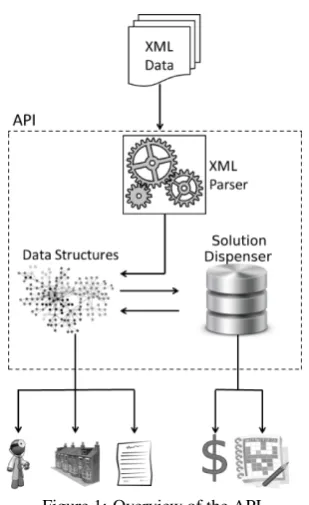
[image:3.595.338.493.88.341.2]The proposed API is composed of three main components that allow the user to decode the data files of a problem scenario, to load the data into ef-ficient and easy-to-access data structures and to build and evaluate solutions in a straightforward and effi-cient way.
Figure 1: Overview of the API.
Figure 1 presents an overview of the API compo-nents. On top, we have the XML Data (the files con-taining a problem instance definition) as input for the API. The XML Parser decodes the files and builds the Data Structures that can be accessed by the user of the API. The user can also access the Solution Dispenser to instantiate and dispose of solution objects of the op-timisation problem. The Solution Dispenser commu-nicates with the Data Structures to evaluate and up-date current solutions.
These features facilitate the development of both experimental solving techniques and final release ver-sions. Additionally, they provide a reliable way for the algorithms to query the data and to compare so-lutions from different approaches. We describe next how an algorithmic solver interacts with the API.
3.1
API Concept
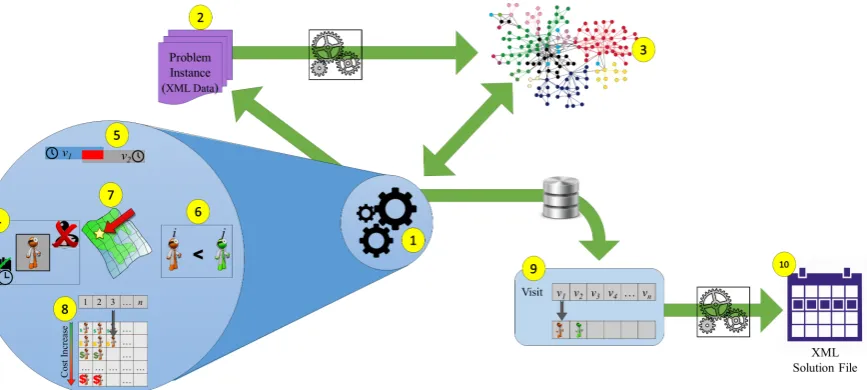
Figure 2 present an overview of the API employed in the WSRP project and how the developed solvers interact with the API. Following, we describe each feature numbered in the figure. Some features extend to all problems and can potentially be employed by an API tackling any problem.
Figure 2: Main features of the WSRP API, where (1) refers to the optimisation solver (mathematical solver, heuristic algo-rithms, etc.), (2) and (10) to the data parser, (3) to the internal memory structures, (4) to (8) to the operations and methods supported by the API and (9) to the Solution Dispenser.
researchers can plug in existing solving APIs and frameworks or new algorithms.
2. Problem Data: we consider that each problem instance can be represented in a set of datafiles (in this case we use XML files). These files must contain all information related to a single instance of the optimisation problem.
3. Internal Data Structures:one of the main func-tionalities of the API is to provide a set of effi-cient data structures to hold the data in the mem-ory. After the solver selects a problem instance to load, the data parser reads the files and allocate the problem data into memory. These structures are designed to provide maximum access perfor-mance to the solver.
Problem-specific features must be adapted to the problem at hand. The API should provide easy ac-cess to the internal data structures and methods for easy and efficient access. Following, we present what we considered to be essential to be provided by the WSRP API:
4. Constraints:the API provides several methods to assess and evaluate the basic problem constraints related to assignments. For example, given an as-signment (a visit and a worker), the API provides methods to:
– Check if the worker is skilled for the visit.
– Check if the worker possesses a valid contract to perform that visit.
– Check if the worker is available at the time of the visit.
– Check if the worker can commute to the place of the visit.
5. Operations: the API also provides several op-erations to be used by the solver. These oper-ations can be simple checks and validoper-ations or complex functionalities. Among the operations in the WSRP we highlight:
– Check if two given visits are time conflicting.
– Check if a worker is qualified to perform two given visits.
– Calculate the best contract for an assignment.
6. Preferences: in addition to constraint methods, the WSRP API also provides methods for evalu-ating preferences (worker, staff and patient’s pref-erences):
– Retrieve the worker preferred to perform a given visit based on historical data.
– Calculate the visits that a given worker prefers to perform.
– Locate the worker that best matches a given pa-tient preferences.
7. Geographical Methods: because the WSRP combines scheduling and routing, we designed a set of methods related to the geographical data, including:
– Check if a given visit is within a given area.
– Given a transportation mode, calculate the time to commute from a visit to another.
– Retrieve all visits within an area.
8. Overall Data Access: it is important to notice that although the provided methods and opera-tions are extensive, specific solvers or techniques may require a different way to access the data, hence, the WSRP API also provides basic ’get’ methods for all information (Figure 3).
Finally, the API also provides functionalities re-lated to building and maintaining solutions for the op-timisation problem:
9. Solution Handling: the solver may deal with a single or with multiple solutions simultaneously. The Solution Dispenser provides an interface for the solver to create and store solutions in the memory. This component provides the following methods:
– Create a new solution.
– Add assignment – given a visit, a worker, a con-tract, start time and transportation mode, the method uses this information and creates an as-signment in a currently specified solution.
– Dispose of the solution.
10. Save Solution: finally, the data parser is able to save a solution object to an XML file that can later be retrieved and loaded back into memory.
Next, we detail each component of the proposed methodology to build an API for optimisation prob-lems data.
3.2
XML Data Parser
Pinheiro and Landa-Silva (2014) proposed the use of a data model to represent the optimisation problem features and data. In a collaborative environment, where practitioners work with the academia to de-velop a decision support system, it is common that an information system already exists and that the de-cision support system is a feature to be incorporated. In this context, a data model to represent the problem was proposed to improve the development of the def-inition of the optimisation problem being tackled, the independence between the development team and the research team and to promote an easy integration of the solver to the actual information system.
Extending the data modelling concept proposed by Pinheiro and Landa-Silva (2014), the first compo-nent of the proposed API is a parser to read the in-put files from the data model and build the data struc-tures. Additionally, the parser is also responsible for converting a solution of the optimisation problem into the data file. Also, the parser must be implemented in such a way to easily accommodate extensions or
updates in the data model. For that purpose, we em-ployed a serialisation library to serialise the data to and from an XML data format.
Since we are using Java, we employed the XStream Java library (Walnes, 2016), however, most high-level languages have XML serialisation mecha-nisms available. The advantage of such approach is that we can create a set of classes that corresponds immediately to the modelled data, hence the seriali-sation library can handle all the file parsing. This is easy to develop and do not require much program-ming time, however, it is likely that the objects in memory are not best suited for performance or for intuitive access because the serialisation mechanism often requires intermediate classes and public access to attributes. Hence, the parser is used exclusively to translate the information from and to the files. For ef-ficient and easy access to the data, we need another set of data structures.
3.3
Internal Data Structures
The second component of the API is composed of the data structures to hold the problem-related data. It is important to emphasise that while the aforementioned data model is intended to be a clear representation of the optimisation problem, the internal data structures must be efficient for access during the optimisation process.
Therefore, we must ensure that the operations in-voked during the optimisation are performed on con-stant (O(1)) time when possible. Additionally, the API should be flexible enough to easily accommo-date different solving techniques, as we are not only concerned about the final product but with the entire process of developing the R&D project. Hence, in our work, we divided the API into groups of objects, following the data model orientation. Therefore, we have in the WSRP API the following groups:
• Visits – containing information about the requiments of each visit, e.g. number of workers quired, start time, duration, location, skills re-quired, preferences, etc.
• Workers – containing information related to the workers themselves, e.g. skills, availability, home location, preferences.
• Areas and locations.
• Transportation modes.
• Contracts – containing information regarding maximum and minimum working hours and costs.
is that to load the data we must first assess its size in order to allocate the right length for the arrays (or use dynamic array structures which could also hinder the performance if the pre-allocated size is not large enough). To increase the loading performance, we added a new XML file to the model, called ’meta-data.xml’ that accommodates several information and statistics of the problem instance, such as the number of workers, tasks, the date format used in the files, etc. Using arrays may be sufficient for most solving algorithms as it allows fast random access and quick interaction through the elements. However, it may be a problem with specialised heuristics or external soft-ware that might have access to the API. Such systems are often linked with a database, hence, they han-dle elements using their own identification number, which is stored in the XML, but is not consistent with the index of the arrays. To solve this matter, we em-ploy a second data structure, a hash table, linking the identification numbers of the database entries to its respective objects. In order to provide better usabil-ity with both data structures, we encapsulated both the hash table and the arrays, for each type of objects, into a single class representing the set of elements.
Finally, to improve the usability of the API, we define a naming convention to make it clear regard-ing the performance of the operations. All methods starting with the words ’get’, ’is’ and ’has’ are guar-anteed to perform inO(1)time. All methods starting with the word ’calculate’ are guaranteed to perform in
O(nk)time in the worst case.
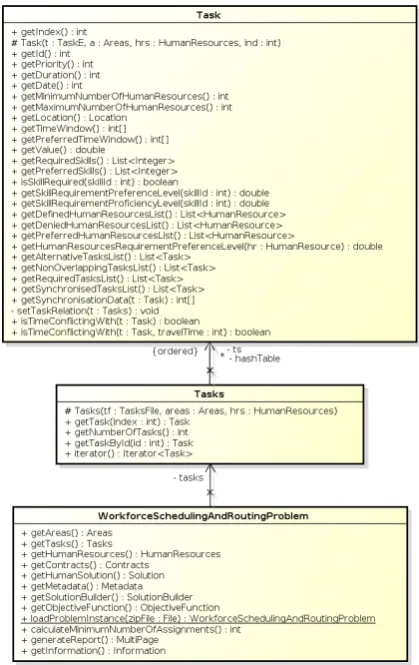
Figure 3 presents a class diagram of the data structures. For simplicity, we included only the main class that defines the optimisation problem and the classes that define the tasks and the set of tasks. The main class, WorkforceSchedulingAndRout-ingProblem, is composed of sets of elements included in a problem instance, namely areas, tasks, human re-sources and contracts. This class provides an inter-face such that the user can retrieve each set and its elements. Also, this class allows the user to obtain the Solution Dispenser, explained in the subsequent section. Note that the calculateMinimumNumberO-fAssignmentsmethod, as aforementioned, starts with the ’calculate’ word, hence in the worst case it per-forms inO(n), while all ’get’ methods performs with
O(1)time complexity.
TheTasks,Areas,HumanResourcesandContracts
[image:6.595.310.520.95.428.2]classes contain both the arrays of elements and the hash table linked by each element’s identification number. Hence, when using these classes it is pos-sible to interact through all elements or retrieve a spe-cific one given its identification number or index, as we can find in theTasksclass. We see that from this
Figure 3: Class diagram for the main problem class and the tasks-related classes.
class it is possible to identify an ordered list of tasks
lsrepresenting the array and the hash tablehashTable
containing the mapping of identification numbers. Fi-nally, the classTaskcontains all the methods to access the data from a single task plus some useful opera-tions, such asisTimeConflictingWithwhich checks if a second given task conflict in time with the current task (hence they cannot be performed by the same worker).
3.4
The Solution Dispenser
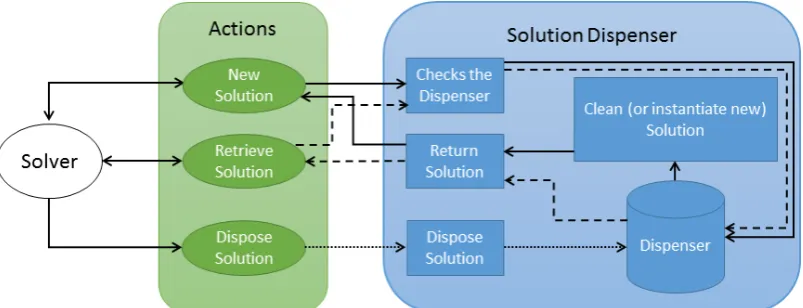
Figure 4: Flow diagram for the Solution Dispenser. Solid lines represent the flow for the ’New Solution’ action, dashed lines for the ’Retrieve Solution’ action and dotted lines for the ’Dispose Solution’ action.
The user can also invoke the objective function to evaluate the solution. Figure 4 presents a schematic for the SD component.
Modern programming languages, such as Java and C#, provide a convenient way to handle objects: a garbage collector. When the user doesn’t need an object anymore, all he has to do is to get rid of the links and pointers to that object. At a given time, the garbage collector starts processing, seeking objects that are not linked by the user’s program and free-ing the memory. That can lead to two problems: the first is the fragmentation of the memory, which is a problem because the defragmentation process can be slow; the second is the extra processing time to seek, to free the memory and later to allocate new objects (Siebert, 2000; Bacon et al., 2003).
Leaving the disposal of objects to the garbage col-lector can lead to a decrease in performance that, aside from being marginal for most applications, can have an unacceptable impact on optimisation algo-rithms. Hence, the SD internally implements an Ob-ject Pool design pattern (Nystrom, 2014) to recycle the objects. To do that we employ a factory object implemented using thefactorydesign pattern (Yener et al., 2014) for easy creation of the objects. This fac-tory is responsible for creating new solution objects.
When a new solution request is invoked (Figure 4), the factory seeks its internal solution repository (a list of disposed solutions). If there is a solution available in the repository, it retrieves it, clears the solution and returns it to the solver. The solver now has an empty solution that it can use. When the solver does not need the solution anymore, it can dispose of the solution by invoking the specific method in the SD. The factory then receives the disposed solution and stores it in the list.
Potentially, the use of the solution dispenser can
provide significant performance gains. Take for in-stance a population-based algorithm that processes one generation per second with a population of 100 individuals. That means 100 solutions being disposed of per second. After ten minutes running, the algo-rithm will have disposed of 60000 solutions, which potentially could fragment the memory and cause sev-eral garbage collection calls. Now, when using the dispenser, considering the worst case, when a new population is created before disposing of the old one, we need 100 active solutions per population, totalling 200 total solutions active that will be recycled dur-ing the execution. Thus, in this hypothetical scenario, we could have a decrease of 99.6% on the number of objects used, which could represent a reduction of 97.5% on the processing time and memory consumed by the garbage collector (see section 4.1).
4
Experiments and Results
mul-25
50
100
250
500 1000 2500 5000
10000 25000
0
1
5
10
15
Solution Size
T
ime(s)
SD - Total
SD - new SD - dispose
GC - Total
[image:8.595.171.427.88.299.2]GC - new GC - dispose
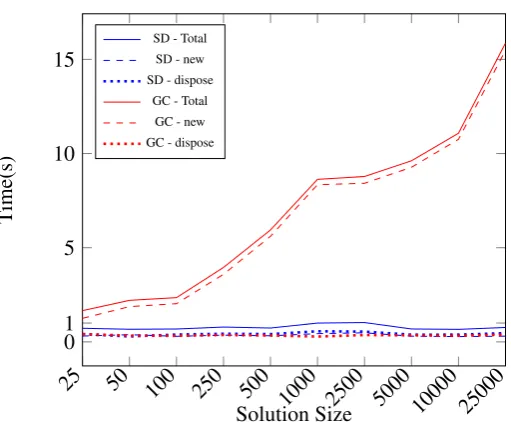
Figure 5: Time comparison between the Solution Dispenser (SD) and the Java Garbage Collector (GC) to instantiate and dispose new solutions.
tiple people working using a single API helps to spot code errors and bugs faster than having each re-searcher to find errors alone on his own code, ensuring higher quality on the software developed.
4.1
Solution Dispenser
We now present an empirical analysis of the effi-ciency of the Solution Dispenser. The SD is respon-sible for holding solution objects of given problem, hence small problems using larger encoding consume more memory than larger problems using smaller en-coding. This is particularly true when comparing an integer array representation (an array the size of the number of tasks) and a binary array representation (a matrix which is of sizenumber of workers × num-ber of tasks). Therefore, to test the solution dispenser we used integer arrays varying from very small (25 elements) to very large (25000 elements) represent-ing respectively a small problem usrepresent-ing integer rep-resentation and a large problem using binary repre-sentation. Note that although the decision variables may be binary, for several reasons it not uncommon to find these arrays implemented using complex ob-jects (Durillo and Nebro, 2011), hence, it is reason-able to use integer varireason-ables instead of binary ones in our experiments.
We defined our experiments as follows: for each problem size, we sequentially created and disposed of one million solution objects. For the experi-ments using the garbage collector, the disposing pro-cess merely unlinked the objects to free them to the Garbage Collector (GC) while for the SD it called
the internal dispose process and cleared the object data. We run each set-up for five times and computed the average results. Additionally, to measure time and memory we used the integrated profiler avail-able on Netbeans which can accurately measure the time spent on each method and the memory allocated during the execution of the application. The exper-iments were performed on a quad-core Intel i7 ma-chine with 32GB memory on the Java platform. The main reason for choosing Java is that is a mature lan-guage, multi-platform and widely employed for opti-misation problems with a large number of optimisa-tion algorithms implemented and available for pub-lic use (Cahon et al., 2004; Durillo and Nebro, 2011; Lukasiewycz et al., 2011).
25
50
100
250
500 1000 2500 5000
10000 25000
0
200
400
600
800
Problem Size
Memory
Used
(MB)
SD Maximum
SD Average GC Maximum
[image:9.595.170.426.88.298.2]GC Average
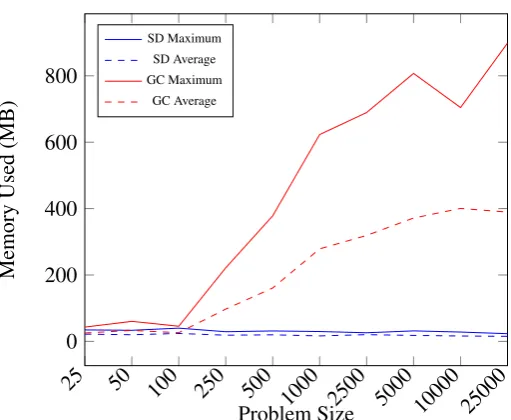
Figure 6: Memory comparison between the Solution Dispenser (SD) and the Java Garbage Collector (GC).
Regarding the tests using the garbage collector, we see that the’dispose’ operation is performed in constant time, but the’new’method requires higher time proportional to the size of the solutions. We can clearly see how relying on the garbage collector to dispose and allocate new objects can hinder the per-formance of the application. Also, it is important to notice that in our experiments we did not specify any parameters for the Java virtual machine, hence the ex-periments had as much memory as it was required. In a real-world environment, that might not be the case. Many processes may be active in the machine and the memory might be limited, which would make the garbage collector to be active more often than it was on the presented tests, hence further decreasing the performance.
In Figure 6 we have the results of the memory allocation measurement. The red lines represent the experiments using the garbage collector and the blue lines the solution dispenser. Also, the solid lines rep-resent the maximum memory allocated in MB and the dashed lines the average memory allocated. Analo-gously to the previous chart, we can clearly see that the memory required by the SD, not surprisingly, is constant throughout all experiments. Although the size of the array changes on each experiment, only one object is allocated in memory during the runtime. However, when relying on the garbage collector, we see that it makes use of much more memory, which reinforces our previous statement that in a scenario where the memory is limited the garbage collector re-quires more frequent activation.
Thus, we can clearly see that by employing the so-lution dispenser we can achieve substantial
improve-ments both in time and memory consumption, espe-cially on larger problems or problems where the so-lution representation is larger. Also, the idea of the solution dispenser of recycling objects could be im-plemented in the solver algorithms themselves, espe-cially on population-based algorithms (because of the high number of created and disposed solutions), to maintain their individuals pool.
5
Conclusion
Because it is not possible to provide a general API that suits all problems, we instead provided in this work a set of guidelines and instructions to aid on the tailoring of an API to efficiently handle the optimisa-tion problem data and to help to increase the perfor-mance of solving techniques. We first stipulated a file parser that can read the modelled format and load all pertinent information into memory. Then we defined an intuitive and efficient approach to storing this in-formation using efficient data structures that are clear and computationally efficient, hence it can improve the research process and be applied to a final solver algorithm. Finally, we proposed a component called Solution Dispenser which provides a solution repos-itory that handles the memory allocation of solution objects in an improved way.
assessment of solving techniques started earlier. We were also able to increase the solvers efficiencies and to promote a consistent mean to compare solutions. Also, we managed to improve the identification of glitches and bugs in the code, raising the reliability of the software being developed from early stages of the project. Moreover, we analysed the advantages of using the Solution Dispenser and presented the com-putational gains that can be obtained by employing such technique and the design patterns presented.
In conclusion, the guidelines of the API design proposed in this work can help academics and practi-tioners to achieve improved results, both for research or production purposes. While the API provides a fair mechanism for researchers to develop and as-sess their algorithms, it also provides a reliable frame-work for practitioners to ground their solutions. Ad-ditionally, the computational performance that can be gained from applying the aforementioned techniques can help researchers to develop their algorithms and the industry to improve their solutions or reduce costs. Finally, our reported experience, arising from a col-laboration with an industrial partner, may be useful for other researchers and practitioners in a similar po-sition.
Our future work will further investigate the data structures aiming to improve their efficiency. Also, we will test the proposed dispenser on a real-world environment, assessing it with optimisation algo-rithms solving real-world problems.
REFERENCES
Bacon, D. F., Cheng, P., and Rajan, V. T. (2003). Con-trolling fragmentation and space consumption in the metronome, a real-time garbage collector for java. SIG-PLAN Not., 38(7):81–92.
Cahon, S., Melab, N., and Talbi, E. (2004). Paradiseo: a framework for the reusable design of parallel and dis-tributed metaheuristics. Journal of heuristics, 10:357– 380.
Castillo-Salazar, J. A., Landa-Silva, D., and Qu, R. (2012). A survey on workforce scheduling and routing prob-lems. InProceedings of the 9th International Conference on the Practice and Theory of Automated Timetabling (PATAT 2012), pages 283–302, Son, Norway.
Castillo-Salazar, J. A., Landa-Silva, D., and Qu, R. (2014). Workforce scheduling and routing problems: literature survey and computational study. Annals of Operations Research.
Durillo, J. J. and Nebro, A. J. (2011). jMetal: A Java frame-work for multi-objective optimization. Advances in En-gineering Software, 42:760–771.
Huang, F. (2012). A New Application Programming
Inter-face and a Fortran-like Modeling Language for Evaluat-ing Functions and SpecifyEvaluat-ing Optimization Problems at Runtime. International Journal of Advanced Computer Science and Applications(IJACSA), 3(4).
Laesanklang, W., Landa-Silva, D., and Castillo-Salazar, J. A. (2015a). Mixed integer programming with de-composition to solve a workforce scheduling and routing problem. InICORES 2015 - Proceedings of the 4rd In-ternational Conference on Operations Research and En-terprise Systems, pages 283–293.
Laesanklang, W., Pinheiro, R., Algethami, H., and Landa-Silva, D. (2015b). Extended decomposition for mixed in-teger programming to solve a workforce scheduling and routing problem. InOperations Research and Enterprise Systems, volume 577 ofCommunications in Computer and Information Science, pages 191–211. Springer Inter-national Publishing.
Lukasiewycz, M., Glaß, M., Reimann, F., and Teich, J. (2011). Opt4J - A Modular Framework for Meta-heuristic Optimization. In Proceedings of the Ge-netic and Evolutionary Computing Conference (GECCO 2011), pages 1723–1730, Dublin, Ireland.
Matias, J., Correia, A., Mestre, P. Graga, C., and Serodio, C. (2010). Web-based application programming interface to solve nonlinear optimization problems. InProceedings of the World Congress on Engineering 2010, Vol III.
Mestre, P., Matias, J., Correia, A., and S., C. (2010). Di-rect search optimization application programming inter-face with remote access. IAENG International Journal of Applied Mathematics, pages 251–261.
Nystrom, R. (2014).Game Programming Patterns. Genever — Benning.
Pinheiro, R., Landa-Silva, D., and Atkin, J. (2016). A vari-able neighbourhood search for the workforce scheduling and routing problem. In Advances in Nature and Bio-logically Inspired Computing, volume 419 ofAdvances in Intelligent Systems and Computing, pages 247–259. Springer International Publishing.
Pinheiro, R. L. and Landa-Silva, D. (2014). A development and integration framework for optimisation-based enter-prise solutions. InICORES 2014 - Proceedings of the 3rd International Conference on Operations Research and Enterprise Systems, Angers, Loire Valley, France, March 6-8, 2014., pages 233–240.
Siebert, F. (2000). Eliminating external fragmentation in a non-moving garbage collector for java. InProceedings of the 2000 International Conference on Compilers, Ar-chitecture, and Synthesis for Embedded Systems, CASES ’00, pages 9–17, New York, NY, USA. ACM.
Walnes, J. (2016). Xstream. http://x-stream.github.io/.