A. Karabanov, D. Wisniewski, I. Lesanovsky, and W. K¨ockenberger∗
Sir Peter Mansfield Magnetic Resonance Centre, School of Physics and Astronomy, University of Nottingham
(Dated: March 13, 2015)
Dynamic nuclear polarization (DNP) is a promising strategy for generating a significantly in-creased non-thermal spin polarization in nuclear magnetic resonance (NMR) applications thereby circumventing the need for strong magnetic fields. Although much explored in recent experiments, a detailed theoretical understanding of the precise mechanism behind DNP is so far lacking. We address this issue by theoretically investigating solid effect DNP in a system where a single electron is coupled to an ensemble of interacting nuclei and which can be microscopically modelled by a quantum master equation. By deriving effective equations of motion that govern the polarization dynamics we show analytically that DNP can be understood as kinetically constrained spin diffu-sion. On the one hand this approach provides analytical insights into the mechanism and timescales underlying DNP. On the other hand it permits the numerical study of large ensembles which are typically intractable from the perspective of a quantum master equation. This paves the way for a detailed exploration of DNP dynamics which might form the basis for future NMR applications.
PACS numbers: Valid PACS appear here
The sensitivity of imaging and spectroscopy techniques based on nuclear magnetic resonance (NMR) depends on the spin polarization that arises from the Zeeman inter-action of the nuclei with an externally applied magnetic field. However, even with the highest magnetic fields that can currently be generated by superconductive mag-nets, the nuclear spin polarization of1H nuclei is only in the order of less than ten parts per million at ambient temperature. A promising strategy to overcome the low sensitivity in many NMR applications is the use of dy-namic nuclear polarization (DNP). Here the electronic spin polarization — that is about three orders of magni-tude higher than the nuclear spin polarization — is trans-ferred from paramagnetic centres in solid state materials to the surrounding nuclear spin ensemble by irradiating with microwave fields at an appropriate frequency. DNP was already proposed and demonstrated in the early days of nuclear magnetic resonance [1–3], but it has recently attracted increased attention since progress in hardware technology, mainly in the form of stable high frequency and high power microwave sources, has made it possible to substantially enhance the NMR signal in several appli-cations [4, 5] including the detection of nuclei with small gyromagnetic constants [6], of nuclei located on the sur-face of structured materials [7] and of nuclei in protein micro-crystallites [8] by magic angle spinning solid state NMR spectroscopy. Furthermore, DNP carried out at cryogenic temperatures combined with a fast dissolution step to rapidly bring the sample to ambient tempera-ture, was successfully used to generate highly polarised 13C-labelled compounds that could be detected inin vivo Magnetic Resonance Imaging applications after their in-jection [9, 10]. A full understanding of the spin dynam-ics during DNP is essential for the interpretation of the experimental data and ultimately for optimising the ex-perimental protocols. In principle this problem can be
addressed by numerically solving the full quantum mas-ter equation [11, 20]. Owing to its complexity, however, this approach is limited to small systems [12, 13].
In this work we show how to overcome this limita-tion and to extend the analysis of the spin dynamics to large ensembles containing more than a thousand cou-pled spins. By using an adiabatic elimination procedure we derive an effective equation for the evolution of the spin polarization. This equation is classical in the sense that it describes transitions between Zeeman basis states and therefore the computational complexity of simulat-ing the spin dynamics is drastically reduced. Moreover, the analytical form of the effective equations of motion permits a transparent interpretation of the physics un-derlying DNP in terms of operator-valued, i.e kinetically constrained, diffusion rates.
Solid effect DNP (SE DNP) is observed in systems that consist of interacting unpaired electronsS and nucleiI
FIG. 1. (a) Sketch of the solid effect DNP setup. The elec-tron is coherently driven by the applied microwave field and coherent excitation-exchange between the spins is mediated through dipole-dipole couplings. Furthermore the electron and nuclei are subject to dissipation leading to relaxation (see text for details). (b) The effective dynamics of the polar-ization is described by a classical master equation and thus permits the simulations of large systems. (c) Comparison be-tween the exact (solid black lines) and effective (colored lines) relaxation dynamics of a system consisting of one electron and four nuclei. (d) Polarization dynamics in a linear spin chain with one electron and 30 nuclear spins. The polarization ver-sus spin index (0 denotes the electron position) is shown for different times and the polarization versus time is shown for the electron (blue line) and four selected nuclear spins (red lines).
used to represent superoperators and a doublehat for a commutation superoperator, i.e. ˆOˆ≡[ ˆO,·].
In the following we discuss the structure of the quan-tum master equation in detail. The Hamiltonian ˆHof the system consists of four terms: ˆH= ˆHZ+ ˆH0+ ˆH++ ˆH−, where ˆHZ =ωI( ˆSz+
∑
kIˆkz) is the Zeeman term. The term
ˆ
H0=λSˆz+ ∑
k
AkIˆkzSˆz+ ∑
k<j
dkj (
3 ˆIkzIˆjz−Iˆk·Iˆj )
describes the hyperfine and nuclear dipole interaction. It depends on the secular strengths of the electron-nuclear hyperfine interaction, parameterized byAk and further-more on the inter-nuclear dipolar coupling coefficientsdjk [21]. There is an additional dependence on the so-called offset parameterλ=ωS−ωI−ω0which represents a res-onance condition between the microwave frequency ω0 and that of the double quantum transitionωS−ωI. The remaining terms of the system Hamiltonian are
ˆ
H±= ω1 2
ˆ
S±+1 2
∑
k
Bk±Iˆk±Sˆz,
which arise from the pseudosecular hyperfine interaction and the microwave irradiation. They are parameterized by the pseudosecular coupling strengthBk±between the electron and the nuclei and the microwave amplitudeω1. Note, that the interaction parametersAk, Bk± anddkj depend on the geometry of the spin system [21].
The relaxation superoperator is composed of two terms,Γ=Γ1+Γ2. The first one is given by
Γ1=R (S) 1
2 [D( ˆS+) +D( ˆS−)] +Γth
+R (I) 1 2
∑
k
[D( ˆIk+) +D( ˆIk−)]
where we have defined the dissipatorD( ˆX) ˆρ≡XˆρˆXˆ†− {ρ,ˆ Xˆ†Xˆ}/2. Γ1 describes dissipative processes or lon-gitudinal relaxation due to interaction of the spins with the environment [22]. The rates for longitudinal relax-ation are R(S)1 and R(I)1 for the electron and the nuclei, respectively. The superoperatorΓth =P0R
(S)
1 [D(S−)− D(S+)]/2 acts as a correction term and ensures that the electron relaxes back to its thermal equilibrium state which—at typical temperatures of T >0.1K— is up to a scaling factor approximated byρth= 1−2P0Sˆz. Here
P0 = tanh (~ωS/2kBT) is the thermal electronic polar-ization [21]. The second term,
Γ2= 2R(S)2 D(Sz) + 2∑ k
R(I)2 D(Ikz)
represents the loss of coherences or transverse relaxation of the spin ensemble, which depends on the ratesR(S)2 and
R(I)2 for the electron and the nuclear spins, respectively. The full quantum master equation describes the dynamics of the spin system in the Liouville space
L of dimension 22N where N = n + 1. How-ever, all information that is relevant for character-izing SE DNP is typically contained in the Zeeman subspace LZ [23] which is spanned by the operators
{ˆ1, Iˆkz,IˆkzIˆk′z,IˆkzIˆk′zIˆk′′z, . . .} and has a dimension 2N. For example the bulk nuclear polarization is given by the expectation value of∑nIˆkz. We have obtained a closed equation for the dynamics in the Zeeman subspace by means of a quite lengthy adiabatic approximation pro-cedure which is detailed in the supplemental material. This resulting effective master equation is of the form
˙ˆ
[image:2.595.59.280.50.245.2]check the validity of this approximate approach we have simulated small systems with the exact quantum Master equation and kMC. Example results are shown in Fig. 1(c) as well as in the supplemental material and show excellent agreement between the two methods.
The effective dynamics in the Zeeman subspace is gov-erned by a set of single-spin and two-spin dissipators: LZ =Lsingle−spin+Ltwo−spin. The single-spin terms are given by
Lsingle−spin= Γ (S)
+ D( ˆS+) + Γ (S)
− D( ˆS−) +
+∑
k [
Γ(I)k+D( ˆIk+) + Γ (I)
k−D( ˆIk−) ]
. (1)
and depend on the constant rates
Γ(S)± =1∓P0
2 R
(S) 1 +
ω2 1 2ω2
I
R(S)2 , (2)
Γ(I)k±=R (I) 1
2 +
Bk−Bk+ 8ω2
I
R(I)2 . (3)
Here Γ(S)± are the rates at which the electron spin flips ’up’ (+) or ’down’ (−). They depend on the longitudi-nal relaxation rateR1(S)of the electron with a weighting pre-factor which ensures that in the absence of any per-turbation by the microwave field the electronic steady-states polarization is identical to the thermal electronic polarizationP0. The second term is a consequence of the applied microwave field. Eq. (3) describe the rates for a nuclear spin k to flip ’up’ or ’down’. Since we have assumed in the derivation of these equations that the thermal nuclear polarization is negligibly small, these two rates coincide and correspond to half the longitudinal nu-clear relaxation rateR(I)1 . The additional term appearing in Eq. (3) arises from the pseudosecular interaction with the electron which leads to a tilt of the nuclear effective field axis.
The two-spin dissipators are given as
Ltwo−spin= ∑
k ˆ
Γ(IS)k D( ˆYk) + ∑
k<j ˆ
Γ(II)kj D( ˆXkj), (4)
with ˆYk= ˆIk+Sˆ−+ ˆIk−Sˆ+ and ˆXkj= ˆIk+Iˆj−+ ˆIk−Iˆj+. They clearly describe a diffusive (flip-flop) dynamics be-tween the electron and the nuclei as well as among the nuclei. Interestingly the diffusion rates Γ(IS)k and ˆΓ(II)kj are not constant, but operator-valued. Hence the diffu-sion rate of the spin-polarization depends on the state of the entire spin system. In the context of the study of glassy relaxation [25, 26] such operator-valued rates are often referred to as kinetic constraint. Explicitly, they read
ˆ
Γ(IS)k = ω 2 1 8ω2
I
|Bk−Bk+|
R2(S)+R(I)2
( ˆ 1 + ˆD2k
)−1
,
ˆ
Dk =
λˆ1 +∑s̸=kAsIˆsz
R(S)2 +R(I)2
, (5)
ˆ
Γ(II)kj = d 2 kj
4R(I)2
( ˆ 1 + ˆCkj2
)−1
,Cˆkj=
(Ak−Aj) ˆSz 2R2(I)
. (6)
A brief discussion of these expressions provides insight into the spin dynamics on which SE DNP is based on. Eq. (5) describes the rate of flip-flop transitions or jumps be-tween a nuclear spinkand the unpaired electron. Hence ˆ
Γ(IS)k is of fundamental importance for the SE DNP effect. This rate depends on both the strength of the microwave fieldω1and the pseudosecular interaction strengthBk±. It is inversely proportional to the square of the nuclear Larmor frequency ωI and also inversely proportional to the sum of the transverse relaxation rates of the electron,
R(S)2 , and the nuclear spin,R2(I). This indicates that al-though this process is represented by the flip-flop jump operator, the underlying quantum mechanical process is mediated by coherences which in fact decay with these relaxation rates.
Most importantly, the rate for polarization transfer be-tween the electron and thek-nucleus is controlled by the operator ˆDk whose (eigen)value depend on the polariza-tion level of the nuclear spin ensemble. For negligible nuclear polarization in an ensemble of nuclear spins the sum ∑s̸=kAsIˆsz evaluates to a value close to zero as there is an equal probability for the nuclei to be in their spin ’up’ or ’down’ state. However, with increasing level of nuclear polarization the magnitude of this sum grows which decreases the effective rate ˆΓ(kIS). Note, that the effect of the off-resonance parameter λ is negligible as long as the microwave frequency ω0 is matched to the double quantum transition atωS−ωI.
The transport of polarization within the dipolar-coupled network of the nuclear spins takes places via spin diffusion which is governed by the operator-valued rate given in Eq. (6). The rate of polarization trans-port among two nuclei is protrans-portional to the square of their nuclear dipolar coupling constantdkj, and it is in-directly proportional to the nuclear transverse relaxation rateR(I)2 . Interestingly, there is also a dependence on the difference of the secular hyperfine interaction strength
Ak of the two nuclei. In the case in which this difference is significant, the internuclear polarization transfer be-tween the spins can become strongly quenched provided the electronic polarization ˆSz is non-zero.
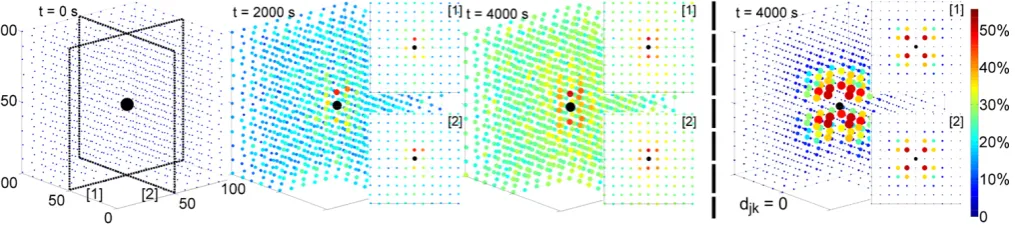
FIG. 2. Simulation of the polarization dynamics of 1330 nuclear spins (13C) arranged on a regular grid in a cube (11×11×11) around one central electron (black). The diameter and the colour of the spheres indicate the expectation value of the nuclear spin polarization at the given position. The simulation demonstrates that polarization buildup is fastest for the nuclei that are located close to the electron at an angle ofπ/4 with respect to direction of the applied static magnetic field. In order to show the contribution of spin diffusion to the distribution of polarization within the spin ensemble the dipolar coupling constants were set to zero in the rightmost panel. This prevents any transport of polarization through spin flip-flop jumps between pairs of nuclear spins. Note, that the front quarter of the13C spin ensemble is not shown for better visibility of the polarization buildup near the electron.
time constants areR(S)1 = 1s−1, R(S)
2 = 105s−1, R (I) 1 = 1.4×10⁻⁴s−1 andR(I)
2 = 104s−1.
Let us finally investigate the role the nuclear dipolar in-teraction plays in the distribution of polarization between the nuclear spins. This question has been addressed e.g. by Hovavet al. in Ref. [11] who conducted simulations of small chains (up to 9 nuclei) within the framework of the full quantum master equation. Their results show that there is only a weak dependence of the polarization build up rates on the nuclear dipolar couplings between nuclei further away from the electron (nuclei belonging to the bulk) suggesting that there is a direct transfer of polarization from the electron to all bulk nuclei through mixing of the multi-nuclear product states. Our data shown in Fig. 2 clearly suggests that the nuclear dipolar couplings are important but this does not rule out the ex-planation provide by Hovavet al. in Ref. [11]. To further investigate the polarization transport we have simulated the polarization dynamics of a linear spin chain consist-ing of 30 spins as shown in Fig. 1(d) [see supplemental material for further details]. In contrast to the analysis in Ref. [11] our findings show that a decrease of the nu-clear dipolar interaction constants of the bulk nuclei by a factor of two alters the polarization buildup dramat-ically, which is consistent with a diffusive polarization transport. The discrepancy is thus most likely caused by boundary effects, which can be severe for short chains. Moreover, further discrepancies might arise due to the way in which relaxation was introduced in the reference frame in Ref. [11] as we have already previously discussed [22].
Let us now establish a more quantitative connection between SE DNP and the diffusion of polarization. For a linear chain ofnnuclear spins, as shown in Fig. 1, we
can derive an average diffusion constant:
Dav= 1
n−1 n∑−1
k=1
Dk, Dk=
4R(I)2 d2 ka2k (
4R(I)2
)2
+ (Ak−Ak+1) 2
(7) Hereak is the distance between the nuclear spinskand
k+ 1, dk is the dipolar coupling constant between the two spins andAk is the strength of the secular hyperfine interaction of spink. The constantDk is the rate of dif-fusive polarization transport among neighboring nuclei. It is quenched when the difference between the secular hyperfine interactions of the two spins, |Ak −Ak+1|, is large and when the nuclear transverse relaxation rateR(I)2
is fast. Comparing the polarization dynamics calculated via kMC with a simple diffusion model, ∂p∂t = Dav∂
2p
∂x2,
where p(x) is the polarization field, indeed shows good agreement with data as the one presented in Fig. 1(d). Further details and a discussion of the relevant boundary conditions is provided in the supplemental material. We conclude that polarization transport in a SE DNP experi-ment is mediated by nuclear spin diffusion. The presence of the electron will hinder this process for nuclei close to the electron since for these nuclei the difference be-tween the strengths of the secular hyperfine interactions is significant [11, 28].
impor-tant step in the quantitative understanding of SE DNP for practical applications in NMR. In the future we will investigate whether the method presented here is also applicable in more complex settings, which involve e.g. more than a single electron.
We are grateful to Prof Shimon Vega, Weizman Insti-tute, Rehovot, for interesting discussions related to DNP. The research leading to these results has received funding from the European Research Council under the European Union’s Seventh Framework Programme (FP/2007-2013) / ERC Grant Agreement No. 335266 (ESCQUMA) and the EU-FET grants HAIRS 612862 and RYSQ 640378.
[1] A. W. Overhauser, Phys. Rev. 92, 411 (1953)
[2] T.R. Carver, C.P. Slichter, Phys. Rev. 102, 975 (1956) [3] C. D. Jeffries. Phys. Rev. 106, 164-165 (1957)
[4] R.G. Griffin, T.F. Prisner, Phys. Chem. Chem. Phys. 12 (22), 5737-5740 (2010)
[5] A.V. Atsarkin, W. K¨ockenberger, Appl. Magn. Reson. 43 (1-2), 1-2 (2012).
[6] T. Maly, G.T. Debelouchina, V.S. Bajaj, K.N. Hu, C.G. Joo, M.L. Mak-Jurkauskas, J.R. Sirigiri, P.C.A. van der Wel, J. Herzfeld, R.J. Temkin, R.G. Griffin, J. Chem. Phys. 128(5) 052211-052229 (2008).
[7] A.J. Rossini, A. Zagdoun, M. Lelli, D. Gajan, F. Rascon, M. Rosay, W.E. Maas, C. Coperet, A. Lesage, L. Emsley, Chemical Science 3(1) 108-115 (2012).
[8] G.T. Debelouchina, M.J. Bayro, P.C.A. van der Wel, M.A. Caporini, A.B. Barnes, M. Rosay, W.E. Maas, R.G. Griffin, Phys. Chem. Chem. Phys. 12(22) 5911-5919 (2010).
[9] J.H. Ardenkjaer-Larsen, B. Fridlund, A. Gram, G. Hans-son, L. HansHans-son, M.H. Lerche, R. Servin, M. Thaning, K. Golman, Proc. Natl. Acad. Science USA. 100(18) 10158-10163 (2003).
[10] K. Golman, J.H. Ardenkjaer-Larsen, J.S. Petersson, S. Mansson, I. Leunbach, Proc. Natl. Acad. Sciences USA, 100(18) 10435-10439 (2003).
[11] Y. Hovav, A. Feintuch, S. Vega, J. Chem. Phys. 134(7), 074509-074528 (2010)
[12] A. Karabanov, I. Kuprov, G. T. P. Charnock, A. van der Drift, L. J. Edwards, W. K¨ockenberger, J. Chem. Phys., 135 (8): 084106 (2011).
[13] A. Karabanov, A. van der Drift, I. Kuprov, L. J. Ed-wards, W. K¨ockenberger, Phys. Chem. Chem. Phys., 14 (8): 2658-68 (2012).
[14] C. Jefferies, Phys. Rev. 106, 164- 165 (1957).
[15] A. Abragam, W. G. Proctor, C.R Hebd. Seances. Acad. Sci. 246, 2253-2256 (1958).
[16] T.J. Schmugge, C.D. Jeffries, Phys. Rev. 138, A1785-A1801 (1965).
[17] C.D. Jeffries, Dynamic Nuclear Orientation, John Wiley, New York, 1963.
[18] M. Borghini, A. Abragam, C.R. Hebd. Seances Acad. Sci. 203 1803 (1959).
[19] A. Abragam, M. Borghini, Progress in Low Temperature Physics, vol. 4, North-Holland, Amsterdam, 1964. [20] Y. Hovav, A. Feintuch, S. Vega, J. Magn. Reson., 207
(2): 176-189 (2010).
[21] A. Abragam,Principles of Nuclear Magnetism, Claren-don Press, Oxford, 1996.
[22] A. Karabanov, G. Kwiatkowski, W. K¨ockenberger, Mol. Phys. 112(14) 1838-1854 (2014).
[23] A.A. Smith, B. Corzilius, A.B. Barnes, T. Maly, R.G. Griffin, J. Chem. Phys. 136, 015101 (2012).
[24] G. Lindblad, Commun. math Phys. 48, 119-130 (1976). [25] F. Ritort and P. Sollich, Adv. Phys. 52, 219 (2003) [26] J. P. Garrahan and D. Chandler, Phys. Rev. Lett. 89,
035704 (2002); Proc. Natl. Acad. Sci. USA 100, 9710 (2003)
[27] C. W. Gardiner, P. Zoller, Quantum Noise. Springer-Verlag: Berlin, Heidelberg, 2004.
SUPPLEMENTARY MATERIAL
Adiabatic Elimination
For any linear system with constant coefficients ˙ˆ
σ=Lσˆ (8)
defined in some vector spaceH, the following technique is valid.
Suppose we need to know dynamics in a subspaceH1⊂ Hand initially also ˆσ(0)≡σˆ1(0)∈ H1. By using the space decomposition
H=H1+H2
and introducing the projections
ˆ
σk=πkσ,ˆ Lkj=πkLπj, k, j= 1,2,
we can write
˙ˆ
σ1=L11σˆ1+L12σˆ2, σ˙ˆ2=L22ˆσ2+L21σˆ1.
Given ˆσ1, the second equation is resolved as
ˆ
σ2(t) =eL22t ∫ t
0
e−L22τL
21σˆ1(τ)dτ.
Substituting this into the first equation, we obtain the equation closed inH1
˙ˆ
σ1(t) =L11σˆ1(t) + ∫ t
0
K(t−τ)ˆσ1(τ)dτ, (9)
where
K(T) =L12eL22TL21. (10)
In terms of the Laplace transforms (defined forζ >0)
ˆ
l1(ζ) = ∫ +∞
0
e−ζtσˆ1(t)dt, lK(ζ) =
∫ +∞
0
e−ζtK(t)dt,
(9) is resolved as
ˆ
l1(ζ) = (P(ζ))−1σˆ1(0), (11)
where
P(ζ) =ζ1−L11−lK(ζ). (12)
The initial value ˆσ1(0) and the Laplace transform of the kernel lK uniquely define the Laplace transform of the
solution. The solution itself is then uniquely found by inversion of its Laplace transform.
It follows from (9) that the solution at timet depends on its history in the time interval [0, t]. The integral kernel K is often called memory function. Besides the memory effects, K describes how dynamics in the complementary subspaceH2 affect the dynamics inH1.
If all eigenvaluesζk of the superoperatorL22have negative real parts then any solution to (9) tends to the
steady-state solution
ˆ
σ1(t)→ˆσ1∗, t→+∞,
satisfying
with
M=
∫ +∞
0
K(t)dt=−L12L22−1L21.
On the other hand, in terms of (10), (12) and the Laplace transform,
K(t) =∑eζktK
k, lK(ζ) =
∑ Kk
ζ−ζk
.
Due to the formulas
lK(0) =−
∑Kk
ζk
=M, dlK
dζ (0) =−
∑Kk
ζ2 k
,
we have that under the conditions
|ζ| ≪ζ−, ∥L12∥ · ∥L21∥ ≪ζ−2, ζ−= min|ζk|
we obtain the approximation
lK(ζ) =lK(0) +
dlK
dζ (0)ζ+. . .∼M
where the second term is negligibly small. Since the small values ofζare responsible for the long-term slow dynamics, it means that the steady-state partMof the integral term well approximates the informative long-term asymptotic of the dynamics.
Thus, under the conditions
∥L12∥ · ∥L21∥ ≪ζ−2, ∥L11+M∥ ≪ζ−, (13)
we have the asymptotics in (12)
P∼ζ1−L11−M.
Returning to the Laplace transform (11), this means that solutions to equation (9) are well approximated by solutions to the equation
˙ˆ
σ1(t) = (L11+M)ˆσ1(t). (14)
Equation (14) does not contain any memory function. Its operatorL11+M is time-independent. Due to (13), fast
dynamics in the complementary subspaceH2 make the solution inH1 tend to the steady-state, rapidly “forgetting” its previous history.
We call equation (14) anadiabatic approximation for equation (9) and say that the complementary subspace H2 is adiabatically eliminated. The term adiabatic means that we first separate fast motions in H2 from slow motions in H1 and then eliminate all information about the fast motions, not influencing the slow dynamics. Here the equation preserves its initial form of the linear system with constant coefficients. The technique is easily generalised to inhomogeneous systems and initial conditions outside the informative subspaceH1.
Such procedures are commonly used (among other fields) in condensed matter theory, quantum optics (where the termadiabatic eliminationinitially comes from), quantum statistics and quantum information, in cases where either external driving or an interaction with an environment are involved in such way that a non-resonant part of the dynamics becomes non-informative. A similar effect, well-known in the NMR context, is achieved by proceeding to a rotating frame and averaging out secular terms. Another example is eliminating high spin correlation orders in multi-spin dynamics where the role of the fast motion is played by spin relaxation. See in this context, for example, [12, 13, 27]. If the dimension of the informative subspace H1 is much smaller than the dimension of the total space
Elimination of non-zero quantum coherences
The Liouville state space can be decomposed as
L=∑Lq,
whereLq is the subspace ofq-quantum coherences, ˆ
ˆ
H Zρˆ=qωIρ,ˆ ρˆ∈ Lq, q= 0,±1, . . . , ±(n+ 1). (15) Within the method described in the previous section, let the subspaceH1be the subspace of zero-quantum coherences
L0 andH2the complementary subspace,
H1=L0, H2= ∑
q̸=0
Lq.
Starting from the thermal equilibrium, we have ˆ
σ1(0) = 1−2P0Sˆz. The relations
(iHˆˆ 0+Γ)Lq ⊂ Lq, Hˆˆ ±Lq ⊂ Lq±1 along with (15) give
L11σˆ1=−(iHˆˆ 0+Γ)ˆσ1, L21σˆ1=−i( ˆHˆ ++ ˆHˆ −)ˆσ1, L12L±1=−iHˆˆ ∓L±1, L12Lq = 0, |q|>1,
L22L±1=−(±iωI1+iHˆˆ 0+iHˆˆ ±+Γ)L±1, L22Lq =−(iqωI1+iHˆˆ 0+iHˆˆ ++iHˆˆ −+Γ)Lq, |q|>1.
(16)
Due to the presence of relaxation, the eigenvalues of the superoperatorL22have negative real parts, satisfying the
requirement outlined in the previous section. Physically, at high magnetic field,
∥ωI−1Hˆˆ 0,±∥,∥ωI−1Γ∥ ∼ϵ≪1, (17) so the superoperatorMis found as the series
M=ω−I1M1+ω−I2M2+. . . (18)
converging exponentially fast
M− m ∑
k=1
ωI−kMk∼ϵm+1.
Using (16), we can calculate
M1=−i[ ˆHˆ+,Hˆˆ−], M2=−Hˆˆ +(iHˆˆ0+Γ) ˆHˆ −−Hˆˆ −(iHˆˆ0+Γ) ˆHˆ+, . . . (19) On the other hand, it follows from (16)
ζ−>|ωI|, ∥L12∥ ≤max∥Hˆˆ ±∥, ∥L21∥ ≤2 max∥Hˆˆ ±∥.
Hence, because of (17), (18), (19), conditions (13) are satisfied, so we can replace equation (9) by its adiabatic approximation
˙ˆ
σ=L0σˆ (20)
with
L0=L11+M=M0+ωI−1M1+ω−I2M2,
where
M0=−(iHˆˆ 0+Γ),
Elimination of non-Zeeman spin orders
In the previous section, we adiabatically proceeded from the initial Liouvillian L to the new Liouvillian L0, well
describing the dynamics closed in the subspaceL0of zero-quantum coherences. We decompose now the zero-quantum subspace as
L0=LZ+LC,
where
LZ=span{ˆ1,Iˆkz,IˆkzIˆk′z,IˆkzIˆk′zIˆk′′z, . . .}
is the subspace of Zeeman spin orders, andLCis the complementary subspace consisting of non-Zeeman zero-quantum coherences.
The commutation character of the notation ˆOˆ≡[ ˆO,·] implies that the superoperatorM1is a commutation,
M1=−iHˆˆ 1, Hˆ1= [ ˆH+,Hˆ−] = ˆH1,0+ ˆH1′,
ˆ
H1,0=
ω2 1 2
ˆ
Sz+ 1 8
∑
Bk+Bk−Iˆkz, Hˆ1′ =−
ω1 4
∑
(Bk+Iˆk+Sˆ−+Bk−Iˆk−Sˆ+).
We have also
ˆ
H0= ˆH0,0+ ˆH0′, Γ=Γ0+Γ′,
ˆ
H0,0=λSˆz+ ∑
k
AkIˆkzSˆz,
ˆ
H0′ =∑ j<k
dkj [
2 ˆIkzIˆjz− 1 2
( ˆ
Ik+Iˆj−+ ˆIk−Iˆj+ )]
,
Γ0=R
(S) 2
ˆ ˆ
Sz2+ ∑
R(2I)Iˆˆkz2,
Γ′= R (S) 1 4
( ˆ ˆ
S+Sˆˆ−+ ˆSˆ−Sˆˆ+ )
+1 4
∑
R(1I)
( ˆ ˆ
Ik+Iˆˆk−+ ˆIˆk−Iˆˆk+ )
+Γth. (21)
The superoperators ˆHˆ0,0,Hˆˆ1,0,Γ0 trivially act on LZ. Within the accuracy of∼ω−I1, only the superoperators ˆ
ˆ
H0′, ˆHˆ1′ contribute toL21,L12. The superoperator
X=−iHˆˆ 0,0−Γ0
mapsLC to itself with eigenvaluesζk′ satisfying
Re ζk′ <0, |ζk′|>min{2R2(I), R(2S)+R(2I)}.
Thus, under the conditions
min { (
2R(2I)
)2
,
(
R(2S)+R2(I)
)2}
≫max {|d2
kj| 4 ,
|ω1Bk|2 16|ωI|2
,
(
R(1S)
)2
,
(
R(1I)
)2}
, (22)
conditions (13) are satisfied and the subspaceLC is adiabatically eliminated. We come then to the adiabatic approx-imation
˙ˆ
closed in the Zeeman subspaceLZ. In accordance with the previous notations,
L0,kj=πk′L0πj′, k, j= 1,2,
whereπ′1,2 are projections onto the subspacesLZ,C respectively.
Using conditions (17) , (22), it can be shown that the right-hand side of (23) is well approximated as
L0,11=−Γ′−Γ′′,
M′=−∑ j<k ˆ
Ckj′ Xˆˆ ′2 kj−
∑
k ˆ
D′kYˆˆ ′2 k ,
(24)
whereΓ′ is given by (21),
Γ′′= 1 4ω2
I [
ω12R(2S)
( ˆ ˆ
S+Sˆˆ−+ ˆSˆ−Sˆˆ+ )
+R (I) 2 4
∑
k
Bk+Bk− (
ˆ ˆ
Ik+Iˆˆk−+ ˆIˆk−Iˆˆk+ )]
,
and
ˆ
Xkj′ =
dkj 2 ( ˆIk+
ˆ
Ij−+ ˆIk−Iˆj+),
ˆ
Yk′= ω1 4ωI
(Bk+Iˆk+Sˆ−+Bk−Iˆk−Sˆ+),
ˆ
Ckj′ =
2R(2I)
( 2R(2I)
)2 + ˆC2
kj
, Dˆ′k=
R(2S)+R(2I)
(
R(2S)+R(2I)
)2 + ˆD2
k
,
ˆ
Ckj= (Ak−Aj) ˆSz+ 1 8ωI
(Bk+Bk−−Bj+Bj−)ˆ1,
ˆ
Dk =λˆ1 + ∑
s̸=k
AsIˆsz+ 1 8ωI
(
4ω12−Bk+Bk− )ˆ
1.
(25)
The advantage of formulas (24) is that they reduce the inversion L0,22−1 in the subspace LC to the much simpler problem of inversions ˆCkj′ ,Dˆk′ of Zeeman operators. The latter are defined in the 2n+1-dimensional Hilbert space and are diagonal in the usual Zeeman basis.
The last terms in the expressions for ˆCkj, ˆDk are the second order corrections with respect to the inverse nuclear Larmor frequencyωI−1. For typical random spin geometries, these terms are either quenched by the first order terms or small simultaneously with them. Hence, these terms can often be neglected.
The Lindblad form
Introducing the notation
D( ˆX) ˆρ≡XˆρˆXˆ†−1
2 {
ˆ
ρ,Xˆ†Xˆ
}
and utilizing the double-commutator character of approximation (24) as well as the thermal correction Γth, it is
straightforward to see that the right-hand side of the Zeeman projected equation (23) is written in the purely Lindblad form
LZ= Γ
(S)
+ D( ˆS+) + Γ (S)
− D( ˆS−) + ∑
k (
Γ(kI+)D( ˆIk+) + Γ (I) k−D( ˆIk−)
) +
+∑
k ˆ
Γ(kIS)D( ˆYk) + ∑
k<j ˆ
with the constant rates
Γ(±S)=1∓P0
2 R
(S) 1 +
ω2 1 2ω2
I
R(2S),
Γ(kI±)= 1 2
(
R(1I)+|Bk| 2
4ω2 I
R(2I)
)
related to the single-spin jump operators ˆS±, ˆIk±, and the operator rates
ˆ
Γ(kIS)= ω 2
1Bk+Bk− 8ω2
I(R (S) 2 +R
(I) 2 )
(1 + ˆDk2)−1,
ˆ
Γ(kjII)= d 2 kj
4R(2I)
(1 + ˆCkj2 )−1,
ˆ
Dk=
λˆ1 +∑s̸=kAsIˆsz
R(2S)+R(2I)
, Cˆkj=
(Ak−Aj) ˆSz 2R(2I)
related to the two-spin jump operators
ˆ
Yk = ˆIk+Sˆ−+ ˆIk−Sˆ+, Xˆkj= ˆIk+Iˆj−+ ˆIk−Iˆj+.
Comparison between full Liouville space simulations and kMC simulations
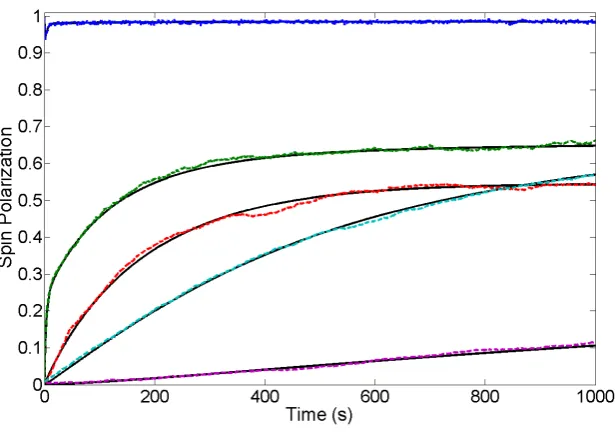
We have carried out a number of comparisons between simulations of the polarization dynamics using the quantum master equation and our proposed method that involves an adiabatic approximation procedure to obtain a master equation for the states contained in the Zeeman subspaceLZ and the use of a kinetic Monte Carlo (kMC) algorithm to calculate the polarization dynamics. As long as the parameters are chosen in accordance with the conditions described in the supplementary material, an excellent agreement between the two simulation methods is achieved. An example of such a comparison is given in fig. (3) which shows the polarization dynamics in a system containing one electron and four nuclear spins forming a coupled network. The agreement can be further improved by increasing the number of averaged trajectories for the kMC method, however this is done on the expense of further increasing the computational time. The parameters used for the simulation are summarised in the following table.
Parameter Value
Nuclei 1H
B0 3.4 T
Temperature 1 K
Number of trajectories 104
ω1 50 kHZ
nuclear X-coord. 3.51, -2.52, 5.98 -4.01 (˚A) nuclear Y-coord. 0.02, 0.03, 0.00 0.00 (˚A) nuclear Z-coord. 3.56, -4.34, -0.52 0.02 (˚A)
electron coord. -0.03, -0.01, -0.01 (˚A)
|B+| 0.935 MHz, 0.822 MHz, 92.1 kHz, 22.2 kHz A 0.318 MHz, 0.794 MHz, -0.352 MHz, -1.26 MHz d1,2, d1,3, d1,4 -0.055 kHz, -0.660 kHz, 0.048 kHz
d2,3, d2,4, d3,4 0.037 kHz, -1.040 kHz, 0.059 kHz
FIG. 3. Comparison between a simulation of the polarization dynamics during SE DNP using the quantum master equation in the full Liouville space and a simulation based on a master equation for states contained in the Zeeman subspace that was obtained by adiabatic elimination and solved by kMC. For the kMC simulation 104trajectories were averaged. The polarization dynamics is calculated for a system containing one electron (blue) and four coupled nulcei. There is excellent agreement between both simulations with the coloured lines indicating the results obtained using kMC and the black lines showing the results using the quantum master equation. The agreement can be further improved by increasing the number of averaged trajectories.
SE DNP and Spin Diffusion
To evaluate the role that the nuclear dipolar interaction plays in the distribution of the polarization within a larger ensemble of coupled nuclear spins, we have simulated the polarization buildup dynamics in a linear chain of 40 coupled spins with an electron located at one end. The individual buildup curves for the 40 nuclear spins are shown in fig. (4). The simulation parameters are listed in the following table (they are identical with the parameters used in [11]) . To investigate the role of the nuclear dipolar coefficientdkj for the distribution of the polarization within
Parameter Value
Nuclei 13C
ωI 36 MHz
Temperature 1 K
Number of trajectories 105
ω1 100 kHz
|B+|e−n1 40 kHz
|B+|e−nj>1 0 kHz
A 0 Hz
⟨d⟩ 7.45 Hz±0.82 Hz
T1e,T2e,t1n,t2n 10 ms, 10µs, 105 s, 1.25 ms
the linear spin chain, we calculated the average polarization buildup and compared it to the buildup obtained when the diplar coefficient is set to half its value for all nuclei k > 1 (fig. (4)). In further simulations we either set all dipolar coefficients to half their value or ,in addition, we decreased the pseudo-secular interaction by a factor √2. These changes of the interaction parameters are in analogy to the set of simulations carried out by Hovav et al. in Ref. [11]. In contrast to their observations, the biggest effect on the average polarization is already brought about by halving the dipolar interaction strength for all nucleik >1, indicating the importance of this interaction for the diffusive transport. Any additional changes only introduced further small decreases of the average polarization.
We then compared a simple diffusion model ∂p∂t =Dav∂
2p
∂x2, wherep(x) is the polarization field and a constant source
FIG. 4. Polarization buildup in a linear chain of 40 coupled nuclear spins with an electron located at one end. The buildup curve for each individual nucleus is shown. On the right hand we show the average polarization for the spin chain for the cases that i) all dipolar constants are given by the spacing between the individual nuclei, ii) the dipolar coupling constantsdkj are
halved for bulk nuclei, iii) the dipolar coupling constants are halved for all nuclei and iv) the dipolar couplings are halved for all nuclei and in addition the pseudo-secular interaction strength between the electron and the first nuclei is reduced by√2
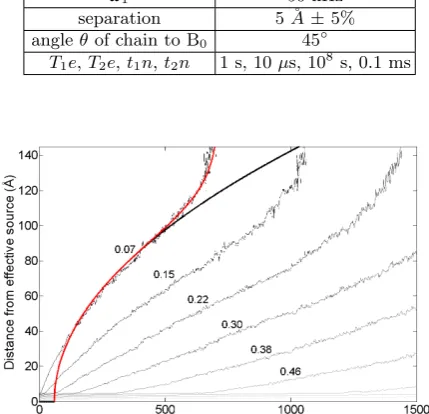
diffusion model was solved for two different boundary conditions, either with an absorbing boundary condition or a reflective boundary condition. The time course of the polarization moving through the linear spin chain is compared in fig. (5) with a contour plot derived from simulating the polarizationchanges within the linear spin chain using our method described in the main part of the paper. It is clear evident that the dynamics is reasonably well approximated by the simple diffusion model if a reflective boundary condition is used. The parameters for this simulation are provided in the following table.
Parameter Value
Nuclei 13C
B0 3.4 T
Temperature 1 K
Number of trajectories 105
ω1 50 kHz
separation 5 ˚A±5%
angleθof chain to B0 45◦
[image:13.595.198.413.427.634.2]T1e,T2e,t1n,t2n 1 s, 10µs, 108 s, 0.1 ms