1
THIS IS AN EARLIER VERSION OF THE MANUSCRIPT. FOR THE FINAL ONLINE PUBLISHED VERSION OF THE MANUSCRIPT PLESASE REFER TO:
Pellicer-Sánchez, A. (2015). Incidental learning of L2 collocations: A classroom study. Language Teaching Research. Advance online publication: DOI:
10.1177/1362168815618428.
Learning L2 collocations incidentally from reading
Ana Pellicer-Sánchez University of Nottingham Abstract
Previous studies have shown that intentional learning through explicit instruction is effective for the acquisition of collocations in a second language (L2) (e.g. Peters, 2014, 2015), but relatively little is known about the effectiveness of incidental approaches for the acquisition of L2 collocations. The present study examined the incidental acquisition of collocational knowledge when learners encounter adjective-pseudoword collocations while reading. Forty-one L2 learners read a story containing six target collocations in a classroom setting. One week after the reading they were interviewed about their
knowledge of the form, meaning and collocation of the target items (at recall and recognition levels). Participants were randomly assigned to one of two experimental groups, i.e. the 4-repetition group and the 8-repetition group. Results showed that collocational knowledge can be learnt incidentally from reading; that it is learnt at a similar rate to other lexical components such as form and meaning of individual words; and that the frequency manipulation in this study did not seem to have a significant effect on the acquisition of any of the aspects examined.
Keywords
2 I Introduction
Vocabulary is an essential component of language and it has a tendency to occur in multi-word units (Schmitt, 2010), i.e. lexical units which consist of more than one multi-word
(McCarthy, 1990). However, despite the importance of mastering knowledge of different types of multi-word units for achieving high levels of language proficiency and fluency in a second language (L2) (e.g. Boers, Eyckmans, Kappel, Stengers, Demecheleer, 2006; Granger, 1998; Stengers, Boers, Housen, Eyckmans, 2011), research into the teaching and learning of multi-word units is still scarce.
Vocabulary teaching traditionally tended to focus on individual words (Schmitt, 2010) and consequently, vocabulary learning studies also focused on examining the best
approaches to teach and learn single words. However, vocabulary instruction research has recently started to examine the acquisition of lexical items beyond the single word, and collocation has been one of the types of multi-word units examined. Mackin (1978) already noted that learners of English could learn collocations from repeated exposures in reading or by explicit teaching in the classroom. Recent studies on the learning of
collocations have indeed been conducted around these two main approaches:
3
impossibility to teach all collocations by means of explicit vocabulary activities, due to the often limited classroom time, leads to the need to explore other incidental approaches to the learning of collocations. Very few studies have examined the incidental acquisition of collocations and they have yielded somewhat conflicting results. Webb, Newton, and Chang (2013) showed that reading while listening seemed to be an effective1 method for learning L2 collocations, whereas Szudarski (2012) found that reading only did not lead to much learning of collocations. With the limited empirical evidence available so far, little is still known about how, and if, collocations can be learned incidentally from reading.
II Background
1 Knowledge of L2 collocations
4
random probability in its (textual) context” (Hoey, 1991, p. 7) and this is the type of collocations that will be examined in this study. Knowledge of collocations is one of the key components of the use of a word and “knowing a word involves knowing what words it typically occurs with” (Nation, 2001, p.56).
Previous studies have suggested that L2 learners’ knowledge of multi-word units lags behind their knowledge of single words (e.g. Bahns & Eldaw, 1993) and that, even when they produce multi-word units, they tend to overuse certain types that they know very well (e.g. Foster, 2001; Granger, 1998) and their usage is sometimes inappropriate (e.g. Nesselhauf, 2003, 2005). Regarding collocations, some studies have shown that learners tend to produce fewer collocations than native speakers in oral tasks (e.g. Serrano, Stengers, & Housen, 2015) and in writing (e.g. Laufer & Waldman, 2011), even at the more advanced levels of proficiency. “This suggests that the difficulty learners have is not only that of learning which words go together, but also learning how to employ the chunks they know” (Schmitt, 2010, p. 144). These difficulties have not only been shown in the production of collocations, but also in their processing. Even advanced learners of English seem to have poorer intuitions than native speakers regarding the frequency of collocations and seem to be slower at processing them (Siyanova & Schmitt, 2008; Siyanova-Chanturia & Spina, in press). This has led to the general impression that collocations, and other multi-word units, are particularly problematic for L2 learners and are more difficult to learn but, as Schmitt (2010) notes, research has only partially
supported this initial impression. Some other studies have in fact shown that learners’ use of collocations does not significantly differ from native speakers’ use (e.g. Siyanova & Schmitt, 2008).
5
Previous research has shown that several types of explicit teaching activities can improve learners’ knowledge of collocations. One of the types of activities previously investigated has been the use of corpus tools. Chan and Liou (2005) examined the potential of a bilingual concordancer on the learning of verb-noun collocations. The Chinese EFL learners in their study completed several online activities, some of which required them to use a concordancer and some others did not. Results showed that there was a
significant improvement of collocational knowledge after completing the activities and that the concordancing approach led to higher gains in the immediate post-test. The concordancer has also been found to be particularly effective when used with an
inductive approach, suggesting that it provides effective discovery learning possibilities (Sun & Wang, 2003).
Another type of explicit activity that has been shown to positively contribute to the learning of collocations is dictionary use. The L2 learners in Laufer’s (2011) study were given a set of sentences containing verb-noun collocations whose verb was missing, and they were asked to fill the missing verb with dictionary assistance. Results showed that the use of dictionary significantly increased collocational knowledge for the intermediate learners. However, the study also showed that sometimes the look ups resulted in the use of the wrong collocations and other times learners were not aware that the collocation was unfamiliar to them and did not seek dictionary help. This led her to conclude that awareness of collocations should be supplemented with word-focused instruction.
6
types of exercises. Not only did Webb and Kagimoto (2009) find that both productive tasks (i.e. a cloze task) and receptive tasks (i.e. reading and memorizing) improved learners’ collocational knowledge but that both types of tasks seemed to be equally beneficial, with productive tasks being more effective for learners of higher proficiency and receptive tasks for learners of lower level.
The effect of tasks which promote the noticing of form and sound patterns has been investigated in several studies. Studies have shown the effectiveness of tasks involving several types of phonemic repetition, i.e. alliteration (e.g. Lindstromberg & Boers, 2008a), and assonance (e.g. Lindstromberg & Boers, 2008b).
Laufer and Girsai (2008) compared the effectiveness of a meaning-focused instruction (i.e. reading a text and completing two communicative tasks) with two other focus-on-form approaches (i.e. reading the same text and completing text-based vocabulary tasks vs. reading the text and completing text-based translation tasks) for the learning of single words and verb-noun collocations. Results showed that the two focus-on-form groups led to the acquisition of collocations, whereas the meaning-focused instruction group learned almost no vocabulary. The contrastive analysis and translation group outperformed the other two groups in all tests.
7
word in a two-word combination. The known component of the collocation helped learners to learn the unknown component of the collocations.
This learning accruing from explicit activities appears to be affected by several
intralexical and interlexical factors: the number of collocates per node word (with higher number of collocates leading to better learning of collocations than lower number of collocates), synonymy (with higher number of synonyms having a negative effect on the learning of collocations) (Webb & Kagimoto, 2011); congruency (with congruent collocations being easier to recall than incongruent ones) (Nesselhauf, 2003) and collocate-node relationship (with adjective-noun collocations being easier to recall than verb-noun collocations) (Peters, 2015).
3 Incidental learning of L2 collocations
The majority of studies on incidental vocabulary learning have focused on the acquisition of new words from reading. Research studies in this area have shown that, although with modest gains, new words can be acquired incidentally from reading in a first language (L1) (e.g. Freebody & Anderson, 1983; Nagy, Herman, & Anderson, 1985; Saragi, Nation, & Meister, 1978) and in an L2 context (e.g. Day, Omura, & Hiramatsu, 1991; Horst, 2005; Zahar, Cobb, & Spada, 2001) and that several components, other than meaning, can be acquired from reading (e.g. Brown, Waring, & Donkaewbua, 2008; Horst, Cobb, & Meara, 1998; Pellicer-Sánchez, 2015; Pellicer-Sánchez & Schmitt, 2010; Pigada & Schmitt, 2006; Rott, 1999; Waring & Takaki, 2003; Webb, 2005, 2007a, 2007b), with different degrees of certainty of that knowledge (Pellicer-Sánchez, 2015; Wesche & Paribakht, 2000).
8
of collocations. Their EFL learners simultaneously read and listened to a modified graded reader which contained 18 verb-noun collocations. Participants read one of four versions of a graded reader, varying in the number of times the target collocations appeared, i.e. 1, 5, 10, 15. Receptive knowledge of the form of the collocations was tested in a pre-test. Immediately after the treatment session participants completed four tests measuring their receptive and productive knowledge of the form and meaning of the collocations. Results showed a significant increase in learners’ receptive knowledge of the form of the target collocations from the pre- to post-test in the four versions (27%, 33%, 55%, and 76% of the unknown items respectively). Results also showed gains in the other three measures (i.e. productive knowledge of form, productive knowledge of meaning, receptive knowledge of meaning). However, as noted by the authors, results from these three measures need to be interpreted with caution because of the lack of a pre-test of learners’ productive knowledge of these three components of lexical knowledge. What can be interpreted with certainty though, is the higher scores obtained in the receptive measures when compared to productive tests.
9
collocation form recall. However, this small improvement was not significantly different from the improvement experienced by the control group, which led him to conclude that the reading only condition did not lead to much improvement. Similarly, in a later study Szudarski and Carter (2014) examined the effectiveness of reading only (input flood condition) and reading with target words underlined (input enhancement condition) for the acquisition of verb-noun and adjective-noun collocations and found that the input flood condition did not appear to enhance learners’ knowledge.
Although with a focus on the investigation of implicit and explicit knowledge of
collocations, Sonbul and Schmitt (2013) compared the effect of reading and reading plus treatments on the learning of adjective-noun collocations. They examined three learning conditions: the enriched condition (i.e. reading a text with certain target collocations embedded three times); the enhanced condition (i.e. reading a text with embedded target collocations made salient with red, bold font); and the decontextualized condition (i.e. explicit teaching of target collocations). Results of explicit (i.e. form recall and
recognition tasks) post-tests suggested that the reading only condition, i.e. the enriched condition, led to delayed recall gains of 27 percentage points and to delayed recognition gains of 21 percentage points for L2 participants. When the target items were made salient, i.e. the enhanced condition, gains were significantly higher (form recall= 37 percentage points; form recognition= 32 percentage points).
5 The effect of frequency of exposure on incidental learning
10
(Nation & Wang, 1999; Pigada & Schmitt, 2006; Pellicer-Sánchez & Schmitt, 2010; Webb, 2007b). Results from these studies have led researchers to conclude that for considerable learning of new words from reading to take place, words need to be encountered around 8-10 times.
However, very few studies have looked at the effect of frequency on the learning of collocations. In her examination of the effect of explicit teaching activities, Peters (2014) compared the learning of items with 1, 3, and 5 exposures, and found that there was a large repetition effect (difference between 1 and 5 times) and that this effect seemed to be durable. Only a few studies have looked at the effect of repetition on the incidental
learning of collocations from reading and studies have yielded conflicting results. Durrant and Schmitt’s study (2010) highlighted the importance of repetition in establishing initial collocation memory traces. In a laboratory setting, their L2 speakers of English were exposed to adjective-noun combinations in conditions which manipulated the frequency of exposure of those items: the first group was exposed to the target collocations once in a sentence context; the second group was exposed to target collocations twice in the same sentence context (i.e. verbatim repetition); and the third group was exposed to the target collocations twice in two different sentences (i.e. varied repetition). Results showed that both repetition conditions showed better levels of recall than the single exposure group, with verbatim repetition being slightly more effective.
11
conclude that five or more encounters may be necessary to learn the form of collocations incidentally.
However, Szudarski and Carter (2014), in their comparison of input flood and input enhancement conditions, compared the acquisition of collocations appearing six times vs. those appearing 12 times in the texts and found that more encounters did not necessarily lead to better results at all levels of collocational competence.
III Aims and research questions
With the little empirical evidence available the effectiveness of reading for the incidental learning of L2 collocations is still unclear. Some of the studies reviewed in the previous section showed the effectiveness of reading for the incidental learning of L2 collocations (e.g. Sonbul & Schmitt, 2013; Webb, Newton, & Chang, 2013), whereas others
questioned this effectiveness (e.g. Szudarski, 2012). Besides, the reading treatment in Webb, Newton, and Chang (2013) was supported by audio which could have led to greater gains. Most importantly, these previous studies used real collocations as their target collocations. Although having a higher ecological validity, the use of real
collocations makes it difficult to control for prior knowledge of the collocation and of the individual components, particularly with transparent collocations. In order to overcome this limitation and eliminate the need to use pre-tests, Webb, Newton, and Chang (2013) suggested the use of pseudowords.
12
Another component of vocabulary knowledge examined in this study was the degree of certainty of responses. Subjective certainty ratings have been used in grammar research as a way of distinguishing between conscious and unconscious knowledge (Rebuschat, 2013). In vocabulary research Wesche and Paribakht (2000) found different levels of certainty in participants’ knowledge of target words appearing in text-based vocabulary activities. Pellicer-Sánchez (2015), in her investigation of vocabulary learning from reading, found that the recall aspect examined (i.e. meaning recall) was not only the most difficult to acquire but it was also the aspect with the lowest degree of certainty for both L1 and L2 participants. No previous studies have investigated this component in the acquisition of collocations.
In order to address these issues, the present study explored the acquisition of L2
collocational knowledge from reading in a classroom context. Following Webb, Newton and Chang’s (2016) recommendation, collocations containing a pseudoword were used. The study attempted to examine whether learners can acquire information about
collocates when encountering novel words in a text or whether they would focus solely on the unknown items. The following research questions were therefore addressed:
Can intermediate L2 learners acquire knowledge of the form and meaning of novel words and collocational knowledge regarding those novel words
incidentally from reading? Which aspects are easier or more difficult to acquire?
How certain are L2 learners of the knowledge of the form and meaning of novel words and of collocational knowledge regarding those novel words?
Does frequency of exposure have an effect on the incidental acquisition of collocational knowledge?
13
knowledge of the form and meaning of the pseudoword and the composition of the adjective-pseudoword collocation. Based on previous research, it was hypothesized that learners would be successful in learning the form-meaning link of some of the target pseudowords; that knowledge of the form of the collocations would be significantly more difficult to acquire than other components of lexical mastery (i.e. form and meaning of pseudowords); and that frequency of exposure would have a significant effect on this learning.
IV Methodology
1 Participants
Forty-six L2 learners of English initially participated in this study. Data from five
14
difficulties when reading the text. The lower self-score was probably due to a more cautious self-reporting style. Using the same self-rating test, the advanced learners of English in Pellicer-Sánchez’ (2015) study had a mean reading score of 9 (Min= 7; Max= 10). It was therefore hypothesized that a score of 6 would be appropriate for an
intermediate group of learners. A one-sample Wilcoxon signed ranked test (data not normally distributed) was run to determine whether participants’ self-reported reading scores were significantly different from a hypothesized median of 6. Results showed that there was no significant difference between participants’ reading scores and the
hypothesized median score of 6 (p = .263) and the null hypothesis was therefore retained. Participants were randomly assigned to one of the two treatment groups. A
Mann-Whitney U test revealed no significant difference in the self-reported reading scores of the two groups (U = 197, Z= -.36, p = .722).
2 Reading Materials
The difficulty of finding enough collocations in written texts makes researching
15
British National Corpus (determined by Lextutor (Cobb, n.d.)). This was considered adequate percentage to indicate comprehension for participants of an intermediate level of proficiency, and the suitability of the text was later confirmed by the language tutor.
In order to avoid participants going back to previously read items, which would make it difficult to control for the effect of frequency of exposure, the story was divided into 25 paragraphs, each presented in a different A3 card. A True-False comprehension test containing 12 statements assessed participants’ comprehension (from Pellicer-Sánchez, 2015).
3 Target items
The use of pseudowords as target stimuli has been a common procedure in vocabulary acquisition research with single words. Using pseudowords in studies examining the acquisition of collocations allows us to examine highly transparent collocations without having to pre-test previous knowledge of the collocation or of the constituent parts, or having to account for L1-L2 congruency, factors that are often very difficult to control for in acquisition research. Six adjective-pseudoword collocations were therefore inserted in the two versions of the story. The pseudowords, i.e. the second component of the target collocations, were taken from Pellicer-Sánchez’ (2015): holter (workhouse), berrow (bowl), bancel (criminal), cambul (ring), twoser (noise), and soters (clothes). They all replaced high-frequency (1-3K from the BNC) concrete nouns in the text. They were carefully piloted by Pellicer-Sánchez’ (2015) with both native and non-native
participants, ensuring their suitability for the study and the similar degree of
informativeness of the contexts in which target words were embedded. In order to select the first component, i.e. a real, high frequent adjective, a list of the most frequent
16
selected. All adjectives selected were within the twenty most frequent collocates of each noun and they all belonged to the first 2,000 most frequent words in the British National Corpus. This resulted in the following adjective-pseudoword collocations: old holter (old workhouse), small berrow (small bowl), dangerous bancel (dangerous criminal), magic cambul (magic ring), loud twoser (loud noise), and dirty soters (dirty clothes).
The target items were distributed throughout the story ensuring a balanced distribution. A maximum of two pseudowords appeared in any one paragraph.
4 Measurement instruments
A combination of paper and pencil and interview tests were used to measure participants’ knowledge of the pseudoword and their collocates. The first three tests were taken from Pellicer-Sánchez (2015) and assessed learners’ knowledge of the pseudowords. The first test assessed participants’ ability to recognize the correct form of the target pseudowords among five options provided (the correct form, three distracters, and an “I don’t know” option). The second test assessed participants’ ability to recall the meaning of the
17 5 Procedure
The reading session took place in two intermediate English language classes during normal class time. At the beginning of the session participants completed a language background questionnaire and signed the consent forms. The reading activity was then explained by the researcher. Each learner was randomly given Version A or B of the story. Participants were not aware of the differences between the two versions. They were instructed to read individually for general comprehension and to read the A3 cards one by one, without going back to previously read sections of the story. After reading the story, learners completed the comprehension questions individually.
18 V Results
Results of the comprehension test showed adequate comprehension of the text (M= 11.20, SD= 1.2, Min= 7; Max= 12).
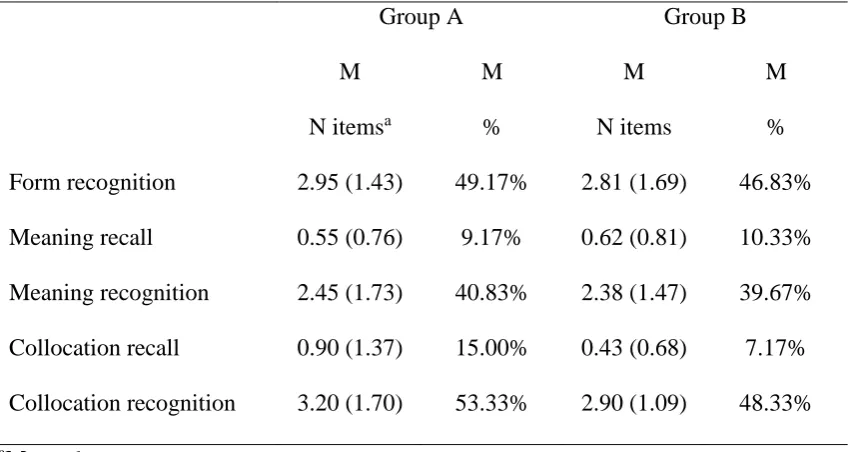
To answer the first research question, a non-parametric Friedman test (data not normally distributed) was conducted to examine participants’ performance in the five post-tests (see Table 1). Results showed that there was a significant difference across the scores of the five tests of Group A (participants exposed to the adjective-pseudoword collocations eight times) (χ 2 (5, n = 20) = 66.78, p < .001). Post-hoc analyses with Wilcoxon signed-rank tests were conducted with Bonferroni correction applied (p < .005) and results showed that Group A participants’ ability to recall the meaning of the pseudowords was significantly lower than their ability to recognize the form of the pseudowords (Z = -3. 86, p < .001, r = .86), their ability to recognize the meaning (Z = -3.56, p < .001, r = .79), and their ability to recognize the correct collocate (Z = -3.97, p < .001, r = .89). Similarly, participants’ ability to recall the correct collocate of the pseudowords was significantly lower than their ability to recognize the form of the pseudoword (Z = -.3.70, p < .001, r = .83), their ability to recognize the meaning of the pseudoword (Z= -3.44, p = .001, r = .77), and their ability to recognize the correct collocate (Z = -3.96, p < .001, r = .89). The effect sizes are large, according to Cohen’s (1988) criteria and medium-large according to Plonsky and Oswald’s (2014) recently suggested more conservative criteria.
Results of the Friedman test with scores of Group B (participants exposed to the pseudowords eight times and to the adjective-pseudoword collocation four times) also showed that there was a significant difference across the scores of the five tests (χ 2 (5, n = 21) = 68.16, p < .001). Post-hoc analyses with Wilcoxon signed-rank tests were
19
than their ability to recognize their form (Z = -3.75, p < .001, r = .82), their ability to recognize the meaning of the pseudowords (Z = -3.72, p < .001, r = .81), and their ability to recognize the correct collocate of the pseudoword (Z = -4.05, p< .001, r = .99).
Participants’ ability to recall the correct collocate was significantly lower than their ability to recognize the form of the pseudoword (Z = -3.75, p < .001, r = .82), their ability to recognize their meaning (Z = -3.76, p < .001, r = .82), and their ability to recognize the correct collocate (Z = -4.04, p < .001, r = .88), with large effect sizes according to
Cohen’s (1988) criteria and medium-large according to Plonsky and Oswald’s (2014) criteria.
[INSERT TABLE 1 HERE]
Overall, as expected, recall aspects were significantly more difficult to acquire than recognition aspects for both groups. No significant differences were found among the three recognition aspects or the two recall aspects. Recalling the collocate of a word was not significantly more difficult than recalling the meaning of the new lexical items. Similarly, learners’ ability to recognize the correct meaning of the pseudoword was not significantly better than the ability to recognize the correct collocate. Knowledge of the form of collocations does not seem to be significantly more difficult to acquire than knowledge of the form-meaning link of novel words. The comparison between meaning and collocation recognition scores should be treated with caution, since the difficulty of these tests depends on the distracters included.
20
high collocation recognition scores. The correlation coefficient was large according to Cohen’s (1988) criteria and medium-large according to Plonsky and Oswald’s (2014) criteria.
[INSERT TABLE 2 HERE]
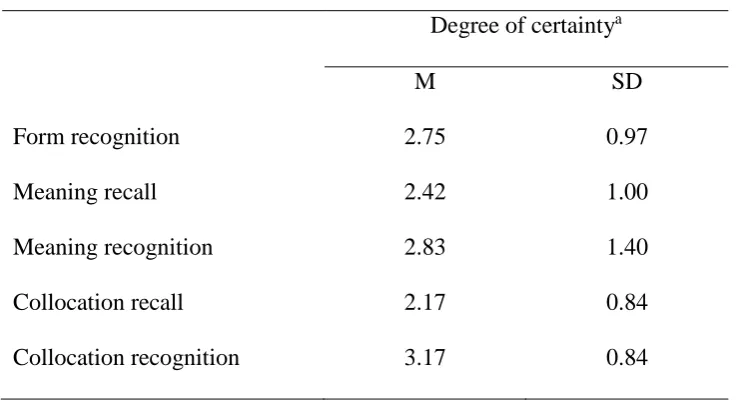
21 [INSERT TABLE 3 HERE]
In response to the first and second research questions, results of this study showed that intermediate L2 learners of English were able to acquire knowledge of the form-meaning link of the unknown pseudowords and of the form of the collocations of those unknown lexical items, with participants in both groups learning around 40.50% of the six items at the recognition level and around 10% at the recall level. Results also showed that recall aspects were more difficult to acquire than recognition aspects and that knowledge of the form of collocations does not seem to be more difficult to acquire incidentally than the other components examined. Results also suggested that overall, participants’ certainty of their ability to recognize the correct form of the collocation was significantly higher that most of the other aspects examined.
In order to answer the third research question and determine whether frequency of exposure has an effect on the incidental acquisition of collocational knowledge, non-parametric Mann Whitney U tests between each of the measures for Group A and Group B were conducted. Results showed that there were no significant differences between the two groups in any of the post-reading tests (Form recognition: U = 207.50, Z = -.07, p = .95, r = .01; Meaning recall: U = 199.50, Z = -.31, p = .76, r = .05; Meaning recognition: U = 209.00, Z = -.027, p = .98, r = .004; Collocation recall: U = 172.50, Z = -1.11, p = .27, r = .02; Collocation recognition: U = 203.00, Z = -.19, p = .85, r = .03). The lack of difference between the acquisition of meaning and form was expected, due to the same number of exposures to the pseudowords in both groups. However, despite the different number of exposures to the collocates, results showed no significant differences in the acquisition of collocational knowledge by the two groups.
22
In response to the first research question, results of this study support previous research demonstrating the effectiveness of reading for the incidental learning of the form and meaning of unknown single words (e.g. Brown, Waring, & Donkaewbua, 2008; Horst, Cobb, & Meara, 1998; Pellicer-Sánchez, 2015; Pellicer-Sánchez & Schmitt, 2010; Pigada & Schmitt, 2006; Rott, 1999; Waring & Takaki, 2003; Webb, 2005, 2007a, 2007b). Results also indicate that reading can lead to the improvement of learners’ knowledge of the form of collocations, with participants recalling on average 11% and recognizing 50.5% of the collocates. This supports and expands results of Webb, Newton and Chang (2013), suggesting that a reading only treatment can also lead to the acquisition of
collocations. Although these two studies had different frequency groups, a comparison of the most similar frequency groups shows similar results, considering that they looked at different types of items. The 48% of collocations that participants in this study were able to recognize after eight exposures is similar to the 33% figure in the five exposures group in Webb, Newton, and Chang. Similarly, the 53% of collocations that participants in this study were able to recognize after eight exposures is similar to the 55% of collocations recognized after ten exposures. Results are even more encouraging considering that Webb, Newton, and Chang had immediate post-test whereas the post-tests in this study were conducted one week after the treatment. The collocation recognition scores in this study are higher than those in Sonbul and Schmitt (2013) (21 percentage points) but the recall scores are lower (27 percentage points).
23
reason might lie in the fact that, as shown by Kasahara (2011), the nature of the collocations explored in the present study, i.e. known adjective-unknown noun, might have supported the learning process. It is important to note that this comparison of learning gains in different studies needs to be treated with caution due to the different number of target items in each of these studies and the differences in the length of the reading treatments.
Not surprisingly, results have also shown that receptive aspects of the form of
collocations are more easily enhanced than recall aspects, in line with other single word studies (e.g. Brown et al., 2008; Pellicer-Sanchez, in-press; Pellicer-Sánchez & Schmitt, 2010; Webb, 2005, 2007a, 2007b) and other collocation studies (e.g. Peters, 2015; Szudarski, 2012; Webb, Newton, & Chang, 2013). Findings also suggest that receptive aspects of the form of collocations are not only easier to acquire than productive ones but learners are also more certain about this knowledge. Within the recognition components examined in this study, results have also shown that learners are more certain about their ability to recognize the correct collocate of a word than their ability to recognize the form or the meaning of a novel word, providing further evidence that acquiring knowledge of the form of a collocation may not be intrinsically more difficult than other components of lexical mastery.
24
information about what words tend to co-occur together and any problems in their
knowledge might be due to inadequate input (Durrant & Schmitt, 2010). Collocations are more frequent in spoken discourse than in written discourse, and the amount of exposure to authentic spoken discourse that most EFL learners receive is often very limited (Shin & Nation, 2008). The likelihood of encountering the same collocations several times in the same text is very small (Boers & Lindstromberg, 2009; Boers, Demecheleer, et al., 2014) and collocations in EFL textbooks do not recur enough for the learner to
consolidate collocational knowledge (Tsai, 2014). The difficulty in the acquisition of collocations might not therefore lie in their intrinsic nature but in the difficulty of encountering collocations sufficient times and in a relatively short period of time in the kind of spoken and written texts that learners are usually exposed to.
Contrary to the initial hypothesis, the frequency manipulation in this study (eight vs. four exposures) did not have a significant effect on the learning of the form of collocations. This might suggest that for a significant effect of frequency to occur in an only reading treatment, items need to appear more frequently. This is contrary to results of Webb, Newton and Chang (2013) who found significant differences between five and ten encounters in a reading while listening condition. However, this lack of effect of frequency is in line with other recent studies which have claimed that the effect of frequency is more complex than we thought and that other factors may determine the effect of frequency, both with the acquisition of single words (e.g. Laufer & Rozovski-Roitblat, 2014; Webb & Chang, 2014) and with collocations (e.g. Szudarski & Carter, 2014).
Knowing that the explicit teaching of collocations can be expanded and supported by learning outside the classroom or by classroom reading activities which do not
25
Approach who believe that teachers should not spend time teaching lexical chunks but raising students’ awareness of the importance of phraseology so that they are more inclined to attend to multi-word units outside the classroom and can learn them incidentally (Boers & Lindstromberg, 2009). The results of this study have therefore suggested that this is possible. However this assumption is based on an analogy with L1 learning and, as Boers and Lindstromberg (2009) claim, lexical chunks occur relatively infrequently in the written or spoken discourse learners are exposed to and even when they occur, learners may fail to notice them in the input. They therefore suggest the use of techniques which could make learners notice and pay attention to those lexical chunks in the input, e.g. highlighting or glossing, suggesting what they call a ‘semi-incidental acquisition’ approach. They define this approach as acquisition that still happens as a by-product of a meaning-oriented activity but in which materials are manipulated or
designed to stimulate learners’ paying attention to these items. If we want to ensure that learners are exposed to collocations, and other types of multi-word units, sufficient number of times to lead to a considerable uptake, materials should therefore be modified to ensure this repeated exposure. As Webb, Newton, and Chang (2013) propose, unless reading materials are designed to ensure sufficient exposure to collocations, the potential for learning the majority of collocations incidentally is small. Graded readers and reading texts in textbooks should therefore consider this as a key design principle so that we can maximize the potential of learning collocations incidentally both in and outside the classroom.
VI Limitations and Future Directions
26
learning the form of the collocation (Webb, Newton & Chang, 2013). On the contrary, other researchers have suggested that having multi-word units made up of unknown words might make the words more noticeable and may result in greater learning (e.g. Boers & Lindstromberg, 2009). In addition, as Kasahara (2011) showed, the known component of the collocation might have positively influenced the learning of the
pseudoword. Future research should compare the incidental learning of collocations made up of unknown items with comparable collocations made up of known items.
The pseudowords in this study replaced high frequency words, as opposed to low
frequency real words as it is the case in other studies. As Pellicer-Sánchez (2015) argued, results of the study are representative of those situations in which learners learn another L2 label for a concept for which they already have an L2 word, but not of those different learning contexts in which learners learn an L2 word for an L1 concept for which they do not have an L2 word yet.
In addition, the adjectives selected for the collocations were frequent collocates of the real nouns that the pseudowords replaced. The possible association in the learners’ mental lexicon of the adjective and the substituted noun might have influenced post-test
performance. This transfer of knowledge of the noun collocation to adjective-pseudoword might explain the strong correlation found between participants’
performance on the word-meaning and the collocation tests. Future studies should be conducted with adjectives that are less frequent collocates of the real nouns substituted.
27
the learning of the pseudoword. Future research should look at the acquisition of collocations with different levels of transparency.
Regarding the measures used, it is important to note that being exposed to the meaning of the pseudowords in the third test, i.e. meaning recognition, might have influenced the responses in the two collocation tests, particularly in the collocation recognition test, although distracters were carefully designed to make them all possible candidates.
Although all participants in this study had been placed at an intermediate level in the school and there were not significant differences in the self-rated reading scores between the two experimental groups, the use of a more generalized measure of proficiency would have allowed for a more in depth investigation of the role of proficiency and vocabulary knowledge on the learning gains in the study.
VII Conclusion
The results of the present study suggest that knowledge of the form of collocations can be acquired incidentally from reading, and that it seems to be acquired at a rate similar to that of other components of lexical mastery, i.e. form and meaning of single words. This study, however, can only explain the acquisition of this particular type of two-word combinations. Given the multifarious nature of collocations, further research needs to be conducted with different types of collocations so that we can reach a clearer
understanding of the effectiveness of reading for the incidental acquisition of collocations.
Acknowledgements
I would like to thank Elizabeth Stewart for her help with data collection. Declaration of conflicting interest
28
1 Effectiveness is understood in this paper as leading to significant learning gains.
2 See Pellicer-Sánchez (2015) for a detailed explanation of reading materials, target items, and their piloting.
References
Altenberg, B. & Granger, S. (2001). The grammatical and lexical patterning of make in native and non-native student writing. Applied Linguistics, 22, pp.173-195.
Bahns, J., & Eldaw, M. (1993). Should we teach EFL students collocations? System, 21, 101–114.
Boers, F., Demecheleer, M., Coxhead, A., & Webb, S. (2014). Gauging the effects of exercises on verb-noun collocations. Language Teaching Research, 18(1), 54–74. Boers, F., Eyckmans, J., Kappel, J., Stengers, H., & Demecheleer, M. (2006). Formulaic
sequences and perceived oral proficiency: Putting a lexical approach to the test. Language Teaching Research, 10, 245-261.
Boers, F., Eyckmans, J., & Lindstromberg, S. (2014). The effect of discrimination task on L2 learners’ recall of collocations and compounds. International Journal of Applied Linguistics, 24(3), 357-369.
Boers, F. & Lindstromberg, S. (2009). Optimizing a lexical approach to instructed language acquisition. Palgrave Macmillan: Basingstoke, UK,
Brown, R., Waring, R., & Donkaewbua, S. (2008). Incidental vocabulary acquisition from reading, reading-while-listening, and listening. Reading in a Foreign Language, 20, 136–63.
29
Cohen, J. W. (1988). Statistical power analysis for the behavioural sciences (2ndedn.). Hillsdale, NJ: Lawrence Erlbaum Associates.
Cowie, A. P. (1994). Phraseology. In R. E. Asher (Ed.), The Encyclopedia of Language and Linguistics (pp. 3168-3171). Oxford: Pergamon.
Day, R. R., Omura, C., & Hiramatsu, M. (1991). Incidental EFL vocabulary learning and reading. Reading in a Foreign Language, 7, 541-551.
Durrant, P. & Schmitt, N. (2010). Adult learners’ retention of collocations from exposure. Second Language Research, 26(2), 163-188.
Ellis, R. (1999). Learning a second language through interaction. Amsterdam: John Benjamins.
Foster, P. (2001). Rules and routines: A consideration of their role in the task-based language production of native and non-native speakers. In M. Bygate, P. Skehan, & M. Swain (Eds.), Researching pedagogic tasks: Second language learning, teaching, and testing (pp. 75-93). Harlow: Longman.
Freebody, P., & Anderson, R. (1983). Effects of vocabulary difficulty, text cohesion, and schema availability on reading comprehension. Reading Research Quarterly,18, 277-294.
Granger, S. (1998). Prefabricated patterns in advanced EFL writing: Collocations and formulae. In Cowie, A. P. (ed.), Phraseology: Theory, Analysis, and Applications (pp.145-160). Oxford: Oxford University Press.
Halliday, M. A. K. (1961). Categories of the theory of grammar. Word, 17, 241-292. Hoey, M. (1991). Patterns of lexis in text. Oxford: Oxford University Press.
Horst, M. (2005). Learning L2 vocabulary through extensive reading: A measurement study. The Canadian Modern Language Review, 61, 355–382.
30
Howarth, P. (1998). Phraseology and second language proficiency. Applied Linguistics, 19(1), 24-44.
Kasahara, K. (2010). Are two words better than one for intentional vocabulary learning? Annual Review of English Language Education in Japan, 21, 111-120.
Kasahara, K. (2011). The effect of known-and-unknown word combinations on intentional vocabulary learning. System, 39, 491-499.
Laufer, B. (2011). The contribution of dictionary use to the production and retention of collocations in a second language. International Journal of Lexicography, 24(1), 29-49.
Laufer, B. & Girsai, N. (2008). Form-focused instruction in L2 vocabulary learning. Applied Linguistics, 29(4), 694–716.
Laufer, B. & Rozovski-Roitblat, B. (2015). Retention of new words: Quantity of
encounters, quality of task, and degree of knowledge. Language Teaching Research, 19(6), 687-711.
Laufer, B. & Waldman, T. (2011). Verb-noun collocations in second language writing: A corpus analysis of learners’ English. Language Learning, 61, 647-672.
Lewis, M. (2000). Teaching collocation: further developments in the lexical approach. Hove: Language Teaching Publications.
Lindstromberg, S. & Boers F. (2008a). The mnemonic effect of noticing alliteration in lexical chunks. Applied Linguistics 29(2), 200-222.
Lindstromberg, S. & Boers, F. (2008b). Phonemic repetition and the learning of lexical chunks: The power of assonance. System, 36, 423-436.
Mackin, R. (1978). On collocations: ‘Words shall be known by the company they keep’. In P. Strevens (ed.), In honour of A. S. Hornby (pp. 149-165). Oxford: Oxford University Press.
31
Nagy, W., Herman, P., & Anderson, R. (1985). Learning words from context. Reading Research Quarterly, 20, 233-253.
Nation, I. S. P. (2001). Learning Vocabulary in Another language. Cambridge: Cambridge University Press.
Nation, I. S. P., & Wang, K. (1999).Graded readers and vocabulary. Reading in a Foreign Language, 12, 355–380.
Nesselhauf, N. (2003). The use of collocations by advanced learners of English and some implications for teaching. Applied Linguistics, 24(2), 223-242.
Nesselhauf, N. (2005). Collocations in a learner corpus. Amsterdam: John Benjamins. Pellicer-Sánchez, A. (2015). Incidental L2 vocabulary acquisition from and while
reading: An eye-tracking study. Studies in Second Language Acquisition, available on CJO2015. doi:10.1017/S0272263115000224.
Pellicer-Sánchez, A., & Schmitt, N. (2010). Incidental Vocabulary Acquisition from an Authentic Novel: Do things fall apart? Reading in a Foreign Language, 22(1), 31-55. Peters, E. (2014). The effects of repetition and time of post-test administration on EFL
learners’ form recall of single words and collocations. Language Teaching Research, 18(1), 75-94.
Peters, E. (2015). The learning burden of collocations: The role of interlexical and intralexical factors. Language Teaching Research, 1-26.
Pigada, M., & Schmitt, N. (2006). Vocabulary acquisition from extensive reading: A case study. Reading in a Foreign Language, 18(1), 1-28.
Plonsky, L. & Oswald, F. L. (2014). How big is “Big”? Interpreting effect sizes in L2 research. Language Learning, 64(4), 878-912.
Rebuschat, P. (2013). Measuring implicit and explicit knowledge in second language research. Language Learning, 63, 595-626.
32
incidental vocabulary acquisition through reading. Studies in Second Language Acquisition, 21, 589-619.
Saragi, T., Nation, I. S. P., & Meister, F. (1978). Vocabulary learning and reading. System, 6, 72–78.
Schmitt, N. (2010). Researching vocabulary: A vocabulary research manual. London: Palgrave Macmillan.
Serrano, R., Stengers, H., & Housen, A. (2015). Acquisition of formulaic sequences in intensive and regular EFL programmes. Language Teaching Research, 19(1), 89-106.
Shin, D., & Nation, I. S. P. (2008). Beyond single words: The most frequent collocations in spoken English. ELT Journal, 64, 339–348.
Sinclair, J. (1991). Corpus, concordance, collocation: Describing English Language. Oxford: Oxford University Press.
Siyanova, A. & Schmitt, N. (2008).L2 learner production and processing of collocation: A multi-study perspective. The Canadian Modern Language Review, 64(3), 429– 458.
Siyanova-Chanturia, A. & Spina, S. (in press, 2015). Investigation of native speaker and second language learner intuition of collocation frequency. Language Learning, 65(3).
Sonbul. S. & Schmitt, N. (2013). Explicit and Implicit lexical knowledge: Acquisition of collocations under different input conditions. Language Learning, 63(1), 121-159. Stengers, H., Boers, F., Housen, A., & Eyckmans, J. (2011). Formulaic sequences and L2
33
Sun, Y. C., & Wang, L. Y. (2003). Concordancers in the EFL classroom: Cognitive approaches and collocation difficulty. Computer Assisted Language Learning, 16, 83-94.
Szudarski, P. (2012). Effects of Meaning- and Formed-Focused instruction on the acquisition of verb-noun collocations in L2 English. Journal of Second Language Teaching and Research, 1(2), 3-37.
Szudarski, P. & Carter, R. (2014). The role of input flood and input enhancement in EFL learners’ acquisition of collocations. International Journal of Applied Linguistics, available on doi: 10.1111/ijal.12092.
Tsai, K. (2014). Profiling the collocation use in ELT textbooks and learner writing. Language Teaching Research, 1-18.
Waring, R., & Takaki, M. (2003). At what rate do learners learn and retain new
vocabulary from reading a graded reader? Reading in a Foreign Language, 15, 130– 63.
Webb, S. (2005). Receptive and productive vocabulary learning: The effect of reading and writing on word knowledge. Studies in Second Language Acquisition, 27(1), 33-52.
Webb, S. (2007a). Learning word pairs and glossed sentences: The effects of a single context on vocabulary learning. Language Teaching Research, 11(1), 63-81. Webb, S. (2007b). The effects of repetition on vocabulary knowledge. Applied
Linguistics, 28, 46–65.
Webb, S. & Chang, A. (2015). Second language vocabulary learning through extensive reading with audio support: How do frequency and distribution of occurrence affect learning? Language Teaching Research, 19(6), 667-686.
34
Webb, S. & Kagimoto, S. (2011). Learning Collocations: Do the number of collocates, position of the node word, and synonymy affect learning? Applied Linguistics, 32(3), 259-276.
Webb, S., Newton, J., & Chang, A. (2013). Incidental learning of collocation. Language Learning, 63(1), 91-120.
Wesche, M. & Paribakht, S. (2000). Reading-based exercises in second language
vocabulary learning: An introspective study. Modern Language Journal, 84, 196-213.
Wray, A. (2002). Formulaic language and the lexicon. Cambridge: Cambridge University Press.
35 Appendices
Test 1- Form recognition
Choose the right spelling for the following six words that have appeared in the story (Only one is correct) and indicate in the scale on the right how certain you are of your response. Example:
a) ackol b) acklon c) hacklon d) hackol 1. a) hotler b) holter c) houter d) houler 1 2 3 4 2. a) twoser b) twonse c) twiser d) twines 1 2 3 4 3. a) borreu b) berrou c) berrow d) borrew 1 2 3 4 4. a) bancel b) bansel c) blancel d) blansel 1 2 3 4 5. a) cambule b) cambuel c) cambeul d) cambul 1 2 3 4 6. a) solers b) soters c) sorels d) sorets 1 2 3 4
Test 3-Meaning recognition
Select one of the five options. Only one is the correct definition. If you don’t know the meaning of the word, please select option “e”. For each response indicate how certain you are of your response (1-4).
1) holter a) basement b) workhouse c) prison
d) food hall e) I don’t know. 2) twoser
a) story b) punishment c) noise d) game
e) I don’t know
3) berrow
a) market b) bowl c) entrance d) bottle e) I don’t know 4) bancel
a) orphan b) prisoner c) worker d) chief
36 5) cambul a) picture b) plate c) window d) ring
e) I don’t know.
6) soters
a) shoes b) clothes c) dishes d) tools
e) I don’t know.
Test 5- Collocation recognition
Try to fill the blanks with the word that you think appeared frequently in the story before the words in bold. Select one of the five options. Only one is the correct option. If you don’t know the meaning of the word, please select option “e”.
1) They lived in a/an _____ holter a) small
b) old c) poor
d) dirty
e) I don’t know.
2) They heard a/an _____ twoser a) big
b) huge c) loud d) bad
e) I don’t know
3) They ate in a/an _____ berrow a) small
b) slight c) tiny d) little
e) I don’t know
4) He was treated like a/an _____ bancel a) poor
b) serious c) angry d) dangerous e) I don’t know.
5) His mother gave him a/an _____ cambul a) secret
b) magic c) old d) lucky
e) I don’t know. 6) The had to wear _____ soters
a) old b) dirty c) small d) poor
37 Tables
Table 1
Post reading vocabulary test scores
Group A Group B
M N itemsa
M %
M N items
[image:37.595.86.511.168.394.2]M % Form recognition 2.95 (1.43) 49.17% 2.81 (1.69) 46.83% Meaning recall 0.55 (0.76) 9.17% 0.62 (0.81) 10.33% Meaning recognition 2.45 (1.73) 40.83% 2.38 (1.47) 39.67% Collocation recall 0.90 (1.37) 15.00% 0.43 (0.68) 7.17% Collocation recognition 3.20 (1.70) 53.33% 2.90 (1.09) 48.33% aMax= 6
Table 2
Non-parametric correlations between meaning and collocation components of lexical
mastery
Collocation recall Collocation recognition rs Sig. (2-tailed) rs Sig. (2-tailed)
Meaning recognition .452 .003* .571 .000*
Meaning recall .122 .245 .528 .000*
38 Table 3
Degree of certainty scores
Degree of certaintya
M SD
Form recognition 2.75 0.97
Meaning recall 2.42 1.00
Meaning recognition 2.83 1.40
Collocation recall 2.17 0.84
Collocation recognition 3.17 0.84