Towards cross-lingual distributed representations without parallel text
trained with adversarial autoencoders
Antonio Valerio Miceli Barone
The University of Edinburgh Informatics Forum, 10 Crichton Street
Edinburgh
Abstract
Current approaches to learning vector rep-resentations of text that are compatible be-tween different languages usually require some amount of parallel text, aligned at word, sentence or at least document level. We hypothesize however, that different natural languages share enough semantic structure that it should be possible, in prin-ciple, to learn compatible vector represen-tations just by analyzing the monolingual distribution of words.
In order to evaluate this hypothesis, we propose a scheme to map word vectors trained on a source language to vectors se-mantically compatible with word vectors trained on a target language using an ad-versarial autoencoder.
We present preliminary qualitative results and discuss possible future developments of this technique, such as applications to cross-lingual sentence representations.
1 Introduction
Distributed representations that map words, sen-tences, paragraphs or documents to vectors real numbers have proven extremely useful for a va-riety of natural language processing tasks (Bengio et al., 2006; Collobert and Weston, 2008; Turian et al., 2010; Maas et al., 2011; Mikolov et al., 2013b; Socher et al., 2013; Pennington et al., 2014; Levy and Goldberg, 2014; Le and Mikolov, 2014; Ba-roni et al., 2014; Levy et al., 2015), as they provide an effective way to inject into machine learning models general prior knowledge about language automatically obtained from inexpensive unanno-tated corpora. Based on the assumption that dif-ferent languages share a similar semantic
struc-ture, various approaches succeeded to obtain dis-tributed representations that are compatible across multiple languages, either by learning mappings between different embedding spaces (Mikolov et al., 2013a; Faruqui and Dyer, 2014) or by jointly training cross-lingual representations (Klementiev et al., 2012; Hermann and Blunsom, 2013; Chan-dar et al., 2014; Gouws et al., 2014). These ap-proaches all require some amount of parallel text, aligned at word level, sentence level or at least document level, or some other kind of parallel re-sources such as dictionaries (Ammar et al., 2016). In this work we explore whether the assumption of a shared semantic structure between languages is strong enough that it allows to induce compati-ble distributed representations without using any parallel resource. We only require monolingual corpora that are thematically similar between lan-guages in a general sense.
We hypothesize there exist a suitable vectorial space such that each language can be viewed as a random process that produces vectors at some level of granularity (words, sentences, paragraphs, documents) which are then encoded as discrete surface forms, and we hypothesize that, if lan-guages are used to convey thematically similar in-formation in similar contexts, these random pro-cesses should be approximately isomorphic be-tween languages, and that this isomorphism can be learned from the statistics of the realizations of these processes, the monolingual corpora, in prin-ciple without any form of explicit alignment.
We motivate this hypothesis by observing that humans, especially young children, who acquire multiple languages, can often do so with rela-tively little exposure to explicitly aligned paral-lel linguistic information, at best they may have access to distant and noisy alignment information in the form of multisensorial environmental clues. Nevertheless, multilingual speakers are always
tomatically able to translate between all the lan-guages that they can speak, which suggests that their brain either uses a shared conceptual repre-sentations for the different surface features of each language, or uses distinct but near-isomorphic rep-resentations that can be easily transformed into each other.
2 Learning word embedding cross-lingual mappings with adversarial autoencoders
The problem of learning transformations between probability distributions of real vectors has been studied in the context of generative neural net-work models, with approaches such as Genera-tive Moment Matching Networks (GMMNs) (Li et al., 2015) and Generative Adversarial Networks (GANs) (Goodfellow et al., 2014). In this work we consider GANs, since their effectiveness has been demonstrated in the literature more thoroughly than GMMNs.
In a typical GAN, we wish to train a genera-tormodel, usually a neural network, to transform samples from a known, easy to sample, uninfor-mative distribution (e.g. Gaussian or uniform) into samples distributed according to a target distribu-tion defined implicitly by a training set. In order to do so, we iteratively alternate between training a differentiablediscriminatormodel, also a neural network, to distinguish between training samples and artificial samples produced by the generator, and training the generator to fool the discriminator into misclassifying the artificial examples as train-ing examples. This can be done with conventional gradient-based optimization because the discrim-inator is differentiable thus it can backpropagate gradients into the generator.
It can be proven that, with sufficient model capacity and optimization power, sufficient en-tropy (information dimension) of the generator in-put distribution, and in the limit of infinite train-ing set size, the generator learns to produce sam-ples from the correct distribution. Intuitively, if there is any computable test that allows to dis-tinguish the artificial samples from the training samples with better than random guessing prob-ability, then a sufficiently powerful discriminator will eventually learn to exploit it and then a suffi-ciently powerful generator will eventually learn to counter it, until the generator output distribution becomes undistinguishable from the true training
Generator Source
embedding Transformedembedding
OR Target
embedding
Discriminator
Adversarial prediction
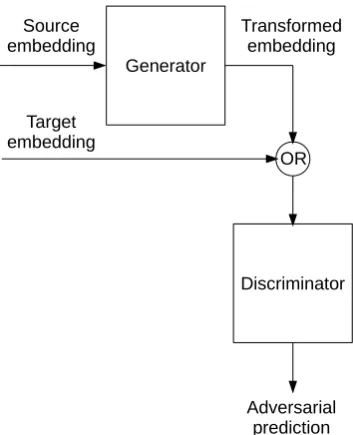
Figure 1: Generative adversarial network for cross-lingual embedding mapping
distribution. In practice, actual models have fi-nite capacity and gradient-based optimization al-gorithms can become unstable or stuck when ap-plied to this multi-objective optimization problem, though hey have been successfully used to gener-ate fairly realistic-looking images (Denton et al., 2015; Radford et al., 2015).
In our preliminary experiments we attempted to adapt GANs to our problem, by training the gen-erator to learn a transformation between word em-beddings trained on different languages (fig. 1). Let d be the embedding dimensionality, GθG :
Rd → Rd be the generator parametrized by
θG, DθD : Rd → [0,1] be the discriminator parametrized byθD.
At each training step:
1. draw a sample{f}nofnsource embeddings, according to their (adjusted) word frequen-cies
2. transform them into target-like embeddings
{ˆe}n=GθG({f}n)
3. evaluate them with the discriminator, esti-mating their probability of having been sam-pled from the true target distribution{p}n =
DθD({ˆe})
4. update the generator parameters θG to re-duce the average adversarial loss La =
[image:2.595.309.486.62.280.2]5. draw a sample{e}n ofntrue target embed-dings
6. update the discriminator parametersθDto re-duce its binary cross-entropy loss on the clas-sification between{e}n (positive class) and
{ˆe}(negative class)
repeat these steps until convergence.
Unfortunately we found that in this setup, even with different network architectures and hyperpa-rameters, the model quickly converges to a patho-logical solution where the generator always emits constant or near-constant samples that somehow can fool the discriminator. This appears to be an extreme case of the know mode-seeking issue of GANs (Radford et al., 2015; Theis et al., 2015; Salimans et al., 2016), which is probably exac-erbated in our settings because of the point-mass nature of our probability distributions where each word embedding is a mode on its own.
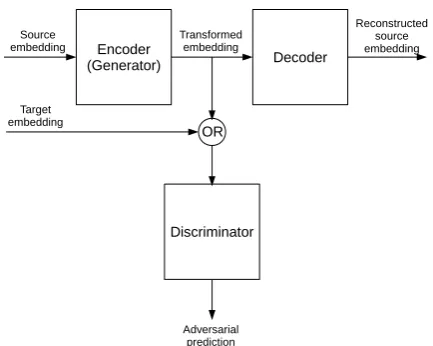
In order to avoid these pathological solutions, we needed a way to penalize the generator for destroying too much information about its input. Therefore we turned our attention to Adversarial Autoencoders (AAE) (Makhzani et al., 2015). In an AAE, the generator, now called encoder, is paired with another model, the decoder RθR :
Rd → Rdparametrized byθR which attempts to transform the artificial samples emitted by the en-coder back into the input samples. The enen-coder and the decoder are jointly trained to minimize a combination of the average reconstruction loss
Lr({f}n, RθR(GθG({f}n))) and the adversarial loss defined as above. The discriminator is trained as above. In the original formulation of the AAE, the discriminator is used to enforce a known prior (e.g. Gaussian or Gaussian mixture) on the inter-mediate, latent representation, in our setting in-stead we use it to match the latent representation to the target embedding distribution so that the en-coder can be used to transform source embeddings into target ones (fig. 2).
In our experiments, we use the cosine dissim-ilarity as reconstruction loss, and as a further penalty we also include the pairwise cosine dis-similarity between the generated latent samples
{ˆe}and the true target samples{e}n. Therefore, the total loss incurred by the encoder-decoder at each step is
LGR = λrLr({f}n, RθR(GθG({f}n))) −
λalog({p}n) +λcLr({e}n, GθG({f}n))
Encoder (Generator)
Source embedding
Transformed embedding
OR
Target embedding
Discriminator
Adversarial prediction
Decoder
Reconstructed source embedding
Figure 2: Adversarial autoencoder for cross-lingual embedding mapping (loss function blocks not shown).
whereλr, λaandλcare hyperparameters (all set equal to 1 in our experiments).
3 Experiments
We performed some preliminary exploratory ex-periments on our model. In this section we report salient results.
The first experiment is qualitative, to assess whether our model is able to learn any semanti-cally sensible transformation at all. We consider English to Italian embedding mapping.
We train English and Italian word embeddings on randomly subsampled Wikipedia corpora con-sisting of about 1.5 million sentences per lan-guage. We use word2vec (Mikolov et al., 2013b) in skipgram mode to generate embeddings with di-mension d = 100. Our encoder and decoder are linear models with tied matrices (one the trans-pose of the other), initialized as random orthog-onal matrices (we also explored deep non-linear autoencoders but we found that they make the op-timization more difficult without providing appar-ent benefits).
Our discriminator is a Residual Network (He et al., 2015) without convolutions, one leaky ReLU non-linearity (Maas et al., 2013) per block, no non-linearities on the passthrough path, batch nor-malization (Ioffe and Szegedy, 2015) and dropout (Nitish et al., 2014). The block (layer) equation is:
ht+1=φ(Wt×ht−1) +ht−1 (1)
[image:3.595.307.524.60.233.2]by leaky ReLU and ht is a k-dimensional block state (in our experiments k = 40). The network hasT = 10 blocks followed by a 1-dimensional output layer with logistic sigmoid activation. We found that using a Residual Network as discrim-inator rather than a standard multi-layer percep-tron yields larger gradients being backpropagated to the generator, facilitating training. We actu-ally train two discriminators per experiment, with identical structure but different random initializa-tions, and use one to train the generator and the other for monitoring in order to help us determine whether overfitting or underfitting occurs.
At each step, word embeddings are sampled according to their frequency in the original cor-pora, adjusted to subsample frequent words, as in word2vec. Updates are performed using the Adam optimizer (Kingma and Ba, 2014) with learning rate0.001for the encoder-decoder and0.01for the discriminator.
The code1 is implemented in Python, Theano (Theano Development Team, 2016) and Lasagne.
We qualitatively analyzed the quality of the embeddings by considering the closest Italian beddings to a sample of transformed English em-beddings. We notice that in some cases the closest or nearly closest embedding is the true translation, for instance ’computer’ (en) ->’computer’ (it). In other cases, the closest terms are not translations but subjectively appear to be semantically related, for instance ’rain’ (en) ->’gelo’, ’gela’, ’in-tensissimo’, ’galleggiava’, ’rigidissimo’, ’arida’, ’semi-desertico’, ’fortunale’, ’gelata’, ’piovosa’ (it 10-best), or ’comics’ (en) ->’Kadath’, ’Microci-ccio’,’Cugel’,’Promethea’,’flashback’,’episodio’, ’Morimura’, ’Chatwin’, ’romanzato’,’Deedlit’ (it 10-best), or ’anime’ (en) ->’Zatanna’, ’Alita’, ’Yuriko’, ’Wildfire’, ’Carmilla’, ’Batwoman’, ’Leery’, ’Aquarion’, ’Vampirella’, ’Minaccia’ (it 10-best). Other terms, such as names of places however, tend to be transformed incorrectly, for instance ’France’ (en) ->’Radiomobile’, ’Cartubi’, ’Freniatria’, ’UNUCI’, ’Cornhole’, ’Internazione’, ’CSCE’, ’Folklorica’, ’UECI’, ’Rientro’ (it 10-best).
We further evaluate our model on German to English and English to German embedding trans-formations, using the same evaluation setup as (Klementiev et al., 2012) with embeddings trained
1Code with full hyperparameters available at:
https://github.com/Avmb/clweadv
on the concatenation of the Reuters corpora and the News Commentary 2015 corpora, with embed-ding dimension d = 40 and discriminator depth
T = 4. On a qualitative analysis notice simi-lar partial semantic simisimi-larity patterns. However the cross-lingual document classification task we were able to improve over the baseline only for the smallest training set size.
4 Discussion and future work
From the qualitative analysis of the word embed-ding mappings it appears that the model does learn to transfer some semantic information, although it’s not competitive with other cross-lingual rep-resentation approaches. This may be possibly an issue of hyperparameter choice and architectural details, since, to our knowledge, this is the first work to apply adversarial training techniques to point-mass distribution arising from NLP tasks.
Further experimentation is needed to determine whether the model can be improved or whether we already hit a fundamental limit on how much se-mantic transfer can be performed by monolingual distribution matching alone. This additional ex-perimentation may help to test how strongly our initial hypothesis of semantic isomorphism be-tween languages holds, in particular across lan-guages of different linguistic families.
Even if this hypothesis does not hold in a strong sense and semantic transfer by monolingual text alone turns out to be infeasible, our technique might help in conjunction with training on paral-lel data. For instance, in neural machine transla-tion ”sequence2sequence” transducers without at-tention (Cho et al., 2014), it could be useful to train as usual on parallel sentences and train in autoencoder mode on monolingual sentences, us-ing an adversarial loss computed by a discrimi-nator on the intermediate latent representations to push them to be isomorphic between languages. A modification of this technique that allows for the latent representation to be variable-sized could be also applied to the attentive ”sequence2sequence” transducers (Bahdanau et al., 2014), as an alterna-tive or in addition to monolingual dataset augmen-tation by backtranslation (Sennrich et al., 2015).
adver-sarial discriminator loss both to match latent dis-tributions and to enforce reconstruction, and also to consider more recent GAN training techniques (Salimans et al., 2016).
In conclusion we believe that this work initi-ates a potentially promising line of research in natural language processing consisting of apply-ing distribution matchapply-ing techniques such as ad-versarial training to learn isomorphisms between languages.
Acknowledgements
This project has received funding from the Eu-ropean Union’s Horizon 2020 research and inno-vation programme under grant agreement 645452 (QT21).
References
Waleed Ammar, George Mulcaire, Yulia Tsvetkov, Guillaume Lample, Chris Dyer, and Noah A Smith. 2016. Massively multilingual word embeddings.
arXiv preprint arXiv:1602.01925.
Dzmitry Bahdanau, Kyunghyun Cho, and Yoshua Ben-gio. 2014. Neural machine translation by jointly
learning to align and translate. arXiv preprint
arXiv:1409.0473.
Marco Baroni, Georgiana Dinu, and Germ´an
Kruszewski. 2014. Don’t count, predict! a
systematic comparison of context-counting vs.
context-predicting semantic vectors. In ACL (1),
pages 238–247.
Yoshua Bengio, Holger Schwenk, Jean-S´ebastien Sen´ecal, Fr´ederic Morin, and Jean-Luc Gauvain. 2006. Neural probabilistic language models. In
Innovations in Machine Learning, pages 137–186. Springer.
Sarath Chandar, Stanislas Lauly, Hugo Larochelle, Mitesh Khapra, Balaraman Ravindran, Vikas C Raykar, and Amrita Saha. 2014. An autoencoder approach to learning bilingual word representations. InAdvances in Neural Information Processing
Sys-tems, pages 1853–1861.
Kyunghyun Cho, Bart van Merri¨enboer, Dzmitry Bah-danau, and Yoshua Bengio. 2014. On the properties of neural machine translation: Encoder-decoder ap-proaches. arXiv preprint arXiv:1409.1259.
Ronan Collobert and Jason Weston. 2008. A unified architecture for natural language processing: Deep
neural networks with multitask learning. In
Pro-ceedings of the 25th international conference on Machine learning, pages 160–167. ACM.
Emily L Denton, Soumith Chintala, Rob Fergus, et al. 2015. Deep generative image models using a
lapla-cian pyramid of adversarial networks. InAdvances
in Neural Information Processing Systems, pages 1486–1494.
J. Donahue, P. Kr¨ahenb¨uhl, and T. Darrell. 2016. Ad-versarial Feature Learning. ArXiv e-prints, May. V. Dumoulin, I. Belghazi, B. Poole, A. Lamb, M.
Ar-jovsky, O. Mastropietro, and A. Courville. 2016.
Adversarially Learned Inference. ArXiv e-prints,
June.
Manaal Faruqui and Chris Dyer. 2014. Improving vector space word representations using multilingual correlation. Association for Computational Linguis-tics.
Ian Goodfellow, Jean Pouget-Abadie, Mehdi Mirza, Bing Xu, David Warde-Farley, Sherjil Ozair, Aaron Courville, and Yoshua Bengio. 2014. Generative adversarial nets. InAdvances in Neural Information Processing Systems, pages 2672–2680.
Stephan Gouws, Yoshua Bengio, and Greg Corrado. 2014. Bilbowa: Fast bilingual distributed
repre-sentations without word alignments. arXiv preprint
arXiv:1410.2455.
Kaiming He, Xiangyu Zhang, Shaoqing Ren, and Jian Sun. 2015. Deep residual learning for image recog-nition.arXiv preprint arXiv:1512.03385.
Karl Moritz Hermann and Phil Blunsom. 2013. Mul-tilingual distributed representations without word alignment.arXiv preprint arXiv:1312.6173. Sergey Ioffe and Christian Szegedy. 2015. Batch
normalization: Accelerating deep network training by reducing internal covariate shift. arXiv preprint arXiv:1502.03167.
Diederik Kingma and Jimmy Ba. 2014. Adam: A
method for stochastic optimization. arXiv preprint
arXiv:1412.6980.
Alexandre Klementiev, Ivan Titov, and Binod Bhat-tarai. 2012. Inducing crosslingual distributed rep-resentations of words. InProceedings of the Inter-national Conference on Computational Linguistics (COLING), Bombay, India, December.
Quoc V Le and Tomas Mikolov. 2014. Distributed
representations of sentences and documents. arXiv
preprint arXiv:1405.4053.
Omer Levy and Yoav Goldberg. 2014. Neural word
embedding as implicit matrix factorization. In
Ad-vances in Neural Information Processing Systems, pages 2177–2185.
Omer Levy, Yoav Goldberg, and Ido Dagan. 2015. Im-proving distributional similarity with lessons learned
from word embeddings. Transactions of the
Yujia Li, Kevin Swersky, and Richard Zemel. 2015.
Generative moment matching networks. arXiv
preprint arXiv:1502.02761.
Andrew L Maas, Raymond E Daly, Peter T Pham, Dan Huang, Andrew Y Ng, and Christopher Potts. 2011. Learning word vectors for sentiment analysis. In
Proceedings of the 49th Annual Meeting of the Asso-ciation for Computational Linguistics: Human Lan-guage Technologies-Volume 1, pages 142–150. As-sociation for Computational Linguistics.
Andrew L Maas, Awni Y Hannun, and Andrew Y Ng. 2013. Rectifier nonlinearities improve neural
net-work acoustic models. InProc. ICML, volume 30,
page 1.
Alireza Makhzani, Jonathon Shlens, Navdeep Jaitly, and Ian Goodfellow. 2015. Adversarial autoen-coders.arXiv preprint arXiv:1511.05644.
Tomas Mikolov, Quoc V Le, and Ilya Sutskever.
2013a. Exploiting similarities among
lan-guages for machine translation. arXiv preprint
arXiv:1309.4168.
Tomas Mikolov, Ilya Sutskever, Kai Chen, Greg S Cor-rado, and Jeff Dean. 2013b. Distributed represen-tations of words and phrases and their composition-ality. InAdvances in neural information processing systems, pages 3111–3119.
Srivastava Nitish, Geoffrey Hinton, Alex Krizhevsky, Ilya Sutskever, and Ruslan Salakhutdinov. 2014. Dropout: A simple way to prevent neural networks
from overfitting. The Journal of Machine Learning
Research, 15(1):1929–1958.
Jeffrey Pennington, Richard Socher, and Christopher D Manning. 2014. Glove: Global vectors for word
representation. InEMNLP, volume 14, pages 1532–
1543.
Alec Radford, Luke Metz, and Soumith Chintala. 2015. Unsupervised representation learning with deep convolutional generative adversarial networks.
arXiv preprint arXiv:1511.06434.
T. Salimans, I. Goodfellow, W. Zaremba, V. Cheung, A. Radford, and X. Chen. 2016. Improved Tech-niques for Training GANs.ArXiv e-prints, June.
Rico Sennrich, Barry Haddow, and Alexandra Birch.
2015. Improving neural machine translation
models with monolingual data. arXiv preprint
arXiv:1511.06709.
Richard Socher, John Bauer, Christopher D Manning, and Andrew Y Ng. 2013. Parsing with composi-tional vector grammars. InACL (1), pages 455–465.
Theano Development Team. 2016. Theano: A Python framework for fast computation of mathematical ex-pressions. arXiv e-prints, abs/1605.02688, May.
Lucas Theis, A¨aron van den Oord, and Matthias Bethge. 2015. A note on the evaluation of gener-ative models. arXiv preprint arXiv:1511.01844. Joseph Turian, Lev Ratinov, and Yoshua Bengio. 2010.