Morphological Segmentation Can Improve Syllabification
Garrett Nicolai Lei Yao Grzegorz Kondrak
Department of Computing Science University of Alberta
{nicolai,lyao1,gkondrak}@ualberta.ca
Abstract
Syllabification is sometimes influenced by morphological boundaries. We show that incorporating morphological infmation can improve the accuracy of or-thographic syllabification in English and German. Surprisingly, unsupervised seg-menters, such as Morfessor, can be more useful for this purpose than the supervised ones.
1 Introduction
Syllabification is the process of dividing a word into syllables. Although in the strict linguistic sense syllables are composed of phonemes rather than letters, due to practical considerations we fo-cus here on orthographic syllabification, which is
also referred to as hyphenation. Some
dictionar-ies include hyphenation information to indicate where words may be broken for end-of-line di-visions, and to assist the reader in recovering the correct pronunciation. In many languages the or-thographic and phonological representations of a word are closely related.
Orthographic syllabification has a number of
computational applications. Incorporation of
the syllable boundaries between letters benefits grapheme-to-phoneme conversion (Damper et al., 2005), and respelling generation (Hauer and Kon-drak, 2013). Hyphenation of out-of-dictionary words is also important in text processing (Trogka-nis and Elkan, 2010). Because of the produc-tive nature of language, a dictionary look-up pro-cess for syllabification is inadequate. Rule-based systems are generally outperformed on out-of-dictionary words by data-driven methods, such as those of Daelemans et al. (1997), Demberg (2006), Marchand and Damper (2007), and Trogkanis and Elkan (2010).
Morphological segmentation is the task of dividing words into morphemes, the smallest meaning-bearing units in the word (Goldsmith,
2001). For example the morphemeoveroccurs in
words likehold+over,lay+over, andskip+over.1
Roots combine with derivational (e.g.refut+able)
and inflectional affixes (e.g. hold+ing).
Compu-tational segmentation approaches can be divided into rule-based (Porter, 1980), supervised (Ruoko-lainen et al., 2013), semi-supervised (Gr¨onroos et al., 2014), and unsupervised (Creutz and Lagus, 2002). Bartlett et al. (2008) observe that some of the errors made by their otherwise highly-accurate
system, such ashol-dov-er andcoad-ju-tors, can
be attributed to the lack of awareness of mor-phological boundaries, which influence syllabifi-cation.
In this paper, we demonstrate that the accu-racy of orthographic syllabification can be im-proved by considering morphology. We aug-ment the syllabification approach of Bartlett et al. (2008), with features encoding morphological seg-mentation of words. We investigate the degree of overlap between the morphological and sylla-ble boundaries. The results of our experiments on English and German show that the incorporation of expert-annotated (gold) morphological bound-aries extracted from lexical databases substantially reduces the syllabification error rate, particularly in low-resource settings. We find that the accu-racy gains tend to be preserved when unsuper-vised segmentation is used instead. On the other hand, relying on a fully-supervised system appears to be much less robust, even though it generates more accurate morphological segmentations than the unsupervised systems. We propose an expla-nation for this surprising result.
1We denote syllable boundaries with ‘-’, and morpheme
boundaries with ‘+’.
2 Methods
In this section, we describe the original syllabi-fication method of Bartlett et al. (2008), which serves as our baseline system, and discuss various approaches to incorporating morphological infor-mation.
2.1 Base system
Bartlett et al. (2008) present a discriminative ap-proach to automatic syllabification. They for-mulate syllabification as a tagging problem, and learn a Structured SVM tagger from labeled data (Tsochantaridis et al., 2005). Under the Markov assumption that each tag is dependent on its
previ-ousntags, the tagger predicts the optimal tag
se-quence (Altun et al., 2003). A large-margin train-ing objective is applied to learn a weight vector to separate the correct tag sequence from other possi-ble sequences for each training instance. The test instances are tagged using the Viterbi decoding al-gorithm on the basis of the weighted features.
Each training instance is represented as a se-quence of feature vectors, with the tags following the “Numbered NB” tagging scheme, which was found to produce the best results. In the scheme, the B tags signal that a boundary occurs after the current character, while the N tags indicate the dis-tance from the previous boundary. For example,
the wordsyl-lab-i-fyis annotated as: N1 N2 B N1
N2 B B N1 N2. The feature vectors consist of all n-grams around the current focus character, up to
size 5. These n-grams are composed of context
letters, and word-boundary markers that are added at the beginning and end of each word.
2.2 Morphological information
We incorporate available morphological informa-tion by adding morpheme boundary markers into the input words. The extracted features belong to two categories: orthographic and morphologi-cal. The orthographic features are identical to the ones described in Section 2.1. The
morphologi-cal features are also contextualn-grams, but may
contain morphological breaks, which can poten-tially help identify the correct syllabification of words. Manually-annotated morphological lexi-cons sometimes distinguish between inflectional, derivational, and compound boundaries. We can pass this information to the syllabification system by marking the respective boundaries with differ-ent symbols.
Since morphologically annotated lexicons are expensive to create, and available only for well-studied languages, we investigate the idea of replacing them with annotations generated by fully-supervised, distantly-supervised, and unsu-pervised segmentation algorithms.
2.2.1 Fully-supervised
While supervised methods typically require large amounts of annotated training data, they can per-form segmentation of unseen (out-of-dictionary) words. As our fully-supervised segmenter, we use the discriminative string transducer of Jiampo-jamarn et al. (2010). The transducer is trained on aligned source-target pairs, one pair per word; the target is identical to the source except that it includes characters that represent morphological breaks. Using source and target context, the trans-ducer learns to insert these breaks into words.
2.2.2 Distantly-supervised
Whereas morphologically-annotated lexicons are rare, websites such as Wiktionary contain crowd-generated inflection tables for many languages. A distantly-supervised segmenter can be trained on semi-structured inflection tables to divide words into stems and affixes without explicit segmenta-tion annotasegmenta-tion. We adopt the approach of Nico-lai and Kondrak (2016), which combines unsuper-vised alignment with a discriminative string trans-duction algorithm, An important limitation of this approach is that it can only identify inflectional morpheme boundaries.
2.2.3 Unsupervised
3 Experiments
In this section, we introduce our data sets, and dis-cuss the overlap between morphological and syl-labic boundaries. We investigate the quality of the morphological segmentations of produced by var-ious methods, and replicate the syllabification re-sults of Bartlett et al. (2008). Finally, we discuss the results of incorporating morphological infor-mation into the syllabification system.
3.1 Data
Our data comes from the English and German sec-tions of the CELEX lexical database (Baayen et al., 1995). The English and German training sets contain 43,212 and 41,382 instances, with corre-sponding development sets of 8,735 and 5,173 in-stances, and test sets of 8,608 and 5,173 instances. The distantly-supervised and fully-supervised seg-menters were trained on the union of the training and development sets, while the unsupervised seg-menters were applied to the union of the train-ing, development and test sets. The distantly-supervised system had no access to the gold mor-phological segmentations.
The annotation in CELEX distinguishes be-tween inflectional vs. derivational affixes, as well as derivational vs. compound breaks. The latter distinction did not help in our development exper-iments, so we disregard it. We refer to the two subsets of the morpheme boundary annotations as “Gold Inflectional” and “Gold Derivational”.
[image:3.595.332.502.195.321.2]3.2 Quality of morphological segmentation
Table 1 shows the word accuracy (entire words segmented correctly) of various segmentation methods on the test sets. Unsurprisingly, the fully-supervised segmenter is substantially more accurate than the other systems. The distantly-supervised system can only identify inflectional boundaries. so its overall accuracy is rather low;
EN DE
Morfessor 1.0 59.4 39.8
Morfessor FlatCat 59.6 40.8
Morpheme++ 66.3 39.1
Distantly-supervised 63.5 21.3
Fully-supervised 95.4 71.3
Table 1: Morphological segmentation word accu-racy on the test set.
however, its accuracy on the inflectional bound-aries is 96.0% for English, and 82.6% for Ger-man. Among the unsupervised systems, Morfes-sor FlatCat is only slightly better than MorfesMorfes-sor 1.0, while Morpheme++ is comparable on Ger-man, and significantly better on English. It should be noted that since our focus is on syllabification, no careful parameter tuning was performed, and our data excludes word frequency information.
EN DE
Morfessor 38.2 61.4
Morfessor FlatCat 39.1 66.7
Morpheme++ 46.4 67.1
Distantly-supervised 24.8 7.9
Fully-supervised 44.5 51.5
Gold 45.1 49.7
Gold Inflectional 24.4 4.5
Gold Derivational 68.6 57.6
Table 2: Overlap between syllabic and morpho-logical boundaries on the test set.
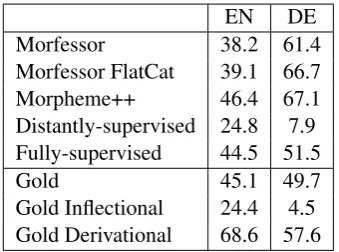
Table 2 shows the percentage of the predicted morphological breaks that match gold syllable
boundaries. We observe that the inflectional
boundaries are far less likely than the deriva-tional ones to correspond to syllable breaks. We also note that on German the unsupervised seg-menters exhibit much higher syllabification over-lap than the gold annotation. We attribute this to the tendency of the unsupervised methods to over-segment.
3.3 Baseline syllabification
As a baseline, we replicate the experiments of Bartlett et al. (2008), and extend them to low-resource settings. Since the training sets are of slightly different sizes, we label each training size point as specified in Table 3. We see that correct syllabification of approximately half of the words is achieved with as few as 100 English and 50 Ger-man training examples.
3.4 Morphologically-informed syllabification
[image:3.595.98.265.641.725.2]mor-Label Training Size Error Rate
EN DE EN DE
A 51 45 61.27 52.97
B 101 91 51.25 44.08
C 203 182 43.05 35.37
D 406 364 34.00 25.32
E 812 727 27.23 19.01
F 1623 1455 21.50 12.74
G 3247 2910 16.96 9.24
H 6493 5819 10.50 6.27
I 12987 11639 6.61 4.64
J 25974 23278 3.73 3.19
[image:4.595.82.283.62.245.2]K 51947 46555 2.18 2.04
Table 3: Absolute error rate for the baseline with varying amounts of the training data.
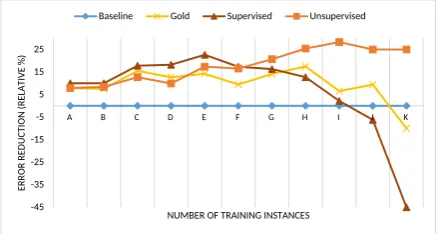
phology are necessarily small. In Figures 1 and 2, we show the relative error reduction at various training sizes. The absolute error rate can be ob-tained by multiplying the values from the table and the figures.
For the sake of clarity, we omit some of the methods from the graphs. The unsupervised meth-ods are represented by Morfessor FlatCat. The distantly-supervised system is generally success-ful at predicting the inflectional boundaries, but fails to improve on the baseline, as they are less important for syllabification than the derivational boundaries.
3.5 Discussion
Overall, the results confirm that morphology can help syllabification. The incorporation of gold segmentation boundaries consistently leads to the reduction of the syllabification error rate; the only exception occurs on the full English training set. While the fully-supervised system provides a ben-efit at lower training thresholds, it actually hurts the accuracy at larger training sizes. Notably, unsupervised segmentation appears to outperform fully-supervised segmentation as the amount of the training data increases; the corresponding er-ror rate reduction approaches 25% on German.
One explanation for the strong performance of the unsupervised systems is their high accuracy on compound words. Consider the German
com-pound Toppflagge“masthead flag”. An
unsuper-vised system is able to guess that the word is
com-posed of the wordsToppandFlaggethat exist in
the lexicon on their own. To produce the same
-30 -20 -10 0 10 20 30
A B C D E F G H I J K
E
R
R
O
R
R
E
DUCT
IO
N
(
R
E
LA
T
IV
E
%
)
NUMBER OF TRAINING INSTANCES
[image:4.595.307.527.75.194.2]Baseline Gold Supervised Unsupervised
Figure 1: Syllabification error rate reduction on English.
-45 -35 -25 -15 -5 5 15 25
A B C D E F G H I J K
E
R
R
O
R
R
EDUCTIO
N
(R
E
LA
T
IV
E
%
)
NUMBER OF TRAINING INSTANCES Baseline Gold Supervised Unsupervised
Figure 2: Syllabification error rate reduction on German.
segmentation, the fully-supervised system must be trained on a number of compound words that
include either topp or flagge. Since compound
boundaries are almost always syllable breaks as well, they have a strong effect on syllabification.
Sometimes even a linguistically incorrect seg-mentation proposed by an unsupervised segmenter may work better for the purposes of syllabifica-tion. Many words of Latin origin contain affixes that are no longer productive in English. Thus, an unsupervised system over-segments the word ob+literate, which allows it to produce the
cor-rect syllabificationob-lit-er-ate, as opposed to
o-blit-er-atepredicted by the gold-informed system.
This phenomenon appears to be particularly fre-quent in German.
4 Conclusion
[image:4.595.307.528.259.376.2]this counter-intuitive phenomenon. We hope that this work will contribute a computational perspec-tive on the issue of interaction between syllabifi-cation and morphology.
Acknowledgments
This research was supported by the Natural Sciences and Engineering Research Council of Canada, and the Alberta Innovates Technology Futures.
References
Yasemin Altun, Ioannis Tsochantaridis, and Thomas Hofmann. 2003. Hidden Markov support vector
machines. InICML, pages 3–10.
Harald R. Baayen, Richard Piepenbrock, and Leon
Gu-likers. 1995. The CELEX Lexical Database.
Re-lease 2 (CD-ROM). Linguistic Data Consortium, University of Pennsylvania.
Susan Bartlett, Grzegorz Kondrak, and Colin Cherry. 2008. Automatic syllabification with structured
SVMs for letter-to-phoneme conversion. In ACL,
pages 568–576.
Mathias Creutz and Krista Lagus. 2002.
Unsuper-vised discovery of morphemes. InProceedings of
the ACL-02 workshop on Morphological and phono-logical learning-Volume 6, pages 21–30.
Mathias Creutz and Krista Lagus. 2005. Induc-ing the morphological lexicon of a natural language
from unannotated text. InConference on Adaptive
Knowledge Representation and Reasoning (AKRR), pages 51–59.
Walter Daelemans, Antal van den Bosch, and Ton Wei-jters. 1997. Igtree: Using trees for compression and classification in lazy learning algorithms. Artificial Intellegence Review, 11(1-5):407–423.
Robert I Damper, Yannick Marchand, J-DS Marsters, and Alexander I Bazin. 2005. Aligning text and phonemes for speech technology applications
us-ing an em-like algorithm. International Journal of
Speech Technology, 8(2):147–160.
Sajib Dasgupta and Vincent Ng. 2007.
High-performance, language-independent morphological
segmentation. InHLT-NAACL, pages 155–163.
Vera Demberg. 2006. Letter-to-phoneme conversion for a german text-to-speech system.
John Goldsmith. 2001. Unsupervised learning of the
morphology of a natural language. Computational
Linguisitics, 27(2), June.
Stig-Arne Gr¨onroos, Sami Virpioja, Peter Smit, and Mikko Kurimo. 2014. Morfessor FlatCat: An HMM-based method for unsupervised and
semi-supervised learning of morphology. In COLING,
pages 1177–1185.
Bradley Hauer and Grzegorz Kondrak. 2013. Auto-matic generation of English respellings. InNAACL, pages 634–643.
Sittichai Jiampojamarn, Colin Cherry, and Grzegorz Kondrak. 2010. Integrating joint n-gram features into a discriminative training network. InNAACL. Yannick Marchand and Robert I. Damper. 2007. Can
syllabification improve pronunciation by analogy of
English? Natural Language Engineering, 13(1):1–
24.
Garrett Nicolai and Grzegorz Kondrak. 2016. Lever-aging inflection tables for stemming and lemmatiza-tion. InACL.
Martin F Porter. 1980. An algorithm for suffix
strip-ping. Program, 14(3):130–137.
Teemu Ruokolainen, Oskar Kohonen, Sami Virpioja, and Mikko Kurimo. 2013. Supervised morpholog-ical segmentation in a low-resource learning setting using conditional random fields. InCoNLL. Nikolaos Trogkanis and Charles Elkan. 2010.
Condi-tional random fields for word hyphenation. InACL, pages 366–374.
Ioannis Tsochantaridis, Thorsten Joachims, Thomas Hofmann, and Yasemin Altun. 2005. Large mar-gin methods for structured and interdependent
out-put variables. InJournal of Machine Learning