Deep Lexical Segmentation and Syntactic Parsing in the Easy-First
Dependency Framework
Matthieu Constant♠♦ Joseph Le Roux♣ Nadi Tomeh♣
♠Universit´e Paris-Est, LIGM, Champs-sur-Marne, France ♦Alpage, INRIA, Universit´e Paris Diderot, Paris, France
♣LIPN, Universit´e Paris Nord, CNRS UMR 7030, Villetaneuse, France [email protected], [email protected], [email protected]
Abstract
We explore the consequences of representing token segmentations as hierarchical structures (trees) for the task of Multiword Expression (MWE) recognition, in isolation or in com-bination with dependency parsing. We pro-pose a novel representation of token segmen-tation as trees on tokens, resembling depen-dency trees. Given this new representation, we present and evaluate two different archi-tectures to combine MWE recognition and de-pendency parsing in theeasy-firstframework: a pipeline and a joint system, both taking ad-vantage of lexical and syntactic dimensions. We experimentally validate that MWE recog-nition significantly helps syntactic parsing.
1 Introduction
Lexical segmentation is a crucial task for natural language understanding as it detects semantic units of texts. One of the main difficulties comes from the identification of multiword expressions [MWE] (Sag et al., 2002), which are sequences made of mul-tiple words displaying multidimensional idiomatic-ity (Nunberg et al., 1994). Such expressions may ex-hibit syntactic freedom and varying degree of com-positionality, and many studies show the advantages of combining MWE identification with syntactic parsing (Savary et al., 2015), for both tasks (Wehrli, 2014). Indeed, MWE detection may help parsing, as it reduces the number of lexical units, and in turn parsing may help detect MWEs with syntactic free-dom (syntactic variations, discontinuity, etc.).
In the dependency parsing framework, some pre-vious work incorporated MWE annotations within
syntactic trees, in the form of complex subtrees ei-ther with flat structures (Nivre and Nilsson, 2004; Eryi˘git et al., 2011; Seddah et al., 2013) or deeper ones (Vincze et al., 2013; Candito and Constant, 2014). However, these representations do not cap-ture deep lexical analyses like nested MWEs. In this paper, we propose a two-dimensional repre-sentation that separates lexical and syntactic layers with two distinct dependency trees sharing the same nodes1. This representation facilitates the annota-tion of complex lexical phenomena like embedding of MWEs (e.g. I will (take a (rain check))). Given this representation, we present two easy-first depen-dency parsing systems: one based on a pipeline ar-chitecture and another as a joint parser.
2 Deep Segmentation and Dependencies
This section describes a lexical representation able to handle nested MWEs, extended from Constant and Le Roux (2015) which was limited to shallow MWEs. Such a lexical analysis is particularly rele-vant to perform deep semantic analysis.
A lexical unit [LU] is a subtree of the lexical seg-mentation tree composed of either a single token unit or an MWE. In case of a single token unit, the sub-tree is limited to a single node. In case of an MWE, the subtree is rooted by its leftmost LU, from which there are arcs to every other LU of the MWE. For instance, the MWEin spite of made of three single token units is a subtree rooted byin. It comprises two arcs: in→spiteandin→of. The MWEmake
1This is related to thePrague Dependency Treebank(Hajiˇc et al., 2006) which encodes MWEs in tectogrammatical trees connected to syntactic trees (Bejˇcek and Straˇn´ak, 2010).
The Los Angeles Lakers made a big deal out of it ROOT
lex submwe mwe
lex
lexmwe mwe lex
[image:2.612.160.452.58.130.2]mwelex
Figure 1:Deep segmentation ofLos Angeles Lakers made a big deal out of itrepresented as a tree.
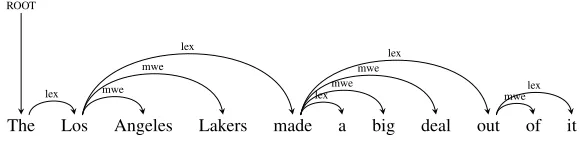
The Los Angeles Lakers made a big deal out of it ROOT
lex mwe mwe
lex
lexmwe mwe lex
mwelex
Figure 2:Shallow segmentation ofLos Angeles Lakers made a big deal out of itrepresented as a tree.
big dealis more complex as it is formed of a single token unitmakeand an MWEbig deal. It is repre-sented as a subtree whose root ismakeconnected to the root of the MWE subtree corresponding tobig deal. The subtree associated with big dealis made of two single token units. It is rooted bybig with an arcbig→ deal. Such structuring allows to find nested MWEs when the root is not an MWE itself, like formake big deal. It is different for the MWE
Los Angeles Lakerscomprising the MWELos Ange-lesand the single token unitLakers. In that case, the subtree has a flat structure, with two arcs from the nodeLos, structurally equivalent toin spite of that has no nested MWEs. Therefore, some extra infor-mation is needed in order to distinguish these two cases. We use arc labels.
Labeling requires to maintain a counter l in or-der to indicate the embedding level in the leftmost LU of the encompassing MWE. Labels have the form sublmwe for l ≥ 0. Let U = U1...Un be
a LU composed of n LUs. If n = 1, it is a sin-gle token unit. Otherwise,subtree(U,0), the lexical subtree2 forU is recursively constructed by adding arcssubtree(U1, l+1) sub
lmwe
−−−−−→subtree(Ui,0)for
i 6= 1. In the case of shallowrepresentation, every LUs ofU are single token units.
Once built the LU subtrees (the internal depen-dencies), it is necessary to create arcs to connect them and form a complete tree : that we call
ex-2The second argumentlcorresponds to the embedding level.
ternal dependencies. LUs are sequentially linked together: each pair of consecutive LUs with roots (wi,wj), i < j, gives an arcwi −−→lex wj. Figure 1
and Figure 2 respectively display the deep and shal-low lexical segmentations of the sentence The Los Angeles Lakers made a big deal out of it.
For readibility, we note mwe for sub0mwe and
submweforsub1mwe.
3 Multidimensional Easy-first Parsing
3.1 Easy-first parsing
Informally, easy-first proposed in Goldberg and El-hadad (2010) predicts easier dependencies before risky ones. It decides for each token whether it must be attached to the root of an adjacent subtree and how this attachment should be labeled3. The order in which these decisions are made is not decided in ad-vance: highest-scoring decisions are made first and constrain the following decisions.
This framework looks appealing in order to test our assumption that segmentation and parsing are mutually informative, while leaving the exact flow of information to be learned by the system itself: we do not postulate any priority between the tasks nor that all attachment decisions must be taken jointly. On the contrary, we expect most decisions to be made independently except for some difficult cases that need both lexical and syntactic knowledge.
[image:2.612.160.451.167.239.2]build both lexical and parse trees from a unique se-quence of tokens4. The key component is to use fea-tures linking information from the two dimensions.
3.2 Pipeline Architecture
In this trivial adaptation, two parsers are run sequen-tially. The first one builds a structure in one dimen-sion (i.e. for segmentation or syntax). The second one builds a structure in the other dimension, with the result of the first parser available as features.
3.3 Joint Architecture
The second adaptation is more substantial and takes the form of a joint parsing algorithm. This adap-tation is provided in Algorithm 1. It uses a single classifier to predict lexical and syntactic actions. As in easy-first, each iteration predicts the most cer-tain head attachment action given the currently pre-dicted subtrees, but here it may belong to any di-mension. This action can be mapped to an edge in the appropriate dimension via function EDGE. Func-tion score(a,i)computes the dot-product of feature weights and features at positioniusing surrounding subtrees in both dimensions5.
Algorithm 1Joint Easy-first parsing 1: functionJOINTEASY-FIRSTPARSING(w0...wn)
2: LetAbe the set of possible actions 3: arcss,arcsl:=(∅,∅)
4: hs,hl:=w0. . . wn, w0. . . wn
5: while |hl|>1∨ |hs|>1do
6: ˆa,ˆi:=argmaxa∈A,i∈[|hd|]score(a,i) 7: (par, lab, child, dim):= EDGE((hs, hl),ˆa,ˆi)
8: arcsdim:= arcsdim∪(par, lab, child)
9: hdim:= hdim\{child}
10: end while
11: return(arcsl, arcss)
12: end function
13: functionEDGE((hs, hl),(dir, lab, dim), i)
14: ifdir=←then .we have a left edge 15: return(hdim[i], lab, hdim[i+ 1], dim)
16: else
17: return(hdim[i+ 1], lab, hdim[i], dim)
18: end if 19: end function
We can reuse the reasoning from Goldberg and Elhadad (2010) and derive a worst-case time com-4It is straightforward to add any number of tree structures. 5Let us note that the algorithm builds projective trees for each dimension, but their union may contain crossing arcs.
English French
Corpus EWT FTB Sequoia
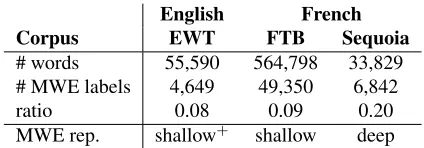
# words 55,590 564,798 33,829 # MWE labels 4,649 49,350 6,842
ratio 0.08 0.09 0.20
[image:3.612.319.531.56.130.2]MWE rep. shallow+ shallow deep Table 1:Datasets statistics. The first part describes the number of words in training sets with MWE label ratio. shallow+refers
to a shallow representation with enriched MWE labels indicat-ing the MWE strength (collocation vs. fixed).
plexity ofO(nlogn), provided that we restrict fea-ture extraction at each position to a bounded vicinity.
4 Experiments
4.1 Datasets
We used data sets derived from three different ref-erence treebanks: English Web Treebank (Linguis-tic Data Consortium release LDC2012T13)[EWT], French treebank (Abeill´e et al., 2003) [FTB], Se-quoia Treebank (Candito and Seddah, 2012) [Se-quoia]. These treebanks have MWE annotations available on at least a subpart of them. For EWT, we used the STREUSLE corpus (Schneider et al., 2014b) that contains annotations of all types of MWEs, including discontiguous ones. We used the train/test split from Schneider et al. (2014a). The FTB contains annotations of contiguous MWEs. We generated the dataset from the version described in Candito and Constant (2014) and used the shallow lexical representation, in the official train/dev/test split of the SPMRL shared task (Seddah et al., 2013). The Sequoia treebank contains some limited annotations of MWEs (usually, compounds having an irregular syntax). We manually extended the cov-erage to all types of MWEs including discontiguous ones. We also included deep annotation of MWEs (in particular, nested ones). We used a 90%/10% train/test split in our experiments. Some statistics about the data sets are provided in table 4.1. Tokens were enriched with their predicted part-of-speech (POS) and information from MWE lexicon6 lookup as in Candito and Constant (2014).
6We used the Unitex platform (www-igm.univ-mlv.
4.2 Parser and features
Parser. We implemented our systems by modify-ing the parser of Y. Goldberg7 also used as a base-line. We trained all models for 20 iterations with dynamic oracle (Goldberg and Nivre, 2013) using the following exploration policy: always choose an oracle transition in the first 2 iterations (k= 2), then choose model prediction with probabilityp= 0.9. Features. One-dimensional features were taken directly from the code supporting Goldberg and Nivre (2013). We added information on typograph-ical cues (hyphenation, digits, capitalization, . . . ) and the existence of substrings in MWE dictionaries in order to help lexical analysis. Following Constant et al. (2012) and Schneider et al. (2014a), we used dictionary lookups to build a first naive segmenta-tion and incorporate it as a set of features. Two-dimensional features were used in both pipeline and joint strategies. We first added syntactic path fea-tures to the lexical dimension, so syntax can guide segmentation. Conversely, we also added lexical path features to the syntactic dimension to provide information about lexical connectivity. For instance, two nodes being checked for attachment in the syn-tactic dimension can be associated with information describing whether one of the corresponding node is an ancestor of the other one in the lexical dimension (i.e. indicating whether the two syntactic nodes are linked via internal or external paths).
We also selected automatically generated features combining information from both dimensions. We chose a simple data-driven heuristics to select com-bined features. We ran one learning iteration over the FTB training corpus adding all possible combi-nations of syntactic and lexical features. We picked the templates of the 10 combined features whose scores had the greatest absolute values. Although this heuristics may not favor the most discriminant features, we found that the chosen features helped accuracy on the development set.
4.3 Results
For each dataset, we carried out four experiments. First we learned and ran independently twodistinct
7We started from the version available at the time of writing at https://bitbucket.org/yoavgo/ tacl2013dynamicoracles
baseline easy-first parsers using one-dimensional features: one producing a lexical segmentation, an-other one predicting a syntactic parse tree. We also trained and ran a joint easy-first system predict-ing lexical segmentations and syntactic parse trees, using two-dimensional features. We also experi-mented thepipelinesystem for each dimension, con-sisting in applying the baseline parser on one dimen-sion and using the resulting tree as source of two-dimensional features in a standard easy first parser applied on the other dimension. Since pipeline ar-chitectures are known to be prone to error propaga-tion, we also run an experiment where the pipeline second stage is fed with oracle first-stage trees.
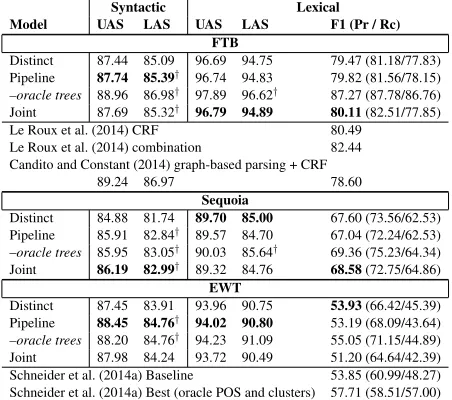
Results on the test sets are provided in table 2, where LAS and UAS are computed with punctua-tion. Overall, we can see that the lexical information tends to help syntactic prediction while the other way around is unclear.
Syntactic Lexical
Model UAS LAS UAS LAS F1 (Pr / Rc) FTB
Distinct 87.44 85.09 96.69 94.75 79.47 (81.18/77.83) Pipeline 87.74 85.39† 96.74 94.83 79.82 (81.56/78.15)
–oracle trees 88.96 86.98† 97.89 96.62† 87.27 (87.78/86.76)
Joint 87.69 85.32† 96.79 94.89 80.11(82.51/77.85)
Le Roux et al. (2014) CRF 80.49 Le Roux et al. (2014) combination 82.44 Candito and Constant (2014) graph-based parsing + CRF
89.24 86.97 78.60
Sequoia
Distinct 84.88 81.74 89.70 85.00 67.60 (73.56/62.53) Pipeline 85.91 82.84† 89.57 84.70 67.04 (72.24/62.53)
–oracle trees 85.95 83.05† 90.03 85.64† 69.36 (75.23/64.34)
Joint 86.19 82.99† 89.32 84.76 68.58(72.75/64.86)
EWT
Distinct 87.45 83.91 93.96 90.75 53.93(66.42/45.39) Pipeline 88.45 84.76† 94.02 90.80 53.19 (68.09/43.64)
–oracle trees 88.20 84.76† 94.23 91.09 55.05 (71.15/44.89)
[image:4.612.314.540.328.528.2]Joint 87.98 84.24 93.72 90.49 51.20 (64.64/42.39) Schneider et al. (2014a) Baseline 53.85 (60.99/48.27) Schneider et al. (2014a) Best (oracle POS and clusters) 57.71 (58.51/57.00)
Table 2:Results on our three test sets. Statistically significant differences (p-value<0.05) from the corresponding “distinct” setting are indicated with†. Rows-oracle treesare the same as pipeline but using oracle, instead of predicted, trees.
5 Discussion
that only 15% of the MWEs in EWT are discontigu-ous and most of them have gaps of one token. This could explain why syntactic information is not use-ful for segmentation. On the other hand, the lexical dimension tends to help syntactic predictions. More precisely, while the pipeline and the joint approach reach comparable scores on the FTB and Sequoia, the joint system has disappointing results on EWT. The good scores for Sequoia could be explained by the larger MWE coverage.
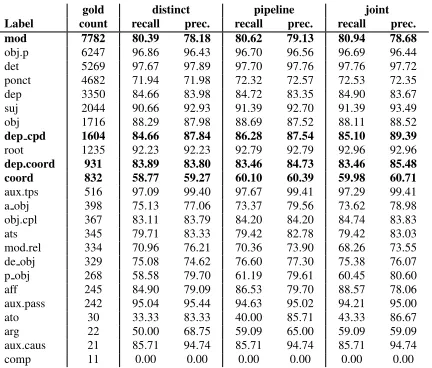
In order to get a better intuition on the real impact of each of the three approaches, we broke down the syntax results by dependency labels. Some labels are particularly informative. First of all, the preci-sion on the modifier label mod, which is the most frequent one, is greatly improved using the pipeline approach as compared with the baseline (around 1 point). This can be explained by the fact that many nominal MWEs have the form of a regular noun phrase, to which its internal adjectival or preposi-tional constituents are attached with themodlabel. Recognizing a nominal MWE on the lexical dimen-sion may therefore give a relevant clue on its cor-responding syntactic structure. Then, the dep cpd
connects components of MWE with irregular syntax that cannot receive standard labels. We can observe that the pipeline (resp. the joint) approach clearly improves the precision (resp. recall) as compared with the baseline (+1.6 point). This means that the combination of a preliminary lexical segmentation and a possibly partial syntactic context helps im-proving the recognition of syntax-irregular MWEs. Coordination labels (dep.coordandcoord) are par-ticularly interesting as the joint system outperforms the other two on them. Coordination is known to be a very complex phenomenon: these scores would tend to show that the lexical and syntactic dimen-sions mutually help each other.
When comparing this work to state-of-the-art sys-tems on data sets with shallow annotation of MWEs, we can see that we obtain MWE recognition scores comparable to systems of equivalent complexity and/or available information. This means that our novel representation which allows for the annotation of more complex lexical phenomena does not dete-riorate scores for shallow annotations.
gold distinct pipeline joint Label count recall prec. recall prec. recall prec. mod 7782 80.39 78.18 80.62 79.13 80.94 78.68
obj.p 6247 96.86 96.43 96.70 96.56 96.69 96.44 det 5269 97.67 97.89 97.70 97.76 97.76 97.72 ponct 4682 71.94 71.98 72.32 72.57 72.53 72.35 dep 3350 84.66 83.98 84.72 83.35 84.90 83.67 suj 2044 90.66 92.93 91.39 92.70 91.39 93.49 obj 1716 88.29 87.98 88.69 87.52 88.11 88.52
dep cpd 1604 84.66 87.84 86.28 87.54 85.10 89.39
root 1235 92.23 92.23 92.79 92.79 92.96 92.96
dep.coord 931 83.89 83.80 83.46 84.73 83.46 85.48 coord 832 58.77 59.27 60.10 60.39 59.98 60.71
[image:5.612.317.533.56.240.2]aux.tps 516 97.09 99.40 97.67 99.41 97.29 99.41 a obj 398 75.13 77.06 73.37 79.56 73.62 78.98 obj.cpl 367 83.11 83.79 84.20 84.20 84.74 83.83 ats 345 79.71 83.33 79.42 82.78 79.42 83.03 mod.rel 334 70.96 76.21 70.36 73.90 68.26 73.55 de obj 329 75.08 74.62 76.60 77.30 75.38 76.07 p obj 268 58.58 79.70 61.19 79.61 60.45 80.60 aff 245 84.90 79.09 86.53 79.70 88.57 78.06 aux.pass 242 95.04 95.44 94.63 95.02 94.21 95.00 ato 30 33.33 83.33 40.00 85.71 43.33 86.67 arg 22 50.00 68.75 59.09 65.00 59.09 59.09 aux.caus 21 85.71 94.74 85.71 94.74 85.71 94.74 comp 11 0.00 0.00 0.00 0.00 0.00 0.00 Table 3:Results on FTB development set, broken down by de-pendency labels. Scores correspond to recall and precision.
6 Conclusions and Future Work
In this paper we presented a novel representation of deep lexical segmentation in the form of trees, forming a dimension distinct from syntax. We ex-perimented strategies to predict both dimensions in the easy-first dependency parsing framework. We showed empirically that joint and pipeline process-ing are beneficial for syntactic parsprocess-ing while hardly impacting deep lexical segmentation.
The presented combination of parsing and seg-menting does not enforce any structural constraint over the two trees8. We plan to address this issue in future work. We will explore less redundant, more compact representations of the two dimensions since some annotations can be factorized between the two dimensions (e.g. MWEs with irregular syntax) and some can easily be induced from others (e.g. se-quential linking between lexical units).
Acknowledgments
This work has been partly funded by the French
Agence Nationale pour la Recherche, through the PARSEME-FR project (ANR-14-CERA-0001) and as part of the Investissements d’Avenir program (ANR-10-LABX-0083)
References
Anne Abeill´e, Lionel Cl´ement, and Franc¸ois Toussenel. 2003. Building a treebank for French. In Anne Abeill´e, editor,Treebanks. Kluwer, Dordrecht. Eduard Bejˇcek and Pavel Straˇn´ak. 2010. Annotation of
multiword expressions in the prague dependency tree-bank. Language Resources and Evaluation, 44(1-2). Marie Candito and Matthieu Constant. 2014. Strategies
for contiguous multiword expression analysis and de-pendency parsing. InACL 14-The 52nd Annual Meet-ing of the Association for Computational LMeet-inguistics. ACL.
Marie Candito and Djam´e Seddah. 2012. Le corpus Sequoia : annotation syntaxique et exploitation pour l’adaptation d’analyseur par pont lexical. In TALN 2012 - 19e conf´erence sur le Traitement Automatique des Langues Naturelles, Grenoble, France.
Matthieu Constant and Joseph Le Roux. 2015. De-pendency representations for lexical segmentation. In Proceedings of the international workshop on sta-tistical parsing of morphologically-rich languages (SPMRL 2015).
Matthieu Constant, Anthony Sigogne, and Patrick Wa-trin. 2012. Discriminative strategies to integrate mul-tiword expression recognition and parsing. In Pro-ceedings of the 50th Annual Meeting of the Associ-ation for ComputAssoci-ational Linguistics (ACL’12), pages 204–212.
G¨uls¸en Eryi˘git, Tugay ˙Ilbay, and Ozan Arkan Can. 2011. Multiword Expressions in Statistical Depen-dency Parsing. In Proceedings of the Second Work-shop on Statistical Parsing of Morphologically Rich Languages, SPMRL ’11, pages 45–55, Stroudsburg, PA, USA. Association for Computational Linguistics. Yoav Goldberg and Michael Elhadad. 2010. An
effi-cient algorithm for easy-first non-directional depen-dency parsing. In Human Language Technologies: The 2010 Annual Conference of the North American Chapter of the Association for Computational Linguis-tics, pages 742–750. Association for Computational Linguistics.
Yoav Goldberg and Joakim Nivre. 2013. Training deterministic parsers with non-deterministic oracles. Transactions of the association for Computational Linguistics, 1:403–414.
J. Hajiˇc, J. Panevov´a, E. Hajiˇcov´a, P. Sgall, P. Pajas, ˇStˇep´anek, Havelka J., Mikulov´a J., Z. M., ˇZabokrtsk´y, and M. ˇSevˇc´ıkov´a Raz´ımov´a. 2006. Prague depen-dency treebank 2.0. Linguistic Data Consortium. Joseph Le Roux, Antoine Rozenknop, and Matthieu
Con-stant. 2014. Syntactic parsing and compound recogni-tion via dual decomposirecogni-tion: Applicarecogni-tion to french. In COLING.
Joakim Nivre and Jens Nilsson. 2004. Multiword units in syntactic parsing. Proceedings of Methodologies and Evaluation of Multiword Units in Real-World Applica-tions (MEMURA).
Geoffrey Nunberg, Ivan A. Sag, and Thomas Wasow. 1994. Idioms. Language, 70:491 – 538.
Ivan A. Sag, Timothy Baldwin, Francis Bond, Ann Copestake, and Dan Flickinger. 2002. Multiword ex-pressions: A pain in the neck for nlp. InIn Proc. of the 3rd International Conference on Intelligent Text Processing and Computational Linguistics (CICLing-2002, pages 1–15.
Agata Savary, Manfred Sailer, Yannick Parmen-tier, Michael Rosner, Victoria Ros´en, Adam Przepi´orkowski, Cvetana Krstev, Veronika Vincze, Beata W´ojtowicz, Gyri Smørdal Losnegaard, Carla Parra Escart´ın, Jakub Waszczuk, Matthieu Con-stant, Petya Osenova, and Federico Sangati. 2015. PARSEME – PARSing and Multiword Expressions within a European multilingual network. In 7th Language & Technology Conference: Human Lan-guage Technologies as a Challenge for Computer Science and Linguistics (LTC 2015), Pozna´n, Poland, November.
Nathan Schneider, Emily Danchik, Chris Dyer, and Noah A Smith. 2014a. Discriminative lexical se-mantic segmentation with gaps: running the mwe gamut. Transactions of the Association for Compu-tational Linguistics, 2:193–206.
Nathan Schneider, Spencer Onuffer, Nora Kazour, Emily Danchik, Michael T. Mordowanec, Henrietta Conrad, and Noah A. Smith. 2014b. Comprehensive anno-tation of multiword expressions in a social web cor-pus. In Nicoletta Calzolari, Khalid Choukri, Thierry Declerck, Hrafn Loftsson, Bente Maegaard, Joseph Mariani, Asuncion Moreno, Jan Odijk, and Stelios Piperidis, editors, Proceedings of the Ninth Interna-tional Conference on Language Resources and Eval-uation, pages 455–461, Reykjav´ık, Iceland, May. ELRA.
Veronika Vincze, J´anos Zsibrita, and Istv`an Nagy T. 2013. Dependency parsing for identifying hungarian light verb constructions. In Proceedings of Interna-tional Joint Conference on Natural Language Process-ing (IJCNLP 2013), Nagoya, Japan.