Native Language Identification on Text and Speech
Marcos Zampieri1, Alina Maria Ciobanu2, Liviu P. Dinu2 1University of Wolverhampton, United Kingdom
2University of Bucharest, Romania [email protected]
Abstract
This paper presents an ensemble system combining the output of multiple SVM classifiers to native language identification (NLI). The system was submitted to the NLI Shared Task 2017 fusion track which featured students essays and spoken re-sponses in form of audio transcriptions and iVectors by non-native English speak-ers of eleven native languages. Our sys-tem competed in the challenge under the team name ZCD and was based on an en-semble of SVM classifiers trained on char-actern-grams achieving 83.58% accuracy and ranking 3rdin the shared task.
1 Introduction
Native language identification (NLI) is the task of automatically identifying non-native speakers’ na-tive language based on their foreign language pro-duction. As evidenced inMalmasi(2016) NLI is a vibrant research area in NLP and is usually mod-eled as single-label text classification.
NLI is based on the assumption that the mother tongue influences second language acquisition (SLA) and production. Corpora containing texts and utterances by non-native speakers are used to train systems that are able to recognize features that are prominent in the production of speakers of a particular native language. These features are subsequently used to identify texts (or utterances) that are likely to be written or spoken by speakers of the same language.
There are two important reasons to study NLI. Firstly, there is SLA. NLI methods can be ap-plied to learner corpora to investigate the influence of native language in second language acquisi-tion and producacquisi-tion complementing corpus-based and corpus-driven studies. The second reason is a
practical one. NLI methods can be an important part of several NLP systems including, for exam-ple, author profiling systems developed for foren-sic linguistics.
This paper presents the system submitted by the ZCD team to the NLI Shared Task 2017 ( Mal-masi et al., 2017). The organizers of the chal-lenge provided participants with a dataset contain-ing essays and spoken responses in form of tran-scriptions and acoustic features (iVectors) by non-native English speakers of eleven non-native languages taking a standardized assessment of English profi-ciency for academic purposes. Native languages included are: Arabic, Chinese, French, German, Hindi, Italian, Japanese, Korean, Spanish, Telugu, and Turkish. To discriminate between these eleven native languages we apply an ensemble of multi-ple linear SVM classifiers trained on character n-grams. The main motivation behind the choice of this approach is the success of linear SVMs and SVM ensembles in NLI and in similar text classi-fication tasks such as dialect, language variety, and similar language identification as will be discussed in Section2.
2 Related Work
There have been several NLI studies published in the past few years. Due to the availability of suitable language resources for English (e.g. learner corpora), the vast majority of these stud-ies dealt with English (Brooke and Hirst, 2012;
Bykh and Meurers, 2014), however, a few NLI studies have been published on other languages. Examples of NLI applied to languages other than English include Arabic (Ionescu, 2015), Chinese (Wang et al., 2016), and Finnish (Malmasi and Dras,2014).
To the best of our knowledge, the NLI Shared Task 2013 (Tetreault et al., 2013) was the first
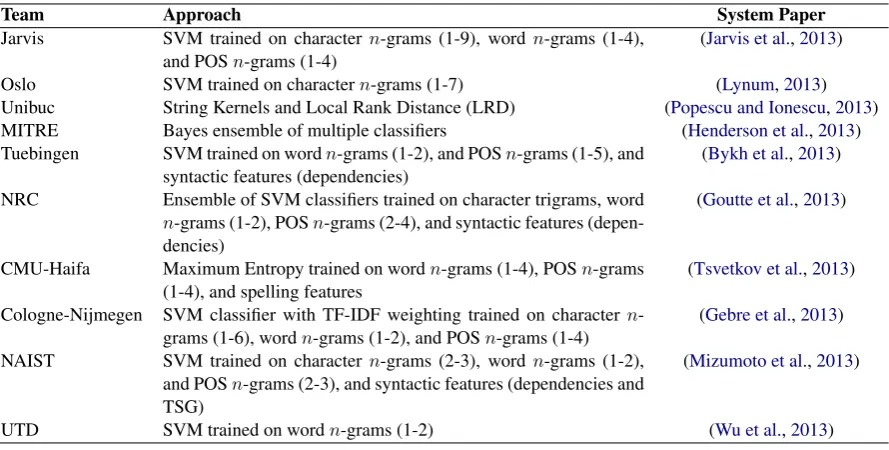
Team Approach System Paper
Jarvis SVM trained on charactern-grams (1-9), word n-grams (1-4),
and POSn-grams (1-4) (Jarvis et al.,2013)
Oslo SVM trained on charactern-grams (1-7) (Lynum,2013)
Unibuc String Kernels and Local Rank Distance (LRD) (Popescu and Ionescu,2013) MITRE Bayes ensemble of multiple classifiers (Henderson et al.,2013) Tuebingen SVM trained on wordn-grams (1-2), and POSn-grams (1-5), and
syntactic features (dependencies) (Bykh et al.,2013) NRC Ensemble of SVM classifiers trained on character trigrams, word
n-grams (1-2), POSn-grams (2-4), and syntactic features (depen-dencies)
(Goutte et al.,2013)
CMU-Haifa Maximum Entropy trained on wordn-grams (1-4), POSn-grams
(1-4), and spelling features (Tsvetkov et al.,2013) Cologne-Nijmegen SVM classifier with TF-IDF weighting trained on charactern
-grams (1-6), wordn-grams (1-2), and POSn-grams (1-4) (Gebre et al.,2013) NAIST SVM trained on charactern-grams (2-3), word n-grams (1-2),
and POSn-grams (2-3), and syntactic features (dependencies and TSG)
(Mizumoto et al.,2013)
[image:2.595.79.524.61.286.2]UTD SVM trained on wordn-grams (1-2) (Wu et al.,2013)
Table 1: Top ten NLI Shared Task 2013 entries ordered by performance.
shared task to provide a benchmark for NLI focus-ing on written texts by non-native English speak-ers. A few years later, the 2016 Computational Paralinguistics Challenge (Schuller et al., 2016) included an NLI task on speech data. The NLI Shared Task 2017 combines these two modalities of non-native language production by including essays and spoken responses of test takers in form of transcriptions and iVectors.
The combination of text and speech has been previously used in similar shared tasks such as the dialect identification shared tasks organized at the VarDial workshop series (Zampieri et al., 2017) and described in more detail in Section2.2.
In the next sections we present the most suc-cessful entries submitted for the NLI Shared Task 2013 and their overlap with methods applied to di-alect, language variety, and similar language iden-tification.
2.1 NLI Shared Task 2013
The aforementioned NLI Shared Task 2013 (Tetreault et al.,2013) established the first bench-mark for NLI on written texts. Organizers of the first NLI task provided participants with the TOEFL 11 (Blanchard et al.,2013) dataset which contained essays written by students native speak-ers of the same eleven languages included in the NLI Shared Task 2017.
Twenty-nine teams participated in the competi-tion, testing a wide range of computational meth-ods for NLI. In Table 1 we list the top ten best
entries ranked by performance along with their re-spective system description papers.
The best system byJarvis et al.(2013) applied a linear SVM classifier trained on character, word, and POS n-grams. Seven out of the ten best en-tries in the shared task used SVM classifiers. This indicates that SMVs are a very good fit for NLI and motivates us to test SVM classifiers in our ensemble-based system described in this paper.
2.2 Overlap with Dialect Identification In the last few years, we observed a significant and important overlap between NLI approaches and computational methods applied to dialect, lan-guage variety, and similar lanlan-guage identification. So far the overlap between the two tasks has not been substantially explored in the literature.
Members of several teams that submitted sys-tems to the NLI Shared Task 2013, some of them presented in Table 1, also participated in the di-alect identification shared tasks organized within the scope of the VarDial workshop series held from 2014 to 2017. The three related shared tasks organized at the VarDial workshop thus far are the Discriminating between Similar Languages (DSL) task organized from 2014 to 2017, Arabic Di-alect Identification (ADI) organized in 2016 and 2017, and German Dialect Identification (GDI) or-ganized in 2017.
• Variations of the string kernels method by the Unibuc team (Popescu and Ionescu, 2013) competed in the ADI task in 2016 (Ionescu and Popescu,2016) and in 2017 (Ionescu and Butnaru,2017) achieving the best results.
• Cologne-Nijmegen’s TF-IDF-based ap-proach (Gebre et al., 2013) competed in the DSL shared task 2015 (Zampieri et al.,
2015a) as team MMS ranking among the top 3 systems.
• A variation of NRC’s SVM approach (Goutte et al., 2013) competed in the DSL 2014 (Goutte et al., 2014) achieving the best re-sults.
• Bobicev applied Prediction for Partial Match-ing (PPM) in the NLI shared task (Bobicev,
2013) with results that did not reach top ten performance. A similar improved ap-proached competed in the DSL 2015 ( Bo-bicev,2015) ranking in the top half of the ta-ble.
• A similar approach to the one by Jarvis (Jarvis et al., 2013) that ranked 1st place in the NLI task 2013 competed in the DSL 2017 (Bestgen, 2017), achieving the best perfor-mance in the competition.
• Variations of MQ’s SVM ensemble approach (Malmasi et al., 2013) have competed in the DSL 2015 (Malmasi and Dras, 2015) and the ADI 2016 (Malmasi and Zampieri,
2016), achieving the best performance in both shared tasks.
This section evidenced an important overlap be-tween NLI methods and dialect identification methods both in terms of participation overlap in the shared tasks and in terms of successful ap-proaches. With the exception ofBobicev (2013), most teams that were ranked among the top ten en-tries in the NLI shared task were also successful at the VarDial workshop shared tasks.
Detailed information about all approaches and performance obtained in these competitions can be found in the VarDial shared task reports (Zampieri et al., 2014, 2015b; Malmasi et al.,
2016b;Zampieri et al.,2017) and in the evaluation paper byGoutte et al.(2016).
3 Methods
In the next sections we describe the data provided by the shared task organizers and the ensemble SVM approach applied by the ZCD team.
3.1 Data
The organizers of the NLI Shared Task 2017 provided participants with data corresponding to eleven native languages: Arabic, Chinese, French, German, Hindi, Italian, Japanese, Korean, Span-ish, Telugu and Turkish. The training dataset consists of 11,000 essays, orthographic transcrip-tions of 45-second English spoken responses, and iVectors (1,000 instances for each of the eleven native languages), while the development dataset was stratified similarly, containing 100 instances for each native language.
There were individual tracks in which only the essays or only the responses could be used and a fusion track in which both the essays and the speech transcriptions (including iVectors) could be used. The test dataset, containing 1,100 instances with essays, speech transcriptions and iVectors, was released at a later date.
The use of a dataset containing text and speech is the main new aspect of the 2017 NLI task so we decide to compete in the fusion track taking both modalities into account. The approach used in our submission is described next.
3.2 Approach
We built a classification system based on SVM en-sembles, following the methodology proposed by
Malmasi and Dras(2015).
The idea behind classification ensembles is to improve the overall performance by combining the results of multiple classifiers. Such systems have proved successful not only in NLI and di-alect identification, as evidenced in the previous sections, but also in numerous text classification tasks, among which are complex word identifica-tion (Malmasi et al., 2016a) and grammatical er-ror diagnosis (Xiang et al.,2015). The classifiers can differ in a wide range of aspects, such as algo-rithms, training data, features or parameters.
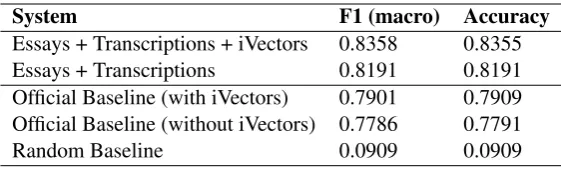
System F1 (macro) Accuracy Essays + Transcriptions + iVectors 0.8358 0.8355 Essays + Transcriptions 0.8191 0.8191 Official Baseline (with iVectors) 0.7901 0.7909 Official Baseline (without iVectors) 0.7786 0.7791
[image:4.595.158.439.61.146.2]Random Baseline 0.0909 0.0909
Table 2: ZCD results and baselines for the fusion track.
used TF-IDF weighting applied on the tokenized version of the essays and speech transcripts (pro-vided by the organizers). As a pre-processing step, we lowercased all words.
We first trained a classifier for each type of feature using the essays as input data, and per-formed cross-validation to determine the optimal value for the SVM hyperparameterC, searching in {10−5, ...,105}. Further, for the n-gram fea-tures we kept only those classifiers whose individ-ual cross-validation performance was higher than 0.8. Thus, our first ensemble consisted of individ-ual classifiers using charactern-grams (withnin {6,7,8}) from essays and speech transcripts.
For the second ensemble, we introduced an additional classifier using the iVectors as fea-tures. To combine the classifiers, we employed a majority-based fusion method: the class label dicted by the ensemble is the one that was pre-dicted by the majority of the classifiers. We used the SVM implementation provided by Scikit-learn (Pedregosa et al.,2011), based on the Liblinear li-brary (Fan et al.,2008).
On the development dataset, the first ensemble (essays + speech transcripts) obtained 0.83 accu-racy, and the second ensemble (essays + speech transcripts + iVectors) obtained 0.84 accuracy.
4 Results
We submitted two runs of our system. The first run included the essays and the transcriptions of responses, whereas the second run included also the iVectors. We present the results obtained by the two runs along with a random baseline and the performance of the unigram-based official base-line system in terms of F1 score and accuracy in Table2.
The best results were achieved by the second run, reaching 83.55% accuracy and 83.58% F1 score. As can be seen in Table2, the iVectors bring a performance improvement of about 1.6 percent-age points in terms of accuracy and F1 score.
Ten teams participated in the fusion track and our best run was ranked 3rdby the shared task or-ganizers. Ranks were calculated using McNemars test for statistical significance, a common practice in many NLI shared tasks (e.g. DSL 2016 ( Mal-masi et al.,2016b), and the shared tasks at WMT (Bojar et al.,2016)).
The confusion matrix of our best submission is presented in Table 3. We observed that the best performance was obtained for Japanese and the worst performance was obtained for Arabic. Not surprisingly, most confusion occurred between Hindi and Telugu. Our initial analysis indicates that this confusion occurred because of geographic proximity and not by intrinsic linguistic proper-ties shared by these two languages, as Hindi and Telugu do not belong to the same language family - Hindi is a Hindustani language and Telugu is a Dravidian language.
5 Most Informative Features
CHI JPN KOR HIN TEL FRE ITA SPA GER ARA TUR
CHI 91 3 2 0 0 0 2 0 0 1 1
JPN 2 93 2 0 1 1 0 0 1 0 0
KOR 4 14 77 0 0 1 1 1 0 1 1
HIN 1 0 1 80 18 0 0 0 0 0 0
TEL 0 0 1 18 78 0 0 1 0 2 0
FRE 2 0 0 2 1 87 5 0 2 1 0
ITA 0 0 0 1 0 6 85 3 3 2 0
SPA 1 1 2 2 1 4 7 77 2 2 1
GER 0 1 0 3 0 3 2 1 90 0 0
ARA 2 2 2 3 2 7 1 2 1 77 1
TUR 1 2 0 3 0 2 3 1 1 3 84
Table 3: Confusion matrix on the test set.
Language Most Informative Features
Arabic |alot of|alot of|y thing|statmen|statment|e alot o|tatment|ery thin|very thi|every th| Chinese |i think|taiwan|i think|beijing|beijing|taipei|in chin|in china|n china|chinese| French |indeed|. indeed|. indee|indeed ,|ndeed ,|france|developp|french|to concl|o conclu| German |, that|and um|germany|germany|berlin|, that t|have to|have to|um yeah|um yeah| Hindi |towards|towards|as compa|as comp|various|various|s compar|enjoyme|mumbai|behind| Italian |hink tha|nk that|ink that|in ital|n italy|in fact|in italy|in fact|i think|italian|
Japanese |in japan|n japan|in japa|apanese|japanes|japanese|japan ,|japan ,|i disagr|japan .| Korean |korean|in korea|in kore|n korea|however|however|korea ,|korea ,|. howev|. howeve| Spanish |mexico|oing to|going to|going t|diferen|le that|the cit|es that|diferent|ple that| Telugu |ing the|hyderaba|hyderab|yderabad|derabad|subject|we can|i concl|i conclu|where as| Turkish |turkey|istanbul|stanbul|istanbu|uh and|n turkey|in turk|in turke|s about|. becau|
Table 4: Top ten most informative character 8-grams for each language.
In the most informative features for French, for example, we find developp from the French d´evelopp´ewhich leads to a misspelling of the En-glish word developed. In Arabic we observed a number of features that indicate misspellings. The Arabic alphabet is very different from the Latin one, making spelling English words particularly challenging for native speakers of Arabic. The top ten most informative features for Arabic include word boundary errors such as every thingfor ev-erything, andalotfora lot, as well as the omission of vowels such asstatmentforstatement.
6 Conclusion
To the best of our knowledge, the NLI Shared Task 2017 fusion track was the first shared task to pro-vide both written and spoken data for NLI. It was an interesting opportunity to evaluate the perfor-mance of NLI methods beyond written texts.
In this paper we highlighted the overlap be-tween NLI and dialect, language variety, and sim-ilar language identification and used an approach
that achieved high results in both tasks. We ap-plied an SVM ensemble approach trained char-acter n-grams achieving competitive results of 83.55% accuracy ranking 3rdin the fusion track.
Even though the results obtained by our ap-proach were not low, we believe that there is still room for improvement. In previous shared tasks (e.g. NLI 2013, DSL 2015, and ADI 2016) we ob-served that SVM ensembles ranked higher in the results tables than our method did in the NLI 2017. We are investigating whether the combination of features or the implementation itself can be opti-mized for better performance.
Acknowledgements
We would like to thank the NLI Shared Task 2017 organizers for making the dataset available and for replying promptly to all our inquiries. We further thank the anonymous reviewers for their valuable feedback.
References
Yves Bestgen. 2017. Improving the Character Ngram Model for the DSL Task with BM25 Weighting and Less Frequently Used Feature Sets. InProceedings of the Fourth Workshop on NLP for Similar Lan-guages, Varieties and Dialects (VarDial). Valencia, Spain, pages 115–123.
Daniel Blanchard, Joel Tetreault, Derrick Higgins, Aoife Cahill, and Martin Chodorow. 2013. Toefl11: A corpus of non-native english. Technical report, Educational Testing Service.
Victoria Bobicev. 2013. Native language identification with ppm. In Proceedings of the Eighth Workshop on Innovative Use of NLP for Building Educational Applications. Atlanta, Georgia, pages 180–187.
Victoria Bobicev. 2015. Discriminating between sim-ilar languages using ppm. In Proceedings of the Joint Workshop on Language Technology for Closely Related Languages, Varieties and Dialects (LT4VarDial). Hissar, Bulgaria, pages 59–65.
Ondrej Bojar, Rajen Chatterjee, Christian Federmann, Yvette Graham, Barry Haddow, Matthias Huck, An-tonio Jimeno Yepes, Philipp Koehn, Varvara Lo-gacheva, Christof Monz, et al. 2016. Findings of the 2016 Conference on Machine Translation. In Pro-ceedings of WMT.
Julian Brooke and Graeme Hirst. 2012. Measuring Interlanguage: Native Language Identification with L1-influence Metrics. InProceedings of Language Resources and Evaluation (LREC). pages 779–784.
Serhiy Bykh and Detmar Meurers. 2014. Exploring Syntactic Features for Native Language Identifica-tion: A Variationist Perspective on Feature Encod-ing and Ensemble Optimization. In Proceedings of COLING 2014, the 25th International Confer-ence on Computational Linguistics: Technical Pa-pers. Dublin, Ireland, pages 1962–1973.
Serhiy Bykh, Sowmya Vajjala, Julia Krivanek, and Detmar Meurers. 2013. Combining shallow and linguistically motivated features in native language identification. In Proceedings of the Eighth Work-shop on Innovative Use of NLP for Building Edu-cational Applications. Atlanta, Georgia, pages 197– 206.
Rong-En Fan, Kai-Wei Chang, Cho-Jui Hsieh, Xiang-Rui Wang, and Chih-Jen Lin. 2008. LIBLINEAR: A Library for Large Linear Classification. Journal of Machine Learning Research9:1871–1874.
Binyam Gebrekidan Gebre, Marcos Zampieri, Peter Wittenburg, and Tom Heskes. 2013. Improving na-tive language identification with tf-idf weighting. In Proceedings of the Eighth Workshop on Innovative Use of NLP for Building Educational Applications. Atlanta, Georgia, pages 216–223.
Cyril Goutte, Serge L´eger, and Marine Carpuat. 2013. Feature space selection and combination for na-tive language identification. In Proceedings of the Eighth Workshop on Innovative Use of NLP for Building Educational Applications. Atlanta, Geor-gia, pages 96–100.
Cyril Goutte, Serge L´eger, and Marine Carpuat. 2014. The nrc system for discriminating similar languages. In Proceedings of the First Workshop on Applying NLP Tools to Similar Languages, Varieties and Di-alects (VarDial). Dublin, Ireland, pages 139–145.
Cyril Goutte, Serge L´eger, Shervin Malmasi, and Mar-cos Zampieri. 2016. Discriminating Similar Lan-guages: Evaluations and Explorations. In Pro-ceedings of Language Resources and Evaluation (LREC).
John Henderson, Guido Zarrella, Craig Pfeifer, and John D. Burger. 2013. Discriminating non-native english with 350 words. In Proceedings of the Eighth Workshop on Innovative Use of NLP for Building Educational Applications. Atlanta, Geor-gia, pages 101–110.
Radu Tudor Ionescu. 2015. A Fast Algorithm for Local Rank Distance: Application to Arabic Native Lan-guage Identification. InProceedings of the Interna-tional Conference on Neural Information Process-ing. Springer, pages 390–400.
Radu Tudor Ionescu and Andrei Butnaru. 2017. Learn-ing to identify arabic and german dialects usLearn-ing mul-tiple kernels. In Proceedings of the Fourth Work-shop on NLP for Similar Languages, Varieties and Dialects (VarDial). Valencia, Spain, pages 200–209. Radu Tudor Ionescu and Marius Popescu. 2016. UnibucKernel: An Approach for Arabic Dialect Identification Based on Multiple String Kernels. In Proceedings of the Third Workshop on NLP for Sim-ilar Languages, Varieties and Dialects (VarDial3). Osaka, Japan, pages 135–144.
Scott Jarvis, Yves Bestgen, and Steve Pepper. 2013. Maximizing classification accuracy in native lan-guage identification. In Proceedings of the Eighth Workshop on Innovative Use of NLP for Building Educational Applications. Atlanta, Georgia, pages 111–118.
Andr´e Lynum. 2013. Native language identification us-ing large scale lexical features. In Proceedings of the Eighth Workshop on Innovative Use of NLP for Building Educational Applications. Atlanta, Geor-gia, pages 266–269.
Shervin Malmasi. 2016. Native Language Identifica-tion: Explorations and Applications. Ph.D. thesis. Shervin Malmasi and Mark Dras. 2014. Finnish Native
Shervin Malmasi and Mark Dras. 2015. Language identification using classifier ensembles. In Pro-ceedings of the VarDial Workshop.
Shervin Malmasi, Mark Dras, and Marcos Zampieri. 2016a. LTG at SemEval-2016 Task 11: Complex Word Identification with Classifier Ensembles. In Proceedings of SemEval.
Shervin Malmasi, Keelan Evanini, Aoife Cahill, Joel Tetreault, Robert Pugh, Christopher Hamill, Diane Napolitano, and Yao Qian. 2017. A Report on the 2017 Native Language Identification Shared Task. In Proceedings of the 12th Workshop on Building Educational Applications Using NLP. Copenhagen, Denmark.
Shervin Malmasi, Sze-Meng Jojo Wong, and Mark Dras. 2013. Nli shared task 2013: Mq submission. In Proceedings of the Eighth Workshop on Innova-tive Use of NLP for Building Educational Applica-tions. Atlanta, Georgia, pages 124–133.
Shervin Malmasi and Marcos Zampieri. 2016. Arabic Dialect Identification in Speech Transcripts. In Pro-ceedings of the Third Workshop on NLP for Similar Languages, Varieties and Dialects (VarDial3). Os-aka, Japan, pages 106–113.
Shervin Malmasi, Marcos Zampieri, Nikola Ljubeˇsi´c, Preslav Nakov, Ahmed Ali, and J¨org Tiedemann. 2016b. Discriminating between similar languages and arabic dialect identification: A report on the third dsl shared task. In Proceedings of the 3rd Workshop on Language Technology for Closely Re-lated Languages, Varieties and Dialects (VarDial). Osaka, Japan.
Tomoya Mizumoto, Yuta Hayashibe, Keisuke Sak-aguchi, Mamoru Komachi, and Yuji Matsumoto. 2013. Naist at the nli 2013 shared task. In Pro-ceedings of the Eighth Workshop on Innovative Use of NLP for Building Educational Applications. At-lanta, Georgia, pages 134–139.
F. Pedregosa, G. Varoquaux, A. Gramfort, V. Michel, B. Thirion, O. Grisel, M. Blondel, P. Pretten-hofer, R. Weiss, V. Dubourg, J. Vanderplas, A. Pas-sos, D. Cournapeau, M. Brucher, M. Perrot, and E. Duchesnay. 2011. Scikit-learn: Machine Learn-ing in Python. Journal of Machine Learning Re-search12:2825–2830.
Marius Popescu and Radu Tudor Ionescu. 2013. The story of the characters, the dna and the native lan-guage. InProceedings of the Eighth Workshop on Innovative Use of NLP for Building Educational Ap-plications. Atlanta, Georgia, pages 270–278. Bj¨orn Schuller, Stefan Steidl, Anton Batliner, Julia
Hirschberg, Judee K. Burgoon, Alice Baird, Aaron Elkins, Yue Zhang, Eduardo Coutinho, and Keelan Evanini. 2016. The INTERSPEECH 2016 Compu-tational Paralinguistics Challenge: Deception, Sin-cerity & Native Language. InProceedings of Inter-speech. pages 2001–2005.
Joel Tetreault, Daniel Blanchard, and Aoife Cahill. 2013. A Report on the First Native Language Iden-tification Shared Task. InProceedings of the Eighth Workshop on Building Educational Applications Us-ing NLP. Atlanta, GA, USA.
Yulia Tsvetkov, Naama Twitto, Nathan Schneider, Noam Ordan, Manaal Faruqui, Victor Chahuneau, Shuly Wintner, and Chris Dyer. 2013. Identifying the l1 of non-native writers: the cmu-haifa system. In Proceedings of the Eighth Workshop on Innova-tive Use of NLP for Building Educational Applica-tions. Atlanta, Georgia, pages 279–287.
Lan Wang, Masahiro Tanaka, and Hayato Yamana. 2016. What is your Mother Tongue?: Improving Chinese Native Language Identification by Cleaning Noisy Data and Adopting BM25. InProceedings of the International Conference on Big Data Analysis (ICBDA). IEEE, pages 1–6.
Ching-Yi Wu, Po-Hsiang Lai, Yang Liu, and Vin-cent Ng. 2013. Simple yet powerful native lan-guage identification on toefl11. In Proceedings of the Eighth Workshop on Innovative Use of NLP for Building Educational Applications. Atlanta, Geor-gia, pages 152–156.
Yang Xiang, Xiaolong Wang, Wenying Han, and Qinghua Hong. 2015. Chinese Grammatical Error Diagnosis Using Ensemble Learning. In Proceed-ings of the 2nd Workshop on Natural Language Pro-cessing Techniques for Educational Applications. pages 99–104.
Marcos Zampieri, Binyam Gebrekidan Gebre, Hernani Costa, and Josef van Genabith. 2015a. Comparing approaches to the identification of similar languages. InProceedings of the Joint Workshop on Language Technology for Closely Related Languages, Vari-eties and Dialects (LT4VarDial). Hissar, Bulgaria, pages 66–72.
Marcos Zampieri, Shervin Malmasi, Nikola Ljubeˇsi´c, Preslav Nakov, Ahmed Ali, J¨org Tiedemann, Yves Scherrer, and No¨emi Aepli. 2017. Findings of the VarDial Evaluation Campaign 2017. InProceedings of the Fourth Workshop on NLP for Similar Lan-guages, Varieties and Dialects (VarDial). Valencia, Spain, pages 1–15.
Marcos Zampieri, Liling Tan, Nikola Ljubeˇsi´c, and J¨org Tiedemann. 2014. A Report on the DSL Shared Task 2014. InProceedings of the First Workshop on Applying NLP Tools to Similar Languages, Varieties and Dialects (VarDial). Dublin, Ireland, pages 58– 67.