Fewer features perform well at Native Language Identification task
Taraka Rama and C¸a˘grı C¸¨oltekin Department of Linguistics University of T¨ubingen, Germany
[email protected] [email protected]
Abstract
This paper describes our results at the NLI shared task 2017. We participated in es-says, speech, and fusion task that uses text, speech, and i-vectors for the task of iden-tifying the native language of the given input. In the essay track, a linear SVM system using word bigrams and charac-ter 7-grams performed the best. In the speech track, an LDA classifier based only on i-vectors performed better than a com-bination system using text features from speech transcriptions and i-vectors. In the fusion task, we experimented with systems that used combination of i-vectors with higher order n-grams features, combina-tion of i-vectors with word unigrams, a mean probability ensemble, and a stacked ensemble system. Our finding is that word unigrams in combination with i-vectors achieve higher score than systems trained with larger number of n-gram features. Our best-performing systems achieved F1-scores of 87.16 %, 83.33 % and 91.75 % on the essay track, the speech track and the fusion track respectively.
1 Introduction
In this paper, we describe our (team tubafs) ef-forts in three different tasks during our partici-pation in NLI shared task 2017 (Malmasi et al., 2017). All the three tasks aim at identifying native language using essays (essay track), speech tran-scriptions along with i-vectors (speech track) and fusion trackthat allows the participants to use all the three data sources to design and test a system for the purpose of NLI.
The first NLI task employed only essays written in English for the identification of native language.
To date, all NLI shared tasks have been based on L2 English data, but NLI research has been ex-tended to at least six other non-English languages (Malmasi and Dras, 2015). In addition to using the written responses, a recent trend has been the use of speech transcriptions and audio features for dialect identification (Malmasi et al.,2016). The combination of transcriptions and acoustic fea-tures has also provided good results for dialect identification (Zampieri et al., 2017). Following this trend, the 2016 Computational Paralinguistics Challenge (Schuller et al.,2016) also included an NLI task based on the spoken response. The NLI 2017 shared task attempts to combine these ap-proaches by including a written response (essay) and a spoken response (speech transcriptions and i-vector acoustic features) for each subject. The task also allows for the fusion of all features.
Recent years have seen a large amount of work on employing text based features for the pur-pose of native language identification. The win-ning system (Jarvis et al., 2013) of NLI shared task 2013 featured a single model SVM system that used n-grams of lemmas, words, and part-of-speech tags. The authors normalized each text to unit length and obtained an accuracy of 83.60 %. In another work, Ionescu et al. (2014) applied a union of character n-gram based string kernels and obtained an accuracy of 85.30 % on the dataset from NLI shared task 2013.
Using the data from NLI shared task 2013, Bykh and Meurers (2014) explored the use of phrase structure rules for the purpose of NLI. The authors obtained an accuracy of84.82 %which is similar to the results reported by previous authors. In another paper, Goutte et al. (2013) employed an ensemble of SVM classifiers trained on char-acter, word, part-of-speech n-grams, and syntactic dependencies and showed that the system achieves an accuracy of 81.82 % at NLI task. Recently,
Malmasi and Dras (2017) explored ensemble re-lated classifiers using word, character, lemma, and grammar based features and found that stacking the classifiers’ ensemble achieves an accuracy of 87.10 %.
In this paper, we used the single SVM model of C¸¨oltekin and Rama(2016) that combines charac-ter n-grams with word n-grams for the essay task. We explored different ensemble models such as hard majority ensemble, mean majority ensemble, and stacked ensemble for the fusion task. In the case of speech task, we found that a linear clas-sifier trained on i-vectors (alone) achieves an ac-curacy greater than80 %on the test data. We also found that i-vectors combined with word unigrams from essays and speech transcriptions achieve an accuracy of 90.64 %on the test data. The main result from our experiments is that i-vectors con-tribute towards improving the performance of NLI systems.
We also experimented with adding POS tags as features, and a number of neural network classi-fiers. However, within our efforts, neither options improve the results. As a result we only submitted results with the linear models noted above, and we only discuss these models in detail in this paper.
The remainder of the paper is organized as fol-lows. In section2, we describe the different tasks and systems. In section3, we describe the results of our experiments. We conclude our paper in sec-tion4.
2 Methodology and Data 2.1 Task description
In this subsection, we provide a description of the three subtasks in NLI shared task 2017 (Malmasi and Dras,2017). The goal of the shared task is to produce a system that can identify the native lan-guage of the test giver based on written response (essays), speech transcriptions, and audio files (i-vectors). The native languages are known before-hand and are as follows: Arabic, Chinese, French, German, Hindi, Italian, Japanese, Korean, Span-ish, Telugu, Turkish.
The essaystask is limited to using (only) writ-ten response for identifying the native language of the individual. The speechtask consists of using speech transcriptions and i-vectors (fixed-length vectors representing some acoustic properties of whole utterances) for NLI. In thefusiontask, we use essays, speech transcriptions, and i-vectors for
the purpose of NLI.
The organizers provided separate training and development datasets for each task. The training dataset consisted of11 000examples and the de-velopment dataset consisted of1 100examples.
2.2 NLI with a single classifier
In this paper, we extracted character n-grams, word n-grams, and word skip-grams from essays and speech transcriptions for training our classi-fiers. Specifically, we used the following features in our experiments. We used a simple regular ex-pression based tokenizer for extracting words and did not apply any filtering (e.g., case normaliza-tion).
• Word n-grams: Unigrams and bigrams.
• Character n-grams: We extracted character substrings of length from 1–9.
• Word skip-grams: We extracted word bi-grams by skipping a intermediary word for extracting 1-skip word bigram (Ionescu et al., 2014).
For each task, we extracted the following fea-tures:
• Essays task: Each document is represented as a combination of word and character n-grams which are weighted using sub-linear tf-idf scaling (Jurafsky and Martin,2009, p.805).
• Speech task: We used a combination of i-vectors, word and character n-grams (ex-tracted from speech transcriptions). The word/character n-grams are weighted sepa-rately using sublinear tf-idf scaling and then combined with the i-vectors.
• Fusion task: We extracted word and charac-ter n-grams from both essays and speech tran-scriptions and, then, applied sublinear tf-idf scaling to the combined word and character n-gram vectors. Finally, we combined the i-vectors with the sublinear tf-idf scaled speech & transcriptions n-grams.
et al., 2011) and trained and tested using Liblin-ear backend (Fan et al.,2008). All our multi-class classifiers are trained in a one-vs-many fashion.
2.3 Ensemble classifiers
In a recent paper, Malmasi and Dras (2017) showed that ensemble classifiers perform the best at NLI task. Specifically, Malmasi and Dras (2017) showed that ensemble of linear classifiers trained on multiple feature types performed bet-ter than a single classifier trained on a combina-tion of feature types. We trained an SVM classi-fier on each of the above listed feature types ex-tracted from essays and speech transcriptions. In the case of i-vectors, we trained an LDA classi-fier (Hastie et al.,2009, p.106) since it performed better than the SVM classifier on the development data. A classifier trained on a feature type predicts both the label and the probability score for each class. Based on this, we created two ensembles as follows:
• Majority Ensemble: In this system, each clas-sifier labels an example and the class with the highest frequency is chosen as the label for the instance.
• Mean probability Ensemble: In this system, the probability estimates for each class are added and the class with the highest sum is chosen as the label for the instance.
• Meta Classifier: FollowingMalmasi (2016), we train a linear SVM classifier for each fea-ture type through ten-fold cross-validation on the training data. This step results in 10 clas-sifiers for each feature type. For each fea-ture type, we average the class probability es-timates of the ten classifiers and then train a linear SVM classifier with the probability estimates as features and the corresponding class label as target class.
2.4 Submitted systems
• Essay task: We trained SVM classifiers on combinations of word n-grams (ranging from 1 to 3) and character n-grams (ranging from 1-9) and found that the SVM system trained with word bigrams and character 7-grams performed the best at F1-score on the devel-opment data. We submitted the results of the trained model asw2c7.
• Speech track: We submitted the following two systems:
– only i-vectors: In our experiments, we found that a Linear Discriminant Clas-sifier (LDA) trained on i-vectors per-formed better than an SVM model on the development data. We submitted the system asLDA (only i-vectors).
– Transcripts + i-vectors: We submitted the results of the SVM model trained on a combination of i-vectors, word bi-grams, and character 7-grams (extracted from speech transcriptions) as SVM (i+t).
• Fusion track: We submitted four systems in this task. The first two systems are based on two SVM models trained on different combi-nations of word- and character-ngrams. The third system is a mean majority ensemble based on different feature types. The fourth system is a meta classifier model based on different feature types.
3 Results
In this section, we describe the results of the sub-mitted systems in each track.
3.1 Essay task
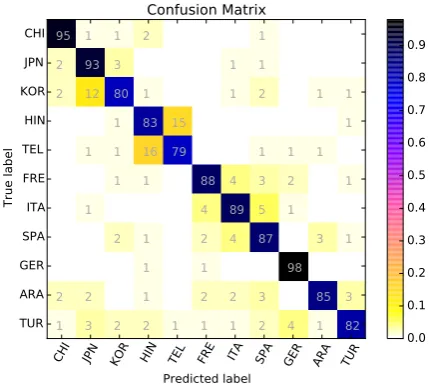
In this track, the best performing model is a lin-ear SVM model trained with word bigrams and character 7-grams (w2c7 model). We explored the effect of using higher order word and charac-ter n-grams for this task by training a linear SVM model on the training data and testing the model on the development data. In the case of develop-ment data, with w2c7 model, we report an accu-racy of84.09 %and an F1 score of84.04 %. The results on the test data for the same model is given in table1. The results suggest that the model per-formed better on the testing data than development data. We also explored the effect of tuning the SVM hyperparameter ‘C’ and found that the F1-score on the development data are not sensitive to the ‘C’ parameter.
System F1 (macro) Accuracy
w2c7 0.871 6 0.871 8 Official baseline 0.710 4 0.710 9 Random baseline 0.090 9 0.090 9
Table 1: The results for word bigrams and charac-ter 7-grams using Linear SVMs for essay task.
CHI JPN KOR HIN TEL FRE ITA SPA GER ARA TUR Predicted label
CHI JPN KOR HIN TEL FRE ITA SPA GER ARA TUR
True label
95 1 1 2 1
2 93 3 1 1
2 12 80 1 1 2 1 1
1 83 15 1
1 1 16 79 1 1 1 1 1 88 4 3 2 1
1 4 89 5 1
2 1 2 4 87 3 1
1 1 98
2 2 1 2 2 3 85 3 1 3 2 2 1 1 1 2 4 1 82
Confusion Matrix
[image:4.595.74.289.183.376.2]0.0 0.1 0.2 0.3 0.4 0.5 0.6 0.7 0.8 0.9
Figure 1: Confusion matrix for theessaytrack.
Italian–Spanish). In the case of Turkish, the model errs uniformly at classifying Turkish instances as instances of other classes.
3.2 Speech task
We submitted two systems in the case of speech task: an LDA classifier based on i-vectors and an SVM classifier based on the combined features of speech transcriptions and i-vectors. We expected that a combination of transcriptions and i-vectors might capture the acoustic features that would dis-criminate the highly confused language pairs such as Hindi–Telugu. However, the F1-scores in table 2 show that i-vectors alone perform better than a combination of transcriptions and i-vectors at NLI task. Although the combination model of tran-scriptions and i-vector features yield an F1-score of81.57 %on the development data, the combined model performs poorly with test data. In contrast, the LDA model trained on i-vectors yielded an F1-score of83.33 %on the test data.
The confusion matrix for the LDA model is presented in figure 2. The results suggest that the model makes most of its mistake at classi-fying Telugu–Hindi language pair. We
hypothe-System F1 (macro) Accuracy
LDA (only i-vectors) 0.833 3 0.833 6
SVM (combined) 0.280 1 0.293 6
Official Baseline
transcriptions 0.543 5 0.546 4
combined 0.798 0 0.798 2
Random Baseline 0.909 0 0.909 0
Table 2: Results of LDA classifier on i-vectors and the results on combined transcriptions and i-vectors.
CHI JPN KOR HIN TEL FRE ITA SPA GER ARA TUR Predicted label
CHI JPN KOR HIN TEL FRE ITA SPA GER ARA TUR
True label
92 3 4 1
2 88 6 2 1 1
3 4 87 3 1 1 1
1 65 34
22 74 1 1 2 1 5 1 84 3 2 4
2 1 4 85 3 2 3 3 3 5 1 83 2 1 2 1 1 1 2 1 94 1 2 1 1 6 5 3 1 76 4
1 1 2 2 1 4 89
Confusion Matrix
0.0 0.1 0.2 0.3 0.4 0.5 0.6 0.7 0.8 0.9
Figure 2: Confusion matrix for thespeechtask (i-vectors only).
sized that i-vectors might be useful to discriminate Telugu–Hindi language pair since they might cap-ture differences between languages that are in con-tact. However, theLDA (only i-vector)model errs more than the essay-based SVM model for the test dataset originating from the same set of individu-als.
3.3 Fusion task
We submitted four systems in this task.
The first system is a Combined feature system is a combination of the following features:
• Word bigrams and character 7-grams from essays (w2c7model)
• Word bigrams from transcriptions
• i-vectors
[image:4.595.306.525.233.425.2]and test data is similar to that of the SVM model trained on essays data. We attribute the improve-ment from essay model SVM mainly to i-vector based features.
Due to the poor performance of the combination of transcriptions and i-vectors, we also explored if reducing the features would improve the per-formance of the model. After exploring different combinations of n-grams in essays and transcrip-tions, we found that the following feature com-bination (a 66 881 dimension vector) yielded an F1-score of88.20 %on the development data and 90.65 %on the test data.
• Both Essays and transcriptions: Word uni-grams andnocharacter n-grams
• i-vectors
The third system is a mean probability ensemble trained on the following features:
• Essays: char ngrams (n ranging from 2–5), word ngrams (n ranging from 1–2), 1-skip word bigram
• Transcripts: word 1gram, 1-skip word bi-gram
• i-vectors
The mean probability ensemble yielded an F1-score of 89.93 % on the development data and a score of91.75 %on the test data. The mean prob-ability ensemble made the most number of mis-takes in classifying Telugu–Hindi language pair but erred less than the essay based SVM model at other language pairs.
The meta classifier described in section 2.3 was trained on the following feature types and yielded an F1-score of90.54 %on the development data.
• essays: character ngrams 2–7, word ngrams 1–2
• transcriptions: word 1-gram
• i-vectors: LDA
The meta classifier performed better than the mean probability ensemble on the development data. This result is in line with the previously re-ported results of Malmasi and Dras(2017). Sur-prisingly, the meta classifier performs worse on the test data.
4 Discussion
In this paper, we described our systems participat-ing in the NLI shared task 2017. We participated in all the three tasks offered during this shared task campaign. We find that word unigram fea-tures in conjunction with i-vectors perform
bet-System F1 (macro) Accuracy Combined system 0.887 1 0.887 3 Simple system 0.906 5 0.906 4 Mean probability ensemble 0.917 5 0.917 3 Meta Classifier 0.848 1 0.848 2 Official Baseline
[image:5.595.307.526.234.425.2]essays and trans. 0.778 6 0.779 1 all 0.790 1 0.790 9 Random Baseline 0.909 0 0.909 0
Table 3: Results of different submissions for Fu-sion track.
CHI JPN KOR HIN TEL FRE ITA SPA GER ARA TUR Predicted label
CHI JPN KOR HIN TEL FRE ITA SPA GER ARA TUR
True label
98 1 1 1 98 1
2 6 90 1 1
1 83 16
21 77 1 1
1 93 2 2 1 1 1 1 4 93 1
2 1 2 94 1
2 98
1 1 3 1 1 91 2
1 4 1 94
Confusion Matrix
0.0 0.1 0.2 0.3 0.4 0.5 0.6 0.7 0.8 0.9
Figure 3: Confusion matrix of Mean probability ensemble for thefusiontrack.
ter than a combination of word or character based higher order n-gram features. We also find that transcription-based features do not improve the performance on the test data as is in the case of the combination system. All the systems make er-rors when discriminating between Hindi vs. Tel-ugu. Another surprising result from experiments is that the Meta Classifier approach does not perform better than the mean probability ensemble which is not in line with the result ofMalmasi and Dras (2017).
is in line with our earlier experiments (C¸¨oltekin and Rama,2016,2017) in a similar task, discrim-inating between similar languages and dialects (Malmasi et al.,2016;Zampieri et al.,2017), our experiments were not exhaustive and it is likely that one can get better results with neural networks with different architectures, and/or more data. Acknowledgements
The first author is supported by the ERC Advanced Grant 324246 EVOLAEMP, which is gratefully acknowledged.
References
Serhiy Bykh and Detmar Meurers. 2014. Exploring Syntactic Features for Native Language Identifica-tion: A Variationist Perspective on Feature Encod-ing and Ensemble Optimization. In Proceedings of COLING 2014, the 25th International Confer-ence on Computational Linguistics: Technical Pa-pers. Dublin, Ireland, pages 1962–1973.
C¸a˘grı C¸¨oltekin and Taraka Rama. 2016. Discriminat-ing Similar Languages with Linear SVMs and Neu-ral Networks. In Proceedings of the Third Work-shop on NLP for Similar Languages, Varieties and Dialects (VarDial3). Osaka, Japan, pages 15–24. C¸a˘grı C¸¨oltekin and Taraka Rama. 2017. T¨ubingen
system in VarDial 2017 shared task: experiments with language identification and cross-lingual
pars-ing. In Proceedings of the Fourth Workshop on
NLP for Similar Languages, Varieties and
Di-alects (VarDial). Valencia, Spain, pages 146–155.
http://www.aclweb.org/anthology/W17-1218. Rong-En Fan, Kai-Wei Chang, Cho-Jui Hsieh,
Xiang-Rui Wang, and Chih-Jen Lin. 2008. LIBLINEAR: A library for large linear classification. Journal of
Machine Learning Research9:1871–1874.
Cyril Goutte, Serge L´eger, and Marine Carpuat. 2013. Feature space selection and combination for native language identification. In BEA@ NAACL-HLT. pages 96–100.
Trevor Hastie, Robert Tibshirani, and Jerome Fried-man. 2009. The Elements of Statistical Learning:
Data Mining, Inference, and Prediction. Springer
series in statistics. Springer-Verlag New York, sec-ond edition.
Radu Tudor Ionescu, Marius Popescu, and Aoife Cahill. 2014. Can characters reveal your native lan-guage? A language-independent approach to native language identification. InProceedings of the 2014 Conference on Empirical Methods in Natural
Lan-guage Processing (EMNLP).
Scott Jarvis, Yves Bestgen, and Steve Pepper. 2013. Maximizing Classification Accuracy in Native Lan-guage Identification. InProceedings of the Eighth Workshop on Innovative Use of NLP for Building
Educational Applications. Atlanta, Georgia, pages
111–118.
Daniel Jurafsky and James H. Martin. 2009. Speech and Language Processing: An Introduction to Nat-ural Language Processing, Computational Linguis-tics, and Speech Recognition. Pearson Prentice Hall, second edition.
Shervin Malmasi. 2016. Native Language Identifica-tion: Explorations and Applications. Ph.D. thesis. http://hdl.handle.net/1959.14/1110919.
Shervin Malmasi and Mark Dras. 2015. Multilingual Native Language Identification. In Natural Lan-guage Engineering.
Shervin Malmasi and Mark Dras. 2017. Native Lan-guage Identification using Stacked Generalization.
arXiv preprint arXiv:1703.06541.
Shervin Malmasi, Keelan Evanini, Aoife Cahill, Joel Tetreault, Robert Pugh, Christopher Hamill, Diane Napolitano, and Yao Qian. 2017. A Report on the 2017 Native Language Identification Shared Task.
In Proceedings of the 12th Workshop on Building
Educational Applications Using NLP. Copenhagen,
Denmark.
Shervin Malmasi, Marcos Zampieri, Nikola Ljubeˇsi´c, Preslav Nakov, Ahmed Ali, and J¨org Tiedemann. 2016. Discriminating between Similar Languages and Arabic Dialect Identification: A Report on the Third DSL Shared Task. InProceedings of the
Var-Dial Workshop. Osaka, Japan.
F. Pedregosa, G. Varoquaux, A. Gramfort, V. Michel, B. Thirion, O. Grisel, M. Blondel, P. Pretten-hofer, R. Weiss, V. Dubourg, J. Vanderplas, A. Pas-sos, D. Cournapeau, M. Brucher, M. Perrot, and E. Duchesnay. 2011. Scikit-learn: Machine learning in Python. Journal of Machine Learning Research 12:2825–2830.
Bj¨orn Schuller, Stefan Steidl, Anton Batliner, Ju-lia Hirschberg, Judee K. Burgoon, Alice Baird, Aaron Elkins, Yue Zhang, Eduardo Coutinho, and Keelan Evanini. 2016. The INTER-SPEECH 2016 Computational Paralinguistics Challenge: Deception, Sincerity & Native Lan-guage. In Interspeech 2016. pages 2001–2005. https://doi.org/10.21437/Interspeech.2016-129. Marcos Zampieri, Shervin Malmasi, Nikola Ljubeˇsi´c,