Improving Claim Stance Classification with Lexical Knowledge
Expansion and Context Utilization
Roy Bar-Haim
IBM Research - Haifa Mount Carmel Haifa, 3498825, Israel [email protected]
Lilach Edelstein
IBM Research - Haifa Mount Carmel Haifa, 3498825, Israel [email protected]
Charles Jochim
IBM Research - Ireland Damastown Industrial Estate
Dublin 15, Ireland [email protected]
Noam Slonim
IBM Research - Haifa Mount Carmel Haifa, 3498825, Israel [email protected]
Abstract
Stance classification is a core compo-nent in on-demand argument construction pipelines. Previous work onclaim stance classificationrelied on background knowl-edge such as manually-composed senti-ment lexicons. We show that both accu-racy and coverage can be significantly im-proved through automatic expansion of the initial lexicon. We also developed a set of contextual features that further improves the state-of-the-art for this task.
1 Introduction
Debating technologiesaim to help humans debate and make better decisions. A core capability for these technologies is the on-demand construction of pro and con arguments for a given controversial topic. Most previous work was aimed at detect-ing topic-dependent argument components, such as claims and evidence (Levy et al.,2014;Rinott et al.,2015). Recently,Bar-Haim et al.(2017) in-troduced the related task ofclaim stance classifi-cation. For example, given the topic
(1) The monarchyshould be abolished.
and the following two claims
(2) Social traditions or hierarchiesare essential for social order.⊕ ⇔
(3) People feel greater dignity when choosing their head of state.⊕ 6⇔
the goal is to classify (2) as Con and (3) as Pro
with respect to (1).
Bar-Haim et al. proposed a model that breaks this task into several sub-tasks: (a) Identify the
sentiment targets of the topic and the claim (b) De-termine the sentiment of the topic and the claim towards their sentiment targets, and (c) Determine the relation between the targets. TargetAis con-sistent/contrastive with targetB if the stance to-wardsAimplies the same/opposite stance towards
B, respectively.
In (1)–(3), targets are marked in bold, posi-tive/negative sentiment is indicated as ⊕/ and consistent/contrastive relation is marked as⇔/6⇔. For instance, (3) has positive sentiment towards its target,choosing their head of state, which implies negative sentiment towards the monarchy, since the targets are contrastive. The topic’s sentiment towardsthe monarchyis also negative, hence it is aProclaim.
On-demand argument generation is inherently an open-domain task, so one cannot learn topic-specific features for stance classification from the training data. Furthermore, claims are short sen-tences, and the number of claims in the training data is relatively small as compared to common sentiment analysis and stance classification bench-marks. Consequently, external knowledge such as sentiment lexicons is crucial for this task. How-ever, the coverage of manually-constructed senti-ment lexicons is often incomplete. As reported by Bar-Haim et al., the sentiment lexicon they used was able to match sentiment terms in fewer than 80% of the claims. Moreover, manually composed sentiment lexicons lack the notion of (numeric) sentiment strength.
A more general limitation of sentiment-based approaches is that some claims express stance but do not convey explicit sentiment. As an example,
consider the followingProclaim for (1):
(4) The people, not the members of one family, should be sovereign.
In this work we present several improvements to the system ofBar-Haim et al.(2017) (henceforth, thebaseline system), which address the above lim-itations. First, we present a method for automatic expansion of a given sentiment lexicon, which leads to a substantial performance increase. Sec-ond, while the baseline system only considers the claim itself, we developed a set of contextual fea-tures that further boosts the performance of the system. In particular, these contextual features al-low classification of claims with no explicit sen-timent. Overall, we outperformed the best pub-lished results for this task by a large margin.
2 Baseline System
We first give a high-level description of the Bar-Haim et al. system, which we build upon in this work. Given a topic t and a claim c, let xt and
xcbe their sentiment targets, respectively, and let
st,sc∈[−1,1]be the sentiment of the topic and the claim towards their respective targets. Posi-tive/negative values indicate posiPosi-tive/negative sen-timent. LetR(xc, xt)∈[−1,1]denote the relation between the claim target and the topic target. Posi-tive/negative values indicate consistent/contrastive targets (as defined in the previous section). The absolute value of both scores indicates confidence. The stance ofctowardstis predicted as:
Stance(c, t) =sc× R(xc, xt)×st (1) Positive/negative prediction indicates Pro/Con
stance. As before, the absolute value indicates confidence. Having an effective confidence mea-sure is important for on-demand argument con-struction, where we typically want to present to the user only high-confidence predictions, or rank them higher in the output.
Bar-Haim et al. assumed that the topic target
xt and sentiment st are given as input, and de-veloped three classifiers for predictingxc, sc and R(xc, xt). The system predicts the stance of the claimctowards the given topic targetxt(e.g.,the
monarchy) assc× R(xc, xt). The result is multi-plied by the given topic target sentimentstto ob-tainStance(c, t).1
1For example, a claim in favor of the monarchyisPro
for“The monarchy should be preserved”, andConfor“The monarchy should be abolished”withst=+1/-1, respectively.
Most relevant to our work is the sentiment clas-sifier, which predicts the sentimentsctowards the targetxc. It is based on matching sentiment terms from a lexicon, detecting polarity flips by senti-ment shifters, and aggregating sentisenti-ment scores for matched terms, which decay based on their dis-tance from the target.
The claim stance classification dataset intro-duced by Bar-Haim et al. includes 2,394 claims, manually found in Wikipedia articles for 55 top-ics, their stance (Pro/Con), and fine-grained anno-tations for targets (xt,xc), sentiments (st,sc) and target relations (R(xc, xt)).
In this dataset, 94.4% of the claims were found to be compatible with the above modeling, out of which 20% of the claims have contrastive targets. Since identifying contrastive targets with high pre-cision is hard, the implemented relation classifier only predictsR(xc, xt)∈[0,1], (i.e., always pre-dictsconsistent). Even so, multiplying by the clas-sifier’s confidence improves the accuracy of top predictions, since it ranks claims with consistent targets higher; this reduces stance classification er-rors caused by contrastive targets.
3 Lexicon Expansion
To obtain a wide-coverage sentiment lexicon that also includes weak sentiment, we took the follow-ing approach. Given a seed lexicon, we trained a classifier to predict the sentiment polarity for unseen words. We trained the classifier over the words in the lexicon, where the feature vector was the word embedding and the label was its polarity. We started with the Opinion Lexicon (Hu and Liu, 2004), used in the baseline system, as a seed sentiment lexicon containing 6,789 words. For word embeddings, we trained a skip-gram model (Mikolov et al.,2013) over Wikipedia, us-ingword2vec. With the 200-dimensional word embedding feature vectors and labels from the lex-icon, we trained a linear SVM classifier (LIBLIN-EAR, Fan et al., 2008). Following Rothe et al. (2016), we only trained on high-frequency words (4,861 words with frequency>300).
After removing single character terms and terms containing non-alphabetic characters, we predicted sentiment for the remaining 938,559 terms with word embeddings. The predicted SVM scores are roughly in[−3,3], and we adapted max-min scaling to return sentiment scores in [−1,1] (the sentiment scores in the seed lexicon are either 1or−1).
To obtain a more compact lexicon, we applied a filtering step using WordNet relations (Miller, 1995;Fellbaum, 1998). For each term in the ex-panded lexicon, we looked up all its synsets. Then, for each of those synsets we collected all terms in the synset along with the terms that are deriva-tionally related, hypernyms, or antonyms. Next, we looked up each of the terms from this collec-tion in the seed lexicon and counted the number of positive and negative matches (the polarity of the antonyms was reversed). If the term had no matches, or the majority count did not agree with the SVM prediction, the term was discarded. This filter drastically reduced the expanded lexicon size to only 28,670 terms (including the seed lexicon), while achieving similar performance on the stance classification task.
4 Contextual Features
Following the assumption that neighboring texts tend to agree on sentiment, we enhanced the sys-tem to use the claim’s context.
We trained a linear SVM classifier, which in-cludes the baseline system (with the expanded lex-icon) as a feature, together with a set of contextual features, described below. Similar to the baseline system, the classifier aims to predict the stance to-wards the topic targetxt, and the result is multi-plied by the givenstto obtainStance(c, t).2
We employed the following features.
Header Features: Each article in Wikipedia is divided into titled sections, subsections and sub-subsections. We assume the sentiment is shared by the section header and the claims presented in the section. For example, a claim under the
“Criticism” section is usually of negative senti-ment, while the header“Advantages”would gov-ern positive claims. We considered the headers of the claim’s enclosing section, subsection and sub-subsection. The sentiment of each header was taken as a feature. In addition, we performed
2Accordingly, the training labels wereStance(c,t)
st .
a Fisher Exact Test (Agresti, 1992) on the train-ing data and composed two short lists of preva-lent header words that were found to be the most significantly associated with positive (or negative) claims in their sections. The difference between the number of positive and negative words appear-ing in the claim’s enclosappear-ing headers was taken as an additional feature.3
Claim Sentence: In some cases, the claim’s en-closing sentence contains helpful cues for the claim polarity (e.g., in: “Unfortunately, it’s clear that <claim>”). Therefore, the sentiment score of the entire sentence also served as a feature.4
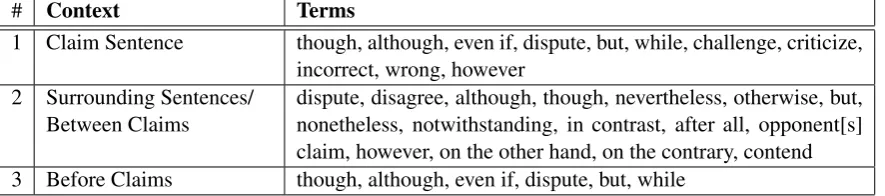
Neighboring Sentences: We computed the aver-age sentiment score of sentences preceding and following the claim sentence in the same para-graph. Specifically, we considered the maximal set of consecutive sentences that do not contain contrastive discourse markers and terms indicat-ing controversy (listed in Table 1, row 2). If the claim sentence itself contained certain terms indi-cating contrast or controversy (Table1, row 1), the context was ignored and the feature value was set to zero.
Neighboring Claims: Neighboring claims tend to agree on sentiment : in article sections that include more than one claim in our training data, 88% of the claims shared the majority polarity. Thus, we clustered the claims so that each pair in the same paragraph shared a cluster unless a term indicat-ing potential polarity flip was found before the two claims or between them. The polarity flip indi-cators considered between/before the claims are listed in Table 1, rows 2/3, respectively. For ex-ample, consider the following claim pairs:
(5) Whileadoption can provide stable families to children in need, it is also suggested that
adoption in the immediate aftermath of a trauma might not be the best option. (6) Democracy is far from perfect. However,
it’s the best form of government created so far.
In both cases, the underlined discourse marker in-dicates a polarity shift between the claims (shown inbold), so the claims are not clustered together. For each claim, we summed the sentiment scores
3The positive words aresupport, benefit, overview, pro,
growth, reform, and the negative words are criticism, anti, failure, abuse, dissent, corrupt, opposite, disadvantage.
4Since the whole sentence is likely to have the same
# Context Terms
1 Claim Sentence though, although, even if, dispute, but, while, challenge, criticize, incorrect, wrong, however
2 Surrounding Sentences/
[image:4.595.80.523.64.162.2]Between Claims dispute, disagree, although, though, nevertheless, otherwise, but,nonetheless, notwithstanding, in contrast, after all, opponent[s] claim, however, on the other hand, on the contrary, contend 3 Before Claims though, although, even if, dispute, but, while
Table 1: Contrast and controversy indicators considered for each context type by theneighboring sen-tencesfeature (rows 1+2), and theneighboring claimsfeature (rows 2+3).
over all other claims in its cluster. Note that this feature requires additional information about other claims for the topic.
5 Evaluation
We followed the experimental setup of Bar-Haim et al., including the train/test split of the dataset and the evaluation measures, and predicted the majority class in the train set with a constant, very low confidence when the classifier’s output was zero. The training set contained 25 topics (1,039 claims), and the test set contained 30 topics (1,355 claims).
The evaluation explored the trade-off between
accuracy (fraction of correct stance predictions) and coverage (fraction of claims for which we make a non-zero prediction). This tradeoff was controlled by setting a minimum confidence threshold for making a prediction. Given a cover-age level β, Accuracy@β is defined as the max-imal accuracy such that the corresponding cover-age is at leastβ, found by exhaustive search over the threshold values. Coverage and accuracy for each threshold are macro-averaged over the tested topics.
The results are summarized in Table 2. Rows (1-2) quote the two best-performing configura-tions reported by Bar-Haim et al. The first is the baseline configuration used in this work, which performed best on lower coverage rates. The sec-ond is a combination of the baseline system and an SVM with unigram features, which was the best performer on higher coverage rates. Row 3 is our rerun of the baseline system. The results are close to the EACL ’17 results (row 1) but not identical. This is due to some changes in low-level tools used by the system, such as the wikifier.5
5As explained byBar-Haim et al.(2017), the baseline
re-sults (rows 1,3) for each coverage level≥ 0.8are the same, since they all add the default majority class predictions.
The configurations in rows 4-6 are the contri-butions of this work. Row 4 reports the results for the baseline system with the expanded lexicon (Section3). Like the baseline system, this config-uration only considers the claim itself. The results show substantial improvements over the baseline (row 3), as well as the best previously reported re-sults (rows 1-2). The expanded lexicon increased the (macro-averaged) coverage of the system from 78.2% to 98.1%.
The next two configurations use increasingly richer contexts, in addition to using the expanded lexicon. Row 5 shows the results for the classi-fier described in Section4, using all the contextual features except for theneighboring claimsfeature. We refer to this feature set aslocal contextual fea-tures. The results show that these features achieve further improvement.
Last, row 6 shows the results for adding the
neighboring claims feature, which achieves the best results. This configuration requires addi-tional knowledge about other claims in the prox-imity of the given claim. While in this experiment the labeled data provides perfect knowledge about neighboring claims, in actual implementations of argument construction pipelines this information is obtained from the imperfect output of a claim detection module.
Overall, our results represent significant ad-vancement of the state-of-the-art for this task, both for lower coverage rates (top predictions) and over the whole dataset ([email protected]).
6 Related Work
Accuracy@Coverage
# Configuration 0.1 0.2 0.3 0.4 0.5 0.6 0.7 0.8 0.9 1.0
[image:5.595.73.525.61.149.2]1 Baseline (EACL’17) 0.849 0.847 0.836 0.793 0.767 0.740 0.704 0.632 0.632 0.632 2 Baselne+SVM (EACL’17) 0.784 0.758 0.749 0.743 0.730 0.711 0.682 0.671 0.658 0.645 3 Baseline (Rerun) 0.846 0.841 0.823 0.787 0.771 0.742 0.706 0.633 0.633 0.633 4 +Lexicon Expansion 0.899 0.867 0.844 0.803 0.765 0.749 0.731 0.705 0.697 0.677 5 +Local Contextual Features 0.935 0.892 0.866 0.833 0.805 0.773 0.749 0.729 0.704 0.690 6 +Neighboring Claims 0.954 0.935 0.882 0.856 0.811 0.776 0.764 0.734 0.708 0.691
Table 2: Stance classification results. Majority baseline [email protected]=51.9%
work has improved stance classification by using the conversation structure (e.g., discussion reply links) (Walker et al.,2012a;Sridhar et al.,2015) or by applying classification to groups of arguments linked by citations or agreement/disagreement (Burfoot et al.,2011;Sridhar et al.,2014). How-ever, many features used in previous works were not available for our task. Instead, we leveraged other context information present in Wikipedia articles, and assume sentiment agreement across neighboring text fragments.
A number of approaches in the literature can generate sentiment lexicons (Hatzivassiloglou and McKeown, 1997; Turney and Littman, 2003), many of which rely on graph-based approaches over WordNet (Hu and Liu, 2004; Esuli and Se-bastiani, 2006; Blair-Goldensohn et al., 2008) or over a graph of distributionally similar n-grams (Velikovich et al., 2010). Our approach (Sec-tion 3) differs in that we leverage larger exist-ing sentiment lexicons, instead of relyexist-ing on small seed sets. Moreover, we opt for classifying word embeddings instead of graph-based approaches, which are sensitive to parameter settings.
More similar recent work includes Amir et al. (2015), who also used manually-created sentiment lexicons (annotated with discrete sentiment lev-els) and word embeddings to train linear regres-sion models that aim to predict the polarity and intensity of new terms. Out of the tested methods,
Support Vector Regression was found to perform best. However, they did not filter the resulting lex-icon.
7 Conclusion
We addressed two of the main limitations of pre-vious work on claim stance classification: insuf-ficient coverage of manually-composed sentiment lexicons, and ignoring the claim’s context. We presented a lexicon expansion method and a set of effective contextual features, which together sig-nificantly advance the state-of-the-art. A
remain-ing challenge is accurate prediction of contrastive targets, which seems crucial for further substantial improvement over the whole dataset.
Acknowledgments
We would like to thank Francesco Dinuzzo for his contribution to the initial stages of this work. We also thank Francesca Bonin for her helpful feed-back on this work.
References
Alan Agresti. 1992. A survey of exact inference for
contingency tables. Statistical sciencepages 131–
153.
Silvio Amir, Ram´on Astudillo, Wang Ling, Bruno Mar-tins, Mario J. Silva, and Isabel Trancoso. 2015. Inesc-id: A regression model for large scale twit-ter sentiment lexicon induction. InProceedings of the 9th International Workshop on Semantic Eval-uation (SemEval 2015). Association for Computa-tional Linguistics, Denver, Colorado, pages 613–
618. http://www.aclweb.org/anthology/S15-2102.
Roy Bar-Haim, Indrajit Bhattacharya, Francesco
Din-uzzo, Amrita Saha, and Noam Slonim. 2017.Stance
classification of context-dependent claims. In Pro-ceedings of the 15th Conference of the European Chapter of the Association for Computational Lin-guistics: Volume 1, Long Papers. Association for Computational Linguistics, Valencia, Spain, pages
251–261.
http://www.aclweb.org/anthology/E17-1024.
Sasha Blair-Goldensohn, Tyler Neylon, Kerry Hannan, George A. Reis, Ryan Mcdonald, and Jeff Reynar. 2008. Building a sentiment summarizer for local
service reviews. InNLP in the Information
Explo-sion Era.
Clinton Burfoot, Steven Bird, and Timothy
Bald-win. 2011. Collective classification of
congres-sional floor-debate transcripts. In Proceedings of the 49th Annual Meeting of the Association for Computational Linguistics: Human Language Tech-nologies. Association for Computational Linguis-tics, Portland, Oregon, USA, pages 1506–1515.
Andrea Esuli and Fabrizio Sebastiani. 2006. SENTI-WORDNET: A publicly available lexical resource
for opinion mining. In Proceedings of the 5th
Conference on Language Resources and Evaluation (LREC ’06). pages 417–422.
Rong-En Fan, Kai-Wei Chang, Cho-Jui Hsieh, Xiang-Rui Wang, and Chih-Jen Lin. 2008. LIBLINEAR: A library for large linear classification. Journal of Machine Learning Research9:1871–1874.
Christiane Fellbaum, editor. 1998. WordNet: An
Elec-tronic Lexical Database. The MIT Press, Cam-bridge, MA.
Kazi Saidul Hasan and Vincent Ng. 2013. Stance
classification of ideological debates: Data,
mod-els, features, and constraints. In Proceedings of
the Sixth International Joint Conference on Natural Language Processing. Asian Federation of Natural Language Processing, Nagoya, Japan, pages 1348–
1356.http://www.aclweb.org/anthology/I13-1191.
Vasileios Hatzivassiloglou and Kathleen R.
McK-eown. 1997. Predicting the semantic
orienta-tion of adjectives. In Proceedings of the 35th
Annual Meeting of the Association for Com-putational Linguistics. Association for Computa-tional Linguistics, Madrid, Spain, pages 174–181. https://doi.org/10.3115/976909.979640.
Minqing Hu and Bing Liu. 2004. Mining and
sum-marizing customer reviews. In Proceedings of
the Tenth ACM SIGKDD International Conference on Knowledge Discovery and Data Mining. ACM, New York, NY, USA, KDD ’04, pages 168–177. https://doi.org/10.1145/1014052.1014073.
Ran Levy, Yonatan Bilu, Daniel Hershcovich, Ehud
Aharoni, and Noam Slonim. 2014. Context
depen-dent claim detection. InProceedings of COLING
2014, the 25th International Conference on Com-putational Linguistics: Technical Papers. Dublin City University and Association for Computational Linguistics, Dublin, Ireland, pages 1489–1500.
http://www.aclweb.org/anthology/C14-1141.
Tomas Mikolov, Ilya Sutskever, Kai Chen, Greg
Corrado, and Jeffrey Dean. 2013. Distributed
representations of words and phrases and
their compositionality. In Proceedings of
the 26th International Conference on Neural Information Processing Systems. Curran As-sociates Inc., USA, NIPS’13, pages 3111–3119. http://dl.acm.org/citation.cfm?id=2999792.2999959.
George A. Miller. 1995. Wordnet: A lexical
database for english.Commun. ACM38(11):39–41.
https://doi.org/10.1145/219717.219748.
Ruty Rinott, Lena Dankin, Carlos Alzate Perez, Mitesh M. Khapra, Ehud Aharoni, and Noam
Slonim. 2015. Show me your evidence - an
au-tomatic method for context dependent evidence
detection. In Proceedings of the 2015
Con-ference on Empirical Methods in Natural Lan-guage Processing. Association for Computational Linguistics, Lisbon, Portugal, pages 440–450. http://aclweb.org/anthology/D15-1050.
Sascha Rothe, Sebastian Ebert, and Hinrich Sch¨utze.
2016. Ultradense word embeddings by orthogonal
transformation. InProceedings of the 2016 Confer-ence of the North American Chapter of the Associ-ation for ComputAssoci-ational Linguistics: Human Lan-guage Technologies. Association for Computational Linguistics, San Diego, California, pages 767–777.
http://www.aclweb.org/anthology/N16-1091.
Swapna Somasundaran and Janyce Wiebe. 2009.
Rec-ognizing stances in online debates. In
Proceed-ings of the Joint Conference of the 47th An-nual Meeting of the ACL and the 4th Interna-tional Joint Conference on Natural Language Pro-cessing of the AFNLP. Association for Computa-tional Linguistics, Suntec, Singapore, pages 226–
234.
http://www.aclweb.org/anthology/P/P09/P09-1026.
Dhanya Sridhar, James Foulds, Bert Huang, Lise
Getoor, and Marilyn Walker. 2015. Joint
mod-els of disagreement and stance in online de-bate. In Proceedings of the 53rd Annual Meet-ing of the Association for Computational Lin-guistics and the 7th International Joint Con-ference on Natural Language Processing (Vol-ume 1: Long Papers). Association for Computa-tional Linguistics, Beijing, China, pages 116–125.
http://www.aclweb.org/anthology/P15-1012.
Dhanya Sridhar, Lise Getoor, and Marilyn Walker.
2014. Collective stance classification of posts in
online debate forums. InProceedings of the Joint
Workshop on Social Dynamics and Personal At-tributes in Social Media. Association for Computa-tional Linguistics, Baltimore, Maryland, pages 109–
117. http://www.aclweb.org/anthology/W14-2715.
Matt Thomas, Bo Pang, and Lillian Lee. 2006. Get out the vote: Determining support or op-position from congressional floor-debate
tran-scripts. In Proceedings of the 2006 Conference
on Empirical Methods in Natural Language Processing. Association for Computational Lin-guistics, Sydney, Australia, pages 327–335. http://www.aclweb.org/anthology/W/W06/W06-1639.
Peter D. Turney and Michael L. Littman.
2003. Measuring praise and criticism:
In-ference of semantic orientation from
associ-ation. ACM Trans. Inf. Syst. 21(4):315–346.
https://doi.org/10.1145/944012.944013.
Leonid Velikovich, Sasha Blair-Goldensohn, Kerry
Hannan, and Ryan McDonald. 2010. The
Human Language Technologies: The 2010 An-nual Conference of the North American Chap-ter of the Association for Computational Lin-guistics. Association for Computational Linguis-tics, Los Angeles, California, pages 777–785.
http://www.aclweb.org/anthology/N10-1119.
Marilyn Walker, Pranav Anand, Rob Abbott, and Ricky
Grant. 2012a. Stance classification using dialogic
properties of persuasion. InProceedings of the 2012 Conference of the North American Chapter of the Association for Computational Linguistics: Human Language Technologies. Association for Computa-tional Linguistics, Montr´eal, Canada, pages 592–
596. http://www.aclweb.org/anthology/N12-1072.
Marilyn A. Walker, Pranav Anand, Rob Abbott, Jean E. Fox Tree, Craig Martell, and Joseph King. 2012b. That is your evidence?: Classifying stance in online
political debate. Decis. Support Syst. 53(4):719–
729. https://doi.org/10.1016/j.dss.2012.05.032. Ainur Yessenalina, Yisong Yue, and Claire Cardie.
2010. Multi-level structured models for
document-level sentiment classification. InProceedings of the 2010 Conference on Empirical Methods in Natu-ral Language Processing. Association for Compu-tational Linguistics, Cambridge, MA, pages 1046–