Predicting Specificity in Classroom Discussion
Luca Lugini and Diane Litman
Computer Science Department & Learning Research and Development Center University of Pittsburgh
Pittsburgh, PA 15260
{lucalugini,litman}@cs.pitt.edu
Abstract
High quality classroom discussion is im-portant to student development, enhancing abilities to express claims, reason about other students’ claims, and retain informa-tion for longer periods of time. Previous small-scale studies have shown that one indicator of classroom discussion quality is specificity. In this paper we tackle the problem of predicting specificity for class-room discussions. We propose several methods and feature sets capable of out-performing the state of the art in specificity prediction. Additionally, we provide a set of meaningful, interpretable features that can be used to analyze classroom discus-sions at a pedagogical level.
1 Introduction
Classroom discussion plays an important role in the learning process. It has been shown that rea-soning, reading, and writing skills can be pos-itively affected by high-quality student-centered classroom discussion in the context of English Language Arts (ELA) classrooms (Reznitskaya and Gregory,2013;Graham and Perin,2007; Ap-plebee et al., 2003). High quality discussions encourage student-to-student talk, negotiation of claims, supporting claims with evidence, and rea-soning about those claims. Although the effective-ness of particular kinds of claims, evidence and reasoning can vary across disciplines, Chisholm and Godley (2011) and Lee (2006) showed that the specificity of these argument moves is related to discussion quality. These findings are based on a largely qualitative analysis of a single classroom discussion that relied on the manual annotation of specificity and discussion quality. The proposed method in this paper will help address this
limita-tion by making the annotalimita-tion of specificity auto-matic.
Specificity is defined by the Oxford Dictionary as “The quality of belonging or relating uniquely to a particular subject”1. Natural language pro-cessing (NLP) techniques can be used to facilitate the analysis of classroom discussion and of speci-ficity. Chen et al. (2014) developed a tool for teacher self-assessment of classroom discussion through the analysis of the frequency of partici-pation of students in the discussion, and teacher-student turn patterns. Blanchard et al. (2016) de-veloped a system for detecting teacher questions from classroom discussion recordings. These works, however, do not take into account the ac-tual student discussion content. Speciteller (Li and Nenkova, 2015) is a current state of the art method for predicting sentence specificity. It was developed by analyzing newspaper articles to dis-tinguish between general and specific sentences. Spoken and written language differ in grammat-ical structure, contextual influence, and cognitive process and skills (Chafe and Tannen,1987;Biber,
1988). As such we believe that using Speciteller as-is on classroom discussions will lead to sub-optimal performance, which we can improve.
In this paper we propose a method to auto-matically determine specificity of student turns at talk in high school ELA classroom discus-sions of texts. The contributions of this paper are twofold. For the educational community this work will enable the exploration of hypotheses concern-ing specificity and discussion quality over large datasets, spanning multiple classes and including a large number of students, which would otherwise require a prohibitive amount of work for manually annotating data. Additionally, we develop a set of pedagogically meaningful features which can be
1https://en.oxforddictionaries.com/definition/specificity
used to understand important elements of highly specific discussions. For the NLP community, we make the following contributions: we experimen-tally evaluate the performance of prior approaches for predicting specificity in a new domain; we compare between different feature sets and algo-rithms; finally, we provide a model for predicting specificity tailored to spoken dialogue and in an educational context, which outperforms the cur-rent state of the art.
2 Related Work
To the best of our knowledge, this is the first work to analyze specificity of spoken dialogue, and more precisely in classroom discussions. Louis and Nenkova (2011) analyzed specificity in news articles and their summarizations. Their proposed method leverages a combination of lexical and syntactic features and annotated data from the Penn Discourse Treebank to train a logistic regres-sion classifier. They used the trained model to analyze differences in specificity between human-written and automatically-generated summaries of news articles. Li and Nenkova (2015) developed Speciteller, a tool for predicting the specificity score of sentences. Specificity was defined in re-lation to the amount of details in a sentence. This tool uses a set of shallow features (described in Section4.2) and two dense word vector represen-tations to train two logistic regression models on Wall Street Journal articles. Additionally, they improved classification accuracy by using a semi-supervised co-training method on over thirty thou-sand sentences from the Associated Press, New York Times, and Wall Street Journal. Finally, Li et al. (2016) improved the annotation scheme used in (Louis and Nenkova, 2011; Li and Nenkova,
2015) by considering contextual information, and by using a scale from 0 to 6 rather than binary specificity annotations. Our annotation scheme is based on prior educational work in coding speci-ficity (Chisholm and Godley,2011), and our pre-diction models will incorporate features used by Speciteller.
Like other machine learning-based methods, Speciteller is highly dependent on its training data. Since our objective is to analyze classroom dis-cussion, we also draw on work that has used Spe-citeller to analyze data that is more similar to our corpus. Swanson et al. (2015) analyzed online fo-rum dialogues in the context of argument mining.
By performing feature selection they observed that argument quality is highly correlated with speci-ficity as measured by Speciteller across multiple topics. We believe there might be a correlation be-tween specificity and other features used in their work (described in Section 4.3) to predict argu-ment quality, therefore we used some of these fea-tures in our approach.
3 Dataset Description
The dataset for this work consists of manually transcribed text-based classroom discussions from English Language Arts high school classes. Text-based discussions are about a “text” (e.g., litera-ture such as Macbeth and Memoir of a Geisha, a news article, a speech, etc.) and can either be mediated by a teacher or conducted exclusively among students. The number of students per dis-cussion ranges from 5 to 13 in our dataset.
Motivated by Chisholm and Godley’s (2011) and Lee’s (2006) coding of classroom discussions, a codebook for manually annotating student argu-ment moves and specificity has been developed. Each student turn at talk is labeled for: (i) speci-ficity (low, medium, high); (ii) argument move (claim, evidence, warrant). Specificity was labeled at the level of argument move: each transcript was preprocessed by one of the annotators and a deci-sion was made on whether to segment each turn at talk into multiple ones if the turn at talk could potentially contain multiple argument move types. The following aspects were considered when la-beling specificity for a turn at talk:
1. it involves one character or scene;
2. it gives substantial qualifications or elabora-tion;
3. it uses content-specific vocabulary; 4. it provides a chain of reasons.
If none of the four elements was present, or if the turn at talk refers to all humans or the text in gen-eral, the turn at talk is labeled as low specificity. Medium specificity turns at talk contain one of the four elements, while high specificity ones contain at least two of the four elements.
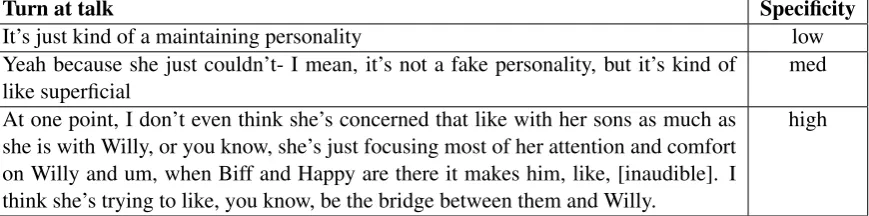
Turn at talk Specificity
It’s just kind of a maintaining personality low
Yeah because she just couldn’t- I mean, it’s not a fake personality, but it’s kind of
like superficial med
At one point, I don’t even think she’s concerned that like with her sons as much as she is with Willy, or you know, she’s just focusing most of her attention and comfort on Willy and um, when Biff and Happy are there it makes him, like, [inaudible]. I think she’s trying to like, you know, be the bridge between them and Willy.
[image:3.595.84.519.65.173.2]high
Table 1: Examples of turns at talk for different specificity classes.
unsubstantiated. The student did not give a defini-tion of what maintaining personality means in this context, nor did they mention the reasons for mak-ing such a claim. The second turn at talk in the table, although not providing considerable elab-oration, is clearly about one individual character in the book. As such, it is classified as medium specificity. The third turn at talk is classified as high specificity because the statement is particular to one or a few selected characters, and the student shows a clear chain of reasoning.
The dataset spans23classroom discussions and over 2000 turns at talk. Two pairs of annota-tors coded specificity for 5 and 9 transcripts re-spectively, while the remaining 9 transcripts were single-coded. Inter-rater reliability on specificity labels for the two annotator pairs as measured by quadratic-weighted Cohen’s Kappa is 0.714 and
0.9, indicating substantial agreement and almost perfect agreement, respectively.2 A gold standard set of labels for each double-coded discussion was obtained by resolving the disagreements between the two annotators. Table2shows the distribution of specificity classes in our dataset.
Turns at talk Low Medium HighSpecificity
2057 730 974 353
Table 2: Dataset statistics.
4 Proposed Method
This section provides a description of Speciteller (Li and Nenkova, 2015) and additional features and models that we propose to predict specificity.
2Although argument move types are not used in our study, Kappa for the two annotator pairs were0.75and0.89.
4.1 Speciteller tool
The baseline for testing our hypotheses consists of using Speciteller out of the box to predict the specificity of each turn at talk. Speciteller accepts a string as input and outputs a specificity score in the range[0,1], where 0 indicates general sen-tences and 1 indicates specific sensen-tences. Since the unit of analysis for the current work is a turn at talk, which may consist of multiple sentences, we evaluated the performance of Speciteller in several scenarios (e.g. sentence, turn at talk). We found that the best results are obtained when using the complete turn at talk as input to Speciteller. In or-der to convert the numeric specificity score into a specificity class (i.e. low, medium, or high) we set two thresholdst1 andt2, then labeled turns at
talk with specificity score s ≤ t1 as low, those
with score t1 < s ≤ t2 as medium, and those
with scores > t2as high. The optimal thresholds
were found by starting at0and iteratively increas-ing them by0.001at each step, while saving the best results. The values for the optimal thresholds are: t1 = 0.02 andt2 = 0.78. It is important to
note that this represents the upper bound for Spe-citeller’s performance. Finding the optimal thresh-olds is not trivial and in practice it could be done through cross-validation.
4.2 Speciteller feature set
set. Shallow features for each sentence consist of: number of connectives, sentence length (number of words), number of numbers, number of capi-tal letters, number of symbols (including punctua-tion), average number of characters for the words in the sentence, number of stopwords (normalized by sentence length), number of strongly subjec-tive and polar words (using the MPQA (Wilson et al., 2009) and the General Inquirer (Stone and Hunt,1963) dictionaries), average word familiar-ity and imageabilfamiliar-ity (using the MRC Psycholin-guistic Database (Wilson, 1988)), average, maxi-mum, minimum inverse document frequency val-ues. Word embeddings features consist of the av-erage of 100-dimensional vectors for each word in the sentence. The embeddings were provided by Turian et al. (2010) and trained on a corpus con-sisting of news articles.
4.3 Online dialogue features
While extracting arguments from online forum di-alogues, Swanson at al. (2015) found that Spe-citeller scores (as a measure of specificity) are highly correlated with argument quality. In addi-tion to Speciteller scores, their model used several feature sets. While not explicitly stated by the au-thors, we believe there might exist a correlation between specificity and the other feature sets. We will add the following sets of features to the fea-tures already present in Speciteller.
Semantic features4 The number of pronouns present in a given turn at talk. Descriptive statis-tics for word lengths: minimum, maximum, av-erage, and median length of the words in a turn at talk. It is worth noting that the average word length differs from the one implemented in Spe-citeller as this feature keeps punctuation into ac-count. Number of occurrences of words of length 1 to 20: one feature for each word length - words longer than 20 characters will be counted in the feature for length 20.
Lexical features N-gram language models are often powerful features, but one drawback is their dependence on specific domains. Since we plan to build a model for predicting specificity which is able to generalize to multiple topics, we did not use the raw N-gram features. To alleviate this problem, we used the term frequency - inverse document frequency (tf-idf) feature for each uni-4The name of the feature set in the original paper is semantic-density features; we use semantic features for brevity.
gram and bigram in the corpus with frequency of at least 5. Descriptive statistics of lexical features for each turn at talk, namely minimum, maximum, and average, were also used.
Syntactic features To mitigate the data sparsity that impacts word n-grams, and to get more gener-alizable features, we extracted unigrams, bigrams, and trigrams of Parts Of Speech (POS) tags, using the Natural Language Toolkit (Bird et al.,2009).
4.4 Additional feature sets
In addition to the previous feature sets, we also extracted the following feature sets which we be-lieve are able to capture specificity with respect to the educational domain of ELA text-based class-room discussions.
Pronoun features Pronouns are grammatical units that might help us gain useful information about the focus of a turn at talk. For example, if the pronoun “she” is present in a turn at talk, the student might likely be referring to one spe-cific character, which is one of the aspects con-sidered when annotating specificity. Therefore we extracted a set of the following pronoun features: binary feature indicating presence/absence of pro-nouns; total number of pronouns in the turn at talk5; the numbers of first, second, and third per-son pronouns; the number of singular and plural pronouns; the number of pronouns for each of the following categories: personal, possessive, reflex-ive, reciprocal, relatreflex-ive, demonstratreflex-ive, interroga-tive, indefinite.
length of the turn at talk, for each of them.
Book features Since our dataset consists of text-based discussions, we might be able to lever-age information about the texts (i.e. books) for each discussion to understand how much each turn at talk is related to the book or its characters. First, a manually-created summary and a list of charac-ters for each book were obtained from the web, us-ing Wikipedia when possible or Sparknotes as an alternative. Then, the following character-related features were extracted from each turn at talk: a binary feature indicating the presence/absence of a character’s name; the number of characters men-tioned; the number of characters mentioned nor-malized by the length of the turn at talk. A charac-ter was counted by matching each word in the turn at talk to their first name, last name, or their nick-name. Additionally the following summary re-lated features were extracted: the number of over-lapping words with the turn at talk; Jaccard simi-larity between the turn at talk and the summary; tf-idf based cosine similarity between the summary and the turn at talk. We extracted the summary related features in two different settings: consider-ing the book summary as a sconsider-ingle entity; comput-ing the similarity between the turn at talk and each sentence in the summary, then picking the maxi-mum. All features were extracted after removing stopwords from the turn and summary.
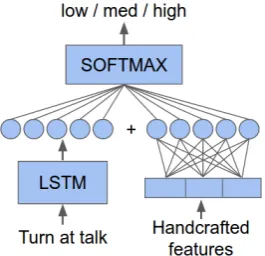
Embeddings Li and Nenkova (2015) used sen-tence embeddings based on word embeddings in order to increase the accuracy of Speciteller. The sentence embeddings were obtained by comput-ing the average of pre-trained word embeddcomput-ings for each word in the sentence. We believe our method can further benefit from sentence em-beddings specifically trained on our corpus and optimized for our target: predicting specificity. We generated embeddings by training a character-level Long-Short Term Memory (LSTM) network (Hochreiter and Schmidhuber, 1997), using it as an encoder on the turns at talk from our corpus. Each turn at talk, which might consist of multiple sentences, represents one sequence (training sam-ple) for the LSTM training. Since punctuation is not very meaningful given that we are analyzing spoken discussions, all characters that are not let-ters or numbers are ignored. Inputs for the LSTM consist of one-hot (1 X N) encoding of individual characters.
The neural network is trained by using the
hid-Figure 1: Network setup for training neural network-based embeddings.
den state of the LSTM unit at the end of the turn at talk as embedding, feeding it to a soft-max classifier for predicting specificity, and back-propagating errors. Cross-entropy was used as the objective function to optimize during training. A disadvantage of neural network models is the fact that their large number of parameters requires ex-tensive amount of data to show their expressive power. Given the size of our training data we try to mitigate this problem by merging the embeddings for a turn at talk with handcrafted features. Ideally we would combine embeddings with all the fea-tures described previously but the resulting model would be far too large for our dataset, therefore we chose to use theSpeciteller+Semanticfeature set for this task. The training procedure changes slightly: a turn at talk is propagated through the LSTM resulting in a fixed size embedding; hand-crafted features are extracted from the turn at talk, concatenated to form a vector, and a fully-connected layer is applied to those; the output of the fully-connected layer is concatenated with the embedding, and given as input to a softmax classi-fier to predict specificity. A graphical overview of the model is given in Figure1.
It is important to note that the neural net-work for embeddings and the classifier are jointly trained, therefore the embeddings are specifically tailored to encode information regarding speci-ficity. The Keras library (Chollet et al.,2015) was used for extracting sentence embeddings as well as for evaluating performance of the softmax clas-sifier.
[image:5.595.351.484.63.191.2]as-pects of highly specific discussions. Many of the features described above, like N-grams or tf-idf, might have good predictive power but they are not easily interpretable and bear little relation to our codebook.
When considering NLP techniques applied to the educational domain, there is an increasing in-terest in developing models that capture important components of the construct to measure. Rahimi et al. (2017), for example, developed a model for automated essay scoring using rubric-based fea-tures; Loukina et al. (2015) evaluated different feature selection methods to obtain interpretable features in an educational setting.
In order to create an interpretable feature set we started by manually selected meaningful fea-tures from Speciteller (imageability, subjectivity, polarity, and familiarity ratings, number of con-nectives, fraction of stopwords). At training/test time, this set is combined with features from the
Pronoun, Named entities, and Book feature sets. Since all the features from the last 3 sets are inter-pretable, we only chose a few features from each set, selecting the ones with highest information gain with respect to specificity. For each fold, we first rank features in thePronoun,Named entities, andBooksets by information gain, then select the top k (based on the number of features in each re-spective set), concatenate them to the interpretable Speciteller features and train a logistic regression model. Section 5.4 will give examples of selected features.
5 Experiments and Results
In this section we provide results for our ex-periments. All classifiers and feature sets were evaluated using 10-fold cross validation, and us-ing quadratic-weighted Cohen’s kappa as the per-formance metric since it is important to make a distinction between different classification errors (e.g. classifying a low specificity turn at talk as high should result in bigger error than classifying it as medium). We used the scikit-learn Python package6for training and evaluating classifiers, as well as performing feature selection. Specifically, sections 5.1 and 5.2 will be used to test our first hypothesis: that by retraining an existing model on our corpus we will obtain an improvement in performance. Sections 5.2 and 5.3 will be used to test our second hypothesis: that by using
[image:6.595.308.524.60.230.2]fea-6http://scikit-learn.org/stable/
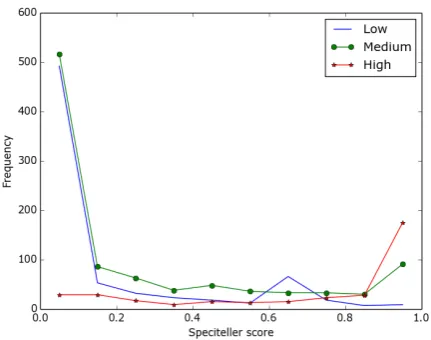
Figure 2: Speciteller scores by specificity class.
tures from additional NLP literature we can fur-ther improve the performance of a state-of-the-art model. Section 5.4 will test our third hypothesis: that the additional features we handcrafted to cap-ture specificity with respect to verbal discussion in an educational setting will lead to better perfor-mance.
5.1 Baseline using Speciteller off-the-shelf
Since we plan to use Speciteller as a baseline for comparing the performance of our proposed method, we iteratively tested thresholds to find the set which results in the highest quadratic-weighted kappa in all scenarios described in Section 4.1. The best result was obtained when the input to Speciteller is the complete turn at talk, and the re-sulting quadratic-weighted kappa is0.495, which represents Speciteller’s upper bound performance. Figure2shows the frequency distribution of spe-citeller scores for each specificity class.
will further penalize accuracy.
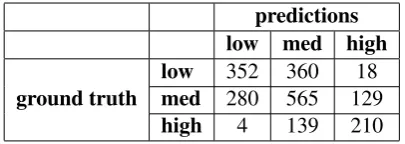
Table 3 shows the confusion matrix when ap-plying the optimal thresholds in order to get speci-ficity labels from Speciteller scores. As we can see from the confusion matrix the overlap be-tween the low and medium specificity classes and the medium and high specificity classes causes a large number of misclassifications: almost half of the low specificity turns at talk are classified as medium, over40%of the medium specificity turns at talk are classified as either low or high, and al-most40%of high specificity turns at talk are clas-sified as medium. We believe these errors stem from two main reasons: as with many data-driven approaches, Speciteller is highly dependent on its training corpus. Speciteller was trained on articles from the Wall Street Journal and the New York Times. Articles written by professional writers are inherently different from transcriptions of spoken discussions between high school students. Addi-tionally, for training the model, Speciteller used a binary general/specific label, while we consider three labels in our work. Since Speciteller has no prior knowledge on medium specificity sentences, it is understandable that most of the misclassifica-tions come from this class.
5.2 Training using Speciteller features
Our hypotheses as to why Speciteller does not work effectively out of the box are related to its corpora and the way it was trained. With respect to the features used by Speciteller, we believe they might be useful in the context of classroom discus-sion as well. We extracted the shallow feature set and the neural network word embeddings feature sets and combined them to train a logistic regres-sion classifier on our dataset. This classifier was chosen because one of our objectives is to compare the importance of other feature sets in addition to theSpeciteller one, and in order for this compar-ison to be fair we decided to use the same clas-sifier Speciteller uses. Additionally, the clasclas-sifier
predictions low med high
ground truth lowmed 352 360280 565 12918
high 4 139 210
Table 3: Confusion matrix using Speciteller scores to classify according to the optimal split points.
weights can be used to understand the importance of each feature. It is important to note that, un-like Speciteller, we will be using a single classifier on the combination of all features, and will not be able to leverage semi-supervised co-training.
Table4shows the performance of a logistic re-gression classifier trained on this feature set and others described in the previous section. As we
Feature sets QWKappa
Speciteller 0.5758
Speciteller + Online dialogue 0.6347* All: Speciteller + Online
dia-logue + Pronoun + NE + Book 0.6360* Speciteller + Semantic +
Em-beddings 0.6550*
Pedagogical 0.5886
Table 4: Classification performance of different feature sets. * indicates statistically significant im-provement over Speciteller features with p-value <0.001. Statistical significance was tested using a two-tailed paired t-test. Bold font highlights best results.
can see from the table, training a classifier using the Speciteller feature set on our corpus results in a considerable increase in performance, with QWKappa of 0.5758 which represents a16% rel-ative improvement over the 0.495 QWKappa ob-tained using Speciteller out of the box. This con-firms our first hypothesis that Speciteller’s perfor-mance, like many other methods, is highly depen-dent on its training corpus and using this model out of the box would give sub-optimal results.
5.3 Speciteller and online dialogue features
[image:7.595.308.525.185.300.2] [image:7.595.80.283.658.730.2]num-ber of features is over 7000, we also tried using Recursive Feature Elimination (RFE) and Princi-pal Component Analysis (PCA) for feature selec-tion/reduction, but neither improved performance.
5.4 Additional features
To the feature set described in the previous section, we added the features described in Section 4.4. We then tested our third hypothesis by evaluating the performance of a logistic regression model trained with these features.
We can see from Table 4 that all additional feature sets yield better performance than the Speciteller feature set by itself. This result con-firms our third hypothesis: the additional fea-ture sets are able to capfea-ture aspects of speci-ficity with respect to verbal discussion and the educational domain. In particular the feature set containing neural network-based sentence embed-ding achieved the best kappa measure of 0.6550, which suggests that sentence embeddings are also domain-dependent. Compared to using Speciteller off-the-shelf this method improves kappa by32%. While the size of the neural network was constant during training/test (not optimized for each fold), we experimented with several numbers of hidden nodes (ranging from 50 to 200) for the LSTM and fully-connected layers, which resulted in kappa values in the range0.6283−0.6550.
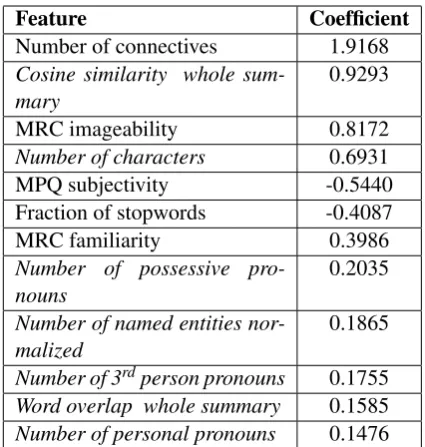
The Pedagogical feature set is also able to marginally outperform the Speciteller feature set. Compared to the best result, the loss in kappa when using the Pedagogical set is 11%. At the expense of a slightly lower accuracy we gain the ability to use only informative features, which can be used to better understand highly specific versus general classroom discussions. The use of logistic regression also makes this possible: the model’s coefficients give us an indication of how important features are. Table5shows the top 12 features in the Pedagogical feature set ranked by the magni-tude of the model’s coefficients.
The table shows the results of a model trained on the complete dataset. The number of connec-tives seems to be the most important feature for predicting high specificity. This seems straight-forward, as more connectives translates into more clauses, which provide more information. While the annotators did not look for connectives dur-ing coddur-ing, one of the aspects they analyzed was the presence/absence of a chain of reasoning, and
Feature Coefficient
Number of connectives 1.9168
Cosine similarity whole
sum-mary 0.9293
MRC imageability 0.8172
Number of characters 0.6931
MPQ subjectivity -0.5440
Fraction of stopwords -0.4087
MRC familiarity 0.3986
Number of possessive
pro-nouns 0.2035
Number of named entities
nor-malized 0.1865
Number of 3rdperson pronouns 0.1755
Word overlap whole summary 0.1585
[image:8.595.310.523.60.284.2]Number of personal pronouns 0.1476 Table 5: Pedagogical feature set and respective logistic regression coefficients. Italic font shows features developed in this study (Section 4.4).
the number of connectives might capture that as-pect. The cosine similarity between the turn at talk and the book summary (considered as one entity) is another important feature in the model: higher similarity between the summary and what a stu-dent says means that they are using terms from the book. This feature seems to capture another aspect in our codebook, the use of book-specific vocabu-lary. We can use the information provided by these features to understand specificity, and to give feed-back to teachers and students: if for example a stu-dent tends to produce low specificity turns at talk and the number of connectives used is generally low, that might be an indication that they should elaborate more on their statements. Conversely, if the number of connectives used is high but the number of characters mentioned is low, that might be an indication that the student should reference specific characters more often.
6 Conclusions and Future Work
com-bined with neural network embeddings and other new features tailored to text-based classroom dis-cussion. Finally we proposed a subset of peda-gogical features which, even though slightly less performing, provide the ability to interpret the fea-tures, which is especially important for the educa-tional community.
As more data becomes available, we will ex-plore more advanced neural network models and examine method generalization (e.g., social sci-ence vs. ELA, middle vs. high school). We also plan to analyze features at a finer granularity than a turn at talk and to extract the book summary fea-tures automatically from the original texts. Since our dataset is already annotated for argument type, and will be annotated for discussion quality, we plan to investigate relationships between speci-ficity, argumentation, and quality.
Acknowledgements
We want to thank Dr. Amanda Godley, Christo-pher Olshefski, Zane Denmon, Zinan Zhuang, Clare Miller, Keya Bartolomeo, and Annika Swallen for their contribution, and all the anony-mous reviewers for their helpful suggestions.
This work was supported by the Learning Re-search and Development Center at the University of Pittsburgh.
References
Arthur N Applebee, Judith A Langer, Martin Nystrand, and Adam Gamoran. 2003. Discussion-based ap-proaches to developing understanding: Classroom instruction and student performance in middle and
high school english. American Educational
Re-search Journal, 40(3):685–730.
Douglas Biber. 1988. Variation across speech and
writing. Cambridge University Press.
Steven Bird, Ewan Klein, and Edward Loper. 2009. Natural language processing with Python: analyz-ing text with the natural language toolkit. ” O’Reilly Media, Inc.”.
Nathaniel Blanchard, Patrick J Donnelly, Andrew M Olney, Borhan Samei, Brooke Ward, Xiaoyi Sun, Sean Kelly, Martin Nystrand, and Sidney K DMello. 2016. Identifying teacher questions using automatic
speech recognition in classrooms. In 17th Annual
Meeting of the Special Interest Group on Discourse and Dialogue, page 191.
W. Chafe and D. Tannen. 1987. The relation between
written and spoken language. Annual Review of
An-thropology, 16(1):383–407.
G Chen, SN Clarke, and LB Resnick. 2014. An ana-lytic tool for supporting teachers reflection on
class-room talk. In Learning and becoming in
prac-tice: The International Conference of the Learning Sciences (ICLS) 2014. International Society of the Learning Sciences.
James S Chisholm and Amanda J Godley. 2011. Learn-ing about language through inquiry-based discus-sion: Three bidialectal high school students talk about dialect variation, identity, and power. Journal of Literacy Research, 43(4):430–468.
Franc¸ois Chollet et al. 2015. Keras. https://
github.com/fchollet/keras.
Jenny Rose Finkel, Trond Grenager, and Christopher Manning. 2005. Incorporating non-local informa-tion into informainforma-tion extracinforma-tion systems by gibbs
sampling. InProceedings of the 43rd annual
meet-ing on association for computational lmeet-inguistics, pages 363–370. Association for Computational Lin-guistics.
Steve Graham and Dolores Perin. 2007. A meta-analysis of writing instruction for adolescent
students. Journal of Educational Psychology,
99(3):445–476.
Sepp Hochreiter and J¨urgen Schmidhuber. 1997.
Long short-term memory. Neural computation,
9(8):1735–1780.
Carol D Lee. 2006. every good-bye aint gone: ana-lyzing the cultural underpinnings of classroom talk. International Journal of Qualitative Studies in Edu-cation, 19(3):305–327.
Junyi Jessy Li and Ani Nenkova. 2015. Fast and accu-rate prediction of sentence specificity. In Proceed-ings of the Twenty-Ninth Conference on Artificial In-telligence (AAAI), pages 2281–2287.
Junyi Jessy Li, Bridget ODaniel, Yi Wu, Wenli Zhao, and Ani Nenkova. 2016. Improving the annotation of sentence specificity. InProceedings of the Tenth International Conference on Language Resources and Evaluation (LREC).
Annie Louis and Ani Nenkova. 2011. General versus specific sentences: automatic identification and ap-plication to analysis of news summaries. Technical Report MS-CIS-11-07, University of Pennsylvania. Anastassia Loukina, Klaus Zechner, Lei Chen, and
Michael Heilman. 2015. Feature selection for au-tomated speech scoring. InProceedings of the Tenth Workshop on Innovative Use of NLP for Building Educational Applications, pages 12–19.
Zahra Rahimi, Diane Litman, Richard Correnti, Elaine Wang, and Lindsay Clare Matsumura. 2017. As-sessing students use of evidence and organization in response-to-text writing: Using natural language
processing for rubric-based automated scoring.
Alina Reznitskaya and Maughn Gregory. 2013. Stu-dent thought and classroom language: Examining
the mechanisms of change in dialogic teaching.
Ed-ucational Psychologist, 48(2):114–133.
Philip J Stone and Earl B Hunt. 1963. A computer ap-proach to content analysis: studies using the general
inquirer system. InProceedings of the May 21-23,
1963, spring joint computer conference, pages 241– 256. ACM.
Reid Swanson, Brian Ecker, and Marilyn Walker. 2015. Argument mining: Extracting arguments from
on-line dialogue. In Proceedings of the 16th Annual
Meeting of the Special Interest Group on Discourse and Dialogue, pages 217–226.
Joseph Turian, Lev Ratinov, and Yoshua Bengio. 2010. Word representations: a simple and general method for semi-supervised learning. InProceedings of the 48th annual meeting of the association for compu-tational linguistics, pages 384–394. Association for Computational Linguistics.
Michael Wilson. 1988. Mrc psycholinguistic database:
Machine-usable dictionary, version 2.00. Behavior
Research Methods, 20(1):6–10.