UTU: Disease Mention Recognition and Normalization with CRFs and
Vector Space Representations
Suwisa Kaewphan1,2,3∗, Kai Hakaka1∗, Filip Ginter1 1 Dept. of Information Technology, University of Turku, Finland
2Turku Centre for Computer Science (TUCS), Turku, Finland
3The University of Turku Graduate School (UTUGS), University of Turku, Finland
[email protected], [email protected], [email protected]
Abstract
In this paper we present our system par-ticipating in the SemEval-2014 Task 7 in both subtasks A and B, aiming at recognizing and normalizing disease and symptom mentions from electronic medi-cal records respectively. In subtask A, we used an existing NER system, NERsuite, with our own feature set tailored for this task. For subtask B, we combined word vector representations and supervised ma-chine learning to map the recognized men-tions to the corresponding UMLS con-cepts. Our system was placed 2nd and 5th out of 21 participants on subtasks A and B respectively showing competitive perfor-mance.
1 Introduction
The SemEval 2014 task 7 aims to advance the de-velopment of tools for analyzing clinical text. The task is organized by providing the researchers an-notated clinical records to develop systems that can detect the mentions of diseases and symptoms in medical records. In particular, the SemEval task 7 comprises two subtasks, recognizing the men-tions of diseases and symptoms (task A) and map-ping the mentions to unique concept identifiers that belong to the semantic group of disorders in the Unified Medical Language System (UMLS).
Our team participated in both of these sub-tasks. In subtask A, we used an existing named entity recognition (NER) system, NERsuite, sup-plemented with UMLS dictionary and normaliza-tion similarity features. In subtask B, we com-bined compositional word vector representations
∗These authors contributed equally.
This work is licensed under a Creative Commons At-tribution 4.0 International Licence. Page numbers and pro-ceedings footer are added by the organisers. Licence details: http://creativecommons.org/licenses/by/4.0/
with supervised machine learning to map the rec-ognized mentions from task A to the UMLS con-cepts. Our best systems, evaluated on strict match-ing criteria, achieved F-score of 76.6% for the sub-task A and accuracy of 60.1% for the subsub-task B, showing competitive performance in both tasks.
2 Task A: Named Entity Recognition with NERSuite
The ML approach based on conditional random fields (CRFs) has shown to have state-of-the-art performance in recognizing the biological entities. We thus performed task A by using NERsuite, an existing NER toolkit with competitive perfor-mance on biological entity recognition (Campos et al., 2013).
NERsuite is a NER system that is built on top of the CRFsuite (Okazaki, 2007). It con-sists of three language processing modules: a to-kenizer, a modified version of the GENIA tagger and a named entity recognizer. NERsuite allows user-implemented features in addition to dictio-nary matching and features shown to benefit the systems such as raw token, lemma, part-of-speech (POS) and text chunk.
Prior to detecting the disease mentions by the recognizer module of NERsuite, the clinical text is split into sentences by using GENIA Sentence Splitter, a supervised ML system that is known to be well optimized for biomedical texts (Sætre et al., 2007). The sentences are subsequently tok-enized and POS tagged.
To represent the positive entities, the “BIO” model was used in our system. The first tokens of positive mentions are labeled with “B” and the rest with “I”. Negative examples, non-entities, are thus labeled with “O”. This model was used for both contiguous and discontiguous entities.
The features include the normalization similar-ity (see Section 3.3), types of medical records ( dis-charge,echo,radiologyandecg), and UMLS
Trained Model Precision Recall F-score
train + positive samples 77.3% 72.4% 74.8% train + development 76.7 % 76.5% 76.6%
Table 1: The results of our different NERsuite models, announced by the organizers.
tionary matching in addition to NERsuite’s own feature generation.
The UMLS dictionary is prepared by extract-ing the UMLS database for the semantic types de-manded by the task. In addition to those 11 seman-tic types, “Finding” was also included in our dic-tionary since, according to its definition, the con-cept is also deemed relevant for the task. Due to the common use of acronyms, which are not ex-tensively provided by UMLS, we also extended the coverage of our prepared UMLS dictionary by extracting medical acronyms from the UMLS database using regular expression.
We assessed the effect of dictionary matching by training the models with and without the com-piled UMLS dictionary and evaluating against the development set. The model trained with dictio-nary features outperformed the one without. The best model was obtained by training the NERsuite with UMLS dictionary in case-number-symbol normalization mode. In this mode, all letters, numbers and symbols are converted to lower case, zero (0) and underscore ( ) respectively.
The regularization parameter (C2) was selected by using development set to evaluate the best model. The default parameter (C2 = 1.0) gave the best performing system and thus was used throughout the work.
Finally, for the NER task, we submitted two models. The first model was trained with the orig-inal training data and duplicates of sentences with at least one entity mention. The second model was trained by using the combination of the first model’s training data and development set.
2.1 Results and Discussions
Our NER system from both submissions benefited from the increased number of training examples while the more diverse training data set gave a bet-ter performance. The official results are shown in table 1.
The analysis of our best performing NER sys-tem is not possible since the gold standard of the test data is not publicly available. We thus simply analyze our second NER system based on the
eval-uation on the development data. The F-score of the system was 75.1% and 88.0% for the strict and re-laxed evaluation criteria respectively. Among all the mistakes made by the system, the discontigu-ous entities were the most challenging ones for the NERsuite. In development data, the discontiguous entities contribute about 10% of all entities, how-ever, only 2% were recognized correctly. On the contrary, the system did well for the other types as 73% were correctly recognized under strict crite-ria. This demonstrates that the “BIO” model has limitations in representing the discontiguous enti-ties. Improving the model to better represent the discontiguous entities can possibly boost the per-formance of the NER system significantly.
3 Task B: Normalization with
Compositional Vector Representations Our normalization approach is based on con-tinuous distributed word vector representations, namely the state-of-the-art method word2vec (Mikolov et al., 2013a). Our word2vec model was trained on a subset of abstracts and full ar-ticles from the PubMed and PubMed Central re-sources. This data was used as it was readily available to us from the EVEX resource (Van Lan-deghem et al., 2013). Before training, all non-alphanumeric characters were removed and all to-kens were lower-cased. Even though a set of unan-notated clinical reports was provided in the task to support unsupervised learning methods, our ex-periments on the development set showed better performance with the model trained with PubMed articles. This might be due to the size of the cor-pora, as the PubMed data included billions of to-kens whereas the provided clinical reports totaled in over 200 million tokens.
The dimensionality of the word vectors was set to 300 and we used the continuous skip-gram ap-proach. For other word2vec parameters default values were used.
We then formed a lexicon including all preferred terms and synonyms of all the concepts in the subset of UMLS defined in the task guidelines. This lexicon is a mapping from the compositional vector representations of the concept names into the corresponding UMLS identifiers. To select the best concept for a recognized entity we calculated cosine similarity between the vector representa-tion of the given entity and all the concept vectors in the lexicon and the concept with the highest similarity was chosen.
Word2vec is generally able to relate different forms of the same word to each other, but we no-ticed a small improvement in accuracy when pos-sessive suffixes were removed and all tokens were lemmatized.
3.1 Detecting CUI-less Mentions
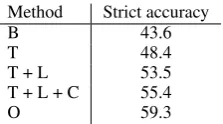
As some of the mentions in the training data do not have corresponding concepts in the semantic cat-egories listed in the task guidelines, they are an-notated as “CUI-less”. However, our normaliza-tion approach will always find the nearest match-ing concept, thus gettmatch-ing penalized for wrong pre-dictions in the official evaluation. To overcome this problem, we implemented three separate steps for detecting the “CUI-less” mentions. As the simplest approach we set a fixed cosine similarity threshold and if the maximal similarity falls below it, the mention is normalized to “CUI-less”. The threshold value was selected using a grid search to optimize the performance on the official develop-ment set. Although this method resulted in decent performance, it is not capable of coping with cases where the mention has very high similarity or even exact match with a concept name. For instance our system normalized “aspiration” mentions into UMLS concept “Pulmonary aspiration” which has a synonym “Aspiration”, thus resulting in an exact match. To resolve this kind of cases, we used sim-ilar approach as in the DNorm system (Leaman et al., 2013b), where the “CUI-less” mentions occur-ring several times in the training data were added to the concept lexicon with concept ID “CUI-less”. As the final step we trained a binary SVM classi-fier to distinguish the “CUI-less” mentions. The classifier utilized bag-of-word features as well as the compositional vectors. The performance im-provement provided by each of these steps is pre-sented in table 2. This evaluation shows that each step increases the performance considerably, but
Method Strict accuracy
B 43.6
T 48.4
T + L 53.5
T + L + C 55.4
[image:3.595.362.474.61.123.2]O 59.3
Table 2: Evaluation of the different approaches to detect CUI-less entities on the official develop-ment set compared to a baseline without CUI-less detection and an oracle method with perfect de-tection. This evaluation was done with the entities recognized by our NER system instead of the gold standard entities. B = baseline without CUI-less detection, T = similarity threshold, L = Lexicon-based method, C = classifier, O = Oracle.
the overall performance is still 3.9pp below per-fect detection.
3.2 Acronym Resolution
Abbreviations, especially acronyms, form a con-siderable portion of the entity mentions in clini-cal reports. One of the problems in normalizing the acronyms is disambiguation as one acronym can be associated with multiple diseases. Previ-ous normalization systems (Leaman et al., 2013b) handle this by selecting the matching concept with most occurrences in the training data. However, this approach does not resolve the problem of non-standard acronyms, i.e. acronyms that are not known in the UMLS vocabulary or in other medi-cal acronym dictionaries. Our goal was to resolve both of these problems by looking at the other enti-ties found in the same document instead of match-ing the acronym against the concept lexicon. With this approach for instance entity mention “CP” was on multiple occasions correctly normalized into the concept “Chest Pain”, even though UMLS is not aware of this acronym for the given concept and in fact associates it with several other con-cepts such as “Chronic Pancreatitis” and “Cerebral Palsy”. However, the overall gain in accuracy ob-tained from this method was only minor.
3.3 Normalization Feedback to Named Entity Recognition
the entities may not have exact dictionary matches. Moreover the different forms of medical terms may not share a common morphological root dis-covered by simple stemming methods, thus com-plicating approximate matching. In this task we tried to boost the recall of our entity recognition by feeding back the normalization similarity informa-tion as features. These features included the max-imum similarity between the token and the UMLS concepts as a numerical value as well as a boolean feature describing whether the similarity exceeded a certain threshold.
In addition we experimented by calculating the similarities for bigrams and trigrams in a slid-ing window around the tokens, but these features did not provide any further performance improve-ments.
3.4 Other Directions Explored
The DNorm system utilizes TF-IDF vectors to rep-resent the entities and concepts but instead of cal-culating cosine similarity, the system trains a rank-ing algorithm to measure the maximal similarity (Leaman et al., 2013a). Their evaluation, carried out on the NCBI disease corpus (Do˘gan et al., 2014), showed a notable improvement in perfor-mance compared to cosine similarity. In our anal-ysis we noticed that in 39% of the false predic-tions made by our normalization system, the cor-rect concept was in the top 10 most similar con-cepts. This strongly suggested that a similar rank-ing method might be beneficial with our system as well. To test this we trained a linear SVM to rerank the top 10 concepts with highest cosine similarity, but we were not able to increase the overall per-formance of the system. However, due to the strict time constraints of the task, we cannot conclude whether this approach is feasible or not.
As our compositional vectors are formed by summing the word vectors, each word has an equal weight in the sum. Due to this our system made various errors where the entity was a single word matching closely to several concepts with longer names. For instance entity “hypertensive” was falsely normalized to concept “Hypertensive car-diopathy” whereas the correct concept was “Hy-pertensive disorder”. These mistakes could have been prevented to some extent if the more impor-tant words had had a larger weight in the sum, e.g. word “disorder” is of low significance when try-ing to disttry-inguish different disorders. However,
Team Strict accuracy Relaxed accuracy
UTH CCB 74.1 87.3
UWM 66.0 90.9
RelAgent 63.9 91.2
IxaMed 60.4 86.2
UTU 60.1 78.3
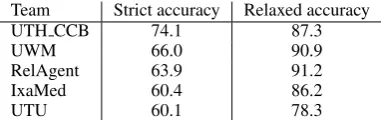
Table 3: Official evaluation results for the top 5 teams in the normalization task.
weighting the word vectors with their IDF values, document in this case being an UMLS concept, did not improve the performance.
3.5 Results
The official results for the normalization task are shown in table 3. Our system achieved accuracy of 60.1% when evaluated with the official strict evaluation metric. This result suggests that com-positional vector representations are a competitive approach for entity normalization. However, the best performing team surpassed our performance by 14.0pp, showing that there is plenty of room for other teams to improve. It is worth noting though that their recall in the NER task tops ours by 8.2pp thus drastically influencing the normalization re-sults as well. To evaluate the normalization sys-tems in isolation from the NER task, a separate evaluation set with gold standard entities should be provided.
4 Conclusions
Overall, our NER system can perform well with the same default settings of NERsuite for gene name recognition. The performance improves when relevant features, such as UMLS dictionary matching and word2vec similarity are added. We speculated that representing the nature of the data with more suitable model can improve the system performance further. As a part of a combined sys-tem, the improvement on NER system can result in the increased performance of normalization sys-tem.
[image:4.595.321.512.62.122.2]Acknowledgements
Computational resources were provided by CSC — IT Center for Science Ltd, Espoo, Finland. This work was supported by the Academy of Finland.
References
David Campos, S´ergio Matos, and Jos´e Lu´ıs Oliveira. 2013. Gimli: open source and high-performance biomedical name recognition. BMC bioinformatics, 14(1):54.
Rezarta Islamaj Do˘gan, Robert Leaman, and Zhiyong Lu. 2014. NCBI disease corpus: a resource for dis-ease name recognition and concept normalization.
Journal of Biomedical Informatics, 47:1–10, Feb. Robert Leaman, Rezarta Islamaj Do˘gan, and Zhiyong
Lu. 2013a. DNorm: disease name normaliza-tion with pairwise learning to rank. Bioinformatics, 29(22):2909–2917.
Robert Leaman, Ritu Khare, and Zhiyong Lu. 2013b. NCBI at 2013 ShARe/CLEF eHealth Shared Task: Disorder normalization in clinical notes with DNorm. InProceedings of the Conference and Labs of the Evaluation Forum.
Tomas Mikolov, Kai Chen, Greg Corrado, and Jeffrey Dean. 2013a. Efficient estimation of word represen-tations in vector space. InICLR Workshop.
Tomas Mikolov, Ilya Sutskever, Kai Chen, Gregory S. Corrado, and Jeffrey Dean. 2013b. Distributed rep-resentations of words and phrases and their compo-sitionality. InNIPS, pages 3111–3119.
Tomas Mikolov, Wen tau Yih, and Geoffrey Zweig. 2013c. Linguistic regularities in continuous space word representations. InHLT-NAACL, pages 746– 751.
Naoaki Okazaki. 2007. CRFsuite: a fast im-plementation of conditional random fields (CRFs). http://www.chokkan.org/software/crfsuite/.
Rune Sætre, Kazuhiro Yoshida, Akane Yakushiji, Yusuke Miyao, Y Matsubyashi, and Tomoko Ohta. 2007. AKANE system: protein-protein interaction pairs in BioCreAtIvE2 challenge, PPI-IPS subtask. In Proceedings of the BioCreative II, pages 209– 212.