Proceedings of NAACL-HLT 2018, pages 55–60
Guiding Generation for Abstractive Text Summarization
based on Key Information Guide Network
Chenliang Li and Weiran Xu∗and Si Li and Sheng Gao Beijing University of Posts and Telecommunications, Beijing chenliangli,xuweiran,lisi,[email protected]
Abstract
Neural network models, based on the at-tentional encoder-decoder model, have good capability in abstractive text summarization. However, these models are hard to be con-trolled in the process of generation, which leads to a lack of key information. We propose a guiding generation model that combines the extractive method and the abstractive method. Firstly, we obtain keywords from the text by a extractive model. Then, we introduce a Key Information Guide Network (KIGN), which encodes the keywords to the key information representation, to guide the process of gener-ation. In addition, we use a prediction-guide mechanism, which can obtain the long-term value for future decoding, to further guide the summary generation. We evaluate our model on the CNN/Daily Mail dataset. The exper-imental results show that our model leads to significant improvements.
1 Introduction
Text summarization aims to generate a brief sum-mary from an input document while retaining the key information. There are two broad approaches to summarization: extractiveandabstractive. Ex-tractive models (Mihalcea and Tarau, 2004; Ya-sunaga et al.,2017) usually extract a few sentences or keywords from the source text, while abstrac-tive models (Rush et al., 2015; Nallapati et al.,
2016) generate new words and phrases that not in the source text to construct the summary.
Recently, inspired by the success of encoder-decoder model (Sutskever et al.,2014), abstractive summarization models (Nallapati et al.,2016;See et al., 2017) are able to generate the summaries with high ROUGE scores. While these models proved to be capable of capturing the regularities of the text summarization, they are hard to be con-trolled in the process of generation. Without ex-ternal guidance, these models just get the source
∗ Corresponding Author: Weiran Xu
text as input and then output the summary, which certainly leads to a lack of key information.
Zhou et al.(2017) propose a selective gate net-work to retain more key information in the sum-mary. However, the selective gate network, which is controlled by the representation of the input text, controls the information flow from encoder to decoder for just once. If some key informa-tion does not pass the network, it is hard for them to appear in the summary. See et al. (2017) pro-pose a pointer-generator model, which uses the pointer mechanism (Vinyals et al.,2015) to copy words from the input text, to deal with the out-of-vocabulary (OOV) words. Without external guid-ance, it is hard for the pointer to identify key-words. To address these problems, we combine the extractive model and the abstractive model and use the former one to obtain keywords as guidance for the latter one.
In this paper we propose a guiding generation model for abstractive text summarization. Firstly, we use a extractive method to obtain the keywords from the text. Then, we introduce a Key Infor-mation Guide Network (KIGN), which encodes the keywords to the key information representa-tion and integrates it into the abstractive model, to guide the process of generation. The guidance is mainly in two aspects: the attention mechanism (Bahdanau et al., 2014) and the pointer mecha-nism. In addition, we propose a novel prediction-guide mechanism based onHe et al.(2017), which predicts the extent of key information covered in the final summary, to further guide the summary generation. Experiments show that our model achieves significant improvements.
2 Related work
Neural encoder-decoder models. Abstractive
models(Rush et al., 2015; Chopra et al., 2016) have been widely used in text summarization. Nal-lapati et al.(2016) use a pointer network (Vinyals
attention
An earthquake magnitude struck sourthern iran on wednesday Text:
earthquake struck iran wednesday keywods:
...
...
softmax
earthquake An
<START> W
F
W V
struck(0.6) hit(0.3) shake(0.05) ...
Encoder Decoder
... ...
Key Information
[image:2.595.75.522.66.223.2]Guide Network pointer
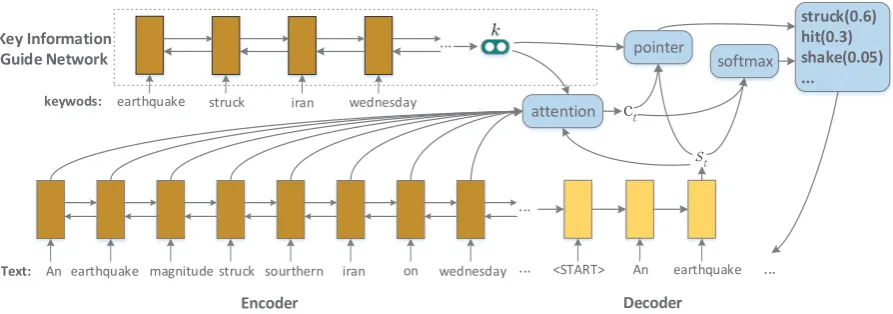
Figure 1: Our key information guide model. It consists of key information guide network, encoder and decoder. In the key information guide network, we encode the keywords to the key information representationk.
et al.,2015) to deal with the unknown word prob-lem.
Keywords extraction. TextRank algorithm
(Mihalcea and Tarau, 2004), which extracts key-words from the source text, is unsupervised.
Prediction-guide mechanism. Inspired by the
success of AlphaGO, He et al. (2017) propose a prediction network to predict the long-term value of the final summary. Our prediction-guide mech-anism is use to guarantee the more key information covered in the final summary.
3 Our Model
In this section, we describe (1) our baseline encoder-decoder model, (2) our key information guide network, and (3) our prediction-guide mech-anism.
3.1 Encoder-decoder model based attention
Our baseline model is similar to that of Nallap-ati et al. (2016). The tokens of the input arti-clex={x1, x2, ..., xN}are fed into the encoder,
which maps the text into a sequence of encoder hidden states{h1, h2, ..., hn}. At each decoding
time step t, the decoder reads the previous word embeddingwt−1 and the previous context vector ct−1 as inputs to obtain the decoder hidden state st. The context vectorctis calculated by using the
attention mechanism:
eti=vTtanh(Whhi+Wsst) (1)
αet =sof tmax(et) (2)
ct= N
X
i=1
αetihi (3)
where v, Wh, Ws are learnable parameters, hi is
the hidden state of the input tokenxi.
The context vector ct, which represents what
has been read from the source text, is concatenated with the decoder hidden statestto predict the next
word with a softmax layer over the whole vocabu-lary:
P(yt|y1, ..., yt−1) =sof tmax(f(st, ct)) (4)
wheref represents a linear function.
3.2 Key information guide network
Most encoder-decoder models (Zhou et al.,2017;
See et al., 2017) just get the source text as input and then output the summary, which is hard to be controlled in the process of generation and leads to a lack of key information in the summary. We propose a key information guide network to guide the process of generation from two aspects: the attention mechanism and the pointer mechanism.
In detail, we extract keywords from the text by using TextRank algorithm. As shown in Figure1, the keywords are fed one-by-one into the key in-formation guide network, and then we concatenate the last forward hidden state~hnand backward
hid-den state ~h1as the key information representation k:
k=
"
~h
1 ~hn
#
(5)
Attention mechanism: Traditional attention
extra input to the attention mechanism, changing equation (1) to:
eti=vTtanh(Whhi+Wsst+Wkk) (6)
where Wk is a learnable parameter. We use the
new eti to obtain new attention distribution αet
(Equation2) and new context vector ct(Equation 3).
Our key information representationkmakes the
attention mechanism more focus on the keywords. That is seem like to introduce prior knowledge to the model.
Then, we apply the key information representa-tionkand use the new context vectorctto
calcu-late a probability distribution over all words in the vocabulary, changing equation (4) to:
Pv(yt|y1, ..., yt−1) =sof tmax(f(st, ct, k)) (7)
wherevrepresents thatytis from the target
vocab-ulary.
Pointer mechanism: Due to the limitation of
the vocabulary size, some keywords may not be in the target vocabulary, which will certainly lead to a lack of them in the final summary. Therefore we take the key information representationk, the
context vectorctand the decoder hidden statest
as inputs to calculate a soft switchpsw, which is
used to choose between generating a word from the target vocabulary or copying a word from the input text:
psw =σ(wkTk+wcTct+wTstst+bsw) (8)
where wTk, wcT, wsT and bsw are parameters, σ is
the sigmoid function.
Our pointer mechanism, which is equipped with the key information representation, has the ability to identify the keywords. We use the new atten-tion distribuatten-tionαetias the probability of the input
tokenwi and obtain the following probability
dis-tribution to predict the next word:
P(yt=w) =pswPv(yt=w)
+ (1−psw)
X
i:wi=w
αeti (9)
Note that if w is an out-of-vocabulary word, Pv(yt=w)is zero.
During training, we minimize a maximum-likelihood loss at each decoding time step, which is most widely used in sequence generation. We
defineyt∗as the target word for the decoding time step t and the overall loss is:
L=−1
T T
X
t=0
logP(yt∗|y1∗, ..., yt∗−1, x) (10)
3.3 Prediction-guide mechanism at test time
At test time, when predicting the next word, we consider not only the above probability (Equa-tion 9), but also a long-term value predicted by the guide mechanism. The prediction-guide mechanism is based onHe et al.(2017).
Our prediction-guide mechanism, which is a single-layer feed forward network with sigmoid activation function, predicts the extent of the key information covered in the final summary. At each decoding time step t, we take mean pooling over the decoder hidden states¯st = 1tPtl=1sl, the
en-code hidden states ¯hn = 1
n
Pn
i=1hi and the key
information representationkas inputs to calculate
the long-term value.
We sample two partial summaries yp1 andyp2
for each x with random stop to gets¯t. Then, we
finish the generation from yp to obtain M
aver-age decoder hidden statess¯of the completed sum-maries S(yp) (using beam search), and compute
the average score:
AvgCos(x, yp) =
1
M
X
¯
s∈S(yp)
cos(¯s, k) (11)
wherecosis the function of cosine similarity. We hope the predicted value of v(x, yp1) can
be larger than v(x, yp2) if AvgCos(x, yp1) > AvgCos(x, yp2). Therefore, the loss function of
the prediction-guide network is as follows:
Lpg =
X
(x,yp1,yp2)
ev(x,yp2)−v(x,yp1) (12)
whereAvgCos(x, yp1)> AvgCos(x, yp2).
At test time, we first compute the normalized log probability of each candidate, and then lin-early combine it with the value predicted by the prediction-guide network. In detail, given an ab-stractive modelP(y|x)(Equation9), a prediction-guide networkv(x, y)and a hyperparameter α ∈
(0,1), the score of partial sequenceyfor x is
com-puted by:
α×logP(y|x) + (1−α)×log v(x, y) (13)
Model ROUGE-1 ROUGE-2 ROUGE-L
Enc-dec+attn baseline (50k vocab) 31.33 11.81 28.83 Abstractive model (Nallapati et al.,2016) 35.46 13.30 32.65
Baseline+pointer 36.44 15.66 33.42
KIGN 37.76 16.56 34.49
Prediction-guide 37.24 16.27 34.14
[image:4.595.317.523.221.348.2]KIGN+Prediction-guide 38.95 17.12 35.68
Table 1: ROUGE F1 scores for models on the CNN/Daily Mail test set. All our ROUGE scores have a 95% confidence interval of at most±0.25 as reported by the official ROUGE script.
4 Experiments
4.1 Experiment setting
We use the CNN/Daily Mail dataset(Nallapati et al.,2016;Hermann et al.,2015) and use scripts supplied by Nallapati et al. (2016) to obtain the same version of the data, which has 28,7226 train-ing pairs, 13,368 validation pairs and 11,490 test pairs. We use two 256-dimensional LSTMs for the bidirectional encoder and one 256-dimensional LSTM for the decoder. In our key information guide network, the approach of encoding key-words is same to the encoder. In addition, we use a vocabulary of 50k words for both source and target and do not pre-train the word embeddings - they are learned from scratch during training. During training and testing, we truncate the text to 400 kens and limit the length of the summary to 100 to-kens. We train using Adagrad (Duchi et al.,2011) with learning rate 0.15 and an initial accumulator value of 0.1. The batch size is set as 16. Following the previous work, our evaluation metric is F-score of ROUGE (Lin and Hovy,2003).
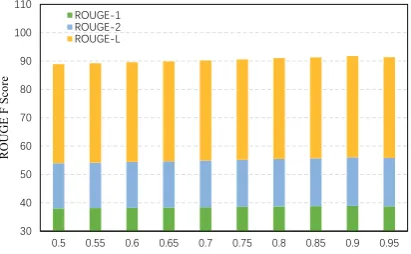
In addition, for the prediction-guide mecha-nism, we set the single-layer feed forward network with 800 nodes. For the hyperparameter α, we test the performances of KIGN+Prediction-guide model using differentαduring decoding. As can
be seen from the figure2, the performance is sta-ble for the α ranging from 0.8 to 0.95. When α
is set as 0.9, we can obtain the highest F-score of ROUGE. Besides, we set the M as 8 and adapt mini-batch training with batch size to be 16. The network is trained with AdaDelta (Zeiler,2012).
During training and at test time we truncate the input tokens to 400 and limit the length of the output summary to 100 tokens for training and 120 tokens at test time, which is similar to See et al. (2017). We trained our keywords network model less than200,000training iterations. Then
濆濃 濇濃 濈濃 濉濃 濊濃 濋濃 濌濃 濄濃濃 濄濄濃
濃濁濈 濃濁濈濈 濃濁濉 濃濁濉濈 濃濁濊 濃濁濊濈 濃濁濋 濃濁濋濈 濃濁濌 濃濁濌濈
R
O
U
G
E
F
S
c
o
re
濥濢濨濚濘激濄 濥濢濨濚濘激濅 濥濢濨濚濘激濟
Figure 2: ROUGE-1, ROUGE-2 and ROUGE-L F1 scores of KIGN+Prediction-guide model w.r.t different hyperparameterα.
we trained the single-layer feed forward network based on the KIGN model. Finally, at test time, we combine the KIGN model and the prediction-guide mechanism to generate the summary.
4.2 Results and discussions
We compare our model with the baseline model (enc-dec+attn), hierarchical networks (Nallapati et al.,2016) and the baseline model equipped with pointer-mechanism since we use the pointer mech-anism in our model.
pointer-Text(truncated): google claimsto have cracked a problem that has flummoxed anyone who has tried to read a doctor’s note - how toread anyone’s handwriting. the firm claims the latest update to itsandroid handsets can under 82 lan-guages in 20 distinct scripts, andworks with both printed and cursive writing input with or without a stylus. it even allows users to simply draw emoji they want to send. scroll down for video. the california search giant claims the latest update to its android handsets can understand handwriting in 82 languages in 20 distinct scripts. google says its handwrit-ing recognition works by buildhandwrit-ing on large-scale language modeling, robust multi-language ocr.
Gold: google handwriting input works on android phones and tablets. handsets can under 82 languages in 20 distinct scripts. works with both printed and cursive writing input with or without a stylus.
Baseline+pointer-mechanism: google claims to have cracked a problem that has flummoxed anyone who has tried to read a doctor ’s note how to read anyone ’s handwriting.
Our model: google claims the latest update to its android handsets can under 82 languages in 20 distinct scripts, and works with both printed and cursive writing input with or without a stylus.
Figure 3: Comparison of the output of two models on a news article. Bold words in text are the key information. (Baseline: enc-dec+attn; Our model: KIGN+prediction-guide)
mechanism by (+2.5 ROUGE-1, +1.5 ROUGE-2, +2.2 ROUGE-L). In this paper, we do not imple-ment coverage mechanism in our model, which can greatly improve the score of ROUGE (See et al.,2017).
4.3 Case study
Figure 3 is an example to show the coverage of the key information between the text and the sum-mary and the bold words are the key information of the text. We compare the output of two models and give the gold summary. It shows that the main idea of the text is about google handwriting input working on android handsets and some function introduction. The baseline model equipped with pointer-mechanism produces the summary, which just shows that google have cracked the problem of reading handwriting, while the summary gener-ated by our model covers almost all the key infor-mation of the text.
5 Conclusion
In this work, we propose a guiding generation model for abstractive text summarization. We combine the extractive model and the abstractive model. Firstly, we use the extractive method to
obtain keywords from the input text. Then, we in-troduce a key information guide network, which encodes the keywords to the key information rep-resentation, to guide the process of generation. In addition, we propose a prediction-guide mecha-nism to further guide the generation at test time. Experiments show that our model leads to signifi-cant improvements.
Acknowledge
We thank the anonymous reviewers for useful comments. This work was supported by Beijing Natural Science Foundation (4174098), National Natural Science Foundation of China (61702047), National Natural Science Foundation of China (61703234) and the Fundamental Research Funds for the Central Universities (2017RC02).
References
Dzmitry Bahdanau, Kyunghyun Cho, and Yoshua Bengio. 2014. Neural machine translation by jointly learning to align and translate. CoRR, abs/1409.0473.
Sumit Chopra, Michael Auli, and Alexander M. Rush. 2016. Abstractive sentence summarization with at-tentive recurrent neural networks. InProceedings of the 2016 Conference of the North American Chap-ter of the Association for Computational Linguistics: Human Language Technologies, pages 93–98. Asso-ciation for Computational Linguistics.
John Duchi, Elad Hazan, and Yoram Singer. 2011. Adaptive subgradient methods for online learning and stochastic optimization. J. Mach. Learn. Res., 12:2121–2159.
Di He, Hanqing Lu, Yingce Xia, Tao Qin, Liwei Wang, and Tieyan Liu. 2017. Decoding with value net-works for neural machine translation. In I. Guyon, U. V. Luxburg, S. Bengio, H. Wallach, R. Fergus, S. Vishwanathan, and R. Garnett, editors,Advances in Neural Information Processing Systems 30, pages 177–186. Curran Associates, Inc.
Karl Moritz Hermann, Tomas Kocisky, Edward Grefenstette, Lasse Espeholt, Will Kay, Mustafa Su-leyman, and Phil Blunsom. 2015. Teaching ma-chines to read and comprehend. In C. Cortes, N. D. Lawrence, D. D. Lee, M. Sugiyama, and R. Garnett, editors,Advances in Neural Information Processing Systems 28, pages 1693–1701. Curran Associates, Inc.
North American Chapter of the Association for Computational Linguistics.
Rada Mihalcea and Paul Tarau. 2004. Textrank: Bring-ing order into texts. In Proceedings of EMNLP 2004, pages 404–411, Barcelona, Spain. Associa-tion for ComputaAssocia-tional Linguistics.
Ramesh Nallapati, Bowen Zhou, Cicero dos Santos, Caglar Gulcehre, and Bing Xiang. 2016. Ab-stractive text summarization using sequence-to-sequence rnns and beyond. InProceedings of The 20th SIGNLL Conference on Computational Natural Language Learning, pages 280–290. Association for Computational Linguistics.
Alexander M. Rush, Sumit Chopra, and Jason Weston. 2015. A neural attention model for abstractive sen-tence summarization. In Proceedings of the 2015 Conference on Empirical Methods in Natural Lan-guage Processing, pages 379–389. Association for Computational Linguistics.
Abigail See, Peter J. Liu, and Christopher D. Manning. 2017.Get to the point: Summarization with pointer-generator networks. InProceedings of the 55th An-nual Meeting of the Association for Computational Linguistics (Volume 1: Long Papers), pages 1073– 1083. Association for Computational Linguistics.
Ilya Sutskever, Oriol Vinyals, and Quoc V. Le. 2014. Sequence to sequence learning with neural net-works. In Proceedings of the 27th International Conference on Neural Information Processing Sys-tems - Volume 2, NIPS’14, pages 3104–3112, Cam-bridge, MA, USA. MIT Press.
Oriol Vinyals, Meire Fortunato, and Navdeep Jaitly. 2015. Pointer networks. In C. Cortes, N. D. Lawrence, D. D. Lee, M. Sugiyama, and R. Garnett, editors,Advances in Neural Information Processing Systems 28, pages 2692–2700. Curran Associates, Inc.
Michihiro Yasunaga, Rui Zhang, Kshitijh Meelu, Ayush Pareek, Krishnan Srinivasan, and Dragomir Radev. 2017. Graph-based neural multi-document summarization. In Proceedings of the 21st Con-ference on Computational Natural Language Learn-ing (CoNLL 2017), pages 452–462. Association for Computational Linguistics.
Matthew D. Zeiler. 2012. ADADELTA: an adaptive learning rate method.CoRR, abs/1212.5701.