Proceedings of NAACL-HLT 2018, pages 896–906
Embedding Syntax and Semantics of Prepositions via Tensor
Decomposition
Hongyu Gong, Suma Bhat, Pramod Viswanath {hgong6, spbhat2, pramodv}@illinois.edu Department of Electrical and Computer Engineering
University of Illinois at Urbana-Champaign, USA
Abstract
Prepositions are among the most frequent words in English and play complex roles in the syntax and semantics of sentences. Not surprisingly, they pose well-known difficulties in automatic processing of sentences (prepo-sitional attachment ambiguities and idiosyn-cratic uses in phrases). Existing methods on preposition representation treat preposi-tions no different from content words (e.g., word2vec and GloVe). In addition, recent studies aiming at solving prepositional attach-ment and preposition selection problems de-pend heavily on external linguistic resources and use dataset-specific word representations. In this paper we useword-triplecounts (one of the triples being a preposition) to capture a preposition’s interaction with its attachment and complement. We then derive preposi-tion embeddings via tensor decomposipreposi-tion on a large unlabeled corpus. We reveal a new ge-ometry involving Hadamard products and em-pirically demonstrate its utility in paraphras-ing phrasal verbs. Furthermore, our preposi-tion embeddings are used as simple features in two challenging downstream tasks: prepo-sition selection and prepoprepo-sitional attachment disambiguation. We achieve results compara-ble to or better than the state-of-the-art on mul-tiple standardized datasets.
1 Introduction
Prepositions are a linguistically closed class com-prising some of the most frequent words; they play an important role in the English language since they encode rich syntactic and semantic informa-tion. Many preposition-related tasks are challeng-ing in computational lchalleng-inguistics because of their polysemous nature and flexible usage patterns. An accurate understanding and representation of prepositions’ linguistic role is key to several im-portant NLP tasks such as grammatical error cor-rection and prepositional phrase attachment. A
first-order approach is to represent prepositions as real-valued vectors via word embeddings such as word2vec (Mikolov et al.,2013) and GloVe ( Pen-nington et al.,2014).
Word embeddings have brought a renaissance in NLP research; they have been very successful in capturing word similarities as well as analo-gies (both syntactic and semantic) and are now mainstream in nearly all downstream NLP tasks (such as question-answering (Chen et al., 2017)). Despite this success, available literature does not highlight any specific properties of word embed-dings of prepositions. Indeed, many of the com-mon prepositions have very similar vector rep-resentations as shown in Table 1 for preposition vectors trained using word2vec and GloVe (Ten-sor embedding is our proposed representation for prepositions). While this suggests that using avail-able representations for prepositions diminishes the distinguishing aspect between prepositions, one could hypothesize that this is primarily be-cause standard word embedding algorithms treat prepositions no different from other content words such as verbs and nouns, i.e., embeddings are cre-ated based on co-occurrences with other words. However, prepositions are very frequent and co-occur with nearly all words, which means that their co-occurrence ought to be treated differently.
Preposition pair Word2vec GloVe Tensor (above, below) 0.85 0.78 0.22 (above, beneath) 0.40 0.45 0.15 (after, before) 0.83 0.70 0.44 (after, during) 0.56 0.42 0.16 (amid, despite) 0.47 0.37 0.12 (amongst, besides) 0.46 0.37 0.21 (beneath, inside) 0.55 0.47 0.29 Table 1: Cosine similarity between pairs of centered prepositions using some word embeddings
Modern descriptive linguistic theory proposes
to understand a preposition via its interactions with both the head it attaches to (termed head) and its complement (Huddleston, 1984; DeCar-rico, 2000). This theory naturally suggests that one should count co-occurrences of a given prepo-sition withpairs of neighboring words. One way of achieving this would be by considering a ten-sorof triples (word1,word2, preposition), where
we do not restrictword1andword2to be the head
and complement words; instead we model a prepo-sition’s interaction with all pairs of neighboring words via asliceof a tensorX, where the slice is populated by word co-occurrences restricted to a context window of the specific preposition. Thus, the tensor dimension isN ×N ×K whereN is the vocabulary size andKis the number of prepo-sitions; sinceK ≈50, we note thatN K.
Using such a representation, we notice that the resulting tensor is low rank and use it to ex-tract embeddings for both preposition and non-preposition words. In doing so, we use a com-bination of standard ideas from word represen-tations (such as weighted spectral decomposition as in GloVe (Pennington et al.,2014)) and tensor decompositions (alternating least squares (ALS) methods (Sharan and Valiant,2017)). We find that the preposition embeddings extracted in this man-ner are discriminative (see the preposition similar-ity of the tensor embedding in Table1). Note that the smaller the cosine similarity is, the more dis-tinct the representations are from each other. We demonstrate that the resulting preposition repre-sentation captures the core linguistic properties of prepositions–the attachment and the complement properties. Using both intrinsic evaluations and downstream tasks, we show this by providing new state-of-the-art results on well-known NLP tasks involving prepositions.
Intrinsic evaluations: We show that the Hadamard product of the embeddings of a verb and a preposition that together make a phrasal verb, closely approximates the representation of this phrasal verb’s paraphrase as a single verb. Ex-ample: vmade vfrom ≈ vproduced v, where represents the Hadamard product (i.e.,
element-wise multiplication) of two vectors andvis a con-stant vector (not associated with a specific word and is defined later); this approximation validates that prepositional semantics are appropriately en-coded into their trained embeddings. We provide a mathematical interpretation for this new geometry
while empirically demonstrating the paraphrasing of compositional phrasal verbs.
Extrinsic evaluations: Our preposition embed-dings are used as features for a simple classifier in two well-known challenging downstream NLP classification tasks. In both tasks, we perform as well as or strictly better than the state-of-the-art on multiple standardized datasets.
Preposition selection: While the context in which a preposition occurs governs the choice of the preposition, the specific preposition by itself sig-nificantly influences the semantics of the context in which it occurs. Furthermore, the choice of the right preposition for a given context can be very subtle. This idiosyncratic behavior of prepositions is the reason behind preposition errors being one of the most frequent error types made by second language English speakers (Leacock et al.,2010)). We demonstrate the utility of the preposition em-beddings in the preposition selection task, which is to choose the correct preposition to a given sen-tence. We show this for a large set of contexts–
7,000combined instances from the CoNLL-2013
and the SE datasets (Prokofyev et al.,2014). Our approach achieves6%and2%absolute
improve-ment over the previous state-of-the-art results on the respective datasets.
Prepositional phrase attachment disambiguation: Prepositional phrase attachment is a common cause of structural ambiguity in natural language. In the sentence “Pierre Vinken joined the board as a voting member”, the prepositional phrase “as a voting member” can attach to either “joined” (the VP) or “the board” (the NP); in this case the VP attachment is correct. Despite being exten-sively studied over decades, prepositional attach-ment continues to be a major source of syntac-tic parsing errors (Brill and Resnik, 1994; Kum-merfeld et al.,2012;de Kok and Hinrichs,2016). We use our prepositional representations as sim-ple features to a standard classifier on this task. Our approach tested on a widely studied standard dataset (Belinkov et al.,2015) achieves 89% accu-racy and compares favorably with the state-of-the art. It is noteworthy that while the state-of-the-art results are obtained with significant linguistic re-sources, including syntactic parsers and the Word-Net, our approach achieves a comparable perfor-mance without relying on such resources.
word counts are previously shown to capture much of the benefits of the unlabeled sentence-data; ex-ample: (Sharan and Valiant, 2017) reports that their word representations via word-triple counts are better than others, but still significantly worse than regular word2vec representations. One of our main observations is that considering word-triple counts makes most (linguistic) sense when one of the words is a preposition. Furthermore, the spar-sity of the corresponding tensor is no worse than the sparsity of the regular word co-occurrence ma-trix (since prepositions are so frequent and co-occur with essentially every word). Taken to-gether, these two points strongly suggest the ben-efits of tensor representations in the context for prepositions.
(2) The word and preposition representations via tensor decomposition are simple features leading to a standard classifier. In particular, we do not use dependency parsing (which many prior methods have relied on) or handcrafted features (Prokofyev et al., 2014) or train task-specific representations on the annotated training dataset (Belinkov et al., 2015). The simplicity of our approach, combined with the strong empirical results, lends credence to the strength of the prepositional representations found via tensor decompositions.
2 Method
We begin with a description of how the tensor with triples (word, word, preposition) is formed and empirically show that its slices are low-rank. Next, we derive low dimensional vector representations for words and prepositions via appropriate tensor decomposition methods.
Tensor creation: Suppose thatKprepositions are in the preposition set P = {p1, . . . , pK}; here K is 49 in our preposition selection task, and 76 in the attachment disambiguation task. We limited the number of prepositions to what was needed in the dataset. The vocabulary, the set of all words excluding the prepositions, containsN words, V = {w1, . . . , wN}, and N ≈ 1M. We generate a third order tensorXN×N×(K+1) from
the WikiCorpus (Al-Rfou et al.,2013) as follows. We say two words co-occur if they appear within a distancetof each other in a sentence. Fork≤K, the entryXijkis the number of occurrences where word wi co-occurs with preposition pk, and wj also co-occurs with prepositionpkin the same sen-tence, and this is counted across all sentences in
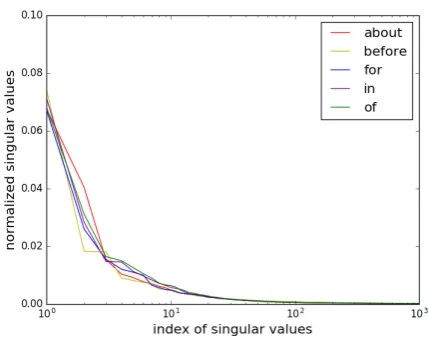
Figure 1: Decaying normalized singular values of slices.
the WikiCorpus. For0 ≤ k ≤ K, X[:,:, k]is a
matrix of the count of the word pairs that co-occur with the prepositionk, and we call such a matrix a slice.
Here we use a window of size t = 3. While
prepositions co-occur with many words, there are also a number of other words which do not oc-cur in the context of any preposition. In order to make the maximal use of the data, we add an ex-tra sliceX[:,:, K+ 1], where the entryXij(K+1)
is the number of occurrences wherewi co-occurs with wj (within distance 2t = 6) but at least one of them is not within a distance of t of any preposition. Note that the preposition window of
3 is smaller than the word window of 6, since
it is known that the interaction between prepo-sitions and neighboring words usually weakens more sharply with distance when compared to that of content words (Hassani and Lee,2017).
Empirical properties ofX: We find that the
ten-sor X is very sparse – only 1% of the tensor
el-ements are non-zero. Furthermore, log(1 +X[:
,:, k]) is low-rank (here the logarithm is applied
component-wise to every entry of the tensor slice). Towards seeing this, we choose slices correspond-ing to the prepositions “about”, “before”,“for”, “in” and “of”, and plot their normalized singular values in Figure1. We see that the singular values decay dramatically, suggesting the low-rank struc-ture in each slice.
[image:3.595.308.523.61.230.2]particular, we consider two separate methods: 1. Alternating Least Squares (ALS). A generic method to decompose a tensor into its modes is via the CANDECOMP/PARAFAC (CP) decom-position (Kolda and Bader, 2009). The tensor
log(1 + X) is decomposed into three modes:
Ud×N, Wd×N and Qd×(K+1), based on the
so-lutions to the optimization problem (1). Here ui, wi and qi are the i-th column of U, W andQ, respectively.
L= min
U,W,Q
N
X
i=1
N
X
j=1
KX+1
k=1
(hui,wj,qki
−log(1 +Xijk) )2, (1)
where ha,b,ci = 1t(a b c) is the inner
product of three vectors a,b and c. Here 1 is the column vector of all ones andrefers to the Hadamard product. We can interpret the columns ofU as the word representations and the columns ofQas the preposition representations, each of di-mensiond(equal to 200 in this paper). There are several algorithmic solutions to this optimization problem in the literature, most of which are based on alternating least squares methods (Kolda and Bader, 2009; Comon et al., 2009; Anandkumar et al., 2014) and we employ a recent one named Orth-ALS (Sharan and Valiant,2017) in this paper. Orth-ALS periodically orthogonalizes the decom-posed components while fixing two modes and up-dating the remaining one. It is supported by the-oretical guarantees and empirically outperforms standard ALS methods in different applications.
2. Weighted Decomposition (WD): Based on ideas from the literature on word embedding al-gorithms, we also consider weighting different el-ements of the tensors differently in order to reduce the effect of the large dynamic range of the tensor values. Specifically, we employ the GloVe objec-tive function to our tensor model and minimize the objective function (2):
Lweighted= min U,W,Q
N
X
i=1
N
X
j=1
KX+1
k=1
ωijk(hui,wj,qki
+bU i+bW j+bQk−log(Xijk+ 1) )2, (2)
wherebU i is the scalar bias for the wordiin the matrixU. Similarly,bW jis the bias for the wordj in the matrixW, andbQkfor prepositionkin the matrix Q. Bias terms are learned in such a way as to minimize the loss function. Hereωijk is the
weight assigned to each tensor elementXijk, and we use the weighting proposed by GloVe:
ωijk= min
Xijk xmax
α ,1
.
We set the hyperparameters to bexmax= 10, and α= 0.75in this work. We solve this optimization
problem via standard gradient descent, arriving at word representationsUand tensor representations Q.
3 Geometry of Phrasal Verbs
Representation Interpretation Suppose that we have a phrase(h, pi, c)whereh,pi andcare the head word, the prepositioni(i≤K)and the
com-plement respectively. The inner product of the word vectors ofh, piandcreflects how frequently handcco-occur in the context ofp. It also reflects how cohesive the triple is.
Recall that there is an extra (K + 1)−th slice
that describes the word co-occurrences outside the preposition window, which considers cases such as the verb phrase (v, c) where v and c are the verb and its complement without a preposition in their shared context. Now consider a phrasal verb sparked off and a verb phrase with headprompted. For any complement word c that fits these two phrases–the phrasal verb havinghas its head verb andpi as its preposition, and the other, the verb phrase withvas its head–we can expect that
huh,qi,wci ≈ huv,qK+1,wci.
In other wordsuhqi ≈uvqK+1, wherea bdenotes the pointwise multiplication (Hadamard
product) of vectorsa and b. This suggests that:
(1) The vector qK+1 is a constant vector for all
(v, c) pairs, and that (2) we could paraphrase the
verb phrase (h, pi) by finding a verb v such that
uvqK+1is closest touhqi.
paraphrase = arg min
v kuvqK+1−uhqik. (3)
This shows that well-trained embeddings are able to capture the relation between phrasal verbs and their equivalent single verb forms.
Phrase replied to blocked off put in pray for dreamed of sparked off
Paraphrase answered intercepted place hope wanted prompted
Phrase stuck with derived from switched over asked for passed down blend in
[image:5.595.338.492.157.290.2]Paraphrase stalled generated transferred requested delivered mix
Table 2: Paraphrasing of prepositional phrases.
validates that the trained embedding is inter-pretable in terms of lexical semantics.
In the next two sections, we evaluate the pro-posed tensor-based preposition embeddings in the context of two important NLP downstream tasks: preposition selection and preposition attachment disambiguation. In this work, we use the En-glish WikiCorpus (around 9 GB) as the train-ing corpus for different sets of embeddtrain-ings. We train tensor embeddings with both Orth-ALS and weighted decomposition. The implementation of Orth-ALS is built upon the SPLATT toolkit (Smith and Karypis, 2016). We perform orthogonaliza-tion in the first 5 iterations in Orth-ALS
decom-position, and the training is completed when its performance stabilizes. As for the weighted de-composition, we train for20iterations, and its
hy-perparameters are set asxmax= 10, andα= 0.75.
We also include two baselines for comparison– word2vec’s CBOW model and GloVe. We set
20 training iterations for both the models. The
hyperparameters in word2vec are set as: win-dow size=6, negative sampling=25 and win- down-sampling=1e-4. The hyperparameters in GloVe are set as: window size=6,xmax=10,α=0.75 and minimum word count=5. We note that all the rep-resentations in this study–word2vec, GloVe and our tensor embedding–are of dimension 200.
4 Downstream Application: Preposition Selection
Grammatical error detection and correction consti-tute important tasks in NLP. Among grammatical errors, prepositional errors constitute about 13%
of all errors, ranking second among the most com-mon error types (Leacock et al., 2010). This is due to the fact that prepositions are highly poly-semous and have idiosyncratic usage. Selecting a preposition depends on how well we can capture the interaction between a preposition and its con-text. Hence we choose this task to evaluate how well the lexical interactions are captured by differ-ent methods.
Task. Given a sentence in English containing
FCE
# of sent 27119 # of prep 60279 Error ratio 4.8
CoNLL
# of sent 1375 # of prep 3241 Error ratio 4.7
SE
# of sent 5917 # of prep 15814 Error ratio 38.2
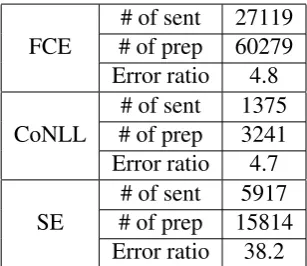
Table 3: Dataset statistics.
a preposition, we either replace the preposition with the correct one or retain it. For example, in the sentence “It can save the effort to carry-ing a lot of cards,” “to” should be corrected as “of.” Formally, there is a closed set of preposi-tion candidates P = {p1, . . . , pm}. A preposi-tionpis used in a sentencesconsisting of words s = {. . . , w−2, w−1, p, w1, w2, . . .}. If used
in-correctly, we need to replacepby another prepo-sitionpˆ∈Pbased on the context.
Dataset. For training, we use the data from the Cambridge First Certificate in English (FCE) exam, just as used by the state-of-the-art on prepo-sition error correction (Prokofyev et al.,2014). As for test data, we use two the CoNLL-2013 and the Stack Exchange (SE) datasets. The CoNLL dataset on preposition error correction was pub-lished by the CoNLL 2013 shared task (Ng et al., 2014), collected from 50 essays written by 25 non-native English learners at a university. The SE dataset consists of texts generated by non-native speakers on the Stack Exchange website. De-tailed statistics are shown in Table 3. We focus on the most frequent49prepositions listed in
Ap-pendixA.
Evaluation metric. Three metrics–precision, recall and F1 score–are used to evaluate the prepo-sition selection performance.
Our algorithm. We first preprocess the dataset by removing articles, determiners and pronouns, and take a context window of 3. We divide the
cor-Dataset Method Precision Recall F1 score
CoNLL
State-of-the-art 0.2592 0.3611 0.3017 Word2vec 0.1558 0.1579 0.1569
GloVe 0.1538 0.1578 0.1558
Our method (ALS) 0.3355 0.3355 0.3355 Our method (WD) 0.3590 0.3684 0.3636
SE
State-of-the-art 0.2704 0.2961 0.2824 Word2vec 0.2450 0.2585 0.2516
GloVe 0.2454 0.2589 0.2520
Our method (ALS) 0.2958 0.3146 0.3049
[image:6.595.151.446.61.219.2]Our method (WD) 0.2899 0.3055 0.2975
Table 4: Performance on preposition selection.
rection. Firstly, we decide whether a preposition is used correctly in the context. If not, we sug-gest another preposition as replacement in the sec-ond step. The detection step uses only three fea-tures: the cosine similarity between the the current preposition embedding and the average context embedding, the rank of the preposition in terms of this cosine similarity, and the probability that this preposition is not changed in the training corpus. We build a decision tree classifier with these three features and find that we can identify errors with
98% F1 score in the CoNLL dataset and96% in
the SE dataset.
For the error correction part, we only focus on the errors detected in the first stage. Suppose that the original preposition is q, and the candidate preposition ispwith the embeddingvp. The word vectors in the left context window are averaged as the left context embeddingv`, and the right vectors are averaged to give the right context embedding vr. We have the following features:
1. Embedding features:v`,vpandvr;
2. Pair similarity between the preposition and the context: maximum of the similar-ity of the preposition between the left and the right context, i.e., pair sim = max vT`vp
kv`k2·kvpk2,
vT rvp
kvrk2·kvpk2
;
3. Triple similarity= hv`,vp,vri
kv`k3·kvpk3·kvrk3;
4. Confusion probability: the probability thatq is replaced bypin the training data.
A two-layer feed-forward neural network (FNN) with hidden layer sizes of 500 and 10 is trained with these features to score prepositions in
each sentence. The preposition with the highest score is the suggested edit.
Baseline. The state-of-the-art on preposition selection uses n-gram statistics from a large cor-pus (Prokofyev et al., 2014). Features such as point-wise mutual information (PMI) and part-of-speech tags are fed into a supervised scoring sys-tem. Given a sentence with a preposition to either replace or retain, the preposition with the highest score is chosen.
The performance of the baseline is affected by both the system architecture and the features. To evaluate the benefits brought about by our ten-sor embedding-based features, we also consider other baselines which have the same two-step ar-chitecture whereas the features are generated from word2vec and GloVe embeddings. These base-lines allow us to compare the representation power independent of the classifier.
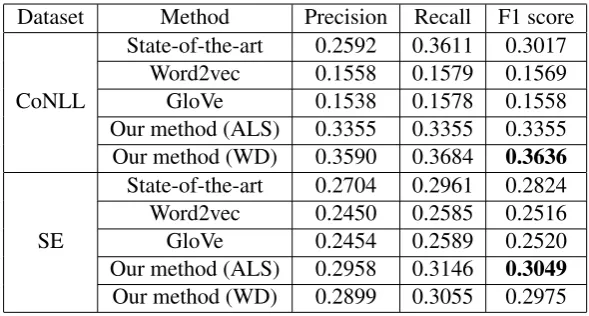
Result. We compare our proposed embedding-based method against baselines mentioned in Ta-ble 4. We note that the proposed tensor embed-dings achieve the best performance among all ap-proaches. In particular, the tensor with weighted decomposition has the highest F1 score on the CoNLL dataset–a6%improvement over the
state-of-the-art. However, the tensor with ALS de-composition performs the best on the SE dataset, achieving a 2% improvement over the
state-of-the art. We also note that with state-of-the same archi-tecture, tensor embeddings perform much better than word2vec and GloVe embeddings on both the datasets. This validates the representation power of tensor embeddings of prepositions.
Removed feature
Left context embedding
Prep embedding
Right context embedding
Pair similarity
Triple similarity
Confusion score
CoNLL
Precision 0.1558 0.2662 0.3117 0.3247 0.3247 0.3506
Recall 0.1579 0.2697 0.3158 0.3289 0.3289 0.3553
F1 score 0.1569 0.2680 0.3137 0.3268 0.3268 0.3529
SE
Precision 0.2587 0.2796 0.2649 0.2658 0.2647 0.1993
Recall 0.2743 0.2964 0.2801 0.2818 0.2807 0.2114
F1 score 0.2663 0.2877 0.2726 0.2735 0.2725 0.2052
Table 5: Ablation analysis in preposition selection.
method with weighted decomposition as shown in Table 5. We find that the left context is the most important feature in for the CoNLL dataset, whereas the confusion score is the most important for the SE dataset. Pair similarity and triple sim-ilarity are less important when compared with the other features. This is because the neural network was able to learn the lexical similarity from the embedding features, thus reducing the importance of the similarity features.
Discussion. Now we analyze different cases where our approach selects the wrong preposi-tion. (1) Limited context window. We focus on the local context within a preposition’s window. In some cases, we find that head words might be out of the context window. An instance of this is found in the sentence “prevent more of this kind of tragedytohappening”toshould be corrected as from. Given the context window of 3, we cannot get the lexical clues provided by prevent, which leads to the selection error. (2)Preposition selec-tion requires more context. Even when the con-text window contains all the words on which the preposition depends, it still may not be sufficient to select the right one. For example, in the sen-tence “it is controlled by some menina bad pur-pose” where our approach replaces the preposition inwith the prepositionongiven the high frequency of the phrase “on purpose”. The correct preposi-tion should beforbased on the whole sentence.
5 Downstream Application: Prepositional Attachment
In this section, we discuss the task of prepositional phrase (PP) attachment disambiguation, a well-studied, but hard task in syntactic parsing. The PP attachment disambiguation inherently requires an accurate description of the interactions among the head, the preposition and the complement, which becomes an ideal task to evaluate our tensor-based
embeddings.
Task. The English dataset used in this work is collected from a linguistic treebank by ( Be-linkov et al., 2015). It provides 35,359training
and1,951test instances. Each instance consists of
several head candidates, a preposition and a com-plement word. The task is to pick the head to which the preposition attaches. In the example “he saw an elephant with long tusks”, the words “saw” and “elephant” are the candidate head words.
Our algorithm. Letvh,vp andvc be embed-dings for the head candidateh, prepositionp and child c respectively. We then use the following features:
1. Embedding feature: candidate head, preposi-tion and complement embedding;
2. Triple similarity: hvh,vp,vci kvhk3·kvpk3·kvck3;
3. Head-preposition similarity: vThvp
kvhk2·kvpk2·;
4. Head-child similarity: vThvc
kvhk2·kvck2·;
5. Part-of-speech (pos) tag of candidates and next words;
6. Distance betweenhandp.
We use a basic neural network, a two-layer feed-forward network (FNN) with hidden-layers of size
1000and20, to take the input features and predict the probability that a candidate is the head. The candidate with the highest likelihood is chosen as the head.
Classifier (enriching)HPCD LRFR OntoLSTM FNN FNN FNN FNN Embedding
method GloVe Word2vec extendedGlove- Word2vec GloVe Our method(ALS) Our method(WD)
Resources
POS tag, WordNet, VerbNet
POS tag, WordNet, VerbNet
POS tag,
[image:8.595.74.527.60.169.2]WordNet POS tag POS tag POS tag POS tag Accuracy 0.887 0.903 0.897 0.866 0.858 0.883 0.892
Table 6: Accuracy in prepositional attachment disambiguation.
(1) Head-Prep-Child-Dist (HPCD) Model ( Be-linkov et al.,2015): this compositional neural net-work is used to train task-specific representations of prepositions.
(2) Low-Rank Feature Representation (LRFR) (Yu et al.,2016): this method incorporates word parts, contexts and labels into a tensor, and uses decom-posed vectors as features for disambiguation. (3) Ontology LSTM (OntoLSTM) (Dasigi et al., 2017): the vectors are initialized with GloVe, ex-tended by AutoExtend (Rothe and Sch¨utze,2015), and trained via LSTMs for head selection.
Similar to the experiments in the preposition selection task (see Section 4), we also include baselines which have the same feed-forward net-work architecture but generate features with vec-tors trained by word2vec and GloVe. They are de-noted as FNN with different initializations in Ta-ble6. Since the attachment disambiguation is a se-lection task, accuracy is a natural evaluation met-ric.
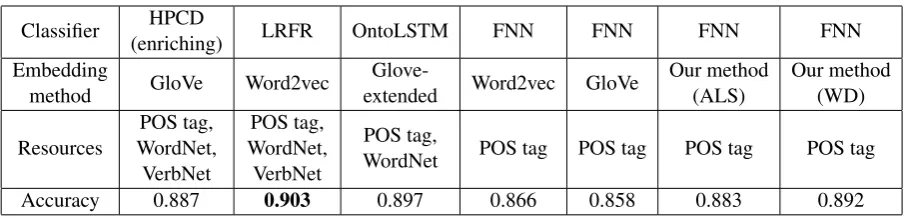
Result. We compare the results of the differ-ent approaches and the linguistic resources used in Table6, where we see that our simple classifier built on the tensor representation is comparable in performance to the state-of-the-art (within 1% of the result). This result is notable considering that prior competitive approaches have used significant linguistic resources such as VerbNet and WordNet, whereas we use none. With the same feed-forward neural network as the classifier, our tensor-based approaches (both ALS and WD) achieve better performance than word2vec and GloVe.
An ablation analysis that is provided in Table7 shows that the head vector feature affects the per-formance the most (indicating that heads interact more closely with prepositions), and the POS tag feature comes second. The similarity features ap-pear less important since the classifier has access to the lexical relatedness via the embedding
fea-tures. Prior works have reported the importance of the distance feature since81.7%sentences take
the word closest to the preposition as the head. In our experiments, the distance feature was found to be less important compared to the embedding fea-tures.
Discussion. We found that one source of attach-ment disambiguation error is the lack of a broader context in our features. A broader context is crit-ical in examples such as “worked” and “system,” which are head candidates of “for trades” in the sentence “worked on a system for trading”. They are reasonable heads in the expressions “worked for trades” and “system for trades” and further dis-ambiguation requires a context larger than what we considered.
6 Related Work
Word representation. Word embeddings have been successfully used in many NLP applications. Word2vec (Mikolov et al.,2013) and GloVe ( Pen-nington et al., 2014) show that embeddings can capture lexical semantics very well. Zhang et al. (2014) studied embeddings which can generalize different similarity perspectives when combined with corresponding linear transformations. Unlike other words, the crucial syntactic roles of prepo-sitions in addition to their rich semantic mean-ings have been highlighted in prior works (Hovy et al., 2010; Schneider et al., 2015). Neverthe-less, word representations specifically focused on prepositions are not available and to the best of our knowledge, ours is the first work exploring this in-triguing direction.
Si-Removed
feature vectorHead vectorPrep vectorChild Head-prepsimilarity Head-childsimilarity similarityTriple POS Distance
[image:9.595.80.527.62.108.2]Accuracy 0.843 0.871 0.880 0.877 0.885 0.873 0.850 0.872
Table 7: Ablation analysis in preposition attachment disambiguation.
multaneous Diagonalization (SD) (Kuleshov et al., 2015) and optimization-based methods (Liu and Nocedal,1989;Mor´e,1978). Orthogonalized Al-ternating Least Square (Orth-ALS) adds the step of component orthogonalization to each update step in the ALS method (Sharan and Valiant, 2017). Owing to its theoretical guarantees and, more relevantly due to its good empirical perfor-mance, Orth-ALS is the algorithm of choice in this paper.
Preposition Selection. Preposition selection, an important area of study in computational lin-guistics, is also a very practical topic in the context of grammar correction and second language learn-ing. Prior works have used hand-crafted heuristic rules (Xiang et al.,2013), n-gram features ( Proko-fyev et al.,2014;Rozovskaya et al.,2013), and by the use of POS tags and dependency relations to enrich other features (Kao et al.,2013)–all toward addressing preposition error correction.
Prepositional Attachment Disambiguation. There is a storied literature on prepositional at-tachment disambiguation, long recognized as an important part of syntactic parsing (Kiperwasser and Goldberg, 2016). Recent works, based on word embeddings have pushed the boundary of state of the art empirical results. A seminal work in this direction is the Head-Prep-Child-Dist Model, which trained embeddings in a com-positional network to maximize the accuracy of head prediction (Belinkov et al.,2015). The per-formance has been further improved in conjunc-tion with semantic and syntactic features. A recent work has proposed an initialization with semantics-enriched GloVe embeddings, and re-trained representations with LSTM-RNNs (Dasigi et al., 2017). Another recent work has used ten-sor decompositions to capture the relation between word representations and their labels (Yu et al., 2016).
7 Conclusion
Co-occurrence counts of word pairs in sentences and the resulting word vector representations (em-beddings) have revolutionalized NLP research. A
natural generalization is to consider co-occurrence counts of word triples, resulting in a third order tensor. Partly due to the size of the tensor (a vocab-ulary of 1M, leads to a tensor with1018 entries!)
and partly due to the extreme dynamic range of en-tries (including sparsity), word vector representa-tions via tensor decomposirepresenta-tions have largely been inferior to their lower order cousins (i.e., regular word embeddings).
In this work, we trek this well-trodden but ar-duous terrain by restricting word triples to the sce-nario when one of the words is a preposition. This is linguistically justified, since prepositions are understood to model interactions between pairs of words. Numerically, this is also very well justi-fied since the sparsity and dynamic range of the resulting tensor is no worse than the original ma-trix of pairwise co-occurrence counts; this is be-cause prepositions are very frequent and co-occur with essentially every word in the vocabulary.
Our intrinsic evaluations and new state-of-the-art results in downstream evaluations lend strong credence to the tensor-based approach to preposi-tional representation. We expect our vector rep-resentations of prepositions to be widely used in more complicated downstream NLP tasks where prepositional role is crucial, including “text to pro-grams” (Guu et al.,2017).
Acknowledgements
This work is supported by IBM-ILLINOIS Cen-ter for Cognitive Computing Systems Research (C3SR) - a research collaboration as part of the IBM AI Horizons Network.
References
Animashree Anandkumar, Rong Ge, and Majid Janza-min. 2014. Guaranteed non-orthogonal tensor de-composition via alternating rank-1 updates. arXiv preprint arXiv:1402.5180.
Yonatan Belinkov, Tao Lei, Regina Barzi-lay, and Amir Globerson. 2015. Erratum: ”exploring compositional architectures and word vector representations for prepositional phrase attachment”. TACL 3:101. https: //tacl2013.cs.columbia.edu/ojs/ index.php/tacl/article/view/593. Eric Brill and Philip Resnik. 1994. A rule-based
ap-proach to prepositional phrase attachment disam-biguation. InProceedings of the 15th conference on Computational linguistics-Volume 2. Association for Computational Linguistics, pages 1198–1204. Danqi Chen, Adam Fisch, Jason Weston, and
An-toine Bordes. 2017. Reading wikipedia to answer open-domain questions. InProceedings of the 55th Annual Meeting of the Association for Computa-tional Linguistics, ACL 2017, Vancouver, Canada, July 30 - August 4, Volume 1: Long Papers. pages 1870–1879. https://doi.org/10.18653/ v1/P17-1171.
Pierre Comon, Xavier Luciani, and Andr´e LF De Almeida. 2009. Tensor decompositions, alter-nating least squares and other tales. Journal of chemometrics23(7-8):393–405.
Pradeep Dasigi, Waleed Ammar, Chris Dyer, and Ed-uard Hovy. 2017. Ontology-aware token embed-dings for prepositional phrase attachment. arXiv preprint arXiv:1705.02925.
Dani¨el de Kok and Erhard Hinrichs. 2016. Transition-based dependency parsing with topological fields. InProceedings of the 54th Annual Meeting of the As-sociation for Computational Linguistics. volume 2, pages 1–7.
Jeanette S DeCarrico. 2000. The structure of English: Studies in form and function for language teaching, volume 1. University of Michigan Press/ESL. Kelvin Guu, Panupong Pasupat, Evan Zheran Liu,
and Percy Liang. 2017. From language to programs: Bridging reinforcement learning and maximum marginal likelihood. arXiv preprint arXiv:1704.07926.
Kaveh Hassani and Won-Sook Lee. 2017. Disam-biguating spatial prepositions using deep convolu-tional networks. InAAAI. pages 3209–3215. Dirk Hovy, Stephen Tratz, and Eduard Hovy. 2010.
What’s in a preposition?: dimensions of sense dis-ambiguation for an interesting word class. In Pro-ceedings of the 23rd International Conference on Computational Linguistics: Posters. Association for Computational Linguistics, pages 454–462.
Rodney Huddleston. 1984. Introduction to the Gram-mar of English. Cambridge University Press. Ting-Hui Kao, Yu-Wei Chang, Hsun-Wen Chiu,
Tzu-Hsi Yen, Joanne Boisson, Jian-Cheng Wu, and Ja-son S Chang. 2013. Conll-2013 shared task: Gram-matical error correction nthu system description. In CoNLL Shared Task. pages 20–25.
Eliyahu Kiperwasser and Yoav Goldberg. 2016. Sim-ple and accurate dependency parsing using bidirec-tional lstm feature representations. arXiv preprint arXiv:1603.04351.
Tamara G Kolda and Brett W Bader. 2009. Ten-sor decompositions and applications. SIAM review 51(3):455–500.
Volodymyr Kuleshov, Arun Chaganty, and Percy Liang. 2015. Tensor factorization via matrix fac-torization. In Artificial Intelligence and Statistics. pages 507–516.
Jonathan K Kummerfeld, David Hall, James R Cur-ran, and Dan Klein. 2012. Parser showdown at the wall street corral: An empirical investigation of error types in parser output. InProceedings of the 2012 Joint Conference on Empirical Methods in Natural Language Processing and Computational Natural Language Learning. Association for Computational Linguistics, pages 1048–1059.
Claudia Leacock, Martin Chodorow, Michael Gamon, and Joel Tetreault. 2010. Automated grammatical error detection for language learners. Synthesis lec-tures on human language technologies3(1):1–134. Dong C Liu and Jorge Nocedal. 1989. On the limited
memory bfgs method for large scale optimization. Mathematical programming45(1):503–528. Tomas Mikolov, Kai Chen, Greg Corrado, and
Jef-frey Dean. 2013. Efficient estimation of word representations in vector space. arXiv preprint arXiv:1301.3781.
Jorge J Mor´e. 1978. The levenberg-marquardt algo-rithm: implementation and theory. In Numerical analysis, Springer, pages 105–116.
Hwee Tou Ng, Siew Mei Wu, Ted Briscoe, Christian Hadiwinoto, Raymond Hendy Susanto, and Christo-pher Bryant. 2014. The conll-2014 shared task on grammatical error correction. In CoNLL Shared Task. pages 1–14.
Jeffrey Pennington, Richard Socher, and Christopher Manning. 2014. Glove: Global vectors for word representation. InProceedings of the 2014 confer-ence on empirical methods in natural language pro-cessing (EMNLP). pages 1532–1543.
23rd ACM International Conference on Conference on Information and Knowledge Management. ACM, pages 331–340.
Sascha Rothe and Hinrich Sch¨utze. 2015. Au-toextend: Extending word embeddings to embed-dings for synsets and lexemes. arXiv preprint arXiv:1507.01127.
Alla Rozovskaya, Kai-Wei Chang, Mark Sammons, and Dan Roth. 2013. The university of illinois sys-tem in the conll-2013 shared task. InProceedings of the Seventeenth Conference on Computational Nat-ural Language Learning: Shared Task. pages 13–19. Nathan Schneider, Vivek Srikumar, Jena D Hwang, and Martha Palmer. 2015. A hierarchy with, of, and for preposition supersenses. InProceedings of The 9th Linguistic Annotation Workshop. pages 112–123. Vatsal Sharan and Gregory Valiant. 2017.
Orthogonal-ized als: A theoretically principled tensor decom-position algorithm for practical use. arXiv preprint arXiv:1703.01804.
Shaden Smith and George Karypis. 2016. SPLATT: The Surprisingly ParalleL spArse Tensor Toolkit. http://cs.umn.edu/˜splatt/.
Yang Xiang, Bo Yuan, Yaoyun Zhang, Xiaolong Wang, Wen Zheng, and Chongqiang Wei. 2013. A hybrid model for grammatical error correction. InCoNLL Shared Task. pages 115–122.
Mo Yu, Mark Dredze, Raman Arora, and Matthew Gormley. 2016. Embedding lexical features via low-rank tensors. arXiv preprint arXiv:1604.00461. Jingwei Zhang, Jeremy Salwen, Michael Glass, and
Alfio Gliozzo. 2014. Word semantic representa-tions using bayesian probabilistic tensor factoriza-tion. In Proceedings of the 2014 Conference on Empirical Methods in Natural Language Processing (EMNLP). pages 1522–1531.
A Roster of Prepositions
The list of most frequent 49 Prepositions in the task of preposition selection is shown below: