Deep contextualized word representations
Matthew E. Peters
†, Mark Neumann
†, Mohit Iyyer
†, Matt Gardner
†,
{
matthewp,markn,mohiti,mattg
}
@allenai.org
Christopher Clark
⇤, Kenton Lee
⇤, Luke Zettlemoyer
†⇤{
csquared,kentonl,lsz
}
@cs.washington.edu
†
Allen Institute for Artificial Intelligence
⇤
Paul G. Allen School of Computer Science & Engineering, University of Washington
Abstract
We introduce a new type ofdeep contextual-izedword representation that models both (1) complex characteristics of word use (e.g., syn-tax and semantics), and (2) how these uses vary across linguistic contexts (i.e., to model polysemy). Our word vectors are learned func-tions of the internal states of a deep bidirec-tional language model (biLM), which is pre-trained on a large text corpus. We show that these representations can be easily added to existing models and significantly improve the state of the art across six challenging NLP problems, including question answering, tex-tual entailment and sentiment analysis. We also present an analysis showing that exposing the deep internals of the pre-trained network is crucial, allowing downstream models to mix different types of semi-supervision signals.
1 Introduction
Pre-trained word representations (Mikolov et al., 2013; Pennington et al.,2014) are a key compo-nent in many neural language understanding mod-els. However, learning high quality representa-tions can be challenging. They should ideally model both (1) complex characteristics of word use (e.g., syntax and semantics), and (2) how these uses vary across linguistic contexts (i.e., to model polysemy). In this paper, we introduce a new type of deep contextualized word representation that directly addresses both challenges, can be easily integrated into existing models, and significantly improves the state of the art in every considered case across a range of challenging language un-derstanding problems.
Our representations differ from traditional word type embeddings in that each token is assigned a representation that is a function of the entire input sentence. We use vectors derived from a bidirec-tional LSTM that is trained with a coupled
lan-guage model (LM) objective on a large text cor-pus. For this reason, we call them ELMo (Em-beddings from Language Models) representations. Unlike previous approaches for learning contextu-alized word vectors (Peters et al.,2017;McCann et al., 2017), ELMo representations are deep, in the sense that they are a function of all of the in-ternal layers of the biLM. More specifically, we learn a linear combination of the vectors stacked above each input word for each end task, which markedly improves performance over just using the top LSTM layer.
Combining the internal states in this manner al-lows for very rich word representations. Using in-trinsic evaluations, we show that the higher-level LSTM states capture context-dependent aspects of word meaning (e.g., they can be used with-out modification to perform well on supervised word sense disambiguation tasks) while lower-level states model aspects of syntax (e.g., they can be used to do part-of-speech tagging). Simultane-ously exposing all of these signals is highly bene-ficial, allowing the learned models select the types of semi-supervision that are most useful for each end task.
those derived from just the top layer of an LSTM. Our trained models and code are publicly avail-able, and we expect that ELMo will provide simi-lar gains for many other NLP problems.1
2 Related work
Due to their ability to capture syntactic and se-mantic information of words from large scale un-labeled text, pretrained word vectors (Turian et al., 2010; Mikolov et al., 2013; Pennington et al., 2014) are a standard component of most state-of-the-art NLP architectures, including for question answering (Liu et al., 2017), textual entailment (Chen et al., 2017) and semantic role labeling (He et al.,2017). However, these approaches for learning word vectors only allow a single context-independent representation for each word.
Previously proposed methods overcome some of the shortcomings of traditional word vectors by either enriching them with subword informa-tion (e.g., Wieting et al.,2016;Bojanowski et al., 2017) or learning separate vectors for each word sense (e.g., Neelakantan et al., 2014). Our ap-proach also benefits from subword units through the use of character convolutions, and we seam-lessly incorporate multi-sense information into downstream tasks without explicitly training to predict predefined sense classes.
Other recent work has also focused on learning context-dependent representations. context2vec (Melamud et al., 2016) uses a bidirectional Long Short Term Memory (LSTM; Hochreiter and Schmidhuber,1997) to encode the context around a pivot word. Other approaches for learning contextual embeddings include the pivot word itself in the representation and are computed with the encoder of either a supervised neural machine translation (MT) system (CoVe; McCann et al., 2017) or an unsupervised lan-guage model (Peters et al.,2017). Both of these approaches benefit from large datasets, although the MT approach is limited by the size of parallel corpora. In this paper, we take full advantage of access to plentiful monolingual data, and train our biLM on a corpus with approximately 30 million sentences (Chelba et al.,2014). We also generalize these approaches to deep contextual representations, which we show work well across a broad range of diverse NLP tasks.
1http://allennlp.org/elmo
Previous work has also shown that different lay-ers of deep biRNNs encode different types of in-formation. For example, introducing multi-task syntactic supervision (e.g., part-of-speech tags) at the lower levels of a deep LSTM can improve overall performance of higher level tasks such as dependency parsing (Hashimoto et al., 2017) or CCG super tagging (Søgaard and Goldberg,2016). In an RNN-based encoder-decoder machine trans-lation system,Belinkov et al.(2017) showed that the representations learned at the first layer in a 2-layer LSTM encoder are better at predicting POS tags then second layer. Finally, the top layer of an LSTM for encoding word context (Melamud et al., 2016) has been shown to learn representations of word sense. We show that similar signals are also induced by the modified language model objective of our ELMo representations, and it can be very beneficial to learn models for downstream tasks that mix these different types of semi-supervision. Dai and Le (2015) and Ramachandran et al. (2017) pretrain encoder-decoder pairs using lan-guage models and sequence autoencoders and then fine tune with task specific supervision. In con-trast, after pretraining the biLM with unlabeled data, we fix the weights and add additional task-specific model capacity, allowing us to leverage large, rich and universal biLM representations for cases where downstream training data size dictates a smaller supervised model.
3 ELMo: Embeddings from Language
Models
Unlike most widely used word embeddings ( Pen-nington et al.,2014), ELMo word representations are functions of the entire input sentence, as de-scribed in this section. They are computed on top of two-layer biLMs with character convolutions (Sec.3.1), as a linear function of the internal net-work states (Sec.3.2). This setup allows us to do semi-supervised learning, where the biLM is pre-trained at a large scale (Sec.3.4) and easily incor-porated into a wide range of existing neural NLP architectures (Sec.3.3).
3.1 Bidirectional language models
Given a sequence of N tokens,(t1, t2, ..., tN), a
to-kentkgiven the history(t1, ..., tk 1):
p(t1, t2, . . . , tN) = N
Y
k=1
p(tk |t1, t2, . . . , tk 1).
Recent state-of-the-art neural language models (J´ozefowicz et al.,2016;Melis et al.,2017; Mer-ity et al.,2017) compute a context-independent to-ken representationxLM
k (via token embeddings or
a CNN over characters) then pass it throughL lay-ers of forward LSTMs. At each position k, each LSTM layer outputs a context-dependent repre-sentation!hLM
k,j wherej = 1, . . . , L. The top layer
LSTM output, !hLM
k,L, is used to predict the next
tokentk+1with a Softmax layer.
A backward LM is similar to a forward LM, ex-cept it runs over the sequence in reverse, predict-ing the previous token given the future context:
p(t1, t2, . . . , tN) = N
Y
k=1
p(tk|tk+1, tk+2, . . . , tN).
It can be implemented in an analogous way to a forward LM, with each backward LSTM layer j in aLlayer deep model producing representations
hLM
k,j oftkgiven(tk+1, . . . , tN).
A biLM combines both a forward and backward LM. Our formulation jointly maximizes the log likelihood of the forward and backward directions:
N
X
k=1
( logp(tk|t1, . . . , tk 1; ⇥x,!⇥LST M,⇥s)
+ logp(tk|tk+1, . . . , tN; ⇥x,⇥LST M,⇥s) ).
We tie the parameters for both the token represen-tation (⇥x) and Softmax layer (⇥s) in the forward
and backward direction while maintaining sepa-rate parameters for the LSTMs in each direction. Overall, this formulation is similar to the approach ofPeters et al.(2017), with the exception that we share some weights between directions instead of using completely independent parameters. In the next section, we depart from previous work by in-troducing a new approach for learning word rep-resentations that are a linear combination of the biLM layers.
3.2 ELMo
ELMo is a task specific combination of the in-termediate layer representations in the biLM. For
each tokentk, aL-layer biLM computes a set of 2L+ 1representations
Rk = {xLMk ,!hLMk,j ,hLMk,j |j= 1, . . . , L}
= {hLMk,j |j= 0, . . . , L},
where hLM
k,0 is the token layer and hLMk,j = [!hLM
k,j ; hLMk,j ], for each biLSTM layer.
For inclusion in a downstream model, ELMo collapses all layers in R into a single vector, ELMok = E(Rk;⇥e). In the simplest case,
ELMo just selects the top layer, E(Rk) = hLMk,L,
as in TagLM (Peters et al.,2017) and CoVe ( Mc-Cann et al.,2017). More generally, we compute a task specific weighting of all biLM layers:
ELMotaskk =E(Rk; ⇥task) = task L
X
j=0
staskj hLMk,j .
(1) In (1),staskare softmax-normalized weights and
the scalar parameter taskallows the task model to
scale the entire ELMo vector. is of practical im-portance to aid the optimization process (see sup-plemental material for details). Considering that the activations of each biLM layer have a different distribution, in some cases it also helped to apply layer normalization (Ba et al.,2016) to each biLM layer before weighting.
3.3 Using biLMs for supervised NLP tasks Given a pre-trained biLM and a supervised archi-tecture for a target NLP task, it is a simple process to use the biLM to improve the task model. We simply run the biLM and record all of the layer representations for each word. Then, we let the end task model learn a linear combination of these representations, as described below.
First consider the lowest layers of the super-vised model without the biLM. Most supersuper-vised NLP models share a common architecture at the lowest layers, allowing us to add ELMo in a consistent, unified manner. Given a sequence of tokens (t1, . . . , tN), it is standard to form a
context-independent token representation xk for
each token position using pre-trained word em-beddings and optionally character-based represen-tations. Then, the model forms a context-sensitive representation hk, typically using either
concatenate the ELMo vector ELMotaskk with xk and pass the ELMo enhanced representation [xk;ELMotaskk ] into the task RNN. For some
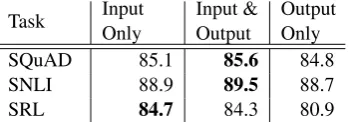
tasks (e.g., SNLI, SQuAD), we observe further improvements by also including ELMo at the out-put of the task RNN by introducing another set of output specific linear weights and replacinghk
with [hk;ELMotaskk ]. As the remainder of the
supervised model remains unchanged, these addi-tions can happen within the context of more com-plex neural models. For example, see the SNLI experiments in Sec. 4 where a bi-attention layer follows the biLSTMs, or the coreference resolu-tion experiments where a clustering model is lay-ered on top of the biLSTMs.
Finally, we found it beneficial to add a moder-ate amount of dropout to ELMo (Srivastava et al., 2014) and in some cases to regularize the ELMo weights by adding kwk2
2 to the loss. This im-poses an inductive bias on the ELMo weights to stay close to an average of all biLM layers. 3.4 Pre-trained bidirectional language model
architecture
The pre-trained biLMs in this paper are similar to the architectures in J´ozefowicz et al. (2016) and Kim et al. (2015), but modified to support joint training of both directions and add a residual con-nection between LSTM layers. We focus on large scale biLMs in this work, as Peters et al.(2017) highlighted the importance of using biLMs over forward-only LMs and large scale training.
To balance overall language model perplexity with model size and computational requirements for downstream tasks while maintaining a purely character-based input representation, we halved all embedding and hidden dimensions from the single best modelCNN-BIG-LSTMinJ´ozefowicz et al. (2016). The final model usesL= 2biLSTM lay-ers with 4096 units and 512 dimension projections and a residual connection from the first to second layer. The context insensitive type representation uses 2048 character n-gram convolutional filters followed by two highway layers (Srivastava et al., 2015) and a linear projection down to a 512 repre-sentation. As a result, the biLM provides three lay-ers of representations for each input token, includ-ing those outside the traininclud-ing set due to the purely character input. In contrast, traditional word em-bedding methods only provide one layer of repre-sentation for tokens in a fixed vocabulary.
After training for 10 epochs on the 1B Word Benchmark (Chelba et al.,2014), the average for-ward and backfor-ward perplexities is 39.7, compared to 30.0 for the forwardCNN-BIG-LSTM. Gener-ally, we found the forward and backward perplex-ities to be approximately equal, with the backward value slightly lower.
Once pretrained, the biLM can compute repre-sentations for any task. In some cases, fine tuning the biLM on domain specific data leads to signifi-cant drops in perplexity and an increase in down-stream task performance. This can be seen as a type of domain transfer for the biLM. As a result, in most cases we used a fine-tuned biLM in the downstream task. See supplemental material for details.
4 Evaluation
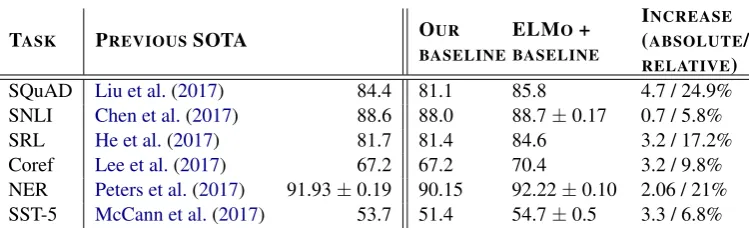
Table1shows the performance of ELMo across a diverse set of six benchmark NLP tasks. In every task considered, simply adding ELMo establishes a new state-of-the-art result, with relative error re-ductions ranging from 6 - 20% over strong base models. This is a very general result across a di-verse set model architectures and language under-standing tasks. In the remainder of this section we provide high-level sketches of the individual task results; see the supplemental material for full ex-perimental details.
Question answering The Stanford Question Answering Dataset (SQuAD) (Rajpurkar et al., 2016) contains 100K+ crowd sourced question-answer pairs where the question-answer is a span in a given Wikipedia paragraph. Our baseline model (Clark and Gardner,2017) is an improved version of the Bidirectional Attention Flow model in Seo et al. (BiDAF; 2017). It adds a self-attention layer af-ter the bidirectional attention component, simpli-fies some of the pooling operations and substitutes the LSTMs for gated recurrent units (GRUs; Cho et al.,2014). After adding ELMo to the baseline model, test set F1improved by 4.7% from 81.1% to 85.8%, a 24.9% relative error reduction over the baseline, and improving the overall single model state-of-the-art by 1.4%. A 11 member ensem-ble pushes F1to 87.4, the overall state-of-the-art at time of submission to the leaderboard.2 The
increase of 4.7% with ELMo is also significantly larger then the 1.8% improvement from adding CoVe to a baseline model (McCann et al.,2017).
TASK PREVIOUSSOTA OUR
BASELINE
ELMO+ BASELINE
INCREASE
(ABSOLUTE/
RELATIVE)
[image:5.595.112.487.90.205.2]SQuAD Liu et al.(2017) 84.4 81.1 85.8 4.7 / 24.9% SNLI Chen et al.(2017) 88.6 88.0 88.7±0.17 0.7 / 5.8% SRL He et al.(2017) 81.7 81.4 84.6 3.2 / 17.2% Coref Lee et al.(2017) 67.2 67.2 70.4 3.2 / 9.8% NER Peters et al.(2017) 91.93±0.19 90.15 92.22±0.10 2.06 / 21% SST-5 McCann et al.(2017) 53.7 51.4 54.7±0.5 3.3 / 6.8% Table 1: Test set comparison of ELMo enhanced neural models with state-of-the-art single model baselines across six benchmark NLP tasks. The performance metric varies across tasks – accuracy for SNLI and SST-5; F1for SQuAD, SRL and NER; average F1for Coref. Due to the small test sizes for NER and SST-5, we report the mean and standard deviation across five runs with different random seeds. The “increase” column lists both the absolute and relative improvements over our baseline.
Textual entailment Textual entailment is the task of determining whether a “hypothesis” is true, given a “premise”. The Stanford Natu-ral Language Inference (SNLI) corpus (Bowman et al.,2015) provides approximately 550K hypoth-esis/premise pairs. Our baseline, the ESIM se-quence model fromChen et al.(2017), uses a biL-STM to encode the premise and hypothesis, fol-lowed by a matrix attention layer, a local infer-ence layer, another biLSTM inferinfer-ence composi-tion layer, and finally a pooling operacomposi-tion before the output layer. Overall, adding ELMo to the ESIM model improves accuracy by an average of 0.7% across five random seeds. A five member ensemble pushes the overall accuracy to 89.3%, exceeding the previous ensemble best of 88.9% (Gong et al.,2018).
Semantic role labelingA semantic role label-ing (SRL) system models the predicate-argument structure of a sentence, and is often described as answering “Who did what to whom”. He et al. (2017) modeled SRL as a BIO tagging problem and used an 8-layer deep biLSTM with forward and backward directions interleaved, following Zhou and Xu(2015). As shown in Table1, when adding ELMo to a re-implementation ofHe et al. (2017) the single model test set F1jumped 3.2% from 81.4% to 84.6% – a new state-of-the-art on the OntoNotes benchmark (Pradhan et al.,2013), even improving over the previous best ensemble result by 1.2%.
Coreference resolutionCoreference resolution is the task of clustering mentions in text that re-fer to the same underlying real world entities. Our baseline model is the end-to-end span-based neu-ral model ofLee et al.(2017). It uses a biLSTM
and attention mechanism to first compute span representations and then applies a softmax men-tion ranking model to find coreference chains. In our experiments with the OntoNotes coreference annotations from the CoNLL 2012 shared task (Pradhan et al.,2012), adding ELMo improved the average F1 by 3.2% from 67.2 to 70.4, establish-ing a new state of the art, again improvestablish-ing over the previous best ensemble result by 1.6% F1.
Named entity extraction The CoNLL 2003 NER task (Sang and Meulder,2003) consists of newswire from the Reuters RCV1 corpus tagged with four different entity types (PER,LOC,ORG, MISC). Following recent state-of-the-art systems (Lample et al.,2016;Peters et al.,2017), the base-line model uses pre-trained word embeddings, a character-based CNN representation, two biLSTM layers and a conditional random field (CRF) loss (Lafferty et al.,2001), similar toCollobert et al. (2011). As shown in Table1, our ELMo enhanced biLSTM-CRF achieves 92.22% F1averaged over five runs. The key difference between our system and the previous state of the art fromPeters et al. (2017) is that we allowed the task model to learn a weighted average of all biLM layers, whereas Pe-ters et al.(2017) only use the top biLM layer. As shown in Sec.5.1, using all layers instead of just the last layer improves performance across multi-ple tasks.
syntac-Task Baseline Last Only =1All layers=0.001
SQuAD 80.8 84.7 85.0 85.2
SNLI 88.1 89.1 89.3 89.5
SRL 81.6 84.1 84.6 84.8
Table 2: Development set performance for SQuAD, SNLI and SRL comparing using all layers of the biLM (with different choices of regularization strength ) to just the top layer.
Task InputOnly Input &Output OutputOnly
SQuAD 85.1 85.6 84.8
SNLI 88.9 89.5 88.7
SRL 84.7 84.3 80.9
Table 3: Development set performance for SQuAD, SNLI and SRL when including ELMo at different lo-cations in the supervised model.
tic constructions such as negations that are diffi-cult for models to learn. Our baseline model is the biattentive classification network (BCN) from McCann et al. (2017), which also held the prior state-of-the-art result when augmented with CoVe embeddings. Replacing CoVe with ELMo in the BCN model results in a 1.0% absolute accuracy improvement over the state of the art.
5 Analysis
This section provides an ablation analysis to vali-date our chief claims and to elucivali-date some inter-esting aspects of ELMo representations. Sec.5.1 shows that using deep contextual representations in downstream tasks improves performance over previous work that uses just the top layer, regard-less of whether they are produced from a biLM or MT encoder, and that ELMo representations pro-vide the best overall performance. Sec. 5.3 ex-plores the different types of contextual informa-tion captured in biLMs and uses two intrinsic eval-uations to show that syntactic information is better represented at lower layers while semantic infor-mation is captured a higher layers, consistent with MT encoders. It also shows that our biLM consis-tently provides richer representations then CoVe. Additionally, we analyze the sensitivity to where ELMo is included in the task model (Sec. 5.2), training set size (Sec.5.4), and visualize the ELMo learned weights across the tasks (Sec.5.5).
5.1 Alternate layer weighting schemes There are many alternatives to Equation1for com-bining the biLM layers. Previous work on con-textual representations used only the last layer, whether it be from a biLM (Peters et al.,2017) or an MT encoder (CoVe;McCann et al.,2017). The choice of the regularization parameter is also important, as large values such as = 1 effec-tively reduce the weighting function to a simple average over the layers, while smaller values (e.g.,
= 0.001) allow the layer weights to vary. Table2compares these alternatives for SQuAD, SNLI and SRL. Including representations from all layers improves overall performance over just us-ing the last layer, and includus-ing contextual rep-resentations from the last layer improves perfor-mance over the baseline. For example, in the case of SQuAD, using just the last biLM layer im-proves development F1by 3.9% over the baseline. Averaging all biLM layers instead of using just the last layer improves F1 another 0.3% (comparing “Last Only” to =1 columns), and allowing the task model to learn individual layer weights im-proves F1 another 0.2% ( =1 vs. =0.001). A small is preferred in most cases with ELMo, al-though for NER, a task with a smaller training set, the results are insensitive to (not shown).
The overall trend is similar with CoVe but with smaller increases over the baseline. For SNLI, av-eraging all layers with =1 improves development accuracy from 88.2 to 88.7% over using just the last layer. SRL F1increased a marginal 0.1% to 82.2 for the =1 case compared to using the last layer only.
5.2 Where to include ELMo?
[image:6.595.106.281.224.285.2]Source Nearest Neighbors
GloVe play playing, game, games, played, players, plays, player,Play, football, multiplayer
biLM
Chico Ruiz made a spec-tacular play on Alusik ’s grounder{. . .}
Kieffer , the only junior in the group , was commended for his ability to hit in the clutch , as well as his all-round excellent play .
Olivia De Havilland signed to do a Broadway play for Garson{. . .}
[image:7.595.108.500.105.221.2]{. . .}they were actors who had been handed fat roles in a successful play , and had talent enough to fill the roles competently , with nice understatement .
Table 4: Nearest neighbors to “play” using GloVe and the context embeddings from a biLM.
Model F1
WordNet 1st Sense Baseline 65.9 Raganato et al.(2017a) 69.9 Iacobacci et al.(2016) 70.1 CoVe, First Layer 59.4 CoVe, Second Layer 64.7
[image:7.595.342.471.256.360.2]biLM, First layer 67.4 biLM, Second layer 69.0 Table 5: All-words fine grained WSD F1. For CoVe and the biLM, we report scores for both the first and second layer biLSTMs.
the task-specific context representations are likely more important than those from the biLM. 5.3 What information is captured by the
biLM’s representations?
Since adding ELMo improves task performance over word vectors alone, the biLM’s contextual representations must encode information gener-ally useful for NLP tasks that is not captured in word vectors. Intuitively, the biLM must be disambiguating the meaning of words using their context. Consider “play”, a highly poly-semous word. The top of Table 4 lists near-est neighbors to “play” using GloVe vectors. They are spread across several parts of speech (e.g., “played”, “playing” as verbs, and “player”, “game” as nouns) but concentrated in the sports-related senses of “play”. In contrast, the bottom two rows show nearest neighbor sentences from the SemCor dataset (see below) using the biLM’s context representation of “play” in the source sen-tence. In these cases, the biLM is able to disam-biguate both the part of speech and word sense in the source sentence.
These observations can be quantified using an
Model Acc.
Collobert et al.(2011) 97.3 Ma and Hovy(2016) 97.6 Ling et al.(2015) 97.8 CoVe, First Layer 93.3
CoVe, Second Layer 92.8 biLM, First Layer 97.3
biLM, Second Layer 96.8
Table 6: Test set POS tagging accuracies for PTB. For CoVe and the biLM, we report scores for both the first and second layer biLSTMs.
intrinsic evaluation of the contextual representa-tions similar toBelinkov et al.(2017). To isolate the information encoded by the biLM, the repre-sentations are used to directly make predictions for a fine grained word sense disambiguation (WSD) task and a POS tagging task. Using this approach, it is also possible to compare to CoVe, and across each of the individual layers.
Word sense disambiguationGiven a sentence, we can use the biLM representations to predict the sense of a target word using a simple 1-nearest neighbor approach, similar to Melamud et al. (2016). To do so, we first use the biLM to compute representations for all words in Sem-Cor 3.0, our training corpus (Miller et al.,1994), and then take the average representation for each sense. At test time, we again use the biLM to com-pute representations for a given target word and take the nearest neighbor sense from the training set, falling back to the first sense from WordNet for lemmas not observed during training.
[image:7.595.118.270.259.360.2]rep-resentations have F1 of 69.0 and are better at WSD then the first layer. This is competitive with a state-of-the-art WSD-specific supervised model using hand crafted features (Iacobacci et al.,2016) and a task specific biLSTM that is also trained with auxiliary coarse-grained semantic labels and POS tags (Raganato et al., 2017a). The CoVe biLSTM layers follow a similar pattern to those from the biLM (higher overall performance at the second layer compared to the first); however, our biLM outperforms the CoVe biLSTM, which trails the WordNet first sense baseline.
POS tagging To examine whether the biLM captures basic syntax, we used the context resentations as input to a linear classifier that pre-dicts POS tags with the Wall Street Journal portion of the Penn Treebank (PTB) (Marcus et al.,1993). As the linear classifier adds only a small amount of model capacity, this is direct test of the biLM’s representations. Similar to WSD, the biLM rep-resentations are competitive with carefully tuned, task specific biLSTMs (Ling et al.,2015;Ma and Hovy,2016). However, unlike WSD, accuracies using the first biLM layer are higher than the top layer, consistent with results from deep biL-STMs in multi-task training (Søgaard and Gold-berg,2016;Hashimoto et al.,2017) and MT ( Be-linkov et al.,2017). CoVe POS tagging accuracies follow the same pattern as those from the biLM, and just like for WSD, the biLM achieves higher accuracies than the CoVe encoder.
Implications for supervised tasks Taken to-gether, these experiments confirm different layers in the biLM represent different types of informa-tion and explain why including all biLM layers is important for the highest performance in down-stream tasks. In addition, the biLM’s representa-tions are more transferable to WSD and POS tag-ging than those in CoVe, helping to illustrate why ELMo outperforms CoVe in downstream tasks. 5.4 Sample efficiency
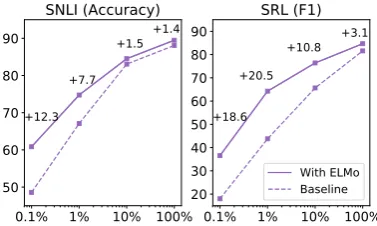
[image:8.595.310.499.96.209.2]Adding ELMo to a model increases the sample ef-ficiency considerably, both in terms of number of parameter updates to reach state-of-the-art perfor-mance and the overall training set size. For ex-ample, the SRL model reaches a maximum devel-opment F1 after 486 epochs of training without ELMo. After adding ELMo, the model exceeds the baseline maximum at epoch 10, a 98% relative decrease in the number of updates needed to reach
[image:8.595.307.507.273.353.2]Figure 1: Comparison of baseline vs. ELMo perfor-mance for SNLI and SRL as the training set size is var-ied from 0.1% to 100%.
Figure 2: Visualization of softmax normalized biLM layer weights across tasks and ELMo locations. Nor-malized weights less then1/3are hatched with hori-zontal lines and those greater then2/3are speckled.
the same level of performance.
In addition, ELMo-enhanced models use smaller training sets more efficiently than mod-els without ELMo. Figure 1 compares the per-formance of baselines models with and without ELMo as the percentage of the full training set is varied from 0.1% to 100%. Improvements with ELMo are largest for smaller training sets and significantly reduce the amount of training data needed to reach a given level of performance. In the SRL case, the ELMo model with 1% of the training set has about the same F1as the baseline model with 10% of the training set.
5.5 Visualization of learned weights
Task GloVe ELMotype ELMo ELMo +GloVe SQuAD 80.8 81.4 85.3 85.6
SNLI 88.1 88.5 89.1 89.5
[image:9.595.93.292.93.158.2]SRL 81.6 81.7 84.5 84.7
Table 7: Development set ablation analysis for SQuAD, SNLI and SRL comparing different choices for the context-independent type representation and contextual representation. From left to right, the table compares systems with only GloVe vectors; only the ELMo context-independent type representation with-out the ELMo biLSTM layers; full ELMo representa-tions without GloVe; both GloVe and ELMo.
5.6 Contextual vs. sub-word information In addition to the contextual information cap-tured in the biLM’s biLSTM layers, ELMo rep-resentations also contain sub-word information in the fully character based context insensitive type layer, xLM
k . To analyze the relative
contribu-tion of the contextual informacontribu-tion compared to the sub-word information, we ran an additional ab-lation that replaced the GloVe vectors with just the biLM character basedxLM
k layer without the
biLM biLSTM layers. Table7summarizes the re-sults for SQuAD, SNLI and SNLI. Replacing the GloVe vectors with the biLM character layer gives a slight improvement for all tasks (e.g. from 80.8 to 81.4 F1 for SQuAD), but overall the improve-ments are small compared to the full ELMo model. From this, we conclude that most of the gains in the downstream tasks are due to the contextual in-formation and not the sub-word inin-formation. 5.7 Are pre-trained vectors necessary with
ELMo?
All of the results presented in Sec.4include pre-trained word vectors in addition to ELMo repre-sentations. However, it is natural to ask whether pre-trained vectors are still necessary with high quality contextualized representations. As shown in the two right hand columns of Table7, adding GloVe to models with ELMo generally provides a marginal improvement over ELMo only models (e.g. 0.2% F1improvement for SRL from 84.5 to 84.7).
6 Conclusion
We have introduced a general approach for learn-ing high-quality deep context-dependent represen-tations from biLMs, and shown large
improve-ments when applying ELMo to a broad range of NLP tasks. Through ablations and other controlled experiments, we have also confirmed that the biLM layers efficiently encode different types of syntactic and semantic information about words-in-context, and that using all layers improves over-all task performance.
References
Jimmy Ba, Ryan Kiros, and Geoffrey E. Hinton. 2016. Layer normalization. CoRRabs/1607.06450. Yonatan Belinkov, Nadir Durrani, Fahim Dalvi,
Has-san Sajjad, and James R. Glass. 2017. What do neu-ral machine translation models learn about morphol-ogy? InACL.
Piotr Bojanowski, Edouard Grave, Armand Joulin, and Tomas Mikolov. 2017. Enriching word vectors with subword information.TACL5:135–146.
Samuel R. Bowman, Gabor Angeli, Christopher Potts, and Christopher D. Manning. 2015. A large an-notated corpus for learning natural language infer-ence. In Proceedings of the 2015 Conference on Empirical Methods in Natural Language Processing (EMNLP). Association for Computational Linguis-tics.
Ciprian Chelba, Tomas Mikolov, Mike Schuster, Qi Ge, Thorsten Brants, Phillipp Koehn, and Tony Robin-son. 2014. One billion word benchmark for mea-suring progress in statistical language modeling. In INTERSPEECH.
Qian Chen, Xiao-Dan Zhu, Zhen-Hua Ling, Si Wei, Hui Jiang, and Diana Inkpen. 2017. Enhanced lstm for natural language inference. InACL.
Jason Chiu and Eric Nichols. 2016. Named entity recognition with bidirectional LSTM-CNNs. In TACL.
Kyunghyun Cho, Bart van Merrienboer, Dzmitry Bah-danau, and Yoshua Bengio. 2014. On the properties of neural machine translation: Encoder-decoder ap-proaches. InSSST@EMNLP.
Christopher Clark and Matthew Gardner. 2017. Sim-ple and effective multi-paragraph reading compre-hension.CoRRabs/1710.10723.
Kevin Clark and Christopher D. Manning. 2016. Deep reinforcement learning for mention-ranking corefer-ence models. InEMNLP.
Ronan Collobert, Jason Weston, L´eon Bottou, Michael Karlen, Koray Kavukcuoglu, and Pavel P. Kuksa. 2011. Natural language processing (almost) from scratch. InJMLR.
Greg Durrett and Dan Klein. 2013. Easy victories and uphill battles in coreference resolution. InEMNLP. Yarin Gal and Zoubin Ghahramani. 2016. A
theoret-ically grounded application of dropout in recurrent neural networks. InNIPS.
Yichen Gong, Heng Luo, and Jian Zhang. 2018. Nat-ural language inference over interaction space. In ICLR.
Kazuma Hashimoto, Caiming Xiong, Yoshimasa Tsu-ruoka, and Richard Socher. 2017. A joint many-task model: Growing a neural network for multiple nlp tasks. InEMNLP 2017.
Luheng He, Kenton Lee, Mike Lewis, and Luke S. Zettlemoyer. 2017. Deep semantic role labeling: What works and what’s next. InACL.
Sepp Hochreiter and J¨urgen Schmidhuber. 1997. Long short-term memory.Neural Computation9. Ignacio Iacobacci, Mohammad Taher Pilehvar, and
Roberto Navigli. 2016. Embeddings for word sense disambiguation: An evaluation study. InACL. Rafal J´ozefowicz, Oriol Vinyals, Mike Schuster, Noam
Shazeer, and Yonghui Wu. 2016. Exploring the lim-its of language modeling.CoRRabs/1602.02410. Rafal J´ozefowicz, Wojciech Zaremba, and Ilya
Sutskever. 2015. An empirical exploration of recur-rent network architectures. InICML.
Yoon Kim, Yacine Jernite, David Sontag, and Alexan-der M Rush. 2015. Character-aware neural language models. InAAAI 2016.
Diederik P. Kingma and Jimmy Ba. 2015. Adam: A method for stochastic optimization. InICLR. Ankit Kumar, Ozan Irsoy, Peter Ondruska, Mohit
Iyyer, Ishaan Gulrajani James Bradbury, Victor Zhong, Romain Paulus, and Richard Socher. 2016. Ask me anything: Dynamic memory networks for natural language processing. InICML.
John D. Lafferty, Andrew McCallum, and Fernando Pereira. 2001. Conditional random fields: Prob-abilistic models for segmenting and labeling se-quence data. InICML.
Guillaume Lample, Miguel Ballesteros, Sandeep Sub-ramanian, Kazuya Kawakami, and Chris Dyer. 2016. Neural architectures for named entity recognition. InNAACL-HLT.
Kenton Lee, Luheng He, Mike Lewis, and Luke S. Zettlemoyer. 2017. End-to-end neural coreference resolution. InEMNLP.
Wang Ling, Chris Dyer, Alan W. Black, Isabel Tran-coso, Ramon Fermandez, Silvio Amir, Lu´ıs Marujo, and Tiago Lu´ıs. 2015. Finding function in form: Compositional character models for open vocabu-lary word representation. InEMNLP.
Xiaodong Liu, Yelong Shen, Kevin Duh, and Jian-feng Gao. 2017. Stochastic answer networks for machine reading comprehension. arXiv preprint arXiv:1712.03556.
Xuezhe Ma and Eduard H. Hovy. 2016. End-to-end sequence labeling via bi-directional LSTM-CNNs-CRF. InACL.
Mitchell P. Marcus, Beatrice Santorini, and Mary Ann Marcinkiewicz. 1993. Building a large annotated corpus of english: The penn treebank. Computa-tional Linguistics19:313–330.
Bryan McCann, James Bradbury, Caiming Xiong, and Richard Socher. 2017. Learned in translation: Con-textualized word vectors. InNIPS 2017.
Oren Melamud, Jacob Goldberger, and Ido Dagan. 2016. context2vec: Learning generic context em-bedding with bidirectional lstm. InCoNLL. G´abor Melis, Chris Dyer, and Phil Blunsom. 2017. On
the state of the art of evaluation in neural language models.CoRRabs/1707.05589.
Stephen Merity, Nitish Shirish Keskar, and Richard Socher. 2017. Regularizing and optimizing lstm lan-guage models.CoRRabs/1708.02182.
Tomas Mikolov, Ilya Sutskever, Kai Chen, Greg S Cor-rado, and Jeff Dean. 2013. Distributed representa-tions of words and phrases and their compositional-ity. InNIPS.
George A. Miller, Martin Chodorow, Shari Landes, Claudia Leacock, and Robert G. Thomas. 1994. Us-ing a semantic concordance for sense identification. InHLT.
Tsendsuren Munkhdalai and Hong Yu. 2017. Neural tree indexers for text understanding. InEACL. Arvind Neelakantan, Jeevan Shankar, Alexandre
Pas-sos, and Andrew McCallum. 2014. Efficient non-parametric estimation of multiple embeddings per word in vector space. InEMNLP.
Martha Palmer, Paul Kingsbury, and Daniel Gildea. 2005. The proposition bank: An annotated corpus of semantic roles. Computational Linguistics31:71– 106.
Jeffrey Pennington, Richard Socher, and Christo-pher D. Manning. 2014. Glove: Global vectors for word representation. InEMNLP.
Matthew E. Peters, Waleed Ammar, Chandra Bhaga-vatula, and Russell Power. 2017. Semi-supervised sequence tagging with bidirectional language mod-els. InACL.
Sameer Pradhan, Alessandro Moschitti, Nianwen Xue, Olga Uryupina, and Yuchen Zhang. 2012. Conll-2012 shared task: Modeling multilingual unre-stricted coreference in ontonotes. In EMNLP-CoNLL Shared Task.
Alessandro Raganato, Claudio Delli Bovi, and Roberto Navigli. 2017a. Neural sequence learning models for word sense disambiguation. InEMNLP. Alessandro Raganato, Jose Camacho-Collados, and
Roberto Navigli. 2017b. Word sense disambigua-tion: A unified evaluation framework and empirical comparison. InEACL.
Pranav Rajpurkar, Jian Zhang, Konstantin Lopyrev, and Percy Liang. 2016. Squad: 100, 000+ questions for machine comprehension of text. InEMNLP. Prajit Ramachandran, Peter Liu, and Quoc Le. 2017.
Improving sequence to sequence learning with unla-beled data. InEMNLP.
Erik F. Tjong Kim Sang and Fien De Meulder. 2003. Introduction to the CoNLL-2003 shared task: Language-independent named entity recognition. In CoNLL.
Min Joon Seo, Aniruddha Kembhavi, Ali Farhadi, and Hannaneh Hajishirzi. 2017. Bidirectional attention flow for machine comprehension. InICLR. Richard Socher, Alex Perelygin, Jean Y Wu, Jason
Chuang, Christopher D Manning, Andrew Y Ng, and Christopher Potts. 2013. Recursive deep mod-els for semantic compositionality over a sentiment treebank. InEMNLP.
Anders Søgaard and Yoav Goldberg. 2016. Deep multi-task learning with low level tasks supervised at lower layers. InACL 2016.
Nitish Srivastava, Geoffrey E. Hinton, Alex Krizhevsky, Ilya Sutskever, and Ruslan Salakhutdi-nov. 2014. Dropout: a simple way to prevent neural networks from overfitting. Journal of Machine Learning Research15:1929–1958.
Rupesh Kumar Srivastava, Klaus Greff, and J¨urgen Schmidhuber. 2015. Training very deep networks. InNIPS.
Joseph P. Turian, Lev-Arie Ratinov, and Yoshua Ben-gio. 2010. Word representations: A simple and gen-eral method for semi-supervised learning. InACL. Wenhui Wang, Nan Yang, Furu Wei, Baobao Chang,
and Ming Zhou. 2017. Gated self-matching net-works for reading comprehension and question an-swering. InACL.
John Wieting, Mohit Bansal, Kevin Gimpel, and Karen Livescu. 2016. Charagram: Embedding words and sentences via character n-grams. InEMNLP.
Sam Wiseman, Alexander M. Rush, and Stuart M. Shieber. 2016. Learning global features for coref-erence resolution. InHLT-NAACL.
Matthew D. Zeiler. 2012. Adadelta: An adaptive learn-ing rate method.CoRRabs/1212.5701.
Jie Zhou and Wei Xu. 2015. End-to-end learning of semantic role labeling using recurrent neural net-works. InACL.