Proceedings of the Workshop on Figurative Language Processing, pages 115–120
Di-LSTM Contrast : A Deep Neural Network for Metaphor Detection
Krishnkant Swarnkar and Anil Kumar Singh Indian Institute of Technology (BHU), Varanasi, India {krishnkant.swarnkar.cse15, aksingh.cse}@iitbhu.ac.in
Abstract
The contrast between the contextual and gen-eral meaning of a word serves as an important clue for detecting its metaphoricity. In this pa-per, we present a deep neural architecture for metaphor detection which exploits this con-trast. Additionally, we also use cost-sensitive learning by re-weighting examples, and base-line features like concreteness ratings, POS and WordNet-based features. The best per-forming system of ours achieves an overall F1 score of 0.570 on All POS category and 0.605 on the Verbs category at the Metaphor Shared Task 2018.
1 Introduction
Lakoff (1993) defines a metaphorical expression as a linguistic expression which is the surface real-ization of a cross-domain mapping in a conceptual system. On one hand, metaphors play a signifi-cant role in making a language more creative. On the other, they also make language understanding difficult for artificial systems.
Metaphor Shared Task 2018 (Leong et al., 2018) aims to explore various approaches for word-level metaphor detection in sentences. The task is to predict whether the target word in the given sentence is metaphoric or not. There are two categories for this shared task. The first one, All POS, tests the models for content words from all types of POS among nouns, adjectives, adverbs and verbs, while the second category, Verbs, tests the models only for verbs.
2 Related Work
Various attempts have been made for metaphor detection in recent years, but only a few of them utilize the power of distributed represen-tation of words (Bengio et al., 2003) combined with deep neural networks. Rei et al.(2017) pro-posed and evaluated the first deep neural network
for metaphor identification on two datasets, Saif M. Mohammad and Turney(2016) and Tsvetkov et al. (2014). Do Dinh and Gurevych (2016) ex-plore MLP classifier with trainable word embed-dings on VUAMC corpus and achieve comparable results to other systems which use corpus-based or based on handcrafted features.
Other attempts which employ supervised learning approaches for metaphor detection on VUAMC corpus involve the use of logistic classifier (Beigman Klebanov et al., 2014) on a set of features, which include unigrams, topic models, POS, and concreteness features. Later, Beigman Klebanov et al. (2015) showed a sig-nificant improvement by re-weighting examples for cost sensitive learning and experimenting with concreteness information. Gargett and Barnden (2015) focused on utilizing the interactions between concreteness, imageability, and affective meaning for metaphor detection. Rai et al.(2016) explored Conditional Random Fields with syntac-tic, conceptual, affective, and contextual (word embeddings) features. Beigman Klebanov et al. (2016) experimented with unigrams, WordNet (Miller,1995) and VerbNet (Schuler,2006) based features for detection of verb metaphors.
3 Data
The dataset provided for this task is VU Ams-terdam Metaphor Corpus (VUAMC). VUAMC is extracted from the British National Corpus (BNC Baby) and is annotated using MIPVU Procedure (Steen,2010). It contains examples from four gen-res of text: Academic, News, Fiction and Conver-sation.
Table1and Table2summarize the statistics of the data for this shared task.
Content
Tokens Metaphors%
Training Set 72611 15.2%
Test Set 22196 17.9%
Table 1: Summary of data statistics for All POS cat-egory (Content Tokens: nouns, adjectives, adverbs and verbs)
Content
Tokens Metaphors%
Training Set 17240 27.8%
[image:2.595.306.521.60.309.2]Test Set 5873 29.9%
Table 2: Summary of data statistics for Verbs category (Content Tokens: verbs)
4 System Description
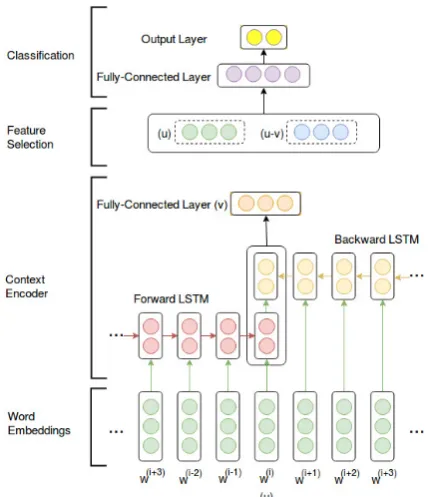
This section describes our proposed system for this shared task, which we call Di-LSTM Contrast (illustrated in Figure11) and is divided into three
modules trained in an end to end setting. The input to the model is given as pre-trained word embed-dings. An encoder uses these word embeddings to encode the context of the sentence with respect to the target word using forward and backward LSTMs (Hochreiter and Schmidhuber,1997). The output from the encoder is fed to the feature selec-tion module (secselec-tion4.2) for generating contrast-based features for the token word. The classifier module (section 4.3) then predicts the probabili-ties for the target word being metaphoric.
4.1 Context Encoder
The context encoder is inspired by Bidirec-tional LSTM (BLSTM, Graves and Schmidhu-ber (2005)). Given an input sentence S =
{w1, w2, ...wn}, with n as the number of tokens in a sentence and i as the index of target token, we make two setsA = {w1, w2, ...wi}andB = {wn, wn−1, ...wi}and feed them into forward and backward LSTMs respectively. The motivation for this split is to produce the context with respect to the target word (wi).
hf =LST Mf(A)
hb =LST Mb(B)
The hidden states hf ∈ IRd and hb ∈ IRd, so obtained from forward and backward LSTMs are
[image:2.595.79.286.61.118.2]1Figure generated usinghttps://www.draw.io/
Figure 1: The Architecture of DiLSTM Contrast Model
combined by concatenation or averaging, followed by a fully connected layer to producev∈IRd, the context encoding.
h= [hf;hb]
v=sigmoid(W(1)h+b(1))
W(1) ∈IR(d×2d)is the transformation weight ma-trix, andb(1)∈IRdis bias.
4.2 Feature Selection
A combination of the context encoding(v)and the
word vector of the target wordu=wiis then fed to the classification module as
g= [u; (u−v)]
The intuition behind this feature setg ∈ IR2d is
that the properties of the word and the difference between the general and contextual meanings play a major role in determining the metaphoricity of a word (Steen,2010).
4.3 Classification
The vector g from the previous module is
trans-formed to a hidden layer and then to the output layer to obtain the softmax probabilities(p∈IR2)
for metaphoricity.
[image:2.595.79.282.179.235.2]Model
Variants Val. Test AllPOS VerbsTest
DC (avg) 0.541 0.538 0.572
DC 0.554 0.542 0.584
DC +R 0.570 0.562 0.590
DC +RL 0.575 0.570 0.605
Task Baseline - 0.589 0.600
Table 3: Comparision of F1 scores on Validation, All POS (Test) and Verbs (Test) scores between the various approaches. DC = DiLSTM Contrast with concatenation, DC (avg) = DiLSTM Contrast with averaging, R = Re-weighting of Examples, L = Additional Linguistic Features (Baseline), Task Baseline = The baseline system used by the task organizers
p=sof tmax(W(4)h1+b(4))
W(2) ∈IR(m×2d), W(4) ∈ IR(2×m) are the weight
matrices andb(2)∈IRm, b(4) ∈IR2are the biases.
To enable the use of some additional binary baseline features (section 6.3), we modify the equations as
h1 =sigmoid(W(2)g+b(2))
l2 =W(3)gbaseline+b(3)
l1 =W(4)h1+b(4)
p=sof tmax(α l1+ (1−α)l2)
W(2) ∈ IR(m×2d), W(3) ∈ IR(2×k), W(4) ∈
IR(2×m) are the corresponding weight matrices,
b(2) ∈ IRm, b(3) ∈ IR2, b(4) ∈ IR2 are the cor-responding biases,gbaseline ∈ IRk is the baseline feature vector andα is a trainable variable which
determines the weights to be given to the baseline features and the contrast features.
5 Implementation Details
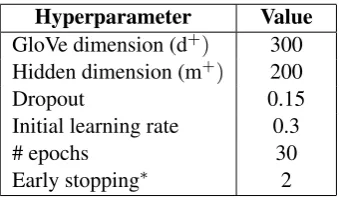
We split the provided training data in 90:10 ra-tio as training set and development set. We use this development set to tune our hyperparameters for the different variations of our model. We use 300-dimensional GloVe vectors (Pennington et al., 2014) trained on 6B Common Crawl corpus as word embeddings, setting the embeddings of out-of-vocabulary words to zero. To prevent overfit-ting on the training set, we use dropout regular-ization (Srivastava et al.,2014) and early stopping (Yao et al.,2007). We set the minibatch size to 50 examples and we zero pad the A and B split sets (as defined in section 4.1 ). More details on the hyperparameter settings can be found in the table 4.
Hyperparameter Value
GloVe dimension (d+) 300 Hidden dimension (m+) 200
Dropout 0.15
Initial learning rate 0.3
# epochs 30
[image:3.595.171.425.61.161.2]Early stopping∗ 2
Table 4: Hyperparameter settings for out best perform-ing model; +: d, m as indicated in section4; *: stop training after loss divergence for 2 consecutive itera-tions .
We use TensorFlow (Abadi et al.,2015) library in Python2 to implement our model. AdaGrad
(Duchi et al.,2011) optimizer is used for optimiza-tion of the model.
We train our models only on the All POS cate-gory training set, and evaluate it on the test sets of both All POS and Verb categories, since the train-ing set for all the verbs is a subset of the ALL POS category .
6 Experiments and Evaluation
In this section, we present evaluation results for our model. Table3shows their comparison on the test set using F1 score as the metric for evalua-tion. Experimental results indicate that our model generalizes well on the tests for both the task cat-egories and the performance trends on tests are consistent with those on validation. Table3 also shows the performance comparison of the vari-ants of our model with the baseline results for the shares task provided by the organizers. Our best performing model surpasses the baseline results on the Verbs category, while it achieves a lesser but comparable performance with the baseline on
[image:3.595.332.502.238.338.2]Text Genre P All POSR F P VerbsR F
Academic 0.641 0.683 0.661 0.736 0.753 0.744
Conversation 0.346 0.724 0.469 0.308 0.729 0.433
Fiction 0.413 0.596 0.488 0.416 0.665 0.512
News 0.566 0.591 0.578 0.643 0.665 0.654
Average 0.491 0.648 0.549 0.525 0.703 0.585
[image:4.595.156.444.60.175.2]Overall 0.511 0.644 0.570 0.529 0.708 0.605
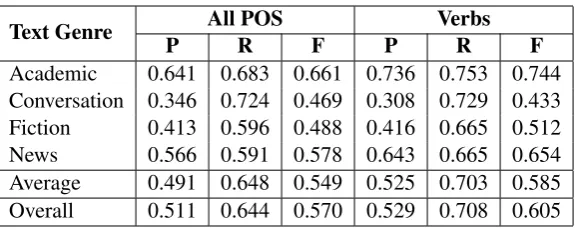
Table 5: Analysis of our best performing system on the Test Sets (both categories). P = Precision. R = Recall, F = F1 Score
All POS category.
6.1 Experiment with the Encoder
We experiment with the combining function of the hidden states of forward and backward LSTM (in section4.1) using both averaging and concate-nation. The validation results on both the cat-egories show that concatenation performs much better than averaging. This observation is sup-ported by the fact that concatenation followed by a fully connected layer allows more parameterized interactions between the two states than averaging.
6.2 Re-weighting of Training Examples We employ cost-sensitive learning (Yang et al., 2014) by re-weighting examples for our model. This brings an appreciable improvement in the performance of our model, 1.6% F1 gain on Val-idation, 2.0% on All POS category (Test) and 0.6% on verb category (Test). This increment in the performance agrees with the previous works on metaphor detection (Beigman Klebanov et al., 2015, 2016) which show the effectiveness of re-weighting training examples on VUAMC corpus.
6.3 Additional Baseline Features
The use of baseline features like WordNet (Miller, 1995) features, part-of-speech tags and Concrete-ness features (Brysbaert et al.,2014) in our model additionally improves the F1 score by 0.8% on the All POS category (Test) and 1.5% on verb cate-gory (Test), though it shows a relatively lesser im-provement on the Validation set.
To obtain the POS-tag-based features, we en-code the POS tag of the target tokens into a one-hot vector. By Wordnet features, we re-fer to one-hot encoding of the 26 class clas-sification of the words based on their gen-eral meaning. The concreteness features
repre-sent the concatenation of the one hot represen-tation of concreteness-mean-binning-BiasDown, and concreteness-mean-binning-BiasUp features (as indicated in Beigman Klebanov et al. (2015, 2016)).
7 Analysis
After the completion of the shared task, we down-loaded the publicly available labels of the test data to analyze the results of our best performing model across all the four genres of text (section3) on both the categories (as shown in the Table5). Our sys-tem performs comparatively better on academic and news texts than on conversation and fiction texts.
8 Conclusion and Future Work
We described a deep neural architecture Di-LSTM Contrast Network for metaphor detection, which we submitted for Metaphor Shared Task 2018 (Leong et al.,2018). We showed that our system achieves appreciable performance solely by using the contrast features, generated by our model us-ing pre-trained word embeddus-ings. Additionally, our model gets a significant performance boost from the use of extra baseline features, and re-weighting of examples.
For our future work, we plan to experiment with CNNs along with LSTM for capturing the context representation of the sentence in light of the target word. Another interesting idea is the use of at-tention mechanism (Mnih et al.,2014), which has proven to be effective in many NLP tasks.
Acknowledgments
References
Mart´ın Abadi, Ashish Agarwal, Paul Barham, Eugene Brevdo, Zhifeng Chen, Craig Citro, Greg S. Cor-rado, Andy Davis, Jeffrey Dean, Matthieu Devin, Sanjay Ghemawat, Ian Goodfellow, Andrew Harp, Geoffrey Irving, Michael Isard, Yangqing Jia, Rafal Jozefowicz, Lukasz Kaiser, Manjunath Kudlur, Josh Levenberg, Dandelion Man´e, Rajat Monga, Sherry Moore, Derek Murray, Chris Olah, Mike Schus-ter, Jonathon Shlens, Benoit Steiner, Ilya Sutskever, Kunal Talwar, Paul Tucker, Vincent Vanhoucke, Vijay Vasudevan, Fernanda Vi´egas, Oriol Vinyals, Pete Warden, Martin Wattenberg, Martin Wicke, Yuan Yu, and Xiaoqiang Zheng. 2015. TensorFlow: Large-scale machine learning on heterogeneous sys-tems. Software available from tensorflow.org.
Beata Beigman Klebanov, Ben Leong, Michael Heil-man, and Michael Flor. 2014. Different texts, same metaphors: Unigrams and beyond. InProceedings of the Second Workshop on Metaphor in NLP, pages 11–17. Association for Computational Linguistics.
Beata Beigman Klebanov, Chee Wee Leong, and Michael Flor. 2015. Supervised word-level metaphor detection: Experiments with concreteness and reweighting of examples. InProceedings of the Third Workshop on Metaphor in NLP, pages 11–20. Association for Computational Linguistics.
Beata Beigman Klebanov, Chee Wee Leong, E. Dario Gutierrez, Ekaterina Shutova, and Michael Flor. 2016. Semantic classifications for detection of verb metaphors. InProceedings of the 54th Annual Meet-ing of the Association for Computational LMeet-inguistics (Volume 2: Short Papers), pages 101–106. Associa-tion for ComputaAssocia-tional Linguistics.
Yoshua Bengio, R´ejean Ducharme, Pascal Vincent, and Christian Janvin. 2003. A neural probabilistic lan-guage model.J. Mach. Learn. Res., 3:1137–1155.
Marc Brysbaert, AB Warriner, and V Kuperman. 2014. Concreteness ratings for 40 thousand gener-ally known english word lemmas. BEHAVIOR RE-SEARCH METHODS, 46(3):904–911.
Erik-Lˆan Do Dinh and Iryna Gurevych. 2016. Token-level metaphor detection using neural networks. In
Proceedings of the Fourth Workshop on Metaphor in NLP, pages 28–33. Association for Computational Linguistics.
John Duchi, Elad Hazan, and Yoram Singer. 2011. Adaptive subgradient methods for online learning and stochastic optimization. J. Mach. Learn. Res., 12:2121–2159.
Andrew Gargett and John Barnden. 2015. Modeling the interaction between sensory and affective mean-ings for detecting metaphor. InProceedings of the Third Workshop on Metaphor in NLP, pages 21–30. Association for Computational Linguistics.
Alex Graves and J¨urgen Schmidhuber. 2005.2005 spe-cial issue: Framewise phoneme classification with bidirectional lstm and other neural network architec-tures.Neural Netw., 18(5-6):602–610.
Sepp Hochreiter and J¨urgen Schmidhuber. 1997. Long short-term memory. Neural Comput., 9(8):1735– 1780.
George Lakoff. 1993. The contemporary theory of metaphor, 2 edition. Cambridge University Press. Chee Wee Leong, Beata Beigman Klebanov, and
Eka-terina Shutova. 2018. A report on the 2018 vua metaphor detection shared task. In Proceedings of the Workshop on Figurative Language Processing, New Orleans, LA.
George A. Miller. 1995. Wordnet: A lexical database for english.Commun. ACM, 38(11):39–41.
Volodymyr Mnih, Nicolas Heess, Alex Graves, and Ko-ray Kavukcuoglu. 2014. Recurrent models of visual attention. CoRR, abs/1406.6247.
Jeffrey Pennington, Richard Socher, and Christo-pher D. Manning. 2014. Glove: Global vectors for word representation. InEmpirical Methods in Nat-ural Language Processing (EMNLP), pages 1532– 1543.
Sunny Rai, Shampa Chakraverty, and Devendra K. Tayal. 2016. Supervised metaphor detection using conditional random fields. In Proceedings of the Fourth Workshop on Metaphor in NLP, pages 18– 27. Association for Computational Linguistics. Marek Rei, Luana Bulat, Douwe Kiela, and Ekaterina
Shutova. 2017. Grasping the finer point: A su-pervised similarity network for metaphor detection.
CoRR, abs/1709.00575.
Ekaterina Shutova Saif M. Mohammad and Peter D. Turney. 2016. Metaphor as a medium for emotion: An empirical study. InProceedings of the Fifth Joint Conference on Lexical and Computational Seman-tics (*Sem), Berlin, Germany.
Karin Kipper Schuler. 2006. VerbNet: A Broad-Coverage, Comprehensive Verb Lexicon. Ph.D. the-sis, University of Pennsylvania.
Nitish Srivastava, Geoffrey Hinton, Alex Krizhevsky, Ilya Sutskever, and Ruslan Salakhutdinov. 2014. Dropout: A simple way to prevent neural networks from overfitting. J. Mach. Learn. Res., 15(1):1929– 1958.
G. Steen. 2010. A Method for Linguistic Metaphor Identification: From MIP to MIPVU. Converging evidence in language and communication research. John Benjamins Publishing Company.
for Computational Linguistics (Volume 1: Long Pa-pers), volume 1, pages 248–258.
X. Yang, A. Loukina, and K. Evanini. 2014. Ma-chine learning approaches to improving pronunci-ation error detection on an imbalanced corpus. In
2014 IEEE Spoken Language Technology Workshop (SLT), pages 300–305.