TALN at SemEval-2016 Task 11: Modelling Complex Words by Contextual,
Lexical and Semantic Features
Francesco Ronzano, Ahmed Abura’ed, Luis Espinosa-Anke, Horacio Saggion Department of Information and Communication Technologies (DTIC)
Universitat Pompeu Fabra Tang`er 122, Barcelona (08018), Spain
{francesco.ronzano,ahmed.aburaed,luis.espinosa,horacio.saggion}@upf.edu
Abstract
This paper presents the participation of the TALN team in the Complex Word Identifica-tion Task of SemEval-2016 (Task 11). The purpose of the task was to determine if a word in a given sentence can be judged as com-plex or not by a certain target audience. To experiment with word complexity identifica-tion approaches, Task organizers provided a training set of 2,237 words judged as com-plex or not by 20 human evaluators, together with the sentence in which each word occurs. In our contribution we modelled each word to evaluate as a numeric vector populated with a set of lexical, semantic and contextual fea-tures that may help assess the complexity of a word. We trained a Random Forest clas-sifier to automatically decide if each word is complex or not. We submitted two runs in which we respectively considered unweighted and weighted instances of complex words to train our classifier, where the weight of each instance is proportional to the number of eval-uators that judged the word as complex. Our system scored as the third best performing one.
1 Introduction
Approaches to automatically identify if a target au-dience will perceive a certain word as complex or not constitute a core component in several language-related areas of research, including Lexical Simpli-fication (Bott et al., 2012) and Readability Assess-ment(Collins-Thompson, 2014).
The Complex Word Identification Task of SemEval-2016 proposes a shared framework for
evaluating complex word identification systems. Task participants were provided with a set of sen-tences where, for each sentence, one or more words have been rated as complex or not by 20 human eval-uators. An example sentence from this dataset is:
If the growth rate is known , the maximum lichen size will give a minimum age for when this rock was deposited.
In this sentence, the words ’lichen’ and ’de-posited’ were classified as complex by at least one out of the 20 evaluators, unlike e.g. ’growth’, which did not received this label by any of them.
In our participation in Task 11, we cast the identi-fication of complex words as a binary classiidenti-fication problem in which each word is evaluated as com-plex or not, given the sentence in which it occurs. We modelled each word by a set of lexical, semantic and contextual features and evaluated distinct binary classification algorithms. Our approach to Task 11 obtained good performance: our team ranked as the second best performing one and one of the two sys-tems we proposed scored as the third best perform-ing system accordperform-ing to the G-score official evalua-tion metric (harmonic mean between Accuracy and Recall).
In Section 2 we provide an overview of rele-vant research related to Complex Word Identifica-tion. Section 3 and 4 respectively introduce the Task 11 dataset and present the text analysis tools and re-sources we exploited to characterize complex words. In Section 5 we describe the word features we used to build our complex word classifier. In Section 6 we present and discuss the performance of our Task 11 system. Finally, in Section 7 we formulate our
conclusions and outline future venues of research.
2 Related work
The identification of complex words constitutes a key aspect of Lexical Simplification (Bott et al., 2012). It can be defined as the problem of replac-ing difficult words by their simpler synonyms takreplac-ing into account the specific context in which each word is used. Several techniques have been applied so far to identify complex words. In the context of the PSET Project (Devlin and Tait, 1998), the first lexi-cal simplification system for English was developed, aimed at people with aphasia. It relies on a word difficulty assessment based on psycholinguistic evi-dence (Quinlan, 1992) in order to decide whether to simplify a word. Recent work exploited the avail-ability of comparable corpora of original documents (e.g. English Wikipedia) and their ’simplified’ ver-sions (e.g. Simple English Wikipedia pages) to in-duce measures which can be used to compare and rank ’quasi-synonymic’ word pairs (Yatskar et al., 2010). (Shardlow, 2013) compares three techniques to identify complex words in English: a psycholin-guistic approach (Devlin and Tait, 1998), frequency thresholding (i.e. words with low frequency are considered complex), and a machine learning algo-rithm trained only on word features (frequency, syl-lable count, ambiguity, etc.). In this work, a cor-pus of complex words is created based on edit his-tories from the Simple Wikipedia. The authors con-clude that the three tested methods perform similarly in terms of F-measure. (Saggion et al., 2016) use the combined evidence of word frequency and word length to assess the word complexity of a list of syn-onyms so as to select the simpler one in an Spanish lexical simplification system. (Rello et al., 2013) ar-gue that word frequency and length are two impor-tant factors affecting readability and understanding for people with dyslexia.
Besides lexical simplification, the identification of complex words constitutes a core component of
readability assessment (Collins-Thompson, 2014), the problem of quantifying the readability of a given text. The presence of complex words usually penal-izes readability. Lists of easy words (Dale and Chall, 1948), word characteristics (Kincaid et al., 1975; Gunning, 1952; Mc Laughlin, 1969), or word use in
context (e.g. language models) (Si and Callan, 2001) are all techniques or resources which have been used to support the assessment of text readability: these approaches could also be adapted to evaluate word complexity.
3 Dataset
The organizers of SemEval-2016 Task 11 released a
training datasetcomposed of 2,236 words together with the sentence in which each word occurs. For each word, the binary complexity judgements of 20 human evaluators were provided (complex word or not complex word). Similarly, Task 11 testing datasetconsisted of 88,221 words together with the sentence in which each word occurs. In this case, for each word, the binary complexity judgement of only one human annotator was collected.
4 Resources and Tools
In order to identify complex words, we character-ize each word by means of a set of lexical, semantic and contextual features. To this purpose, we analyze both the word and the sentence in which it occurs by means of the language resources and text analysis tools described in what follows.
4.1 Language Resources
Information about the frequency of use is impor-tant to assess word complexity. Therefore, in our complex word identification approach we exploit the word frequency data of two large corpora: (i) a 2014 English Wikipedia Dump and (ii) the British Na-tional Corpus (Leech and Rayson, 2014). We also use WordNet (Miller, 1995) to model semantic word features by relying on word senses and synset rela-tions (e.g. hypernymy). Moreover, we use the Dale & Chall list of 3,000 simple words (Dale and Chall, 1948) in order to incorporate the text readability di-mension, as this list contains words which 4th grade students considered understandable.
4.2 Text Analysis Tools
of the sentence, along with its syntactic dependen-cies. Both POS tags and dependency information are used to compute several features as described in the following Section.
We also processed each sentence by the UKB graph-based Word Sense Disambiguation algo-rithm (Agirre and Soroa, 2009). Specifically, we benefited from the UKB implementation integrated in the Freeling workbench (Padr´o and Stanilovsky, 2012). In this way, we may disambiguate single or multiword expressions against WordNet 3.0.
5 Method
In order to evaluate the complexity of a word, we modelled each word as a feature vector. Then, we used such word representation to enable the training and evaluation of distinct binary classification algo-rithms tailored to determine whether a word is com-plex or not. To this end, we relied on the Weka ma-chine learning framework (Witten and Frank, 2000). We evaluated the performance of four classification algorithms: Support Vector Machine (with linear kernel), Na¨ıve Bayes, Logistic Regression and Ran-dom Forest. For each algorithm, we experimented the effectiveness of the following two training ap-proaches:
• Simple: in which complex and non complex word training instances have the same rele-vance (weight);
• Weighted: in which we weighted each non complex word with weight 1 and each com-plex word with a weight ranging from 1 to 20 with respect to the number of human annotators (over 20) that evaluated the word as complex.
In the remainder of this Section we describe the set of word features we used, and motivate their rel-evance with respect to the characterization of com-plex words. When presenting word features, we group subsets of related features in the same subsec-tion (Shallow features, Dependency Tree features, etc.). It is important to note that some of the word features presented are computed by considering, be-sides the target word, also context words in a[−3,3]
window, where position 0 refers to the target word. If the context word at a specific position cannot be
determined, the value of the related feature is set to
undefined.
5.1 Shallow Features
We exploited the following set of shallow word fea-tures:
• Word length(CharNumber): the length of the
target word (number of characters).
• Position of the word(WordPosition): the po-sition of the target word in the sentence. The value of this feature is normalized in the inter-val[0,1]by dividing the the position of the
tar-get word in the sentence by the length of the same sentence (number of words). The posi-tion of the first word of a sentence is 0.
• Words in sentence(NumSentenceWords): the number of tokens in the sentence.
5.2 Dependency Tree Features
The following set of features is derived by process-ing the dependency tree of the sentences that include the word to evaluate:
• Word depth in the dependency tree
(DepthInTree position - 7 features): we considered the depth in the dependency tree of the target word (positionequal to 0), the three previous words and the three following words.
• Parent word length(ParentCharNumber): the length (number of characters) of the parent of the current (target) word in the dependency tree.
5.3 Corpus-based Features
Word frequency data derived from the British Na-tional Corpus and the 2014 English Wikipedia was used to compute the following set of features:
• British National Corpus frequency
(BNCFrequencyposition - 7 features): we considered the BNC frequency1 of the target word lemma (position equal to 0), the three previous word lemmas and the three following word lemmas.
• English Wikipedia frequency (ENwikiFre-quency position - 7 features): we considered the 2014 English Wikipedia frequency of the target word (positionequal to 0), the three pre-vious words and the three following words. Word frequencies were computed over a tok-enized and lower-cased version of the English Wikipedia.
• Simple word list(Dale Chall): a binary fea-ture to point out the presence of the target word in the Dale & Chall list.
5.4 WordNet features
We used WordNet 3.0 to compute the following features. Given a target word, we refer as target-word-synsets the set of synsets that have the same POS of the target word and include the target word among their lexicalizations (all the senses of the tar-get word). Note that this set of features is computed without relying on Word Sense Disambiguation.
• Number of Synsets(WNSynsetN): the number
of synsets intarget-word-synsets(i.e. number of senses of the target word).
• Number of Senses (WNSenseN): the sum of the number of word senses (i.e. the number of lexicalizations) of eachtarget-word-synset.
• Depth in the hypernym tree(WNDepth): the average depth in the WordNet hypernym hier-archy among all thetarget-word-synsets.
• Number of Lemmas(WNLemma): the
aver-age number of synset lexicalizations among all thetarget-word-synsets.
• Gloss length (WNGloss): the average length
of synset Glosses among all the target-word-synsets, in terms of number of tokens.
• Number of relations(WNRelation): the aver-age number of semantic relations among all the
target-word-synsets.
• Number of Distinct POSs(WNDistinctPOS): the number of distinct POS represented by at least onetarget-word-synset.
• Part of Speech (WN POS - 4 features): for each WordNet POS (POSequal to Noun, Verb, Adjective and Adverb) we counted the num-ber of synsets with that POS among the target-word-synsets, thus generating four features.
5.5 WordNet and corpus frequency features
The following set of features was computed by com-bining WordNet data, the word frequencies of the British National Corpus (BNC) and the results of the UKB WordNet-based Word Sense Disambiguation algorithm applied to the sentences where complex words appear. Thanks to the UKB algorithm, we identify the WordNet 3.0 synset that characterizes the sense of each target word (WSD-synset). Besides the target word, eachWSD-synsetusually has other lexicalizations, i.e. other synonyms. We retrieve the BNC frequency of all the lexicalizations of the
target-word-WSD-synsetand compute the following features:
• Percentage of lexicalizations with higher / lower frequency than target word
(LexicHigher/LowerFreqWSD - 2 features): the percentage of the lexicalizations of the
WSD-synset with a BNC frequency higher / lower than the target word BNC frequency.
• Ratio of total lexicalizations’ frequencies related to lexicalizations with higher / lower frequency than target word
(LexicHigher/LowerSumFreqWSD - 2 features): the ratio between the sum of BNC frequencies of the lexicalizations of the WSD-synsetwith a frequency higher / lower than the target word frequency and the sum of BNC frequencies of all the lexicalizations of the
WSD-synset.
6 Experiment and results
In order to identify the best approach to classify words as complex or not, we compared four clas-sifiers by training on both theSimpleandWeighted
datasets. We evaluated the classification perfor-mance by means of a 10-fold cross-validation. Re-sults are summarized in Table 1.
Classifier Dataset Precision Recall G-Score F-Score Random Simple 0.746 0.756 0.582 0.735 (run 1)
Forest Weighted 0.836 0.823 0.780 0.824 (run 2) Support Vector Simple 0.685 0.707 0.707 0.650
Machine Weighted 0.728 0.718 0.718 0.719
Logistic Simple 0.667 0.697 0.476 0.659
Regression Weighted 0.733 0.734 0.745 0.733
Na¨ıve Simple 0.654 0.613 0.594 0.626
Bayes Weighted 0.706 0.708 0.750 0.705 Table 1:Comparison of the performance of four complex word binary classifiers by a 10-fold cross-validation over the Task 11 training dataset.
Table 1 shows that the best performance in terms of F-Score was achieved by the Random Forest clas-sifier for both approaches (Simple and Weighted). As a consequence, the two systems we submitted to Task 11 relied on a Random Forest model re-spectively trained on Simple (unweighted, run 1) andWeighted (run 2) instances. Our run based on
Weighted instances performed quite well, ranking as the third best system in Task 11 with a G-Score of 0.772, where the G-Score of the best perform-ing system is 0.774. With respect to F-Score our best performing run was the one based onSimple in-stances that ranked as sixth.
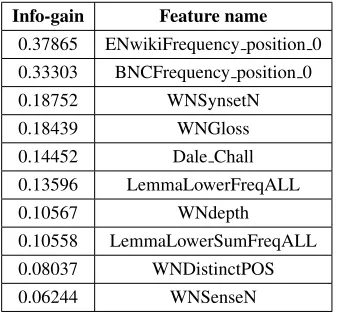
In Table 2 we show the top 10 features in our fea-ture set in terms of information gain.
Info-gain Feature name
0.37865 ENwikiFrequency position 0 0.33303 BNCFrequency position 0
0.18752 WNSynsetN
0.18439 WNGloss
0.14452 Dale Chall 0.13596 LemmaLowerFreqALL
0.10567 WNdepth
0.10558 LemmaLowerSumFreqALL 0.08037 WNDistinctPOS
0.06244 WNSenseN
Table 2:Top 10 features with respect to information gain.
We can see that the frequencies of the word to evaluate in the two corpora we considered (English Wikipedia and British National Corpus) constitute the two most informative features. Five of the top 10 features are computed by relying on WordNet, with-out performing Word Sense Disambiguation: among them we can find the number of synsets (senses) of the word to evaluate (WNSynsetN), the average length of the glosses of these synsets (WNGloss) and the average depth of these synsets in the hy-pernym tree (WNDepth). Other useful indicators of word complexity are the presence of the word in the simple words list of Dale & Chall and the set of lexicalizations (of the synsets associated to the word) characterized by a frequency in the British National Corpus lower than the frequency of the word to evaluate (LexicLowerFreqALL and Lexi-cLowerSumFreqALL).
In Table 3 we show the performance of the four classification algorithms we considered by training them on the wholetraining dataset(withSimpleor
Weightedinstances) and testing them on thetesting dataset. The best performance in terms of both F-Score and G-F-Score are achieved by the two Ran-dom Forest classifiers that were trained respectively onSimple(unweighted) andWeighted instances. In general, when we train the classifiers on Weighted
instances in place ofSimpleones, on the one hand both recall and accuracy improve, thus resulting in a higher G-Score, on the other hand the precision decreases, thus resulting in a lower F-Score.
Classifier Dataset Precision Recall G-Score F-Score
Random Simple 0.186 0.673 0.750 0.292+
Forest Weighted 0.164 0.736 0.772* 0.268
Support Vector Simple 0.132 0.406 0.549 0.199
Machine Weighted 0.103 0.720 0.706 0.180
Logistic Simple 0.131 0.454 0.588 0.203
Regression Weighted 0.086 0.804 0.682 0.156
Na¨ıve Simple 0.083 0.769 0.670 0.151
[image:5.612.102.273.535.692.2]7 Conclusions
In this paper, we described our participation to SemEval-2016 Task 11 concerning Complex Word Identification. We presented and evaluated our sys-tem based on both the characterization of words by means of contextual, lexical and semantic features and the exploitation of a Random Forest classifier to decide if a word is complex or not.
As future work we are planning to expand the fea-ture set that we consider to characterize words by relying on new corpora and lexical resources. More-over, we would like to explore complementary ap-proaches to take advantage of distributional repre-sentations of words (i.e. word embeddings) or other language models to determine words complexity.
Acknowledgments
This work is partly supported by the Spanish Min-istry of Economy and Competitiveness under the Maria de Maeztu Units of Excellence Programme (MDM-2015-0502) and the ABLE-TO-INCLUDE Project (Competitivity and Innovation Programme of the European Commission, CIP-ICT-PSP-2013-7/621055).
References
Eneko Agirre and Aitor Soroa. 2009. Personaliz-ing Pagerank for Word Sense Disambiguation. In
Proceedings of the 12th Conference of the European Chapter of the Association for Computational Linguis-tics, pages 33–41. Association for Computational Lin-guistics.
Bernd Bohnet. 2010. Very High Accuracy and Fast De-pendency Parsing is not a Contradiction. In Proceed-ings of the 23rd International Conference on Compu-tational Linguistics (Coling 2010), pages 89–97, Bei-jing, China, August.
Stefan Bott, Luz Rello, Biljana Drndarevic, and Horacio Saggion. 2012. Can Spanish Be Simpler? LexSiS: Lexical Simplification for Spanish. InProceedings of the 24th International Conference on Computational Linguistics (CoLing 2012), December.
Kevyn Collins-Thompson. 2014. Computational Assess-ment of Text Readability. A Survey of Current and Fu-ture Research. ITL - International Journal of Applied Linguistics 165:2, 165(2):97–135.
Edgar Dale and Jeanne S. Chall. 1948. The Concept of Readability.Elementary English, 23(24).
Siobhan Devlin and John Tait. 1998. The Use of a Psy-cholinguistic Database in the Simplification of Text for Aphasic Readers. Linguistic Databases, pages 161– 173.
Robert Gunning. 1952. The Technique of Clear Writing. McGraw-Hill.
J. Peter Kincaid, Robert P. Fishburne Jr., Richard L. Rogers, and Brad S. Chissom. 1975. Derivation of New Readability Formulas for Navy Enlisted Person-nel. Technical report, Naval Technical Training Com-mand.
Geoffrey Leech and Paul Rayson. 2014. Word Fre-quencies in Written and Spoken English: Based on the British National Corpus. Routledge.
G. Harry Mc Laughlin. 1969. SMOG Grading - a new Readability Formula. Journal of Reading, pages 639– 646, May.
George A. Miller. 1995. WordNet: a Lexical Database for English.Communications of the ACM, 38(11):39– 41.
Lluis Padr´o and Evgeny Stanilovsky. 2012. FreeLing 3.0: Towards Wider Multilinguality. InProceedings of the Language Resources and Evaluation Conference (LREC 2012), Istanbul, Turkey, May. ELRA.
Philip T. Quinlan. 1992. The Oxford Psycholinguistic Database. Oxford University Press.
Luz Rello, Ricardo Baeza-Yates, Laura Dempere-Marco, and Horacio Saggion. 2013. Frequent Words Improve Readability and Short Words Improve Understandabil-ity for People with Dyslexia. InHuman-Computer In-teraction - INTERACT 2013, pages 203–219.
Horacio Saggion, Stefan Bott, and Luz Rello. 2016. Simplifying Words in Context. Experiments with Two Lexical Resources in Spanish. Computer Speech & Language, 35:200–218.
Matthew Shardlow. 2013. A Comparison of Techniques to Automatically Identify Complex Words. In ACL (Student Research Workshop), pages 103–109. The Association for Computer Linguistics.
Luo Si and Jamie Callan. 2001. A Statistical Model for Scientific Readability. InProceedings of the Tenth International Conference on Information and Knowl-edge Management, CIKM ’01, pages 574–576, New York, NY, USA. ACM.
Ian H. Witten and Eibe Frank. 2000.Data Mining: Prac-tical Machine Learning Tools and Techniques with Java Implementations. Morgan Kaufmann Publishers Inc., San Francisco, CA, USA.