Optimized Online Rank Learning for Machine Translation
Taro Watanabe
National Institute of Information and Communications Technology 3-5 Hikaridai, Seika-cho, Soraku-gun, Kyoto, 619-0289 JAPAN
{taro.watanabe}@nict.go.jp
Abstract
We present an online learning algorithm for statistical machine translation (SMT) based on stochastic gradient descent (SGD). Under the online setting of rank learning, a corpus-wise loss has to be approximated by a batch lo-cal loss when optimizing for evaluation mea-sures that cannot be linearly decomposed into a sentence-wise loss, such as BLEU. We pro-pose a variant of SGD with a larger batch size in which the parameter update in each iteration is further optimized by a passive-aggressive algorithm. Learning is efficiently parallelized and line search is performed in each round when merging parameters across parallel jobs. Experiments on the NIST Chinese-to-English Open MT task indicate significantly better translation results.
1 Introduction
The advancement of statistical machine translation (SMT) relies on efficient tuning of several or many parameters in a model. One of the standards for such tuning is minimum error rate training (MERT) (Och, 2003), which directly minimize the loss of transla-tion evaluatransla-tion measures, i.e. BLEU (Papineni et al., 2002). MERT has been successfully used in prac-tical applications, although, it is known to be un-stable (Clark et al., 2011). To overcome this insta-bility, it requires multiple runs from random start-ing points and directions (Moore and Quirk, 2008), or a computationally expensive procedure by linear programming and combinatorial optimization (Gal-ley and Quirk, 2011).
Many alternative methods have been proposed based on the algorithms in machine learning, such as averaged perceptron (Liang et al., 2006), maximum entropy (Och and Ney, 2002; Blunsom et al., 2008), Margin Infused Relaxed Algorithm (MIRA) (Watan-abe et al., 2007; Chiang et al., 2008b), or pairwise rank optimization (PRO) (Hopkins and May, 2011). They primarily differ in the mode of training; on-line or MERT-like batch, and in their objectives; max-margin (Taskar et al., 2004), conditional log-likelihood (or softmax loss) (Berger et al., 1996), risk (Smith and Eisner, 2006; Li and Eisner, 2009), or ranking (Herbrich et al., 1999).
We present an online learning algorithm based on stochastic gradient descent (SGD) with a larger batch size (Shalev-Shwartz et al., 2007). Like Hop-kins and May (2011), we optimize ranking in n -best lists, but learn parameters in an online fash-ion. As proposed by Haddow et al. (2011), BLEU is approximately computed in the local batch, since BLEU is not linearly decomposed into a sentence-wise score (Chiang et al., 2008a), and optimization for sentence-BLEU does not always achieve opti-mal parameters for corpus-BLEU. Setting the larger batch size implies the more accurate corpus-BLEU, but at the cost of slower convergence of SGD. There-fore, we propose an optimized update method in-spired by the passive-aggressive algorithm (Cram-mer et al., 2006), in which each parameter update is further rescaled considering the tradeoff between the amount of updates to the parameters and the ranking loss. Learning is efficiently parallelized by splitting training data amongshardsand by merging parame-ters in each round (McDonald et al., 2010). Instead
of simple averaging, we perform an additional line search step to find the optimal merging across paral-lel jobs.
Experiments were carried out on the NIST 2008 Chinese-to-English Open MT task. We found signif-icant gains over traditional MERT and other tuning algorithms, such as MIRA and PRO.
2 Statistical Machine Translation
SMT can be formulated as a maximization problem of finding the most likely translationegiven an input sentencef using a set of parametersθ(Brown et al., 1993)
ˆ
e= arg max
e
p(e|f;θ). (1)
Under this maximization setting, we assume that
p(·) is represented by a linear combination of fea-ture functions h(f, e) which are scaled by a set of parametersw(Och and Ney, 2002)
ˆ
e= arg max
e
w⊤h(f, e). (2)
Each element ofh(·)is a feature function which cap-tures different aspects of translations, for instance, log ofn-gram language model probability, the num-ber of translated words or log of phrasal probability. In this paper, we concentrate on the problem of learningw, which is referred to astuning. One of the standard methods for parameter tuning is mini-mum error rate training (Och, 2003) (MERT) which directly minimizes the task loss ℓ(·), i.e. negative BLEU (Papineni et al., 2002), given training data
D={(f1,e1), ...,(fN,eN)}, sets of paired source sentencefiand its reference translationsei
ˆ
w= arg min w
ℓ(
{
arg max
e
w⊤h(fi, e)
}N
i=1
,{ei}Ni=1).
(3) The objective in Equation 3 is discontinuous and non-convex, and it requires decoding of all the train-ing data given w. Therefore, MERT relies on a derivative-free unconstrained optimization method, such as Powell’s method, which repeatedly chooses one direction to optimize using a line search pro-cedure as in Algorithm 1. Expensive decoding is approximated by an n-best merging technique in which decoding is carried out in each epoch of it-erationstand the maximization in Eq. 3 is
approxi-Algorithm 1MERT
1: Initializew1
2: fort= 1, ..., T do ▷Or, until convergence
3: Generaten-bests usingwt
4: Learn newwt+1by Powell’s method
5: end for 6: returnwT+1
mated by search over then-bests merged across iter-ations. The mergedn-bests are also used in the line search procedure to efficiently draw the error surface for efficient computation of the outer minimization of Eq. 3.
3 Online Rank Learning
3.1 Rank Learning
Instead of the direct task loss minimization of Eq. 3, we would like to find w by solving the L2 -regularized constrained minimization problem
arg min w
λ
2∥w∥
2
2+ℓ(w;D) (4)
whereλ >0is a hyperparameter controlling the fit-ness to the data. The loss functionℓ(·)we consider here is inspired by a pairwise ranking method (Hop-kins and May, 2011) in which pairs of correct trans-lation and incorrect transtrans-lation are sampled fromn -bests and suffer a hinge loss
1
M(w;D)
∑
(f,e)∈D
∑
e∗,e′
max
{
0,1−w⊤Φ(f, e∗, e′)
}
(5) where
e′ ∈NBEST(w;f)\ORACLE(w;f,e)
e∗ ∈ORACLE(w;f,e)
Φ(f, e∗, e′) =h(f, e∗)−h(f, e′).
to enumerate all possible translations, we follow the convention of approximating the domain of transla-tion byn-bests. Unlike Hopkins and May (2011), we do not randomly sample from all the pairs in the
n-best translations, but extract pairs by selecting one oracle translation and one other translation in then -bests other than those in ORACLE(·). Oracle trans-lations are selected by minimizing the task loss,
ℓ({e′ ∈NBEST(w;fi)}Ni=1,{ei}Ni=1)
i.e. negative BLEU, with respect to a set of ref-erence translations e. In order to compute oracles with corpus-BLEU, we apply a greedy search strat-egy overn-bests (Venugopal, 2005). Equation 5 can be easily interpreted as a constant loss “1” for choos-ing a wrong translation under current parametersw, which is in contrast with the direct task-loss used in max-margin approach to structured output learning (Taskar et al., 2004).
As an alternative, we would also consider a soft-max loss (Collins and Koo, 2005) represented by
1
N
∑
(f,e)∈D
−logZO(w;f,e)
ZN(w;f)
(6)
where
ZO(w;f,e) =
∑
e∗∈ORACLE(w;f,e)exp(w⊤f(f, e∗))
ZN(w;f) =
∑
e′∈NBEST(w;f)exp(w⊤f(f, e′)).
Equation 6 is a log-linear model used in common NLP tasks such as tagging, chunking and named en-tity recognition, but differ slightly in that multiple correct translations are discriminated from the oth-ers (Charniak and Johnson, 2005).
3.2 Online Approximation
Hopkins and May (2011) applied a MERT-like pro-cedure in Alg. 1 in which Equation 4 was solved to obtain new parameters in each iteration. Here, we employ stochastic gradient descent (SGD) meth-ods as presented in Algorithm 2 motivated by Pega-sos (Shalev-Shwartz et al., 2007). In each iteration, we randomly permuteDand choose a set of batches
Bt ={bt1, ..., btK}with eachbtj consisting ofN/K
training data. For each batchb inBt, we generate
n-bests from the source sentences inband compute oracle translations from the newly created n-bests
Algorithm 2Stochastic Gradient Descent
1: k= 1,w1←0
2: fort= 1, ..., T do
3: ChooseBt={bt1, ..., btK}fromD
4: forb∈Btdo
5: Computen-bests and oracles ofb
6: Set learning rateηk
7: wk+1
2 ←wk−ηk∇(wk;b)
▷Our proposed algorithm solve Eq. 12 or 16
8: wk+1 ←min
{
1, 1/
√
λ
∥wk+ 1 2∥2
}
wk+1 2
9: k←k+ 1
10: end for 11: end for 12: returnwk
(line 5) using a batch local corpus-BLEU (Haddow et al., 2011). Then, we optimize an approximated objective function
arg min w
λ
2∥w∥
2
2+ℓ(w;b) (7)
by replacingDwithbin the objective of Eq. 4. The parameters wk are updated by the sub-gradient of
Equation 7, ∇(wk;b), scaled by the learning rate ηk (line 7). We use an exponential decayed learn-ing rateηk =η0αk/K, which converges very fast in practice (Tsuruoka et al., 2009)1. The sub-gradient of Eq.7 with the hinge loss of Eq. 5 is
λwk−
1
M(wk;b)
∑
(f,e)∈b
∑
e∗,e′
Φ(f, e∗, e′) (8)
such that
1−w⊤kΦ(f, e∗, e′)>0. (9)
We found that the normalization term byM(·)was very slow in convergence, thus, instead, we used
M′(w;b), which was the number of paired loss terms satisfied the constraints in Equation 9. In the case of the softmax loss objective of Eq. 6, the sub-gradient is
λwk −
1
|b|
∑
(f,e)∈b ∂
∂wL(w;f,e)
w=wk
(10)
1We setα = 0.85andη
0 = 0.2which converged well in
where L(w;f,e) = log (ZO(w;f,e)/ZN(w;f)).
After the parameter update, wk+1
2 is projected within the L2-norm ball (Shalev-Shwartz et al., 2007).
Setting smaller batch size implies frequent up-dates to the parameters and a faster convergence. However, as briefly mentioned in Haddow et al. (2011), setting batch size to a smaller value, such as
|b|= 1, does not work well in practice, since BLEU is devised for a corpus based evaluation, not for an individual sentence-wise evaluation, and it is not lin-early decomposed into a sentence-wise score (Chi-ang et al., 2008a). Thus, the smaller batch size may also imply less accurate batch-local corpus-BLEU and incorrect oracle translation selections, which may lead to incorrect sub-gradient estimations or slower convergence. In the next section we propose an optimized parameter update which works well when setting a smaller batch size is impractical due to its task loss setting.
4 Optimized Online Rank Learning
4.1 Optimized Parameter Update
In line 7 of Algorithm 2, parameters are updated by the sub-gradient of each training instance in a batch
b. When the sub-gradient in Equation 8 is employed, the update procedure can be rearranged as
wk+1
2 ←(1−ληk)wk+
∑
(f,e)∈b,e∗,e′ ηk M(wk;b)
Φ(f, e∗, e′)
(11) in which each individual loss termΦ(·)is scaled uni-formly by a constantηk/M(·).
Instead of the uniform scaling, we propose to up-date the parameters in two steps: First, we suffer the sub-gradient from theL2regularization
wk+1
4 ←(1−ληk)wk.
Second, we solve the following problem
arg min w
1
2∥w−wk+14∥ 2 2+ηk
∑
(f,e)∈b,e∗,e′
ξf,e∗,e′ (12)
such that
w⊤Φ(f, e∗, e′)≥1−ξf,e∗,e′
ξf,e∗,e′ ≥0.
The problem is inspired by the passive-aggressive algorithm (Crammer et al., 2006) in which new pa-rameters are derived through the tradeoff between the amount of updates to the parameters and the margin-based loss. Note that the objective in MIRA is represented by
arg min w
λ
2∥w − wk∥
2
2 +
∑
(f,e)∈b,e∗,e′
ξf,e∗,e′ (13)
If we treatwk+1
4 as our previous parameters and set
λ= 1/ηk, they are very similar. Unlike MIRA, the
learning rateηkis directly used as a tradeoff
param-eter which decays as training proceeds, and the sub-gradient of the globalL2 regularization term is also combined in the problem throughwk+1
4. The Lagrangian dual of Equation 12 is
arg min
τe∗,e′
1 2∥
∑
(f,e)∈b,e∗,e′
τe∗,e′Φ(f, e∗, e′)∥22
− ∑
(f,e)∈b,e∗,e′ τe∗,e′
{
1−w⊤k+1 4
Φ(f, e∗, e′)
}
(14)
subject to
∑
(f,e)∈b,e∗,e′
τe∗,e′ ≤ηk.
We used a dual coordinate descent algorithm (Hsieh et al., 2008)2 to efficiently solve the quadratic
pro-gram (QP) in Equation 14, leading to an update
wk+1
2 ←wk+ 1 4 +
∑
(f,e)∈b,e∗,e′
τe∗,e′Φ(f, e∗, e′). (15)
When compared with Equation 11, the update pro-cedure in Equation 15 rescales the contribution from each sub-gradient through the Lagrange multipliers
τe∗,e′. Note that if we setτe∗,e′ =ηk/M(·), we
sat-isfy the constraints in Eq. 14, and recover the update in Eq. 11.
In the same manner as Eq. 12, we derive an opti-mized update procedure for the softmax loss, which replaces the update with Equation 10, by solving the
2
Specifically, each parameter is bound constrained0≤τ≤ ηkbut is not summation constrained
∑
τ ≤ηk. Thus, we
following problem
arg min w
1
2∥w − wk+14∥ 2 2 + ηk
∑
(f,e)∈b
ξf (16)
such that
w⊤Ψ(wk;f,e)≥ −L(wk;f,e)−ξf
ξf ≥0
in whichΨ(w′;f,e) = ∂∂wL(w;f,e)w=w′.
Equa-tion 16 can be interpreted as a cutting-plane approx-imation for the objective of Eq. 7, in which the orig-inal objective of Eq. 7 with the softmax loss in Eq. 6 is approximated by |b| linear constraints derived from the sub-gradients at pointwk(Teo et al., 2010).
Eq. 16 is efficiently solved by its Lagrange dual, leading to an update
wk+1
2 ←wk+ 1 4 +
∑
(f,e)∈b
τfΨ(wk;f,e) (17)
subject to∑(f,e)∈bτf ≤ηk. Similar to Eq. 15, the
parameter update byΨ(·)is rescaled by its Lagrange multipliersτf in place of the uniform scale of1/|b|
in the sub-gradient of Eq. 10.
4.2 Line Search for Parameter Mixing
For faster training, we employ an efficient paral-lel training strategy proposed by McDonald et al. (2010). The training dataD is split intoS disjoint
shards,{D1, ..., DS}. Each shard learns its own
pa-rameters in each single epochtand performs param-eter mixing by averaging paramparam-eters across shards.
We propose an optimized parallel training in Al-gorithm 3 which performs better mixing with re-spect to the task loss, i.e. negative BLEU. In line 5, wt+12 is computed by averagingwt+1,s from all the shards after local training using their own data
Ds. Then, the new parameterswt+1are obtained by linearly interpolating with the parameters from the previous epochwt. The linear interpolation weight
ρ is efficiently computed by a line search proce-dure which directly minimizes the negative corpus-BLEU. The procedure is exactly the same as the line search strategy employed in MERT usingwtas our starting point with the direction wt+12 −wt. The idea of using the line search procedure is to find the optimum parameters under corpus-BLEU without a
Algorithm 3Distributed training with line search
1: w1 ←0
2: fort= 1, ..., T do
3: wt,s←wt ▷Distribute parameters
4: Each shard learnswt+1,s usingDs
▷Line 3–10 in Alg. 2
5: wt+12 ←1/S∑
swt+1,s ▷Mixing
6: wt+1←(1−ρ)wt+ρwt+12 ▷Line search
7: end for 8: returnwT+1
batch-local approximation. Unlike MERT, however, we do not memorize nor merge all then-bests gener-ated across iterations, but keep onlyn-bests in each iteration for faster training and for memory saving. Thus, the optimumρobtained by the line search may be suboptimal in terms of the training objective, but potentially better than averaging for minimizing the final task loss.
5 Experiments
Experiments were carried out on the NIST 2008 Chinese-to-English Open MT task. The training data consists of nearly 5.6 million bilingual sen-tences and additional monolingual data, English Gigaword, for 5-gram language model estimation. MT02 and MT06 were used as our tuning and devel-opment testing, and MT08 as our final testing with all data consisting of four reference translations.
inter-sected rules. n-bests are generated from the pre-computed forests on the fly using the forest rescor-ing framework (Huang and Chiang, 2007) with ad-ditional non-local features, such as 5-gram language models.
We compared four algorithms, MERT, PRO, MIRA and our proposed online settings, online rank optimization (ORO). Note that ORO without our op-timization methods in Section 4 is essentially the same as Pegasos, but differs in that we employ the algorithm for ranking structured outputs with var-ied objectives, hinge loss or softmax loss3. MERT learns parameters from forests (Kumar et al., 2009) with 4 restarts and 8 random directions in each it-eration. We experimented on a variant of PRO4, in which the objective in Eq. 4 with the hinge loss of Eq. 5 was solved in each iteration in line 4 of Alg. 1 using an off-the-shelf solver5. Our MIRA solves the problem in Equation 13 in line 7 of Alg. 2. For a sys-tematic comparison, we used our exhaustive oracle translation selection method in Section 3 for PRO, MIRA and ORO. For each learning algorithm, we ran 30 iterations and generated duplicate removed 1,000-best translations in each iteration. The hyper-parameterλfor PRO and ORO was set to10−5, se-lected from among{10−3,10−4,10−5}, and102for MIRA, chosen from {10,102,103} by preliminary testing on MT06. Both decoding and learning are parallelized and run on 8 cores. Each online learn-ing took roughly 12 hours, and PRO took one day. It took roughly 3 days for MERT with 20 iterations. Translation results are measured by case sensitive BLEU.
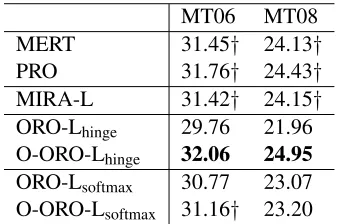
Table 1 presents our main results. Among the pa-rameters from multiple iterations, we report the out-puts that performed the best on MT06. With Moses (Koehn et al., 2007), we achieved 30.36 and 23.64 BLEU for MT06 and MT08, respectively. We de-note the “O-” prefix for the optimized parameter up-dates discussed in Section 4.1, and the “-L” suffix
3
The other major difference is the use of a simpler learning rate,λk1 , which was very slow in our preliminary studies.
4Hopkins and May (2011) minimized logistic loss sampled from the mergedn-bests, and sentence-BLEU was used for de-termining ranks.
5
We used liblinear (Fan et al., 2008) at http://www.
csie.ntu.edu.tw/˜cjlin/liblinearwith the solver
type of 3.
MT06 MT08
MERT 31.45† 24.13†
PRO 31.76† 24.43†
MIRA-L 31.42† 24.15†
ORO-Lhinge 29.76 21.96
O-ORO-Lhinge 32.06 24.95
ORO-Lsoftmax 30.77 23.07
[image:6.612.342.511.59.171.2]O-ORO-Lsoftmax 31.16† 23.20
Table 1: Translation results by BLEU. Results with-out significant differences from the MERT baseline are marked†. The numbers in boldface are signif-icantly better than the MERT baseline (both mea-sured by the bootstrap resampling (Koehn, 2004) withp >0.05).
0 5 10 15 20 25 30 35 40
0 5 10 15 20 25 30
BLEU
iteration
MIRA-L MT02 MT08 ORO-L MT02 MT08 O-ORO-L MT02 MT08
Figure 1: Learning curves for three algorithms, MIRA-L, ORO-Lhingeand O-ORO-Lhinge.
for parameter mixing by line search as described in Section 4.2. The batch size was set to 16 for MIRA and ORO. In general, our PRO and MIRA settings achieved the results very comparable to MERT. The hinge-loss and softmax objective OROs were lower than those of the three baselines. The softmax ob-jective with the optimized update (O-ORO-Lsoftmax)
performed better than the non-optimized version, but it was still lower than our baselines. In the case of the hinge-loss objective with the optimized update (O-ORO-Lhinge), the gain in MT08 was significant,
and achieved the best BLEU.
Figure 1 presents the learning curves for three al-gorithms MIRA-L, ORO-Lhinge and O-ORO-Lhinge,
[image:6.612.314.539.285.442.2]MT06 MT08
MIRA 30.95 23.06
MIRA-L 31.42† 24.15†
OROhinge 29.09 21.93
ORO-Lhinge 29.76 21.96
OROsoftmax 30.80 23.06
ORO-Lsoftmax 30.77 23.07
O-OROhinge 31.15† 23.20
O-ORO-Lhinge 32.06 24.95
O-OROsoftmax 31.40† 23.93†
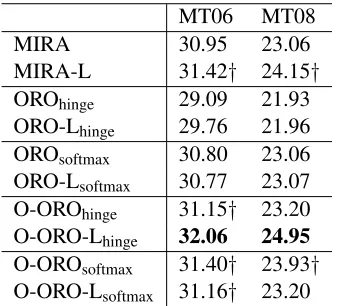
[image:7.612.102.271.59.212.2]O-ORO-Lsoftmax 31.16† 23.20
Table 2: Parameter mixing by line search.
on the training data (MT02) and on the test data (MT08). MIRA-L quickly converges and is slightly unstable in the test set, while ORO-Lhingeis very
sta-ble and slow to converge, but with low performance on the training and test data. The stable learning curve in ORO-Lhinge is probably influenced by our
learning rate parameter η0 = 0.2, which will be investigated in future work. O-ORO-Lhinge is less
stable in several iterations, but steadily improves its BLEU. The behavior is justified by our optimized update procedure, in which the learning rate ηk is
used as a tradeoff parameter. Thus, it tries a very aggressive update at the early stage of training, but eventually becomes conservative in updating param-eters.
Next, we compare the effect of line search for pa-rameter mixing in Table 2. Line search was very effective for MIRA and O-OROhinge, but less
effec-tive for the others. Since the line search procedure directly minimizes a task loss, not objectives, this may hurt the performance for the softmax objective, where the margins between the correct and incorrect translations are softly penalized.
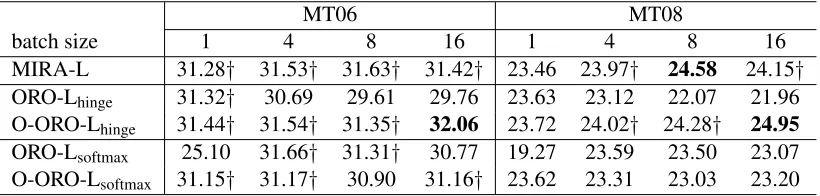
Finally, Table 3 shows the effect of batch size se-lected from{1,4,8,16}. There seems to be no clear trends in MIRA, and we achieved BLEU score of 24.58 by setting the batch size to 8. Clearly, set-ting smaller batch size is better for ORO, but it is the reverse for the optimized variants of both the hinge and softmax objectives. Figure 2 compares ORO-Lhinge and O-ORO-Lhinge on MT02 with
dif-ferent batch size settings. ORO-Lhinge converges
faster when the batch size is smaller and fine
20 25 30 35 40
0 5 10 15 20 25 30
BLEU
iteration
ORO-L batch-16 batch-8 batch-4 O-ORO-L batch-16 batch-8 batch-4
Figure 2: Learning curves on MT02 for ORO-Lhinge
and O-ORO-Lhingewith different batch size.
ing of the learning rate parameter will be required for a larger batch size. As discussed in Section 3, the smaller batch size means frequent updates to pa-rameters and a faster convergence, but potentially leads to a poor performance since the corpus-BLEU is approximately computed in a local batch. Our op-timized update algorithms address the problem by adjusting the tradeoff between the amount of up-date to parameters and the loss, and perform better for larger batch sizes with a more accurate corpus-BLEU.
6 Related Work
Our work is largely inspired by pairwise rank op-timization (Hopkins and May, 2011), but runs in an online fashion similar to (Watanabe et al., 2007; Chiang et al., 2008b). Major differences come from the corpus-BLEU computation used to select oracle translations. Instead of the sentence-BLEU used by Hopkins and May (2011) or the corpus-BLEU statis-tics accumulated from previous translations gener-ated by different parameters (Watanabe et al., 2007; Chiang et al., 2008b), we used a simple batch lo-cal corpus-BLEU (Haddow et al., 2011) in the same way as an online approximation to the objectives. An alternative is the use of a Taylor series approxi-mation (Smith and Eisner, 2006; Rosti et al., 2011), which was not investigated in this paper.
[image:7.612.316.539.61.222.2]MT06 MT08
batch size 1 4 8 16 1 4 8 16
MIRA-L 31.28† 31.53† 31.63† 31.42† 23.46 23.97† 24.58 24.15†
ORO-Lhinge 31.32† 30.69 29.61 29.76 23.63 23.12 22.07 21.96
O-ORO-Lhinge 31.44† 31.54† 31.35† 32.06 23.72 24.02† 24.28† 24.95
ORO-Lsoftmax 25.10 31.66† 31.31† 30.77 19.27 23.59 23.50 23.07
[image:8.612.102.512.60.158.2]O-ORO-Lsoftmax 31.15† 31.17† 30.90 31.16† 23.62 23.31 23.03 23.20
Table 3: Translation results with varied batch size.
for more accurate corpus-BLEU is addressed by optimally scaling parameter updates in the spirit of a passive-aggressive algorithm (Crammer et al., 2006). The derived algorithm is very similar to MIRA, but differs in that the learning rate is em-ployed as a hyperparameter for controlling the fit-ness to training data which decays when training proceeds. The non-uniform sub-gradient based up-date is also employed in an exponentiated gradient (EG) algorithm (Kivinen and Warmuth, 1997; Kivi-nen and Warmuth, 2001) in which parameter updates are maximum-likely estimated using an exponen-tially combined sub-gradients. In contrast, our ap-proach relies on an ultraconservative update which tradeoff between the amount of updates performed to the parameters and the progress made for the ob-jectives by solving a QP subproblem.
Unlike a complex parallelization by Chiang et al. (2008b), in which support vectors are asyn-chronously exchanged among parallel jobs, train-ing is efficiently and easily carried out by distribut-ing traindistribut-ing data among shards and by mixdistribut-ing pa-rameters in each iteration (McDonald et al., 2010). Rather than simple averaging, new parameters are derived by linearly interpolating with the previously mixed parameters, and its weight is determined by the line search algorithm employed in (Och, 2003).
7 Conclusion
We proposed a variant of an online learning al-gorithm inspired by a batch learning alal-gorithm of (Hopkins and May, 2011). Training is performed by SGD with a parameter projection (Shalev-Shwartz et al., 2007) using a larger batch size for a more accu-rate batch local corpus-BLEU estimation. Parameter updates in each iteration is further optimized using an idea from a passive-aggressive algorithm
(Cram-mer et al., 2006). Learning is efficiently parallelized (McDonald et al., 2010) and the locally learned pa-rameters are mixed by an additional line search step. Experiments indicate that better performance was achieved by our optimized updates and by the more sophisticated parameter mixing.
In future work, we would like to investigate other objectives with a more direct task loss, such as max-margin (Taskar et al., 2004), risk (Smith and Eisner, 2006) or softmax-loss (Gimpel and Smith, 2010), and different regularizers, such as L1-norm for a sparse solution. Instead of n-best approximations, we may directly employ forests for a better con-ditional log-likelihood estimation (Li and Eisner, 2009). We would also like to explore other mix-ing strategies for parallel trainmix-ing which can directly minimize the training objectives like those proposed for a cutting-plane algorithm (Franc and Sonnen-burg, 2008).
Acknowledgments
We would like to thank anonymous reviewers and our colleagues for helpful comments and discussion.
References
Adam L. Berger, Vincent J. Della Pietra, and Stephen A. Della Pietra. 1996. A maximum entropy approach to natural language processing. Computational Lin-guistics, 22:39–71, March.
Phil Blunsom, Trevor Cohn, and Miles Osborne. 2008. A discriminative latent variable model for statistical machine translation. InProc. of ACL-08: HLT, pages 200–208, Columbus, Ohio, June.
Eugene Charniak and Mark Johnson. 2005. Coarse-to-fine n-best parsing and maxent discriminative rerank-ing. InProc. of ACL 2005, pages 173–180, Ann Arbor, Michigan, June.
David Chiang, Steve DeNeefe, Yee Seng Chan, and Hwee Tou Ng. 2008a. Decomposability of transla-tion metrics for improved evaluatransla-tion and efficient al-gorithms. InProc. of EMNLP 2008, pages 610–619, Honolulu, Hawaii, October.
David Chiang, Yuval Marton, and Philip Resnik. 2008b. Online large-margin training of syntactic and struc-tural translation features. In Proc. of EMNLP 2008, pages 224–233, Honolulu, Hawaii, October.
David Chiang. 2007. Hierarchical phrase-based transla-tion. Computational Linguistics, 33(2):201–228. Jonathan H. Clark, Chris Dyer, Alon Lavie, and Noah A.
Smith. 2011. Better hypothesis testing for statistical machine translation: Controlling for optimizer insta-bility. InProc. of ACL 2011, pages 176–181, Portland, Oregon, USA, June.
Michael Collins and Terry Koo. 2005. Discrimina-tive reranking for natural language parsing. Compu-tational Linguistics, 31:25–70, March.
Koby Crammer, Ofer Dekel, Joseph Keshet, Shai Shalev-Shwartz, and Yoram Singer. 2006. Online passive-aggressive algorithms. Journal of Machine Learning Research, 7:551–585, March.
Chris Dyer, Kevin Gimpel, Jonathan H. Clark, and Noah A. Smith. 2011. The cmu-ark german-english translation system. InProc. of SMT 2011, pages 337– 343, Edinburgh, Scotland, July.
Rong-En Fan, Kai-Wei Chang, Cho-Jui Hsieh, Xiang-Rui Wang, and Chih-Jen Lin. 2008. Liblinear: A library for large linear classification. Journal of Ma-chine Learning Research, 9:1871–1874, June. Vojtˇech Franc and Soeren Sonnenburg. 2008. Optimized
cutting plane algorithm for support vector machines. In Proc. of ICML ’08, pages 320–327, Helsinki, Fin-land.
Michel Galley and Chris Quirk. 2011. Optimal search for minimum error rate training. InProc. of EMNLP 2011, pages 38–49, Edinburgh, Scotland, UK., July. Kevin Gimpel and Noah A. Smith. 2010.
Softmax-margin crfs: Training log-linear models with cost functions. InProc. of NAACL-HLT 2010, pages 733– 736, Los Angeles, California, June.
Barry Haddow, Abhishek Arun, and Philipp Koehn. 2011. Samplerank training for phrase-based machine translation. InProc. of SMT 2011, pages 261–271, Ed-inburgh, Scotland, July.
Ralf Herbrich, Thore Graepel, and Klaus Obermayer. 1999. Support vector learning for ordinal regression. In In Proc. of International Conference on Artificial Neural Networks, pages 97–102.
Mark Hopkins and Jonathan May. 2011. Tuning as rank-ing. InProc. of EMNLP 2011, pages 1352–1362, Ed-inburgh, Scotland, UK., July.
Cho-Jui Hsieh, Kai-Wei Chang, Chih-Jen Lin, S. Sathiya Keerthi, and S. Sundararajan. 2008. A dual coordinate descent method for large-scale linear svm. InProc. of ICML ’08, pages 408–415, Helsinki, Finland.
Liang Huang and David Chiang. 2007. Forest rescor-ing: Faster decoding with integrated language models. InProc. of ACL 2007, pages 144–151, Prague, Czech Republic, June.
Jyrki Kivinen and Manfred K. Warmuth. 1997. Expo-nentiated gradient versus gradient descent for linear predictors. Information and Computation, 132(1):1– 63, January.
J. Kivinen and M. K. Warmuth. 2001. Relative loss bounds for multidimensional regression problems.
Machine Learning, 45(3):301–329, December. Philipp Koehn, Hieu Hoang, Alexandra Birch, Chris
Callison-Burch, Marcello Federico, Nicola Bertoldi, Brooke Cowan, Wade Shen, Christine Moran, Richard Zens, Chris Dyer, Ondrej Bojar, Alexandra Con-stantin, and Evan Herbst. 2007. Moses: Open source toolkit for statistical machine translation. InProcc of ACL 2007, pages 177–180, Prague, Czech Republic, June.
Philipp Koehn. 2004. Statistical significance tests for machine translation evaluation. In Proc. of EMNLP 2004, pages 388–395, Barcelona, Spain, July.
Shankar Kumar, Wolfgang Macherey, Chris Dyer, and Franz Och. 2009. Efficient minimum error rate train-ing and minimum bayes-risk decodtrain-ing for translation hypergraphs and lattices. In Proc. of ACL-IJCNLP 2009, pages 163–171, Suntec, Singapore, August. Zhifei Li and Jason Eisner. 2009. First- and second-order
expectation semirings with applications to minimum-risk training on translation forests. InProc. of EMNLP 2009, pages 40–51, Singapore, August.
Percy Liang, Alexandre Bouchard-Cˆot´e, Dan Klein, and Ben Taskar. 2006. An end-to-end discriminative approach to machine translation. In Proc. of COL-ING/ACL 2006, pages 761–768, Sydney, Australia, July.
Ryan McDonald, Keith Hall, and Gideon Mann. 2010. Distributed training strategies for the structured per-ceptron. InProc. of NAACL-HLT 2010, pages 456– 464, Los Angeles, California, June.
Robert C. Moore and Chris Quirk. 2008. Random restarts in minimum error rate training for statistical machine translation. InProc. of COLING 2008, pages 585–592, Manchester, UK, August.
statis-tical machine translation. InProc. of ACL 2002, pages 295–302, Philadelphia, July.
Franz Josef Och. 2003. Minimum error rate training in statistical machine translation. InProc. of ACL 2003, pages 160–167, Sapporo, Japan, July.
Kishore Papineni, Salim Roukos, Todd Ward, and Wei-Jing Zhu. 2002. Bleu: a method for automatic evalu-ation of machine translevalu-ation. In Proc. of ACL 2002, pages 311–318, Philadelphia, Pennsylvania, USA, July.
Antti-Veikko Rosti, Bing Zhang, Spyros Matsoukas, and Richard Schwartz. 2011. Expected bleu training for graphs: Bbn system description for wmt11 system combination task. InProc. of SMT 2011, pages 159– 165, Edinburgh, Scotland, July.
Shai Shalev-Shwartz, Yoram Singer, and Nathan Srebro. 2007. Pegasos: Primal estimated sub-gradient solver for svm. InProc. of ICML ’07, pages 807–814, Cor-valis, Oregon.
David A. Smith and Jason Eisner. 2006. Minimum risk annealing for training log-linear models. InProc. of COLING/ACL 2006, pages 787–794, Sydney, Aus-tralia, July.
Ben Taskar, Dan Klein, Mike Collins, Daphne Koller, and Christopher Manning. 2004. Max-margin parsing. In
Proc. of EMNLP 2004, pages 1–8, Barcelona, Spain, July.
Choon Hui Teo, S.V.N. Vishwanthan, Alex J. Smola, and Quoc V. Le. 2010. Bundle methods for regularized risk minimization. Journal of Machine Learning Re-search, 11:311–365, March.
Yoshimasa Tsuruoka, Jun’ichi Tsujii, and Sophia Ana-niadou. 2009. Stochastic gradient descent training for l1-regularized log-linear models with cumulative penalty. InProc. of ACL-IJCNLP 2009, pages 477– 485, Suntec, Singapore, August.
Ashish Venugopal. 2005. Considerations in maximum mutual information and minimum classification error training for statistical machine translation. InProc. of EAMT-05, page 3031.
Taro Watanabe, Jun Suzuki, Hajime Tsukada, and Hideki Isozaki. 2007. Online large-margin training for statis-tical machine translation. InProc. of EMNLP-CoNLL 2007, pages 764–773, Prague, Czech Republic, June. Xinyan Xiao, Yang Liu, Qun Liu, and Shouxun Lin.