Labeling the Languages of Words in Mixed-Language Documents using
Weakly Supervised Methods
Ben King
Department of EECS University of Michigan
Ann Arbor, MI
Steven Abney
Department of Linguistics University of Michigan
Ann Arbor, MI
Abstract
In this paper we consider the problem of label-ing the languages of words in mixed-language documents. This problem is approached in a weakly supervised fashion, as a sequence la-beling problem with monolingual text sam-ples for training data. Among the approaches evaluated, a conditional random field model trained with generalized expectation criteria was the most accurate and performed consis-tently as the amount of training data was var-ied.
1 Introduction
Language identification is a well-studied problem (Hughes et al., 2006), but it is typically only studied in its canonical text-classification formulation, iden-tifying a document’s language given sample texts from a few different languages. But there are sev-eral other interesting and useful formulations of the problem that have received relatively little attention. Here, we focus on the problem of labeling the lan-guages of individual words within a multilingual document. To our knowledge, this is the first paper to specifically address this problem.
Our own motivation for studying this problem stems from issues encountered while attempting to build language resources for minority languages. In trying to extend parts of Kevin Scannell’s Cr´ubad´an project (Scannell, 2007), which automatically builds minority language corpora from the Web, we found that the majority of webpages that contain text in a minority language also contain text in other lan-guages. Since Scannell’s method builds these
cor-pora by bootstrapping from the pages that were re-trieved, the corpus-building process can go disas-trously wrong without accounting for this problem. And any resources, such as a lexicon, created from the corpus will also be incorrect.
In this paper, we explore techniques for per-forming language identification at the word level in mixed language documents. Our results show that one can do better than independent word language classification, as there are clues in a word’s context: words of one language are frequently surrounded by words in the same language, and many documents have patterns that may be marked by the presence of certain words or punctuation. The methods in this paper also outperform sentence-level language iden-tification, which is too coarse to capture most of the shifts between language.
To evaluate our methods, we collected and man-ually annotated a corpus of over 250,000 words of bilingual (though mostly non-parallel) text from the web. After running several different weakly-supervised learning methods, we found that a condi-tional random field model trained with generalized expectation criteria is the most accurate and per-forms quite consistently as the amount of training data is varied.
In section 2, we review the related work. In sec-tion 3, we define the task and describe the data and its annotation. Because the task of language identi-fication for individual words has not been explicitly studied in the literature, and because of its impor-tance to the overall task, we examine the features and methods that work best for independent word language identification in section 4. We begin to
amine the larger problem of labeling the language of words in context in section 5 by describing our methods. In section 6, we describe the evaluation and present the results. We present our error analy-sis in section 7 and conclude in section 8.
2 Related Work
Language identification is one of the older NLP problems (Beesley, 1988), especially in regards to spoken language (House and Neuburg, 1977), and has received a fair share of attention through the years (Hughes et al., 2006). In its standard formu-lation, language identification assumes monolingual documents and attempts to classify each document according to its language from some closed set of known languages.
Many approaches have been proposed, such as Markov models (Dunning, 1994), Monte Carlo methods (Poutsma, 2002), and more recently sup-port vector machines with string kernels, but nearly all approaches use the n-gram features first sug-gested by (Cavnar and Trenkle, 1994). Performance of language identification is generally very high with large documents, usually in excess of 99% accuracy, but Xia et al. (2009) mention that current methods still can perform quite poorly when the class of po-tential languages is very large or the texts to be clas-sified are very short.
This paper attempts to address three of the on-going issues specifically mentioned by Hughes et al. (2006) in their survey of textual language iden-tification: supporting minority languages, sparse or impoverished training data, and multilingual docu-ments.
A number of methods have been proposed in re-cent years to apply to the problems of unsuper-vised and weakly-superunsuper-vised learning. Excluding self- and co-training methods, these methods can be categorized into two broad classes: those which bootstrap from a small number of tokens (some-times called prototypes) (Collins and Singer, 1999; Haghighi and Klein, 2006), and those which impose constraints on the underlying unsupervised learning problem (Chang et al., 2007; Bellare et al., 2009; Druck et al., 2008; Ganchev et al., 2010).
Constraint-based weakly supervised learning has been applied to some sequence labeling problems,
through such methods as contrastive estimation (Smith and Eisner, 2005), generalized expectation criteria (Mann and McCallum, 2008), alternating projections (Singh et al., 2010), and posterior reg-ularization (Ganchev et al., 2010).
Perhaps the work that is most similar to this work is the study ofcode-switchingwithin NLP literature. Most of the work done has been on automatically identifying code-switch points (Joshi, 1982; Solorio and Liu, 2008). The problem of identifying lan-guage in the presence of code-switching has seen the most attention in the realm of speech process-ing (Chu et al., 2007; Lyu and Lyu, 2008), among many others. Though code-switching has been well-studied linguistically, it is only one possible rea-son to explain why a document contains multiple languages, and is actually one of the less common causes observed in our corpus. For that reason, we approach this problem more generally, assuming no specific generative process behind multilingual text.
3 Task Definition
The task we describe in this paper is a sequence labeling problem, labeling a word in running text according to the language to which it belongs. In the interest of being able to produce reliable hu-man annotations, we limit ourselves to texts with exactly two languages represented, though the tech-niques developed in this paper would certainly be applicable to documents with more than two lan-guages. The two languages represented in the paper are knowna prioriby the labeler and the only train-ing data available to the labeler is a small amount of sample text in each of the two languages repre-sented.
as-sumption that sequences within the same document areiid.
Because of this difference, the labeler is presented each document separately and must label its words independently of any other document. And the train-ing data for this task is not in the form of labeled sequences. Rather, the models in this task are given two monolingual example texts which are used only to learn a model for individual instances. Any se-quential dependencies between words must be boot-strapped from the document. It is this aspect of the problem that makes it well-suited for weakly-supervised learning.
It is worth considering whether this problem is best approached at the word level, or if perhaps sentence- or paragraph-level language identification would suffice for this task. In those cases, we could easily segment the text at the sentence or paragraph level and feed those segments to an existing lan-guage identifier. To answer this question we seg-mented our corpus into sentences by splitting at ev-ery period, exclamation point, or question mark (an overly agressive approximation of sentence segmen-tation). Even if every sentence was given the cor-rect majority label under this sentence segmentation, the maximum possible word-level accuracy that a sentence-level classifier could achieve is 85.8%, and even though this number reflects quite optimistic conditions, it is still much lower than the methods of this paper are able to achieve.
3.1 Evaluation Data
To build a corpus of mixed language documents, we used the BootCat tool (Baroni and Bernardini, 2004) seeded with words from a minority language. Boot-Cat is designed to automatically collect webpages on a specific topic by repeatedly searching for key-words from a topic-specific set of seed key-words. We found that this method works equally well for lan-guages as for topics, when seeded with words from a specific language. Once BootCat returned a col-lection of documents, we manually identified docu-ments from the set that contained text in both the tar-get language and in English, but did not contain text in any other languages. Since the problem becomes trivial when the languages do not share a character set, we limited ourselves to languages with a Latin orthography.
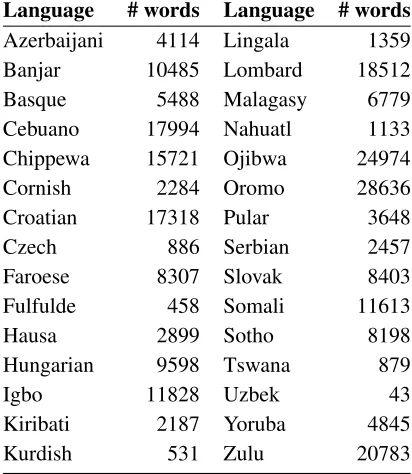
Language # words Language # words Azerbaijani 4114 Lingala 1359 Banjar 10485 Lombard 18512
Basque 5488 Malagasy 6779
Cebuano 17994 Nahuatl 1133 Chippewa 15721 Ojibwa 24974
Cornish 2284 Oromo 28636
Croatian 17318 Pular 3648
Czech 886 Serbian 2457
Faroese 8307 Slovak 8403
Fulfulde 458 Somali 11613
Hausa 2899 Sotho 8198
Hungarian 9598 Tswana 879
Igbo 11828 Uzbek 43
Kiribati 2187 Yoruba 4845
[image:3.612.322.528.64.301.2]Kurdish 531 Zulu 20783
Table 1: Languages present in the corpus and their number of words before separating out English text.
We found that there was an important balance to be struck concerning the popularity of a language. If a language is not spoken widely enough, then there is little chance of finding any text in that language on the Web. Conversely if a language is too widely spo-ken, then it is difficult to find mixed-language pages for it. The list of languages present in the corpus and the number of words in each language reflects this balance as seen in Table 1.
For researchers who wish to make use this data, the set of annotations used in this paper is available from the first author’s website1.
3.2 Annotation
Before the human annotators were presented with the mixed-language documents fetched by Boot-Cat, the documents were first stripped of all HTML markup, converted to Unicode, and had HTML es-cape sequences replaced with the proper Unicode characters. Documents that had any encoding er-rors (e.g.original page used a mixture of encodings) were excluded from the corpus.
1
ENG: because of LUTARU.Thank you ntate T.T! Sevice...
SOT: Retselisitsoemonethi ekare jwale hotla sebetswa ...
ENG: Lesotho is heading 4 development #big-ups Mr ...
SOT: Basotho bare monoana hao its’upe.
ENG: Just do the job and lets see what you are made ...
SOT: Malerato Mokoena Ntate Thabane, molimo ...
ENG: It is God who reigns and if God is seen in your ...
SOT: Mathabo Letsie http://www.facebook.com/taole. ...
ENG: As Zuma did he should introduce a way of we can ...
[image:4.612.322.529.66.315.2]SOT: Msekhotho Matona a rona ha a hlomamisoe, re ...
Table 2: An example of text from an annotated English-Sotho web page.
Since there are many different reasons that the language in a document may change (e.g. code-switching, change of authors, borrowing) and many variations thereof, we attempted to create a broad set of annotation rules that would cover many cases, rather than writing a large number of very specific rules. In cases when the language use was ambigu-ous, the annotators were instructed simply to make their best guess. Table 2 shows an example of an annotated document.
Generally, only well-digested English loanwords and borrowings were to be marked as belonging to the foreign language. If a word appeared in the con-text of both languages, it was permissible for that word to receive different labels at different times, depending on its context.
Ordinary proper names (like “John Williams” or “Chicago”) were to be marked as belonging to the language of the context in which they appear. This rule also applied to abbreviations (like “FIFA” or “BBC”). The exception to this rule was proper names composed of common nouns (like “Stairway to Heaven” or “American Red Cross”) and to abbre-viations that spelled out English words, which were to be marked as belonging to the language of the words they were composed of.
The annotators were instructed not to assign la-bels to numbers or punctuation, but they were al-lowed to use numbers as punctuation as clues for as-signing other labels.
3.3 Human Agreement
To verify that the annotation rules were reasonable and led to a problem that could potentially be solved by a computer, we had each of the annotators mark
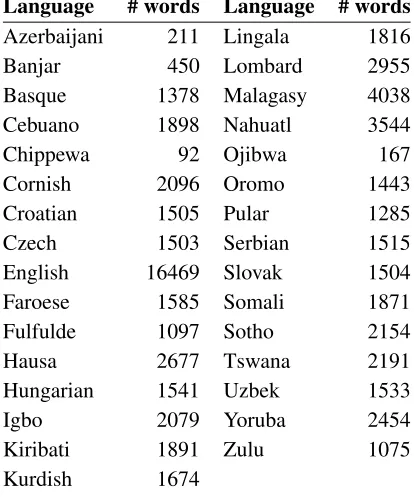
Language # words Language # words Azerbaijani 211 Lingala 1816
Banjar 450 Lombard 2955
Basque 1378 Malagasy 4038
Cebuano 1898 Nahuatl 3544
Chippewa 92 Ojibwa 167
Cornish 2096 Oromo 1443
Croatian 1505 Pular 1285
Czech 1503 Serbian 1515
English 16469 Slovak 1504
Faroese 1585 Somali 1871
Fulfulde 1097 Sotho 2154
Hausa 2677 Tswana 2191
Hungarian 1541 Uzbek 1533
Igbo 2079 Yoruba 2454
Kiribati 1891 Zulu 1075
Kurdish 1674
Table 3: Number of total words of training data for each language.
up a small shared set of a few hundred words from each of eight documents, in order to measure the inter-annotator agreement.
The average actual agreement was 0.988, with 0.5 agreement expected by chance for a kappa of 0.975.
3.4 Training Data
Following Scannell (2007), we collected small monolingual samples of 643 languages from four sources: the Universal Declaration of Human Rights2, non-English Wikipedias3, the Jehovah’s Witnesses website4, and the Rosetta project (Lands-bergen, 1989).
Only 30 of these languages ended up being used in experiments. Table 3 shows the sizes of the mono-lingual samples of the languages used in this paper.
2The Universal Declaration of Human Rights is a document created by the United Nations and translated into many lan-guages. As of February 2011 there were 365 versions available fromhttp://www.unicode.org/udhr/
3
As of February 2011, there were 113 Wikipedias in differ-ent languages. Currdiffer-ent versions of Wikipedia can be accessed fromhttp://meta.wikimedia.org/wiki/List of Wikipedias
They range from 92 for Chippewa to 16469 for En-glish. Most of the languages have between 1300 and 1600 words in their example text. To attempt to mit-igate variation caused by the sizes of these language samples, we sample an equal number of words with replacement from each of English and a second lan-guage to create the training data.
4 Word-level Language Classification
We shift our attention momentarily to a subproblem of the overall task: independent word-level language classification. While the task of language identifica-tion has been studied extensively at the document, sentence, and query level, little or no work has been done at the level of an individual word. For this rea-son, we feel it is prudent to formally evaluate the fea-tures and classifiers which perform most effectively at the task of word language classification (ignoring any sequential dependencies at this point).
4.1 Features
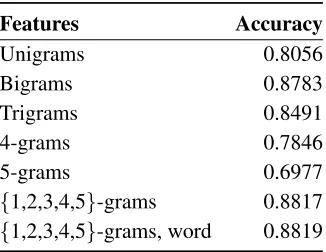
We used a logistic regression classifier to experiment with combinations of the following features: charac-ter unigrams, bigrams, trigrams, 4-grams, 5-grams, and the full word. For these experiments, the train-ing data consisted of 1000 words sampled uniformly with replacement from the sample text in the appro-priate languages. Table 4 shows the accuracies that the classifier achieved when using different sets of features averaged over 10 independent runs.
Features Accuracy
Unigrams 0.8056
Bigrams 0.8783
Trigrams 0.8491
4-grams 0.7846
5-grams 0.6977
{1,2,3,4,5}-grams 0.8817
[image:5.612.318.550.53.246.2]{1,2,3,4,5}-grams, word 0.8819
Table 4: Logistic regression accuracy when trained using varying features.
The use of all available features seems to be the best option, and we use the full set of features in all proceeding experiments. This result also concurs with the findigs of (Cavnar and Trenkle, 1994), who
0 200 400 600 800 1,000
0.7 0.8 0.9
Sampled W ords
Accur
acy
[image:5.612.106.269.474.600.2]logistic regression na¨ıve Bayes decision tree winnow2
Figure 1: Learning curves for logistic regression, na¨ıve Bayes, decision tree, and Winnow2 on the in-dependent word classification problem as the num-ber of sampled words in each training example changes from 10 to 1000.
found 1-5-grams to be most effective for document language classification.
4.2 Classifiers
Using all available features, we compare four MAL-LET (McCallum, 2002) classifiers: logistic regres-sion, na¨ıve Bayes, decision tree, and Winnow2. Fig-ure 1 shows the learning curves for each classifier as the number of sampled words comprising each train-ing example is varied from 10 to 1000.
Since a na¨ıve Bayes classifier gave the best per-formance in most experiments, we use na¨ıve Bayes as a representative word classifier for the rest of the paper.
5 Methods
Moving onto the main task of this paper, labeling sequencesof words in documents according to their languages, we use this section to describe our meth-ods.
The sequence labeling methods are presented with a few new sequence-relevant features, which are not applicable to independent word classification (since these features do not appear in the training data):
• a feature for the presence of each possible non-word character (punctuation or digit) between the previous and the current words
• a feature for the presence of each possible non-word character between the current and next words
In addition to independent word classification, which was covered in section 4, we also imple-ment a conditional random field model trained with generalized expectation criteria, a hidden Markov model (HMM) trained with expectation maximiza-tion (EM), and a logistic regression model trained with generalized expectation criteria.
We had also considered that a semi-Markov CRF (Sarawagi and Cohen, 2004) could be useful if we could model segment lengths (a non-Markovian feature), but we found that gold-standard segment lengths did not seem to be distributed according to any canonical distribution, and we did not have a re-liable way to estimate these segment lengths.
5.1 Conditional Random Field Model trained with Generalized Expectation
Generalized expectation (GE) criteria (Druck et al., 2008) are terms added to the objective function of a learning algorithm which specify preferences for the learned model. When the model is a linear chain conditional random field (CRF) model, we can straightforwardly express these criteria in the objec-tive function with a KL-divergence term between the expected values of the current modelp˜and the pre-ferred modelpˆ(Mann and McCallum, 2008).
O(θ;D, U) =X d
logpθ(y(d)|x(d))−
P
kθk 2σ2
−λD(ˆp||p˜θ)
Practically, to compute these expectations, we produce the smoothed MLE on the output label dis-tribution for every feature observed in the training
data. For example, the trigram “ter” may occur 27 times in the English sample text and 34 times in the other sample text, leading to an MLE of
ˆ
p(eng|ter)≈0.44.
Because we do not expect the true marginal label distribution to be uniform (i.e. the document may not have equal numbers of words in each language), we first estimate the expected marginal label distri-bution by classifying each word in the document in-dependently using na¨ıve Bayes and taking the result-ing counts of labels produced by the classifier as an MLE estimate for it:pˆ(eng)andpˆ(non).
We use these terms to bias the expected label dis-tributions over each feature. LetFeng andFnon
re-spectively be the collections of all training data fea-tures with the two labels. For every labell ∈ L = {eng,non}and every featuref ∈ Feng∪ Fnon, we calculate
p(l|f) = count(f,Fl) +δ
count(f,S
iFi) +δ|L|
× pˆ(l)
punif orm(l)
,
the biased maximum likelihood expected output label distribution. To avoid having p(l|f) = 0, which can cause the KL-divergence to be undefined, we perform additive smoothing withδ = 0.5on the counts before multiplying with the biasing term.
We use the implementation of CRF with GE cri-teria from MALLET (McCallum, 2002), which uses a gradient descent algorithm to optimize the objec-tive function. (Mann and McCallum, 2008; Druck, 2011)
5.2 Hidden Markov Model trained with Expectation Maximization
A second method we used was a hidden Markov model (HMM) trained iteratively using the Expec-tation Maximization algorithm (Dempster et al., 1977). Here an HMM is preferable to a CRF be-cause it is a generative model and therefore uses pa-rameters with simple interpretations. In the case of an HMM, it is easy to estimate emission and transi-tion probabilities using an external method and then set these directly.
In the expectation step, we simply pass the docu-ment through the HMM and record the labels it pro-duces for each word in the document.
In the maximization step, we produce maximum-likelihood estimates for transition probabilities from the transitions between the labels produced. To estimate emission probabilities, we retrain a na¨ıve Bayes classifier on the small language samples along the set of words from the document that were labeled as being in the respective language. We iterated this process until convergence, which usually took fewer than 10 iterations.
We additionally experimented with a na¨ıve Bayes classifier trained by EM in the same fashion, except that it had no transition probabilities to update. This classifier’s performance was almost identical to that of the GE-trained MaxEnt method mentioned in the following section, so we omit it from the results and analysis for that reason.
5.3 Logistic Regression trained with Generalized Expectation
GE criteria can also be straightforwardly applied to the weakly supervised training of logistic regression models. The special case where the constraints spec-ified are over marginal label distributions, is called label regularization.
As with the CRF constraint creation, here we first use an ordinary supervised na¨ıve Bayes classifier in order to estimate the marginal label distributions for the document, which can be used to create more ac-curate output label expectations that are biased to the marginal label distributions over all words in the document.
We use the MALLET implementation of a GE-trained logistic regression classifier, which opti-mizes the objective function using a gradient descent algorithm.
5.4 Word-level Classification
Our fourth method served as a baseline and did not involve any sequence labeling, only independent classification of words. Since na¨ıve Bayes was the best performer among word classification methods, we use that the representative of independent word classification methods. The implementation of the na¨ıve Bayes classifier is from MALLET.
0 200 400 600 800 1,000
0.7 0.75 0.8 0.85 0.9 0.95
Sampled W ords
Accur
acy
na¨ıve Bayes
GE-trained logistic regression EM-trained HMM
[image:7.612.317.551.55.249.2]GE-trained CRF
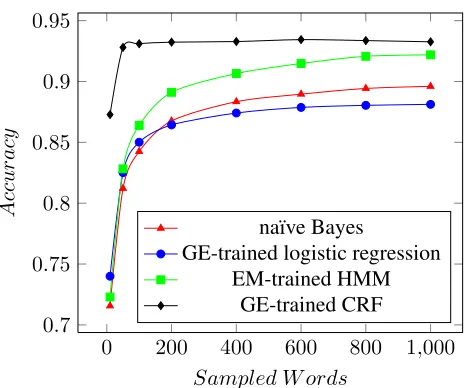
Figure 2: Learning curves for na¨ıve Bayes, logistic regression trained with GE, HMM trained with EM, and CRF trained with GE as the number of sampled words in each training example changes from 10 to 1000.
We also implemented a self-trained CRF, initially trained on the output of this na¨ıve Bayes classifier, and trained on its own output in subsequent itera-tions. This method was not able to consistently out-perform the na¨ıve Bayes classifier after any number of iterations.
6 Evaluation and Results
We evaluated each method using simple token-level accuracy,i.e.whether the correct label was assigned to a word in the document. Word boundaries were defined by punctuation or whitespace, and no tokens containing a digit were included. Figure 2 displays the accuracy for each method as the number of sam-pled words from each language example is varied from 10 to 1000.
lower variance in its performance across different files, though not at a statistically significant level.
Contrary to most of the results in (Mann and Mc-Callum, 2010), a logistic regression classifier trained with GE did not outperform a standard supervised na¨ıve Bayes classifier. We suspect that this is due to the different nature of this problem as compared to most other sequence labeling problems, with the classifier bootstrapping over a single document only. In the problems studied by Mann and McCallum, the GE-trained classifier was able to train over the entire training set, which was on average about 50,000 in-stances, far more than the number of words in the average document in this set (2,500).
7 Error Analysis
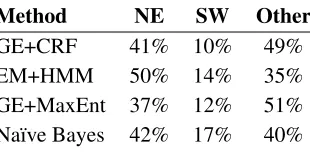
In order to analyze the types of mistakes that the models made we performed an error analysis on ten randomly selected files, looking at each mislabeled word and classifying the error according to its type. The results of this analysis are in Table 5. The three classes of errors are (1) named entity errors, when a named entity is given a label that does not match the label it was given in the original annotation, (2) shared word errors, when a word that could belong to either language is classified incorrectly, and (3) other, a case that covers all other types of errors.
Method NE SW Other
GE+CRF 41% 10% 49%
EM+HMM 50% 14% 35%
[image:8.612.110.265.441.517.2]GE+MaxEnt 37% 12% 51% Na¨ıve Bayes 42% 17% 40%
Table 5: Types of errors and their proportions among the different methods. NE stands for Named Entity, SW stands for Shared Word, and Other covers all other types of errors.
Our annotation rules for named entities specified that named entities should be given a label match-ing their context, but this was rather arbitrary, and not explicitly followed by any of the methods, which treat a named entity as if it was any other token. This was the one of most frequent types of error made by each of the methods and in our conclusion in sec-tion 8, we discuss ways to improve it.
In a regression analysis to determine which fac-tors had the greatest correlations with the GE-trained CRF performance, the estimated proportion of named entities in the document had by far the greatest correlation with CRF accuracy of anything we measured. Following that in decreasing order of correlation strength were the cosine similarity be-tween English and the document’s second language, the number of words in the monolingual example text (even though we sampled from it), and the aver-age length of gold-standard monolingual sequences in the document.
The learning curve for GE-trained CRF in Fig-ure 2 is somewhat atypical as far as most machine learning methods are concerned: performance is typically non-decreasing as more training data is made available.
We believe that the model is becoming over-constrained as more words are used to create the constraints. The GE method does not have a way to specify that some of the soft constraints (for the labels observed most frequently in the sample text) should be more important than other constraints (those observed less frequently). When we mea-sure the KL-divergence between the label distribu-tions predicted by the constraints and the true la-bel distribution, we find that this divergence seems to reach its minimum value between 600 and 800 words, which is where the GE+CRF also seems to reach its maximum performance.
The step with a na¨ıve Bayes classifier estimating the marginal label distribution ended up being quite important overall. Without it, the accuracy dropped by more than a full percentage point absolute. But the problem of inaccurate constraint estimation is one that needs further consideration. Some possible ways to address it may be to prune the constraints according to their frequency or perhaps according to a metric like entropy, or to vary the GE-criteria coef-ficient in the objective function in order to penalize the model less for varying from the expected model.
8 Conclusion
fact, almost all of the languages we tested on would be considered minority languages. We also address the issue ofsparse or impoverished training data. Because we use weakly-supervised methods, we are able to successfully learn to recognize a language with as few as 10 words of training data5. The last and most obvious point we address is that of multi-lingual documents, which is the focus of the paper.
We present a weakly-supervised system for iden-tifying the languages of individual words in mixed-language documents. We found that across a broad range of training data sizes, a CRF model trained with GE criteria is an accurate sequence classifier and is preferable to other methods for several rea-sons.
One major issue to be improved upon in future work is how named entities are handled. A straight-forward way to approach this may be to create an-other label for named entities, which (for the pur-poses of evaluation) would be considered not to be-long to any of the languages in the document. We could simply choose not to evaluate a system on the named entity tokens in a document. Alternatively, the problem of language-independent named entity recognition has received some attention in the past (Tjong Kim Sang and De Meulder, 2003), and it may be beneficial to incorporate such a system in a robust word-level language identification system.
Going forward, an issue that needs to be ad-dressed with this method is its dependence on know-ing the set of possible languagesa priori. Because we don’t see an easy way to adapt this method to ac-curately label words in documents from a possible set of thousands of languages when the document itself may only contain two or three languages, we would propose the following future work.
We propose a two-step approach to general word-level language identification. The first step would be to examine a multilingual document, and with high accuracy, list the languages that are present in the document. The second step would be identical to the approach described in this paper (but with the two-language restriction lifted), and would be responsi-ble for labeling the languages of individual words, using the set of languages provided by the first step.
5With only 10 words of each language as training data, the CRF approach correctly labels 88% of words
References
Marco Baroni and Silvia Bernardini. 2004. Bootcat: Bootstrapping corpora and terms from the web. In
Proceedings of the Fourth International Conference on Langauge Resources and Evaluation (LREC 2004), volume 4, pages 1313–1316, Lisbon, Portugal. Kenneth R. Beesley. 1988. Language identifier: A
com-puter program for automatic natural-language identifi-cation of on-line text. InProceedings of the 29th An-nual Conference of the American Translators Associa-tion, volume 47, page 54.
Kedar Bellare, Gregory Druck, and Andrew McCallum. 2009. Alternating projections for learning with expec-tation constraints. InProceedings of the Twenty-Fifth Conference on Uncertainty in Artificial Intelligence, pages 43–50. AUAI Press.
William B. Cavnar and John M. Trenkle. 1994. N-gram-based text categorization. InProceedings of the Third Annual Symposium on Document Analysis and Information (SDAIR 94), pages 161–175, Las Vegas, Nevada.
Ming-Wei Chang, Lev Ratinov, and Dan Roth. 2007. Guiding semi-supervision with constraint-driven learning. InProceedings of the 45th Annual Meeting of the Association of Computational Linguis-tics, pages 280–287, Prague, Czech Republic, June. Association for Computational Linguistics.
Chyng-Leei Chu, Dau-cheng Lyu, and Ren-yuan Lyu. 2007. Language identification on code-switching speech. InProceedings of ROCLING.
Michael Collins and Yoram Singer. 1999. Unsupervised models for named entity classification. InProceedings of the Joint SIGDAT Conference on Empirical Meth-ods in Natural Language Processing and Very Large Corpora, pages 100–110.
Arthur P. Dempster, Nan M. Laird, and Donald B. Ru-bin. 1977. Maximum likelihood from incomplete data via the em algorithm. Journal of the Royal Statistical Society. Series B (Methodological), pages 1–38. Gregory Druck, Gideon Mann, and Andrew McCallum.
2008. Learning from labeled features using general-ized expectation criteria. InProceedings of the 31st annual international ACM SIGIR conference on Re-search and development in information retrieval (SI-GIR 2008), pages 595–602. ACM.
Gregory Druck. 2011.Generalized Expectation Criteria for Lightly Supervised Learning. Ph.D. thesis, Univer-sity of Massachusetts Amherst.
Ted Dunning. 1994. Statistical identification of lan-guage. Technical report.
Aria Haghighi and Dan Klein. 2006. Prototype-driven learning for sequence models. In Proceedings of the Human Language Technology Conference of the NAACL, Main Conference, pages 320–327, New York City, USA, June. Association for Computational Lin-guistics.
A.S. House and E.P. Neuburg. 1977. Toward automatic identification of the language of an utterance. i. pre-liminary methodological considerations. The Journal of the Acoustical Society of America, 62:708.
Baden Hughes, Timothy Baldwin, Steven Bird, Jeremy Nicholson, and Andrew MacKinlay. 2006. Recon-sidering language identification for written language resources. InProc. International Conference on Lan-guage Resources and Evaluation, pages 485–488. Aravind K. Joshi. 1982. Processing of sentences with
intra-sentential code-switching. InProceedings of the 9th conference on Computational linguistics-Volume 1, pages 145–150. Academia Praha.
Jan Landsbergen. 1989. The rosetta project. pages 82– 87, Munich, Germany.
Dau-Cheng Lyu and Ren-Yuan Lyu. 2008. Language identification on code-switching utterances using mul-tiple cues. InNinth Annual Conference of the Interna-tional Speech Communication Association.
Gideon S. Mann and Andrew McCallum. 2008. Gener-alized expectation criteria for semi-supervised learn-ing of conditional random fields. InProceedings of ACL-08: HLT, pages 870–878, Columbus, Ohio, June. Association for Computational Linguistics.
Gideon S. Mann and Andrew McCallum. 2010. Gener-alized expectation criteria for semi-supervised learn-ing with weakly labeled data. The Journal of Machine Learning Research, pages 955–984.
Andrew McCallum. 2002. Mallet: A machine learning for language toolkit. http://mallet.cs.umass.edu. Arjen Poutsma. 2002. Applying monte carlo techniques
to language identification. Language and Computers, 45(1):179–189.
Sunita Sarawagi and William W. Cohen. 2004. Semi-markov conditional random fields for information ex-traction. Advances in Neural Information Processing Systems (NIPS 2004), 17:1185–1192.
Kevin P. Scannell. 2007. The cr´ubad´an project: Cor-pus building for under-resourced languages. In Build-ing and ExplorBuild-ing Web Corpora: ProceedBuild-ings of the 3rd Web as Corpus Workshop, volume 4, pages 5–15, Louvain-la-Neuve, Belgium.
Sameer Singh, Dustin Hillard, and Chris Leggetter. 2010. Minimally-supervised extraction of entities from text advertisements. In Human Language Technologies: The 2010 Annual Conference of the North American
Chapter of the Association for Computational Linguis-tics, pages 73–81, Los Angeles, California, June. As-sociation for Computational Linguistics.
Noah A. Smith and Jason Eisner. 2005. Contrastive estimation: Training log-linear models on unlabeled data. InProceedings of the 43rd Annual Meeting of the Association for Computational Linguistics (ACL’05), pages 354–362, Ann Arbor, Michigan, June. Associa-tion for ComputaAssocia-tional Linguistics.
Thamar Solorio and Yang Liu. 2008. Learning to pre-dict code-switching points. InProceedings of the 2008 Conference on Empirical Methods in Natural Lan-guage Processing, pages 973–981, Honolulu, Hawaii, October. Association for Computational Linguistics. Erik F. Tjong Kim Sang and Fien De Meulder. 2003.
In-troduction to the conll-2003 shared task: Language-independent named entity recognition. In Walter Daelemans and Miles Osborne, editors, Proceed-ings of the Seventh Conference on Natural Language Learning at HLT-NAACL 2003, pages 142–147. Fei Xia, William Lewis, and Hoifung Poon. 2009.