Large-scale Native Language Identification with Cross-Corpus Evaluation
Shervin Malmasi
Centre for Language Technology Macquarie University Sydney, NSW, Australia [email protected]
Mark Dras
Centre for Language Technology Macquarie University Sydney, NSW, Australia [email protected]
Abstract
We present a large-scale Native Language Identification (NLI) experiment on new data, with a focus on cross-corpus evaluation to identify corpus- and genre-independent lan-guage transfer features. We test a new corpus and show it is comparable to other NLI cor-pora and suitable for this task. Cross-corpus evaluation on two large corpora achieves good accuracy and evidences the existence of reli-able language transfer features, but lower per-formance also suggests that NLI models are not completely portable across corpora. Fi-nally, we present a brief case study of fea-tures distinguishing Japanese learners’ En-glish writing, demonstrating the presence of cross-corpus and cross-genre language trans-fer features that are highly applicable to SLA and ESL research.
1 Introduction
Native Language Identification, the task of deter-mining the native language (L1) of an author based on a second language (L2) text, has received much attention recently. Much of this is motivated by Sec-ond Language Acquisition (SLA) as NLI, often ac-complished via machine learning methods, can be used to study language transfer effects.
Most NLI research hitherto has focused on identi-fying linguistic phenomena that can capture trans-fer effects, with little effort towards interpreting discriminant features. Some researchers have now shifted their focus to developing data-driven meth-ods for the automatic extraction and ranking of lin-guistic features that distinguish specific L1s (Swan-son and Charniak, 2014).
Such methods could be used not only to confirm existing SLA hypotheses, but also to create new ones. This hypothesis formulation is an inherently
difficult problem requiring copious amounts of data. Contrary to this requirement, researchers have long noted the paucity of suitable corpora1 for this task
(Brooke and Hirst, 2011). This is one of the research issues addressed by this work.
Furthermore, deriving SLA hypotheses from a single corpus may not be entirely useful for SLA research. Many variables like genre and topic are constant within a corpus, restricting the validity of such cross-validation studies to those dimensions.
An alternative, potentially more helpful approach, is to identify transfer features that reliably distin-guish an L1 across multiple corpora of differing gen-res and domains. A cross-corpus methodology may be a more promising avenue to finding features that generalize to diverse text sources, but requires addi-tional large corpora. It is also a more realistic ap-proach, and one we pursue in this work.
Accordingly, the aims of the present work are to: (1) test a large new corpus suitable for NLI, (2) perform within-corpus evaluation with a compara-tive analysis against equivalent corpora, (3) perform cross-corpus evaluation to determine the efficiency of corpus independent features and (4) analyze the features’ utility for SLA & ESL research.
2 Background and Motivation
NLI work has been growing in recent years, using a wide range of syntactic and more recently, lexical features to distinguish the L1. A detailed review of NLI methods is omitted here for reasons of space, but a thorough exposition is presented in the report from the very first NLI Shared Task that was held in 2013 (Tetreault et al., 2013).
Most English NLI work has been done using two corpora. TheInternational Corpus of Learner
En-1An ideal NLI corpus should have multiple L1s, be balanced by topic, proficiency, texts per L1 and be large in size.
glish (Granger et al., 2009) was widely used un-til recently, despite its shortcomings2 being widely
noted (Brooke and Hirst, 2012a). More recently, TOEFL11, the first corpus designed for NLI was
released (Blanchard et al., 2013). While it is the largest NLI dataset available, it only contains argu-mentative essays, limiting analyses to this genre.
Research has also expanded to use non-English learner corpora (Malmasi and Dras, 2014a; Mal-masi and Dras, 2014c). Recently, MalMal-masi and Dras (2014b) introduced the Chinese Learner Corpus for NLI and their results indicate that feature perfor-mance may be similar across corpora and even L1-L2 pairs. This is a claim that we will test here.
NLI is now also moving towards using features to generate SLA hypotheses. Swanson and Charniak (2014) approach this by using both L1 and L2 data to identify features exhibiting non-uniform usage in both datasets, creating lists of candidate transfer fea-tures. Malmasi and Dras (2014d) propose a different method, using linear SVM weights to extract lists of overused and underused linguistic features for each L1 group.
Cross-corpus studies have been conducted for various data-driven NLP tasks, including parsing (Gildea, 2001), WSD (Escudero et al., 2000) and NER (Nothman et al., 2009). While most such ex-periments show a drop in performance, the effect varies widely across tasks, making it hard to predict the expected drop for NLI. We aim to address this question using large training and testing data. 3 EFCamDat: A new corpus for NLI The EF Cambridge Open Language Database (EFCAMDAT) is an English L2 corpus that was
re-leased recently (Geertzen et al., 2013). It is com-posed of texts submitted to Englishtown, an online school used by thousands of learners daily.
This corpus is notable for its size, containing some550k texts from numerous nationalities, mak-ing it an ideal candidate for NLI research. While the TOEFL11is made of argumentative essays, EF
-CAMDAThas a much wider range of genres
includ-ing writinclud-ing emails, descriptions, letters, reviews, in-structions and more.
In this work we present an application of NLI to this new data. As some of the texts can be short, we use the methodology of Brooke and Hirst (2011) to concatenate and create texts with at least300tokens, much like the TOEFL11.
2The issues exist as the corpus was not designed for NLI.
Common Arabic, Chinese, French, German, Italian,Japanese, Korean, Spanish, Turkish EFCAMDAT Portuguese, Russian
[image:2.612.322.531.59.98.2]TOEFL11 Hindi, Telugu
Table 1: The 11 L1 classes extracted from theEFCAMDAT
corpus, compared to the TOEFL11 corpus. The first 9
classes are common between both.
From the data we choose850texts from each of the top11nationalities. This subset of EFCAMDAT
thus consists of9,350documents totalling approxi-mately3.2m tokens. This is an average of337 to-kens per text, close to the 348 tokens per text in TOEFL11.
This also provides us with the same number of classes as the TOEFL11, as shown in Table 1,
fa-cilitating direct performance comparisons. The ta-ble also indicates the9classes common to both cor-pora. This subset of common classes enables us to perform large-scale cross-corpus validation experi-ments that have not been possible until now.
4 Methodology
We use the standard NLI classification approach. A linear Support Vector Machine is used for classi-fication and feature vectors are created using rel-ative frequency values. We also combine features with a mean probability ensemble classifier (Polikar, 2006,§4.2) using the probabilities assigned to each class. We compare results with a random base-line and the oracle basebase-line used by Malmasi et al. (2015). The oracle correctly classifies a text if any ensemble member correctly predicts its label and defines an upper-bound for classification accuracy. We avoid using lexical features as EFCAMDAT is
not topic balanced. We extract the following topic-independent feature types:
Function words are topic-independent
grammat-ical words such as prepositions which indicate the relations between other words. They are known to be useful for NLI. Frequencies of400English func-tion words3are extracted as features. We also apply
function word bigrams as described in Malmasi et al. (2013).
Context-free Grammar Production Rules are
extracted after parsing each sentence. Each rule is a classification feature (Wong and Dras, 2011) and captures global syntactic patterns.
POS-1 POS-2 POS-3 FW PR
0 10 20 30 40 50 60
Accurac
y
(%)
[image:3.612.326.524.59.233.2]EFCamDat TOEFL11 CLC
Figure 1: Comparing EFCAMDAT feature performance
with the TOEFL11and Chinese Learner Corpus (CLC).
POS-1/2/3: POS uni/bi/trigrams, FW: Function Words, PR: CFG Productions
Part-of-Speech (POS) n-grams of size 1–3 are extracted as features. They capture preferences for word classes and their localized ordering patterns. 5 Within-Corpus Evaluation
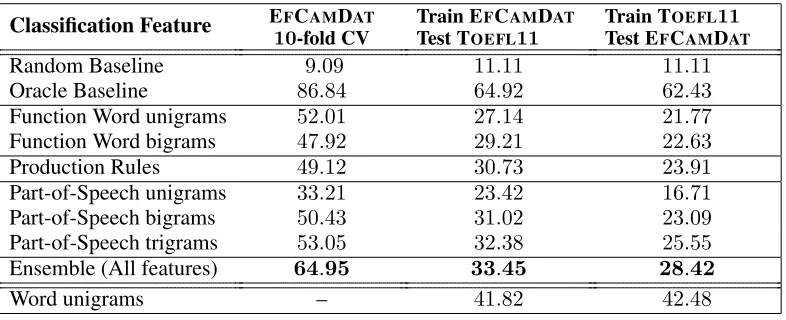
Our first experiment applies10-fold cross-validation within the corpus to assess feature efficacy. The re-sults are shown in the first column of Table 2.
All features perform substantially higher than the
9%baseline. POS trigrams are the best single fea-ture (53%), suggesting there exist significant inter-class syntactic differences. Next, we also combined all features using a classifier ensemble, which has been shown to be helpful for NLI (Tetreault et al., 2012). This yields the best accuracy of65%against an upper-bound of87%set by the oracle.
We also compare these results to those from the TOEFL11 and Chinese Learner Corpus (CLC). As
shown in Figure 1, we find that feature performance is nearly identical across corpora. Consistent with the results in Malmasi and Dras (2014b), this seems to suggest an invariant degree of transfer across dif-ferent learners and L1-L2 pairs.
Figure 2 shows the confusion matrix. German is the most correctly classified L1, while the highest confusion is between Japanese–Korean, followed by Spanish–Portuguese and French–Italian. This is not surprising given their syntactic similarity as well as being typologically related in case of the latter two. 6 Large-scale Cross-Corpus Evaluation Our second experiment tests the cross-corpus effi-cacy of the features by training on EFCAMDATand
testing on TOEFL11,4andvice versa. As the corpus
texts are from different genres, this approach enables 4The 9 common classes discussed in§3 are used.
ARA CHI FRE GER ITA JPN KOR SPA TUR RUS POR
Predicted label ARA
CHI FRE GER ITA JPN KOR SPA TUR RUS POR
True label
Confusion Matrix
[image:3.612.76.285.61.188.2]0 80 160 240 320 400 480 560 640
Figure 2: EFCAMDAT11-class confusion matrix.
Arabic German Japanese
Saudi Germany Japan
Arabia Berlin Tokyo
Arabic Hamburg Osaka
Mohammed Frankfurt Nagoya
Ali Munich Yen
Table 3: Selected items from the top15most discrimina-tive words for Arabic/German/Japanese.
us to test the cross-corpus and cross-genre general-izability of our features.
Results are shown in the second and third column of Table 2. While lower than the cross-validation results which were on 11 classes vs 9 here, the results are far greater than the baseline. The ac-curacy for training on EFCAMDAT and testing on
TOEFL11 is higher (33.45%) than the other way
around (28.42%), even though TOEFL11is the larger
corpus. This is possibly because EFCAMDAT has
numerous genres while TOEFL11 does not. The
cross-corpus oracle is also over20%lower, despite an increase in the random baseline, showing some features are not portable across corpora. Training on TOEFL11yields a lower oracle.
Although a performance drop was expected due to the big genre differences, results suggest the pres-ence of some corpus-independent features that cap-ture cross-linguistic influence. However, they also suggest that a large portion of the features helpful for NLI are genre-dependent.
[image:3.612.318.535.262.339.2]Classification Feature EFCAMDAT10-fold CV Train EFCAMDATTest TOEFL11 Train TOEFLTest EFCAMDAT11
Random Baseline 9.09 11.11 11.11
Oracle Baseline 86.84 64.92 62.43
Function Word unigrams 52.01 27.14 21.77
Function Word bigrams 47.92 29.21 22.63
Production Rules 49.12 30.73 23.91
Part-of-Speech unigrams 33.21 23.42 16.71
Part-of-Speech bigrams 50.43 31.02 23.09
Part-of-Speech trigrams 53.05 32.38 25.55
Ensemble (All features) 64.95 33.45 28.42
[image:4.612.110.503.59.219.2]Word unigrams – 41.82 42.48
Table 2: Classification accuracy (%) for our within- and cross-corpus experiments.
(Odlin, 1989). The effects are mediated not only by cognates and word form similarities, but also seman-tics and meanings. Other NLI studies have also pro-vided empirical evidence for this hypothesis (Mal-masi and Cahill, 2015).
However, issues stemming from topic bias5 have
also limited their use in NLI (Brooke and Hirst, 2012a), although use could be justified in cross-corpus scenarios due to the lower risk of topic-bias across corpora. We applied word unigrams to our cross-corpus experiment, achieving an accuracy of
41.8% for training on the EFCAMDAT and
test-ing on TOEFL11 and42.5%for the reverse setting.
These are the best results in this setup.
To check for any topic-bias effects, we inspected the most discriminative features for each L1 class using the method proposed by Malmasi and Dras (2014d). This analysis revealed that the top features were mostly cultural and geographic references re-lated to the author’s country. Table 3 contains words selected from the top 15 most discriminative fea-tures found in the cross-corpus experiment for three L1s. We observe that most of these are toponyms or culture-specific terms such as names and curren-cies. These results reveal another potential issue with using lexical features. Although this isn’t topic-bias, the features do not represent genuine linguis-tic differences or lexical transfer effects between L1 groups. In practical scenarios, this could also make NLI systems vulnerable to content-based manipula-tion. The exclusion of proper nouns is one way to combat this.
7 A Case Study of Japanese Learners To demonstrate the utility of this cross-corpus ap-proach we present a brief case study of features that
5Due to correlations between text topics and L1 classes.
characterize English writings of Japanese learners. We extracted the most discriminative cross-corpus features of Japanese learner texts using the method of Malmasi and Dras (2014d).
Table 4 contains the top production rule features. The first rule shows a preference for having a subor-dinate clause before the main clause. The next two rules show that Japanese learners tend to begin their sentences with adverbs and conjunctions. This pref-erence for placing information at the start of sen-tences is most likely rooted in the fact that Japanese is an SOV head-final language6 where dependent
clauses generally precede the main clause and rel-ative clauses precede the noun they modify. The in-fluence of this head-direction parameter on English acquisition has been previously investigated (Flynn, 1989).
In contrast, it is quite common for the main clause to precede the subordinate clause in English. Other research has also noted that Japanese speakers have a “long before short” preference7 (Yamashita and
Chang, 2001). This is also evidence by another highly discriminative rule for this L1: S → S , CC S .
Japanese writers also seem more likely to split longer arguments into multiple shorter sentences, as suggested by our third production rule. It has also been noted that Japanese and Korean sentences in the TOEFL11have the shortest mean length (Cimino
et al., 2013, p. 211).
Turning to POS trigrams, the POS tag sequence
VBZ JJ NN is strongly linked to Japanese
learn-6Contrasted with English which is SVO.
Production Rule Example Sentence
S → SBAR , NP VP . If you have spare time, you’ll think of shopping.
S → ADVP , NP VP . Therefore, the online studying system is really convenient for me.
[image:5.612.91.525.60.114.2]S → CC NP VP . But I’m not good at English. / But it wasn’t comfortable and cosy. Table 4: The top 3 cross-corpus production rule features for Japanese L1 with example lexicalizations.
Overuse Underuse
however perhaps
though somebody
cannot everything
therefore behind
such upon
into between
Table 5: English function words overused and underused by Japanese learners in their writing.
ers. It represents a third person verb, such asis or
has followed by an adjective and a noun. A brief analysis reveals that this is commonly observed in Japanese learner texts because the sequence is miss-ing a determiner before the noun phrase.8 This likely
stems from the fact that Japanese learners have diffi-culty with English articles, often failing to use them (Butler, 2002; Thomas, 1989). Its prominence in the ranked list shows that it is a common issue across distinct learners and genres.
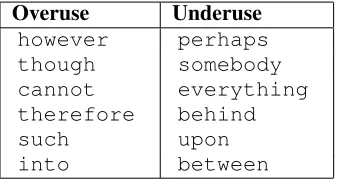
The top overused and underused function words are listed in Table 5. The wordshoweverand there-foreare highly relevant; Japanese writers often use these to start sentences, possibly due to the above-mentioned production rules. The wordinto is also predictive and seems to be used in places whereinis more appropriate. This may be due to the Japanese words forin,toandintobeing similar.9 In the
under-use list,perhapsis never used by Japanese learners. Other words here are low-frequency in Japanese L1 texts in both corpora.
8 Discussion
In this work we presented the first application of one of the largest and newest publicly available learner corpora to NLI. Cross-validation experiments mir-rored the performance of other corpora and demon-strated its utility for the task. We believe this will motivate future work by equipping researchers with a large-scale corpus that is highly suitable for NLI.
8Example lexicalizations from EFCAMDAT include “She wears black top” and “This areais famous park.”
9All use the particleni, see Takenobu et al. (2005)
Next, results from the largest cross-corpus NLI evaluation to date were presented, providing strong evidence for the presence of transfer features that generalize across learners, corpora, topics and gen-res. However, the fact that the cross-corpus accuracy is lower than within-corpus cross-validation high-lights that a large portion of the features are highly corpus-specific. This suggests that NLI models are not entirely portable across corpora. Practical appli-cations of NLI to forensic linguistics or SLA must be robust to input from numerous sources and their associated variations, and this finding highlights the need for a cross-corpus approach.
To demonstrate how this methodology could be used for SLA, an examination of the cross-corpus features effective in classifying texts of Japanese learners was conducted. Through feature analysis, we were able to link these patterns of syntactic pro-ductions, article use and lexical choices to L1-based SLA hypotheses.
Our output lists hundreds of features, not included or examined here due to space limitations, whose analysis would allow SLA researchers to explore and generate new hypotheses, specially by combin-ing multiple syntactic feature types.
A shortcoming here is that we did not balance texts by proficiency to match the TOEFL11. We
ex-pect that a more even sampling of proficiency or us-ing proficiency-segregated models will yield higher accuracy and features more representative of stu-dents at each proficiency level.
Directions for future work are manifold. The next phase of this research will focus on developing tools to derive and browse ranked lists of the most dis-criminative cross-corpus features, which will then be used to formulate SLA hypotheses. Subject to availability of data, this could be expanded to a mul-tiple cross-corpus methodology, using three or more corpora. Its application to other languages besides English is also of interest.
[image:5.612.102.273.143.234.2]References
Daniel Blanchard, Joel Tetreault, Derrick Higgins, Aoife Cahill, and Martin Chodorow. 2013. TOEFL11: A Corpus of Non-Native English. Technical report, Ed-ucational Testing Service.
Julian Brooke and Graeme Hirst. 2011. Native language detection with ‘cheap’ learner corpora. Presented at theConference of Learner Corpus Research, Univer-sity of Louvain, Belgium.
Julian Brooke and Graeme Hirst. 2012a. Measuring in-terlanguage: Native language identification with L1-influence metrics. InProceedings of the Eight Interna-tional Conference on Language Resources and Eval-uation (LREC’12), pages 779–784, Istanbul, Turkey, May.
Julian Brooke and Graeme Hirst. 2012b. Robust, Lexi-calized Native Language Identification. InProc. Inter-nat. Conf. on Computat. Linguistics (COLING). Yuko Goto Butler. 2002. Second language learners’
the-ories on the use of english articles. Studies in second language acquisition, 24(03):451–480.
Andrea Cimino, Felice Dell’Orletta, Giulia Venturi, and Simonetta Montemagni. 2013. Linguistic profiling based on general–purpose features and native language identification. InProceedings of the Eighth Workshop on Innovative Use of NLP for Building Educational Applications, pages 207–215, Atlanta, Georgia, June. Association for Computational Linguistics.
Gerard Escudero, Llu´ıs M`arquez, and German Rigau. 2000. An empirical study of the domain dependence of supervised word sense disambiguation systems. In
Proceedings of the 2000 Joint SIGDAT conference on Empirical methods in natural language processing and very large corpora, pages 172–180. Association for Computational Linguistics.
Suzanne Flynn. 1989. The role of the head-initial/head-final parameter in the acquisition of English relative clauses by adult Spanish and Japanese speakers. Lin-guistic perspectives on second language acquisition, pages 89–108.
Jeroen Geertzen, Theodora Alexopoulou, and Anna Ko-rhonen. 2013. Automatic Linguistic Annotation of Large Scale L2 Databases: The EF-Cambridge Open Language Database (EFCamDat).
Daniel Gildea. 2001. Corpus variation and parser per-formance. InProceedings of the 2001 Conference on Empirical Methods in Natural Language Processing, pages 167–202.
Sylviane Granger, Estelle Dagneaux, Fanny Meunier, and Magali Paquot. 2009. International Corpus of Learner English (Version 2). Presses Universitaires de Louvain, Louvian-la-Neuve.
Shervin Malmasi and Aoife Cahill. 2015. Measur-ing Feature Diversity in Native Language Identifica-tion. InProceedings of the Tenth Workshop on Inno-vative Use of NLP for Building Educational Applica-tions, Denver, Colorado, June. Association for Com-putational Linguistics.
Shervin Malmasi and Mark Dras. 2014a. Arabic Native Language Identification. In Proceedings of the Ara-bic Natural Language Processing Workshop (EMNLP 2014), pages 180–186, Doha, Qatar, October. Associ-ation for ComputAssoci-ational Linguistics.
Shervin Malmasi and Mark Dras. 2014b. Chinese Na-tive Language Identification. pages 95–99, Gothen-burg, Sweden, April. Association for Computational Linguistics.
Shervin Malmasi and Mark Dras. 2014c. Finnish Na-tive Language Identification. In Proceedings of the Australasian Language Technology Workshop (ALTA), pages 139–144, Melbourne, Australia.
Shervin Malmasi and Mark Dras. 2014d. Language Transfer Hypotheses with Linear SVM Weights. In
Proceedings of the 2014 Conference on Empirical Methods in Natural Language Processing (EMNLP), pages 1385–1390, Doha, Qatar, October. Association for Computational Linguistics.
Shervin Malmasi, Sze-Meng Jojo Wong, and Mark Dras. 2013. NLI Shared Task 2013: MQ Submission. In
Proceedings of the Eighth Workshop on Innovative Use of NLP for Building Educational Applications, pages 124–133, Atlanta, Georgia, June. Association for Computational Linguistics.
Shervin Malmasi, Joel Tetreault, and Mark Dras. 2015. Oracle and Human Baselines for Native Language Identification. InProceedings of the Tenth Workshop on Innovative Use of NLP for Building Educational Applications, Denver, Colorado, June. Association for Computational Linguistics.
Joel Nothman, Tara Murphy, and James R Curran. 2009. Analysing Wikipedia and gold-standard corpora for NER training. InProceedings of the 12th Conference of the European Chapter of the Association for Com-putational Linguistics, pages 612–620. Association for Computational Linguistics.
Terence Odlin. 1989. Language Transfer: Cross-linguistic Influence in Language Learning. Cambridge University Press, Cambridge, UK.
Robi Polikar. 2006. Ensemble based systems in deci-sion making. Circuits and Systems Magazine, IEEE, 6(3):21–45.
Tokunaga Takenobu, Koyama Tomofumi, and Saito Sug-uru. 2005. Meaning of japanese spatial nouns. In Pro-ceedings of the Second ACL-SIGSEM Workshop on the Linguistic Dimensions of Prepositions and their Use in Computational Linguistics Formalisms and Appli-cations, pages 93–100.
Joel Tetreault, Daniel Blanchard, Aoife Cahill, and Mar-tin Chodorow. 2012. Native Tongues, Lost and Found: Resources and Empirical Evaluations in Na-tive Language Identification. InProceedings of COL-ING 2012, pages 2585–2602, Mumbai, India, Decem-ber. The COLING 2012 Organizing Committee. Joel Tetreault, Daniel Blanchard, and Aoife Cahill. 2013.
A Report on the First Native Language Identification Shared Task. InProceedings of the Eighth Workshop on Innovative Use of NLP for Building Educational Applications, pages 48–57, Atlanta, Georgia, June. Association for Computational Linguistics.
Margaret Thomas. 1989. The acquisition of English ar-ticles by first-and second-language learners. Applied Psycholinguistics, 10(03):335–355.
Sze-Meng Jojo Wong and Mark Dras. 2011. Exploiting Parse Structures for Native Language Identification. In Proceedings of the 2011 Conference on Empiri-cal Methods in Natural Language Processing, pages 1600–1610, Edinburgh, Scotland, UK., July. Associa-tion for ComputaAssocia-tional Linguistics.