Proceedings of NAACL-HLT 2015, pages 21–25,
RExtractor: a Robust Information Extractor
Vincent Kr´ıˇz and Barbora Hladk´a
Charles University in Prague Faculty of Mathematics and Physics Institute of Formal and Applied Linguistics
{kriz, hladka}@ufal.mff.cuni.cz
Abstract
The RExtractor system is an information ex-tractor that processes input documents by nat-ural language processing tools and conse-quently queries the parsed sentences to ex-tract a knowledge base of entities and their re-lations. The extraction queries are designed manually using a tool that enables natural graphical representation of queries over de-pendency trees. A workflow of the system is designed to be language and domain indepen-dent. We demonstrate RExtractor on Czech and English legal documents.
1 Introduction
In many domains, large collections of semi/un-structured documents form main sources of informa-tion. Their efficient browsing and querying present key aspects in many areas of human activities.
We have implemented an information extrac-tion system, RExtractor, that extracts informa-tion from texts enriched with linguistic structures, namely syntactic dependency trees. This structure is represented as a rooted ordered tree with nodes and edges and the dependency relation between two nodes is captured by an edge between them. Namely, we work with the annotation framework de-signed in the Prague Dependency Treebank project.1
RExtractor forms an extraction unit of a com-plex system performing both information extraction and data publication according to the Linked Data Principles. More theoretical and practical details
1http://ufal.mff.cuni.cz/pdt3.0
on the system are provided in (Kr´ıˇz et al., 2014). The system focuses on processing Czech legal doc-uments and has been implemented in an applied re-search project addressed by rere-search and business partners.2
The extraction systems known from literature were evaluated against gold standard data, e.g. DKPro Keyphrases (Erbs et al., 2014), Relation-Factory (Roth et al., 2014), KELVIN (McNamee et al., 2013), Propminer (Akbik et al., 2013), OL-LIE (Mausam et al., 2012). We name this type of evaluation as academic one. According to the statistics provided by International Data Corpora-tion (Gantz and Reinsel, 2010), 90% of all avail-able digital data is unstructured and its amount cur-rently grows twice as fast as structured data. Nat-urally, there is no capacity to prepare gold stan-dard data of statistically significant amount for each domain. When exploring domains without gold standard data, a developer can prepare a small set of gold standard data and do academic evaluation. He gets a rough idea about his extractor perfor-mance. But he builds a system that will be used by users/customers, not researchers serving as eval-uators. So it is user/customer feedback what pro-vides evidence of performance. This particular fea-ture of information extraction systems is discussed in (Chiticariu et al., 2013) together with techniques they use academic systems and commercial systems. We decided to do a very first RExtractor testing by experts in accountancy. It has not done yet so we have no evidence about its quality from their per-spective. However, we know what performance the
2http://ufal.mff.cuni.cz/intlib
system achieves on the gold standard data that we prepared in the given domain. We list it separately for entity extraction, where Precision = 57.4%, Re-call = 91.7%, and relation extraction, where P = 80.6%, R = 63.2%. Details are provided in (Kr´ıˇz et al., 2014).
2 RExtractor Description
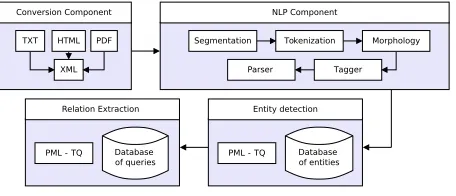
RExtractor is an information extractor that processes input documents by natural language processing tools and consequently queries the parsed sentences to extract a knowledge base of entities and their re-lations. The parsed sentences are represented as dependency trees with nodes bearing morphologi-cal and syntactic attributes. The knowledge base has the form of (subject, predicate, object) triples wheresubject andobject are entities andpredicate represents their relation. One has to carefully distin-guish subjects, predicates and objects in dependency trees from subjects, predicates and objects in entity-relation triples.
Figure 1: RExtractor workflow
RExtractor is designed as a four-component sys-tem displayed in Figure 1. The NLP component out-puts a syntactic dependency tree for each sentence from the input documents using tools available in the Treex framework.3 Then the dependency trees are
queried in the Entity Detection and Relation Extrac-tion components using the PML-TQ search tool (Pa-jas and ˇStˇep´anek, 2009). The Entity Detection com-ponent detects entities stored in Database of Entities (DBE). Usually, this database is built manually by a domain expert. The Relation Extraction compo-nent exploits dependency trees with detected entities using queries stored in Database of queries (DBQ). This database is built manually by a domain expert
[image:2.612.317.541.71.256.2]3http://ufal.mff.cuni.cz/treex
Figure 2: Extraction ofwho creates what
Subject Predicate Object
[image:2.612.74.302.375.473.2]accounting unit create fixed item accounting unit create reserve
Table 1: Data extracted by the query displayed in Figure 2
in cooperation with an NLP expert. Typically, do-main experts describe what kind of information they are interested in and their requests are transformed into tree queries by NLP experts.
Illustration Let’s assume this situation. A domain expert is browsing a law collection and is interested in theto create somethingresponsibility of any body. In other words, he wants to learnwho creates what as is specified in the collection. We illustrate the RExtractor approach for extracting such informa-tion using the sentenceAccounting units create fixed items and reserves according to special legal regu-lations.
Figure 3: Extraction ofwho should do what
Subject Predicate Object
operator submit proposal
Table 2: Data extracted by the query displayed in Figure 3
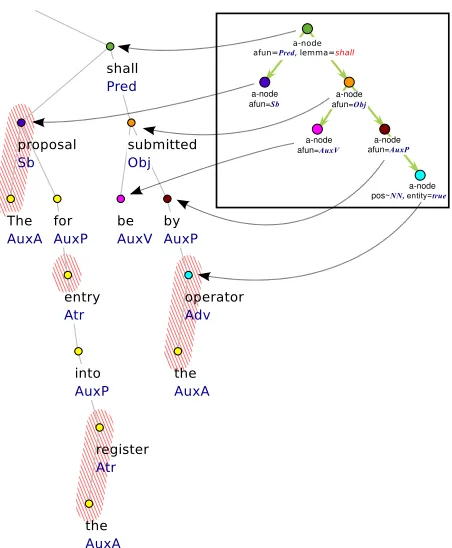
(see the left son of the root and its syntactic function afun=Sb), and what, i.e. the object (see the right son of the root and its syntactic function afun=Obj). Even more, he restricts the subjects to those that are pre-specified in DBE (see the left son of the root and its restriction entity=true). Finally, the Relation Extraction component matches the query with the sentence and outputs the data presented in Table 1.
A domain expert could be interested in more gen-eral responsibility, namely he wants to learn who should do what wherewho is an entity in DBE. A tree query matching this issue is displayed in Fig-ure 3. The query is designed to extract (subject, predicate, object) relations where thesubjectis the object in a sentence. We extract the data listed in Table 2 using this query for entity-relation extrac-tion from the sentence The proposal for entry into the register shall be submitted by the operator.
Technical details RExtractor is conceptualized as a modular framework. It is implemented in Perl pro-gramming language and its code and technical de-tails are available on Github:
http://github.com/VincTheSecond/rextractor Each RExtractor component is implemented as a standalone server. The servers regularly check new documents waiting for processing. A document cessing progress is characterized by a document pro-cessing status in the extraction pipeline, e.g. 520 – Entity detection finished.
The system is designed to be domain independent. However, to achieve better performance, one would like to adapt the default components for a given do-main. Modularity of the system allows adding, mod-ifying or removing functionalities of existing ponents and creating new components. Each com-ponent has a configuration file to enable various set-tings of document processing.
A scenario with all settings for the whole extrac-tion pipeline (set up in a configuraextrac-tion file) is called anextraction strategy. An extraction strategy sets a particular configuration for the extraction pipeline, e.g. paths to language models for NLP tools, paths to DBE and DBQ.
The RExtractor API enables easy integration into more complex systems, like search engines.
3 RExtractor Demonstration
The RExtractor architecture comprises two core components: (a) a background server processing submitted documents, and (b) a Web application to view a dynamic display of submitted document pro-cessing.
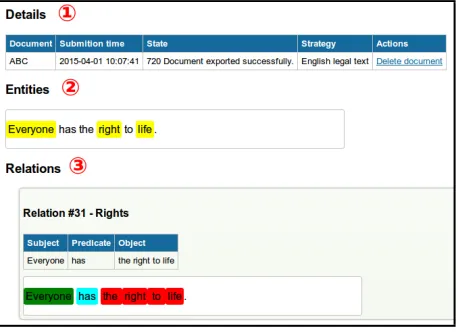
Web interface enables users to submit documents to be processed by RExtractor. In the submission window, users are asked to select one of the extrac-tion strategies. Users can browse extracextrac-tion strate-gies and view their detailed description. After suc-cessful document submission, the document waits in a queue to be processed according to the speci-fied extraction strategy. Users can view a display of submitted document processing that is automatically updated, see Figure 4.
Figure 4: RExtractor web interface, part 1
Figure 5: RExtractor web interface, part 2
input document with the highlighted entities that can be viewed interactively: by clicking on the entity, an additional information about the entity is uploaded and presented. (3) Relations section consists of tables where(subject, predicate, object) triples are listed. In addition, the relevant part of the document with the highlighted triples is presented as well.
Our demonstration enables users to submit texts from legal domain and process them according to two currently available extraction strategies, Czech and English. Once the document processing is finished, users can browse extracted entity-relation triples.
4 RExtractor Online
http://odcs.xrg.cz/demo-rextractor
5 Conclusion
We presented the RExtractor system with the follow-ing features:
• Our ambition is to provide users with an inter-active and user-friendly information extraction system that enables submitting documents and browsing extracted data without spending time with understanding technical details.
• A workflow of RExtractor is language inde-pendent. Currently, two extraction strategies are available, for Czech and English. Creat-ing strategies for other languages requires NLP tools, Database of entities (DBE) and Database of queries (DBQ) for a given language.
• A workflow of RExtractor is domain indepen-dent. Currently, the domain of legislation is covered. Creating strategies for other domains requires building DBE and DBQ. It is a joint work of domain and NLP experts.
• RExtractor extracts information from syntactic dependency trees. This linguistic structure en-ables to extract information even from complex sentences. Also, it enables to extract even com-plex relations.
• RExtractor has both user-friendly interface and API to address large-scale tasks. The system has already processed a collection of Czech le-gal documents consisting of almost 10,000 doc-uments.
• RExtractor is an open source system but some language models used by NLP tools can be ap-plied under a special license.
Our future plansconcern the following tasks:
• experimenting with syntactic parsing proce-dures in the NLP component that are of a cru-cial importance for extraction
• evaluating RExtractor against the data that are available for various shared tasks and confer-ences on information retrieval, e.g. TAC4,
TRAC5
[image:4.612.73.302.238.406.2]• making tree query design more user-friendly for domain experts
• getting feedback from customers
• incorporating automatic procedures for extrac-tion of both entities and relaextrac-tions that are not pre-specified in Database of Entities and Database of Queries, resp.
• creating strategies for other languages and other domains
Through this system demonstration we hope to re-ceive feedback on the general approach, explore its application to other domains and languages, and at-tract new users and possibly developers.
Acknowledgments
We gratefully acknowledge support from the Tech-nology Agency of the Czech Republic (grant no. TA02010182), The Bernard Bolzano Foundation and SVV project no. 260 224. This work has been using language resources developed and/or stored and/or distributed by the LINDAT/CLARIN project. We highly appreciate RExtractor-related discussions with Martin Neˇcask´y and colleagues from Sysnet, Ltd.
References
Alan Akbik, Oresti Konomi, and Michail Melnikov. 2013. Propminer: A workflow for interactive infor-mation extraction and exploration using dependency trees. InProceedings of the 51st Annual Meeting of the ACL: System Demonstrations, pages 157–162. ACL. Laura Chiticariu, Yunyao Li, and Frederick R. Reiss.
2013. Rule-based information extraction is dead! long live rule-based information extraction systems! In EMNLP, pages 827–832. ACL.
Nicolai Erbs, Bispo Pedro Santos, Iryna Gurevych, and Torsten Zesch. 2014. Dkpro keyphrases: Flexible and reusable keyphrase extraction experiments. In Pro-ceedings of 52nd Annual Meeting of the ACL: System Demonstrations, pages 31–36. ACL.
John Gantz and David Reinsel. 2010. The digital uni-verse decade – Are you ready?
Vincent Kr´ıˇz, Barbora Hladk´a, Martin Neˇcask´y, and Tom´aˇs Knap. 2014. Data extraction using NLP techniques and its transformation to linked data. In HumanInspired Computing and Its Applications
-13th Mexican International Conference on Artificial Intelligence, MICAI 2014, Tuxtla Guti´errez, Mexico, November 16-22, 2014. Proceedings, Part I, pages 113–124.
Mausam, Michael Schmitz, Robert Bart, Stephen Soder-land, and Oren Etzioni. 2012. Open language learn-ing for information extraction. InProceedings of the 2012 Joint Conference on Empirical Methods in Natu-ral Language Processing and Computational NatuNatu-ral Language Learning, EMNLP-CoNLL ’12, pages 523– 534, Stroudsburg, PA, USA. ACL.
Paul McNamee, James Mayfield, Tim Finin, Tim Oates, Dawn Lawrie, Tan Xu, and Douglas Oard. 2013. Kelvin: a tool for automated knowledge base construc-tion. InProceedings of the 2013 NAACL HLT Demon-stration Session, pages 32–35. ACL.
Petr Pajas and Jan ˇStˇep´anek. 2009. System for query-ing syntactically annotated corpora. In Gary Lee and Sabine Schulte im Walde, editors,Proceedings of the ACL-IJCNLP 2009 Software Demonstrations, pages 33–36, Suntec, Singapore. Association for Computa-tional Linguistics.