Proceedings of NAACL-HLT 2019: Demonstrations, pages 6–11 6
ADIDA: Automatic Dialect Identification for Arabic
Ossama Obeid, Mohammad Salameh,†Houda Bouamor,†Nizar Habash
New York University Abu Dhabi, UAE
†Carnegie Mellon University in Qatar, Qatar
{oobeid,nizar.habash}@nyu.edu {msalameh,hbouamor}@cmu.edu
Abstract
This demo paper describes ADIDA, a web-based system for automatic dialect identifica-tion for Arabic text. The system distinguishes among the dialects of 25 Arab cities (from Ra-bat to Muscat) in addition to Modern Standard Arabic. The results are presented with either a point map or a heat map visualizing the au-tomatic identification probabilities over a geo-graphical map of the Arab World.
1 Introduction
The last few years have witnessed an increased interest within the natural language processing (NLP) community in the computational model-ing of dialectal and non-standard varieties of lan-guages (Malmasi et al., 2016; Zampieri et al.,
2017, 2018). The Arabic language, which is a collection of variants or dialects, has received a decent amount of attention in this regard with a number of efforts focusing on dialect identifica-tion, translation and other forms of modeling. In this demo paper, we present ADIDA,1a public on-line interface for visualizing fine-grained dialect identification of Arabic text (Salameh et al.,2018). The dialect identification system produces a vector of probabilities indicating the likelihood an input sentence is from 25 cities (Table 1) and Modern Standard Arabic (MSA). ADIDA displays the re-sults with either a point map or a heat map overlaid on top of a geographical map of the Arab World.
2 Arabic and its Dialects
Although MSA is the official language across the Arab World, it is not the native language of any speakers of Arabic. Dialectal Arabic (DA), on the other hand, is the daily informal spoken variety.
1https://adida.abudhabi.nyu.edu/
The Arabic word
èYKY«
/ςadida/means ‘numerous’.DA is nowadays emerging as the primary language of communication – not just spoken, but also writ-ten, particularly in social media. Arabic dialects are often classified in terms of geographical re-gions, such as Levantine Arabic, Gulf Arabic and Egyptian Arabic (Habash,2010). However, within each of these regional groups, there is significant variation down to the village, town, and city lev-els. The demo we present is based on the work ofSalameh et al.(2018), who utilize the MADAR Project parallel corpus of 25 Arab cities plus MSA (Table1) (Bouamor et al.,2018).2
Arabic dialects differ in various ways from MSA and from each other. These include phono-logical, morphophono-logical, lexical, and syntactic dif-ferences (Haeri,1991;Holes,2004;Watson,2007;
Bassiouney, 2009). Despite these differences, distinguishing between Arabic dialects in writ-ten form is an arduous task because: (i) dialects use the same writing script and share part of the vocabulary; and (ii) Arabic speakers usually re-sort to repeated code-switching between their di-alect and MSA (Abu-Melhim, 1991;Bassiouney,
2009), creating sentences with different levels of dialectness (Habash et al.,2008).
3 Related Work
3.1 Arabic Dialect Processing
While automatic processing of DA is relatively re-cent compared to MSA, it has attracted a consid-erable amount of research in NLP (Shoufan and Al-Ameri,2015). Most of it focuses on (i) collect-ing datasets from various sources and at different levels (Zaidan and Callison-Burch,2011;Khalifa et al.,2016;Abdul-Mageed et al.,2018;Bouamor et al.,2018), (ii) creating processing tools (Habash et al.,2013;Al-Shargi and Rambow,2015;Obeid et al., 2018) (iii) developing DA to English
Region Maghreb Nile Basin Levant Gulf Yemen
Sub-region Morocco Algeria Tunisia Libya Egypt/Sudan South Levant North Levant Iraq Gulf Yemen
Cities Rabat
Fes
Algiers Tunis Sfax
Tripoli Benghazi
Cairo Alexandria Aswan Khartoum
Jerusalem Amman Salt
Beirut Damascus Aleppo
Mosul Baghdad Basra
Doha Muscat Riyadh Jeddah
[image:2.595.79.519.61.121.2]Sana’a
Table 1: Different city dialects covered in ADIDA and the regions they belong to.
chine translation systems (Zbib et al., 2012; Saj-jad et al.,2013), (iv) or performing dialect identifi-cation (Zaidan and Callison-Burch,2014;Huang,
2015;Salameh et al.,2018).
3.2 Dialect Identification
Dialect Identification (DID) is a particularly chal-lenging task compared to Language Identifica-tion (Etman and Beex, 2015). Since Arabic di-alects use the same script and share part of the vo-cabulary, it is quite arduous to distinguish between them. Hence, developing an automatic identifica-tion system working at different levels of repre-sentation and exploring different datasets has at-tracted increasing attention in recent years. For instance, DID has been the goal of a dedicated shared task (Malmasi et al.,2016;Zampieri et al.,
2017, 2018), encouraging researchers to submit systems to recognize the dialect of speech tran-scripts for dialects of four main regions: Egyptian, Gulf, Levantine and North African, and MSA. Several systems implementing a range of tradi-tional supervised learning (Tillmann et al.,2014) and deep learning methods (Belinkov and Glass,
2016;Michon et al.,2018) were proposed. In the literature, a number of studies have been exploring DID using several datasets, rang-ing from user-generated content (i.e., blogs, so-cial media posts) (Sadat et al.,2014), speech tran-scripts (Biadsy et al.,2009;Bougrine et al.,2017), and other corpora (Elfardy and Diab,2012,2013;
Zaidan and Callison-Burch,2014;Salameh et al.,
2018; Dinu et al., 2018; Goldman et al., 2018).
Shoufan and Al-Ameri (2015) and Al-Ayyoub et al. (2017) present a survey on NLP and deep learning methods for processing Arabic dialectal data with an overview on Arabic DID of text and speech. While most of the proposed approaches targeted regional or country level DID, Salameh et al. (2018) introduced a fine-grained DID sys-tem covering the dialects of 25 cities from several countries across the Arab world (from Rabat to Muscat), including some cities in the same coun-try.
3.3 Visualization
Map visualizations are used in multiple fields of study including linguistics, socio-linguistics, and political science to display geographical relations of non-geographic data. Geographical visualiza-tions may include point maps to display individ-ual data points, choropleths and Voronoi tessala-tion maps that cluster data points by region, and heat maps and surface maps that interpolate data over some geographical area.
In the general context of visualization of lan-guage data, one example is the Visualizing Me-dieval Places project (Wrisley,2017,2019), which extracted place names from medieval French texts and overlaid them over their physical locations as a point map with a color ramp to display their frequency. The Linguistic Landscapes of Beirut Project (Wrisley, 2016) visualizes the presence of multilingual written samples within the greater Beirut area using different geographical visual-izations to explore different aspects of its data. Specifically in the context of dialectometric vi-sualizations, most relevant to this paper,Scherrer and Stoeckle(2016) provide surface and Voronoi tessalation maps3 to visualize difference in Swiss German dialects using data extracted from the Sprachatlas der deutschen Schweiz. Similarly, data collected from The Harvard Dialect Survey (Vaux and Golder, 2003) used point maps to dis-play phrase variation across American English di-alects. Katz and Andrews(2013) provide further visualization ofThe Harvard Dialect Surveyusing heat maps to interpolate data from the survey.
4 Design and Implementation
4.1 Design Considerations
The underlying system we use for dialect identifi-cation can work with any number of words (single words, phrases or sentences) and produces proba-bilities of occurrence in different locales in a one dimensional vector (with 26 values in our case). As such, we want an interface that can visualize
(a)
(b)
[image:3.595.80.520.63.614.2](c)
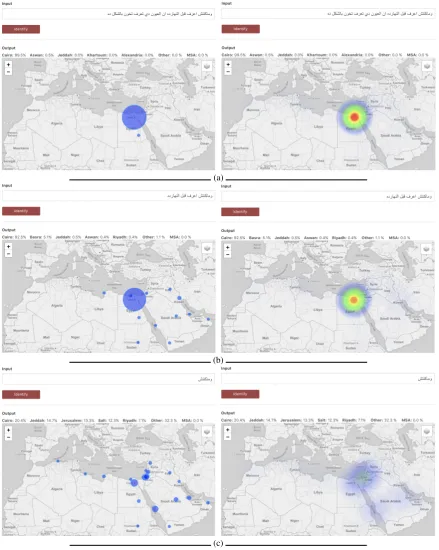
Figure 1: ADIDA Interface showing the output for a verse from an Egyptian Arabic song in the two display modes: point map (right) and heat map (left). The subfigures (a), (b) and (c) correspond to different lengths of the verse: (a) full, (b) first four words, and (c) the first word only.
the probability distribution into a two-dimensional geographical map space allowing us to easily ob-serve and debug connections and patterns relat-ing to dialectal similarities and differences that are harder to catch in the one dimensional output of the system classifier. We also want to visualize
aggregations of probabilities of nearby cities that give a sense of regional presence.
4.2 The ADIDA Interface
The ADIDA interface is publicly available
at https://adida.abudhabi.nyu.edu/.
Figure1.(a, left side) presents the basic structure of the interface. At the top there is a box to in-put the Arabic text to dialect identify. The web page automatically fills the box with a randomly selected song verse from a set of well known songs from different dialects. This is intended to make it easy for the user to understand the task of the inter-face. After the user clicks on theIdentifybutton, a geographical map of the Arab world is shown with one of two toggleable overlays: (1) a point map displaying one point per city scaled to the prob-ability of attribution to the city (default mode), or (2) a heat map that plots the probabilities as Gaussians centered on each city with proportional intensities that aggregate any nearby points at a given zoom level. The point map only shows cities that have an attribution probability larger than 0.1% while the heat map displays Gaussians for all cities. Both visualization modes exclude MSA as there is no geographical location that can represent it. The heat map should not be inter-preted to make claims about the attribution prob-abilities of regions between the considered cities. The falloff of each Gaussian and their aggregates are used solely as a high-level visualization aid through allowing aggregation of probabilities of nearby cities. Additionally, the interface presents the top five cities with their probabilities, together with that of MSA and of the remaining probability mass assigned toOther. We discuss the rest of the screen shots in Figure1in Section4.4.
4.3 Implementation
Back-end The ADIDA back-end was imple-mented in Python usingFlask4 to create a Web API wrapper for the dialect ID code. The core di-alect ID application is based on the best perform-ing model distperform-inguishperform-ing between 26 classes (25 dialects and MSA), described in Salameh et al.
(2018). The application makes use of scikit-learn (Pedregosa et al., 2011) to learn a Multi-nomial Naive Bayes (MNB) classifier using the MADAR corpus (Bouamor et al., 2018), a large-scale collection of parallel sentences built to cover the dialects of 25 cities from the Arab World (Ta-ble1), in addition to MSA. The model is fed with a suite of features covering word unigrams and
char-4http://flask.pocoo.org/
acter unigrams, bigrams and trigrams weighted by their Term Frequency-Inverse Document Fre-quency (TF-IDF) scores, combined with language model scores.The output of the MNB model is a set of 26 probability scores referring to the 25 cities and MSA. Results on a test set show that the model can identify the exact city of a speaker at an accuracy of 67.9% for sentences with an aver-age length of 7 words. Salameh et al.(2018) re-ported on an oracle study showing that accuracy can reach more than 90% with 16-word inputs.
Front-end The front-end was implemented us-ing Vue.js5 for model view control. We use Leaflet6 with Mapbox7 to provide the
geographical map display. We also use
heatmap.js8to generate the heat maps.
4.4 Example
Figure 1 demonstrates the output of ADIDA for a verse from an Egyptian Arabic song (Hafez,
1963). The left side of Figure1shows the default point-map mode, while the right side shows the heat-map mode. In Figure1.(a), the full verse of 11 words is returns a correct preference for Cairo at a high degree of confidence (99.5% probability). In Figure1.(b) and (c), the length is reduced first to the first four words, and then to the very first word only. In all three cases, Cairo is the top choice, but with decreasing confidence correlating with the length of the input: 99.5%>92.5%>20.4%. Additionally we see a great diffusion of the prob-ability score, with the case of one word input re-sulting with more probability mass in the other 20 cities that are not shown than in the first choice.
5 Conclusion and Future Work
We presented ADIDA, a public online interface for visualizing a system for fine-grained dialect iden-tification. This system produces a vector of proba-bilities indicating the likelihood an input sentence is from 25 cities and MSA. ADIDA displays the results as a point map or a heat map overlaid on top of a geographical map of the Arab World.
In the future, we plan to continue improving our dialect identification back-end. We also plan to ex-tend the interface in a number of ways: (a) provide
5https://vuejs.org/ 6
https://leafletjs.com/
7
https://www.mapbox.com/
8https://www.patrick-wied.at/static/
a display mode that better serves color-blind indi-viduals, (b) provide a feedback mode that can be used to collect additional data provided by users with their quality judgments, and (c) gamify the interface to allow the use of it as a tool to identify more cities in the Arab World.
The data we use in building the back-end is made available as part of a shared task on Arabic fine-grained dialect identification (Bouamor et al.,
2019).
Acknowledgments The work presented was made possible by grant NPRP 7-290-1-047 from the Qatar National Research Fund (a member of the Qatar Foundation). The statements made herein are solely the responsibility of the authors. We would like to thank David Wrisley and Yves Scherrer for their valuable feedback and insights.
References
Muhammad Abdul-Mageed, Hassan Alhuzali, and Mo-hamed Elaraby. 2018. You tweet what you speak: A city-level dataset of Arabic dialects. InProceedings of the Language Resources and Evaluation Confer-ence (LREC), Miyazaki, Japan.
Abdel-Rahman Abu-Melhim. 1991. Code-switching and linguistic accommodation in Arabic. In Pro-ceedings of the Annual Symposium on Arabic Lin-guistics, volume 80, pages 231–250.
Mahmoud Al-Ayyoub, Aya Nuseir, Kholoud Alsmearat, Yaser Jararweh, and Brij Gupta. 2017. Deep learning for Arabic nlp: A survey.
Journal of Computational Science.
Faisal Al-Shargi and Owen Rambow. 2015. Diwan: A dialectal word annotation tool for Arabic. In Pro-ceedings of the Workshop for Arabic Natural Lan-guage Processing (WANLP), pages 49–58, Beijing, China.
Reem Bassiouney. 2009.Arabic Sociolinguistics: Top-ics in Diglossia, Gender, Identity, and PolitTop-ics. Georgetown University Press.
Yonatan Belinkov and James Glass. 2016. A Character-level Convolutional Neural Network for Distinguishing Similar Languages and Dialects. In
Proceedings of the Workshop on NLP for Similar Languages, Varieties and Dialects (VarDial), pages 145–152, Osaka, Japan.
Fadi Biadsy, Julia Hirschberg, and Nizar Habash. 2009. Spoken Arabic Dialect Identification Using Phono-tactic Modeling. In Proceedings of the Workshop on Computational Approaches to Semitic Languages (CASL), pages 53–61, Athens, Greece.
Houda Bouamor, Nizar Habash, Mohammad Salameh, Wajdi Zaghouani, Owen Rambow, Dana Abdul-rahim, Ossama Obeid, Salam Khalifa, Fadhl Eryani, Alexander Erdmann, and Kemal Oflazer. 2018. The
MADAR Arabic Dialect Corpus and Lexicon. In
Proceedings of the Language Resources and Eval-uation Conference (LREC), Miyazaki, Japan. Houda Bouamor, Sabit Hassan, Nizar Habash, and
Ke-mal Oflazer. 2019. The MADAR shared task on Arabic fine-grained dialect identification. In Pro-ceedings of the Fourth Arabic Natural Language Processing Workshop (WANLP), Florence, Italy. Soumia Bougrine, Hadda Cherroun, and Djelloul
Ziadi. 2017. Hierarchical Classification for Spoken Arabic Dialect Identification using Prosody: Case of Algerian Dialects.CoRR, abs/1703.10065.
Liviu P. Dinu, Alina Maria Ciobanu, Marcos Zampieri, and Shervin Malmasi. 2018. Classifier ensem-bles for dialect and language variety identification.
CoRR, abs/1808.04800.
Heba Elfardy and Mona Diab. 2012. Token level iden-tification of linguistic code switching. In Proceed-ings of the International Conference on Computa-tional Linguistics (COLING), Mumbai, India. Heba Elfardy and Mona Diab. 2013. Sentence Level
Dialect Identification in Arabic. In Proceedings of the Conference of the Association for Computational Linguistics (ACL), pages 456–461, Sofia, Bulgaria.
Asma Etman and Louis Beex. 2015. Language and Di-alect Identification: A Survey. InProceedings of the Intelligent Systems Conference (IntelliSys), London, UK.
Jean-Philippe Goldman, Yves Scherrer, Julie Glik-man, Mathieu Avanzi, Christophe Benzitoun, and Philippe Boula de Mareil. 2018. Crowdsourcing Re-gional Variation Data and Automatic Geolocalisa-tion of Speakers of European French. In Proceed-ings of the Eleventh International Conference on Language Resources and Evaluation (LREC 2018), Miyazaki, Japan. European Language Resources Association (ELRA).
Nizar Habash, Owen Rambow, Mona Diab, and Reem Kanjawi-Faraj. 2008. Guidelines for Annotation of Arabic Dialectness. InProceedings of the Workshop on HLT & NLP within the Arabic World, Marrakech, Morocco.
Nizar Habash, Ryan Roth, Owen Rambow, Ramy Es-kander, and Nadi Tomeh. 2013. Morphological Analysis and Disambiguation for Dialectal Arabic. InProceedings of the Conference of the North Amer-ican Chapter of the Association for Computational Linguistics (NAACL), Atlanta, Georgia.
Nizar Y Habash. 2010. Introduction to Arabic natural language processing, volume 3. Morgan & Clay-pool Publishers.
Niloofar Haeri. 1991. Sociolinguistic Variation in Cairene Arabic: Palatalization and the qaf in the Speech of Men and Women.
Abdel Halim Hafez. 1963. Gabbar (Arrogant). Lyrics by Hessien El Sayed.
Fei Huang. 2015. Improved Arabic Dialect Classifica-tion with Social Media Data. InProceedings of the Conference on Empirical Methods in Natural Lan-guage Processing (EMNLP), pages 2118–2126, Lis-bon, Portugal.
Josh Katz and Wilson Andrews. 2013. How Yall, Youse and You Guys Talk. https: //www.nytimes.com/interactive/
2014/upshot/dialect-quiz-map.html.
Salam Khalifa, Nizar Habash, Dana Abdulrahim, and Sara Hassan. 2016. A Large Scale Corpus of Gulf Arabic. In Proceedings of the Language Re-sources and Evaluation Conference (LREC), Por-toroˇz, Slovenia.
Shervin Malmasi, Marcos Zampieri, Nikola Ljubeˇsi´c, Preslav Nakov, Ahmed Ali, and J¨org Tiedemann. 2016. Discriminating between Similar Languages and Arabic Dialect Identification: A Report on the Third DSL Shared Task. In Proceedings of the Workshop on NLP for Similar Languages, Varieties and Dialects (VarDial), pages 1–14, Osaka, Japan.
Elise Michon, Minh Quang Pham, Josep Crego, and Jean Senellart. 2018. Neural network architectures for Arabic dialect identification. InProceedings of the Fifth Workshop on NLP for Similar Languages, Varieties and Dialects (VarDial 2018), pages 128– 136.
Ossama Obeid, Salam Khalifa, Nizar Habash, Houda Bouamor, Wajdi Zaghouani, and Kemal Oflazer. 2018. MADARi: A Web Interface for Joint Ara-bic Morphological Annotation and Spelling Correc-tion. InProceedings of the Language Resources and Evaluation Conference (LREC), Miyazaki, Japan.
Fabian Pedregosa, Ga¨el Varoquaux, Alexandre Gram-fort, Vincent Michel, Bertrand Thirion, Olivier Grisel, Mathieu Blondel, Peter Prettenhofer, Ron Weiss, Vincent Dubourg, Jake Vanderplas, Alexan-dre Passos, David Cournapeau, Matthieu Brucher, Matthieu Perrot, and ´Edouard Duchesnay. 2011. Scikit-learn: Machine learning in python. Journal of Machine Learning Research, 12:2825–2830.
Fatiha Sadat, Farnazeh Kazemi, and Atefeh Farzindar. 2014. Automatic Identification of Arabic Dialects in Social Media. In Proceedings of the Workshop on Natural Language Processing for Social Media (SocialNLP), pages 22–27, Dublin, Ireland.
Hassan Sajjad, Kareem Darwish, and Yonatan Be-linkov. 2013. Translating dialectal Arabic to En-glish. InProceedings of the Conference of the Asso-ciation for Computational Linguistics (ACL), pages 1–6, Sofia, Bulgaria.
Mohammad Salameh, Houda Bouamor, and Nizar Habash. 2018. Fine-grained arabic dialect identi-fication. InProceedings of the International Con-ference on Computational Linguistics (COLING), pages 1332–1344, Santa Fe, New Mexico, USA.
Yves Scherrer and Philipp Stoeckle. 2016. A quan-titative approach to Swiss German dialectometric analyses and comparisons of linguistic levels. Di-alectologia et Geolinguistica, 24(1):92–125.
Abdulhadi Shoufan and Sumaya Al-Ameri. 2015. Nat-ural language processing for dialectical Arabic: A survey. InProceedings of the Workshop for Arabic Natural Language Processing (WANLP), page 36, Beijing, China.
Christoph Tillmann, Saab Mansour, and Yaser Al-Onaizan. 2014. Improved Sentence-Level Arabic Dialect Classification. InProceedings of the Work-shop on Applying NLP Tools to Similar Languages, Varieties and Dialects, pages 110–119, Dublin, Ire-land.
Bert Vaux and Scott Golder. 2003. The Harvard Di-alect Survey. Cambridge, MA: Harvard University Linguistics Department.
Janet CE Watson. 2007. The Phonology and Morphol-ogy of Arabic. Oxford University Press.
David Joseph Wrisley. 2016. Linguistic Landscapes of Beirut Project. http://llbeirut.org. David Joseph Wrisley. 2017. Locating medieval
French, or why we collect and visualize the geographic information of texts. Speculum, 92(S1):S145–S169.
David Joseph Wrisley. 2019. ”Aggregate map.” Visualizing Medieval Places. http://vmp.
djwrisley.com/map/.
Omar Zaidan and Chris Callison-Burch. 2014. Ara-bic dialect identification. Computational Linguis-tics, 40(1):171–202.
Omar F Zaidan and Chris Callison-Burch. 2011. The Arabic Online Commentary Dataset: an Annotated Dataset of Informal Arabic With High Dialectal Content. In Proceedings of the Conference of the Association for Computational Linguistics (ACL), pages 37–41.
Marcos Zampieri, Shervin Malmasi, Nikola Ljubeˇsi´c, Preslav Nakov, Ahmed Ali, J¨org Tiedemann, Yves Scherrer, and No¨emi Aepli. 2017. Findings of the VarDial Evaluation Campaign 2017. InProceedings of the Workshop on NLP for Similar Languages, Va-rieties and Dialects (VarDial), pages 1–15, Valencia, Spain.
Marcos Zampieri, Shervin Malmasi, Preslav Nakov, Ahmed Ali, Suwon Shon, James Glass, Yves Scher-rer, Tanja Samardˇzi´c, Nikola Ljubeˇsi´c, J¨org Tiede-mann, Chris van der Lee, Stefan Grondelaers, Nelleke Oostdijk, Antal van den Bosch, Ritesh Ku-mar, Bornini Lahiri, and Mayank Jain. 2018. Lan-guage identification and morphosyntactic tagging: The second VarDial evaluation campaign. In Pro-ceedings of the Fifth Workshop on NLP for Similar Languages, Varieties and Dialects (VarDial), Santa Fe, USA.