77
Evaluation of Morphological Embeddings for English and Russian
Languages
Vitaly Romanov
Innopolis University, Innopolis, Russia
Albina Khusainova
Innopolis University, Innopolis, Russia
Abstract
This paper evaluates morphology-based em-beddings for English and Russian languages. Despite the interest and introduction of sev-eral morphology-based word embedding mod-els in the past and acclaimed performance im-provements on word similarity and language modeling tasks, in our experiments, we did not observe any stable preference over two of our baseline models - SkipGram and FastText. The performance exhibited by morphological embeddings is the average of the two baselines mentioned above.
1 Introduction
One of the most significant shifts in the area of nat-ural language processing is to the practical use of distributed word representations. Collobert et al. (2011) showed that a neural model could achieve close to state-of-the-art results in Part of Speech (POS) tagging and chunking by relying almost only on word embeddings learned with a language model. In modern language processing architec-tures, high quality pre-trained representations of words are one of the major factors of the resulting model performance.
Although word embeddings became ubiqui-tous, there is no single benchmark on evaluating their quality (Bakarov, 2018), and popular intrin-sic evaluation techniques are subject to criticism (Gladkova and Drozd, 2016). Researchers very of-ten rely on intrinsic evaluation, such as semantic similarity or analogy tasks. While intrinsic evalu-ations are simple to understand and conduct, they do not necessarily imply the quality of embed-dings for all possible tasks (Gladkova et al., 2016). In this paper, we turn to the evaluation of mor-phological embeddings for English and Russian languages. Over the last decade, many approaches tried to include subword information into word
representations. Such approaches involve addi-tional techniques that perform segmentation of a word into morphemes (Arefyev N.V., 2018; Virpi-oja et al., 2013). The presumption is that we can potentially increase the quality of distributional representations if we incorporate these segmenta-tions into the language model (LM).
Several approaches that include morphology into word embeddings were proposed, but the evaluation often does not compare proposed bedding methodologies with the most popular em-bedding vectors - Word2Vec, FastText, Glove. In this paper, we aim at answering the question of whether morphology-based embeddings can be useful, especially for languages with rich mor-phology (such as Russian). Our contribution is the following:
1. We evaluate simple SkipGram-based (SG-based) morphological embedding models with new intrinsic evaluation BATS dataset (Gladkova et al., 2016)
2. We compare relative gain of using morpho-logical embeddings against Word2Vec and FastText for English and Russian languages
3. We test morphological embeddings on sev-eral downstream tasks other than language modeling, i.e., mapping embedding spaces, POS tagging, and chunking
2 Related work
The idea to include subword information into word representation is not new. The question is how does one obtain morphological segmentation of words. Very often, researchers rely on the unsu-pervised morphology mining tool Morfessor (Vir-pioja et al., 2013).
Many approaches use simple composition, e.g., sum, of morpheme vectors to define a word em-bedding. Botha and Blunsom (2014) were one of the first to try this approach. They showed a considerable drop in perplexity of log-bilinear lan-guage model and also tested their model on word similarity and downstream translation task. The translation task was tested against an n-gram lan-guage model. Similarly, Qiu et al. (2014) tweak CBOW model so that besides central word it can predict target morphemes in this word. Final em-beddings of morphemes are summed together into the word embedding. They test vectors on analog-ical reasoning and word similarity, showing that incorporating morphemes improves semantic sim-ilarity. El-kishky et al. (2018) develop their own morpheme segmentation algorithm and test the re-sulting embeddings on the LM task with SGNS objective. Their method achieved lower perplex-ity than FastText and SG.
A slightly different approach was taken by Cot-terell and Sch¨utze (2015) who optimized a log-bilinear LM model with a multitask objective, where the second objective is to guess the next morphological tag. They test resulting vector similarity against string distance (morphologically close words have similar substrings) and find that their vectors surpass Word2Vec by a large margin. Bhatia et al. (2016) construct a hierarchical graphical model that incorporates word morphol-ogy to predict the next word and then optimize the variational bound. They compare their model with Word2Vec and the one described by Botha and Blunsom (2014). They found that their method improves results on word similarity but is inferior to approach by Botha and Blunsom (2014) in POS tagging.
Another group of methods tries to incorporate arbitrary morphological information into embed-ding model. Avraham and Goldberg (2017) ob-serve that it is impossible to achieve both high semantic and syntactic similarity on the Hebrew language. Instead of morphemes, they use other linguistic tags for the word, i.e., lemma, the
word itself, and morphological tag. Chaudhary et al. (2018) took the next level of a similar ap-proach. Besides including morphological tags, they include morphemes and character n-grams, and study the possibility of embedding transfer from Turkish to Uighur and from Hindi to Ben-gali. They test the result on NER and monolingual machine translation.
Another approach that deserves being men-tioned here is FastText by Bojanowski et al. (2017). They do not use morphemes explicitly, but instead rely on subword character n-grams, that store morphological information implicitly. This method achieves high scores on both semantic and syntactic similarities, and by far is the most popu-lar word embedding model that also captures word morphology.
There are also approaches that investigate the impact of more complex models like RNN and LSTM. Luong et al. (2013) created a hierarchical language model that uses RNN to combine mor-phemes of a word to obtain a word representa-tion. Their model performed well on word sim-ilarity task. Similarly, Cao and Rei (2016) cre-ate Char2Vec BiLSTM for embedding words and train a language model with SG objective. Their model excels at the syntactic similarity.
3 Embedding techniques
In this work, we test three embedding models on English and Russian languages: SkipGram, Fast-Text, and MorphGram. The latter one is similar to FastText with the only difference that instead of character n-grams we model word morphemes. This approach was often used in previous research. All three models are trained using the negative sampling objective
1
T
T
X
t=1
X
−m≤j≤m,j6=0
logσ(s(wj, wt))+
k
X
i=1
Ew∼Pn(wt)[logσ(s(w, wt))] (1)
s(wj, wt) =
X
s∈Swt
vsTvwj
where Swt is the set of word segmentations into
n-grams or morphemes. We use Gensim1 as the implementation for all models ( ˇReh˚uˇrek and So-jka, 2010). For MorphGram, we utilize FastText model and substitute the function that computes character n-grams for the function that performs morphological segmentation.
4 Experiments and Evaluation
To understand the effect of using morphemes for training word embeddings, we performed intrin-sic and extrinintrin-sic evaluations of SG, FastText, and MorphGram model for two languages - English and Russian. Russian language, in contrast to En-glish, is characterized by rich morphology, which makes this pair of languages a good choice for ex-ploring the difference in the effect of morphology-based models.
4.1 Data and Training Details
We used the first 5GB of unpacked English and Russian Wikipedia dumps2as training data.
For training both SG and FastText we used Gensim library, for MorphGram - we adapted Gensim’s implementation of FastText by break-ing words into morphemes instead of n-grams, all other implementation details left unchanged. Training parameters remain the same as in the original FastText paper, except the learning rate was set to 0.05 at the beginning of the training, and vocabulary size was constrained to 100000 words. Morphemes for English words were gen-erated with polyglot3, and for Russian - with seq2seq segmentation tool4.
When reporting our results in tables, we will re-fer for FastText as FT and MorphGram as Morph.
4.2 Similarity
One of the intrinsic evaluations often used for word embeddings is a similarity test - given word pairs with human judgments of similarity degree
1https://radimrehurek.com/gensim
2
https://dumps.wikimedia.org/ 3
https://polyglot.readthedocs.io/en/ latest/index.html
4https://github.com/kpopov94/morpheme_
seq2seq
SG FT Morph
en 0.37 0.35 0.36
[image:3.595.359.473.63.105.2]ru 0.24 0.19 0.19
Table 1: Correlation between human judgments and model scores for similarity datasets, Spearman’sρ.
SG FT Morph
en
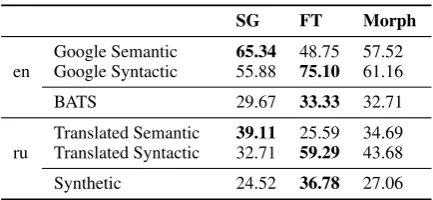
Google Semantic 65.34 48.75 57.52
Google Syntactic 55.88 75.10 61.16
BATS 29.67 33.33 32.71
ru
Translated Semantic 39.11 25.59 34.69
Translated Syntactic 32.71 59.29 43.68
Synthetic 24.52 36.78 27.06
Table 2: Accuracy of models on different analogies tasks.
for words in each pair, human judgments are com-pared with model scores—the more is the corre-lation, the better model “understands” semantic similarity of words. We used SimLex-999 (Hill et al., 2015) dataset—the original one for English and its translated by Leviant and Reichart (2015) version for Russian, for evaluating trained embed-dings. Out-of-vocabulary words were excluded from tests for all models. The results are presented in Table 1.
We see that SG beats the other two models on similarity task for both languages, and Mor-phGram performs almost the same as Fasttext.
4.3 Analogies
Another type of intrinsic evaluations is analo-gies test, where the model is expected to answer questions of the form A is to B as C is to D, D should be predicted. For English, we used Google analogies dataset introduced by Mikolov et al. (Mikolov et al., 2013a) and BATS collec-tion (Gladkova et al., 2016). For Russian, we used a partial translation5 of Mikolov’s dataset, and a synthetic dataset by Abdou et al. (2018).
Again, we excluded all out-of-vocabulary words from tests. We report accuracy for differ-ent models in Table 2.
Interestingly, MorphGram is between SG and FastText in semantic categories for both lan-guages, and between FastText and SG for syntactic categories for English.
5https://rusvectores.org/static/
[image:3.595.308.525.154.254.2]SG FT Morph
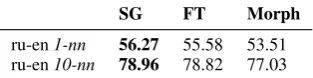
ru-en1-nn 56.27 55.58 53.51
ru-en10-nn 78.96 78.82 77.03
Table 3: Accuracy of supervised mapping from Rus-sian to English using different models, searching among first and ten nearest neighbors.
4.4 Mapping Embedding Spaces
Here we introduce a new type of evaluation—it fo-cuses on a cross-lingual task of mapping two em-bedding spaces for different languages. The core idea is to transform embedding spaces such that after this transformation the vectors of words in one language appear close to the vectors of their translations in another language. We were inter-ested to see if using morphemes has any benefits to perform this kind of mapping.
We map embeddings using a train seed dictio-nary (dictiodictio-nary with word meanings) and state of the art supervised mapping method by Artetxe et al. (2018), and calculate the accuracy of the mapping on the test dictionary. In short, the essence of this method is to find optimal orthogo-nal transforms for both embedding spaces to map them to a shared space based on a seed dictionary, plus some additional steps such as embeddings normalization. For each model—SG, FastText, and MorphGram, we mapped Russian and English embeddings trained using this model. We used the original implementation6for mapping (supervised option), and ground-truth train/test dictionaries provided by Facebook for their MUSE7 library. We report 1-nn and 10-nn accuracy: whether the correct translation was found as a first nearest neighbor or among 10 nearest neighbors of a word in the mapped space. See the results in Table 3.
We observe no positive impact of using Mor-phGram for mapping word embedding spaces.
4.5 POS Tagging and Chunking
Other tasks where incorporation of morphology can be crucial are the tasks of POS Tagging and chunking. We use a simple CNN-based architec-ture introduced in (Collobert et al., 2011), with one projection layer, one convolutional layer, and the final logit layer. The only input features we use are the embeddings from corresponding
mod-6https://github.com/artetxem/vecmap
7https://github.com/facebookresearch/
MUSE
SG FT Morph
en 0.9824 0.9754 0.9722
[image:4.595.103.260.64.103.2]ru 0.8817 0.8899 0.8871
Table 4: Accuracy on POS task
SG FT Morph
en 0.8966 0.9034 0.8985
ru 0.8442 0.8548 0.8534
Table 5: Accuracy on Chunk task
els. The English language embeddings are tested with Conll2000 dataset which contains 8935 train-ing sentences and 44 unique POS tags. The dataset for the Russian language contains 49136 sentences and 458 unique POS tags. Due to time constraint, we train models only for a fixed number of epochs: 50 for English and 20 for Russian (iterations re-duced due to a larger training set). The results for POS and chunking are given in Tables 4 and 5 cor-respondingly. It is interesting to note that SG em-beddings perform better for English on POS task, but for Russian, embeddings that encode more syntactic information always perform better.
5 Results
References
Mostafa Abdou, Artur Kulmizev, and Vinit Ravis-hankar. 2018. Mgad: Multilingual generation of analogy datasets. InProceedings of the Eleventh In-ternational Conference on Language Resources and Evaluation (LREC-2018).
Popov K.P. Arefyev N.V., Gratsianova T.Y. 2018. 24rd International Conference on Computational Linguis-tics and Intellectual Technologies.
Mikel Artetxe, Gorka Labaka, and Eneko Agirre. 2018. Generalizing and improving bilingual word embed-ding mappings with a multi-step framework of linear transformations. InThirty-Second AAAI Conference on Artificial Intelligence.
Oded Avraham and Yoav Goldberg. 2017. The inter-play of semantics and morphology in word embed-dings. arXiv preprint arXiv:1704.01938.
Amir Bakarov. 2018. A survey of word em-beddings evaluation methods. arXiv preprint arXiv:1801.09536.
Parminder Bhatia, Robert Guthrie, and Jacob Eisen-stein. 2016. Morphological priors for proba-bilistic neural word embeddings. arXiv preprint arXiv:1608.01056.
Piotr Bojanowski, Edouard Grave, Armand Joulin, and Tomas Mikolov. 2017. Enriching word vectors with subword information. Transactions of the Associa-tion for ComputaAssocia-tional Linguistics, 5:135–146.
Jan Botha and Phil Blunsom. 2014. Compositional morphology for word representations and language modelling. InInternational Conference on Machine Learning, pages 1899–1907.
Kris Cao and Marek Rei. 2016. A joint model for word embedding and word morphology. arXiv preprint arXiv:1606.02601.
Aditi Chaudhary, Chunting Zhou, Lori Levin, Gra-ham Neubig, David R. Mortensen, and Jaime G. Carbonell. 2018. Adapting Word Embeddings to New Languages with Morphological and Phonolog-ical Subword Representations.
Ronan Collobert, Jason Weston, L´eon Bottou, Michael Karlen, Koray Kavukcuoglu, and Pavel Kuksa. 2011. Natural language processing (almost) from scratch. Journal of Machine Learning Research, 12(Aug):2493–2537.
Ryan Cotterell and Hinrich Sch¨utze. 2015. Morpho-logical word-embeddings. In Proceedings of the 2015 Conference of the North American Chapter of the Association for Computational Linguistics: Hu-man Language Technologies, pages 1287–1292.
Ahmed El-kishky, Frank Xu, Aston Zhang, Stephen Macke, and Jiawei Han. 2018. Entropy-Based Sub-word Mining with an Application to Word Embed-dings. pages 12–21.
Anna Gladkova and Aleksandr Drozd. 2016. Intrinsic evaluations of word embeddings: What can we do better? InProceedings of the 1st Workshop on Eval-uating Vector-Space Representations for NLP, pages 36–42.
Anna Gladkova, Aleksandr Drozd, and Satoshi Mat-suoka. 2016. Analogy-based detection of morpho-logical and semantic relations with word embed-dings: What works and what doesn’t. In Proceed-ings of the NAACL-HLT SRW, pages 47–54, San Diego, California, June 12-17, 2016. ACL.
Felix Hill, Roi Reichart, and Anna Korhonen. 2015. Simlex-999: Evaluating semantic models with (gen-uine) similarity estimation. Computational Linguis-tics, 41(4):665–695.
Ira Leviant and Roi Reichart. 2015. Judgment lan-guage matters: Multilingual vector space models for judgment language aware lexical semantics. CoRR, abs/1508.00106.
Thang Luong, Richard Socher, and Christopher Man-ning. 2013. Better word representations with recur-sive neural networks for morphology. Proceedings of the Seventeenth Conference on Computational Natural Language Learning, pages 104—-113.
Tomas Mikolov, Kai Chen, Greg Corrado, and Jef-frey Dean. 2013a. Efficient estimation of word representations in vector space. arXiv preprint arXiv:1301.3781.
Siyu Qiu, Qing Cui, Jiang Bian, Bin Gao, and Tie-Yan Liu. 2014. Co-learning of word representations and morpheme representations. InProceedings of COL-ING 2014, the 25th International Conference on Computational Linguistics: Technical Papers, pages 141–150.
Radim ˇReh˚uˇrek and Petr Sojka. 2010. Software Frame-work for Topic Modelling with Large Corpora. In Proceedings of the LREC 2010 Workshop on New Challenges for NLP Frameworks, pages 45–50, Val-letta, Malta. ELRA. http://is.muni.cz/ publication/884893/en.