Chinese Answer Extraction Based on POS Tree and Genetic Algorithm
Shuihua Li, Xiaoming Zhang, Zhoujun Li
State Key Laboratory of Software Development Environment Beihang University Beijing 100191, China
Abstract
Answer extraction is the most important part of a chinese web-based question an-swering system. In order to enhance the robustness and adaptability of answer ex-traction to new domains and eliminate the influence of the incomplete and noisy search snippets, we propose two new an-swer exraction methods. We utilize text patterns to generate Part-of-Speech (POS) patterns. In addition, a method is proposed to construct a POS tree by using these POS patterns. The POS tree is useful to candi-date answer extraction of web-based ques-tion answering. To retrieve a efficient POS tree, the similarities between questions are used to select the question-answer pairs whose questions are similar to the unan-swered question. Then, the POS tree is improved based on these question-answer pairs. In order to rank these candidate answers, the weights of the leaf nodes of the POS tree are calculated using a heuris-tic method. Moreover, the Geneheuris-tic Algo-rithm (GA) is used to train the weights. The experimental results of 10-fold cross-validation show that the weighted POS tree trained by GA can improve the accu-racy of answer extraction.
1 Introduction
As mature information retrieval tools, search en-gines can satisfy most information needs of peo-ple. But, with the rapid growth of Internet data, search engines’ weakness is being revealed grad-ually. Traditional search engines which use key-words as input and provide a long list of Hyper-Text Markup Language (HTML) documents are convenient for machines to run. However,
Ques-tion Answering (QA) systems which use natural language as input are convenient for human beings to communicate. Some QA systems directly em-ploy well-built search engines for this task which are called web-based QA systems (Sun et al., 2014). Most web-based QA systems have three modules: 1) question analysis module to ana-lyze the unanswered question and generate queries which are needed for search engines; 2) search snippets retrieval module to send queries which consist of keywords to search engines and then ob-tain search snippets from search engines; 3) an-swer extraction module to extract the final anan-swer from these search snippets. Web-based QA sys-tems compromise the merits of search engines and QA systems: 1) the existing mature search engines enable web-based QA systems to use the abundant data on the Internet; 2) web-based QA systems can communicate with people in natural language.
At present, there are less studies on chinese web-based QA than english web-based QA. More-over, chinese web-based QA embodies many im-provements on candidate answer extraction and ranking. We focus on answer extraction of chi-nese web-based QA system which can answer fac-toid questions. In order to enhance the robustness and adaptability of answer extraction to new do-mains and eliminate the influence of the incom-plete and noisy search snippets, we propose two answer exraction methods based on POS tree.
The similarities between questions are used to select the question-answer pairs whose questions are similar to the unanswered question. These question-answer pairs are utilized to generate text patterns which can be transformed to POS pat-terns. Then, we propose a method to construct a POS tree using these POS patterns. The POS tree is of use to candidate answer extraction of web-based QA. To rank candidate answers, we use a heuristic method to calculate the weights of the
gorithm (GA) (Andrew, 1993) is used to train the weights. The results of the experiments show that the weighted POS tree trained by GA can improve the accuracy of answer extraction.
Our contributions in the paper are three-fold: 1) proposal of a new chinese answer extraction method based on POS tree; 2) proposal of a train-ing method for POS tree by ustrain-ing GA; 3) empirical verification of the proposed methods.
The remainder of this paper is organized as fol-lows: in section 2, we will discuss about related work. In section 3, a method to construct a POS tree and another method to train the POS tree with GA will be presented in detail. In section 4, the ex-perimental results of 10-fold cross-validation will be shown. In section 5, this paper will be con-cluded.
2 Related Work
Answer extraction is the most difficult part of a web-based QA system. As such, it is also the focus of this paper.
Traditional web-based QA systems typically use search snippets directly (Brill et al., 2001; Sun et al., 2015). Although plain texts in the retrieved HTML documents can offer more in-formation (Ravichandran and Hovy, 2002; Liu et al., 2014), the search snippets as high-quality summarizations generated by search engines can save web-based QA systems from having to crawl, parse and filter HTML documents. In spite of ef-ficiency improved by search engines, they lead to another problem: some state-of-the-art answer ex-traction methods (Severyn and Moschitti, 2013; Yao et al., 2013; Liu et al., 2014) rely on syntactic information cound be seriously affected by these search snippets which consis of incomplete sen-tences.
The process of extracting a final answer from the search snippets has two steps: 1) extract candi-date answers such as names, candi-dates and places, and so on; 2) rank these candidate answers based on ranking method to find the best one as the final an-swer. There are many candidate answer extraction methods, such as: 1) some work use dictionaries which are edited manually or generated automat-ically to generate candidate answers. For exam-ple, the famous QA system Watson (Chu-Carroll and Fan, 2011) extracts titles from Wikipedia en-tries as candidate answers. This method provides
effort for maintaining, updating and ranking. Be-sides, this method has low adaptability to new do-mains. 2) The most commonly adopted method is to use Named Entity Recognition (NER) tools to extract Named Entity (NE) that matching with question type (Xu et al., 2003). This method is always used together with question type classifi-cation algorithm. The performance of this method will be limited by the performance of classification algorithm and NER tools. 3) Another commonly used method is to etract candidate answers with text patterns which are edited manually or gener-ated automatically (Zhang and Lee, 2002; Bhagat and Ravichandran, 2008; Khashabi et al., 2016). This method has high precision. However, these text patterns are too fine-grained to be adapted to new data.
There are also many ranking methods which can choose a best answer from a candidate an-swer set, such as: 1) a simple and commonly used method is to rank candidate answers by the simi-larities between candidate answers and the unan-swered question in Vector Space Model (VSM). This method can be used with Latent Seman-tic Analysis and word2vec tool (Mikolov et al., 2013). 2) Another commonly used method is to compute the similarities by syntactic information. To improve performance of this method, tree edit distance (Severyn and Moschitti, 2013) and fac-tor graph (Sun et al., 2013) can be used. 3) Some work rank candidate answers by a combination of features, e.g., lexical features, semantic fea-tures, statistical features and similarity feafea-tures, and so on (Severyn and Moschitti, 2013; Khodadi and Abadeh, 2016). For comprehensive utilization of these features, some global optimization algo-rithms such as GA are needed (Figueroa and Neu-mann, 2008).
3 Method
Item Name Item Value
questionQ '!/
keywords ofQ ',!
answerA úN
search snippetS ...-Äè£úNÅû'!iåÅû'!... target substringS∗ úNÅû'!
segmentation ofS∗ úN/nrÅû/v'/j!/n
[image:3.595.96.504.63.173.2]POS patternP nr#a v j#k n#k#e
Table 1: An example of extraction of a POS pattern.
3.1 POS Tree
Extension of POS: Given a wordw, definet(w) as its extension of POS. In addition to POS,t(w) may have some of three different marks: 1) mark #a means w is a part of the answer; 2) mark #k meanswis a keyword of the question; 3) mark #e meanswis the last word of a pattern.
POS Pattern: Given an answered questionQand its answerA, if there is a search snippetScontains
Aand some keywords ofQ, then there is a shortest substringS∗ ofS also containsA and some
key-words ofQ. We nameS∗ as target substring. If
segmentation ofS∗ is(s
1, s2, ..., sn), then we get a POS patternP = (t(s1), t(s2), ..., t(sn)).
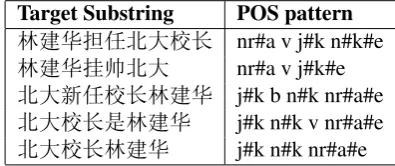
POS patterns that are abstracted from text pat-terns have better adaptability. An example of exraction of a POS pattern is shown in Table 1. The extract POS pattern algorithm is shown in Al-gorithm 1.
Algorithm 1Extract POS Pattern
Input: question’s keywords K, answer A and search snippetS
Output:POS patternP
ifS containsKandAthen
S∗ ⇐target substring ofS
P ⇐()
foreach wordwinS∗do
appendt(w)toP
end for end if
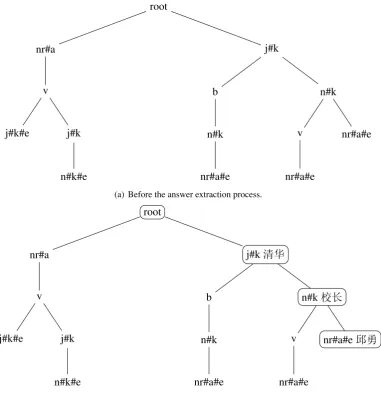
POS Tree: Given a POS pattern set L, we can construct a POS tree T which cover every POS pattern ofL. T consists of extension of POS but excudes the root node. Every path from the root node to a leaf node inT represents a POS pattern inL.
To construct a POS tree, we need some question-answer pairs whose questions are similar
to the unanswered question, because we believe that the more similar a couple of questions are, the more likely they will both match a POS pattern. To find these question-answer pairs, we transform questions to vectors with word2vec tool, then clas-sify the unanswered question with Support Vector Machine (SVM) (Suykens and Vandewalle, 1999) and compute its cosine similarties between ques-tions of all question-answer pairs of its category. In addition, the POS tree can not be cached, but those POS patterns can. Those cached POS pat-terns can speed up the construction of another POS tree. An example of a POS pattern set is shown in Table 2. For this example, the POS tree we can construct is shown in Figure 1(a). The construct POS tree algorithm is shown in Algorithm 2.
Target Substring POS pattern
úNÅû'! nr#a v j#k n#k#e
úN' nr#a v j#k#e
'°û!úN j#k b n#k nr#a#e
'!/úN j#k n#k v nr#a#e
[image:3.595.316.514.448.531.2]'!úN j#k n#k nr#a#e
Table 2: An example of a POS pattern set.
Algorithm 2Construct POS Tree Input:POS pattern setL
Output:POS treeT
add root nodeNROOT toT forP ∈Ldo
NNOW ⇐NROOT foreacht(w)inP do
ifNNOW doesn’t has at(w)childthen create at(w)child forNNOW end if
NNOW ⇐thet(w)child ofNNOW end for
nr#a
v
j#k#e j#k
n#k#e
j#k
b
n#k
nr#a#e
n#k
v
nr#a#e
nr#a#e
(a) Before the answer extraction process.
root
nr#a
v
j#k#e j#k
n#k#e
j#kN
b
n#k
nr#a#e
n#k!
v
nr#a#e
nr#a#e±Ç
[image:4.595.110.492.63.458.2](b) During the answer extraction process.
Figure 1: An example of a POS tree.
3.2 Candidate Answer Extraction Based on POS Tree
When a new questionQis submited, we can ex-tract its keywordsK and get a search snippet set
X about it. For each search snippet S in X, the segmentation of S can be used to extract candi-date answers with the POS tree T that we have constructed before.
For the example questionQin Table 3 and the POS treeT in Figure 1(a), we can extract candi-date answer like Figure 1(b) and then we get a can-didate answer ”±Ç”.
3.3 Train POS Tree and Rank Candidate Answers
In the previous subsection, we discussed how to extract candidate answers with a POS tree. How-ever, people only need a best answer instead of
many equally important candidate answers. To rank these candidate answers, the weights of the leaf nodes of the POS tree are calculated. The score of a candidate answer would be the sum over all the weighs of the leaf nodes which con-tribute to the generation process of this candidate answer. Then we rank these candidate answers by their score to choose the final answer.
Every leaf node of the POS tree corresponds to a POS pattern. So, there is a simple heuristic method to calculate weights of these leaf nodes: just set the weight of a leaf node to the number of POS patterns it corresponds to. These POS patterns are extracted from the question-answer pairs while we are constructing the POS tree. This method does work well. The experimental results of this method will be shown in the next section.
Item Name Item Value
questionQ N!/
keywords ofQ N,!
search snippetS ...2016tN!±ÇÕô...
[image:5.595.110.489.61.132.2]segmentation ofS ...2016/mt/q/wN/j!/n±Ç/nrÕ/vô/v ...
Table 3: A new question.
Algorithm 3Train POS Tree
Input:POS treeT and similar question setV of the new question Output:trained POS treeT
initialize population PNOW which consists of random genes, every gene is a weight array for a leaf node ofT.
GBEST ⇐a random gene
whilethe number of iterations is less than the thresholddo forG∈PNOW do
set the weights of the leaf nodes ofT toG
set the fitness ofGto MRR which computed usingT andV
ifthe fitness ofGis higher than the fitness ofGBEST then
GBEST ⇐G end if
end for
ifthe fitness ofGBEST is equals to the max fitnessthen break while
end if
PNEXT ⇐ ∅
while|PNEXT|<|PNOW|do
get two geneG1andG2by roulette selection fromPNOW cross or mutateG1 andG2in a certain probability
addG1andG2toPNEXT end while
PNOW ⇐PNEXT end while
set the weights of the leaf nodes ofT toGBEST
the leaf nodes. Every gene that used in GA is a weight array. Train data of GA is those question-answer pairs which are used to construct the POS tree. The fitness function of GA is Mean Recipro-cal Rank (MRR) of the ranked candidate answers which are extracted from these question-answer pairs with the POS tree and a gene. The MRR is the average of the reciprocal ranks of the ranked candidate answers for n question-answer pairs:
MRR= n1Xn i=1
1
ranki (1)
where ranki refers to the rank position of the first relevant candidate answer for the i-th question-answer pair. The train pos tree algorithm
is shown in Algorithm 3.
While the web-based QA system is constructing a POS tree, it can retrieval search snippets for the unanswered question at the same time. When the POS tree and these search snippets are both ready, the best answer can be extracted from these search snippets with the POS tree. Then, the system will return a best answer or top k ranked candidate an-swers with sentences based on the circumstances.
4 Experiments
Method WHOs WHENs WHEREs HOW MANYs WHATs MRR
NER 0.6965 0.4130 0.5610 0.5681 0.3102 0.5911
Simple POS tree 0.6943 0.6621 0.6319 0.4621 0.5762 0.6538 POS tree & GA 0.6051 0.7422 0.7226 0.5758 0.5458 0.6615
(a) On baidu data
Method MRR ofWHOs WHENsMRR of WHEREsMRR of HOW MANYsMRR of MRR ofWHATs MRR NER 0.6756 0.3676 0.4762 0.4696 0.3444 0.5431 Simple POS tree 0.6780 0.6207 0.6144 0.4697 0.5213 0.6334 POS tree & GA 0.6053 0.6579 0.6986 0.5182 0.5833 0.6409
[image:6.595.90.509.61.219.2](b) On bing data
Table 4: The results of 10-fold cross-validation
Question/Method WHO WHEN WHERE NUM WHAT
Question /^K s/ÀHö ðq(ê* èôѸ ÀH+
NER 1.2.ùì
3.
1.2015t
2.2014t
3.1224å
1.Nq
2.q
3.ð
1. 2.15 3.à
1.'+
2.ùP
3.+T
Simple POS tree 1.2.ù~zK
3. f
1.1224å
2.1225å
3.1128å
1.q
2.q
3.Äq
1.15 2. 3.AÛ
1.ùP
2.ª¿
3.Bß
POS tree & GA 1.2.ù~zK
3.
1.1224å
2.1225å
3.2016t1224å
1.q
2.q
3.ð
1.15 2.14 3.AÛ
1.ùP
2.È
3.ÂO|
Table 5: Some examples of experimental results.
WHEN, WHERE, HOW MANY, WHAT. For ev-ery question-answer pair, we have retrieved 100 search snippets from two popular search engines, baidu and bing.
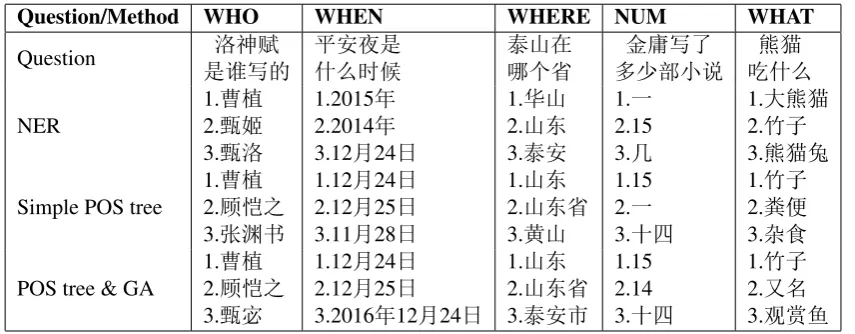
In this paper, we experiment our two meth-ods compared with the commonly used method, NER based method. The results of 10-fold cross-validation on baidu data is shown in Table 4(a) and on bing data is shown in Table 4(b). The heuris-tic method which is proposed in previous section is named ”Simple POS tree”, and the method with GA is named ”POS tree & GA” in experimental results. From Table 4(a) and Table 4(b), we could see that our methods are better than the NER based method expect the WHO questions. We think the cause might be that the NER based method is good at name recognition but weak in recognition of other categories. The experimental results also show that GA can imporve the POS tree method. Our methods’ performance on some pretty specific questions are shown in Table 5.
5 Conclusion
[image:6.595.87.515.258.425.2]References
Alex M. Andrew. 1993. Systems: An Introductory Analysis with Applications to Biology, Control, and Artificial Intelligence, by john h. holland MIT press (bradford books), cambridge, mass., 1992, xiv+211 pp. (paperback £13.50, cloth £26.95). Robotica, 11(5):489.
Rahul Bhagat and Deepak Ravichandran. 2008. Large scale acquisition of paraphrases for learning sur-face patterns. In ACL 2008, Proceedings of the 46th Annual Meeting of the Association for Compu-tational Linguistics, June 15-20, 2008, Columbus, Ohio, USA, pages 674–682.
Eric Brill, Jimmy J. Lin, Michele Banko, Susan T. Du-mais, and Andrew Y. Ng. 2001. Data-intensive question answering. In Proceedings of The Tenth Text REtrieval Conference, TREC 2001, Gaithers-burg, Maryland, USA, November 13-16, 2001. Jennifer Chu-Carroll and James Fan. 2011.
Leverag-ing wikipedia characteristics for search and candi-date generation in question answering. In Proceed-ings of the Twenty-Fifth AAAI Conference on Artifi-cial Intelligence, AAAI 2011, San Francisco, Cali-fornia, USA, August 7-11, 2011.
Alejandro Figueroa and G¨unter Neumann. 2008. Ge-netic algorithms for data-driven web question an-swering. Evolutionary Computation, 16(1):89–125. Daniel Khashabi, Tushar Khot, Ashish Sabharwal, Pe-ter Clark, Oren Etzioni, and Dan Roth. 2016. Question answering via integer programming over semi-structured knowledge. In Proceedings of the Twenty-Fifth International Joint Conference on Arti-ficial Intelligence, IJCAI 2016, New York, NY, USA, 9-15 July 2016, pages 1145–1152.
Iman Khodadi and Mohammad Saniee Abadeh. 2016. Genetic programming-based feature learning for question answering. Inf. Process. Manage., 52(2):340–357.
Zengjian Liu, Xiao-Long Wang, Qingcai Chen, Yaoyun Zhang, and Yang Xiang. 2014. A chinese ques-tion answering system based on web search. In 2014 International Conference on Machine Learn-ing and Cybernetics, Lanzhou, China, July 13-16, 2014, pages 816–820.
Tomas Mikolov, Ilya Sutskever, Kai Chen, Gregory S. Corrado, and Jeffrey Dean. 2013. Distributed rep-resentations of words and phrases and their com-positionality. In Advances in Neural Information Processing Systems 26: 27th Annual Conference on Neural Information Processing Systems 2013. Pro-ceedings of a meeting held December 5-8, 2013, Lake Tahoe, Nevada, United States., pages 3111– 3119.
Deepak Ravichandran and Eduard H. Hovy. 2002. Learning surface text patterns for a question answer-ing system. InProceedings of the 40th Annual
Meet-ing of the Association for Computational LMeet-inguis- Linguis-tics, July 6-12, 2002, Philadelphia, PA, USA., pages 41–47.
Aliaksei Severyn and Alessandro Moschitti. 2013. Au-tomatic feature engineering for answer selection and extraction. InProceedings of the 2013 Conference on Empirical Methods in Natural Language Pro-cessing, EMNLP 2013, 18-21 October 2013, Grand Hyatt Seattle, Seattle, Washington, USA, A meeting of SIGDAT, a Special Interest Group of the ACL, pages 458–467.
Hong Sun, Nan Duan, Yajuan Duan, and Ming Zhou. 2013. Answer extraction from passage graph for question answering. In IJCAI 2013, Proceedings of the 23rd International Joint Conference on Artifi-cial Intelligence, Beijing, China, August 3-9, 2013, pages 2169–2175.
Hong Sun, Furu Wei, and Ming Zhou. 2014. An-swer extraction with multiple extraction engines for web-based question answering. In Natural Lan-guage Processing and Chinese Computing - Third CCF Conference, NLPCC 2014, Shenzhen, China, December 5-9, 2014. Proceedings, pages 321–332. Huan Sun, Hao Ma, Wen-tau Yih, Chen-Tse Tsai,
Jingjing Liu, and Ming-Wei Chang. 2015. Open do-main question answering via semantic enrichment. InProceedings of the 24th International Conference on World Wide Web, WWW 2015, Florence, Italy, May 18-22, 2015, pages 1045–1055.
Johan A. K. Suykens and Joos Vandewalle. 1999. Least squares support vector machine classifiers. Neural Processing Letters, 9(3):293–300.
Jinxi Xu, Ana Licuanan, Jonathan May, Scott Miller, and Ralph M. Weischedel. 2003. Answer selec-tion and confidence estimaselec-tion. InNew Directions in Question Answering, Papers from 2003 AAAI Spring Symposium, Stanford University, Stanford, CA, USA, pages 134–137.
Xuchen Yao, Benjamin Van Durme, Chris Callison-Burch, and Peter Clark. 2013. Answer extrac-tion as sequence tagging with tree edit distance. In Human Language Technologies: Conference of the North American Chapter of the Association of Computational Linguistics, Proceedings, June 9-14, 2013, Westin Peachtree Plaza Hotel, Atlanta, Geor-gia, USA, pages 858–867.