Semgrex-Plus: a tool for automatic dependency-graph rewriting
FabioTamburini UniversityofBologna
FICLIT Bologna, Italy
Abstract
This paper describes an automatic proce-dure, the Semgrex-Plus tool, we developed to convert dependency treebanks into dif-ferent formats. It allows for the definition of formal rules for rewriting dependencies and token tags as well as an algorithm for treebank rewriting able to avoid rule in-terference during the conversion process. This tool is publicly available1.
1 Introduction
Creating a treebank, annotating each sentence with its syntactic structure, is certainly a time-consuming and error prone task. For these rea-sons, treebanks often require maintenance and re-visions to correct mistakes or to adapt it to differ-ent needs.
In big projects, such as the Universal Dependen-cies (UD) project (Nivre et al., 2016), guidelines updates due to new language addition, change in theoretical approaches of a specific phenomenon management, mistakes or other changes often re-quire specific tools to automate, at the maxi-mum possible level, the process of treebank sub-structures rewriting. Moreover, the treebanks de-veloped for a specific language need often to be completely converted to adhere to other standards, for example to comply to the UD specifications and conventions.
For phrase-structure treebanks there are vari-ous tools able to perform trees rewriting, such as Tregex/Tsurgeon pair (Levy and Andrew, 2006), but for dependency treebanks, largely dominant in these years, no specific rewriting tool seems to be available to the community. There are some generic, though very powerful, graph rewriting tools (Guillaume et al., 2012; Ribeyre, 2013) that
1https://github.com/ftamburin/ Semgrex-Plus.git
can be adapted to this task, but with some issues discussed in the last Section.
The StanfordNLP group developed a very in-teresting tool to perform treebank search by us-ing a specialised query language. Usus-ing the Sem-grex package2 (Chambers et al., 2007) the user is able to specify search patterns and retrieve all the matching subgraphs inside a specific depen-dency treebank. This tool is very flexible and rich of operators, allowing the user to design powerful search patterns.
We extended the behaviour of this package adding some new functionalities for automatic dependency-graph rewriting useful for treebank maintenance, revision and conversion, producing a new tool, calledSemgrex-Plus, that we made pub-licly available1.
Semgrex-Plus can be used, in principle, to con-vert any dependency treebank represented using the CoNLL format into a different format that does not require re-tokenisation steps, or to rewrite some parts of the treebank using different depen-dency structures, labels and/or word tags.
This paper is organized as follows: we provide the description of the original Semgrex tool in Sec-tion 2; we then introduce the Semgrex-Plus tool describing the addition to the original tool in Sec-tion 3; in SecSec-tion 4 the rule checking procedures and in Section 5 we present a treebank-conversion experiment using Semgrex-Plus; in the last Sec-tion we draw some provisional conclusion.
2 The Stanford Semgrex Search Language
Semgrex represents nodes in a dependency graph as a (non-recursive) attribute-value ma-trix. It then uses regular expressions for subsets of attribute values. For example,
2http://nlp.stanford.edu/software/ tregex.shtml
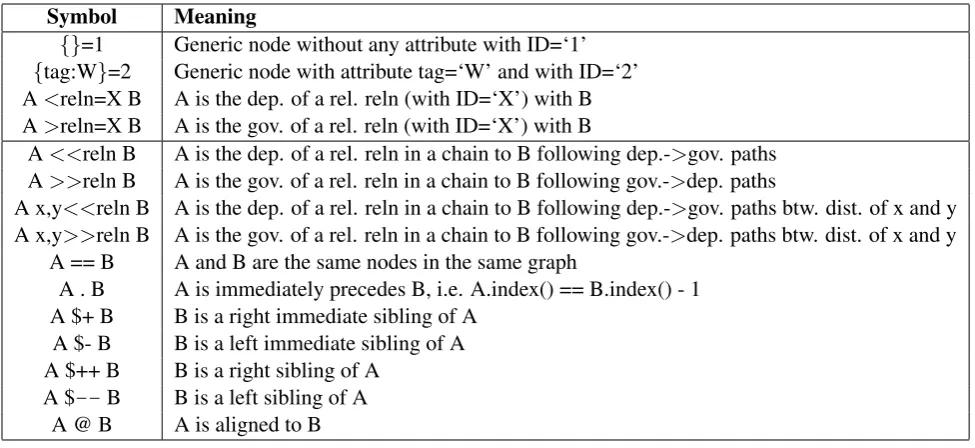
{word:record;tag:/N.*/} refers to any node that has a value ‘record’ for the attribute ‘word’ and a ‘tag’ starting with the letter ‘N’, while ‘{}’ refers to any node in the graph. The most important part of Semgrex regards the possi-bility to specify relations between nodes or group of nodes. See Table 1 for a reference taken from the original documentation and Table 2 for some examples of Semgrex search patterns to-gether with the retrieved subgraphs.
For example, ‘{}=1 <subj=A {}=2’ finds all the pairs of nodes connected by a directed ‘subj’ relation in which the first node ({}=1) is the dependent and the other the head. Logical connec-tives can be used to form more complex patterns and node/relation naming (the ‘=’ assignments) can help to retrieve matched nodes/relations from the patterns. Please refer to (Chambers et al., 2007) or to the online manual3 for a more com-plete description of the Semgrex query language.
3 Semgrex-Plus
Unfortunately Semgrex is only a query language and, in its original form, cannot be used to rewrite dependency (sub)graphs. In order to extend the possibility of Semgrex, we then modified the original application to manage pairs of patterns: the first is used to search into the treebank for the required subgraphs, and the second is used to specify how the retrieved subsgraphs have to be rewritten. For example the pattern pair “{tag:det}=1 >arg=A {tag:noun}=2” → “{tag:ART}=1 <DET=A {tag:NN}=2”, what we called a ‘Semgrex-Plus rule’, changes the direction of the dependency between the head and the dependent and, at the same time, changes the words tags and relation label. The starting ‘search’ pattern and final ‘rewrite’ pattern have to contain the same number of nodes and dependency edges. Node and relation naming has been the fundamental trick to introduce such extension, allowing for nodes and relations matching between the search pattern and rewrite pattern.
3.1 Rule Application Procedure
For converting a treebank into a different format or to adjust some specific subgraphs, by applying a
3https://nlp.stanford.edu/nlp/javadoc/ javanlp/edu/stanford/nlp/semgraph/ semgrex/SemgrexPattern.html
complex set of Semgrex-Plus rules, it is necessary to define a specific procedure in order to avoid rule application interference: the application of a rule to the treebank changes the treebank structure po-tentially blocking the application of the remaining rules.
The solution we adopted decouples the search and rewrite operations for the rule application. We defined a set of new rewriting operations on a gen-eral dependency treebank:
• DEL REL(graphID, depID, headID): deletes a dependency edge between two graph nodes;
• INS REL(graphID, depID, headID, label): inserts a new labelled dependency edge be-tween two graph nodes;
• REN TAG(graphID, nodeID, tag): replace the tag of a specific graph node.
The conversion task has been implemented as a three-steps process:
• first of all, each Semgrex-Plus rule is always applied to the original treebank producing a set of matching subgraphs that have to be rewritten;
• for each match, a set of specific operations for rewriting the subgraph corresponding to the processed matching are generated and stored;
• lastly, the whole set of rewriting opera-tions produced processing the entire set of Semgrex-Plus rules, each applied to the origi-nal treebank, is sorted by graphID, duplicates are removed and every operation is applied graph by graph respecting the following or-der: first dependency deletions, second de-pendency insertions and lastly tag renaming.
This way of processing the original treebank and transforming it into the new format should guarantee that we do not experience rule interfer-ence due to the conversion procedure, because the generation of the rewriting operations due to the Semgrex-Plus rules application is decoupled from the real treebank rewriting.
Symbol Meaning
{}=1 Generic node without any attribute with ID=‘1’ {tag:W}=2 Generic node with attribute tag=‘W’ and with ID=‘2’ A<reln=X B A is the dep. of a rel. reln (with ID=‘X’) with B A>reln=X B A is the gov. of a rel. reln (with ID=‘X’) with B
A<<reln B A is the dep. of a rel. reln in a chain to B following dep.->gov. paths A>>reln B A is the gov. of a rel. reln in a chain to B following gov.->dep. paths
A x,y<<reln B A is the dep. of a rel. reln in a chain to B following dep.->gov. paths btw. dist. of x and y A x,y>>reln B A is the gov. of a rel. reln in a chain to B following gov.->dep. paths btw. dist. of x and y
A == B A and B are the same nodes in the same graph
A . B A is immediately precedes B, i.e. A.index() == B.index() - 1 A $+ B B is a right immediate sibling of A
A $- B B is a left immediate sibling of A A $++ B B is a right sibling of A
[image:3.595.71.559.62.286.2]A $--B B is a left sibling of A A @ B A is aligned to B
Table 1: Supported node specification and relations and their symbols by the original Stanford Semgrex tool. Semgrex-Plus currently supports only the first four operators in rewriting rules.
Semgrex search pattern Retrieved subgraphs
{A}>X
{B}>Y{C}
{A}>X{B}>Y{C}
{D}>Z
{A}>X{B}>Y{C}
... See previous example to build all retrieved subgraphs.
Table 2: Some examples of Semgrex search patterns and the corresponding retrieved subgraphs.
4 Rule Overlap/Interference Checking
Decoupling the ‘search’ from ‘rewrite’ operations should avoid any interference artificially intro-duced by the conversion procedure, but do not guarantee that errors in rules definition could gen-erate problems due to rules interference.
We designed a specific tool that compare each rule in the ruleset with all the other rules and try to find potential interference between them. In order to find this potential problems (without applying the rules to a specific treebank we do not know in advance if a problem effectively will arise or not, thus we prefer to call them ‘potential’) we have to check if two rules exhibit specific kinds of over-laps, but only in the subgraphs that will be actually
modified by the rewrite pattern.
The first step identify which edges in the search pattern are modified by the rewrite pattern of each rule. An edge is modified by a specific rule appli-cation if:
• the relation will be modified (the relation will connect different nodes, one or both, or it will have a different label);
• one of its nodes will be modified by an at-tribute change.
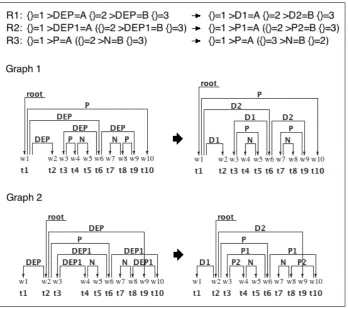
[image:3.595.69.533.332.504.2]Figure 1: An example of graph conversion: the results of the application of three Semgrex-Plus rules to two simple dependency graphs.
Figure 2: Rules added to the first three (R1-R3 in Figure 1) to demonstrate rule overlap checking.
a) the two search patterns completely match, then we have afull overlapbetween rules and this mark a problem. The rule matching is similar to a unification process thus an empty node (e.g. {}=1) will match with any other node.
b) the two search patterns do not completely match, then we got apartial overlapbetween rules and this is only a potential problem be-cause, in principle, the two rules should apply to different subgraph without creating real is-sues.
An empty intersection between rules modified subgraphs do not create any problem.
If we add the rules in Figure 2 to the ones pre-sented in Figure 1 and apply the described algo-rithm to check for rule overlapping, we will obtain two full overlaps for rule pairs R3-R4 and R5-R6 and three partial overlaps for rule pairs R5, R3-R6 and R4-R5.
5 Some Linguistic Examples
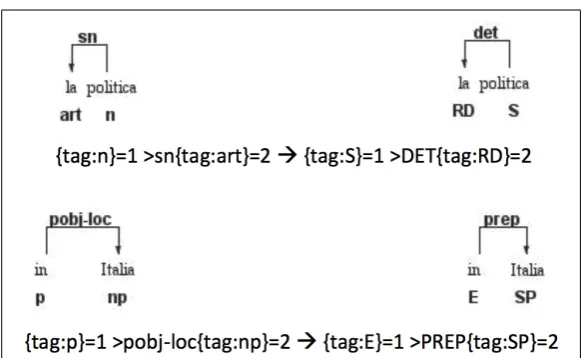
[image:4.595.128.472.451.499.2]Figure 3: Some simple examples of rules that do not modify the dependency structures.
Figure 4: An example of rule that rewrite the dependency structure.
The set of rules manually written for converting VIT dependency structures can be subdivided into two macro-classes: (a) rules that do not modify the structures and (b) rules that need to modify the de-pendencies, both in term of edge direction and in term of different structuring between the involved nodes.
Regarding the rules that do not modify the pendency structures, they simply rename the de-pendency label using a 1:1 or an N:1 look-up ta-ble, as VIT, with respect to MIDT+, typically in-volves more specific dependency types. Figure 3 outlines some simple examples of such kind of conversions.
There are, of course, other kind of operations on subgraphs that require also the rewriting of the dependency structure. A good example concerns relative clauses in which the role of the relative pronoun and, as a consequence, the connections of the edge expressing the noun modification are completely different in the two formalisms. Figure
4 shows one example of this kind of rewriting.
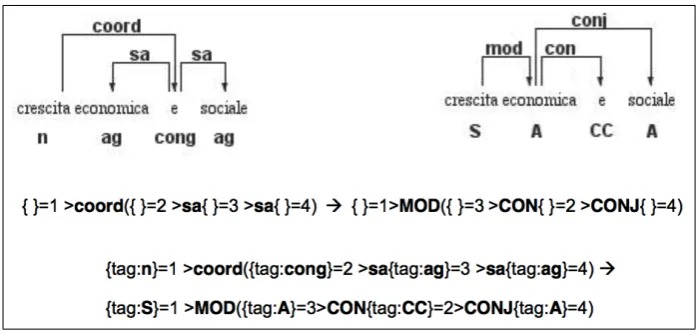
Cases of coordination presented several prob-lems for treebank conversions: in VIT the head of the coordinated structure is linked to the connec-tive and then the two (or possibly more) coordi-nated structures can be linked with a wide range of different dependency types (e.g. between phrases - sn, sa, savv, sq, sp, predicative complements -acomp, ncomp, adjuncts - adj, adjt, adjm, adjv, subjects - subj, objects - obj, etc.) leading to a large number of different combinations. More-over, each dependency combination has to be fur-ther specified by the different token tags. MIDT+ represents coordinate structures in a different way: the connective and the second conjunct are both linked to the first conjunct that is connected to the head of the coordinated structure.
Figure 5: An example of coordination structures in VIT and MIDT+ and the conversion rule.
rules, one of them outlined by the second com-plete Semgrex-Plus rule. This process generated more than 2,800 different rules for handling all the coordinated structures in VIT.
There is also a need for a third kind of rules for rewriting single PoS-tags that might have re-mained unchanged during the main conversion process.
Applying all the 4,250 Semgrex-Plus rules we wrote, we obtained a converted treebank in which 228,534 out of 280,641 dependency relation were automatically converted, giving a global coverage of 81.4%.
To test the effectiveness of the conversion pro-cedure and the conversion rules we randomly se-lected 100 sentences (2582 dependency relations to be converted) from the treebank and manually checked every newly created dependency relation, both in term of the connected nodes and the as-signed label. We obtained the following results: among the 2008 relations that have been automat-ically converted we found 125 wrongly converted dependency relations. So, on this sample, we ob-tained a coverage of 2008/2582 = 77.8%, slightly less than on the whole treebank, with a conversion error rate = 125/2008 = 6.2%.
6 Conclusions
This paper presents the tool Semgrex-Plus, rived from the StanfordNLP Semgrex tool, we de-veloped to allow for dependency structure rewrit-ing inside a specific treebank.
This procedure can be, in principle, adaptable to any conversion between different dependency treebank formats or to modify the specific
de-pendency structures, labels and/or word tags con-nected with a particular phenomenon.
Beside some simple examples of dependency structure rewriting using Semgrex-Plus we gave in this paper, we briefly reported on the use of this tool for automating the conversion of an Italian de-pendency treebank into a different format, in order to show the effectiveness of this tool when used in big and complex conversion projects.
To the best of our knowledge, there are only general-graph rewriting tools (Guillaume et al., 2012; Ribeyre, 2013) available to automatise this task for dependency graphs. Though this pack-ages are very powerful and quite flexible, it is not clear, however, if they apply the rewriting op-erations when a rule pattern is found, modifying the treebank immediately, or not, and if there are some rule-checking procedures for raising poten-tial problems in rules application, because, as we have seen in Section 4, a sequential application of the various rewriting rules could complicate the process of treebanks conversion. On the other hand, decoupling the pattern recognition from the rewriting operations, as done by the Semgrex-Plus tool, guarantee that we can write rules having in mind the original tagset without any modification, but we should still check and avoid interference among the conversion rules.
2006).
In any case, the formal rules for converting a treebank have to be manually written by using the proposed tool syntax and the final result has to be carefully tested to check the effectiveness of the conversion rules. The tool do not guarantee that, writing incomplete or wrong rules, the final result will be fine. For example, if we need to invert the direction of a dependency, we must include in the rule conversion also the node governing such de-pendency, in order to properly manage the graph and avoid the generation of illegal graphs (e.g. non-rooted trees/graphs).
References
Linda Alfieri and Fabio Tamburini. 2016. (Almost) Automatic Conversion of the Venice Italian Tree-bank into the Merged Italian Dependency TreeTree-bank Format. InProc. 3rd Italian Conference on Compu-tational Linguistics - CLiC-IT 2016, pages 19–23, Napoli, Italy.
Cristina Bosco, Simonetta Montemagni, and Maria Simi. 2012. Harmonization and Merging of two Italian Dependency Treebanks. In Proc. of LREC 2012, Workshop on Language Resource Merging, pages 23–30, Istanbul.
Nathanael Chambers, Daniel Cer, Trond Grenager, David Hall, Chloe Kiddon, Bill MacCartney, Marie-Catherine de Marneffe, Daniel Ramage, Eric Yeh, and Christopher Manning. 2007. Learning Align-ments and Leveraging Natural Logic. InProc. of the Workshop on Textual Entailment and Paraphrasing, pages 165–170.
Jinho Choi and Martha Palmer. 2010. Robust Constituent-to-Dependency Conversion for English. InProc. of 9th International Workshop on Treebanks and Linguistic Theories - TLT9, Tartu, Estonia.
Rodolfo Delmonte, Antonella Bristot, and Sara Tonelli. 2007. VIT - Venice Italian Treebank: Syntactic and Quantitative Features. InProc. Sixth International Workshop on Treebanks and Linguistic Theories.
Bruno Guillaume, Guillaume Bonfante, Paul Masson, Mathieu Morey, and Guy Perrier. 2012. Grew: un outilderéécrituredegraphespourleTAL.InGilles Sérasset Georges Antoniadis, Hervé Blan-chon, editor, 12ième Conférence annuelle sur le Traitement Automatique des Langues (TALN’12), Grenoble,France.ATALA.
Richard Johansson and Pierre Nugues. 2007. Ex-tended Constituent-to-dependency Conversion for English. InProc. of NODALIDA 2007, Tartu, Es-tonia.
Roger Levy and Galen Andrew. 2006. Tregex and Tsurgeon: tools for querying and manipulating tree data structures. InProc. of 5th International Conference on Language Resources and Evaluation -LREC 2006, Genoa, Italy.
Joakim Nivre, Marie-Catherine de Marneffe, Filip Gin-ter, Yoav Goldberg, Jan Hajic, Christopher D. Man-ning, Ryan McDonald, Slav Petrov, Sampo Pyysalo, Natalia Silveira, Reut Tsarfaty, and Daniel Zeman. 2016. Universal dependencies v1: A multilingual treebank collection. InProceedings of the Tenth In-ternational Conference on Language Resources and Evaluation (LREC 2016), pages 1659–1666, Por-toroˇz, Slovenia.