Adapting Term Recognition to an Under-Resourced Language: the Case
of Irish
John P. McCrae
Insight Centre for Data Analytics Data Science Institute
National University of Ireland Galway [email protected]
Adrian Doyle
National University of Ireland Galway [email protected]
Abstract
Automatic Term Recognition (ATR) is an important method for the summarization and analysis of large corpora, and normally requires a significant amount of linguis-tic input, in parlinguis-ticular the use of part-of-speech taggers. For an under-resourced language such as Irish, the resources nec-essary for this may be scarce or entirely ab-sent. We evaluate two methods for the au-tomatic extraction of terms, based on the small part-of-speech-tagged corpora that are available for Irish and on a large ter-minology list, and show that both meth-ods can produce viable term extractors. We evaluate this with a newly constructed corpus that is the first available corpus for term extraction in Irish. Our results shine some light on the challenge of adapt-ing natural language processadapt-ing systems to under-resourced scenarios.
1 Introduction
Automatic term recognition (ATR) is the task of identifying relevant and interesting terms from a text corpus. This can be useful for a wide range of text understanding tasks, however most of the work on this task has to date focused on term extraction for English. In contrast, there are up to 7,000 languages spoken in the world, most of which are severely under-resourced, and the task of adapting Natural Language Processing (NLP) tools to such languages is still not well explored. The principle issue for these language is the lack
c
2019 The authors. This article is licensed under a Creative Commons 4.0 licence, no derivative works, attribution, CC-BY-ND.
of resources available and as such they are called
under-resourced languages. In this paper, we will focus on the development of automatic term recog-nition for the Irish language, an under-resourced Celtic language spoken primarily on the island of Ireland. In particular, we will base our work on the previously developed Saffron system (Bordea et al., 2014; Pereira et al., 2019). The main re-quirements for this are the development of a part-of-speech tagger, a lemmatizer and a large back-ground corpus and we will detail in this paper how we constructed these models for Irish.
In particular, the largest challenge was the con-struction of a part-of-speech tagger and we base our work on two main systems that have been de-veloped based on annotated corpora. Firstly, we look at the system of U´ı Dhonnchadha and van Genabith (2006), which was developed on a gen-eral language domain and secondly we refer to the system of Lynn et al. (2015), which was developed specifically for tweets. We then looked at an al-ternative approach using the terminology database, Tearma1, to provide an annotation over the Irish Wikipedia, ‘An Vicip´eid’2. For both the systems trained on part-of-speech corpora and those on the terminology database, we compare them for the challenge of recognizing terms. We show how we incorporate into our term recognition system morphology information extracted from Pota Fo-cal (Mˇechura, 2018). To analyse this we developed a small gold standard dataset of Wikipedia articles and compared the two methods on this dataset3. We then describe the construction of the automatic
1https://www.tearma.ie/eolas/tionscadal. en
2
https://ga.wikipedia.org/wiki/Pr\%C3\ %ADomhleathanach
term recognition system and compare the results of these two methods on a small corpus of discussion related to the future of the National University of Ireland Galway. Our results show that both meth-ods provide a viable method of constructing a term extraction system, however there is still a need for significant language specific knowledge in the de-velopment of such a system and that new generic methods would be necessary to scale this to more under-resourced languages.
2 Related Work
Automatic term recognition is an area that has seen interest for a long time (Kageura and Umino, 1996), and a number of supervised and unsuper-vised methods have been proposed. More re-cently this has led to a couple of mature toolk-its for this including Jate (Zhang et al., 2016), ATR4S (Astrakhantsev, 2018) and Saffron (Pereira et al., 2019), the latter of which we use as the basis for this work. This work has been characterized in terms of filters that extract terms, either in terms of ‘closed’ filters that focus only on nouns (Arora et al., 2014) and open filters that include adjectives (such as in this work). Open filters capture more general terms consisting of adjective and nouns such as ‘natural language processing’, which can-not be captured by closed filters, which would only accept noun terms such as ‘language processing’. The result of choosing an open filter is a trade-off that increases the recall of the system at the cost of precision. Thus, in order to ensure high-quality re-sults, there are a number of methods of ranking that are performed in order to rank the terms and thus to improve the precision of the top ranked candidates. The initial methods in this area focused on the use of term frequency statistics such as TF-IDF (Evans and Lefferts, 1995), or the relative frequency of the term compared to a background corpus (Ah-mad et al., 1999; Pe˜nas et al., 2001; Church and Gale, 1999). A further approach has been based on the analysis of the term, and in particular the pres-ence of subterms in the same domain, which can be indicative of termhood (Buitelaar et al., 2013). It has been shown that the best performance is gener-ally obtained through a combination of these meth-ods (Astrakhantsev, 2018).
3 Methodology
The methodology for automatic term extraction as implemented by the Saffron system consists of the
following steps
1. Part-of-speech tagging is applied to the text corpus.
2. The candidate terms are extracted us-ing a simple regular expression over the part-of-speech tags. For English texts tagged with the Penn Treebank, this was ((NN|JJ|NNP|NNS)+ (IN|NN|JJ|NNP|NNS)*)?
(NN|CD|NNS)
3. A morphological engine is used to create a single normalized base form for the term, e.g., in English we turn plural nouns into singular nouns.
4. The frequency of the terms is recorded and from this a number of metrics are calculated (see Section 3.4).
5. The candidates are ranked according to the mean reciprocal rank of the metrics and top N candidates are returned.
From this it can be seen the key language-dependent elements are: part-of-speech tagging, term normalization and the inclusion of a back-ground corpus for some of the metrics. We will explain how we adapted this procedure to Irish.
3.1 Morphology
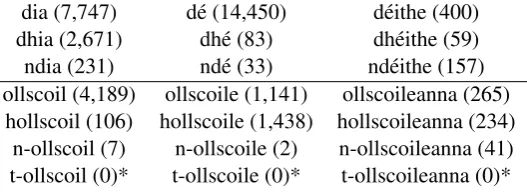
dia (7,747) d´e (14,450) d´eithe (400) dhia (2,671) dh´e (83) dh´eithe (59) ndia (231) nd´e (33) nd´eithe (157) ollscoil (4,189) ollscoile (1,141) ollscoileanna (265)
hollscoil (106) hollscoile (1,438) hollscoileanna (234) n-ollscoil (7) n-ollscoile (2) n-ollscoileanna (41) t-ollscoil (0)* t-ollscoile (0)* t-ollscoileanna (0)*
Table 1: Example of the forms that are lemmatized to ‘dia’ (god) and ‘ollscoil’ (university) and their frequency in the New Corpus for Ireland. *Ungrammatical forms.
However, a particular challenge with Irish (along with other Celtic languages) is initial mu-tation, that is the changing of initial consonant by lenition, eclipsis or prefixing of a consonant to a word starting with a vowel. We used hard-coded rules to generate the forms of each word with ini-tial mutation as they were not included in Pota Fo-cal directly, but could be easily and systematiFo-cally derived. We over-generate forms including apply-ing a t-prefix to feminine nouns such as ‘ollscoil’, on the principle that it is unlikely that we will gen-erate any errors from recognizing too many forms of the noun. An example of all the forms is given in Table 1 and we give the frequency of each form in the New Corpus for Ireland (Kilgarriff et al., 2006), showing that all forms do occur in text, even those that may be considered ungrammatical. The morphology engine is then implemented by a sim-ple lookup.
3.2 Part-of-speech Tagging
Corpus Documents Words #POS
U´ı Dhonn-chadha
42 63,096 16
[image:3.595.169.433.72.168.2]Lynn 3,032 52,279 22
Table 2: Analysis of part-of-speech Corpora used in this work. #POS refers to the number of distinct top-level part of speech categories.
The most important step for the creation of the tool is the identification of terms from the text and this is achieved in English by means of a regular expression over the output of a part-of-speech tag-ger. For adapting this to Irish, there is the obvious challenge that there is much less available train-ing data for a part-of-speech tagger and secondly that the part-of-speech tagset would naturally dif-fer from that of English, as for example there is no tag for genitive noun in English. To our knowledge there are two part-of-speech corpora available for
Irish of sufficient size to apply machine learning techniques. The first one is from U´ı Dhonnchadha and van Genabith (2006) and this corpus consists of the annotation of a number of documents, while a more recent corpus is due to Lynn et al. (2015) and this was created on Twitter by annotating a number of tweets. The basic statistics of the two corpora are given in Table 2, and we can see that both corpora are similar in size (number of words) but there are differences in the number of docu-ments due to the nature of the annotation as in the case of Lynn’s corpus each tweet is considered a single document. U´ı Dhonnchadha’s corpus has more detailed part-of-speech types, however for the purpose of this work we consider only the top category part-of-speechs (e.g., ‘noun’, ‘verb’). In order to adapt our ATR system to this task we fur-ther aligned the two corpora to use a single part-of-speech tagging using the following categories: Noun, Verb, Adjective, Adverb, Preposition, Conjunction, Pronoun, Particle, Determiner and demonstrative4, Numeral andOther5. Further, we considered verbal nouns as verbs as we do not wish them to be extracted as terms, however we note that this could cause issues as there are many cases where there would be ambiguity between nouns and verbal nouns, for example ‘aistri´u’ means ‘translation’ as a noun, but ‘moving’ or ‘translat-ing’ as a verbal noun. We expect that the original corpora have made this distinction consistently so as to enable ATR, but this is certainly an aspect that deserves further investigation. As such we can use the following regular expression to identify terms
4Actually determiners (e.g., ‘an’, ‘na’) and demonstratives (e.g., ‘seo’, ‘sin’, ‘´ud’) are clearly distinct in Irish grammar also determiners, as determiners precede the noun and demon-stratives follows the noun. In U´ı Dhonnchadha’s corpus they are distinct but Lynn confounds them, as such this was the only major failing in harmonizing the two tagsets.
in the text:
N((N|A|D)*(N|A)+)?
Note that this expression allows an article to oc-cur in the middle of a term, which is quite common in Irish, for example in ‘Banc na h ´Eireaan’ (Bank of Ireland). In addition, we observe that it is com-mon for terms in Irish to either start with an arti-cle, for example ‘An Fhrainc’ (France) or contain a preposition, such as ‘aistri´u focal ar fhocal’ (trans-lating word by word), however initial experiments suggested that including prepositions in the pattern lead to too many false positive terms.
3.3 Weak Supervision
While the part-of-speech tagging approach de-scribed above has been successful in English and our results show that it is an effective method also for Irish, there are some clear shortcomings of the approach. In particular, the corpora we train on are quite small and as such there is a necessity to make trade-offs for part-of-speech tags that rarely occur within a term. As an alternative, we consid-ered the use of a large database on known terms which exists in the form of the Tearma database. As such we attempted to train a model that could work at identifying terms in context. To achieve this we collected a large corpus of Irish from the Irish Wikipedia, which was selected due to its size and availability but also due to its technical nature meaning that it is likely to contain the terms used in a similar manner to the Tearma database. We used the dump from April 2019 and in total we extracted 10,074 articles totalling 4,093,665 words and we identified all terms from the Tearma database that occur in this corpus of which we found 24,038 terms. We trained our tagging model based on a simpleIOBtagging (Ramshaw and Marcus, 1999) where a word was tagged asBif it was first word from a term,I if it occurred in a non-initial posi-tion in term andOand if it was not in a term in the Tearma database. This naturally leads to a large number of false negatives as many terms that are used in An Vicip´eid are not in Tearma, more con-cerningly we also found a large number of false positives as there were terms in the database that were similar to other common words. An ex-ample of this was ‘IS’, which is an abbreviation for ‘Intleacht Shaorga’ (Artificial Intelligence), but also matched a very common form of the copula. As such we also filtered the term database as fol-lows:
• If the term occurred more than 3,000 times (this value was hand-tuned) in the corpus it was rejected,
• If the term occurred more than 100 times in the corpus it was accepted only if the first word was marked as a noun in Pota Focal,
• If the term occurred less than 100 times it was accepted as a term.
We also converted the corpora of U´ı Dhonn-chadha and Lynn to the IOB format so that we could compare the result.
3.4 Term Ranking
The goal of the previous task was to identify can-didate terms from the text, and the next step is nor-mally to provide a ranking of these terms so that those which are most relevant to the domain can be identified. A first step is then to provide some basic filters to remove some incorrect terms. In particular, we do the following:
• Filter by the length of the term (up to a maxi-mum of 4 words)
• Remove all terms that consist solely of stop-words6.
• Has a minimum number of occurrences in the corpus. However, given the size of the cor-pus we had, this number was set to 1, and so effectively this filter was ignored
We then carried out the scoring of each term ac-cording to multiple metrics, this has been shown in previous work (Astrakhantsev, 2018) to be very effective and allows the method to be adjusted to the task. To this extent, we consider a corpus, C, and considert ∈ C to a term extracted in the first step. Then, we develop a number of functions fi:T →Rthat produce a score for this.
We can broadly group the ranking categories into four categories:
3.4.1 Frequency of Occurrences
These methods consider as primary evidence the frequency and distribution of the words, in partic-ular focusing on words that are prevalent in only a few documents in the corpus. We define as usual
a set of documents, D, and for each word a fre-quency across all documents denoted,tf(w). We can then define document frequency,df(w), as the number of documents,d∈D, where the word oc-curs at least once. We can then define the following basic metrics:
Total TF-IDF is a well-established method for estimating the importance of a term based on how frequently occurs but penalizing terms that occur uniformly across the corpus.
Total TF-IDF(w) =tf(w) log
|
D|
df(w)
Residual IDF (Church and Gale, 1995) com-pares the distribution of TF-IDF against an ex-pectancy of it being randomly distributed.
Residual IDF(w) =tf(w)×
log2
1−exp
tf(w)
|D|
−log2
df(w)
|D|
3.4.2 Context of occurrences
These functions incorporate the distributional hypothesis (Harris, 1954), by including informa-tion about how terms occur within other terms. For this we define Tsub(w) as the set of terms which are contained inw, that is all sub-sequences of the words ofwandTsuper(w)as all terms that contain woccurring in the corpus. We can then defined the following metrics:
Combo Basic (Astrakhantsev, 2015) uses the count of both the super- and subterms as well as the length (in words) of the term,|w|:
ComboBasic(w) =|w|tf(w)+
α|Tsuper(w)|+β|Tsub(w)|
Similarly, cValue (Ananiadou, 1994) uses the subterm frequency as well:
cValue(w) = log2(|w|+ 0.1)×
tf(w)− P
t0∈T
sub(w)tf(t
0)
|Tsub(w)|
!
The domain coherence measures the correlation, using probabilistic mutual information, of the term with other words in the corpus and then uses this to predict a score, in particular we use the Pos-tRankDC method (Buitelaar et al., 2013).
3.4.3 Reference Corpora
Another important distinguishing factor about terms is that they are very frequent in their do-main but not widely used outside that dodo-main. We do measure this by taking a background cor-pus with term frequencies given as tfref(w), let T = P
tf(w) be the total size in words in the foreground corpus andTref be the total total size of the background corpus. We can define Weird-ness (Ahmad et al., 1999) as:
Weirdness(w) = tf(w) tfref(w)
And a second metric Relevance (Pe˜nas et al., 2001) as:
Relevance(w) = 1−
log
2 +tf(w)Trefdf(w) tfrefwT|D|
3.4.4 Topic Modelling
Finally, the use of topic models has been sug-gested based on the success of Latent Dirichlet Al-location (Blei et al., 2003) in the form of the Novel Topic Model (NTM) (Li et al., 2013), although we did not in fact use this metric, as our previous ex-periments have shown it to perform poorly. NTM requires a probability distribution of a word being labelled to one ofKtopics,p(wi =w|zi =k), the score is then calculated as
NTM(w) =tf(w)X
v∈w
max
k P(wi=w|zi=k)
3.4.5 Multi-metric scoring
Once all the scores for all candidate terms have been calculated, a ranking of the top terms is nec-essary. In general, these terms produce very differ-ent scores and as such, methodologies such as lin-ear models (e.g., support vector machines) or sim-ple classifiers (e.g., feed-forward neural networks) would not work well and would require significant training data. Instead, we have observed that the use of the unsupervised methods ofmean recipro-cal rankproduces a very strong result without the need for training. For this we produce from each score a ranking functionRi :T →Nthat produces
score(t) =
n
X
i
1 Ri(t)
(1)
For our experiments we used a combination of metrics that has proven to work well across many settings that consist of the five scores: ComboBa-sic, Weirdness, TF-IDF, cValue and Residual IDF. Then we apply a filtering step to select the top n candidates; for our experiments we setn= 100.
4 Gold Standard Creation
B I O
U´ı Dhonnchadha 22% 17% 61%
Lynn 19% 10% 71%
Tearma 19% 2% 80%
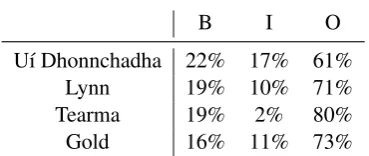
[image:6.595.331.500.154.259.2]Gold 16% 11% 73%
Table 3:The comparative tagging of each of the corpora us-ing the IOB scheme.
In order to evaluate this approach we manually annotated a small section of the Wikipedia corpus. In total we annotated 11 documents consisting of 5,178 words and found among those 846 terms. This annotation was carried out by a single anno-tator and while this makes it difficult to estimate the quality of the annotation, this is unfortunately a typical issue with developing resources for under-resourced languages. In Table 3, we see the pro-portion of words marked with the IOB schema and see that the corpus of Lynn is most similar in terms of composition of the corpus. Moreover, we see that the distant supervision by Tearma while pro-ducing a similar ratio of terms, has far fewer words marked asI, suggesting that there are more one-word terms in this corpus than the part-of-speech tagging based corpora. An example of this annota-tion is given in Figure 1.
5 Results
In order to evaluate the effectiveness of our auto-matic term recognition approach we evaluated the accuracy of the extraction in various settings. For the part-of-speech-based extraction we considered the two corpora of U´ı Dhonnchadha and Lynn sep-arately as well as in a ‘merged’ mode, where we aligned the part-of-speech tags between the two corpora. We also considered each of these corpora where we converted the tagging from the part-of-speech tags to the IOB scheme and then trained
Is ´ı an tSom´ailis an teanga a labhra´ıonn formhor[sic] muintir na Som´aile agus na Som´alaighsna t´ıortha in aice l´aimhe . Isteanga C ´uiseach´ı agus ´ı an darateanga C ´uiseachis m´o a labhra´ıtear ar domhan ´ı (i ndiaidhna hOraimise).
Term Translation
an tSom´ailis Somali (language)
teanga language
an tSom´ail Somalia Som´alach Somali (person) teanga C´uiseach Cushitic Language
[image:6.595.90.275.240.318.2]an Oraimis Oromo
Figure 1:An example from the gold standard annotated cor-pus with terms in bold and the extracted terms with transla-tions
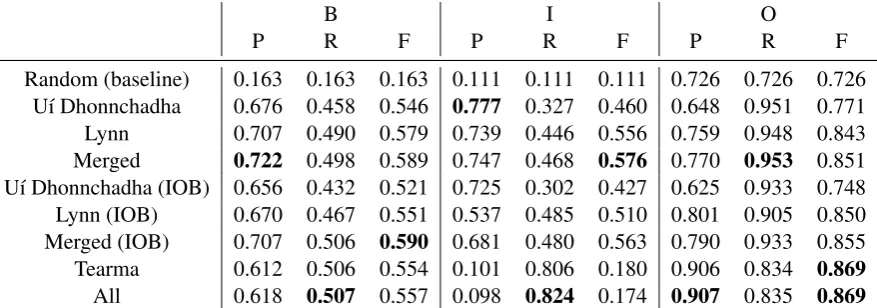
the model on the IOB tags. In addition, we con-sidered the weakly supervised training scheme by using the Tearma-based model and finally we con-catenated all corpora with IOB tags to produce a corpus called ‘All’. We trained all models with the OpenNLP toolkit using the standard maximum entropy model7. In the case of using the part-of-speech tagged corpora the data was trained us-ing the default parameters of the models and the top-level part-of-speech tags as described in Sec-tion 3.2, which for the Tearma database and the models using IOB we again used the default pa-rameters with each word being tagged as either ‘I’, ‘O’ or ‘B’. We note that the maximum en-tropy model implemented by OpenNLP is proba-bly not state-of-the-art and does not take advantage of word embeddings or other techniques. This im-plementation is used by Saffron due to it being a reasonable trade-off between accuracy and compu-tational cost, as well as being openly licensed with-out any copy-left restrictions, however this will likely be revised in the future. In Table 4 we show the results of the extraction presented in terms of precision, recall and F-Measure on each of the classes. We see that no training corpus performs best on all classes, for the B and I class the part-of-speech based system is best when both corpora are combined with only a minor difference between the part-of-speech tags and the IOB tag scheme. For the O class, however the Tearma corpus per-forms best, and the effect of adding the part-of-speech tagged corpora seems to be very marginal.
7
B I O
P R F P R F P R F
[image:7.595.76.515.71.225.2]Random (baseline) 0.163 0.163 0.163 0.111 0.111 0.111 0.726 0.726 0.726 U´ı Dhonnchadha 0.676 0.458 0.546 0.777 0.327 0.460 0.648 0.951 0.771 Lynn 0.707 0.490 0.579 0.739 0.446 0.556 0.759 0.948 0.843 Merged 0.722 0.498 0.589 0.747 0.468 0.576 0.770 0.953 0.851 U´ı Dhonnchadha (IOB) 0.656 0.432 0.521 0.725 0.302 0.427 0.625 0.933 0.748 Lynn (IOB) 0.670 0.467 0.551 0.537 0.485 0.510 0.801 0.905 0.850 Merged (IOB) 0.707 0.506 0.590 0.681 0.480 0.563 0.790 0.933 0.855 Tearma 0.612 0.506 0.554 0.101 0.806 0.180 0.906 0.834 0.869 All 0.618 0.507 0.557 0.098 0.824 0.174 0.907 0.835 0.869
Table 4:Per-class performance of term extraction for various training inputs evaluated on the gold standard.
We then ran the full pipeline embedded in the Saffron system and described in Section 3.4, us-ing An Vicip´eid as a background corpus. This was applied to a set of chat dialogues that concerned plans for the future of National University of Ire-land Galway. Considering each comment as a sin-gle document we used a corpus of 239 documents totalling 9,313 words. We considered two of the best scoring settings for this from the previous ex-periment and the top 20 extracted terms for each settings are shown in Table 5.
6 Discussion
The results presented show that both the extrac-tion using a part-of-speech tagged corpus and us-ing the weak supervision by usus-ing a term database can be effective at developing a term extraction system. The principle difference can be seen from the corpus, in that the Tearma based approach ex-tracted many more one word terms than the part-of-speech-based approach, and this is probably due to the inclusion of many short words as terms, that may have a specific meaning as domain terminol-ogy but are also frequently used in general. This can be seen from the higher prevalence of the ‘B’ tag in Table 3 and by the comparatively better per-formance on the ‘O’ class on the gold standard in Table 4. This is further clearer in the top 20 ex-tracted terms in Table 5, where we can see that the Tearma based system extracted many more one-word terms but only extracted one multione-word term (excluding those terms that erroneously contain the definite article ‘an’). However, the corpus devel-oped by the Tearma approach was much larger than that which has part-of-speech tags, so perfor-mance of this methodology may be impaired.
As such, it seems clear that both methods are
viable approaches and in the context of an under-resourced language both options could be used as the basis for creating a term extractor. As the list of terms is a resource that in general requires less specialist expertise to be created and may be more available for languages with even fewer resources than Irish, for example by using the page titles of Wikipedia articles, it is good to see that for the task of automatic term recognition it may not be neces-sary to engage in the expensive process of anno-tating a corpus with part-of-speech tags. That said, given the relatively small size of the part-of-speech tagged corpus, it may follow that effort spent here more directly translates into improvement in the quality of automatic term recognition.
Part-of-speech Tearma
Irish Translation Irish Translation
gaeilge Irish ollscoil university
mac l´einn student foireann staff
ollscoil university ceart right
ionad ghaeltachta Irish centre an phobail† the public
teanga language d´atheangach bilingual
duine person obair work
mac son c´ursa course
sc´eim teanga language plan seirbh´ıs service
gaeltacht Irish-speaking area ceist question
foireann na hollscoile university staff bliain year
pobal public deis opportunity
´aras na gaeilge Irish Building at NUIG easpa ceannaireachta lack of leadership pobal na hollscoile people of the university lean´unach successor
l´eann learning d´ean dean/‘to do’
foireann staff iarraidh request
cuid na hollscoile part of the university oifigeach officer
n´ıos m´o more dualgas duty
me´an media c´ona´ı residence/always
c´ursa course ple´an† plan
leath na gaeilge for Irish sc´eim plan
hOllscola´ıochta gaeilge† Irish Language Univer-sity Education
comhr´a conversation
seirbh´ıs service ´us´aid usage
c´ona´ı residence/always inbhuanaithe sustainable
deis opportunity cult´ur culture
ball foirne member of stafff an gcl´ar† the programme
oifigeach na gaeilge Irish language officer plean plan hOllscola´ıochta† university education an rud the thing
oifigeach officer r´ol role
ceist question oideachas education
[image:8.595.71.525.72.529.2]acadamh na h´oige youth academy an domhan the world
Table 5: The Top 20 ranked terms extracted using the part-of-speech tagged corpus and the distant supervision via Tearma. Italics indicate terms that are likely incorrect terms,†indicates terms with a lemmatization issues.
cases, we see terms that were extracted were possi-bly also used as adjectives, and hence would not be terms, in particular ‘d´atheangach’ and ‘lean´unach’, which are very rarely used as a noun. Finally, we note that the Tearma-based system extracted the spelling error ‘*ple´an’ (which should likely be ‘plean’), which while incorrect is interesting given that this misspelled form did not occur in training suggesting that the system has been able to gener-alize effectively.
7 Conclusion
We have analyzed two methods for the construc-tion of an automated term recogniconstruc-tion system for
Acknowledgements
This publication has emanated from research sup-ported in part by a research grant from Sci-ence Foundation Ireland (SFI) under Grant Num-ber SFI/12/RC/2289, co-funded by the European Regional Development Fund, and the European Unions Horizon 2020 research and innovation programme under grant agreement No 731015, ELEXIS - European Lexical Infrastructure and grant agreement No 825182, Prˆet-`a-LLOD.
References
Ahmad, Khurshid, Lee Gillam, Lena Tostevin, et al. 1999. University of Surrey Participation in TREC8: Weirdness Indexing for Logical Document Extrap-olation and Retrieval (WILDER). In TREC, pages 1–8.
Ananiadou, Sophia. 1994. A methodology for auto-matic term recognition. In COLING 1994 Volume 2: The 15th International Conference on
Computa-tional Linguistics, volume 2.
Arora, Chetan, Mehrdad Sabetzadeh, Lionel Briand, and Frank Zimmer. 2014. Improving requirements glossary construction via clustering: approach and industrial case studies. In Proceedings of the 8th ACM/IEEE International Symposium on Empirical
Software Engineering and Measurement, page 18.
ACM.
Astrakhantsev, Nikita. 2015. Methods and software for terminology extraction from domain-specific text
collection. Ph.D. thesis, Ph. D. thesis, Institute for
System Programming of Russian Academy of Sci-ences.
Astrakhantsev, Nikita. 2018. ATR4S: toolkit with state-of-the-art automatic terms recognition meth-ods in Scala. Language Resources and Evaluation, 52(3):853–872.
Blei, David M, Andrew Y Ng, and Michael I Jordan. 2003. Latent Dirichlet allocation. Journal of
Ma-chine Learning Research, 3:993–1022.
Bordea, Georgeta, Paul Buitelaar, and Barry Coughlan. 2014. Hot Topics and schisms in NLP: Community and Trend Analysis with Saffron on ACL and LREC Proceedings. In Proceedings of the Ninth LREC,
Reykjavik, Iceland, ACL Anthology: L14-1697.
Buitelaar, Paul, Georgeta Bordea, and Tamara Polajnar. 2013. Domain-independent term extraction through domain modelling. InThe 10th international confer-ence on terminology and artificial intelligconfer-ence (TIA
2013), Paris, France. 10th International Conference
on Terminology and Artificial Intelligence.
Church, Kenneth W and William A Gale. 1995. Poisson mixtures. Natural Language Engineering, 1(2):163–190.
Church, Kenneth and William Gale. 1999. Inverse document frequency (IDF): A measure of deviations from Poisson. InNatural language processing using
very large corpora, pages 283–295. Springer.
Evans, David A and Robert G Lefferts. 1995. CLARIT-TREC experiments. Information
process-ing & management, 31(3):385–395.
Harris, Zellig S. 1954. Distributional structure. Word, 10(2-3):146–162.
Kageura, Kyo and Bin Umino. 1996. Methods of au-tomatic term recognition: A review. Terminology. International Journal of Theoretical and Applied
Is-sues in Specialized Communication, 3(2):259–289.
Kilgarriff, Adam, Michael Rundell, and Elaine U´ı Dhonnchadha. 2006. Efficient corpus develop-ment for lexicography: building the New Corpus for Ireland. Language resources and evaluation, 40(2):127–152.
Li, Sujian, Jiwei Li, Tao Song, Wenjie Li, and Baobao Chang. 2013. A novel topic model for automatic term extraction. InProceedings of the 36th interna-tional ACM SIGIR conference on Research and
de-velopment in information retrieval, pages 885–888.
ACM.
Lynn, Teresa, Kevin Scannell, and Eimear Maguire. 2015. Minority language Twitter: Part-of-speech tagging and analysis of Irish tweets. InProceedings
of the Workshop on Noisy User-generated Text, pages
1–8.
Mˇechura, Michal Boleslav. 2018. Maidir le Pota Focal. URL: http://www.potafocal.com/ _info/.
Pe˜nas, Anselmo, Felisa Verdejo, Julio Gonzalo, et al. 2001. Corpus-based terminology extraction applied to information access. In Proceedings of Corpus
Linguistics, volume 2001, page 458. Citeseer.
Pereira, Bianca, Cecile Robin, Tobias Daudert, John P. McCrae, and Paul Buitelaar. 2019. Taxonomy Ex-traction for Customer Service Knowledge Base Con-struction. InSubmitted to SEMANTICS 2019.
Ramshaw, Lance A and Mitchell P Marcus. 1999. Text chunking using transformation-based learning. In
Natural language processing using very large cor-pora, pages 157–176. Springer.
Zhang, Ziqi, Jie Gao, and Fabio Ciravegna. 2016. JATE 2.0: Java Automatic Term Extraction with Apache Solr. InProceedings of the 10th edition of the Language Resources and Evaluation Conference