Vaijayantīkośa Knowledge-Net
Aruna Vayuvegula∗, Satish Kanugovi†, Sivaja S Nair‡Shivani V§and Mahalakshmi¶
Karnataka Samskrit University Bangalore, India
[email protected], [email protected],
[email protected], [email protected] and [email protected]
Abstract
A kośa (lexicon) is a literary work that provides a comprehensive understanding of words by arranging them along with their synonyms and other words that are semantically related. Its format has been designed to include not just ontological classification, but to give a holistic idea of a concept represented by the word. This allows a thorough understanding of the words, and also the knowledge they embody. Vaijayantīkośa is a popular Sanskrit lexicon that contains words from spoken language as well those used in Vedic literature. To facilitate dissemination of this knowledge, a web-based tool, Vaijayantīkośa Knowledge Net, is created for easy access and analysis of the words in the kośa. The objective of the tool is to provide information to researchers from different fields of study to explore the knowledge contained in the kośa with the help of synsets and ontological structure.
Key words: Vaijayantīkośa, Synset, Ontology, KnowledgeNet, Semantic relations
1 Introduction
Sanskrit is rich with domain-specific and subject-specific kośa literature. They are written in verse format enabling them to be memorized easily by students. Generally kośa, in the Indian tradition of knowledge representation, is a grouping of words with semantic relations to provide comprehensive understanding of the word and its ontological classification. The ontological classification and knowledge structure in Sanskrit kośas have been described in detail by Kulkarni, A (2010).
Patkar (1981) in his book “History of Sanskrit Lexicography”, lists at least 81 lexicons that were written in Sanskrit between 400 BC and 1800 AD. Vogel (1975) in his work, ‘Indian Lexicography’ details the characterization of Indian lexica and lists down over forty unique dictionaries, many special, bilingual and multilingual dictionaries. Unfortunately, many of these works have been lost and we are left with very few of these treasures. Hence, there is a need to ensure that the existing lexicons are well-preserved for posterity and technology can be a great asset to achieve this goal.
Amarakośa is the most authoritative and ancient thesaurus of Sanskrit. There have been several commentaries and translations of the lexicon (Patkar, 1981, pp. 19-21) both in Indian as well as foreign languages. In recent times, it has also captured the interest of computational linguists. Nair, in her PhD thesis (Nair, 2011) has detailed the knowledge structure of Amarakośa and developed the tool, Amarakośa Knowledge Net (AKN), that systematically represents the links between words based on a structured table in a dynamic manner. She has suggested in her thesis that AKN can serve as a model for developing tools for other kośas.
the knowledge structure of Vaijayantīkośa. The paper introduces Vaijayantīkośa and details the different aspects of the VKN development in the following sections.
2 Vaijayantīkośa (VK)
VK is written by Yādavaprakāśa between 10th and 11th century (Bühler, 1887). He lived in the southern part of India, near the present day Kanchipuram in Tamilnadu (Oppert, 1893, p. 2). VK not only has a rich vocabulary of words for common usage, it also has a large number of terms from the Vedas.
Though there are many manuscripts on VK, in different Indian languages, none of them is complete, except one manuscript in Malayalam language. (Oppert, 1893, pp. 3-4).
For the purpose of this work, we have referred to the following two texts of VK.
1. The Vaijayantī of Yādavaprakāśa compiled by Gustav Oppert
This version has introduction by Gustav in English and an elaborate section of vocabulary with meanings in English. Gustav has painstakingly referred to 11 manuscripts and consolidated all the kāṇḍas as one entity (Oppert, 1893).
2. Vaijayantīkośa compiled by Sri. Pandit Haragovindashastri.
This version has introduction by Pandit Haragovindashastri in Hindi and appears, to a large extent, based on Gustav Oppert’s work itself. He gives a brief commentary on the uniqueness of the lexicon and adds glossary of words at the end with references to the ślokas where the words appear (Haragovindashastri, 1971).
Bühler (1887) gives an overview of VK, its structure and information about its author. Kulkarni refers to VK while giving an overview of lexicographic traditions in India and Sanskrit (Kulkarni, 2010). Kaur also touched upon VK through a taxonomical analysis of early Sanskrit literature (Kaur & Singh, 2018). Vogel touches upon VK while chronicling Indian Lexicography and gives brief details about the style and classification adopted by the author (Vogel, 1975). Some regional scholars have also referred to VK in their works. For example, Mallinatha, in Amarapadapārijāta (commentary on Amarakośa) provides close to 212 citations from VK (Nair, 2011).
For this project, the compilation of VK by Gustav Oppert has been taken because of the comprehensiveness of his work as well as the detailed vocabulary of words with meanings in English.
2.1 Structure of VK
The author, Yādavaprakāśa has arranged the words into kāṇḍas and adhyāya�s based on a clear ontological structure. The kāṇḍas are named according to the major topic covered. For example, the antarikṣakāṇḍa consists of all the words related to the sky, universe, astronomy, astrology etc.
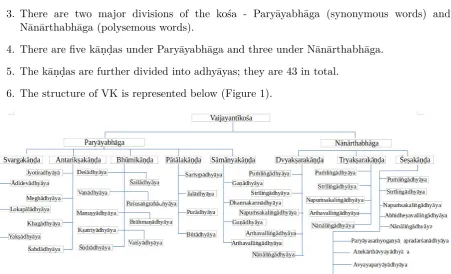
Each kāṇḍa is further divided into adhyāya�s with semantically related words, arranged together according to context, in the form of ślokas. The classification is detailed in the Figure 1.
1. VK consists of nearly 20000 entries of words listed in verse form.
2. It begins with a maṅgalaśloka followed by nine and a half verses of paribhāṣaślokas which provide pointers to decode the gender information of the words.
नृ ी नृष ड ष ड ी ि ल ं वा य ल कम्॥१.१.३॥1
...
समासे युः पृथक् सव श दा बहुवचोऽ तके॥१.१.५॥
More rules for interpreting the liṅga (gender) of the words are described in 58 ślokas of Liṅgasaṅgrahādhyāya (of Śeṣakāṇḍa).
3. There are two major divisions of the kośa - Paryāyabhāga (synonymous words) and Nānārthabhāga (polysemous words).
4. There are five kāṇḍas under Paryāyabhāga and three under Nānārthabhāga.
5. The kāṇḍas are further divided into adhyāya�s; they are 43 in total.
6. The structure of VK is represented below (Figure 1).
Figure 1: Classification of VK
7. Ślokas in VK contain words, their synonyms and meanings. In some cases, probably where the author found it necessary, information pertaining to gender, brief description of the term may also be included.
8. VK emphasizes understanding a concept at greater depth and precision.
2.1.1 Semantic Arrangement of Words in VK
In VK, the kāṇḍas are arranged based on a particular theme. Kāṇḍas are further divided into adhyāyas which are based on sub-themes. Adhyāyas contain ślokas that mostly follow semantic order with occasional violations. Ślokas contain words that are related to a concept. A given word is typically followed with its synonyms and subsequently other relations, like प त-प नीभावः (husband – wife relation), ज य-जनकभावः (child – parent relation), व- वािमभावः (owner – property relation), से य-सेवकभावः (lord - servant relation), धम-ध मभावः (property -locus relation), गुण-गु णभावः (quality - qualifier relation) etc. For example, in concept Viṣṇu, first 53 words form a synset. Subsequently, the author lists words that refer to powers of Viṣṇu. They are followed by possessions of Viṣṇu and so on. Nevertheless, there is a pattern that perhaps reflects the logic of the times it was written.
Given below is the example of the word how Viṣṇu is dealt in VK.
1Śloka reference: The position of a śloka in the VK is represented numerically as x.y.z, where x=adhyāya
Example 1: Concept of िव णुः
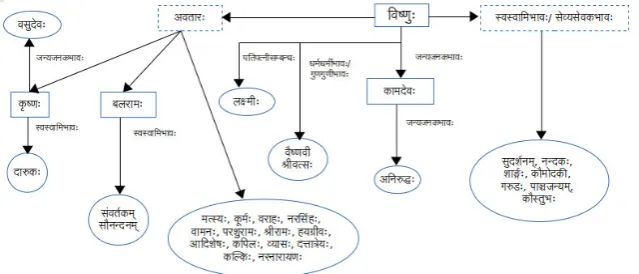
The ślokas 1.1.10 to 1.1.38 from ādidevādhyāya of svargakāṇḍa describe the concept of Viṣṇu with different relations. See Figure 2.
field 1 : word in sanskrit, field 2 : English equivalent in (), field 3 : number in synset in (), field 4 : kāṇḍa.adhyāya.śloka in ()
िव णुः(epithet of Viṣṇu)(53)(1.1.10 - 1.1.15)
वै णवी(power of Viṣṇu)(9)(1.1.16)
कौ तुभः(jewel of Viṣṇu)(1)(1.1.17)
ीव सः(mark on Viṣṇu)(1)(1.1.17)
न दकः(sword of Viṣṇu)(1)(1.1.17)
शा ः(bow of Viṣṇu)(1)(1.1.17)
पा ज यम्(conch of Viṣṇu)(1)(1.1.17)
सुदशनम्(discus of Viṣṇu)(1)(1.1.17)
कौमोदक (mace of Viṣṇu)(1)(1.1.18)
नर सहः(incarnation of Viṣṇu)(1)(1.1.18)
वामनः(incarnation of Viṣṇu)(10)(1.1.19 - 1.1.20)
परशुरामः(incarnation of Viṣṇu)(2)(1.1.20)
ीरामः(incarnation of Viṣṇu)(15)(1.1.20 - 1.1.24)
बलभ ः(incarnation of Viṣṇu)(20)(1.1.22 - 1.1.24)
संवतकम्(Plough of Balabhadra)(1)(1.1.24)
सौन दनम्(pestle of Balabhadra)(1)(1.1.25)
कृ णः(incarnation of Viṣṇu)(10)(1.1.25 - 1.1.26)
दा कः(Charioteer of Kriṣṇa)(1)(1.1.26)
वसुदेवः(father of Kriṣṇa)(3)(1.1.26)
म मथः(god of love, son of Viṣṇu)(25)(1.1.27 - 1.1.29)
अिन ः(son of Manmatha)(3)(1.1.29)
नरनारायणः(incarnation of Viṣṇu)(2)(1.1.30)
हय ीवः(incarnation of Viṣṇu)(2)(1.1.30)
आिदशेषः(incarnation of Viṣṇu)(1)(1.1.30)
यासः(incarnation of Viṣṇu)(6)(1.1.30)
द ा ेयः(incarnation of Viṣṇu)(1)(1.1.31)
क कः(incarnation of Viṣṇu)(1)(1.1.31)
किपलः(incarnation of Viṣṇu)(3)(1.1.31)
यासः(incarnation of Viṣṇu)(6)(1.1.31- 1.1.32)
बु ः(incarnation of Viṣṇu)(32)(1.1.32 - 1.1.35)
ल मीः(wife of Viṣṇu)(10)(1.1.36)
[image:4.595.140.460.596.733.2]ग डः(vehicle of Viṣṇu)(12)(1.1.37 – 1.1.38)
Example 2: Concept of कालः
In VK, the reference to kāla is from śloka 2.1.52 to 2.1.54, which is a total of 43 words in the jyotiradhyāya of antarikṣakāṇḍa. The concept of kāla starts with the smallest unit of time which is referred to as तुिट: (moment). Subsequently, higher units of time are mentioned as depicted below:
कालः(time)(3)(2.1.52)
तुिट: (moment)(2)(2.1.52)
ल व रक: (space of two moments)(1)(2.1.52)
अ रपातक: (space of two laghvakṣarakas)(1)(2.1.52)
िनमेषः(space of two akṣarapātakas)(1)(2.1.53)
लि का(space of two nimeṣas)(1)(2.1.53)
का ा(space of nine liptikās)(1)(2.1.53)
लवः(space of two kāṣṭhas)(1)(2.1.53)
कला(space of five lavas)(1)(2.1.53)
लेशः(space of twelve kalās)(1)(2.1.54)
णः(space of 16 leśas)(1)(2.1.54)
नाडी(space of six kṣaṇas)(1)(2.1.54)
मुहूतः(space of twelve nāḍis)(1)(2.1.54)
घिटका(space equal to one muhūrta)(2)(2.1.54)
Here we can see the hierarchical order of the words which is connected through the relation अवयव-अवयिवस ब धः. Subsequent ślokas i.e. 2.1.55 to 2.1.73 also deal with the concept of kāla but has not been depicted here due to lack of space. A few observations on examining the concept of the word kāla are as follows:
• A very logical and precise structure of division of time has been adopted starting from the lowest measure of time.
• A very systematic division of time until it spans 24 hours or one day is seen. Then, there is the first violation of nesting where day is followed by night and the author goes on to describe night, different kinds of night. Within the nesting of night too, after describing different kinds of night, he suddenly introduces darkness and then goes on to describe different types of darkness.
• After this, there is the third violation of nesting when he goes back to day and then defines different parts of the day followed by different parts of night. Next, he picks terms that talk about space of three hours (which is relevant to both day and night), lucky portion of the day, dawn and twilight. He then ends by addressing a lunar day and different days in a lunar month.
• The list is followed by months, seasons, years, yugas etc.
The author often describes the qualities of a particular term. For example, under the main word ‘sun’, the term sunray is given. The author lists down 22 words under the concept of sunrays. These words do not appear to be synonymous but indicate a more complex idea that needs further research.
तासां शतािन च वा र र मीनां वृि सजने। शत यं िहमो सग ताव घम य सजने॥ २.१.१७2
3 Vaijayantīkośa Knowledge Net (VKN)
VKN is a web-based tool to access knowledge embodied in VK by providing comprehensive information related to the word including meanings, synonyms and relations with other words.
3.1 Scope of the present project
VK is a voluminous lexicon with approximately 20,000 entries of words. However, for developing this version of the web-tool, the first two kāṇḍas mainly the svargakāṇḍa and antarikṣakāṇḍa have been taken, which contain 3,000 entries. The output of the web-tool is the synset and the set of related words of a given input - padam (word in its first person singular form) or prātipadikam (stem). The tool consciously confined to the first 3,000 entries as new fields and features kept evolving through the research. For example, including English meanings was not part of the initial plan but was included as it would help users. Once the web-tool is fine-tuned in all respects, it is easier to scale it up to include the entire database.
An Android Application version of the tool is also currently under development. An initial version is available for volunteer testing to get feedback and suggestions on usability. The Android App is briefly described in Section 3.8.
3.2 Data Structure
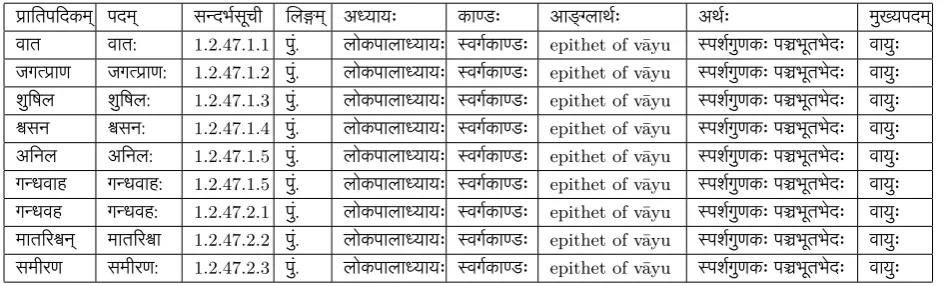
The first step towards the creation of the web-tool is to digitise the entire kośa. The following categories of information are extracted from the ślokas.
ा तपिदकम् (stem), पदम् (nominative form), स दभसूची (reference), ल म् (gender), अ यायः (chapter) andका डः (section)
For example, the śloka number 47 in the lokapālādhyāya reads as follows:
वातो वायुजग ाण शुिषल सनोऽिनलः। ग धवाहो ग धवहो मात र ा समीरणः॥१.२.४७॥
The words are extracted and categorized as in Table 1.
ा तपिदकम् पदम् स दभसूची ल म् अ यायः का डः आ लाथः अथः मु यपदम्
वात वात: 1.2.47.1.1 पुं. लोकपाला यायः वगका डः epithet of vāyu पशगुणकः प भूतभेदः वायुः
जग ाण जग ाण: 1.2.47.1.2 पुं. लोकपाला यायः वगका डः epithet of vāyu पशगुणकः प भूतभेदः वायुः
शुिषल शुिषल: 1.2.47.1.3 पुं. लोकपाला यायः वगका डः epithet of vāyu पशगुणकः प भूतभेदः वायुः
सन सन: 1.2.47.1.4 पुं. लोकपाला यायः वगका डः epithet of vāyu पशगुणकः प भूतभेदः वायुः
अिनल अिनल: 1.2.47.1.5 पुं. लोकपाला यायः वगका डः epithet of vāyu पशगुणकः प भूतभेदः वायुः
ग धवाह ग धवाह: 1.2.47.1.5 पुं. लोकपाला यायः वगका डः epithet of vāyu पशगुणकः प भूतभेदः वायुः
ग धवह ग धवह: 1.2.47.2.1 पुं. लोकपाला यायः वगका डः epithet of vāyu पशगुणकः प भूतभेदः वायुः
मात र न् मात र ा 1.2.47.2.2 पुं. लोकपाला यायः वगका डः epithet of vāyu पशगुणकः प भूतभेदः वायुः
[image:6.595.70.542.432.575.2]समीरण समीरण: 1.2.47.2.3 पुं. लोकपाला यायः वगका डः epithet of vāyu पशगुणकः प भूतभेदः वायुः
Table 1: Information extraction of the synsetवायुः
It is to be noted that words from वात: till समीरण: are synonyms, i.e. words with the same meaning.
1. ा तपिदकम् is the stem of the tokens from śloka and has been used so that it is compatible with other computational resources such as morphological generator and analyser, various e-lexicons etc.; many of them use ा तपिदकम्as input and not the पदम् .
rules of the dictionaries such as Śabdakalpadruma, Vācaspatya etc. This option does not appear in AKN but has been introduced in VKN web-tool to allow users to search for a word using पदम् option in case they are unsure about ा तपिदकम् of a particular word. It is hoped that this feature will make the tool user-friendly.
3. स दभसूचीis the reference indicating the precise position of the word in VK using a 5-tuple number as kāṇḍa, adhyāya, śloka, pāda and word number in the pāda. The pāda number and word number in the pāda are entered manually into the database, whereas the other fields are derived automatically.
4. ल म् - gender information of the word. The gender of a word is decided by the meta-information mentioned by Yādavaprakāśa. Cross reference to ल स हा याय as well as Oppert’s vocabulary is also consulted.
5. अ यायःrefers to the chapter or the adhyāya name to which the entry belongs. The adhyāyas are named based on the topic or subject that the word is categorized under. Thus, this field gives an ontological idea about the word.
6. का डःrefers to the specific section of VK or kāṇḍa to which the entry belongs.
7. आ लाथःor the meaning in English is an additional field that has been included to document from the translation that Oppert compiles under the vocabulary section of the book. This has been included to ensure VKN is accessible to those who may not be Sanskrit scholars.
8. अथः refers to the meaning in Sanskrit given by Yādavaprakāśa in VK. Where ever the meaning is not found in VK, other dictionaries have been referred.
9. मु यपदम् or headword represents the synset with synonymous words. Headword is chosen as follows - if the headword used in AK appears in VK synset, that word is chosen as the headword. In case, there is no equivalent word in AK, Oppert’s vocabulary at the end of the kośa is referred to choose the headword. There are some challenges in choosing the headword because there are no commentaries on VK that a researcher can refer to in case of doubt. However, effort has been made to ensure that words are chosen as far as possible based on the available resources - Compatibility with AKN and Oppert’s vocabulary being a primary guiding forces.
As compared to AKN, three categories, namely - पदम् , meaning in English and meaning in Sanskrit are additional fields incorporated into VKN. The decision to incorporate these additional fields was taken mid-way through the research as it was found to be a useful improvisation over the AKN.
3.3 Relations in VKN
The various relations amongst different headwords are marked in the database. Twelve hierarchical or associative relations are marked in different fields - two kinds of ontological categories, class and attribute are marked in the last two fields. Except ontological categories, all other relations are marked using headwords.
3.3.1 पयायवाची (Synset)
The set of words that have similar meaning is defined as a synset. See the example of वातः in table 2. The output synset is displayed in the Figure 6 in the appendix.
3.3.2 अवयव-अवयिवभावः (Part-whole Relation)
The अवयव-अवयिव relation is marked to indicate part and whole relation. For example - the synsetप ः is a part of the synsetप ी. Each member of the synsetप ःis related to the members of प ीthrough this relation3.
3.3.3 परा-अपरास ब धः (Superset-subset Relation)
This field marks परा-अपरास ब धः. For example - the synset मृदुवातः is a kind of वायुः. So the synset मृदुवातः is related to the synset वायुः with परा-अपरा relation. Each member of the synset मृदुवातःis marked to the synset वायुः4.
3.3.4 ज य-जनकभावः (Child-parent Relation)
This field marks ज य-जनकभावः of two concepts. For example - the synset ofपावती is related to the synsetिहमवान्through ज य-जनकrelation. पावतीis daughter ofिहमवान्andिहमवान् is father of पावती.5
3.3.5 प त-प नीभावः (Husband-wife Relation)
This field is meant for markingप त-प नी relation. For example - the synset of शची is related to the synsetइ ः with Husband-wife relation. Hereइ ः is the husband ofशचीandशची is the wife of इ ः.
3.3.6 व- वािमभावः (Owner-property Relation)
व- वािम relation is marked to indicate owner-property relation. For example - the synsets of वैजय तः - the house of इ ः and अमरावती - the city of इ ः are related to the synset इ ः with owner-property relation. इ ः is the वामी of वैजय तःand अमरावती.
3.3.7 से य-सेवकभावः (Lord-servant Relation)
से य-सेवकrelation is marked to indicate lord-servant relation. For example - the synset ofग डः, the vehicle of िव णुःis related to the synsetिव णुः with lord-servant relation. िव णुःis the से यःof ग डःand ग डः is theसेवकः of िव णुः.
3.3.8 धम-ध मभावः (Property-locus Relation)
धम-ध मrelation is marked in this field. For example - the synsets of वै णवी, the power of िव णुः is related to the synset िव णुःwith property-locus relation. िव णुःis the धम ofवै णवीand वै णवीis theधमः ofिव णुः.
3.3.9 गुण-गु णभावः (Quality-qualificand Relation)
गुण-गु ण relation is marked in this field. For example - the synsets of ीव सः, the mark ofिव णुः is related to the synset िव णुः with quality-qualificant relation. िव णुः is the गुणी of ीव सः and
ीव सःis the गुणः of िव णुः.
3.3.10 उपजी य-उपजीवकभावः (Life-livelihood Relation)
उपजी य-उपजीवक relation is marked to indicate livelihood. For example - the synset ofम यःis related to the synset धीवरःwith life-livelihood relation. म यःis theउपजी यम् of धीवरःand धीवरः is the उपजीवकःofम यः.
3.3.11 अवतारः (Incarnation)
In this field the incarnation or अवतार relation is marked. For example - the synsets of वामनः, ीरामः and ीकृ णः are related to the synset िव णुःwithअवतारrelation.
3.3.12 अ यस ब धाः (Associated With)
This field is meant for other relations which are not defined. For example - the synsetदेवःmay be related to the synset वगः with a relationअावासस ब धः, is not taken care of. The other relations such as ब धुता, सौ ा म्, ातृ वम् etc. are also not considered here. All such relations are marked asअ यस ब धाः. These relations will be categorised later.
3.4 Ontological Categories
The ontological categories are handled based on the corresponding ontological charts as described in theजा तः and उपा धःsections below.
3.4.1 जा तः (Ontological Class)
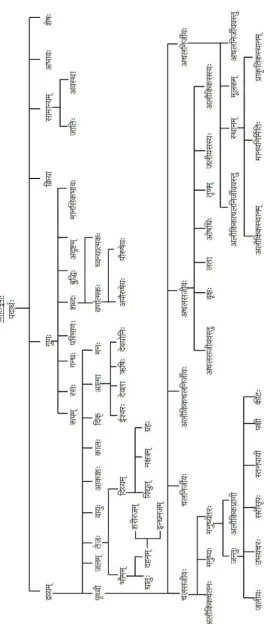
The universal property of a word is considered as jāti. The ontological categories are marked according to the ontological chart proposed by Nair S S. et. al. (2013). Theजा तchart is given in the appendix in Figure 12. Each and every entry has ontological class mentioned in the field6.
3.4.2 उपा धः (Attribute)
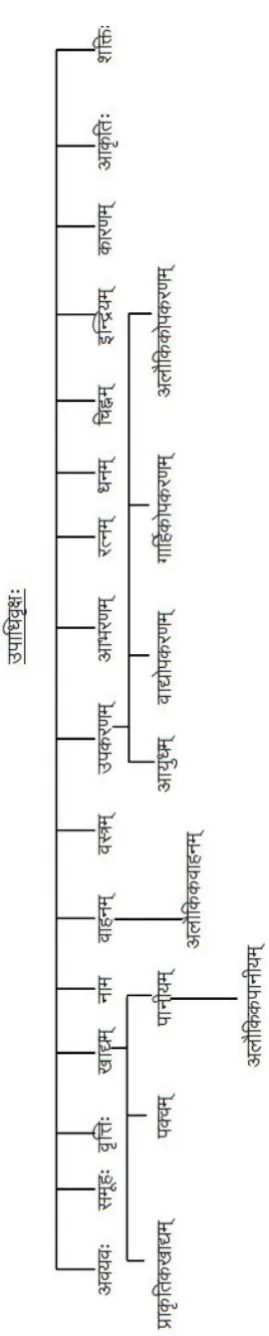
Any property ie. qualified to be the universal as per the conditions mentioned in the article of Nair S S. et. al. (2013) is considered as upādhi. Theउपा धclasses are marked according to the उपा धchart proposed. Theउपा धchart is given in the Figure 13 in the appendix.
3.5 Frequency Analysis
For frequency analysis set of 3,000 words are considered. Among them 2876 words are found unique. 2719 words have single sense, 191 words are having two senses, 81 words are having 3 senses and nine words are having four senses. Out of 3000 words 659 Synsets are created. For each word, one or more relations are marked using headwords. Hierarchical relations such asपरा-अपरास ब धः and अवयव-अवयवीस ब धःare the highly frequent relations. The frequency of high frequent occurrences is detailed in the Table 2.
Relation Total Words Total Synsets परा-अपरास ब धः 1631 356
अवयव-अवयिवभावः 391 117
ज य-जनकभावः 286 15
अ यस ब धाः 275 83
प त-प नीभावः 175 21
व- वािमभावः 149 68
अवतारः 106 15
Table 2: Relational statistics
3.6 Data Implementation
Once the lexicon table was ready with the data, three databases were created using dbm engines of Unix using hashing techniques. Three hash tables were created to represent a data structure to map a given key to value.
• i. Hash table forमु यपदम् _headword (key = पदम् _word and value =मु यपदम् _headword)
• ii. Hash table for synset (key =मु यपदम् _headword and value = synset)
• iii. Hash table for पदम् _word info (key = word and value = िनगम:_Reference & ल म्_Gender)
With the help of this data structure, a user can key in a desired word and get output in the form of synonyms, meaning and related information about the word.
The ontological structure adopted for creating the web-tool for Amarakośa has been replicated here with modifications for two reasons. Firstly, the division of various kāṇḍas and categorization of words in both the lexicons are very similar and therefore what has been
created earlier can be easily adapted to VK as well. Secondly, this also enables for technical integration of the two tools in future that will facilitate easy cross-reference.
As this is an ongoing project, the other relations will be supplied in due course as appropriate. It was felt that the first step to get the synsets in order will provide vital wealth of information to researchers and students on this lexicon and the emphasis was thus on categorizing the headword first.
3.6.1 Processing Flow
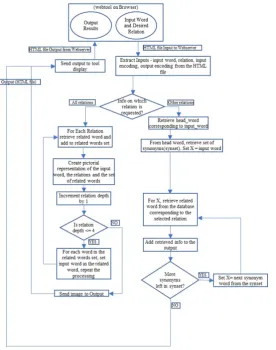
The input word, the type of requested information (meaning and relation with other words) along with parameters like input encoding for the identification of input and output encoding for formatting of the result on the webpage is processed by a series of scripts in the server. The scripts identify the word and the relation for which the information is requested. They access the databases corresponding to the relations that have been created a-priori, and extract information from the database(s) corresponding the selected relation and format the output into HTML file.
When “All Relations” is chosen as the input, a pictographic representation of all relations is created and embedded in the resultant HTML file. Refer Figure 11. for the output in the appendix.
[image:10.595.166.443.378.729.2]This HTML file is returned as response to the requesting browser for display to the user. The following flowchart describes the steps in the processing in Figure 3.
3.7 Architecture of VKN
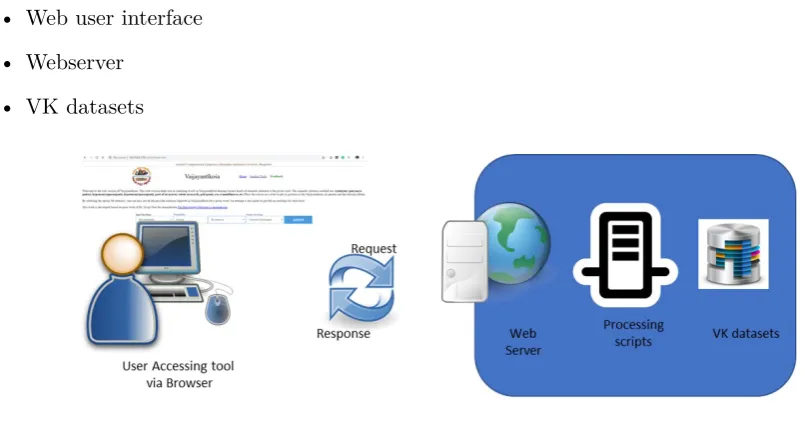
Figure 4 illustrates the architecture of the Vaijayantīkośa KnowledgeNet (VKN) tool. It consists of the following functional components.
• Web user interface
• Webserver
• VK datasets
Figure 4: Architecture of the VKN tool
3.7.1 Web User Interface
[image:11.595.78.528.453.599.2]The user interface for the tool is a HTML web page (currently, first version of the tool is available at http://13.235.131.68/CompLing/vk/) It provides a means to input the word from the VK lexicon that needs to be analysed for the specific set of relations. See Figure 5.
Figure 5: VKN tool
Multiple input encoding forms are provided including Devanagari and WX encoding. The input word can either be ा तपिदकम् or थमा एकवचन पम् . The desired semantic relation can be extracted from the lexicon from the drop-down list. The tool supports analysis of the relations mentioned in the section 3.3.
3.7.2 Webserver
3.7.3 VK Datasets
WX encoded original VK ślokas and database (see secton 3.2 and 3.3) that contain manually created and verified metadata for each word are the input files. The databases are created as per the data implementation described in section ”Data Implementation”. The processing scripts analyse the inputs for requested information/relations associated with the words in VK, retrieve desired information from these datasets and display the results in the tool as results.
3.8 VKN Android Application
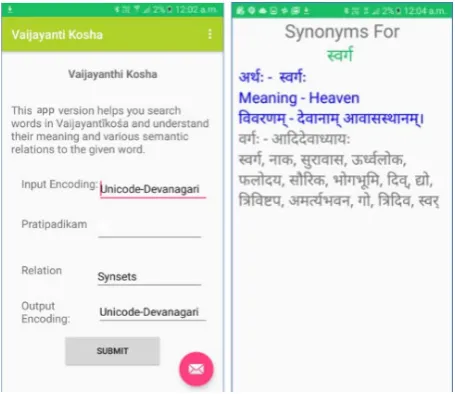
VKN Android App provides a convenient interface to Android smartphone users to access and analyse information in the Vyjayantīkośa. It uses the same input data set, words and relation information used for the web-tool. The Android App collects inputs from the user i.e - the word and its relation. It then communicates the input parameters to a webserver hosted in the cloud, where python scripts are used to search and formulate the response using the input data set. The response is conveyed back to the App on the smartphone for display.
The VKN android App is available for download from the VKN tool webpage. The tool is under development and has been released for volunteer testing and collecting feedback on usability. It currently allows input in Devanagari format and supports the synset relation analysis. The App is being enhanced to support relations and features supported by the web tool as discussed in the previous sections.(See Figure 10)
4 Conclusions
VK has a rich repository of words from the Sanskrit language and literature. The VKN web-tool enables convenient access to this knowledge. It is also designed to enable analysis in specific areas of research by providing a list of words related to that area, which can be used to trace information related to that area in Sanskrit literature. For example, in a paper published in the Indian Journal of History of Science, the use of the term hemaghna (destroyer of Gold), for lead metal was examined in detail (Dube, 2010), and this uncovered, unique properties of the metal lead, when interacting with Gold. There is scope for deeper research for experts from different fields - geology, geography, ornithology, metallurgy, sociology, biology and more. In this context, this tool becomes significant as it provides preliminary information to researchers in their respective fields with synsets and ontological structure and could become a starting point for a more comprehensive research. The inclusion of meaning in English, bridges the language divide, connecting this knowledge base with the large number of English speaking researchers.
5 Future Research
Few suggested future work is as follows:
• Continue updating the kośa with all the remaining entries.
• The child-parent, master-possession, husband-wife relations and other such relations (see section 3.2)were captured at this stage. There are possibilities of including other relations such as siblings, dwellings etc.
• Linking each synset to Amarakośa Knowledge Net.
• Linking it with various other computational linguistic tools.
• Using for Word sense disambiguation.
Acknowledgement
The Authors would like to thank Prof. Amba Kulkarni, Department of Sanskrit Studies, University of Hyderabad, Hyderabad for providing technical support at various levels. The project team also acknowledges the valuable guidance of Prof. Shrinivasa Varakhedi, Vice-chancellor, Kavikulaguru Kalidasa Samskrita University, Nagpur. The team of Post Graduate Diploma in Sanskrit Computational Linguistics at Karnataka Samskrit University, Bangalore is also acknowledged.
References
Bühler, G. (1887). Gleanings from Yâdavaprakâśa’s Vaijayantî. Wiener Zeitschrift für die Kunde des Morgenlandes, 1, 1-7. Retrieved April 1, 2019, from https://www.jstor.org/stable/23858800
Dube, R. K. (2010). An Assessment of the Sanskrit Word Hemaghna used for Lead Metal. Indian Journal of History of Science, 395-401.
Haragovindashastri, P. (1971). Vaijayantikośa. Varanasi: Chowkhamba Sanskrit Series Office.
Kaur, S., & Singh, L. (2018). Indian Arthropods in Early Sanskrit Literature: A Taxonomical Analysis. Indian Journal of History of Science, 59-64.
Kulkarni Amba. & Nair S Sivaja. (2010) Knowledge Structure in Sanskrit Kosas. Proceedings of 8th ICON, Indo-wordnet Workshop, IIT Khragpur.
Nair, S Sivaja. (2011). The Knowledge Structure in Amarakośa. Hyderabad: University of Hyderabad.
Nair, S Sivaja, Varakhedi Shrinivasa & Shivani V (2013). Extended Nyaya-Vaiseshika Ontology as Applied to Amarakośa KnowledgeNet, Proceedings of 5th ISCLS, IIT Bombay, DK Print world, New Delhi
Oppert, Gustav. (1893). The Vaijayanti of Yadavaprakasa. Madras: Madras Sanskrit and Vernacular Text Publication Society.
Patkar, M. M. (1981). History of Sanskrit Lexicography. New Delhi: Munshiram Manoharlal.
Popescu, F. (2019). A Paradigm of Comparative Lexicology. UKNewcastle upon Tyne, UK: Cambridge Scholars Publishing.
Sun, M. H., Safwanah, N. L., & Tan, D. (2017). Lexicology: The Importance of Words in Society. Universiti Sains Malaysia. Retrieved April 19, 2019, from https://www.researchgate.net/profile/Ernest_Mah/publication/320839664_Lexicology_The_ Importance_of_Words_in_Society/links/59fcb88baca272347a22773b/Lexicology-The-Importance-of-Words-in-Society.pdf
A Appendix - 1
VKN Sample Outputs
Figure 6: Example of Ontology
Figure 7: Example ofअवयवः
Figure 9: Example ofजनकः