1052
Team yeon-zi at SemEval-2019 Task 4: Hyperpartisan News Detection by
De-noising Weakly-labeled Data
Nayeon Lee∗, Zihan Liu∗, Pascale Fung
Center for Artificial Intelligence Research (CAiRE) Department of Electronic and Computer Engineering
Hong Kong University of Science and Technology, Clear Water Bay, Hong Kong
[nyleeaa, zliucr].connect.ust.hk, [email protected]
Abstract
This paper describes our system submitted to SemEval-2019 Task 4: Hyperpartisan News Detection. We focus on removing the inher-ent noise in the hyperpartisanship dataset from both data-level and model-level by leveraging semi-supervised pseudo-labels and the state-of-the-art BERT model. Our model achieves 75.8%accuracy in the final by-article dataset without ensemble learning.
1 Introduction
With the ever-growing usage of internet, the prob-lem of fake news that spreads in a destructive speed has attracted many attention. Fake news is a kind of news that is typically inflammatory, ex-tremely one-sided (hyper-partisan) or untruthful to mislead the public into having distorted belief.
Previous works attempted to solve fake news problem from various aspects, ranging from knowledge-based (Wu et al., 2014; Shi and Weninger, 2016; Lee et al., 2018) to style-based (Wang,2017;Potthast et al.,2018). There are some publicly available fake news datasets, however, often too small in size to be suitable for neural approaches (Horne and Adali,2017; P´erez-Rosas et al., 2017). Recently, the organizers of SemEval2019 Task 4 (Kiesel et al.,2019) have re-leased large-scale dataset to address fake news de-tection as a hyper-partisan news dede-tection prob-lem. The task is to determine whether a given arti-cle is hyper-partisan (extremely right-wing or left-wing) or not (mainstream). Such task will allow for pre-screening of semi-automatic fake news de-tection, and more importantly, bring us one step closer to solving fully automated fake news detec-tion.
Initially, we focused on learning and utilizing useful features such as topic and sentiment
infor-∗ ∗
[image:1.595.318.511.225.348.2]These two authors contributed equally.
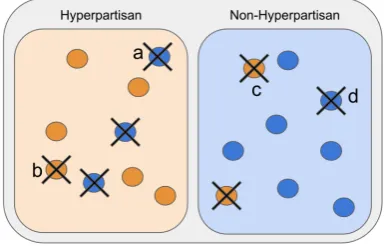
Figure 1: Illustration of filtering. Sampleaandcare removed as pseudo-label6=by-publisher label. Sample
banddare removed as their prediction confidence was below threshold.
mation. Considering the purpose of hyper-partisan news, we believed that the stance on politically sensitive topics would be crucial in determining hyperpartisanship. However, experiments showed that the dataset contains some inherent noise that acted as a big barrier to learning a good classi-fier: 1)noisy textinputs from an article that con-tain domain-specific (i.e. political) words, slangs and spelling mistakes which are likely to be out of vocabulary (OOV). 2)noisy labelsthat mainly re-sulted from using publisher-level information for labeling articles (i.e. all articles from left/right-wing publishers are labeled as “hyper-partisan”. For more detail, refer to Section 2).
2 Data Analysis
Label Items Train Set% Val Set%
right 25% 25%
right-center 7.1% 8.8%
left 25% 25%
left-center 11.7% 15.7%
least bias 31.2% 25.5%
all 100% 100%
hyperpartisan 50% 50%
mainstream 50% 50%
Table 1: Data statistic of hyperpartisan and politi-cal orientation on by-publisher dataset.
We use a publicly available dataset “SemEval 2019 Task 4 - Hyperpartisan News Detection” 1 that are labeled in two different ways - publisher level and article level.
• Publisher-level (by-publisher): A total of 750K articles are labeled based on the po-litical orientation of the publisher, with-out considering the content. It has an equal ratio (375K/375K) between hyperpar-tisan and non-hyperparhyperpar-tisan. Among the hy-perpartisan samples, there’s an equal ratio (187.5K/187.5K) between right and left po-litical orientation.
• Article-level (by-article): A total of 645 arti-cles labeled on article-level by checking the actual content. The data contains only arti-cles for which a consensus among the crowd-sourcing workers existed. Of these, 238 (37%) are hyperpartisan and 407 (63%) are not.
2.1 Discussion on the Inherent Noise
By using human judgment, we discovered that some article samples did not always have the cor-rect labels. Since the political orientation of the publisher was used as a sole criterion for the la-bels, such labeling noise is not surprising. It can-not be guaranteed that all articles from a hyper-partisan publisher are hyper-hyper-partisan. Another possible reason for such noise could be from not having enough non-hyper-partisan publishers (i.e. The percentage of “least bias” label items in Ta-ble1is not 50%), thus, treating news from “right-center” and “left-“right-center” publishers also as non-hyper-partisan.
1https://zenodo.org/record/1489920#.XAAoMJMzYWq
3 Methodology
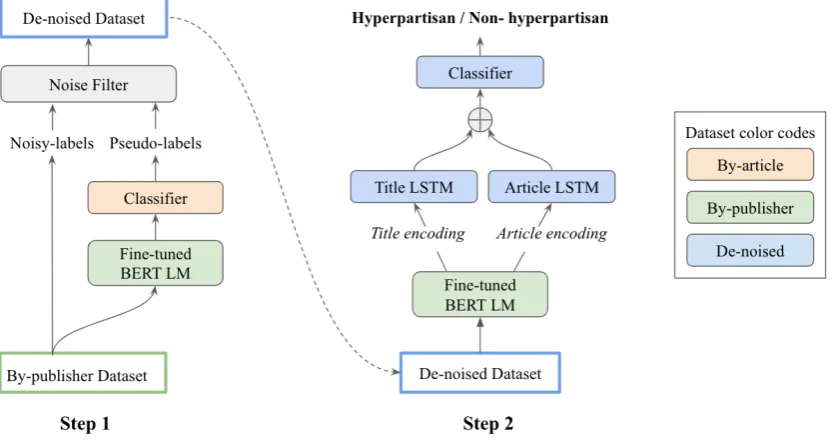
In this section, we describe how we did de-noising in our system in Figure 2. Our system consists of two steps: 1) Obtaining de-noised by-publisher dataset by leveraging clean by-article dataset. 2) Leveraging the de-noised by-publisher dataset and pre-trained BERT to train our final model. Note that our code is publicly available for reproducibil-ity2.
3.1 Step 1: Filter Noise by Leveraging
Pseudo-labeling
To deal with the noise in the labels, we utilize pseudo-label for filtering out noisy labels from data-level (Figure 1). Pseudo-labeling is one of the semi-supervised learning methods, which ap-proximates the labels of unlabeled data by using a model (M) trained on the labeled dataset. Origi-nally, pseudo-labeling directly takes the prediction from the modelM as the label. This could result in the final model trained on both human-labeled and pseudo-labeled to be bounded by the accuracy of the modelM.
To avoid this problem: 1) We use the origi-nal by-publisher label as the constraint. We fil-ter out data points that have a mismatch in the by-publisher label and pseudo-label to obtain cleaner by-publisher. 2) To be robust to the errors made by the modelM, we set some thresholds to only use pseudo-labels with relatively high confidence. We only consider prediction scores that is big-ger/smaller bymargin = 0.2than the mid-value (0.5). By doing so, we can filter out noisy la-bels with the guarantee that the noise level would be at worst kept the same; the size of our de-noised dataset is approximately 32K for both la-bels, which is 8.5% of original data. Note that in our system, the modelM is a binary classifier trained on top of fine-tuned BERT (refer to step 2) using clean by-article dataset.
3.2 Step 2: Obtain Better Input
Representation using BERT
The article texts are noisy with a lot of political words, slangs, and even spelling mistakes, many of which are out of vocabulary (OOV) and harm-ful to the sentence-level and article-level represen-tation learning. We leverage state-of-the-art pre-trained language representation model BERT to
Figure 2: Architecture of the proposed system. Colors represent the dataset used to train the corresponding model.
eliminate OOV problem, since it uses byte-pairs vocabulary, and for a better input representation.
Since the pre-trained BERT model is trained on BooksCorpus and Wikipedia which are not di-rectly relevant to news, we fine-tune the BERT, as in original paper, using our by-publisher news dataset to learn a better representation for our data domain. We build our proposed model by adding title LSTM and article LSTM on top of the fine-tuned BERT model to extract features that are concatenated and fed into the final binary classi-fier. We train our final classifier using the filtered dataset from Step 1.
4 Experiments and Analysis
4.1 Experimental Setup
We use BERTBASE model from (Devlin et al.,
2018) which has 12 layers (i.e., Transformer blocks) with a hidden size of 768 and 12 self-attention heads. In step 1, the parameters of BERT model were fixed after fine-tuned on publisher datset, then we trained classifier on by-article dataset by using 16 batch size. We used 10-fold cross-validation to choose the parameters of the classifier, since the size of by-article dataset is small. In step 2, we used 16 batch size to train our LSTM for article model with a hidden size of 300 and LSTM for title model with a hidden size of 100. The classifiers in step 1 and 2 both consist of two linear layers with ReLU and batch
normal-ization in between.
For the evaluation metric, we mainly consid-ered accuracy and F1 score as the main indicator of performance. For analysis purpose, we also re-port precision and recall. In the competition, there were two types of test sets (i.e. by-publisher test set and by-article test set). However, all of the re-ported results are obtained from the by-article test set for fair and correct comparison.
4.2 Results
We ran the experiment on 3 baseline models for comparison and simple ablation study of our ap-proach, and the results are presented in Table2.
• 2 LSTM + Attention + Fine-tuned
Classi-fier (LST Mf t)
A baseline model consisting of 2 LSTM mod-els (one for the title, and another for the ar-ticle) with attention layers and a multi-layer perceptron (MLP) as a classifier on the top. It was trained on by-publisher dataset directly, then fine-tuned using the by-article dataset.
• Pre-trained BERT+Classifier (BERTpt)
Models Accuracy Precision Recall F1
LST Mf t 0.6258 0.5838 0.8758 0.7006
BERTpt 0.5669 0.8621 0.1592 0.2688
BERTf t 0.6592 0.8378 0.3949 0.5368
[image:4.595.107.488.61.134.2]BERTf t+ De-noise 0.758 0.744 0.7866 0.7647
Table 2:Results of our model and other baseline models on the final by-article test set.
• Fine-tuned BERT+Classifier (BERTf t)
For this model, everything is kept the same as BERTpt except for the fact that pre-trained
BERT was fine-tuned using by-publisher dataset.
Firstly, we can observe that simply using pre-trained BERT (BERTpt) to represent input
can-not out perform LSTM model entirely trained on hyperpartisan dataset. However, by fine-tuning BERT using our dataset (BERTf t), we gain
improvement in performance by approximately 10% in accuracy, outperforming LST Mf t by ≈
3%. Hence, we can infer that by injecting some domain-specific data into the original BERT, we can obtain an improved text representation for solving our task. Note that the model sizes for Pre-trained BERT + Classifier and Fine-tuned BERT + Classifier are the same.
Secondly, by training the same fine-tuned BERT model on the de-noised dataset mentioned in Sec-tion3.1, we observed a big improvement in accu-racy, F1 and recall by≈10%,≈23%and≈40% respectively. This clearly illustrates the power of de-noising the dataset using pseudo-labels as aux-iliary reference label. We also would like to em-phasize that we did not use any ensemble learning or tricks, which normally gives extra1−2%gain in the final performance. Our system ranked 11 out of 43 teams that participated.
Lastly, we would mention that our LST Mf t
model is a strong baseline because it was able to achieve a high score in the by-publisher test set by obtaining 0.663 and 0.694 for accuracy and F1 re-spectively (rank 5/28).
4.3 Interesting Analysis
Although our current system does not make direct use of topic information, we present an interest-ing result obtained while experimentinterest-ing with topic modeling for hyper-partisanship detection. We used Latent Dirichlet allocation (LDA) for topic modeling, and the results empirically showed in-teresting relationships between topics and
hyper-partisanship. Sensitive topics such as war and political parties tend to have more hyperpartisan news than neutral-topics such as school and sports games. We believe that leveraging such informa-tion would be helpful in future works.
5 Related Works
In this part, we briefly review the prior work in language representation as well as the semi-supervised learning method we used.
5.1 Language Representation
(Kiros et al.,2015) tried to learn sentence embed-ding by reconstructing the surrounembed-ding sentences of an encoded passage. (Peters et al., 2018) pro-posed to extract context-sensitive features from a language model. (Devlin et al., 2018) jointly conditioned on both left and right context and obtained state-of-the-art results on eleven natural language processing tasks.
5.2 Semi-supervised Learning
(Triguero et al.,2015) provided a survey of self-labeled methods for semi-supervised classifica-tion. (Zhu and Goldberg, 2009) showed labeled techniques are typically divided into self-training and co-self-training. (Lin et al., 2018) pro-posed semi-supervised learning to leverage a small amount of user-comment data to train a model and then expand the dataset by that trained model.
6 Conclusion
References
Jacob Devlin, Ming-Wei Chang, Kenton Lee, and Kristina Toutanova. 2018. Bert: Pre-training of deep bidirectional transformers for language understand-ing. arXiv preprint arXiv:1810.04805.
Benjamin D Horne and Sibel Adali. 2017. This just in: fake news packs a lot in title, uses simpler, repetitive content in text body, more similar to satire than real news. In Eleventh International AAAI Conference on Web and Social Media.
Johannes Kiesel, Maria Mestre, Rishabh Shukla, Em-manuel Vincent, Payam Adineh, David Corney, Benno Stein, and Martin Potthast. 2019. SemEval-2019 Task 4: Hyperpartisan News Detection. In
Proceedings of The 13th International Workshop on Semantic Evaluation (SemEval 2019). Association for Computational Linguistics.
Ryan Kiros, Yukun Zhu, Ruslan R Salakhutdinov, Richard Zemel, Raquel Urtasun, Antonio Torralba, and Sanja Fidler. 2015. Skip-thought vectors. In
Advances in neural information processing systems, pages 3294–3302.
Nayeon Lee, Chien-Sheng Wu, and Pascale Fung. 2018. Improving large-scale fact-checking using decomposable attention models and lexical tagging. In Proceedings of the 2018 Conference on Empiri-cal Methods in Natural Language Processing, pages 1133–1138.
Zhaojiang Lin, Genta Indra Winata, and Pascale Fung. 2018. Learning comment generation by leveraging user-generated data. arXiv preprint arXiv:1810.12264.
Ver´onica P´erez-Rosas, Bennett Kleinberg, Alexan-dra Lefevre, and Rada Mihalcea. 2017. Auto-matic detection of fake news. arXiv preprint arXiv:1708.07104.
Matthew E Peters, Mark Neumann, Mohit Iyyer, Matt Gardner, Christopher Clark, Kenton Lee, and Luke Zettlemoyer. 2018. Deep contextualized word rep-resentations. arXiv preprint arXiv:1802.05365.
Martin Potthast, Johannes Kiesel, Kevin Reinartz, Ja-nek Bevendorff, and Benno Stein. 2018. A Stylo-metric Inquiry into Hyperpartisan and Fake News. In56th Annual Meeting of the Association for Com-putational Linguistics (ACL 2018), pages 231–240. Association for Computational Linguistics.
Baoxu Shi and Tim Weninger. 2016. Fact checking in heterogeneous information networks. In Proceed-ings of the 25th International Conference Compan-ion on World Wide Web, pages 101–102. Interna-tional World Wide Web Conferences Steering Com-mittee.
Isaac Triguero, Salvador Garc´ıa, and Francisco Her-rera. 2015. Self-labeled techniques for semi-supervised learning: taxonomy, software and em-pirical study. Knowledge and Information systems, 42(2):245–284.
William Yang Wang. 2017. ” liar, liar pants on fire”: A new benchmark dataset for fake news detection.
arXiv preprint arXiv:1705.00648.
You Wu, Pankaj K Agarwal, Chengkai Li, Jun Yang, and Cong Yu. 2014. Toward computational fact-checking. Proceedings of the VLDB Endowment, 7(7):589–600.