1247
Team Taurus at SemEval-2019 Task 9: Expert-informed pattern
recognition for suggestion mining
Nelleke Oostdijk Centre for Language Studies
Radboud University Nijmegen, The Netherlands [email protected]
Hans van Halteren Centre for Language Studies
Radboud University Nijmegen, The Netherlands
Abstract
This paper presents our submissions to SemEval-2019 Task9, Suggestion Mining. Our system is one in a series of systems in which we compare an approach using expert-defined rules with a comparable one using ma-chine learning. We target tasks with a syntac-tic or semansyntac-tic component that might be better described by a human understanding the task than by a machine learner only able to count features. For Semeval-2019 Task 9, the expert rules clearly outperformed our machine learn-ing model when trainlearn-ing and testlearn-ing on equally balanced testsets.
1 Introduction
In the field of natural language processing, ap-proaches featuring machine learning (ML) nowa-days predominate. These have been shown to be quite effective with a wide range of tasks, in-cluding text mining, authorship attribution, and text classification. They are particularly suited for dealing with large data volumes and are ro-bust in the sense that they can handle quite ‘noisy’ data. Unlike expert-informed approaches where rules need to be hand-crafted and apply only under predefined conditions, ML approaches learn from training data and are able to extrapolate. Propo-nents of ML approaches tend to dismiss the en-terprise of hand-crafting rules as difficult, error-prone, time-consuming, and generally ineffective as even an extensive set of complex rules is bound to be incomplete and difficult to maintain.
Over the past years we have conducted a num-ber of studies directed at the extraction of ac-tionable information from microblogs. These clude a range of topic areas and domains, in-cluding the detection of threatening tweets (Oost-dijk and van Halteren, 2013a,b), the identifica-tion of potentially contaminated food supplements in forum posts (Oostdijk et al., submitted), and
topic/event detection in tweets about natural dis-asters (floods (H¨urriyeto˘glu et al., 2016), earth-quakes (H¨urriyeto˘glu and Oostdijk, 2017; Oost-dijk and H¨urriyeto˘glu, 2017)), about traffic flow (Oostdijk et al.,2016) and about outbreaks of the flu (H¨urriyeto˘glu et al., 2017). In each case we have been exploring the role of the human ex-pert in an exex-pert-informed pattern recognition ap-proach and a comparable ML apap-proach, seeking out the strengths and weaknesses of either and at-tempting to arrive at a superior hybrid approach.
Semeval-2019, Task 9, Suggestion Mining (Negi et al.,2019), appeared to be another task that would lend itself to human rule building. As sug-gestions may be phrased in many different ways, successfully recognising that an utterance contains a suggestion requires human understanding of the context. Also, the amount of available training data was quite limited so that bringing into play the human expert’s knowledge of the forms that suggestions may take would be an advantage, even though the task was not too clearly defined.
As a counterpart to the human rules, we built a machine learning system. For easier comparison of the patterns suggested by the machine learner and by the human expert, the learning component was a rather simple odds-based technique which still proved competitive in VarDial2018 (van Hal-teren and Oostdijk, 2018). As features we used character and token n-grams as well as syntac-tic patterns. In addition, the machine learner was somewhat expert-informed, as it was provided with several word lists related to suggestions.
2 Recognition with expert rules
The expert-rule-based system we applied uses a dedicated (task-specific) lexicon and set of hand-crafted rules in order to generate search queries. The system only targets suggestions, i.e. we only specify rules for patterns that should identify sug-gestions. Furthermore, we chose to design and ap-ply one and the same set of rules and lexicon for both evaluation sets.
The lexicon comprises 1256 entries. Most of the entries are single words. However, we also in-cluded some multi-word items such in order to,
for example, at least and be able to as well as phrase-like items such why not and how about. The lexicon includes a few frequently observed spelling variants, for example pls, plz, dont and
kinda. With each entry, part-of-speech-like infor-mation is provided (e.g. verb, adjective, adverb but alsoplease, which is given its own class). Typ-ical examples of some of the lexicon entries are:
awesome ADJ would AUXwould
just ADV very ADVintens
provide Vimp provide Vinfin
The rule set consists of 138 finite state rules. They describe how lexical items can combine to form search queries made up of multi-word n-grams. To give some examples, AUXwould - BE - ADVintens - ADJmatches e.g. would be very
helpfulandwould be really awesome;AUXshould - ADV - Vinfin matches e.g. should directly see and should properly support; and PLEASE -Vimp e.g. please provide and pls fix. Rules typically combine two to five elements (parts of speech; POS). Given that some lexical entries are multi-word items, the patterns actually describe strings up to a length of nine words (one of the strings matching the rule AUXcould - ADV - BE - ADVintens - ADJis, for example,could at the
very least be even more robust).
In previous tasks, pattern recognition using word n-grams has been proven to be very ef-fective. Moreover, the specification of the rules and the lexicon is much easier and far less time-consuming than would be the case for an all-encompassing description, as human experts need not concern themselves with describing elements and details irrelevant to the task at hand. In this particular case, trying to recognize suggestions, we experienced the drawback of only having ac-cess to the raw text input, something that did not
bother us as much with other tasks. What we found was that in order to be able to recognize the many suggestions that take the form of an imper-ative sentence, we somehow needed to be able to distinguish between an imperative verb form and an infinitive or present tense verb. Noting that imperative verbs tend to occur (near) sentence-or clause-initially, we tried to account fsentence-or this in our rules. In some cases we could make use of the presence of a comma, semi-colon or colon, that would identify the (potential) beginning of a clause. In such cases the punctuation mark was included as an element in the rules describing im-perative structures. In order to identify the begin-ning of a sentence, we decided to automatically insert markers in the input during the preprocess-ing phase. These markers would also indicate the type of sentence (interrogativeMRKquesvs declar-ative or imperdeclar-ativeMRKsint). Here the distinction between interrogatives and other types of sentence helped in distinguishing betweendo/don’t/dontas an operator (auxiliary verb) in a question and as an operator in an imperative sentence. MRKsint -Vimp matches e.gAllow applications to define ... andAsk for a room in ...; and MRKsint ADV -Vimp matches e.g. At least support ... and Just don’t forget ...
3 Recognition by machine learning
For the ML approach we tried to use quite a wide spread of feature types, namely (a) character n-grams, with n ranging from 3 to 9; (b) token un-igrams; (c) token n-grams, with n ranging from 2 to 4 (in which the individual positions can be filled with the actual token, the POS tag, or the word group (see below)); (d) syntactic structure of the main clause; (e) syntactic rewrites of all con-stituents; (f) syntactic n-grams (i.e. selected sub-trees from the complete parse tree, e.g. function and category of a mother and two daughters).
For the character n-grams and the tokens, we applied a minimal level of pre-processing. In the training data, we cleaned up misplaced quotes and commas in the provided .csv-files. In the (later) trial data and in the evaluation data, which came in an HTML-format, we also replaced SGML-entities by their character counterpart, e.g." was replaced by".
then transformed to a constituency tree that con-formed (as much as feasible) to our own view of English syntactic structure, being that developed in the TOSCA project (Aarts et al.,1998). All syn-tactic features were derived in either a fully lexi-calized or fully unlexilexi-calized version. Although we feel the syntactic features can be of consid-erable value, we consider this component a weak spot in the current system, as the parser regularly produces incorrect analyses. In the current task, this was especially the case for the training data.
In the lexicalized syntactic features, as well as in the token n-grams, a token slot could also be filled with a word group indicator. We found candidates for these lists by searching the 2006 Google n-gram collection (Brants and Franz, 2006) with some regular expressions, and then cleaned them up manually. There were four word groups. GrpADJgoodcontains 100 positive adjec-tives, e.g.betterandadvisable, being the first 100 manually approved from 1774 sorted matches with e.g. ˆit (would|could|might|may) be (.*) (to|if). GrpADVintencovers 37 intensifying ad-verbs, e.g. veryandcritically, selected from 448 matches with e.g. ˆ(would|could|might|may) be (.*) ($adjgood) (to|if). GrpVadvise contains 723 verbs that indicate what is being suggested, e.g. adopt and edit, se-lected from 987 matches with e.g. ˆ(i|we) (suggest|advise|propose|request) you to
(.*). And GrpADVdescr has 41 adverbs that can modify the advised action, e.g. always
and never, selected from 212 matches with e.g. ˆ(suggest|advise|propose|request) that
you (.*) ($vadvise). When used in a feature, each group indicator is concatenated with the POS tag. The introduction of the word groups appears to be effective: one of the strongest markers, found 82 times with suggestions and only twice with non-suggestions, is “It would be GrpADJgoodJJ”.
Our choice of recognition system was influenced by the desire to compare to the human rules. Af-ter successful recognition, we wanted to be able to identify which features contributed to the success. For this experiment, we chose a very simple algo-rithm. We counted the occurrences of each feature in the training items marked as suggestions or as non-suggestions and compared the two counts to derive odds. For example, the character 8-gram Please awas found 60 times in suggestion items
and once in non-suggestion items. Correcting for the different numbers of items in the two classes, and adding one to avoid division by zero, this led to odds of 45.89 in favour of suggestions. In order to avoid exaggerated counts because of repeated items, we only used the first occurrence of each item, leaving us with 1758 suggestions and 5339 non-suggestions. This removal was done even if the repeated items had different suggestion labels. For the actual recognition, we only used features that had odds higher than or equal to 3:1. In the prediction phase, the odds of all features present in an item were taken and their sum was compared to a threshold, which we chose by tuning on the trial data.
As with other tasks, we investigated hybridization of our two approaches. In this case, straightfor-ward combination of the final choices seemed not very fruitful on the trial data. However, when we compared the suggestions for each individual fea-ture type in the machine learning with those of the expert rules, we found especially syntactic n-grams were able to identify suggestions not found by the rules, which were limited to contiguous n-grams. We therefore built a combination that marked those items as suggestions that were rec-ognized as such by the rules, plus those for which the recognition score by only the syntactic n-gram features was over the optimal threshold for the trial data. The relative quality of rules and machine learning on the trial data for Subtask B made us decide not to attempt combination there.
4 Quantitative evaluation
Approach Meas TrialA EvalA EvalBalA TrialB EvalB EvalBalB
Rules Prec 0.8213 0.4521 0.8761 0.9673 0.8669 0.8991
Rec 0.8851 0.7586 0.7586 0.8045 0.7299 0.7299
F1 0.8520 0.5665 0.8132 0.8784 0.7925 0.8057
Learn Prec 0.7914 0.4848 0.8898 0.5802 0.5099 0.5873
Rec 0.8716 0.7356 0.7356 0.9134 0.8851 0.8851
F1 0.8296 0.5848 0.8054 0.7096 0.6471 0.7061
Combo Prec 0.8179 0.4558 0.8778 NA
Rec 0.8953 0.7701 0.7701 NA
F1 0.8548 0.5726 0.8204 NA
Baseline Prec 0.5872 0.1566 0.6141 0.7277 0.6877 0.7507
Rec 0.9324 0.9195 0.9195 0.8267 0.7845 0.7845
[image:4.595.115.485.61.242.2]F1 0.7206 0.2676 0.7364 0.7740 0.7329 0.7672
Table 1: Quality of submitted systems and organiser baseline.
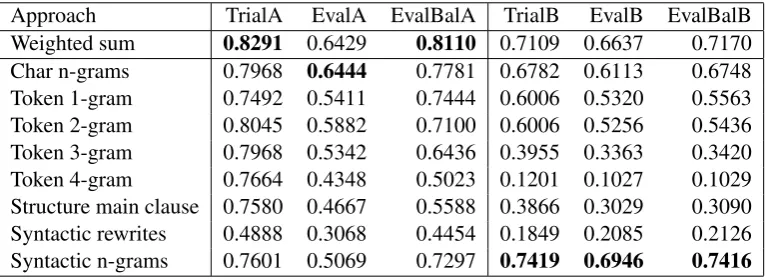
Approach TrialA EvalA EvalBalA TrialB EvalB EvalBalB
Weighted sum 0.8291 0.6429 0.8110 0.7109 0.6637 0.7170
Char n-grams 0.7968 0.6444 0.7781 0.6782 0.6113 0.6748
Token 1-gram 0.7492 0.5411 0.7444 0.6006 0.5320 0.5563
Token 2-gram 0.8045 0.5882 0.7100 0.6006 0.5256 0.5436
Token 3-gram 0.7968 0.5342 0.6436 0.3955 0.3363 0.3420
Token 4-gram 0.7664 0.4348 0.5023 0.1201 0.1027 0.1029
Structure main clause 0.7580 0.4667 0.5588 0.3866 0.3029 0.3090 Syntactic rewrites 0.4888 0.3068 0.4454 0.1849 0.2085 0.2126 Syntactic n-grams 0.7601 0.5069 0.7297 0.7419 0.6946 0.7416
Table 2: F1-score for each test set for each feature type, using model learned from training material for Subtask A, and oracle thresholds.
extrapolating the systems’ behaviour to a balanced testset. E.g., the expert rules had 80 false ac-cepts on a total of 146, so a precision of66/146
i.e. 0.4521. In a balanced dataset, 87 instead of 746 non-suggestions, not 80/746, but 9.3298/87 would be falsely accepted. Precision would be
66/(66 + 9.3298) i.e. 0.8761. We stress that we are not trying to make out results look more im-pressive, but merely want to make behaviour on trial and evaluation sets comparable.
Table 1 shows the evaluation results for our three systems and the organisers’ baseline, with the adjusted scores shown in the columns marked EvalBal. Here, we can see that the enormous drops in quality between TrialA and EvalA were an il-lusion, caused by the difference in balance. Also, our three systems are now consistent in their order: expert rules outperform machine learning, but the (very eclectic) combination scores yet a bit better. In fact, we now see that all systems gain preci-sion when going from TrialA to EvalA, but at the
cost of recall. For the machine learner, this is not exclusively due to overtraining in threshold opti-mization, as we see below in the discussion of Ta-ble 2. A discussion of the results for the expert rules can be found in Section 5. The lower de-gree of change for the baseline can probably be explained by the rather general level of the rules there. Going from Subtask A to Subtask B, the machine learner suffers a substantial loss in qual-ity, which is understandable as it is trained only on Subtask A data. Interestingly, there are almost no differences between TrialB and EvalB. For the expert rules, the situation is rather different. From TrialA to TrialB, we see a precision gain and re-call loss, leading to a slight increase inF1; but the
move from TrialB to EvalB leads to a serious drop in both precision and recall.
In Table2, we show theF1-score for each
[image:4.595.108.491.279.419.2]Feature TrainA TrialA EvalA TrialB EvalB
Total items 1758/ 296/ 87/ 404/ 348/
5339 296 746 404 476
CG8 ##Allow# 63/2 14/0 5/0 0/0 0/0
T4 WWWG It would be GrpADJgoodJJ 82/2 13/1 4/0 0/0 0/0
CG7 re#shou 31/1 8/0 0/1* 0/0 0/0
CG8 Please#a 60/1 6/0 2/0 0/0 0/0
SRFC S V VP A VBx OD NP A PP 28/0 4/0 1/0 0/0 1/0
SCFFCCL S CS AJP(nice) A SBAR(if) 20/1 4/0 1/0 1/0 0/1
CG8 #Provide 20/0 3/0 1/0 0/0 0/0
SCFFCCL ROOT UTT S(suggest) NOFUpunc .(.) 14/0 3/0 1/0 4/0 5/0
T3 WWW # I ’d 24/0 4/1 0/3* 2/0 1/0
SCFFCCL VP AVB MD(should) MVB VBN(GrpVadvise) 46/5 4/1 3/1 1/0 3/1*
Table 3: Ten high-odds features (excluding correlated ones), with effectiveness on all test sets. Each cell contains observation counts in suggestions/non-suggestions. Hash marks indicate spaces and out-of-sentence positions. The asterisk (*) means we disagree on one of the non-suggestions, but did use the provided labels.
character n-grams. The other feature types lag be-hind, but do help reach a higher score with the sum of all feature scores. Syntactic rewrites by them-selves have a much lower F1, but this is due to
their low recall potential (precision 0.7267, recall 0.3682). When moving to EvalA, we see that char-acter n-grams and token unigrams maintain their quality, indicating that the same kind of words are being used, but higher n-grams and syntax lose severely, which suggests that EvalA is more dif-ferent from the training data than TrialA in how words are combined.
When we proceed to Subtask B, all feature types lose quality. As we moved to a different domain, and a different genre, this is not surprising. Ma-chine learning depends on having training and test data that is as similar as possible. It is encourag-ing to see that the syntactic n-grams do manage to perform similarly to Subtask A. This means that machine learning at a more abstract level is able to move to another domain more easily.
If we examine which features are responsible for the recognition, we see that all play some role. There are, however, some more effective ones. We show ten of these in Table 3. Note that this is a manual selection, as simply taking the ten highest scoring ones would show only two basic patterns in various guises, e.g. Pleaseas several character n-grams, as token unigram, in a token bigram, and as an adverbial in a syntactic n-gram. Some of the ten patterns need explanation: CG7 re#shou is part of the token bigram there
should. SRFC S V VP A VBx OD NP A PPmeans that
a sentence is being rewritten as a verb phrase (i.e. a sequence of verb with possibly additional inter-nal adverbials), followed by an adverbial realized by a non-finite verb, then a direct object realized by a noun phrase, and finally an adverbial realized by a prepositional phrase. If we search for exam-ples, we find e.g.Please allow the access to phone filesystem.. It turns out that Stanford CoreNLP marks Please as a verb, placing allow as head of an “xcomp” clause, which confuses our anal-ysis transformer and makes allow an adverbial. This is clearly wrong but, as it is done consis-tently, this pattern still provides a good marker. SCFFCCL VP AVB MD(should) MVB VBN(GrpVadvise)
indicates that within a verb phrase, we find both the modal should and a past participle of one of the verbs for something that is advisable. SCFFCCL S CS AJP(nice) A SBAR(if) represents
a sentence with a subject complement nice
and an adverbial clause headed by if. And SCFFCCL ROOT UTT S(suggest) NOFUpunc .(.)
represents a sentence with a main verb with lemmasuggest, combined with a period as punc-tuation, which nicely rules out questions with
the discussion on feature types above.
5 Qualitative evaluation
Upon inspection of the results obtained on the evaluation set with the expert rules, we specifically looked at the false accepts and false rejects. Con-trary to what we thought might happen, only very few cases were missed out on due to omissions in the lexicon.
With cases that we missed (i.e. where we failed to recognize a suggestion) we did not find any clear clues as to what could be added to the pat-terns already specified in our rules set. There were some cases involving imperatives that we missed due to the fact that the punctuation mark we re-lied upon appeared to be absent, while gleaning the sentence type (interrogative) from the input fi-nal punctuation mark failed in cases where the in-put consisted of two or more sentences.
As for false accepts, we found that several cases were wrongly taken to be suggestions on the basis of a matching imperative pattern. Here the ear-lier problem of being unable to distinguish impera-tive verb forms from infiniimpera-tives and present tenses no longer presented itself. Instead, word forms that are ambiguous between noun and verb such as
mapandphonewere mistakenly held to be imper-ative verbs. Other false accepts were cases where otherwise highly successful rules proved to be too limited in their scope. For example, the pattern AUXwould - Vinfin would match would allow
but then the sentence actually continues with but
so that what initially looks like a suggestion turns out to be an observation, e.g. The control would allow for the use of the contact picker but allows for manual entry and deletion of contacts. Simi-lar cases involvingbutwere found with other pat-terns. In the cases of single instances slight modi-fications of the rules might have avoided wrong-fully identifying something as a suggestion but there is very little evidence to go by, so there is no telling how it would impact on a different dataset.
We also noticed that some patterns occurred (al-most) exclusively in Subtask A or B. Building sep-arate rule sets for the two tasks might hence have been beneficial. However, the whole point of the exercise in Task 9 was to see whether a rule set can be ported to a new, mostly unknown, domain.
6 Discussion
The task was more difficult than we had expected. When we set out, we thought we knew what a suggestion was. However, after confronting our first version of the expert pattern system with the training data, we needed to review our ideas. Af-ter careful error analysis, we adapted our system and came to achieve quite acceptable results on the trial data, yet there remained a gap between what we (intuitively, as experienced language users) would consider a suggestion and quite a number of other cases which were labelled as such. In our view, there is a fine line between a sugges-tion and a non-suggessugges-tion, and perhaps one needs more context than a single sentence in order to tell which it is. We speculate that this may well ex-plain the drop in performance. This is in line with the fact that the datasets provided, i.e. the train-ing, trial and evaluation data, were rather different in nature: the training data comprised many inputs that were made up of multiple sentences, while the trial data and certainly the evaluation data mostly comprised single sentence inputs. Another factor which may have been at play here (and again we can only speculate), is that the annotations pro-vided were made by different groups of annota-tors. This would then also explain some of the in-consistencies in the labeling, where similar cases were labeled differently.
References
Jan Aarts, Hans van Halteren, and Nelleke Oostdijk. 1998. The linguistic annotation of corpora: The TOSCA analysis system. International journal of corpus linguistics, 3(2):189–210.
Thorsten Brants and Alex Franz. 2006.Web 1T 5-gram Version 1. Linguistic Data Consortium, Philadel-phia.
Hans van Halteren and Nelleke Oostdijk. 2018. Iden-tification of differences between Dutch language va-rieties with the VarDial 2018 Dutch-Flemish subtitle data. InProceedings of the Fifth Workshop on NLP for Similar Languages, Varieties and Dialects (Var-Dial 2018), Santa Fe, New Mexico, USA. Associa-tion for ComputaAssocia-tional Linguistics.
Ali H¨urriyeto˘glu, Nelleke Oostdijk, Mustafa Erkan Bas¸ar, and Antal van den Bosch. 2017. Supporting experts to handle tweet collections about significant events. InInternational Conference on Applications of Natural Language to Information Systems, pages 138–141. Springer.
Ali H¨urriyeto˘glu, Jurjen Wagemaker, Antal van den Bosch, and Nelleke Oostdijk. 2016. Analysing the role of key term inflections in knowledge discovery on twitter. InProceedings of the 2nd International Workshop on Knowledge Discovery on the Web (KD-WEB16). Cagliari, Italy.
Christopher D. Manning, Mihai Surdeanu, John Bauer, Jenny Finkel, Steven J. Bethard, and David Mc-Closky. 2014. The Stanford CoreNLP natural lan-guage processing toolkit. InAssociation for Compu-tational Linguistics (ACL) System Demonstrations, pages 55–60.
Sapna Negi, Tobias Daudert, and Paul Buitelaar. 2019. Semeval-2019 task 9: Suggestion mining from on-line reviews and forums. In Proceedings of the 13th International Workshop on Semantic Evalua-tion (SemEval-2019).