Proceedings of the 12th International Workshop on Semantic Evaluation (SemEval-2018), pages 156–161
KDE-AFFECT at SemEval-2018 Task 1: Estimation of Affects
in Tweet by Using Convolutional Neural Network for
n
-gram
Shinnosuke Himeno and Masaki Aono
Department of Computer Science and Engineering Toyohashi University of Technology
[email protected], [email protected]
Abstract
This paper describes our approach to SemEval-2018 Task1: Estimation of Af-fects in Tweet for 1a and 2a. Our team KDE-AFFECT employs several methods including one-dimensional Convolutional Neural Network for n-grams, together with word embedding and other preprocessing such as vocabulary unification and Emoji conversions into four emotional words.
1 Introduction
With the rapid spread of SNS services (e.g. Twit-ter, Facebook, Instagram), massive user opinions have accumulated on the Internet. Among such opinions, it has been observed that not a few SNS contents naturally entail the affects (including joy, anger, sadness, fear) within themselves. Hence, the need to accurately detect the affects is increas-ing year by year.
In SemEval-2018 Task 1: Estimation of Affects in Tweet, we have attempted to extend our hori-zon from positive, neutral, and negative polarity estimations in former SemEval sentiment analy-sis in tweet having been held till 2017, to mul-tiple emotions (joy, anger, sadness, and fear) in terms of regression (Task-1 1a) and classification (Task-1 2a). In doing so, we have adopted a stan-dard one-dimensional Convolutional Neural Net-work (CNN), which is believed to be effective for text polarity estimation, where the kernel window size for 1D convolution is analogous to the con-cept of word n-gram. In addition, as most
peo-ple have noticed, a tweet has potentially many Emojis to express emotions. In the following, we first briefly survey related work on tweet sentiment analysis including emotion estimation. Then, we describe our system, followed by showing the re-sults returned from the organizer, and finally con-cluding our paper.
2 Related Work
Sentiment analysis of tweets has been studied by many researchers from the standpoint of clas-sifying a tweet into either positive or negative polarity, and classifying it into multiple emo-tions (Giachanou and Crestani, 2016;Silva et al.,
2016). A supervised approach to polarity clas-sification of a tweet was proposed by Go et al. (2009). They employed Naive Bayes, Maxi-mum Entropy, Support Vector Machine, and sev-eral other machine learning methods for their su-pervised learning. Bravo-Marque et al. (2013) pre-sented an approach using multiple emotion dic-tionaries, while Saif et al. (2016) employed co-occurrence information of words. Severyn et al. (2015) introduced a deep learning approach. Lu et al. (2013) proposed a deep learning method suited for short texts. In SemEval, since 2014, sen-timent analysis tasks using Twitter have been offi-cially conducted, where a variety of methods have been tested (Hagen et al., 2015; Giorgis et al.,
2016;Deriu et al.,2016;Rouvier and Favre,2016;
Xu et al., 2016). In SemEval2017 Rosenthal et al. (2017), Cliche et al. (2017) and Hamdan et al. (2017) presented methods for combining mul-tiple Convolutional Neural Networks (CNNs) and multiple Long Short-Term Memories (LSTMs). Mohammad (2017) published an open dictionary of emotion scores for each word. Mohammad et al. published a dataset for estimating emotion in-tensities (Mohammad and Bravo-Marquez,2017).
3 Methodology
In this section, we focus on our methods and ideas employed in this task. The fundamental idea of our method is based on the observation that “n
-grams” seem to have vital effects to represent the emotion of a tweet, where “n-gram” denotes n
consecutive words (instead ofnconsecutive
trained Anger NN
Anger
Training data
Training AngerNN
trained Fear NN
Fear Training data
Training Fear NN
trained Joy NN Joy Training data
Training Joy NN
trained Sadness NN
Sadness Training data
Training Sadness NN Vocabulary Unification preprocessing
[image:2.595.141.461.60.229.2]Emoji preprocessing (Anger/Fear/Joy/Sadness)
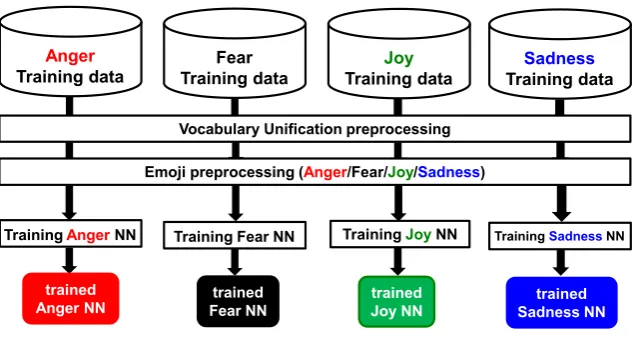
Figure 1: Overall Training Flow of KDE-AFFECT
acters). For instance, if the tweet sentence is “At last I made it.”, 2-gram includes (At, last) and (made, it). Similarly, 3-gram includes (At, last, I) and (I, made, it).
We have adopted the method based on the n -gram convolution proposed by Kim (2014). Here, we prepare a matrix corresponding to a sentence representing ann-gram convolution in which this
filtering process is carried out by the unit of ann
-gram.
The overview of our system is as follows: First we apply preprocessing with “vocabulary unifica-tion” including lower case conversion, URL unifi-cation, two or more consecutive character squeez-ing, and hashtag elimination. Second, we ap-ply Emoji conversion into four emotional words, which will be elaborated later. From Emoji con-version, we train the model independently for each emotion. Finally, we predict the emotion score for an unknown tweet by using the trained model. The overall system flow is shown in Figure1.
3.1 Preprocessing with Vocabulary Unification
This step is applied to all emotions. It consists of the following processing:
• lower case conversion
• conversion of every instance of a URL string
in a tweet to “<URL>”
• collapse of two or more consecutive letters into two
• elimination of hash sign (#)
It should be noted that by a url string we mean a regular expression starting with either “http”, “https”, “ftp”, or “www”. Any url string is con-verted to <URL>. For example, “I want to be
happy on http://t.co/S6moxr1U” is converted to “I want to be happy on<URL>”.
3.2 Preprocessing for Emoji
From our observation of real tweets, approxi-mately more than 20% of them have some kind of Emojis. Emotions are naturally represented by many different Emojis. Hence, we introduce the conversion of possible emotions represented by an Emoji into each emotional word. Please note that Emoji preprocessing is applied to all Emoji data, regardless of emotions. For instance, each anger Emoji might appear not only in an Anger dataset, but in Fear, Joy, and Sadness datasets as well. This is why we have decided to apply the Emoji conver-sion despite the differences of emotions. In the fol-lowing, we present Emoji for each emotion, where Emoji has been taken from a Full Emoji Web site1.
The selection of Emoji has been made by using the labels (such as “face-positive”) annotated to the above Web sites.
3.2.1 Anger Emoji
The Anger Emojis we selected are shown in Fig-ure2. All of them are replaced by ”anger”.
Figure 2: Anger Emoji
3.2.2 Fear Emoji
The Fear Emojis we selected are shown in Fig.3. All of them are replaced by ”fear”.
Figure 3: Fear Emoji
3.2.3 Joy Emoji
[image:3.595.315.519.63.201.2]The Joy Emojis we selected are shown in Fig.4. All of them are replaced by ”joy”.
Figure 4: Joy Emoji
3.2.4 Sadness Emoji
[image:3.595.92.271.192.290.2]The Sadness Emojis we selected are shown in Fig.5. All of them are replaced by ”sadness”.
Figure 5: Sadness Emoji
3.3 Convolutional Neural Network for n-gram
Once preprocessing is done, we have a kind of rec-tified tweet, represented by a matrix. Figure6 il-lustrates a word-by-word matrix representation of a rectified tweet. Here we take a matrix of 80 by 300, where 80 is the maximum number of words per tweet, and 300 corresponds to our embedding vector size. If a tweet has less than 80 words, zero padding is performed to fill the input matrix.
3.3.1 Embedding
In Embedding, each tweet is converted to a matrix. Specifically, we first divide a tweet into words us-ing a whitespace, thereby treatus-ing a special char-acter (one of “.h, “,h, “!h, and “?h ) as a separate word. Second, we transform each word into its distributed representation of 300 dimensions using Word2Vec (Mikolov et al., 2013a,b). The train-ing of Word2Vec itself is done by ustrain-ing approxi-mately 470 million tweets after the processing
de-Embedding
at last
i made
it .
-n-gram convolution
Fully connect Max pooling
Softmax
Figure 6: Ourn-gram Convolution-based Approach
scribed in3.1. We finally obtain the embedding by padding zero values to a fixed size of a 80 by 300 dimensional matrix.
3.3.2 n-gram Convolution Layer
In ann-gram convolutional layer, we perform
con-volution, and generate a length m−n+ 1 vec-tor, where m denotes the maximum word length
(here 80). This is straightforward, since both ends are trimmed during then-gram convolution stage shown in Figure6. For instance, if 3-gram is con-cerned, the length in our implementation will be 80-3+1 = 78. Note that we have multiple n-gram
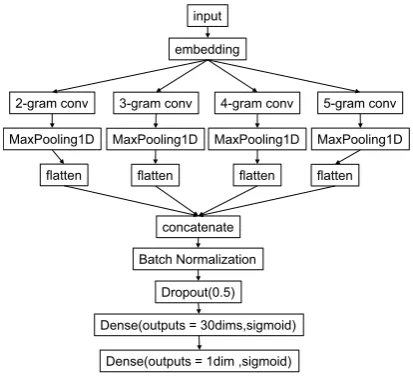
convolutional layers for each emotion. “Joy” neu-ral network architecture, for example, has 2-gram, 3-gram, 4-gram, and 5-gram convolutional layers, which will be discussed later in Table3.
input
embedding
2-gram conv 3-gram conv 4-gram conv 5-gram conv
MaxPooling1D MaxPooling1D MaxPooling1D MaxPooling1D
flatten flatten
flatten flatten
concatenate
Batch Normalization
Dropout(0.5)
Dense(outputs = 30dims,sigmoid)
Dense(outputs = 1dim ,sigmoid)
Figure 7: KDE-AFFECT system’s DNN architecture
3.3.3 Max Pooling Layer
In a Max Pooling layer, from each n-gram
[image:3.595.313.520.483.671.2]Intensity range Intensity amount
[0.0,0.35) 0 (no E)
[0.35,0.5) 1 (low amount of E) [0.5,0.65) 2 (moderate amount of E)
[image:4.595.307.531.63.135.2][0.65,1.0] 3 (high amount of E)
Table 1: Inferred Intensity Level
and a vector of the length equal to the number of filters is generated. In our system, the output of four multiplen-gram convolutional layers are
flat-tened and concatenated in the subsequent layers. The output dimension is the number of filters mul-tiplied by the number ofn-gram convolutional
lay-ers.
3.3.4 Fully-connected Layers
In our system, we have two fully-connected layers, where the first hidden fully-connected layer ac-cepts the input from the concatenation layer con-nceted from multiple max pooling layers. Em-pirically, we set 30 outputs for the first fully-connected layer. The second layer outputs either the estimated intensity value of an emotion (Task 1a) or the estimated intensity level (Task 2a). The way to estimate the intensity level (Task 2a) is elaborated in the next section.
3.4 Estimating Intensity Level (Task 2a)
For Task 2a, we need to estimate the intensity level. Specifically, participants are required to classify the emotional intensities into four levels; high amount, moderate amount, low amount, and nothing. Our strategy for the amount of emotional intensity amount level is simple, which is based on the inferred intensity range as shown in Table1. In Table1, the left column denotes the range of emo-tional amount that we have defined for this task. For example,[0.0,0.35)means that the left
bound-ary 0.0 is inclusive, while the right boundbound-ary 0.35 is exclusive in the range of the amount of emotion.
4 Experiments
Here we describe the experimental environment and our evaluation results.
4.1 dataset
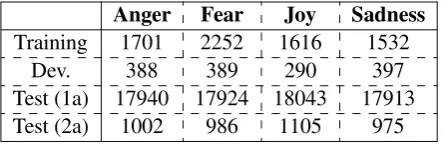
All participants are given SemEval 2018: Task 1 Affect in Tweets (AIT) (Mohammad et al.,2018) dataset. The details are shown in Table2.
Anger Fear Joy Sadness
Training 1701 2252 1616 1532 Dev. 388 389 290 397 Test (1a) 17940 17924 18043 17913 Test (2a) 1002 986 1105 975
Table 2: SemEval 2018: Task 1 dataset (1a and 2a)
4.2 Evaluation Measure
Here, the evaluation measure for a model is cor-relation coefficient r. Given variables x and y,
wherexcorresponds to a predicted emotion value
andyto a true emotion value, and their associated sample variancesSx, Sy, and the covariance Sxy
are represented by the following equation:
r = Sxy
SxSy
4.3 Experiment Environment
For our deep learning program for the task, we used the following list of hyper-parameters:
loss function: Root Mean Square Error (RMSE)
filter number: 200×n epochs: 30
dropout rate: 0.5
optimizer: Adam
batch size: 64
The framework we use is Keras with backend Tensorflow. In our Ubuntu server, it took approxi-mately 1 second for each epoch.
4.4 Preliminary Experiments forn-gram Convolutions
For each emotion, our system attempts to find an empirical optimal combination of n-gram convo-lutions. Table3summarizes the results of prelimi-nary experiments for this purpose. Here,r(A)
de-notes the correlation coefficient for Anger. Sim-ilarly, r(F) for Fear, r(J) for Joy, and r(S) for
Sadness. From the table, we decided as follows: For Anger, we chose [1,2,3,4,5,6] (meaning we took the combination of 1-gram, 2-gram, 3-gram, 4-gram, 5-gram, and 6-gram convolutions). For Fear, we chose [2,3,4,5,6]. For Joy and Sadness, we chose [2,3,4,5].
4.5 Experimental Result (Task 1a)
n r(A) r(F) r(J) r(S) [1,2,3,4,5,6] 0.5529 0.5919 0.5771 0.6349
[2,3,4,5,6] 0.5518 0.5994 0.5464 0.6173 [1,2,3,4,5] 0.5381 0.5948 0.5730 0.6078
[image:5.595.176.423.62.132.2][2,3,4,5] 0.5309 0.5736 0.5906 0.6360
Table 3: Preliminary experiments forn-gram convolustions
Team avg-r r(A) r(F) r(J) r(S)
KDE-AFFECT 0.620 0.630 0.621 0.598 0.630 SeerNet1st 0.799 0.827 0.799 0.792 0.798
NTUA-SLP2nd 0.776 0.782 0.758 0.771 0.792
PlusEmo2Vec3rd 0.766 0.811 0.728 0.773 0.753
CrystalFeel14th 0.717 0.740 0.700 0.708 0.720
EliRF-UPV15th 0.696 0.705 0.686 0.693 0.700
iit delhi29th 0.621 0.633 0.645 0.618 0.588
DeepMiner31th 0.575 0.581 0.570 0.575 0.573
[image:5.595.165.435.166.305.2]Baseline37th 0.520 0.526 0.525 0.575 0.453
Table 4: Our result with selected other teams for Task 1a
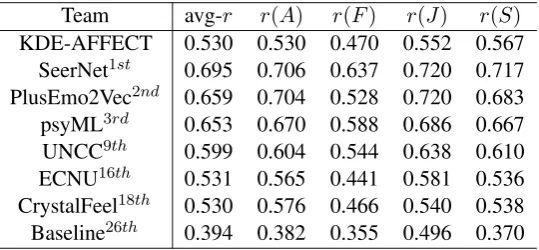
Team avg-r r(A) r(F) r(J) r(S)
KDE-AFFECT 0.530 0.530 0.470 0.552 0.567 SeerNet1st 0.695 0.706 0.637 0.720 0.717
PlusEmo2Vec2nd 0.659 0.704 0.528 0.720 0.683
psyML3rd 0.653 0.670 0.588 0.686 0.667
UNCC9th 0.599 0.604 0.544 0.638 0.610
ECNU16th 0.531 0.565 0.441 0.581 0.536
CrystalFeel18th 0.530 0.576 0.466 0.540 0.538
Baseline26th 0.394 0.382 0.355 0.496 0.370
Table 5: Our result with selected other teams for Task 2a
we use similar notations as in Table3, and pick up the top-3 ranked teams, as well as randomly cho-sen teams CrystalFeel (14-th place), ELipRF-UPV (15-th place), iit delhi (29-th), DeepMiner (31-th), and the baseline (37-th), the result looks like Ta-ble4.
4.6 Experimental Result (Task 2a)
According to the Official Leaderboard for Task 2a, our team KDE-AFFECT turned out to be 17-th. If we use similar notations as in Table3, and pick up top-3 ranked teams, as well as randomly chosen teams UNCC (9-th place), ECNU (16-th place), CrystalFeel (14-th place), and the baseline (26-th), the result looks like Table5.
5 Conclusion
This paper describes the approach we took for SemEval-2018 Task 1: Affect in Tweets (subtasks
1a and 2a). We have chosen a combination of dif-ferentn-gram convolutions with preprocessing
in-cluding vocabulary unification and Emoji conver-sion.
Acknowledgments
Part of this research is supported by MEXT KAK-ENHI, Grant-in-Aid for Scientific Research (B), Grant Number 17H01746.
References
[image:5.595.165.435.339.464.2]Mathieu Cliche. 2017. Bb twtr at semeval-2017 task 4: Twitter sentiment analysis with cnns and lstms. In
Proceedings of the 11th International Workshop on Semantic Evaluation (SemEval-2017), pages 573– 580, Vancouver, Canada. Association for Computa-tional Linguistics.
Jan Deriu, Maurice Gonzenbach, Fatih Uzdilli, Au-relien Lucchi, Valeria De Luca, and Martin Jaggi. 2016. Swisscheese at semeval-2016 task 4: Senti-ment classification using an ensemble of convolu-tional neural networks with distant supervision. In
Proceedings of the 10th International Workshop on Semantic Evaluation (SemEval-2016), pages 1124– 1128, San Diego, California. Association for Com-putational Linguistics.
Anastasia Giachanou and Fabio Crestani. 2016. Like it or not: A survey of twitter sentiment analysis meth-ods.ACM Computing Surveys, 49(2):28:1–28:41.
Stavros Giorgis, Apostolos Rousas, John Pavlopoulos, Prodromos Malakasiotis, and Ion Androutsopoulos. 2016. aueb.twitter.sentiment at semeval-2016 task 4: A weighted ensemble of svms for twitter senti-ment analysis. InProceedings of the 10th Interna-tional Workshop on Semantic Evaluation (SemEval-2016), pages 96–99, San Diego, California. Associ-ation for ComputAssoci-ational Linguistics.
Alec Go, Richa Bhayani, and Lei Huang. 2009. Twit-ter sentiment classification using distant supervision.
Processing, pages 1–6.
Matthias Hagen, Martin Potthast, Michel B¨uchner, and Benno Stein. 2015. Webis: An ensemble for twitter sentiment detection. InProceedings of the 9th In-ternational Workshop on Semantic Evaluation (Se-mEval 2015), pages 582–589, Denver, Colorado. Association for Computational Linguistics.
Hussam Hamdan. 2017. Senti17 at semeval-2017 task 4: Ten convolutional neural network voters for tweet polarity classification. InProceedings of the 11th International Workshop on Semantic Evalua-tion (SemEval-2017), pages 700–703, Vancouver, Canada. Association for Computational Linguistics.
Yoon Kim. 2014. Convolutional neural networks for sentence classification. InProceedings of the 2014 Conference on Empirical Methods in Natural Lan-guage Processing, EMNLP 2014, October 25-29, 2014, Doha, Qatar, A meeting of SIGDAT, a Special Interest Group of the ACL, pages 1746–1751.
Zhengdong Lu and Hang Li. 2013. A deep architecture for matching short texts. InAdvances in Neural In-formation Processing Systems 26, pages 1367–1375. Curran Associates, Inc.
Tomas Mikolov, Kai Chen, Greg Corrado, and Jeffrey Dean. 2013a. Efficient estimation of word represen-tations in vector space.CoRR, abs/1301.3781.
Tomas Mikolov, Ilya Sutskever, Kai Chen, Greg S Cor-rado, and Jeff Dean. 2013b. Distributed represen-tations of words and phrases and their composition-ality. In C. J. C. Burges, L. Bottou, M. Welling, Z. Ghahramani, and K. Q. Weinberger, editors, Ad-vances in Neural Information Processing Systems 26, pages 3111–3119. Curran Associates, Inc. Saif Mohammad and Felipe Bravo-Marquez. 2017.
Emotion intensities in tweets. InProceedings of the 6th Joint Conference on Lexical and Computational Semantics (*SEM 2017), pages 65–77. Association for Computational Linguistics.
Saif M. Mohammad. 2017. Word affect intensities.
CoRR, abs/1704.08798.
Saif M. Mohammad, Felipe Bravo-Marquez, Mo-hammad Salameh, and Svetlana Kiritchenko. 2018. Semeval-2018 Task 1: Affect in tweets. In Proceed-ings of International Workshop on Semantic Evalu-ation (SemEval-2018), New Orleans, LA, USA.
Sara Rosenthal, Noura Farra, and Preslav Nakov. 2017. Semeval-2017 task 4: Sentiment analysis in twitter. In Proceedings of the 11th International Workshop on Semantic Evaluation (SemEval-2017), pages 502–518. Association for Computational Lin-guistics.
Mickael Rouvier and Benoit Favre. 2016. Sensei-lif at semeval-2016 task 4: Polarity embedding fusion for robust sentiment analysis. InProceedings of the 10th International Workshop on Semantic Evalua-tion (SemEval-2016), pages 202–208, San Diego, California. Association for Computational Linguis-tics.
Hassan Saif, Yulan He, Miriam Fernandez, and Harith Alani. 2016. Contextual semantics for sentiment analysis of twitter. Information Processing and Management, 52(1):5–19.
Aliaksei Severyn and Alessandro Moschitti. 2015. Twitter sentiment analysis with deep convolutional neural networks. InProceedings of the 38th Inter-national ACM SIGIR Conference on Research and Development in Information Retrieval, SIGIR ’15, pages 959–962, Santiago, Chile. ACM.
Nadia Felix F. Da Silva, Luiz F. S. Coletta, and Ed-uardo R. Hruschka. 2016. A survey and com-parative study of tweet sentiment analysis via semi-supervised learning. ACM Comput. Surv., 49(1):15:1–15:26.