893
SemEval 2019 Task 10: Math Question Answering
Mark HopkinsDepartment of Mathematics Reed College
Ronan Le Bras and Cristian Petrescu-Prahova
Allen Institute for Artificial Intelligence
{ronanlb,cristipp}@allenai.org
Gabriel Stanovsky and Hannaneh Hajishirzi and Rik Koncel-Kedziorski
Allen School of Computer Science and Engineering University of Washington
{gabis, hannaneh,kedzior}@uw.edu
Abstract
We report on the SemEval 2019 task on math question answering. We provided a question set derived from Math SAT practice exams, in-cluding 2778 training questions and 1082 test questions. For a significant subset of these questions, we also provided SMT-LIB logical form annotations and an interpreter that could solve these logical forms. Systems were eval-uated based on the percentage of correctly an-swered questions. The top system correctly answered 45% of the test questions, a con-siderable improvement over the 17% random guessing baseline.
1 Overview
Over the past four years, there has been a surge of interest in math question answering. Research groups from around the globe have published pa-pers on the topic, including MIT (Kushman et al.,
2014), University of Washington (Hosseini et al.,
2014; Koncel-Kedziorski et al., 2015), National Institute of Informatics, Japan (Matsuzaki et al.,
2014), University of Illinois (Roy and Roth,2015), Microsoft Research (Shi et al., 2015; Upadhyay and Chang,2016), Baidu (Zhou et al.,2015), Ari-zona State University (Mitra and Baral,2016), KU Leuven (Dries et al.,2017), Carnegie Mellon Uni-versity (Sachan et al.,2017), Tencent (Wang et al.,
2017), and DeepMind (Ling et al.,2017).
Math question answering has several attractive properties that have rekindled this interest:
1. It is easy to evaluate. Usually there is a sin-gle correct answer for a given question, either numeric or multiple-choice.
2. In order to achieve robust results, systems require some (explicit or implicit) seman-tic representation of the question language. Consider the first question in Figure1. The
Closed-vocabulary algebra: Suppose 3x + y = 15, where x is a positive integer. What is the difference between the largest possible value of y and the smallest possible value of x, assuming that y is also a positive integer?
Open-vocabulary algebra: At a basketball tournament involving 8 teams, each team played 4 games with each of the other teams. How many games were played at this tourna-ment?
Geometry: The lengths of two sides of a tri-angle are(x−2)and(x+ 2), wherex > 2.
Which of the following ranges includes all and only the possible values of the third side
y? (A) 0 < y < x (B) 0 < y < 2x (C)
4< y <2x
Figure 1: Example math questions from different gen-res.
correct answer (11) has a subtle relationship to the other quantities mentioned in the text (3 and 15). There is no obvious shortcut (like word association metrics on a bag-of-words representation of the question) to guessing 11.
3. Math questions exhibit interesting semantic phenomena like cross-sentence coreference and indirect coreference (e.g. in the geom-etry question from Figure1, “the third side” refers to a triangle introduced in a previous sentence).
Figure 2: Sample of questions of the AQuA dataset.
Closed Open Geometry Total Algebra Algebra
# test questions 476 216 335 1082
# training questions 1068 353 701 2778
Table 1: Data resources for the three subtasks. Note that the fourth column (“Total”) also includes a small minority of questions that do not fall into the three major categories.
phase of this subfield. We discuss these issues in the next section.
2 Existing Resources
Existing datasets are either scraped from the web and filtered (Kushman et al.,2014;Hosseini et al.,
2014; Roy and Roth, 2015; Shi et al., 2015) or crowdsourced (Ling et al.,2017).
The scraped datasets have been observed to be narrow in semantic scope, and to exhibit consid-erable lexical overlap from question to question (Koncel-Kedziorski et al., 2015; Roy and Roth,
2016). Also, they tend to be curated to showcase proposed models (e.g. by requiring every quantity present in the semantic representation to be explic-itly mentioned in the question).
DeepMind (Ling et al.,2017) provided a public, large-scale dataset called AQuA, consisting of ap-proximately 100,000 questions. This dataset was created by using crowdsourcing to augment a nu-cleus of web-scraped questions. Unfortunately, the result is extremely redundant and noisy. Fig-ure2shows a typical excerpt from the sorted list of AQuA questions. Note the amount of repeated boilerplate and the low quality of the language. While AQuA may prove useful for training, it is inappropriate as an evaluation set.
3 Resource: Train/Test Data from Math SAT practice tests
Over the course of the Euclid project (Hosseini et al., 2014; Seo et al., 2014, 2015; Koncel-Kedziorski et al., 2015;Hopkins et al., 2017) at the Allen Institute for Artificial Intelligence, we
curated a sizable collection of practice exams for Math SAT study guides. These were originally used as training and test in a paper that appeared at EMNLP (Hopkins et al., 2017). At the time, this dataset consisted of 648 training questions (12 practice tests) and 1082 test questions (21 practice tests). For this task, we expanded the training set to include 2778 training questions (over 50 prac-tice tests).
Because the data is a compilation of SAT prac-tice exams in their entirety, its distribution of top-ics corresponds to (at least one authority’s idea of) the breadth of knowledge expected of an incom-ing college student. It is curated by impartial third parties (the study guide publishers) and is thus not a priori biased towards any particular model. The language is high quality and diverse.
3.1 Data Collection Process and Format
First, practice exams were scanned from physi-cal printed copies of SAT study guides by Kaplan, McGraw-Hill, and the Princeton Review, among others. We also processed official PDF practice exams issued by the College Board. Then, trained workers manually encoded each exam as a LaTeX document, attempting to preserve the original for-matting as much as possible. PDFs generated from the LaTeX documents were compared against the original scans to ensure quality and corrections were made as necessary.
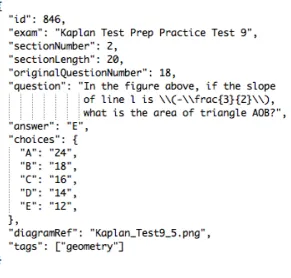
com-Figure 3: JSON representation of a math SAT question.
mon directory. If a question refers to a diagram, then this is captured by the “diagramRef” field. Not all questions are multiple-choice. For non-multiple choice questions, the “answer” field con-tains the answer itself (as a string) rather than the choice key.
3.2 Subtasks
The Math SAT contains three broadly discernible subcategories (examples of which are provided in Figure1):
1. Closed-vocabulary algebra (approxi-mately 44% of the questions): Algebra word problems described with a circum-scribed mathematical vocabulary. Note that the language and semantics can still be quite involved (see the first example in Figure1).
2. Open-vocabulary algebra (approximately 20% of the questions): Algebra word prob-lems described with an open-ended vocabu-lary, often involving real-world situation de-scriptions.
3. Geometry (approximately 31% of the questions): In contrast to the algebra subdo-mains, these often involve diagrams and thus require methods that perform joint reasoning
over language and images, e.g. (Seo et al.,
2014).
As part of the digitization process described in the previous section, we have also tagged the ques-tions based on this categorization. A small mi-nority (approximately 5%) of questions do not fall into any of these categories.
This categorization provides the basis for three subtasks: (1) closed algebra QA, (2) open alge-bra QA, and (3) geometry QA. Note that the al-gebra subtasks do not involve diagrams (alal-gebra questions involving diagrams are classified into the small “other” category). Table 1 shows the number of questions collected, organized by sub-task.
4 Additional Resource: Logical Forms for Closed Algebra
[image:3.595.154.446.66.344.2]Figure 4: Logical form annotation for the question “The sum of a two-digit number and its reverse is 121. What is the number?”
the popular SMT-LIB syntax (Barrett et al.,2017), to facilitate language expansion and the building of alternate engines.
As part of the SemEval task, we provided:
• Logical form annotations for 50% of the closed algebra training data.
• Thorough documentation of the logical form language.
• An interpreter that can solve all provided
an-notations.
The logical form interpreter is an extended version of the one described in (Hopkins et al.,2017). This interpreter is written in Scala. We provide Scala, Java, and Python APIs.
Note: the logical form annotations and inter-preter were provided to help lower the barrier to entry, but participants were not required to use them.
5 Evaluation Methodology and Baseline For each subtask, the main evaluation metric was simply question accuracy, i.e. the number of cor-rectly answered questions. We provided a Python script that took as input a list of JSON datum{id:
<id>, response: “<response>”}, where<id>is
the integer index of a question and<response>is
the guessed response (either a choice key or a nu-meric string). Its output was the number of correct responses divided by the total number of questions in the subtask.
While the main evaluation metric included no penalties for guessing, we also computed a sec-ondary metric that implements the actual evalua-tion metric used to score these SATs. This metric is the number of correct questions, minus 1/4 point for each incorrect guess. We include this met-ric to challenge participants to investigate high-precision QA systems.
For each subtask, we provided a simple Python baseline that reads in a JSON file containing
the evaluation questions, and randomly guesses a choice key for each multiple choice question, and “0” for each numeric-answer question.
To train their systems, participants were per-mitted to use the following public resources: (a) the provided SAT training data and annotations, (b) data collected in MAWPS (Koncel-Kedziorski et al., 2016), (c) AQuA. Participants were also welcome to use standard public corpora for train-ing word vector representations, language models, etc.
6 Evaluation
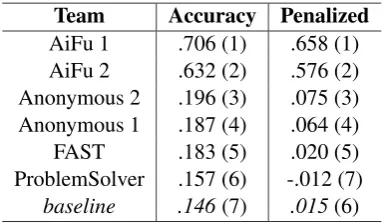
Table2shows the teams (and their affiliations) that submitted systems that beat the baseline in at least one task. Tables3,4,5, and6compares the perfor-mance of these systems. The AiFu systems (Ding et al., 2019) outperformed the other entries by a wide margin.
6.1 The AiFu System
The AiFu system (Ding et al., 2019), like other math question answering systems designed for complex domains (Shi et al.,2015;Hopkins et al.,
2017), followed the architecture in Figure5. First, a natural language question is transformed into a logical form via a “translator” (semantic parser), then this logical form is given to a symbolic solver (after a suitable format conversion).
Like the previous semantic parsing approaches, the AiFu semantic parser is engineered manually, using the training set as a guide.
AiFu also incorporates a neural network-based system trained to guess the answer to a multiple choice question based on its question word se-quence. Although this system does not work well independently, it boosts the performance of the overall system when used as a fallback for ques-tions that go unanswered by the symbolic system. The AiFu team submitted two variants of their system, referred to in the comparison tables as AiFu 1 and AiFu 2.
6.2 The ProblemSolver System
The ProblemSolver system (Luo et al.,2019) com-bines two approaches.
The first approach is a neural sequence-to-sequence translator that maps a question, e.g. “If
x+ 345 = 111, what is the value ofx”, to a
sequence-Team Name Affiliation Citation
AiFu iFLYTEK Research, Shanghai Research Center (Ding et al.,2019) for Brain Science and Brain-Inspired Intelligence,
Fudan University, Massey University, University of Science and Technology of China
ProblemSolver University of Tuebingen, Germany (Luo et al.,2019)
FAST National University of Computer
[image:5.595.98.501.60.175.2]and Emerging Sciences, Pakistan
[image:5.595.81.516.231.270.2]Table 2: Teams whose entries exceeded baseline performance on at least one subtask. FAST (and the two anonymous systems) did not provide system description papers.
Figure 5: The architecture of AiFu. Figure taken from (Ding et al.,2019).
Team Accuracy Penalized
AiFu 1 .454 (1) .368 (1)
AiFu 2 .376 (2) .280 (2)
Anonymous 1 .208 (3) .089 (3) Anonymous 2 .196 (4) .074 (4)
FAST .173 (5) .007 (6)
baseline .170(6) .043(5) ProblemSolver .149 (7) -.021 (7)
Table 3: Results on the overall task (only showing entries that exceeded baseline performance on at least one subtask). System rank on each metric is shown in parentheticals.
Team Accuracy Penalized
AiFu 1 .706 (1) .658 (1)
AiFu 2 .632 (2) .576 (2)
Anonymous 2 .196 (3) .075 (3) Anonymous 1 .187 (4) .064 (4)
FAST .183 (5) .020 (5)
ProblemSolver .157 (6) -.012 (7) baseline .146(7) .015(6)
Table 4: Results on the closed-vocabulary algebra sub-task (only showing entries that exceeded baseline per-formance on at least one subtask). System rank on each metric is shown in parentheticals.
to-sequence model, they use data augmentation methods to increase the data size to over 600K questions.
The second approach is an adaptation of the arithmetic tree approach of (Roy and Roth,2015)
Team Accuracy Penalized
AiFu 1 .251 (1) .145 (1)
AiFu 2 .247 (2) .140 (2)
Anonymous 2 .247 (2) .140 (2) Anonymous 1 .196 (4) .079 (4) baseline .174(5) .052(5)
FAST .146 (6) -.025 (6)
[image:5.595.321.514.323.433.2]ProblemSolver .146 (6) -.025 (6)
Table 5: Results on the open-vocabulary algebra sub-task (only showing entries that exceeded baseline per-formance on at least one subtask). System rank on each metric is shown in parentheticals.
Team Accuracy Penalized
AiFu 1 .265 (1) .145 (1)
Anonymous 1 .216 (2) .099 (2) baseline .212(3) .095(3)
FAST .159 (4) -.009 (6)
Anonymous 2 .152 (5) .023 (4) ProblemSolver .152 (6) -.018 (7)
AiFu 2 .134 (7) -.003 (5)
Table 6: Results on the geometry subtask (only show-ing entries that exceeded baseline performance on at least one subtask). System rank on each metric is shown in parentheticals.
to Math SAT question answering.
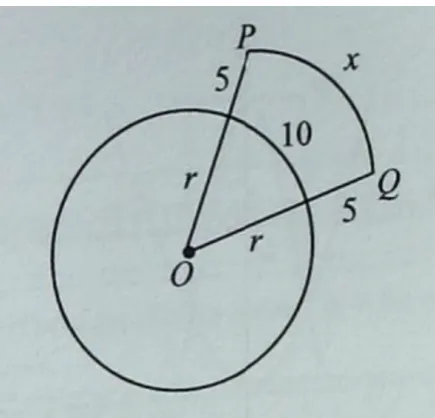
[image:5.595.86.279.324.433.2] [image:5.595.85.279.505.617.2] [image:5.595.320.513.511.622.2]Figure 6: Example diagram accompanying the ques-tion “In the circle above, the length of an arc is 10, and there are two radii shown extended by 5 units outside the circle. If the length of arc Q is x, what must x
equal?”
7 Discussion
Lately, math question answering seems to have bi-furcated into two distinct approaches:
1. Simple, elegant machine learning approaches that work mainly on narrowly-scoped datasets with considerable redundancy.
2. Engineering-heavy, rule-based approaches that significantly outperform ML approaches on more realistic datasets, but are laborious to scale to new domains.
This SemEval task provides additional examples of these two approaches. As NLP researchers, we could focus on narrow-scope datasets for the time being1, improving the performance of scalable
ML approaches on these datasets. However the challenges presented by more difficult datasets, like the Math SAT data provided in this task, are intriguing and important. For instance:
How do we synthesize information that comes from heterogenous sources (e.g. from text and diagrams)?
Many of the geometry questions require a gener-alized notion of coreference resolution that spans 1Indeed, this seems to be the prevailing opinion of the hundredsome task participants who abandoned the task after obtaining the data.
language and vision. Figure6shows an example diagram that accompanies the question “In the cir-cle above, the length of an arc is 10, and there are two radii shown extended by 5 units outside the circle. If the length of arcQis x, what must x equal?”. It remains an open question how to
reliably resolve textual references like “the circle above” and “two radii shown” with diagram com-ponents. (Seo et al.,2014,2015) provide a start-ing point for this area, but their dataset consisted of less than 100 diagrams. Hopefully our larger resource can help spur research into this research question.
How can machine learning be leveraged to reduce (or eliminate) the burden of
engineering semantic parsers for complicated domains?
Given that the only techniques that have so far found success on Math SAT question answering (Hopkins et al.,2017;Ding et al.,2019) have in-volved semantic parsers with engineered rules, it suggests that one path forward might be to use ma-chine learning to facilitate the engineering or elici-tation of such rules for low-resource QA domains.
How do we create ML systems for diverse datasets for which we do not (and will never have) millions of training instances?
Despite the huge industry surrounding the Math SAT, it was still challenging to find and digitize over 50 distinct practice exams. Having millions of instances is not feasible. We argue that there will always be a long tail of domains for which we do not have millions of training instances, and we need ways to induce performant systems on this scale of data.
8 Conclusion
References
Clark Barrett, Pascal Fontaine, and Cesare Tinelli. 2017. The SMT-LIB Standard: Version 2.6. Technical report, Department of Computer Sci-ence, The University of Iowa. Available at www.SMT-LIB.org.
Keyu Ding, Yifan Liu, Yi Zhou, Binbin Deng, Chaoyang Peng, Dinglong Xue, Qinzhuo Wu, Qi Zhang, and Enhong Chen. 2019. Aifu at semeval-2019 task 10: A symbolic and sub-symbolic inte-grated system for sat math question answering. In
SemEval-2019 Task 10.
Anton Dries, Angelika Kimmig, Jesse Davis, Vaishak Belle, and Luc De Raedt. 2017. Solving probability problems in natural language. InInternational Joint Conference on Artificial Intelligence.
Mark Hopkins, Cristian Petrescu-Prahova, Roie Levin, Ronan Le Bras, Alvaro Herrasti, and Vidur Joshi. 2017. Beyond sentential semantic parsing: Tack-ling the math sat with a cascade of tree transducers.
In Proceedings of the 2017 Conference on
Empiri-cal Methods in Natural Language Processing, pages
795–804.
Mohammad Javad Hosseini, Hannaneh Hajishirzi, Oren Etzioni, and Nate Kushman. 2014. Learning to solve arithmetic word problems with verb catego-rization. InEMNLP.
Rik Koncel-Kedziorski, Hannaneh Hajishirzi, Ashish Sabharwal, Oren Etzioni, and Siena Dumas Ang. 2015. Parsing algebraic word problems into equa-tions. TACL, 3:585–597.
Rik Koncel-Kedziorski, Subhro Roy, Aida Amini, Nate Kushman, and Hannaneh Hajishirzi. 2016. Mawps: A math word problem repository. InProceedings of the 2016 Conference of the North American Chap-ter of the Association for Computational Linguistics:
Human Language Technologies, pages 1152–1157.
Nate Kushman, Luke S. Zettlemoyer, Regina Barzilay, and Yoav Artzi. 2014. Learning to automatically solve algebra word problems. InACL.
Wang Ling, Dani Yogatama, Chris Dyer, and Phil Blun-som. 2017. Program induction by rationale genera-tion: Learning to solve and explain algebraic word problems. arXiv preprint arXiv:1705.04146.
Xuefeng Luo, Alina Baranova, and Jonas Biegert. 2019. Problemsolver at semeval-2019 task 10: Sequence-to-sequence learning and expression trees. InSemEval-2019 Task 10.
Takuya Matsuzaki, Hidenao Iwane, Hirokazu Anai, and Noriko H Arai. 2014. The most uncreative ex-aminee: A first step toward wide coverage natural language math problem solving. In AAAI, pages 1098–1104.
Arindam Mitra and Chitta Baral. 2016. Learning to use formulas to solve simple arithmetic problems. InACL.
Subhro Roy and Dan Roth. 2015. Solving general arithmetic word problems. InEMNLP.
Subhro Roy and Dan Roth. 2016. Unit dependency graph and its application to arithmetic word problem solving.arXiv preprint arXiv:1612.00969.
Mrinmaya Sachan, Avinava Dubey, and Eric P. Xing. 2017. From textbooks to knowledge: A case study in harvesting axiomatic knowledge from textbooks to solve geometry problems. InEMNLP.
Min Joon Seo, Hannaneh Hajishirzi, Ali Farhadi, and Oren Etzioni. 2014. Diagram understanding in ge-ometry questions. InAAAI.
Min Joon Seo, Hannaneh Hajishirzi, Ali Farhadi, Oren Etzioni, and Clint Malcolm. 2015. Solving geome-try problems: Combining text and diagram interpre-tation. InEMNLP.
Shuming Shi, Yuehui Wang, Chin-Yew Lin, Xiaojiang Liu, and Yong Rui. 2015. Automatically solving number word problems by semantic parsing and rea-soning. InEMNLP.
Shyam Upadhyay and Ming-Wei Chang. 2016. An-notating derivations: A new evaluation strategy and dataset for algebra word problems. CoRR, abs/1609.07197.
Yan Wang, Xiaojiang Liu, and Shuming Shi. 2017. Deep neural solver for math word problems. In
EMNLP.