Knowledge Completion for Generics using Guided Tensor Factorization
Hanie Sedghi∗
Google Brain
Mountain View, CA, U.S.A. [email protected]
Ashish Sabharwal
Allen Institute for Artificial Intelligence (AI2) Seattle, WA, U.S.A.
Abstract
Given a knowledge base or KB containing (noisy) facts about common nouns or gener-ics, such as “all trees produce oxygen” or “some animals live in forests”, we consider the problem of inferring additional such facts at a precision similar to that of the starting KB. Such KBs capture general knowledge about the world, and are crucial for various appli-cations such as question answering. Differ-ent from commonly studied named Differ-entity KBs such as Freebase, generics KBs involve quan-tification, have more complex underlying reg-ularities, tend to be more incomplete, and vio-late the commonly used locally closed world assumption (LCWA). We show that existing KB completion methods struggle with this new task, and present the first approach that is successful. Our results demonstrate that ex-ternal information, such as relation schemas and entity taxonomies, if used appropriately, can be a surprisingly powerful tool in this set-ting. First, our simple yet effective knowledge guided tensor factorization approach achieves state-of-the-art results on two generics KBs (80% precise) for science, doubling their size at 74%-86% precision. Second, our novel tax-onomy guided, submodular, active learning method for collecting annotations about rare entities (e.g., oriole, a bird) is 6x more effec-tive at inferring further new facts about them than multiple active learning baselines.
1 Introduction
We consider the problem of completing a partial knowledge base (KB) containing facts about gener-∗This work was done while the author was affiliated with
the Allen Institute for Artificial Intelligence.
ics or common nouns, represented as a third-order tensor of (source, relation, target) triples, such as (butterfly, pollinate, flower)and(thermometer, mea-sure, temperature). Such facts capture common knowledge that humans have about the world. They are arguably essential for intelligent agents with human-like conversational abilities as well as for specific applications such as question answering. We demonstrate that state-of-the-art KB completion methods perform poorly when faced with gener-ics, while our strategies for incorporating external knowledge as well as obtaining additional annota-tions for rare entities provide the first successful so-lution to this challenging new task.
Since generics represent classes of similar indi-viduals, the truth valueyi of a generics triple xi = (s, r, t)depends on the quantification semantics one associates with s and t. Indeed, the semantics of
generics statements can be ambiguous, even self-contradictory, due to cultural norms. As Leslie (2008) points out, ‘ducks lay eggs’ is generally con-sidered true while ‘ducks are female’, which is true for a broader set of ducks than the former statement, is generally considered false.
To avoid deep philosophical issues, we fix a par-ticular mathematical semantics that is especially rel-evant for noisy facts derived automatically from text: associate s with a categorical quantification from {all, some, none} and associatet(implicitly) with some. For instance, “all butterflies pollinate (some) flower” and “some animals live in (some) forest”. When presenting such triples to humans, they are phrased as: is it true that all butterflies pollinate some flower? As a notational shortcut, we treat the quantification ofsas the categorical labelyi for the triplexi. For example,(butterfly, pollinate, flower)
197
is labeledallwhile(animal, live in, forest)is labeled
some. Given a noisy KB of such labeled triples, the
task is to infer more triples.
Tensor factorization and graph based methods have both been found to be very effective for ex-panding knowledge bases, but have focused on named entityKBs such as Freebase (Bollacker et al., 2008) involving relations with clear semantics such asliveIn andisACityIn, and disambiguated entities such asBarack ObamaorHawaii. Completing KBs that involve facts about generics, however, brings up new challenges, as evidenced by our empirical re-sults when using existing methods.
It has been observed that Horn clauses often reli-ably connect predicates in the named-entity setting. For instance, for any personx, cityy, and country z, (x, liveIn, y)&(y, isACityIn, z) ⇒(x, liveIn, z).
With generics, however, clear patterns or reliable first-order logic rules are rare, in part due to each generic representing a collection of individuals that often have similarities with respect to some relations and differences with respect to others. For instance, (x, liveIn, mountain)is true for manycatsand cari-bou, but there is little tangible similarity between the two animals and it is unclear what, if anything, can be carried over from one to the other. On the other hand, if we take two animals that share a ‘parent’ in some taxonomy (e.g., reindeer anddeer), then the likelihood of knowledge transfer increases.
We propose to make use of additional rich back-ground knowledge complementing the information present in the KB itself, such as a taxonomic hi-erarchy of entities (available from sources such as WordNet (Miller, 1995)) and the corresponding en-tity types andrelation schema. Our key insight is that, if used appropriately, taxonomic and schema information can be surprisingly effective in making tensor factorization methods vastly more effective for genericsfor deriving high precision facts.
Intuitively, for generics, many properties of inter-est are themselves generic (e.g., living in forinter-ests, as opposed to living in a specific forest) and tend to be shared by siblings in a taxonomy (e.g., finch, oriole, and hummingbird). In contrast, siblings of named entities (e.g., various people) often differ substan-tially in the properties we typically care about and model (e.g., who they are married to, where they live, etc.). Methods that use type information are
thus more promising for generics than for classical NLP tasks involving named entities. We propose three ways of using this information and empirically demonstrate the effectiveness of each on two vari-ants of a KB of elementary level science facts (Dalvi et al., 2017).1
First, we observe that simply imposing schema consistency(Section 3.1) on derived facts can sig-nificantly boost state-of-the-art methods such as Holographic Embeddings (HolE) (Nickel et al., 2016b) from nearly no new facts at 80% precision to over 10,000 new facts, starting with a generics KB of a similar size. Other embedding methods, such as TransE (Bordes et al., 2013), RESCAL (Nickel et al., 2011), and SICTF (Nimishakavi et al., 2016) (which uses schema information as well), also pro-duced no new facts at 80% precision. Graph-based completion methods did not scale to our densely connected tensors.2
Second, one can further boost performance by transferring knowledge up and down thetaxonomic hierarchy, using the quantification semantics of generics (Section 3.2). We show that expanding the starting tensor this way before applying tensor fac-torization is complementary and results in a statis-tically significantly higher precision (86.4% as op-posed to 82%) over new facts at the same yield.
Finally, we propose a novellimited-budget tax-onomy guided active learning method to address the challenge of significant incompleteness in gener-ics KBs, by quantifying uncertainty via siblings (Section 4). Dalvi et al. (2017) have observed that, when using information extraction methods, it is much harder to derive reliable facts about generics than about named entities. This makes generics KBs vastly incomplete, with no or very little information about certain entities such as caribou or oriole.
1We are unaware of other large generics KBs. Our method
does not employ rules or choices specific to this dataset and is expected to generalize to other generics KBs, as and when they become available.
2On the smaller Animals tensor (to be described later),
Our active learning approach addresses the fol-lowing question:Given a new entity3˜eand a budget
B, what is a good set Q of B queries about ˜eto
annotate (via humans) such that expanding the orig-inal tensor with Qhelps a KB completion method
infer many more high precision facts about˜e?
We propose to define a correlation based measure of the uncertainty of each unannotated triple (i.e., a potential query) involving ˜e, based on how
fre-quently the corresponding triple is true for ˜e’s sib-lings in the taxonomic hierarchy (Section 4.1). We then develop a submodular objective function, and a corresponding greedy(1−1/e)-approximation, to search for a small subset of triples to annotate that optimally balances diversity with coverage (Sec-tion 4.2). We demonstrate that annotating this bal-anced subset makes tensor factorization derive sub-stantially more new and interesting facts compared to several active learning baselines. For example, with a budget to annotate 100 queries about a new entity oriole, random queries lead to no new true facts at all (via annotation followed by tensor fac-torization), imposing schema consistency results in 83 new facts, and our proposed method ends up with 483 new facts. This demonstrates that well-designed intelligent queries can be substantially more effec-tive in gathering facts about the new entity.
In summary, this work tackles, for the first time, the challenging task of knowledge comple-tion for generics, by imposing consistency with ex-ternal knowledge. Our efficient sibling-guided ac-tive learning approach addresses the paucity of facts about certain entities, successfully inferring a sub-stantial number of new facts about them.
1.1 Related Work
KB completion approaches fall into two main classes: graph-based methods and those employ-ing low-dimensional embeddemploy-ings via matrix or ten-sor factorization. The former uses graph traversal techniques to complete the KB, by learning which types of paths or transitions are indicative of which relation between the start and end points (Lao et al., 2011; Gardner and Mitchell, 2015). This class of solutions, unfortunately, does not scale well to 3Unless otherwise stated, we will henceforth useentityto
refer to a singular common noun that represents a class or group of individuals, such asanimal, hummingbird, forest,etc.
our setting (cf. Footnote 2). This appears due, at least in part, to different connectivity characteris-tics of generics tensors compared to named entity ones such as FB15k (Bordes et al., 2013). Ad-vances in the latter set of methods have led to several embedding-based methods that are highly successful at KB completion for named entities (Nickel et al., 2011; Riedel et al., 2013; Dong et al., 2014; Trouil-lon et al., 2016; Nickel et al., 2016a). We compare against many of these, including variants of HolE, TransE, and RESCAL.
Recent work on incorporating entity type and re-lation schema in tensor factorization (Krompaß et al., 2014; Krompaß et al., 2015; Xie et al., 2016b) has focused on factual databases about named enti-ties, which, as discussed earlier, have very different characteristics than generics tensors. Nimishakavi et al. (2016) use entity type information as a ma-trix in the context of non-negative RESCAL for schema induction on medical research documents. As a byproduct, they complete missing entries in the tensor in a schema-compatible manner. We show that our proposal performs better on generics tensors than their method, SICTF. SICTF, in turn, is meant to be an improvement over the TRESCAL system of Chang et al. (2014), which also incorporates types in RESCAL in a similar manner. Recently, Sch¨utze et al. (2017) proposed a neural model for fine-grained entity typing and for robustly using type information to improve relation extraction, but this is targeted for Freebase style named entities.
Incorpo-rating given first order logic rules has been explored for the simpler case of matrix factorization (Rock-taschel et al., 2015; Demeester et al., 2016). Exist-ing first order logic rule extraction methods, how-ever, struggle to find meaningful rules for generics, making this approach not yet viable in our setting.
Xie et al. (2016a) consider inferring facts about a new entity e˜given a ‘description’ of that entity. They use Convolutional Neural Networks (CNNs) to encode the description, deriving an embedding fore˜. Such a description in our context would correspond to knowing some factual triples aboute˜, which is a restricted version of our active learning setting.
Krishnamurthy and Singh (2013) consider active learning for a particular kind of tensor tion, namely CP or Candecomp/Parafac decomposi-tion into a low dimensional space. They start with an emptytensor and look for the most informative slices and columns to fill completely to achieve optimal sample complexity. Their framework builds upon the incoherence assumption on the column space, which does not apply to generics KB.
Hegde and Talukdar (2015) use an entity-centric information extraction (IE) approach for obtaining new facts about entities of interest. Narasimhan et al. (2016) use a reinforcement learning approach to issue search queries to acquire additional evidence for a candidate fact. Both of these works, and others along similar lines, are advanced IE techniques that operate via a search for new documents and extrac-tion of facts from them. This is different from the KB completion task, where the only source of infor-mation is the starting KB and possibly some details about the involved entities and relations.
2 Tensors of Generics
We consider knowledge expressed in terms of (source, relation, target) triples, abbreviated as (s, r, t). Such a triple may refer to(subject, pred-icate, object) style facts commonly used in infor-mation extraction. Each source and target is an en-titythat is a generic noun, e.g., animals, habitats, or food items. Examples of relations includefoundIn, eat, etc. As mentioned earlier, with each generics triple(s, r, t), we associate a categorical truth value
q ∈ {all, some, none}, defining the quantification
semantics “q s r(some)t”. For instance, “some
an-imals live in (some) forest” and “all dogs eat (some) bone”.Given a setKof such triples with annotated
truth values, the task is to predict additional triples
K0that are also likely to be true.
In addition to a list of triples, we assume access to
background informationin the form of entity types and the correspondingrelation schema, as well as a taxonomic hierarchy.4 LetE
T denote the set of pos-sible entity types. For each relation r, the relation
schema imposes a type constraint on the entities that may appear as its source or target. Specifically, us-ing[`]to denote the set{1,2, . . . , `}, theschemafor r is a collectionSr = {(Dr(i),R(ri)) ⊆ ET ×ET |
i ∈ [`]} of domain-range pairs with the following property: the truth value of(s, r, t) is none
when-ever for when-everyi∈ [`]it is the case thats /∈ Dr(i) or
t /∈ R(ri). For example, the relationfoundInmay be associated with the schemaSfoundIn ={(animal,
lo-cation), (insect, animal), (plant, habitat),. . .}.
Sim-ilarly, the taxonomic hierarchy defines a partial or-derH over all entities that captures the “isa” rela-tion, with direct links such asisa(dog, mammal)or isa(gerbil, rodent). We use this information to ex-tract “siblings” of a given entity, i.e., entities that share a common parent (this may be easily general-ized to any common ancestor).
3 Guided Knowledge Completion
We begin with an overview of tensor factorization for KB completion for generics. Let (s, r, t) be a generics triple associated with a categorical quantifi-cation label q ∈ {all, some, none}. For example,
((cat, havePart, whiskers), all), ((cat, liveIn, homes), some),and((cat, eat, bear), none). Predicting such labels is thus a multi-class classification problem. Given a setK of labeled triples, the goal of tensor
factorization is to learn a low-dimensional embed-ding h for each entity and relation such that some
functionf ofhbest captures the given labels. Given
a new triple, we can then use f and the learned h
to predict the probability of each label for it. K
of-ten contains only “positive” triples, i.e., those with labelallorsome. A common step in discriminative training for h is thus negative sampling, i.e.,
gen-erating additional triples that (are expected to) have 4We do not assume that the schema or taxonomy is perfect,
labelnone.
With [m] denoting the set {1,2, . . . , m} as be-fore, let K = {(xi, yi), i ∈ [m]} be a set of triples xi = (si, ri, ti) and corresponding labels
yi ∈ {1,2,3} equivalent to categorical quantifica-tion labelqi ∈ {all, some, none}. We learn entity and relation embeddingsΘthat minimize the multi-nomial logistic loss defined as:
min
Θ
m X
i=1 3
X
k=1
−1{yi =k}log Pr(yi=k|xi,Θ)
= min
Θ
m X
i=1 3
X
k=1
−1{yi =k}logσ(yif(hr, hs, ht))
(1)
where hr, hs, ht ∈ Rd denote the learned embed-dings (latent vectors) for s, r, t, respectively, and σ(·) is the sigmoid function defined as σ(z) =
1 1+exp(−z).
If the all categorical label for generics is un-available,5 we can simplify the label space to
{some, none}, modeled asyi ∈ {±1}, and reduce the model to binary classification:
min
Θ
m X
i=1
log [1 + exp [−yif(hr, hs, ht)]]. (2)
We remark that while this generics task with only two labels appears superficially similar to the stan-dard KB completion task for named entities, the un-derlying challenges and solutions are different. For instance, the approach of using taxonomic informa-tion (as opposed to just entity types) as a guide is uniquely suited to generics KBs; the reason being that a generic entity refers to a set of individuals, with a natural subset/superset relation forming a tax-onomy, whereas in standard KBs an entity refers to one specific individual. This prevents taxonomy based rules from providing useful information for standard KBs, while our results demonstrate their high value when reasoning with generics. Differ-ences like this lead to differDiffer-ences in what is success-ful in each setting and what is not.
5This happens to be the case for current generics KBs, but
is expected to change with increasing interest in the research community. A step in this direction is a recent version of the Aristo Tuple KB, http://allenai.org/data/aristo-tuple-kb, which includesmostas a quantification label, in addition tosome.
While all our proposed schemes are embedding oblivious, for concreteness, we describe and eval-uate them for the Holographic Embedding or HolE (Nickel et al., 2016b) which models the label probability as:
f(hr, hs, ht) =h>r(hs◦ht) (3)
where◦: Rd×Rd → Rddenotes circular correla-tion defined as:
[a◦b]k= d−1
X
i=0
aib(i+k) modd. (4)
Intuitively, thek-th dimension of circular correlation
captures how relatedais tobwhen the dimensions
of the latter are shifted (circularly, via themod op-eration) by k. In particular [a◦ b]0 is simply the
dot product of a and b. As can be deduced from
Eqns. (3)-(4), this model resembles circular convo-lution, but can capture, to some extent, relations that are asymmetric among the source and target entities. This is because[a◦b]is not the same as[b◦a]but is rather “flipped” ([a◦b]k= [b◦a]d−k). If we consider thed×dmatrixMab of element-wise relationships betweenaandb, the HolE embedding of a relationr
betweenaandbdefines a weighted sum of circular
anti-diagonals ofMab.
Circular correlation can be computed using the fast Fourier transform (FFT), making HolE quite efficient in practice. Hayashi and Shimbo (2017) recently showed that HolE and complex embed-dings (Trouillon et al., 2016), which is another state-of-the-art method for KB completion, are equivalent and differ only in terms of constraints on initial val-ues. Further, they proposed a linear time computa-tion for HolE by staying fully within the frequency domain of FFT.
3.1 Incorporating Types and Relation Schema (ITRS)
As described earlier, relation schema Sr imposes a restriction on sources and targets that may occur with a relationr. We can incorporate this
the method generates to complement the given, typ-ically positive, triples for training.
In general, the ratio of random negative samples from the entire tensorT and random negative sam-ples from the schema consistent portionT0 ofT is
a parameter that should be tuned such that the re-sulting negative samples mimic the true distribution of labels. It is worth noting that whether the locally closed world assumption (LCWA) holds or not plays an important role in determining this ratio. How-ever, the idea of mixing the two kinds of negative samples has been used in the literature without con-sidering the nature of the dataset, resulting in some seemingly contradicting empirical results on the op-timal ratio (Li et al., 2016; Xie et al., 2016b; Shi and Weninger, 2017; Xie et al., 2017). As discussed later, we found sampling fromT to work best on our datasets.
3.2 Incorporating Entity Taxonomy (IET)
It is challenging to come up with complex Horn or first order logic rules for generics, as each entity rep-resents a class of individuals that may not all be-have identically. However, we can derive simple yet highly effective rules based on categorical quantifi-cation labels, leveraging the fact that entities come from different levels in a taxonomy hierarchy.
Letpbe the parent entity for entity set{ci}. Note thatciitself is a generic, that is, a class of individu-als rather than a single individual. This allows one to make meaningful existential statements such as: if a property holds for all or most members of even one classci, then it holds for some (reasonable number of) members of its parent classp. We use the
fol-lowing rules:6
((p, rj, tj),all)⇒ ∀i ((ci, rj, tj),all)
∀i ((ci, rj, tj),all)⇒((p, ej, tj),all)
∃i ((ci, rj, tj),all)⇒((p, ej, tj),some)
∃i ((ci, rj, tj),some)⇒((p, ej, tj),some)
We apply these rules to address sparsity of gener-ics tensors, making tensor factorization more robust. Specifically, given initial triples K, we use
appli-cable rules to derive additional triplesK0, perform 6The last rule may not be appropriate for KBs wheresome
may refer to the extreme case of a single individual. This is not the case for the KBs we use for our evaluation.
tensor factorization onK∪K0, and then revisit the triples in K0 using their predicted label
probabili-ties. Note that this approach allows us to be robust to taxonomic errors: instead of assuming each triple inK0is true, we use this only as a prior and let
ten-sor factorization determine the final prediction based on global patterns it finds.
4 Active Learning for New or Rare Entities To address the incomplete nature of generics KBs, we considerrareentities for which we have very few facts, ornewentities which are present in the taxon-omy but for which we have no facts in the KB. The goal is to use tensor factorization to generate high quality facts about such entities.
For instance, consider the task of inferring facts aboutoriole, where all we know is that it is a bird. We assume a restricted budget on the number of facts we can query (for human annotation) about ori-ole, using which we would like to predict many more high-quality facts about it.
Given a fixed query budget B, what is the
opti-mal set of queries we should generate for human an-notation about a new or rare entitye˜for this task? We view this as anactive learningproblem and pro-pose a two-step algorithm. First, we use taxonomy guided uncertainty sampling to propose a listL to
potentially query. Next, we describe a submodular objective function and a corresponding linear time algorithm to choose an optimal subsetLb ⊆L
satis-fying|Lb| = B. We then useLb for human
annota-tion, append the result to the original KB, and per-form tensor factorization to predict additional new facts aboute˜. For notational simplicity and without loss of generality, throughout this section, we con-sider the case wheree˜appears as the source entity in the triple; the ideas apply equally when˜eappears as
the target entity in the triple.
4.1 Knowledge Guided Uncertainty Quantification
know from the KB (Settles, 2012). The question is how to model this conditional probability. A sim-ple baseline is to considerRandomqueries, i.e.,r, e
are selected randomly from the list of relations and entities in the tensor, respectively.
To infer information about˜e, we propose the
fol-lowing approximation for the conditional probabil-ity of a new fact aboute˜given the KB. LetE˜e˜ = {e | corr(˜e, e) > 0} be the set of entities that are correlated with˜e,Ω = {((ei, ri, e0i), yi) |ei ∈E˜˜e} be the set of known facts about such entities, andyi be the label for the triple(ei, ri, e0i). We have:
Pr(f(hri, h˜e, he0i))'
1
|Ω|
X
ei∈E˜˜e
corr(˜e, ei) yi. (5)
However, in practice, we cannot measurecorr(˜e, ei) for every entry in the KB as we do not have complete information aboute˜. One simple idea is to consider that every entity is correlated with˜e: corr(˜e, ei) = 1 ∀ei ∈E. We will refer to this asSchema
Consis-tentquery proposal as this relates to summing over all possible (hence schema consistent) facts.
Since we have access to taxonomy information, we can do a more precise,Sibling Guided, approx-imation.7 We propose the following approximation forcorr(˜e, ei)forei∈E:
corr(˜e, ei) =
1 ifei ∈sibling(˜e)
0 otherwise . (6)
Eqns. (5) and (6) can be used to infer uncertain triples: if every sibling ofe˜has relationshipr with
an entity e0, we can infer for “free” that this is the
case for ˜e as well. On the other hand, when sib-lings disagree in this respect, there is more uncer-tainty about(˜e, r, e0)(according to (5) and (6)), mak-ing this triple a good candidate to query. In our ex-ample oforiole, the siblings are thebirdsthat exist in the tensor, e.g.,hummingbird, finch, woodpecker, etc. All of them(eat, insect)and hence we infer this for oriole. But there is no agreement on(appearIn, farm)and hence this is added to the query list.
7One may also definecorr based on entity similarity in a
distributional space. One challenge here is that such similarity generally doesn’t preserve types. For example,dog may co-occur more often with and thus be “closer” toboneorbarking
in a distributional space, than to siblings such ascator other pet animals, which are more helpful in our setting.
Algorithm 1: Active Learning for Query Pro-posal
input new entitye˜, KB, taxonomy, lower bound
κM on agreement, lower boundτLon uncertainty, upper boundτU on uncertainty
1: extract listS˜eof sibling(˜e)using taxonomy
2: for eachei ∈S˜e, add all facts abouteitoΩ
3: for(˜e, ri, e0i)∈Ωdo
4: use (5)-(6) to estimatePr(f(hri, h˜e, he0i))
5: ifp≥κM thenadd(˜e, ri, e0i)to M
6: ifτL≤p≤τU thenadd(˜e, ri, e0i)to L
output L, M
Algorithm 1 formalizes this process. Setting some upper (τU) and lower (τL) bounds on the conditional probability (Eqn. (5)) which quantifies the uncer-tainty, we reach a set L = {(˜e, ri, ei), i ∈ I} of triples to query. Using another high thresholdκM >
τU, we also infer the setM = {(˜e, rj, ej), j ∈ J} of triples that a large majority of siblings agree upon, and hencee˜is expected to agree with as well. Triples whose conditional probability estimate is between
κM andτUare considered neither certain enough to include inMnor uncertain enough to justify adding
toLfor human annotation in hopes of learning from
it. Similarly, triples with a conditional probability estimate lower thanτLare discarded. The output of Algorithm 1 is the listLto query and the listM to
add directly to the knowledge base.
4.2 Efficient Subset Selection
Given the listLas above (Algorithm 1), which we
can write in short asL={(ri, ei), i∈I}, the prob-lem is to find the “best” subsetLb. A baseline for such a selection is to choose the top k queries. We will refer to this asTKsubset selection.
Viewing subset selection as a combinatorial prob-lem, we devise an objectiveF that models several
natural properties of this subset. We then prove that
Fissubmodular, that is, the marginal gain inF(L) obtained by adding one more item toLdecreases as L grows.8 Importantly, this implies that there is a simple known greedy algorithm that can efficiently compute a worst-case (1−1/e)-approximation of
8Formally, forL00⊆L0⊆Land forl= (rl, el)∈L\L0,
the global optimum ofF (Nemhauser et al., 1978). We refer to this asSMsubset selection.
Since queried samples will eventually be fed into tensor factorization, we would like Lb to cover en-tities (for the other argument of the triple) and re-lations as much as possible. In addition, we would likeLbto bediverse, i.e., prioritize relations and en-tities that are more varied.9 At the same time, we would also want to minimize redundancy, i.e., avoid choosing relations (entities) that are too similar. Let
F(L, Rb Lb, ELb)denote our objective, whereRLb,ELb
is the set of relations and entities inLb, respectively. We decompose it as:
F(L, Rb Lb, ELb) =wCC(L, Rb Lb, ELb) (7) +wDD(L, Rb Lb, ELb)−wRR(L, Rb Lb, ELb)
where the terms in RHS correspond to cover-age, diversity, and redundancy, respectively, and
wC, wD, wR are the corresponding non-negative
weights. Next, we propose functional forms for these terms. Note that any function that captures the described properties can be used instead, as long as the objective remains submodular.
Let R andE denote the set of relations and
en-tities in the KB, respectively. The coverage simply captures the fraction of entity and relations that we have included inLb:
C(L, Rb Lb, ELb) = |RLb|
|R| + |ELb|
|E| .
The diversity forLbis the sum of the diversity mea-sure of the entities and relations included in the set:
D(L, Rb Lb, ELb) = X
(r,e)∈Lb
[Vr+Ve],
Vr= |
ESr|+|ETr|
|E| , Ve=
|Re|+|ESe|
|R|+|E| .
HereVrandVerepresent the diversity measure of re-lationrand entitye, respectively. We useESr, ETr to denote the set of sources and targets that appear 9This agrees with the sampling method of Chen et al. (2014)
for factorizing coherentmatrices with missing values, which chooses samples with probability proportional to their local co-herence.
Algorithm 2:Query Subset Selection
input KB, budgetB, query listLfrom Alg. 1. 1: ∀(r, e)∈L, compute the diversity measure
Vr, Ve
2: Lb ← ∅
3: forj= 1toB do
4: ∀l∈L\Lb:G(l) =F(Lb∪l)− F(Lb), forFin (7)
5: Selectl∗= arg maxL\LbG(l)
6: Addl∗toLb output Lb
for relationrin the KB,Reas the set of relations in the KB that haveeas their target, andESe as the set of entities that appear as the first entity wheneis the
second entity of the triple in the KB. The diversity measure for each relationr is defined as the ratio of
the number of entities that appear in the KB as its source or target, over the total number of entities. Similarly, for an entitye, its diversity is defined as
the ratio of the number of relations involvingeplus
the number of source entities that co-occur with e
in a relation, over the total number of relations and entities. Note that the diversity measure is an in-trinsic characteristic of each entity and relationship, dictated by the KB and independent of the setL, and
can thus be computed in advance.
As described above, redundancy is a measure of similarity between relations(entities) in Lb. Ten-sor factorization yields an embedding for each re-lation(entity) given the facts they participated in. Therefore, the learned embeddings are one of the best options for capturing similarities. Let he (and
hr) denote the learned embedding for entitye(and relationr, resp.). We define
R(L, Rb Lb, ELb) = X r1,r2∈Lb
khr1−hr2k
+ X
e1,e2∈Lb
khe1 −he2k.
This completes the definition of all pieces of our objective function, F, from Eqn. (7). In
repeats, the submodular nature ofF, which we will prove shortly, guarantees that Algorithm 2 provides an approximation that, even in the worse case, is no worse than a factor of1−1/efrom the (unknown) true optimum of F. This is formalized in the fol-lowing theorem. Since addition preserves submodu-larity and the weightswC, wD, wRare non-negative, we will show that each of the three terms in F is submodular.
Theorem 1. Given a tensor KB, a budget B, and a candidate query listL, the qualityF(L, Rb Lb, ELb) of the output Lb of Algorithm 2 is a (1 − 1/e) -approximation of the global optimum ofF.
Proof. In order to prove the result, it suffices to show thatF(L, Rb Lb, ELb)in Equation (7) is submod-ular (Nemhauser et al., 1978). To this end, we show that forL00⊆L0 ⊆Land forl= (rl, el)∈L\L0,
F(L00∪l)− F(L00)≥ F(L0∪l)− F(L0).
Since addition preserves submodularity and the weightswC, wD, wR are non-negative, it suffices to
show that each term inFis submodular.
First, consider thecoverageterm, C(L, Rb Lb, ELb). In order to prove that it is submodular, we verify:
(|RL00∪l| − |RL00|)
|R| ≥
(|RL0∪l| − |RL0|)
|R| ,
(|EL00∪l| − |EL00|)
|E| ≥
(|EL0∪l| − |EL0|)
|E| .
Note that for the numerators of each of the above lines, the difference can be either +1 or0. Since
L00⊂L0, LHS is, by definition, never less than RHS
and the inequalities holds.
Next, consider the diversity term,D(L, Rb Lb, ELb). The above argument directly applies here as well.
Finally, consider theredundancyterm. In order to show that−R(L, Rb Lb, ELb)is submodular, note that when taking the difference betweenR(L00∪l) and
R(L00)the terms that correspond to both entities (or both relations) being in L00 cancel out. The same
holds forR(L0∪l)− R(L0). We thus have:
R(L00∪l)− R(L00) =
X
rl∈l,r2∈L00
khr1−hr2k+
X
el∈l,e2∈L00
khe1−he2k
R(L0∪l)− R(L0) =
X
rl∈l,r2∈L0
khr1−hr2k+
X
el∈l,e2∈L0
khe1−he2k.
SinceL00⊆L0and norms are non-negative,
R(L00∪l)− R(L00)≤ R(L0∪l)− R(L0).
The reverse inequality holds for the negation of both sides, proving that−R(L, Rb Lb, ELb)is submodular.
Combining the three items concludes the proof.
We will complement this theoretical guarantee in the experiments section (cf. Table 3) by empirically comparing the performance of our query proposal and subset selection methods with baselines.
5 Experiments
We begin with a description of the datasets and the general setup, then evaluate the effectiveness of our guided KB completion approach, and end with an evaluation of our active learning method.10
5.1 Dataset and Setup
To assess the quality of our guided KB completion method, we consider the only large existing knowl-edge bases about generics that we are aware of:
1. A Science tensor containing facts about vari-ous scientific activities, entities (e.g., animals, instruments, body parts), units, locations, occu-pations, etc. (Dalvi et al., 2017).11This starting tensor has a precision of about80%and acts as a valuable resource for challenging tasks such as question answering. Our goal is to start with this tensor and infer more scientific facts at a similar or higher level of precision.
2. AnAnimals sub-tensor of the Science tensor, which focuses on facts about animals and also has a similar starting precision. Again, the goal is to infer more facts about animals.
The mainstream approach for KB completion is to focus on entities that are mentioned sufficiently often. For instance, the commonly used FB15K dataset guarantees that every entity appears at least 100 times. As a milder version of this, we focus on the subset of the starting tensors where every entity appears at least 20 times. The resulting statistics of the tensors we use here are shown in Table 1.
10Data and code available from the authors.
Dataset # Entities # Relations # Triples
Animals 224 129 10,604
[image:10.612.318.534.51.218.2]Science 1,255 1,513 66,643
Table 1: Datasets, with a 3/1/1 train/validation/test split.
This data, which is the only one we are aware of with generics, does not include ((s, r, t), all) style triples. We therefore use the objective function in Eqn. (2) rather than the multi-class one in Eqn. (1). Despite this limitation of the dataset and its superfi-cial similarity to the binary classification task under-lying standard (non-generics) KB completion, our results reveal that extending a generics KB is sur-prisingly difficult for existing methods.
Dalvi et al. (2017) use a pipeline consisting of Open IE (Banko et al., 2007) extractions, aggrega-tion, and clean up via crowd-sourcing to generate the Science tensor. These facts come with a rele-vant WordNet (Miller, 1995) based taxonomy, entity types (derived from WordNet ‘synsets’), and rela-tion schema. Our method capitalizes on this addi-tional information12to perform high quality knowl-edge completion.
Ourevaluation metricis the accuracy of the top
ktriples generated by various KB completion
meth-ods. We also visualize entire precision-recall curves, where possible. While this metric requires human annotation and is thus more cumbersome than fully-automatic metrics, it is arguably more suitable for evaluating generative tasks with a massive output space, such as KB completion. In this setting, eval-uation against a relatively small held out test set can be misleading—a method may be highly ac-curate at generating thousands of valid and useful triples even if it does not necessarily classify spe-cific held out instances accurately. While measures such MAP and MRR have been used in the past to alleviate this, they provide only a partial solu-tion to the inherent difficulty of evaluating genera-tive systems. Annotation-efficient evaluation meth-ods have recently been proposed to address this chal-lenge (Sabharwal and Sedghi, 2017).
12In order to limit potential error propagation, we collapse
the taxonomy to the top two levels in our experiments.
0 2000 4000 6000 8000 10000
Yield
0.4 0.5 0.6 0.7 0.8 0.9 1.0
Precision
HolE + ITRS + IETHolE + ITRSSICTF HolE
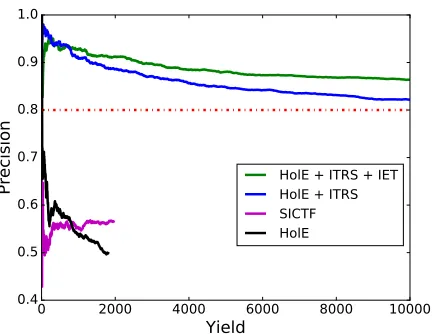
Figure 1: Precision-yield curves for various embedding-based methods on the Animals tensor. State-of-the-art named-entity inspired approaches (black, pink) have low precision even at a low yield. TransE is omitted due to its very low precision here, around 10%. Our method (HolE+ITRS+IET, green) doubles the size of the starting tensor at a precision of 86.4%.
5.2 Guided KB Completion
We first compare our method (Section 3) with exist-ing KB completion techniques on the Animals ten-sor, and then demonstrate that its effectiveness car-ries over scalably to the larger Science tensor as well. In what follows, T denotes the tensor under
consideration.
We examine two alternatives for generating nega-tive samples: given a triple(s, r, t) ∈ T, replaces
with (1) any entitys0or (2) an entitys0 of the same
type ass. The resulting perturbed triple(s0, r, t)is then treated as a negative sample if it is not present inT. We also considered a weighted combination of (1) and (2), and found random sampling to be the most reliable on our datasets. This complies with the commonly used LCWA assumption not being appli-cable to these tensors.
HolE SICTF HolE+ITRS+IET farm,join,farm penguin,has part,tooth salmon,thrive in,water family,join,family mosquito,spread,parasite animal,give birth to,animal tree,resemble,tree spider,has part,skin duck,feed in,water water,is known as,water elephant,eat,fish fish,migrate to,water virus,attract,virus shark,has part,skin fish,thrive in,water animal,resemble,animal crab,eat,insect turtle,swim in,water tree,is known as,tree snake,eat,fish salmon,swim in,water habitat,is known as,habitat otter,has part,tooth turtle,live in,water envment.,is known as,envment. meat,attract,hummingbird animal,chew,food man,join,man spider,has part,claw insect,destroy,tree bird,give birth to,bird turtle,has part,tooth farm,possess,horse region,is known as,region human,eat,plant fish,swim in,ocean virus,derive from,virus monkey,has part,wing turtle,feed in,water food,resemble,food dolphin,has part,tooth turtle,float in,water bird,is known as,bird carnivore,live in,water dinosaur,walk on,leg field,resemble,field lizard,eat,fish turtle,migrate to,water fish,is known as,fish pelican,has part,tooth turtle,return to,water bird,resemble,bird caterpillar,turn into,bird man,ride,cattle grass,graze in,man bee,pollinate,garden turtle,swim in,ocean animal,is known as,animal virus,infect,bird fish,float in,ocean
Table 2: Top 20 predictions by various methods, with invalid triples underlined and uninteresting ones , such as (X, is known as, X) or (Y, resembles, Y), shown initalics. While some of this assessment can be subjective, it is evident that our method, HolE+ITRS+IET, generates many more triples that are valid and interesting than competing approaches.
RESCAL and incorporates schema.
Figure 1 shows the resulting precision-yield curves for the predictions made by each method on theAnimalsdataset containing 10.6K facts. Specif-ically, for each method, we rank the predictions based on the method’s assigned score and compute the precision of the top k predictions for varying k. As expected, we observe a generally decreasing
trend askincreases. TransE+ITRS gave a precision of only around 10% and is omitted from the plot. We make two observations:
First, deriving new facts for these generics tensors at a high precision is challenging! Specifically, none of the baseline methods (black and pink curves), which represent state of the art for named-entity ten-sors, achieve a yield of more than 10% ofT (i.e., 1K predictions) even at a precision of just 60%.
Second, external information, if used appropri-ately, can be surprisingly powerful in this setting. Specifically, simply incorporating relation schema (ITRS, blue curve) allows HolE-based completion to double the size of the starting tensor T by pro-ducing over 10K new triples at a precision of 82%. Further, incorporating entity taxonomy (IET, green
curve) to address tensor sparsity results in the same yield at a statistically significantly higher precision of 86.4%.
It turns out that not only does our method result in substantially improved PR curves, it also generates
qualitatively more interesting and useful generic facts about the world than previous methods. We illustrate this in Table 2, which lists the top 20 pre-dictions made by various approaches. The triples shown in red are false predictions (e.g., (penguin, has part, tooth), (grass, graze in, man), (caterpil-lar, turn into, bird)) or uninteresting ones (e.g., (wa-ter, is known as, water)). As we see, a vast major-ity of the top 20 predictions made by both vanilla HolE and SICTF fall into these categories. On the other hand, our method, HolE+ITRS+IET, predicts 19 true tripes out of the top 20, including interesting scientific facts that were evidently missing from the starting tensor, such as (salmon, thrive in, water), (fish, swim in, ocean)and(insect, destroy, tree).
Finally, we evaluate our proposal on the entire
substan-# New True Triples Inferred
Query Subset From Sibling Tensor
Proposal Selection Anntation Argument Factorization Total
Random - 0 - 0 0
Schema Consistent TK 73 - 10 83
Schema Consistent SM 57 - 27 84
Sibling Guided TK 96 17 211 324
[image:12.612.134.478.53.159.2]Sibling Guided SM 100 17 366 483
Table 3: Active Learning for new entities: Number of new facts inferred (from annotation, sibling agreement, tensor factorization, and in total) for a representative new entitye˜, when querying 100 facts about˜efor human annotation.
tially worse there, we focus here on the scalability and prediction quality of our method. We found that HolE+ITRS+IET scales well to this high dimen-sion, doubling the number of factsby adding 66K new facts at74% precision. Although the Science tensor is 1,000 times larger than the Animals tensor, the method took only 10x longer to run (3 minutes on Animals tensor vs. 56 minutes on Science ten-sor, using a 2.8GHz, 16GB Macbook Pro). With additional improvements such as parallelization, it is easily possible to further scale the method up to substantially larger tensors.
5.3 Active Learning for New Entities
To assess the quality of our active learning mecha-nism (Section 4), we consider predicting facts about a new entity˜ethat is not in the Animals tensor. For
illustration, we choose e˜ from the Science tensor vocabulary while ensuring that it is present in the WordNet taxonomy.
The setup is as follows. We first use aquery gen-eration mechanism(Random, Schema Consistent, or Sibling Guided; cf. Section 4.1) to propose an or-dered listLof facts about e˜to annotate. Next, we performsubset selection(Topkor TK, Submodular
or SM; cf. Section 4.2) onLto identify a subsetLb
of up to100most promising queries. These are then annotated and the true ones fed into tensor factor-ization as additional input to infer further new facts aboute˜.
In Table 3, we assess the quality ofLbin two ways, when|Lb|= 100: how many true facts doesLb have
and how many overall new facts does this annotation produce aboute˜. Figure 2 provides a complemen-tary view, focusing on the overall number of new facts inferred as |Lb| increases. While these
illus-50 60 70 80 90 100
Number of Facts Annotated 0
100 200 300 400 500
Ne
w
Facts
Inferred
SiblingGuided + SM SiblingGuided + TK SchemaConsistent + TK SchemaConsistent + SM Random Queries
Figure 2: Active Learning for new entities: Total num-ber of new inferred facts (y-axis) for various human an-notation query sizes (x-axis). The use of subset selection (green triangles, top) and sibling information (blue cir-cles, 2ndfrom top) vastly outperforms various baselines.
trative numbers are for a representative new entity, reindeer, the overall trend and order of numbers re-mained the same for other new entities we experi-mented with.
We mention some highlights from Table 3. First, not surprisingly, randomly choosing triples about˜e
to annotate is ineffective. Second, choosing schema consistent triples results in 73 true triples (out of 100) but these facts help tensor factorization very lit-tle, resulting in only 10 additional new triples about ˜
e. Our proposed sibling guided querying
[image:12.612.315.538.212.375.2]facts about˜e. These facts cover interesting new in-formation such as(reindeer, eat, fruit),(wolf, chase, reindeer), and(reindeer, provide, fur).
Finally, the plot in Figure 2 demonstrates that the qualitative trends remain the same, irrespective of the number |Lb| of queries annotated. Overall, our sibling guided queries with submodular subset se-lection (green triangles, top-most curve) ultimately results in 5.8 times more new facts about e˜ than a non-trivial, uncertainly based, schema consistent baseline (black stars, 3rd curve from the top). This attests to the efficacy of the method on this challeng-ing problem and dataset.
6 Conclusion
This work explores KB completion for a new class of problems, namely completing generics KBs, which is an essential step for including general world knowledge in intelligent machines. The dif-ferences between generics and much studied named entity KBs make existing techniques either not scale well or produce facts at an undesirably low preci-sion out of the box. We demonstrate that incorporat-ing entity taxonomy and relation schema appropri-ately can be highly effective for generics KBs. Fur-ther, to address scarcity of facts about certain enti-ties in such KBs, we present a novel active learn-ing approach uslearn-ing sibllearn-ing guided uncertainty esti-mation along with submodular subset selection. The proposed techniques substantially outperform vari-ous baselines, setting a new state of the art for this challenging class of completion problems.
Our method is applicable to KBs that have an as-sociated entity taxonomy and relation schema. It is expected to be successful when information from siblings can be used to guide what is likely to be true and what is a good candidate to query for a given entity. We focus on KBs of generics where such in-formation is available and—as we show—is highly valuable for effective KB completion.
Why does our use of types work substantially bet-ter in our setting than the use of types in various baselines? One hypothesis is the following. The use of complicated models requires substantial data and information. In our KB, the information appears so sparse and incomplete that using types in compli-cated ways is not productive. Our proposal instead
attempts to use type information only to gently en-hance the signal and reduce noise, before perform-ing tensor decomposition. We hope this work will trigger further exploration of knowledge bases with generics, a key aspect of machine intelligence.
Acknowledgments
The authors would like to thank Peter Clark for fruitful discussions, valuable feedback, and crowdsourcing anno-tations; Matt Gardner for constructive comments and as-sessing graph-based completion methods on our datasets; and Udai Saini and Partha Talukdar for evaluating their CNTF approach on our datasets.
References
Michele Banko, Michael J. Cafarella, Stephen Soderland, Matthew Broadhead, and Oren Etzioni. 2007. Open information extraction from the web. InIJCAI, pages 2670–2676.
Kurt Bollacker, Colin Evans, Praveen Paritosh, Tim Sturge, and Jamie Taylor. 2008. Freebase: a collabo-ratively created graph database for structuring human knowledge. InICMD, pages 1247–1250. ACM. Antoine Bordes, Nicolas Usunier, Alberto Garcia-Duran,
Jason Weston, and Oksana Yakhnenko. 2013. Trans-lating embeddings for modeling multi-relational data. InNIPS, pages 2787–2795.
Kai-Wei Chang, Wen-tau Yih, Bishan Yang, and Christo-pher Meek. 2014. Typed tensor decomposition of knowledge bases for relation extraction. InEMNLP, pages 1568–1579.
Yudong Chen, Srinadh Bhojanapalli, Sujay Sanghavi, and Rachel Ward. 2014. Coherent matrix completion. InICML.
Bhavana Dalvi, Niket Tandon, and Peter Clark. 2017. Domain-targeted, high precision knowledge extrac-tion. TACL, 5:233–246.
Thomas Demeester, Tim Rockt¨aschel, and Sebastian Riedel. 2016. Lifted rule injection for relation em-beddings. InEMNLP, pages 1389–1399.
Xin Dong, Evgeniy Gabrilovich, Geremy Heitz, Wilko Horn, Ni Lao, Kevin Murphy, Thomas Strohmann, Shaohua Sun, and Wei Zhang. 2014. Knowledge Vault: A web-scale approach to probabilistic knowl-edge fusion. InKDD, pages 601–610. ACM.
Katsuhiko Hayashi and Masashi Shimbo. 2017. On the equivalence of holographic and complex embeddings for link prediction. InACL, pages 554–559.
Manjunath Hegde and Partha P. Talukdar. 2015. An entity-centric approach for overcoming knowledge graph sparsity. InEMNLP, pages 530–535.
Alexandros Komninos and Suresh Manandhar. 2017. Feature-rich networks for knowledge base completion. InACL, pages 324–329.
Akshay Krishnamurthy and Aarti Singh. 2013. Low-rank matrix and tensor completion via adaptive sam-pling. InNIPS, pages 836–844.
Denis Krompaß, Maximilian Nickel, and Volker Tresp. 2014. Large-scale factorization of type-constrained multi-relational data. In 2014 International Con-ference on Data Science and Advanced Analytics (DSAA), pages 18–24. IEEE.
Denis Krompaß, Stephan Baier, and Volker Tresp. 2015. Type-constrained representation learning in knowl-edge graphs. InInternational Semantic Web Confer-ence, pages 640–655. Springer.
Ni Lao, Tom Mitchell, and William W Cohen. 2011. Random walk inference and learning in a large scale knowledge base. InEMNLP, pages 529–539.
Sarah-Jane Leslie. 2008. Generics: Cognition and acqui-sition. Pholosophical Review, 117(1):1–47.
Xiang Li, Aynaz Taheri, Lifu Tu, and Kevin Gimpel. 2016. Commonsense knowledge base completion. In ACL, pages 1445–1455.
George A. Miller. 1995. WordNet: A lexical database for English. Communications of the ACM, 38(11):39–41. Karthik Narasimhan, Adam Yala, and Regina Barzilay. 2016. Improving information extraction by acquir-ing external evidence with reinforcement learnacquir-ing. In EMNLP, pages 2355–2365.
George L. Nemhauser, Laurence A. Wolsey, and Mar-shall L. Fisher. 1978. An analysis of approximations for maximizing submodular set functions - I. Mathe-matical Programming, 14(1):265–294.
Maximilian Nickel, Volker Tresp, and Hans-Peter Kriegel. 2011. A three-way model for collective learning on multi-relational data. In ICML, pages 809–816.
Maximilian Nickel, Kevin Murphy, Volker Tresp, and Ev-geniy Gabrilovich. 2016a. A review of relational ma-chine learning for knowledge graphs. Proceedings of the IEEE, 104(1):11–33.
Maximilian Nickel, Lorenzo Rosasco, and Tomaso A. Poggio. 2016b. Holographic embeddings of knowl-edge graphs. InAAAI, pages 1955–1961.
Madhav Nimishakavi, Uday Singh Saini, and Partha Talukdar. 2016. Relation schema induction using ten-sor factorization with side information. InEMNLP, pages 414–423.
Sebastian Riedel, Limin Yao, Andrew McCallum, and Benjamin M. Marlin. 2013. Relation extraction with matrix factorization and universal schemas. In HLT-NAACL, pages 74–84.
Tim Rocktaschel, Sameer Singh, and Sebastian Riedel. 2015. Injecting logical background knowledge into embeddings for relation extraction. InNAACL, pages 1119–1129.
Ashish Sabharwal and Hanie Sedghi. 2017. How good are my predictions? Efficiently approximating precision-recall curves for massive datasets. InUAI. Hinrich Sch¨utze, Yadollah Yaghoobzadeh, and Heike
Adel. 2017. Noise mitigation for neural entity typing and relation extraction. InEACL, pages 1183–1194. Burr Settles. 2012. Active Learning. Morgan &
Clay-pool.
Baoxu Shi and Tim Weninger. 2017. ProjE: Embedding projection for knowledge graph completion. InAAAI, pages 1236–1242.
Th´eo Trouillon, Johannes Welbl, Sebastian Riedel, ´Eric Gaussier, and Guillaume Bouchard. 2016. Com-plex embeddings for simple link prediction. InICML, pages 2071–2080.
Ruobing Xie, Zhiyuan Liu, Jia Jia, Huanbo Luan, and Maosong Sun. 2016a. Representation learning of knowledge graphs with entity descriptions. InAAAI, pages 2659–2665.
Ruobing Xie, Zhiyuan Liu, and Maosong Sun. 2016b. Representation learning of knowledge graphs with hi-erarchical types. InIJCAI, pages 2965–2971.