Transforming Dependency Structures to Logical Forms for Semantic Parsing
Siva Reddy†a Oscar T¨ackstr¨om‡ Michael Collins‡b Tom Kwiatkowski‡ Dipanjan Das‡ Mark Steedman† Mirella Lapata†
†ILCC, School of Informatics, University of Edinburgh ‡Google, New York
{oscart,mjcollins,tomkwiat,dipanjand}@google.com {steedman,mlap}@inf.ed.ac.uk
Abstract
The strongly typed syntax of grammar for-malisms such as CCG, TAG, LFG and HPSG offers a synchronous framework for deriving syntactic structures and semantic logical forms. In contrast—partly due to the lack of a strong type system—dependency structures are easy to annotate and have become a widely used form of syntactic analysis for many languages. However, the lack of a type system makes a formal mechanism for deriving logical forms from dependency structures challenging. We address this by introducing a robust system based on the lambda calculus for deriving neo-Davidsonian logical forms from dependency trees. These logical forms are then used for semantic parsing of natural language to Free-base. Experiments on the Free917 and Web-Questions datasets show that our representation is superior to the original dependency trees and that it outperforms a CCG-based representa-tion on this task. Compared to prior work, we obtain the strongest result to date on Free917 and competitive results on WebQuestions.
1 Introduction
Semantic parsers map sentences onto logical forms that can be used to query databases (Zettlemoyer and Collins, 2005; Wong and Mooney, 2006), instruct robots (Chen and Mooney, 2011), extract information (Krishnamurthy and Mitchell, 2012), or describe vi-sual scenes (Matuszek et al., 2012). Current systems accomplish this by learning task-specific grammars (Berant et al., 2013), by using strongly-typed CCG grammars (Reddy et al., 2014), or by eschewing the use of a grammar entirely (Yih et al., 2015).
aWork carried out during an internship at Google. bOn leave from Columbia University.
Disney acquired Pixar
nnp vbd nnp
nsubj root dobj
(a) The dependency tree forDisney acquired Pixar.
(nsubj (dobj acquired Pixar) Disney) (b) The s-expression for the dependency tree.
λx.∃yz.acquired(xe)∧Disney(ya)∧Pixar(za)
∧arg1(xe, ya)∧arg2(xe, za)
(c) The composed lambda-calculus expression.
Figure 1: The dependency tree is binarized into its s-expression, which is then composed into the lambda expression representing the sentence logical form.
In recent years, there have been significant ad-vances in developing fast and accurate dependency parsers for many languages (McDonald et al., 2005;
Nivre et al., 2007;Martins et al., 2013, inter alia). Motivated by the desire to carry these advances over to semantic parsing tasks, we present a robust method for mapping dependency trees to logical forms that represent underlying predicate-argument structures.1
We empirically validate the utility of these logical forms for question answering from databases. Since our approach uses dependency trees as input, we hy-pothesize that it will generalize better to domains that are well covered by dependency parsers than methods that induce semantic grammars from scratch.
The system that maps a dependency tree to its log-ical form (henceforth DEPLAMBDA) is illustrated in Figure1. First, the dependency tree is binarized via an obliqueness hierarchy to give ans-expression
that describes the application of functions to pairs
1By “robust”, we refer to the ability to gracefully handle
parse errors as well as the untyped nature of dependency syntax.
127
of arguments. Each node in this s-expression is then substituted for a lambda-calculus expression and the relabeled s-expression is beta-reduced to give the log-ical form in Figure1(c). Since dependency syntax does not have an associated type theory, we introduce a type system that assigns a single type to all con-stituents, thus avoiding the need for type checking (Section2). DEPLAMBDAuses this system to gener-ate robust logical forms, even when the dependency structure does not mirror predicate-argument relation-ships in constructions such as conjunctions, prepo-sitional phrases, relative clauses, and wh-questions (Section3).
These ungrounded logical forms (Kwiatkowski et al., 2013; Reddy et al., 2014; Krishnamurthy and Mitchell, 2015) are used for question answer-ing against Freebase, by passanswer-ing them as input to GRAPHPARSER(Reddy et al., 2014), a system that learns to map logical predicates to Freebase, result-ing ingroundedFreebase queries (Section4). We show that our approach achieves state-of-the-art per-formance on the Free917 dataset and competitive performance on the WebQuestions dataset, whereas building the Freebase queries directly from depen-dency trees gives significantly lower performance. Finally, we show that our approach outperforms a di-rectly comparable method that generates ungrounded logical forms using CCG. Details of our experimen-tal setup and results are presented in Section5and Section6, respectively.
2 Logical Forms
We use a version of the lambda calculus with three base types: individuals (Ind), events (Event), and
truth values (Bool). Roughly speaking individuals
are introduced by nouns, events are introduced by verbs, and whole sentences are functions onto truth values. For typesAandB, we useA×Bto denote
the product type, whileA → B denotes the type
of functions mapping elements ofAto elements of B. We will make extensive use of variables of type Ind×Event. For any variable xof type Ind× Event, we usex = (xa, xe) to denote the pair of
variablesxa(of typeInd) andxe(of typeEvent).
Here, the subscript denotes the projections·a:Ind× Event→Indand·e :Ind×Event→Event.
An important constraint on the lambda calculus system is as follows: All natural language
con-stituents have a lambda-calculus expression of type
Ind×Event→Bool.
A “constituent” in this definition is either a sin-gle word, or an s-expression. S-expressions are defined formally in the next section;
examples are (dobj acquired Pixar) and
(nsubj (dobj acquired Pixar) Disney). Essen-tially, s-expressions are binarized dependency trees, which include an ordering over the different dependencies to a head (in the above the dobj
modifier is combined before thensubj modifier). Some examples of lambda-calculus expressions for single words (lexical entries) are as follows: acquired ⇒ λx.acquired(xe)
Disney ⇒ λy.Disney(ya)
Pixar ⇒ λz.Pixar(za)
An example for a full sentence is as follows: Disney acquired Pixar ⇒
λx.∃yz.acquired(xe)∧Disney(ya)
∧Pixar(za)∧arg1(xe, ya)∧arg2(xe, za)
This is a neo-Davidsonian style of analysis. Verbs such asacquired make use of event variables such asxe, whereas nouns such asDisney make use of
individual variables such asya.
The restriction that all expressions are of type
Ind×Event→Boolsimplifies the type system
considerably. While it leads to difficulty with some linguistic constructions—see Section3.3for some examples—we believe the simplicity and robustness of the resulting system outweighs these concerns. It also leads to some spurious variables that are bound by lambdas or existentials, but which do not appear as arguments of any predicate: for example in the above analysis forDisney acquired Pixar, the variablesxa,
yeandzeare unused. However these “spurious”
vari-ables are easily identified and discarded.
An important motivation for having variables of typeInd×Eventis that a single lexical item
some-times makes use of both types of variables. For exam-ple, the noun phrasepresident in 2009has semantics λx.∃y.president(xa)∧president event(xe)∧
arg1(xe, xa)∧2009(ya)∧prep.in(xe, ya)
In this example president introduces the predi-catespresident, corresponding to an individual, and
president event, corresponding to an event;
Freebase contains an individual corresponding to
Barack Obama, with apresident property, as well as an event corresponding to theObama presidency, with various properties such as a start and end date, a location, and so on. The entry forpresident is then
λx.president(xa)∧president event(xe) ∧arg1(xe, xa)
Note that proper nouns do not introduce an event predicate, as can be seen from the entries forDisney
andPixarabove.
3 Dependency Structures to Logical Forms
We now describe the system used to map dependency structures to logical forms. We first give an overview of the approach, then go into detail about various linguistic constructions.
3.1 An Overview of the Approach
The transformation of a dependency tree to its logical form is accomplished through a series of three steps:
binarization,substitution, andcomposition. Below,
we outline these steps, with some additional remarks.
Binarization. A dependency tree is mapped to an s-expression (borrowing terminology from Lisp). For example,Disney acquired Pixar has the s-expression
(nsubj (dobj acquired Pixar) Disney)
Formally, an s-expression has the form
(exp1 exp2 exp3), where exp1 is a dependency
label, and bothexp2andexp3are either (1) a word
such as acquired; or (2) an s-expression such as
(dobj acquired Pixar).
We refer to the process of mapping a dependency tree to an s-expression asbinarization, as it involves an ordering of modifiers to a particular head, similar to binarization of a context-free parse tree.
Substitution. Each symbol (word or label) in the s-expression is assigned a lambda expression. In our running example we have the following assignments: acquired ⇒λx.acquired(xe)
Disney ⇒λy.Disney(ya)
Pixar ⇒λz.Pixar(za)
nsubj ⇒λf gz.∃x. f(z)∧g(x)∧arg1(ze, xa)
dobj ⇒λf gz.∃x. f(z)∧g(x)∧arg2(ze, xa)
Composition. Beta-reduction is used to compose the lambda-expression terms to compute the final semantics for the input sentence. In this step expres-sions of the form(exp1 exp2 exp3)are interpreted as functionexp1being applied to argumentsexp2
andexp3. For example,(dobj acquired Pixar)
re-ceives the following expression after composition: λz.∃x.acquired(ze)∧Pixar(xa)∧arg2(ze, xa)
Obliqueness Hierarchy. The binarization stage re-quires a strict ordering on the different modifiers to each head in a dependency parse. For example, in(nsubj (dobj acquired Pixar) Disney), thedobj
is attached before thensubj. The ordering is very
similar to the obliqueness hierarchy in syntactic for-malisms such as HPSG (Pollard and Sag, 1994).
Type for Dependency Labels. Recall from Sec-tion2that every s-expression subtree receive a log-ical form of typeη = Ind×Event → Bool. It
follows that in any s-expression(exp1 exp2 exp3), exp1has typeη → (η → η),exp2andexp3both
have typeη, and the full expression has typeη. Since each labeled dependency relation (e.g.,nsubj,dobj, partmod) is associated withexp1in connecting two
s-expression subtrees, dependency labels always re-ceive expressions of typeη→(η→η).
Mirroring Dependency Structure. Whenever a dependency label receives an expression of the form
λf gz.∃x. f(z)∧g(x)∧rel(ze, xa) (1)
whererelis a logical relation, the composition
op-eration builds a structure that essentially mirrors the original dependency structure. For examplensubj
anddobjreceive expressions of this form, withrel
=arg1andrel=arg2, respectively; the final lambda
expression forDisney acquired Pixaris λx.∃yz.acquired(xe)∧Disney(ya)
∧Pixar(za)∧arg1(xe, ya)∧arg2(xe, za)
This structure is isomorphic to the original depen-dency structure: there are variables xe, ya and
za corresponding to acquired, Disney and Pixar,
respectively; and the sub-expressions arg1(xe, ya)
andarg2(xe, za)correspond to the dependencies
ac-quired →Disney andacquired →Pixar.
and many dependency labels receive a semantics of the form shown in (1). However, there are a num-ber of important exceptions. As one example, the dependency labelpartmodreceives semantics
λf gz.∃x. f(z)∧g(x)∧arg1(xe, za)
witharg1(xe, za)in place of thearg1(ze, xa)in (1).
This reverses the dependency direction to capture the predicate-argument structure of reduced relative constructions such asa company acquired by Disney.
Post-processing. We apply three post-processing steps—simple inferences over lambda-calculus expressions—to the derived logical forms. These relate to the handling of prepositions, coordination and control and are described and motivated in more detail under the respective headings below.
3.2 Analysis of Some Linguistic Constructions
In this section we describe in detail how various lin-guistic constructions not covered by the rule in (1)— prepositional phrases, conjunction, relative clauses, and Wh questions—are handled in the formalism.2
Prepositional Phrases. Prepositional phrase mod-ifiers to nouns and verbs have similar s-expressions:
(prep president (pobj in 2009)) (prep acquired (pobj in 2009))
The following entries are used in these examples: in⇒λx.in(xe)
prep⇒λf gz.∃x. f(z)∧g(x)∧prep(ze, xa)
pobj⇒λf gz.∃x. f(z)∧g(x)∧pobj(ze, xa)
president⇒λx.president(xa)
∧president event(xe)∧arg1(xe, xa)
acquired⇒λx.acquired(xe)
where the entries forprepandpobjsimply mirror the
original dependency structure withprepmodifying the event variableze.
The semantics foracquired in 2009 is as follows: λx.∃py.acquired(xe)∧2009(ya)
∧in(pe)∧prep(xe, pe)∧pobj(pe, ya)
2The system contains 32 binarization rules (e.g., rules for
obliqueness hierarchy and identifying traces) and 46 substi-tution rules (i.e., rules for dependency labels and parts of speech). The rules can be found athttp://github.com/ sivareddyg/deplambda.
We replacein(pe)∧prep(xe, pe)∧pobj(pe, ya)by prep.in(xe, ya)as a post-processing step, effectively
collapsing out the p variable while replacing the
prepandpobjdependencies by a single dependency,
prep.in. The final semantics are then as follows:
λx.∃y.acquired(xe)∧2009(ya)∧prep.in(xe, ya)
In practice this step is easily achieved by identifying variables (in this casepe) participating inprepand pobjrelations. It would be tempting to achieve this
step within the lambda calculus expressions them-selves, but we have found the post-processing step to be more robust to parsing errors and corner cases in the usage of theprepandpobjdependency labels.
Conjunctions. First consider a simple case of NP-conjunction, Bill and Dave founded HP, whose s-expression is as follows:
(nsubj (dobj founded HP)
(conj-np (cc Bill and) Dave))
We make use of the following entries:
conj-np⇒λf gx.∃yz. f(y)∧g(z)∧coord(x, y, z)
cc⇒λf gz. f(z)
The sentenceBill and Dave founded HP then re-ceives the following semantics:
λe.∃xyzu.Bill(ya)∧Dave(za)∧founded(ee)∧HP(ua) ∧coord(x, y, z)∧arg1(ee, xa)∧arg2(ee, ua) Note how the x variable occurs in two sub-expressions: coord(x, y, z), and arg1(ee, xa). It
can be interpreted as a variable that conjoins variables y and z together. In particular, we introduce a post-processing step where the sub-expressioncoord(x, y, z)∧arg1(ee, xa)is replaced
witharg1(ee, ya)∧arg1(ee, za), and thexvariable
is removed. The resulting expression is as follows: λe.∃yzu.Bill(ya)∧Dave(za)∧founded(ee)∧HP(ua)
∧arg1(ee, ya)∧arg1(ee, za)∧arg2(ee, ua)
VP-coordination is treated in a very similar way. Consider the sentenceEminem signed to Interscope and discovered 50 Cent. This has the following s-expression:
(nsubj (conj-vp (cc s-to-I and) d-50) Eminem)
wheres-to-Irefers to the VP signed to Interscope, andd-50refers to the VPdiscovered 50 Cent. The
lambda-calculus expression forconj-vpis identical
conj-vp⇒λf gx.∃yz. f(y)∧g(z)∧coord(x, y, z)
The logical form for the full sentence is then λe.∃xyz.Eminem(xa)∧coord(e, y, z)
∧arg1(ee, xa)∧ s to I(y)∧d 50(z)
where we uses to I(y)andd 50(z)as shorthand for
the lambda-calculus expressions for the two VPs. After post-processing this is simplified to
λe.∃xyz.Eminem(xa)∧arg1(ye, xa)
∧arg1(ze, xa)∧s to I(y)∧d 50(z)
Other types of coordination, such as sentence-level coordination and PP coordination, are handled with the same mechanism. All coordination depen-dency labels have the same semantics as conj-np
andconj-vp. The only reason for having distinct
de-pendency labels for different types of coordination is that different labels appear in different positions in the obliqueness hierarchy. This is important for getting the correct scope for different forms of con-junction. For instance, the following s-expression for theEminem example would lead to an incorrect semantics:
(conj-vp (nsubj (cc s-to-I and) Eminem) d-50)
This s-expression is not possible under the oblique-ness hierarchy, which placesnsubjmodifiers to a
verb afterconj-vpmodifiers.
We realize that this treatment of conjunction is quite naive in comparison to that on offer in CCG. However, given the crude analysis of conjunction in dependency syntax, a more refined treatment is beyond the scope of the current approach.
Relative Clauses. Our treatment of relative clauses is closely related to the mechanism for traces de-scribed by Moortgat (1988;1991); see alsoCarpenter (1998) andPereira (1990). Consider the NPApple which Jobs founded with s-expression:
(rcmod Apple
(wh-dobj(BINDf(nsubj (dobj foundedf) Jobs)) which))
Note that the s-expression has been augmented to include a variable f in dobj position, with
(BINDf...) binding this variable at the clause level. These annotations are added using a set of heuristic rules over the original dependency parse tree.
TheBINDoperation is interpreted in the following way. If we have an expression of the form
(BIND f λx. g(x))
where f is a variable and g is an expression that includesf, this is converted to
λz.∃x. g(x)|f=EQ(z)
whereg(x)|f=EQ(z)is the expressiong(x)with the
expressionEQ(z)substituted forf. EQ(z)(z0)is true
iffzandz0 are equal (refer to the same entity). In addition we assume the following entries:
wh-dobj⇒λf gz. f(z)
rcmod⇒λf gz. f(z)∧g(z)
It can be verified that (BIND f (nsubj (dobj foundedf)Jobs))has semantics
λu.∃xyz.founded(xe)∧Jobs(ya)∧EQ(u)(z)
∧arg1(xe, ya)∧arg2(xe, za)
andApple which Jobs founded has semantics λu.∃xyz.founded(xe)∧Jobs(ya)∧EQ(u)(z)
∧arg1(xe, ya)∧arg2(xe, za)∧Apple(ua)
as intended. Note that this latter expression can be simplified, by elimination of thezvariable, to λu.∃xy.founded(xe)∧Jobs(ya)
∧arg1(xe, ya)∧arg2(xe, ua)∧Apple(ua) Wh Questions. Wh questions are handled using theBIND-mechanism described in the previous sec-tion. As one example, the s-expression forWho did Jim marryis as follows:
(wh-dobj(BINDf (nsubj (aux (dobj marryf) did) Jim)) who)
We assume the following lambda expressions: Who ⇒λx.TARGET(xa)
did ⇒λx.TRUE
aux ⇒λf g. f
wh-dobj ⇒λf gx. f(x)∧g(x)
It can be verified that this gives the final logical form λx.∃yz.TARGET(xa)∧marry(ye)∧Jim(za)
∧arg1(ye, za)∧arg2(ye, xa)
3.3 Comparison to CCG
In this section we discuss some differences between our approach and CCG-based approaches for map-ping sentences to logical forms. Although our focus is on CCG, the arguments are similar for other for-malisms that use the lambda calculus in conjunction with a generative grammar, such as HPSG and LFG, or approaches based on context-free grammars.
Our approach differs in two important (and re-lated) respects from CCG: (1) all constituents in our approach have the same semantic type (Ind×
Event→Bool); (2) our formalism does not make
the argument/adjunct distinction, instead essentially treating all modifiers to a given head as adjuncts.
As an example, consider the analysis ofDisney acquired Pixar within CCG. In this case acquired
would be assigned the following CCG lexical entry:
S\NP/NP⇒λf2f1x.∃yz.acquired(x)∧f1(y)∧f2(z) ∧arg1(x, y)∧arg2(x, z)
Note the explicit arguments corresponding to the subject and object of this transitive verb (f1 andf2,
respectively). An intransitive verb such assleeps
would be assigned an entry with a single functional argument corresponding to the subject (f1):
S\NP⇒λf1x.∃y.sleeps(x)∧f1(y)∧arg1(x, y)
In contrast, the entries in our system for these two verbs are simply λx.acquired(xe) and
λx.sleeps(xe). The two forms are similar, have the
same semantic type, and do not include variables such asf1andf2for the subject and object.
The advantage of our approach is that it is ro-bust, and relatively simple, in that a strict gram-mar that enforces type checking is not required. However, there are challenges in handling some lin-guistic constructions. A simple example is passive verbs. In our formalism, the passive form of ac-quired has the formλx.acquired.pass(xe), distinct
from its active form λx.acquired(xe). The
sen-tencePixar was acquired is then assigned the log-ical formλx.∃y.acquired.pass(xe)∧Pixar(ya)∧ arg1(xe, ya). Modifying our approach to give the
same logical forms for active and passive forms would require a significant extension of our approach. In contrast, in CCG the lexical entry for the passive form ofacquired can directly specify the mapping between subject position and thearg2:
S\NP⇒λf2x.∃z.acquired(x)∧f2(z)∧arg2(x, z)
As another example, correct handling of object and subject control verbs is challenging in the single-type system: for example, in the analysis forJohn persuaded Jim to acquire Apple, the CCG analysis would have an entry for persuaded that explicitly takes three arguments (in this case John, Jim, and
to acquire Apple) and assignsJimas both the direct object ofpersuaded and as the subject ofacquire. In our approach the subject relationship toacquire is instead recovered in a post-processing step, based on the lexical identity ofpersuaded.
4 Semantic Parsing as Graph Matching
We next describe how the ungrounded logical forms from the previous section are mapped to a fully grounded semantic representation that can be used for question answering against Freebase. Follow-ingReddy et al. (2014), we treat this mapping as a graph matching problem, but instead of deriving un-grounded graphs from CCG-based logical forms, we use the dependency-based logical forms from the pre-vious sections. To learn the mapping to Freebase, we rely on manually assembled question-answer pairs. For each training question, we first find the set of
oraclegrounded graphs—Freebase subgraphs which
when executed yield the correct answer—derivable from the question logical form. These oracle graphs are then used to train a structured perceptron model.
4.1 Ungrounded Graphs
We followReddy et al. (2014) and first convert logi-cal forms to their corresponding ungrounded graphs. Figure2(a)shows an example forWhat is the name of the company which Disney acquired in 2006?. Predi-cates corresponding to resolved entities (Disney(ya)
and 2006(va)) become entity nodes (rectangles),
whereas remaining entity predicates (name(wa)and company(xa)) become entity nodes (wa and xa),
connected to entity type nodes (nameandcompany;
rounded rectangles). The TARGET(wa) node
(dia-mond) connects to the entity node whose denotation corresponds to the answer to the question.
4.2 Grounded Graphs
name target company
wa we xa
ze
Disney ze
ze
2006 acquired
.arg1
acquired
.arg2
acquired . prep . in acquired . arg 2 acquired .arg 1 acquired .prep .in name.arg1 name.prep.of
typ
e type
contract
(a) BeforeCONTRACT.
target
organization. organization
company
name xa
ze
Disney ze
ze
2006 acquired
.arg1 acquired
.arg2
business. acquistion. acquiring company business.acquistion. company acquired acquired . prep . in acquired . arg 2 business. acquisition. date business. acquistion. company acquired acquired .arg 1 acquired .prep .in business. acquistion. acquiring company business. acquisition. date type typ e
[image:7.612.74.296.53.228.2](b) AfterCONTRACT.
Figure 2: TheCONTRACToperation applied to the un-grounded graph for the questionWhat is the name of the company which Disney acquired in 2006?. AfterCON -TRACThas been applied the graph is isomorphic to the representation in Freebase; in (b) we show the Freebase predicates after grounding in blue.
edges and entity type nodes in the ungrounded graph to Freebase entities, relations and types, respec-tively. WhileReddy et al. (2014) assume that the un-grounded graphs are isomorphic to their correspond-ing Freebase subgraph, at least 15% of the examples in our development set do not satisfy this property. For example, the ungrounded graph in Figure2(a)
is not isomorphic to the Freebase subgraph in Fig-ure2(b), making it impossible to derive the correct grounded graph from the ungrounded one by a direct mapping. To account for such structural mismatch, we introduce two simple transformation operations.
CONTRACT. The CONTRACT operation takes a pair of entity nodes connected by an edge and merges them into a single node. For example, in Figure2(a)
the entity nodeswaandxaare connected by an edge
via the eventwe. After applying theCONTRACT
op-eration to nodeswaandxa, they are merged. Note
how in Figure2(b)all the nodes attached towaattach
to the nodexaafter this operation. The contracted
graph is now isomorphic to its Freebase subgraph.
EXPAND. Parse errors may lead to ungrounded graphs with disconnected components. For example, the ungrammatical questionWhat to do Washington DC December? results in the lambda expression λz.∃xyw.TARGET(xa) ∧do(ze)∧arg1(ze, xa)∧ Washington DC(ya)∧December(wa). The
corre-sponding ungrounded graph has three disconnected components (DecemberandWashington DC, and
the component with entity nodexalinked to event
ze). In such cases, the graph is expanded by
link-ing disconnected entity nodes to the event node with the largest edge degree. In the example above, this would add edges corresponding to the predicates
dep(ze, ya)∧dep(ze, wa), wheredep is the
predi-cate introduced by theEXPANDoperation when link-ingyaandwatoze. When there is no existing event
node in the graph, a dummy event node is introduced.
4.3 Learning
We use a linear model to map ungrounded to grounded graphs. The parameters of the model are learned from question-answer pairs. For example, the questionWhat is the name of the company which Disney acquired in 2006? is paired with its answer {Pixar}. In line with most work on question answer-ing against Freebase, we do not rely on annotated log-ical forms associated with the question for training, instead treating grounded graphs as latent variables.
Letqbe a question, letube an ungrounded graph forqand letgbe a grounded graph formed by ground-ing the nodes and edges ofuto the knowledge base K (throughout we use Freebase as the knowledge base). FollowingReddy et al. (2014), we use beam search to find the highest scoring pair of ungrounded and grounded graphs(ˆu,ˆg)under the modelθ∈ <n:
(ˆu,ˆg) = arg max (u,g)
θ·Φ(u, g, q,K),
whereΦ(u, g, q,K)∈ <ndenotes the features for the
pair of ungrounded and grounded graphs. Note that for a given query there may be multiple ungrounded graphs, primarily due to the optional use of theCON -TRACToperation.3 The feature function has access to the ungrounded and grounded graphs, to the question, as well as to the content of the knowledge base and the denotation|g|K (the denotation of a grounded
graph is defined as the set of entities or attributes reachable at itsTARGETnode). See Section5.3for the features employed.
The model parameters are estimated with the av-eraged structured perceptron (Collins, 2002;
Fre-3Another source of ambiguity may be a lexical item having
und and Schapire, 1999). Given a training question-answer pair(q,A), the update is:
θt+1 ←θt+ Φ(u+, g+, q,K)−Φ(ˆu,g, q,ˆ K),
where(u+, g+)denotes the pair of gold ungrounded
and grounded graphs forq. Since we do not have direct access to these gold graphs, we instead rely on the set oforacle graphs,OK,A(q), as a proxy:
(u+, g+) = arg max (u,g)∈OK,A(q)
θt·Φ(u, g, q,K),
whereOK,A(q)is defined as the set of pairs (u,g)
derivable from the questionq, whose denotation|g|K
has minimalF1-loss against the gold answerA. We
find the oracle graphs for each question a priori by performing beam-search with a beam size of 10k and only use examples with oracleF1 >0.0for training.
5 Experimental Setup
We next verify empirically that our proposed ap-proach derives a useful logical compositional seman-tic representation from dependency syntax. Below, we give details on the evaluation datasets and base-lines used for comparison. We also describe the model features and provide implementation details.
5.1 Training and Evaluation Datasets
We evaluated our approach on the Free917 (Cai and Yates, 2013) and WebQuestions (Berant et al., 2013) datasets. Free917 consists of 917 questions manually annotated with their Freebase query. We retrieved the answer to each question by executing its query on Freebase and ignore the query for all subsequent ex-periments. WebQuestions consists of 5810 question-answer pairs. The standard train/test splits were used for both datasets, with Free917 containing 641 train and 276 test questions and WebQuestions contain-ing 3030 train and 2780 test questions. For all our development experiments we tuned the models on held-out data consisting of 30% of the training ques-tions, while for final testing we used the complete training data.
5.2 Baseline Models and Representations
In addition to the dependency-based semantic rep-resentation DEPLAMBDA(Section3) and previous
work on these datasets, we compare to three addi-tional baseline representations outlined below. We use GRAPHPARSER4to map these representations to Freebase.
DEPTREE. In this baseline, an ungrounded graph is created directly from the original dependency tree. An event is created for each parent and its dependents in the tree. Each dependent is linked to this event with an edge labeled with its dependency relation, while the parent is linked to the event with an edge labeled
arg0. If a word is a question word, an additional
TARGETpredicate is attached to its entity node.
SIMPLEGRAPH. This representation has a single event to which all entities in the question are con-nected by the predicatearg1. An additionalTARGET
node is connected to the event by the predicatearg0.
This is similar to the template representation ofYao (2015) andBast and Haussmann (2015). Note that this cannot represent any compositional structure.
CCGGRAPH. Finally, we compare to the CCG-based semantic representation ofReddy et al. (2014), adding the CONTRACT andEXPAND operations to increase its expressivity.
5.3 Implementation Details
Below are more details of our entity resolution model, the syntactic parser used, features in the grounding model and the beam search procedure.
Entity Resolution. For Free917, we follow prior work and resolve entities by string match against the entity lexicon provided with the dataset. For Web-Questions, we use eight handcrafted part-of-speech patterns to identify entity span candidates. We use the Stanford CoreNLP caseless tagger for part-of-speech tagging (Manning et al., 2014). For each candidate mention span, we retrieve the top 10 entities accord-ing to the Freebase API.5We then create a lattice in
which the nodes correspond to mention-entity pairs, scored by their Freebase API scores, and the edges encode the fact that no joint assignment of entities to mentions can contain overlapping spans. Finally, we generate ungrounded graphs for the top 10 paths through the lattice and treat the final entity disam-biguation as part of the semantic parsing problem.
Representation -C -E -C +E +C -E +C +E (a) Average oracleF1
DEPTREE 30.8 30.8 72.8 72.8
SIMPLEGRAPH 73.0 73.0 73.0 73.0
CCGGRAPH 65.1 70.3 67.6 72.9
DEPLAMBDA 64.8 66.3 71.8 73.0
(b) Average number of oracle graphs per question
DEPTREE 1.5 1.5 354.6 354.6
SIMPLEGRAPH 1.5 1.5 1.8 1.8
CCGGRAPH 1.6 1.7 3.4 3.4
DEPLAMBDA 1.4 1.5 3.6 4.2
(c) AverageF1
DEPTREE 19.9 19.9 42.6 42.6
SIMPLEGRAPH 49.0 49.0 48.2 48.2
CCGGRAPH 44.7 47.3 46.5 48.9
[image:9.612.313.541.49.263.2]DEPLAMBDA 45.9 47.5 48.8 50.4
Table 1: Oracle statistics and accuracies on the Web-Questions development set. +(-)C: with(out)CONTRACT. +(-)E: with(out)EXPAND.
Syntactic Parsing. We recase the resolved entity mentions and run a case-sensitive second-order con-ditional random field part-of-speech tagger ( Laf-ferty et al., 2001). The hypergraph parser ofZhang and McDonald (2014) is used for dependency pars-ing. The tagger and parser are both trained on the OntoNotes 5.0 corpus (Weischedel et al., 2011), with constituency trees converted to Stanford-style depen-dencies (De Marneffe and Manning, 2008). To derive the CCG-based representation, we use the output of the EasyCCG parser (Lewis and Steedman, 2014).
Features. We use the features from Reddy et al. (2014), which include edge alignment and stem over-lap between ungrounded and grounded graphs, and contextual features such as word and grounded rela-tion pairs. In addirela-tion, we introduce a feature indi-cating the use of theCONTRACToperation: (
Merged-SubEdge, HeadMerged-SubEdge, MergedIsEntity, HeadIsEn-tity). For example, in Figure2the edge betweenwa
andxa is contracted toxa, resulting in the feature
(name.arg1, name.prep.of, False, False). The EX
-PANDoperation is treated as a pre-processing step and no features are used to encode its use. Finally, the entity-lattice score is used as a real valued feature.
Beam Search. We use beam search to infer the highest scoring graph pair for a question. The search operates over entity-entity edges and entity type nodes of each ungrounded graph. For an entity-entity
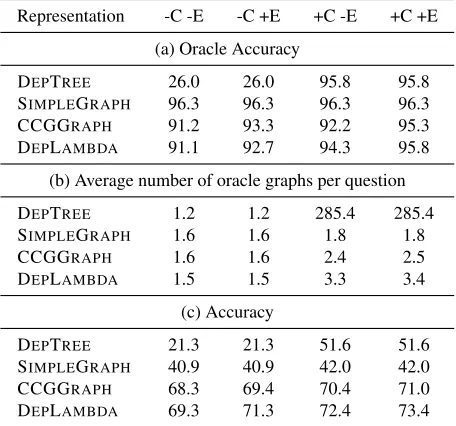
Representation -C -E -C +E +C -E +C +E (a) Oracle Accuracy
DEPTREE 26.0 26.0 95.8 95.8
SIMPLEGRAPH 96.3 96.3 96.3 96.3
CCGGRAPH 91.2 93.3 92.2 95.3
DEPLAMBDA 91.1 92.7 94.3 95.8
(b) Average number of oracle graphs per question
DEPTREE 1.2 1.2 285.4 285.4
SIMPLEGRAPH 1.6 1.6 1.8 1.8
CCGGRAPH 1.6 1.6 2.4 2.5
DEPLAMBDA 1.5 1.5 3.3 3.4
(c) Accuracy
DEPTREE 21.3 21.3 51.6 51.6
SIMPLEGRAPH 40.9 40.9 42.0 42.0
CCGGRAPH 68.3 69.4 70.4 71.0
[image:9.612.313.541.50.263.2]DEPLAMBDA 69.3 71.3 72.4 73.4
Table 2: Oracle statistics and accuracies on the Free917 development set. +(-)C: with(out)CONTRACT. +(-)E: with(out)EXPAND.
edge, we can ground the edge to a Freebase relation, contract the edge in either direction, or skip the edge. For an entity type node, we can ground the node to a Freebase type, or skip the node. The order of traversal is based on the number of named entities connected to an edge. After an edge is grounded, the entity type nodes connected to it are grounded in turn, before the next edge is processed. To restrict the search, if two beam items correspond to the same grounded graph, the one with the lower score is discarded. A beam size of 100 was used in all experiments.
6 Experimental Results
We examine the different representations for ques-tion answering along two axes. First, we compare their expressiveness in terms of answer reachability assuming a perfect model. Second, we compare their performance with a learned model. Finally, we con-duct a detailed error analysis of DEPLAMBDA, with a comparison to the errors made by CCGGRAPH. For WebQuestions evaluation is in terms of the av-erageF1-score across questions, while for Free917,
evaluation is in terms of exact answer accuracy.6
6.1 Expressiveness of the Representations
Table1(a) and Table2(a) show the oracleF1-scores
of each representation on the WebQuestions and
6We use the evaluation scripts available at http://
[image:9.612.70.301.50.263.2]Free917 development sets respectively. According to the first column (-C -E), the original DEPTREE repre-sentation can be directly mapped to Freebase for less than a third of the questions. Adding theCONTRACT operation (+C) improves this substantially to an ora-cleF1of about 73% on WebQuestions and 95.8% on
Free917. However, this comes at the cost of massive spurious ambiguity: from Table1(b) there are on av-erage over 300 oracle graphs for a single dependency tree. Table 1(c) shows the results of the different representations on the WebQuestions development set. Spurious ambiguity clearly hampers learning and DEPTREEfalls behind the other representations. CCGGRAPH and DEPLAMBDA align much more closely to Freebase and achieve similar oracle F1
scores with far less spurious ambiguity. SIMPLE -GRAPH, which cannot represent any compositional semantics, is competitive with these syntax-based representations. This might come as a surprise, but it simply reflects the fact that the dataset does not con-tain questions that require compositional reasoning.
6.2 Results on WebQuestions and Free917
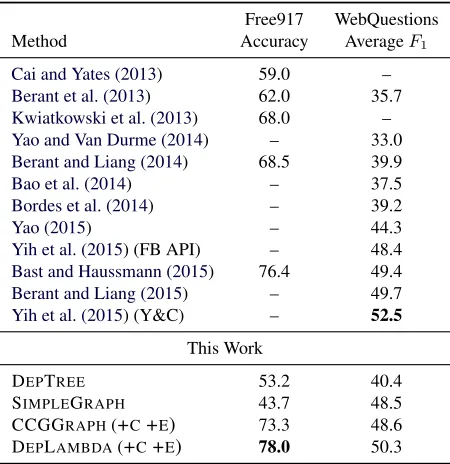
We use the best settings on the development set in subsequent experiments, i.e., withCONTRACTand EXPANDenabled. Table3shows the results on the WebQuestions and Free917 test sets with additional entries for recent prior work on these datasets. The trend from the development set carries over and DE -PLAMBDAoutperforms the other graph-based repre-sentations, while performing slightly below the state-of-the-art model ofYih et al. (2015) (“Y&C”), which uses a separately trained entity resolution system (Yang and Chang, 2015). When using the standard Freebase API (“FB API”) for entity resolution, the performance of their model drops to 48.4%F1.
On Free917, DEPLAMBDAoutperforms all other representations by a wide margin and obtains the best result to date. Interestingly, DEPTREEoutperforms SIMPLEGRAPH in this case. We attribute this to the small training set and larger lexical variation of Free917. The structural features of the graph-based representations seem highly beneficial in this case.
6.3 Error Analysis
We categorized 100 errors made by DEPLAMBDA (+C +E) on the WebQuestions development set. In 43 cases the correct answer is present in the beam,
Free917 WebQuestions
Method Accuracy AverageF1
Cai and Yates (2013) 59.0 –
Berant et al. (2013) 62.0 35.7
Kwiatkowski et al. (2013) 68.0 –
Yao and Van Durme (2014) – 33.0
Berant and Liang (2014) 68.5 39.9
Bao et al. (2014) – 37.5
Bordes et al. (2014) – 39.2
Yao (2015) – 44.3
Yih et al. (2015) (FB API) – 48.4
Bast and Haussmann (2015) 76.4 49.4
Berant and Liang (2015) – 49.7
Yih et al. (2015) (Y&C) – 52.5
This Work
DEPTREE 53.2 40.4
SIMPLEGRAPH 43.7 48.5
CCGGRAPH(+C+E) 73.3 48.6
[image:10.612.314.539.54.286.2]DEPLAMBDA(+C+E) 78.0 50.3
Table 3:Question-answering results on the WebQuestions and Free917 test sets.
but ranked below an incorrect answer (e.g., forwhere does volga river start, the annotated gold answer is
Valdai Hills, which is ranked second, withRussia, Europe ranked first). In 35 cases, only a subset of the answer is predicted correctly (e.g, forwhat coun-tries in the world speak german, the system predicts
Germany from thehuman language.main country
Freebase relation, whereas the gold relation
human language.countries spoken ingives
multi-ple countries). Together, these two categories corre-spond to roughly 80% of the errors. In 10 cases, the Freebase API fails to add the gold entity to the lattice (e.g., forwho is blackwell, the correctblackwell en-tity was missing). Due to the way WebQuestions was crowdsourced, 9 questions have incorrect or incom-plete gold annotations (e.g.,what does each fold of us flag meansis answered withUSA). The remaining 3 cases are due to structural mismatch (e.g., inwho is the new governor of florida 2011, the graph failed to connect the target node with both2011 andFlorida).
victoria beckham kids namesandwhat nestle owns). Examples where DEPLAMBDAfails due to parse er-rors, but CCGGRAPH succeed include when was
blessed kateri born and where did anne frank live before the war. Note that theEXPANDoperation mit-igates some of these problems. While CCG is known for handling comparatives elegantly (e.g.,who was sworn into office when john f kennedy was assassi-nated), we do not have a special treatment for them in the semantic representation. Differences in syn-tactic parsing performance and the somewhat limited expressivity of the semantic representation are likely the reasons for CCGGRAPH’s lower performance. 7 Related Work
There are two relevant strands of prior work: gen-eral purpose ungrounded semantics and grounded semantic parsing. The former have been studied on their own and as a component in tasks such as seman-tic parsing to knowledge bases (Kwiatkowski et al., 2013;Reddy et al., 2014;Choi et al., 2015; Krishna-murthy and Mitchell, 2015), sentence simplification (Narayan and Gardent, 2014), summarization (Liu et al., 2015), paraphrasing (Pavlick et al., 2015) and relation extraction (Rockt¨aschel et al., 2015). There are two ways of generating these representations: ei-ther relying on syntactic structure and producing the semantics post hoc, or generating it directly from text. We adopt the former approach, which was pioneered byMontague (1973) and is becoming increasingly at-tractive with the advent of accurate syntactic parsers. There have been extensive studies on extracting semantics from syntactic representations such as LFG (Dalrymple et al., 1995), HPSG (Copestake et al., 2001; Copestake et al., 2005), TAG ( Gar-dent and Kallmeyer, 2003; Joshi et al., 2007) and CCG (Baldridge and Kruijff, 2002;Bos et al., 2004;
Steedman, 2012;Artzi et al., 2015). However, few have used dependency structures for this purpose.
Debusmann et al. (2004) and Cimiano (2009) de-scribe grammar-based conversions of dependencies to semantic representations, but do not validate them empirically. Stanovsky et al. (2016) use heuristics based on linguistic grounds to convert dependen-cies to proposition structures. B´edaride and Gar-dent (2011) propose a graph-rewriting technique to convert a graph built from dependency trees and se-mantic role structures to a first-order logical form,
and present results on textual entailment. Our work, in contrast, assumes access only to dependency trees and offers an alternative method based on the lambda calculus, mimicking the structure of knowledge bases such as Freebase; we further present extensive empir-ical results on recent question-answering corpora.
Structural mismatch between the source semantic representation and the target application’s represen-tation is an inherent problem with approaches using general-purpose representations.Kwiatkowski et al. (2013) propose lambda-calculus operations to gen-erate multiple type-equivalent expressions to handle this mismatch. In contrast, we use graph-transduction operations which are relatively easier to interpret. There is also growing work on converting syntactic structures to the target application’s structure without going through an intermediate semantic representa-tion, e.g., answer-sentence selection (Punyakanok et al., 2004;Heilman and Smith, 2010;Yao et al., 2013) and semantic parsing (Ge and Mooney, 2009;Poon, 2013;Parikh et al., 2015;Xu et al., 2015;Wang et al., 2015;Andreas and Klein, 2015).
A different paradigm is to directly parse the text into a grounded semantic representation. Typically, an over-generating grammar is used whose accepted parses are ranked (Zelle and Mooney, 1996; Zettle-moyer and Collins, 2005;Wong and Mooney, 2007;
Kwiatkowksi et al., 2010;Liang et al., 2011;Berant et al., 2013;Flanigan et al., 2014;Groschwitz et al., 2015). In contrast, Bordes et al. (2014) andDong et al. (2015) discard the notion of a target represen-tation altogether and instead learn to rank potential answers to a given question by embedding questions and answers into the same vector space.
8 Conclusion
Acknowledgements
This work greatly benefitted from discussions with Slav Petrov, John Blitzer, Fernando Pereira, Emily Pitler and Nathan Schneider. The authors would also like to thank Christopher Potts and the three anony-mous reviewers for their valuable feedback. We ac-knowledge the financial support of EU IST Cognitive Systems IP EC-FP7-270273 “Xperience” (Steedman) and EPSRC (EP/K017845/1) in the framework of the CHIST-ERA READERS project (Lapata).
References
Jacob Andreas and Dan Klein. 2015. Alignment-Based Compositional Semantics for Instruction Following. In
Proceedings of Empirical Methods on Natural Lan-guage Processing, pages 1165–1174.
Yoav Artzi, Kenton Lee, and Luke Zettlemoyer. 2015. Broad-coverage CCG Semantic Parsing with AMR. In
Proceedings of Empirical Methods on Natural Lan-guage Processing, pages 1699–1710.
Jason Baldridge and Geert-Jan Kruijff. 2002. Coupling CCG and Hybrid Logic Dependency Semantics. In Pro-ceedings of Association for Computational Linguistics, pages 319–326.
Junwei Bao, Nan Duan, Ming Zhou, and Tiejun Zhao. 2014. Knowledge-Based Question Answering as Ma-chine Translation. InProceedings of Association for Computational Linguistics, pages 967–976.
Hannah Bast and Elmar Haussmann. 2015. More Accu-rate Question Answering on Freebase. InProceedings of ACM International Conference on Information and Knowledge Management, pages 1431–1440.
Paul B´edaride and Claire Gardent. 2011. Deep Semantics for Dependency Structures. InProceedings of Confer-ence on Intelligent Text Processing and Computational Linguistics, pages 277–288.
Jonathan Berant and Percy Liang. 2014. Semantic Parsing via Paraphrasing. InProceedings of Association for Computational Linguistics, pages 1415–1425. Jonathan Berant and Percy Liang. 2015. Imitation
Learning of Agenda-Based Semantic Parsers. Transac-tions of the Association for Computational Linguistics, 3:545–558.
Jonathan Berant, Andrew Chou, Roy Frostig, and Percy Liang. 2013. Semantic Parsing on Freebase from Question-Answer Pairs. InProceedings of Empirical Methods on Natural Language Processing, pages 1533– 1544.
Antoine Bordes, Sumit Chopra, and Jason Weston. 2014. Question Answering with Subgraph Embeddings. In
Proceedings of Empirical Methods on Natural Lan-guage Processing, pages 615–620.
Johan Bos, Stephen Clark, Mark Steedman, James R. Cur-ran, and Julia Hockenmaier. 2004. Wide-Coverage Semantic Representations from a CCG Parser. In Pro-ceedings of International Conference on Computational Linguistics, pages 1240–1246.
Qingqing Cai and Alexander Yates. 2013. Large-scale Semantic Parsing via Schema Matching and Lexicon Extension. InProceedings of Association for Computa-tional Linguistics, pages 423–433.
Bob Carpenter. 1998. Type-Logical Semantics. MIT Press, Cambridge, MA, USA.
David L. Chen and Raymond J. Mooney. 2011. Learning to Interpret Natural Language Navigation Instructions from Observations. InProceedings of Association for the Advancement of Artificial Intelligence, pages 1–2. Eunsol Choi, Tom Kwiatkowski, and Luke Zettlemoyer.
2015. Scalable Semantic Parsing with Partial Ontolo-gies. InProceedings of Association for Computational Linguistics, pages 1311–1320.
Philipp Cimiano. 2009. Flexible Semantic Composition with DUDES. InProceedings of International Confer-ence on Computational Semantics, pages 272–276. Michael Collins. 2002. Discriminative Training Methods
for Hidden Markov Models: Theory and Experiments with Perceptron Algorithms. InProceedings of Empiri-cal Methods on Natural Language Processing, pages 1–8.
Ann Copestake, Alex Lascarides, and Dan Flickinger. 2001. An Algebra for Semantic Construction in Constraint-based Grammars. InProceedings of Associ-ation for ComputAssoci-ational Linguistics, pages 140–147. Ann Copestake, Dan Flickinger, Carl Pollard, and Ivan A.
Sag. 2005. Minimal Recursion Semantics: An In-troduction.Research on Language and Computation, 3(2-3):281–332.
Mary Dalrymple, John Lamping, Fernando C. N. Pereira, and Vijay A. Saraswat. 1995. Linear Logic for Mean-ing Assembly. InProceedings of Computational Logic for Natural Language Processing.
Marie-Catherine De Marneffe and Christopher D Manning. 2008. Stanford typed dependencies manual. Technical report, Stanford University.
Ralph Debusmann, Denys Duchier, Alexander Koller, Marco Kuhlmann, Gert Smolka, and Stefan Thater. 2004. A Relational Syntax-Semantics Interface Based on Dependency Grammar. InProceedings of Interna-tional Conference on ComputaInterna-tional Linguistics, pages 176–182.
Jeffrey Flanigan, Sam Thomson, Jaime Carbonell, Chris Dyer, and Noah A. Smith. 2014. A Discriminative Graph-Based Parser for the Abstract Meaning Repre-sentation. InProceedings of Association for Computa-tional Linguistics, pages 1426–1436.
Yoav Freund and Robert E. Schapire. 1999. Large Margin Classification Using the Perceptron Algorithm. Ma-chine Learning, 37(3):277–296, December.
Claire Gardent and Laura Kallmeyer. 2003. Semantic Construction in Feature-based TAG. InProceedings of European Chapter of the Association for Computa-tional Linguistics, pages 123–130.
Ruifang Ge and Raymond Mooney. 2009. Learning a Compositional Semantic Parser using an Existing Syntactic Parser. InProceedings of Association for Computational Linguistics, pages 611–619.
Jonas Groschwitz, Alexander Koller, and Christoph Teich-mann. 2015. Graph parsing with s-graph grammars. In
Proceedings of Association for Computational Linguis-tics, pages 1481–1490.
Michael Heilman and Noah A. Smith. 2010. Tree Edit Models for Recognizing Textual Entailments, Para-phrases, and Answers to Questions. In Proceedings of North American Chapter of the Association for Com-putational Linguistics, pages 1011–1019.
Aravind K. Joshi, Laura Kallmeyer, and Maribel Romero. 2007. Flexible Composition In LTAG: Quantifier Scope and Inverse Linking. In Harry Bunt and Reinhard Muskens, editors,Computing Meaning, volume 83 of
Studies in Linguistics and Philosophy, pages 233–256. Springer Netherlands.
Jayant Krishnamurthy and Tom Mitchell. 2012. Weakly Supervised Training of Semantic Parsers. In Proceed-ings of Empirical Methods on Natural Language Pro-cessing, pages 754–765.
Jayant Krishnamurthy and Tom M. Mitchell. 2015. Learn-ing a Compositional Semantics for Freebase with an Open Predicate Vocabulary. Transactions of the Associ-ation for ComputAssoci-ational Linguistics, 3:257–270. Tom Kwiatkowksi, Luke Zettlemoyer, Sharon Goldwater,
and Mark Steedman. 2010. Inducing Probabilistic CCG Grammars from Logical Form with Higher-Order Unification. InProceedings of Empirical Methods on Natural Language Processing, pages 1223–1233. Tom Kwiatkowski, Eunsol Choi, Yoav Artzi, and Luke
Zettlemoyer. 2013. Scaling Semantic Parsers with On-the-Fly Ontology Matching. In Proceedings of Empirical Methods on Natural Language Processing, pages 1545–1556.
John Lafferty, Andrew McCallum, and Fernando Pereira. 2001. Conditional Random Fields: Probabilistic Mod-els for Segmenting and Labeling Sequence Data. In
Proceedings of International Conference on Machine Learning, pages 282–289.
Mike Lewis and Mark Steedman. 2014. A* CCG Parsing with a Supertag-factored Model. InProceedings of Empirical Methods on Natural Language Processing, pages 990–1000.
Percy Liang, Michael Jordan, and Dan Klein. 2011. Learning Dependency-Based Compositional Seman-tics. InProceedings of Association for Computational Linguistics, pages 590–599.
Fei Liu, Jeffrey Flanigan, Sam Thomson, Norman Sadeh, and Noah A. Smith. 2015. Toward Abstractive Sum-marization Using Semantic Representations. In Pro-ceedings of North American Chapter of the Association for Computational Linguistics, pages 1077–1086. Christopher D. Manning, Mihai Surdeanu, John Bauer,
Jenny Finkel, Steven J. Bethard, and David McClosky. 2014. The Stanford CoreNLP Natural Language Pro-cessing Toolkit. InProceedings of Association for Com-putational Linguistics, pages 55–60.
Andre Martins, Miguel Almeida, and Noah A. Smith. 2013. Turning on the Turbo: Fast Third-Order Non-Projective Turbo Parsers. InProceedings of Associa-tion for ComputaAssocia-tional Linguistics, pages 617–622. Cynthia Matuszek, Nicholas FitzGerald, Luke
Zettle-moyer, Liefeng Bo, and Dieter Fox. 2012. A Joint Model of Language and Perception for Grounded At-tribute Learning. InProceedings of International Con-ference on Machine Learning.
Ryan McDonald, Fernando Pereira, Kiril Ribarov, and Jan Hajiˇc. 2005. Non-Projective Dependency Parsing using Spanning Tree Algorithms. InProceedings of Empirical Methods on Natural Language Processing, pages 523–530.
Richard Montague. 1973. The Proper Treatment of Quan-tification in Ordinary English. In K.J.J. Hintikka, J.M.E. Moravcsik, and P. Suppes, editors,Approaches to Nat-ural Language, volume 49 ofSynthese Library, pages 221–242. Springer Netherlands.
Michael Moortgat. 1988.Categorical Investigations. Log-ical and Linguistic Aspects of the Lambek Calculus. Foris, Dordrecht.
Michael Moortgat. 1991. Generalized Quantification and Discontinuous Type Constructors. Technical report, University of Utrecht.
Shashi Narayan and Claire Gardent. 2014. Hybrid Sim-plification using Deep Semantics and Machine Transla-tion. InProceedings of Association for Computational Linguistics, pages 435–445.
Ankur P. Parikh, Hoifung Poon, and Kristina Toutanova. 2015. Grounded Semantic Parsing for Complex Knowl-edge Extraction. InProceedings of North American Chapter of the Association for Computational Linguis-tics, pages 756–766.
Ellie Pavlick, Johan Bos, Malvina Nissim, Charley Beller, Benjamin Van Durme, and Chris Callison-Burch. 2015. Adding Semantics to Data-Driven Paraphrasing. In Pro-ceedings of Association for Computational Linguistics, pages 1512–1522.
Fernando C. N. Pereira. 1990. Categorial Semantics and Scoping.Computational Linguistics, 16(1):1–10. Carl Pollard and Ivan A. Sag. 1994.Head-Driven Phrase
Structure Grammar. University of Chicago Press. Hoifung Poon. 2013. Grounded Unsupervised Semantic
Parsing. InProceedings of Association for Computa-tional Linguistics, pages 933–943.
Vasin Punyakanok, Dan Roth, and Wen-tau Yih. 2004. Mapping Dependencies Trees: An Application to Ques-tion Answering. InProceedings of International Sym-posium on Artificial Intelligence and Mathematics, pages 1–10.
Siva Reddy, Mirella Lapata, and Mark Steedman. 2014. Large-scale Semantic Parsing without Question-Answer Pairs.Transactions of the Association for Com-putational Linguistics, 2:377–392.
Tim Rockt¨aschel, Sameer Singh, and Sebastian Riedel. 2015. Injecting Logical Background Knowledge into Embeddings for Relation Extraction. InProceedings of North American Chapter of the Association for Compu-tational Linguistics, pages 1119–1129.
Gabriel Stanovsky, Jessica Ficler, Ido Dagan, and Yoav Goldberg. 2016. Getting More Out Of Syntax with PropS. ArXiv e-prints, March.
Mark Steedman. 2012. Taking Scope - The Natural Se-mantics of Quantifiers. MIT Press.
Chuan Wang, Nianwen Xue, and Sameer Pradhan. 2015. A Transition-based Algorithm for AMR Parsing. In
Proceedings of North American Chapter of the Associ-ation for ComputAssoci-ational Linguistics, pages 366–375. Ralph Weischedel, Eduard Hovy, Martha Palmer, Mitch
Marcus, Robert Belvin, Sameer Pradhan, Lance Ramshaw, and Nianwen Xue. 2011. OntoNotes: A Large Training Corpus for Enhanced Processing. In J. Olive, C. Christianson, and J. McCary, editors, Hand-book of Natural Language Processing and Machine Translation. Springer.
Yuk Wah Wong and Raymond J. Mooney. 2006. Learning for Semantic Parsing with Statistical Machine Trans-lation. InProceedings of North American Chapter of the Association for Computational Linguistics, pages 439–446.
Yuk Wah Wong and Raymond Mooney. 2007. Learn-ing Synchronous Grammars for Semantic ParsLearn-ing with Lambda Calculus. InProceedings of Association for Computational Linguistics, pages 960–967.
Kun Xu, Yansong Feng, Songfang Huang, and Dongyan Zhao. 2015. Question Answering via Phrasal Semantic Parsing. InProceedings of Conference and Labs of the Evaluation Forum, pages 414–426.
Yi Yang and Ming-Wei Chang. 2015. S-MART: Novel Tree-based Structured Learning Algorithms Applied to Tweet Entity Linking. InProceedings of Association for Computational Linguistics, pages 504–513. Xuchen Yao and Benjamin Van Durme. 2014.
Informa-tion ExtracInforma-tion over Structured Data: QuesInforma-tion Answer-ing with Freebase. InProceedings of Association for Computational Linguistics, pages 956–966.
Xuchen Yao, Benjamin Van Durme, Chris Callison-Burch, and Peter Clark. 2013. Answer Extraction as Sequence Tagging with Tree Edit Distance. InProceedings of North American Chapter of the Association for Compu-tational Linguistics, pages 858–867.
Xuchen Yao. 2015. Lean Question Answering over Free-base from Scratch. InProceedings of North American Chapter of the Association for Computational Linguis-tics, pages 66–70.
Wen-tau Yih, Ming-Wei Chang, Xiaodong He, and Jian-feng Gao. 2015. Semantic Parsing via Staged Query Graph Generation: Question Answering with Knowl-edge Base. InProceedings of Association for Compu-tational Linguistics, pages 1321–1331.
John M. Zelle and Raymond J. Mooney. 1996. Learning to Parse Database Queries Using Inductive Logic Pro-gramming. InProceedings of Association for the Ad-vancement of Artificial Intelligence, pages 1050–1055. Luke S. Zettlemoyer and Michael Collins. 2005. Learning
to Map Sentences to Logical Form: Structured Clas-sification with Probabilistic Categorial Grammars. In
Proceedings of Uncertainty in Artificial Intelligence, pages 658–666.
Hao Zhang and Ryan McDonald. 2014. Enforcing Struc-tural Diversity in Cube-pruned Dependency Parsing. In