Event Time Extraction with a Decision Tree of Neural Classifiers
Nils Reimers†, Nazanin Dehghani‡∗, Iryna Gurevych†
†Ubiquitous Knowledge Processing Lab (UKP) and Research Training Group AIPHES Department of Computer Science, Technische Universit¨at Darmstadt
‡School of Electrical and Computer Engineering, University of Tehran www.ukp.tu-darmstadt.de
Abstract
Extracting the information from text when an event happened is challenging. Documents do not only report on current events, but also on past events as well as on future events. Often, the relevant time information for an event is scattered across the document.
In this paper we present a novel method to auto-matically anchor events in time. To our knowl-edge it is the first approach that takes tempo-ral information from the complete document into account. We created a decision tree that applies neural network based classifiers at its nodes. We use this tree to incrementally infer, in a stepwise manner, at which time frame an event happened. We evaluate the approach on the TimeBank-EventTime Corpus (Reimers et al., 2016) achieving an accuracy of 42.0% com-pared to an inter-annotator agreement (IAA) of 56.7%. For events that span over a single day we observe an accuracy improvement of 33.1 points compared to the state-of-the-art CAEVO system (Chambers et al., 2014). Without re-training, we apply this model to the SemEval-2015 Task 4 on automatic timeline generation and achieve an improvement of 4.01 points F1-score compared to the state-of-the-art. Our
code is publically available.1
1 Introduction
Knowing when an event happened is useful for a lot of use cases. Examples are in the fields of time-aware information retrieval, text summarization, automated timeline generation, and automatic knowledge base population. Many facts in a knowledge base are
∗During author’s internship in the research training group
AIPHES at UKP Lab, TU Darmstadt. 1https://github.com/ukplab/
tacl2017-event-time-extraction
only true for a certain time period, for example the presidency of a person. Hence, the population of a knowledge base can highly benefit from high quality event and event time2extraction (Surdeanu, 2013).
Inherent to events is the connection to time. Allan (2002) defines an event as “something that happens
at some specific time and place”. The challenges for
automatic event time extraction are manifold. The temporal information in news articles which states when an event happened is, in most cases, not in the same or in neighboring sentences with the event (Reimers et al., 2016). It can be mentioned far before the event or far after the event. Even worse, for more than 60% of events, the specific day at which the event happened is not mentioned. However, from the world knowledge and causal relations, the reader can infer a lot of temporal information about those events and can often infer that the event happened before or after some specific point in time.
In this paper we describe a new classifier for auto-matic event time extraction. We use the TimeBank-EventTime Corpus (Reimers et al., 2016) to train and evaluate our proposed architecture. In contrast to other corpora on temporal relations, the annota-tion of the TimeBank-EventTime Corpus does not make restrictions where, and in which form, tempo-ral information for an event must be provided. The annotators were allowed to take the whole document into account and were asked to answer, to the best of their ability, the question at which date or time period the event happened.
The event time annotation for some sample events is shown in the following:
• He was [sent]1980-05-26 into space on May 26,
2We will refer to the temporal information when an event happened asevent time.
77
1980. He [spent]endPoint =1980-06-01
beginPoint=1980-05-26 six days
aboard the Salyut 6 spacecraft.
• [...] two areas [expected]endPoint =before 1998-02-06 beginPoint=before 1998-02-06
to be hardest [hit]after 1998-01-01 before 1998-01-31
when the effects of the Asian crisis [...]. This annotation imposes several challenges for an automatic approach:
1. The number of possible labels is infinite, as date values are part of the labels.
2. Due to the diverse types of events and due to varying temporal information for events, the structure of the labels varies.
3. Temporal information from the whole document must be taken into account.
4. For 12.6% of the events, the event time label is a combination of several temporal clues. An example could be that the annotator combined that the person went missing on the 15th and that the person went missing in the month of August. However, nowhere in text is the 15th of August explicitly mentioned.
The main contribution of this paper is the proposal of a novel combination of a decision tree combined with neural network classifiers for the nodes to solve the afore-mentioned challenges. To our knowledge, this is the first system that works on the complete document and can extract long-range relations be-tween events and temporal expressions. Further, it is the first system that focuses on extracting begin and end points for events that span over multiple days.
Evaluated on the TimeBank-EventTime Corpus (Reimers et al., 2016), it achieves an accuracy of 42.0% compared to an inter-annotator agreement (IAA) of 56.7%. Compared to the state-of-the-art CAEVO system (Chambers et al., 2014), we observe a substantial improvement in accuracy of 33.7 per-centage points for events that happened on a single day. For Multi-Day Events, we observe an accuracy of 24.3% using a strict metric.
We show that the proposed model generalizes well to new tasks and textual domains. We applied it without re-training to the SemEval-2015 Task 4 on automatic timeline generation. There, it achieves an improvement of 4.01 pointsF1-score compared to
the state-of-the-art.
2 Related Work
We start with a review on common annotation schemes to capture temporal information for events in documents. Afterwards, we present related work on automatically extracting temporal information for events.
2.1 Annotation of Events and Temporal Information
One of the most widely used specifications for events and temporal expressions is TimeML (Saur´ı et al., 2004). It provides specifications for the annotation of
events,temporal expressions, and thetemporal links
(TLINK). Aneventis defined as term for situations
that happen or occur. Temporal expressions, such as times, dates, or durations, are annotated and their temporal values are normalized using the definitions of Ferro (2002). A TLINK is the relation between two events, between an event and a temporal expres-sion, or between two temporal expressions. TimeML defines 14 different relation types, however, most corpora which are using the TimeML specification restrict the number of relations to a smaller set.
A prominent corpus using the TimeML specifica-tions is the TimeBank Corpus (Pustejovsky et al., 2003), which was also the basis for the three shared tasks 1 (Verhagen et al., 2007), TempEval-2 (Verhagen et al., TempEval-2010) and TempEval-3 (UzZaman et al., 2013).
pairs in the same sentence as well as in the directly succeeding sentence leading to the densest annota-tion for the TimeBank Corpus. They used six differ-ent relation types: BEFORE, AFTER, INCLUDES,
IS INCLUDED, SIMULTANEOUS, and VAGUE, whereVAGUEencodes that the annotators were not able to make a statement on the temporal relation of the pair.
2.2 Existent Event Time Extraction Systems
Most automatic approaches use the previously in-troduced TLINKs to train and evaluate systems for extracting temporal information about events. For a new document, the system first extracts the temporal relations between events and temporal expressions. In a post-processing step, those TLINKs are used to retrieve the information when an event happened.
Extracting the relations is often formulated as a pair-wise classification task. Each pair of events and/or temporal expressions is examined and classi-fied according to the available relation classes. Ensur-ing transitivity is a big challenge when formulatEnsur-ing this task as a pair-wise classification task. One sim-ple but nonetheless frequently used solution is to automatically infer all temporal relations that can be derived from transitivity. Some systems have tried to take advantage of global information to ensure transi-tivity using Markov logical networks or integer linear programming (Bramsen et al., 2006; Chambers and Jurafsky, 2008; Yoshikawa et al., 2009; UzZaman and Allen, 2010). However, the gains were minor.
Chambers et al. (2014) proposes the CAEVO-system, a sieve-based-architecture that blends mul-tiple classifiers into a precision-ranked cascade of sieves. The system was trained and evaluated on the TimeBank-Dense Corpus and created a dense TLINK annotation for all pairs of events and/or temporal ex-pressions in the same and in adjacent sentences. The code is publically available.3
A bottleneck of current systems is the limitation to TLINKs for pairs that are in the same or in adjacent sentences. According to Reimers et al. (2016) 28.3% of the events happen at the document creation time (DCT). For the remaining 71.7% of events, the event time must be inferred via TLINKs. However, for
3http://www.usna.edu/Users/cs/nchamber/
caevo/
58.7% of those events the most informative time ex-pression4is not in the same nor in the previous/next
sentence. In conclusion, for 42.1% of all the events in a text it would be necessary to take long-range TLINKs into account to correctly retrieve the event time. Extending existing systems to take long-range relations into account is difficult due to a lack of training and evaluation data.
3 Event Time Annotation
We use the TimeBank-EventTime Corpus (Reimers et al., 2016) to evaluate our architecture for automatic event time extraction. The TimeBank-EventTime Corpus does not use the concept of TLINKs, instead, for every event, the annotators were asked to anchor the event in time as precisely as possible.
The annotation distinguishes between events that happened on aSingle DayandMulti-Day Eventsthat span over multiple days. ForSingle Day Events, the annotators provide the day the event happened in the formatYYYY-MM-DD. In the case the exact date is not mentioned in the document, the annotators were asked to anchor the event in time as precisely as possible using the annotationbefore YYYY-MM-DD
andafter YYYY-MM-DD.Beforenotes that the event
must have happened before the stated date andafter
that the event must have happened after the date. A combination ofbeforeandafteris possible.
For Multi-Day Events, the annotators were asked to provide the begin and the end point of the event. As for Single Day Events, they were allowed to use
thebeforeandafternotation in the case the explicit
begin/end point is not mentioned in the document. The annotated corpus contains news articles and TV broadcast transcripts from various sources written mainly between January and April 1998. The shortest document has five sentences, while the longest has 63 sentences. A label distribution can be found in (Reimers et al., 2016).
4 Automatic Event Time Extraction
In this section we first present our hierarchical tree approach to automatically infer the event times in
a document. In Section 4.3 we present two base-lines that we use for comparison: the first uses dense TLINKs extracted by the CAEVO system and the second baseline is a reduced version of the presented tree approach.
4.1 Event Time Extraction using Trees
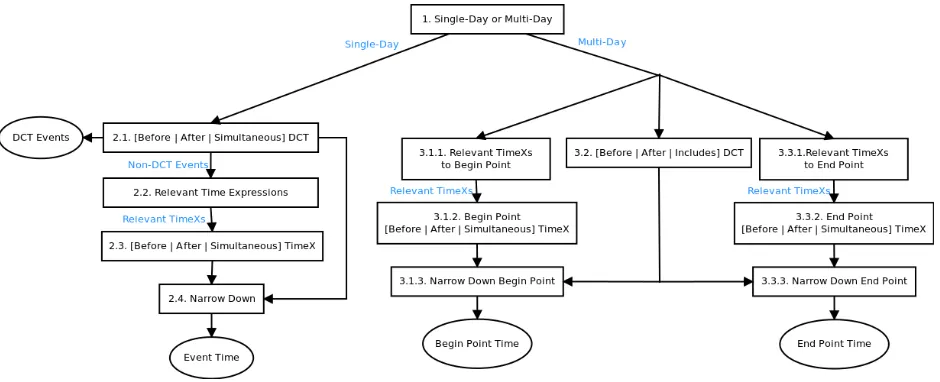
We use the tree structure depicted in Figure 1 to extract the event time for a given target event. The structure was inspired by how annotators labeled the data. When annotating the text, the first decision is typically whether the event is a Single Day Event
or aMulti-Day Event. In the case that it is a Single
Day Event, the next question is whether the event happened at theDocument Creation Time (DCT)or not. As the annotated data comes from the news domain, a large set of events (48.28% of the Single Day Events) happened at the document creation time. In the case the event did not happen at DCT, then the annotator scanned the text to decide whether the date when the event happened is explicitly mentioned or not. If it is not mentioned, the annotator used the
beforeand after notation to define the time frame
when the event happened as precisely as possible. For Multi-Day Events, the process is similar to determine the begin and end point of the event.
The first classifier is a binary classifier to decide whether the event is a Single or a Multi-Day Event. In the case it is a Single Day Event, the next classifier decides the relation between the event and the Doc-ument Creation Time (DCT). In the case the event happened at DCT, the architecture stops. If the event happened before or after DCT, the next classifier is invoked, detecting which temporal expressions are relevant. For all relevant temporal expressions, it is then determined whether the event happened simul-taneously, before, or after the temporal expressions. The final step (2.4) outputs a single event time by narrowing down the information it receives from the relation to DCT (2.1) and the pool of relevant tempo-ral expressions and relations (2.3).
For Multi-Day Events the process is similar, how-ever, the system must return the begin and the end points. The system runs three processes in parallel: it extracts the relations to relevant time expressions for the begin point (3.1.1 and 3.1.2); it extracts the relation to DCT (3.2) and; it extracts the relations to relevant time expressions for the end point (3.3.1 and
3.3.2). There are three possible relations between a Multi-Day Event and the DCT: the event started and ended before the DCT; it started and ended after the DCT; or it started before DCT and ended after DCT. This information is taken into account in step 3.1.3 and 3.3.3 when producing single begin point and end point information for the given event.
4.2 Local Classifiers
This section describes the different local classifiers applied in our tree structure. For all except the
Nar-row Downclassifier, we used the Convolutional
Neu-ral Networks Architecture (Lecun, 1989) depicted in Figure 2. TheNarrow Down classifier is a sim-ple, hand-crafted, rule-based classifier described in Section 4.2.6.
4.2.1 Neural Network Architecture
We use the same neural network architecture with slightly different configurations for the different local classifiers. The architecture is depicted in Figure 2 and is described in the following sections.
The neural network architecture is based on the design proposed by Zeng et al. (2014), which can achieve state-of-the-art performance on relation clas-sification tasks (Zeng et al., 2014; dos Santos et al., 2015). The neural network applies a convolution over the word representations and position embeddings of the input text followed by a max-over-time pooling layer. We call the output of this layerInput Text
Fea-tures. Those Input Text Features are merged with the
word embedding for the event and time expression token. The merged input is fed into a hidden layer using either the hyperbolic tangenttanh(·)or a
rec-tified linear unit (ReLU) as activation function. The choice of the activation function is a hyperparameter and was optimized on a development set. The final layer is either a single sigmoid neuron, in the case of binary classification, or a softmax layer. To avoid overfitting, we used two dropout layers (Srivastava et al., 2014), the first before the dense hidden layer and the second after the dense hidden layer. The percent-ages of the dropouts were set as hyperparameters.
Figure 1: Tree structure used to extract the temporal information for an event. Rectangles are local classifiers based on deep convolutional neural networks except for theNarrow Downrectangles, which are simple rule based classifiers.
Figure 2: The neural network architecture used for the different local classifiers.
replaced with a specialUNKNOWNtoken, for which the word embedding was randomly initialized.
Position Embeddings.Collobert et al. (2011) pro-poses the use of position embeddings to keep track how close words in the input text are to certain
tar-get words. For each input text, we specify certain
words as targets. For example, we specify the event and the temporal expression as target words and train the network to learn the temporal relation between those. Each word in the input text is then augmented with the relative distances. Letpos1,pos2, ... be the
positions of the target words in the input text. Then, a word at positionjis augmented with the features
j−pos1,j−pos2,· · ·. These augmented position
features are then mapped in the embedding layer to a randomly initialized vector. The dimension of this vector is a hyperparameter of the network.
The word embeddings and the position embed-dings are concatenated to form the input for the con-volutional layer. In the case of two target words, the input for the convolutional layer would be:
emboutput ={[wew1, pe1−pos1, pe1−pos2],[wew2,
pe2−pos1, p2−pos2], ...,[wewn, pen−pos1, pen−pos2]}
[image:5.612.142.469.290.479.2]input text,pej−posk the embedding for the distance between thej-th word and the target wordk.
Convolutional & Max-Over-Time Layer. A challenge for the classifier is the variable length of the input text and that important information can be anywhere in the input text. To tackle this issue, we use a convolutional layer to compute a distributed vector representation of the input text. Let us define a vectorxkas the concatenation of the word and
po-sition embeddings for the popo-sitionkas well as form positions to the left and to the right:
xk = ([wewk−m, pek−m−pos1, pek−m−pos2]||...||
[wewk, pek−pos1, pek−pos2]||...||
[wewk+m, pek+m−pos1, pek+m−pos2])
The convolutional layer multiplies all xk by a
weight matrix W1 and applies the activation
func-tion component-wise. After that, amax-over-timeis applied, i.e., the max-function is applied component-wise. Thej-th entry of the convolutional and max-over-time layer output is defined as:
[convoutput]j = max
1≤k≤n[tanh(W1xk)]j
Lexical Features. Previous approaches heavily rely on lexical features. For example, the CAEVO system (Chambers et al., 2014) uses, for the classifi-cation of event-time edges, the token, the lemma, the POS tag, the tense5, the grammatical aspect6and the
class of event7as well as the parse tree between event
and time expression. In our evaluation, we did not observe that these features have a significant impact on the performance. Hence, we decided to use the event and time tokens as the only features besides the dense vector representation of the input text. For multi-token expressions, we only use the first token. Our architecture focuses on extracting the event time when event annotations and temporal expressions are provided. In order to evaluate the accuracy of this isolated step, we decided to use the provided annotations in the corpus. The baselines we
5Defined tenses: simple, perfect, and progressive 6Defined aspects in TimeBank: past, present, future 7Defined classes in TimeBank: occurrence, perception, re-porting, aspectual, state, i state, i action
compared against use these gold annotations as well.
Output.The distributed vector representation of the input text and the embeddings of event/time token are concatenated and passed through a dense layer. As the activation function, we allowed either the hy-perbolic tangent or the rectified linear unit (ReLU). The choice is a parameter of the network. The final layer is either a single sigmoid neuron, in the case of binary classification, or a softmax layer to compute the probabilities of the different tags.
4.2.2 Single vs. Multi-Day Event Classification
The first local classifier, that decides whether an event is aSingle Day Eventor aMulti-Day Event, uses the event word as the target word.
4.2.3 DCT Classification
A Single Day Event can happen either before the document was created (Before-class), on the same day (Simultaneous-class), or it will hap-pen at least one day after the document was created (After-class). The configuration of this local clas-sifier is as in the previous section.
Note, to classify the relation to the DCT, in most cases, it was not important to know the concrete Document Creation Time. Therefore, we did not pass the DCT as a value to the network.
For Multi-Day Events, we decided to group the events into three categories: first, events that be-gan and ended before the Document Creation Time (Before-class); second, events that began before DCT and ended after DCT (Includes-class); and third, events that will begin and end after DCT (After-class).
4.2.4 Detecting Relevant Time Expressions
In the case the event did not happen at the DCT, it is important to take the surrounding text and po-tentially the whole document into account to figure out at which date the event happened. For our classi-fier, we assume that temporal expressions are already detected in the document. To detect temporal ex-pressions, tools like HeidelTime8 can be used that
achieve anF1-score of 0.919 on extracting temporal
expressions in the TimeBank Corpus (Str¨otgen and Gertz, 2015).
As an intermediate step to detect when an event happened, we first decide whether the temporal ex-pression is relevant for the event or not. We define a temporal expression to be relevant, if the (normal-ized) value of the temporal expression is part of the event time annotation. The value of the temporal ex-pression can either be the event time, or it can appear in thebeforeorafternotation.
The classifier is executed for all event and temporal expression pairs. The input text for the distributed text representation is the text between the event and the temporal expression.
4.2.5 Temporal Relation Classification
Given the relevant temporal expression for an event from the previous step, the next local classi-fier establishes the temporal relation between the event and the temporal expression. For a given, relevant event-temporal expression pair, it outputs
BEFORE- when the event happened before the tem-poral expression,AFTER- when it happened after, orSIMULTANEOUS- when it happened on the men-tioned date. This local classifier has the same configu-ration as the network used to detect relevant temporal expression.
4.2.6 Narrow Down Classifier
The goal of the Narrow Down Classifier, that is used in step 2.4, 3.1.3 and 3.3.3 in Figure 1, is to derive the final label given the information on the rel-evant temporal expressions, their relation to the event, and the relation to the document creation time. For most events in the corpus, this information was un-ambiguous, e.g., only one temporal expression was classified as relevant for the event. The proposed approach returns multiple relevant temporal expres-sions only for a small fraction of events. However, this number was too small to train and to validate a learning algorithm for this stage. Hence, we decided to implement a straightforward, rule-based classifier. This classifier is depicted in Algorithm 1.
It takes all relations to relevant temporal expres-sions as well as the relation to the Document Cre-ation Time to derive the final output. In the case a
SIMULTANEOUSrelation exists, the classifier stops and the appropriate temporal expression is used as event time. If no such relation exists, a frequency distribution of the linked dates and relations is
cre-ated for BEFORE as well as for AFTER relations. For example, when the system extracts three relevant
BEFORErelations of different mentions ofdate1
throughout the text and two relevantBEFORE rela-tions of different menrela-tions ofdate2, then the sys-tem would choosedate1as a slot-filler for the be-fore property. If there are as many relevantBEFORE
relations fordate1as fordate2, the system will choose the lowest date for the before property (line 13-18). ForAFTERrelations, we use the same logic, except that we choose the largest date (line 23).
Algorithm 1Narrow Down Classifier 1: functionNARROWDOWN(times)
2: fd before, fd after = FreqDistribution() 3: for[relation, time] in timesdo 4: ifrelation isSIMULTANEOUSthen
5: returntime
6: else ifrelation isBEFOREthen 7: fd before.new sample(time) 8: else ifrelation isAFTERthen 9: fd after.new sample(time) 10: end if
11: end for
12: //fd before elements have the fields .num=#samples and .time=time value
13: iffd before.size>0then
14: // find the largest number of samples of a time 15: max samples = fd before.max( .num)
16: //take minimum over all times having max samples 17: before time = fd before.filter( .num ==
max samples).min( .time) 18: end if
19: iffd after.size>0then
20: // find the largest number of samples of a time 21: max samples = fd after.max( .num)
22: //take maximum over all times having max samples 23: after time = fd after.filter( .num ==
max samples).max( .time) 24: end if
25: returnafter+ after time +before+ before time 26: end function
4.3 Baseline
dif-ferent stages are ranked by precision and are executed consecutively. A shortcoming of the system is that it does not produce temporal information if an event lasted for more than a day. Hence, the system cannot be used to distinguish between Single Day and Multi-Day Events, nor can it extract the begin/end points for Multi-Day Events.
Our previously presented baseline uses the ex-tracted relations for Single Day Events and gener-ates a set of <relation, time> tuples in which the event is involved. We use the narrow down classifier from section 4.2.6 to extract the final label. When all extracted relations are of typeVAGUE, the baseline returns that it cannot infer the time for the event.
The second baseline is a reduced version of the hierarchical tree. For this baseline, we first apply the classifier to decide whether it is a Single Day or Multi-Day Event. When it is a Single Day Event, we classify the relation to the document creation time (DCT) (classifier 2.1). When the event did not happen at DCT, we link it to the closest temporal expression in the document. For Multi-Day Events, we only run the classifier 3.2 to extract the relation to DCT. When the event happened before DCT, we set the begin and end point toBEFORE DCT; when it happened after DCT, we set both toAFTER DCT; and, when the relation wasIncludes, we set the begin point to
BEFORE DCTand the end point toAFTER DCT.
5 Experimental Setup
We conduct our experiments on the TimeBank-EventTime Corpus (Reimers et al., 2016). The corpus is comprised of 36 documents and 1498 annotated events. We use the same split into training, develop-ment, and test set as Chambers et al. (2014) resulting in 22 documents for training, 5 documents for hyper-parameter optimization, and 9 documents for the final evaluation. Using this split allows a fair comparison to the CAEVO system.
Hyperparameters for the individual local classi-fiers were chosen using random search (Bergstra and Bengio, 2012) with at least 1000 iterations per local classifier.
6 Experimental Results
We evaluate our system using two different metrics. Thestrict metricrequires an exact match between
the predicted label and the gold label. A disadvantage of this metric is that it does not allow partial agree-ment. The strict agreement between two annotators is fairly low for events where the exact date of the event was not mentioned.
In order to allow partial matches, we will also use arelaxed metric, which will judge two different la-bels only as an error, if those are mutually exclusive. Two labels are mutually exclusive, if there is no event date which could satisfy both labels at the same time. If the event happened on August 5th, 1998, the two annotationsbefore 1998-08-31andafter 1998-08-01
before 1998-08-31would both be satisfied.
There-fore, these two different labels would be considered as correct. In contrast, the two annotationsafter
1998-02-01andbefore 1997-12-31can never be satisfied at
the same time and are therefore mutually exclusive. The score of the relaxed metric must be seen in combination with the strict metric. A system could trick the relaxed metric by returning a before date that is far in the future which results in a high relaxed score but a negligible strict score. Future research is necessary to judge the quality of different kind of partial matches and to design an appropriate metric.
6.1 System Performance
Following the recommendations in (Reimers and Gurevych, 2017), we train the system with 25 dif-ferent random seed values, and compute the mean performance score and the standard deviation. Table 1 shows the results in comparison to the observed inter-annotator agreement (IAA). The inter-annotator agreement is based on two full annotations of the cor-pus. The chance-corrected agreement isα= 0.617
using Krippendorff’sα(Krippendorff, 2004). The two annotations were merged into a final gold label annotation of the corpus, which we used for training and evaluation.
The accuracy to distinguish between Single Day and Multi-Day Events is 78.2% on the test set, in comparison to an inter-annotator agreement of 81.8%. The overall performance is 42.0%, compared to an IAA of 56.7% using the strict metric.
com-System IAA
Single vs. Multi-Day 78.2%±1.33 81.8% Single Day (Strict) 74.6%±1.04 80.5% Single Day (Relaxed) 92.5%±0.60 98.0%
Multi-Day (Strict) 24.5%±1.61 52.0%
Begin (Strict) 28.5%±0.73 63.8%
End (Strict) 66.5%±1.02 74.9%
Multi-Day (Relaxed) 74.6%±0.55 94.6%
Begin (Relaxed) 94.9%±0.38 98.6%
End (Relaxed) 80.2%±0.73 96.1%
Overall Acc. (Strict) 42.0%±1.21 56.7% Overall Acc. (Relaxed) 84.6%±0.71 95.3%
Table 1: Accuracy for the different stages of our system in comparison to the observed inter-annotator agreement (IAA). Thestrictmetric requires an exact match between the labels. Therelaxedmetric requires that the two anno-tations are not mutually exclusive.
pared to 66.7% accuracy for the end point extraction. However, using the relaxed metric, we see an accu-racy of 94.9% for the begin point and 80.2% for the end point. We can conclude that the extraction of the begin point works well, however, in a large set of cases (66.7%) the extracted begin point is less precise than the gold annotation.
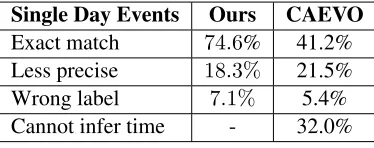
The baseline based on the CAEVO system from Chambers et al. (2014) can only be applied to Single Day Events, as TLINK types that define the start or the end of an event do not exist. We ran this baseline on all events that were correctly identified as Single Day Events. The performance of this baseline is depicted in Table 2. For the proposed approach we observe a performance increase from 41.2% to 74.6%. For 18.3% of the events, the retrieved label of the proposed approach was less precise than the gold label. An example of a less precise label would
bebefore 1998-12-31while the gold label wasbefore
1998-08-15. A clear wrong label was observed for
7.1% of the generated labels.
A big disadvantage of a dense TLINK annotation is the restriction of TLINKs for events and temporal expression that are in the same, or in adjacent, sen-tences. For32.0%of the events, the baseline was not
able to infer any event time information. As our sys-tem outputs a label for every event, we see a slightly increased number of wrong labels in comparison to the baseline.
Single Day Events Ours CAEVO
Exact match 74.6% 41.2%
Less precise 18.3% 21.5%
Wrong label 7.1% 5.4%
[image:9.612.71.301.51.220.2]Cannot infer time - 32.0%
Table 2: Distribution of the retrieved labels for the pro-posed system and for the baseline.Less preciseare labels where the time frame when the event has happened is larger than for the gold label. Wrong label are labels which are in clear contradiction to the gold standard.
Table 3 compares the proposed system against the reduced tree that only classifies the type of the event (Single Day or Multi-Day) and the relation to the doc-ument creation time. We observe a significant drop in accuracy for Single Day Events, indicating that just classifying the relation to the document creation time is insufficient for this task.
System SD MD Overall
Full system 74.6% 24.3% 42.0%
Reduced tree 40.4% 19.6% 24.2%
CAEVO 41.2% - 18.1%
Table 3: Comparison of the accuracy (strict metric) for Single Day Events (SD), Multi-Day Events (MD) and overall. Reduced tree uses only the local classifiers 1, 2.1 and 3.2.
6.2 Error Analysis
Error propagation is an important factor in a decision tree. Table 4 depicts the accuracy of the different local classifiers. We compare those to a Majority Vote baseline. For all local classifiers we can see a large performance increase over the baseline. We observe the lowest accuracy for the classifiers of the begin point (3.1.1. and 3.1.2.). This is in line with the previous observation of the low accuracy for begin point labels as well as with the low IAA for begin point annotations.
[image:9.612.333.520.54.128.2]System Majority Vote
1. Event Type 78.3% 54.5%
Single Day Event
2.1. DCT Rel. 84.2% 55.6% 2.2. Relevant 79.1% 66.0% 2.3. Relation 81.0% 72.7%
Multi-Day Event
3.1. Begin Point
3.1.1. Relevant 79.0% 68.9% 3.1.2. Relation 63.1% 42.9% 3.2. DCT Rel. 65.2% 46.8% 3.3. End Point
[image:10.612.316.537.53.138.2]3.3.1. Relevant 83.8% 65.1% 3.3.2. Relation 85.1% 79.0%
Table 4: Accuracy for the different local classifiers vs. a Majority Vote baseline. Local classifiers are numbered as depicted in Figure 1.
As mentioned in the introduction, the annotators were not restricted to the dates that are explicitly mentioned in the document but could also create new dates. For example, in the sentenceIt’s the [second day]date:1998-03-06of an [offensive]beginPoint=1998-03-05...
it is clear for the annotator that the offensive started on 1998-03-05. However, this date is not explicitly mentioned in the text, only the date 1998-03-06 is mentioned. We call such datesout-of-documentdates. Handling those cases is extremely difficult and our system is currently not capable of creating such out-of-document dates. Table 5 depicts the error rate introduced by those dates.
As the table depicts, 12.6% of the event time labels are affected by out-of-document dates. An especially high percentage of such dates is observed for the be-gin point of Multi-Day Events. In a lot of these cases the document states either an explicit or a rough esti-mation on the duration of the event. In the previous example, the text stated that the offensive already lasted for two days. In another example, the docu-ment gives the information that the event startedin
recent yearsor that it lastedfor roughly 2 1/2 years.
6.3 Ablation Test
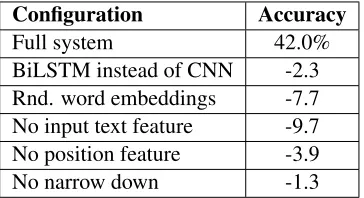
Table 6 presents the changes in accuracy in per-centage points when individual components of the proposed system are changed. We observe a slight
Out-of-document dates
Single Day Events 3.0%
Multi-Day Events 24.1%
Begin Point 17.0%
End Point 9.9%
Overall 12.6%
Table 5: Percentage of labels in the test set affected by out-of-document dates.
drop of -2.3 percentage points if bidirectional LSTM-networks with 100 recurrent units are used instead of Convolutional Neural Networks. LSTM-networks showed for other NLP tasks state-of-the-art perfor-mance, however, for this task they were not able to improve the performance. One reason could be the comparably small training set of 22 documents. A further disadvantage of the BiLSTM-networks was the significantly longer training time, prohibiting run-ning an extensive hyperparameter turun-ning.
Configuration Accuracy
Full system 42.0%
[image:10.612.76.296.53.252.2]BiLSTM instead of CNN -2.3 Rnd. word embeddings -7.7 No input text feature -9.7 No position feature -3.9 No narrow down -1.3
Table 6: Change in accuracy (strict metric) in percent-age points when replacing individual components of the architecture.
An important factor for the performance was the pre-trained word embeddings. Replacing those with randomly initialized embeddings decreased the per-formance by -7.7 percentage points. As before, we think this is due to the small training size. A large number of test tokens do not appear in the training set and several tokens only appear infrequently in the training set. Hence, the network is not able to learn meaningful representations for those words.
Our system successfully uses the text between the event and the temporal expression (Input Text
Fea-tures) for classifying the relation between those.
[image:10.612.337.519.335.434.2]into account. Removing this position information from the input text feature reduces the performance by -3.9 percentage points.
Replacing the narrow down classifier with a classi-fier that randomly selects one of the relevant temporal expressions reduces the performance by only -1.3 per-centage points. For most events, there was only one relevant temporal expression extracted. We analyzed the parameter settings for the top five performing lo-cal classifiers for each stage. The activation function (tanhandReLU) appears to have a negligible impact on the performance.
6.4 Event Timeline Construction
We evaluated our system on the shared task SemEval-2015 Task 4: TimeLine: Cross-Document Event
Or-dering(Minard et al., 2015). The goal is to construct
an event timeline for a target entity given a set of 30 documents from Wikinews on certain topics. We use the setting of Track B, where the events are provided. We used HeidelTime to detect and normalize time expressions. We then ran our system out of the box, i.e., without retraining for the new dataset.
For the shared task, an event can occur either at a specific day, in a specific month, or in a specific year. Events that can not be anchored in time are removed from the evaluation. We implemented simple rules that transform our system output to the format of the shared task: if an event is simultaneous with a specific time expression, we will output this date. If our system returns that it happened before and after a certain date, it will output the year and month if both dates are in the same month. If both dates are in the same year but in different months, it will output the year. Events with predicted timespans of over more than one year are rejected. For Multi-Day Events, we only use the begin point as only this information was annotated for this shared task.
Two teams participated in the shared task (GPL-SIUA and HeidelToul). Currently, the best published performance was achieved by Cornegruta and Vla-chos (2016) with anF1-score of 28.58. Our system
was able to improve the totalF1-score by 4.01 points
as depicted in Table 7.
A challenge for our system is the different anchor-ing of events in time: while our system can anchor events at two arbitrary dates, the SemEval-2015 Task 4 only anchors events either at a specific day, month
System Airbus GM Stock Total
Our approach 30.37 28.83 38.01 32.59
[image:11.612.313.543.54.127.2]Cornegruta 25.65 26.64 32.35 28.58 GPLSIUA 1 22.35 19.28 33.59 25.36 HeidelToul 2 16.50 10.94 25.89 18.34
Table 7: Performance of our system on the SemEval-2015 Task 4 Track B for the topics Airbus, General Motors, and stock market.
or year. When our system returns the event time valueafter 2010-10-01andbefore 2010-11-30, we had to decide how to anchor this event for the gen-erated timeline. For such an event, three final labels would be plausible: 2010-10-xx, 2010-11-xx, and 2010-xx-xx. A similar challenge occurs for events that received a label likebefore 2010-11-30. If we anchor it in 2010-11-xx, we must be certain that the event happened in November. Similarly, if we an-chor it in 2010-xx-xx, we must be certain that the event happened in 2010. Such information cannot be inferred directly from the returned label of our system. As only 30 documents on a single topic were provided for training, we could not tune the transfor-mation accordingly. A manual analysis revealed that this transformation caused around 15% of the errors.
7 Conclusion
Event Time Extraction is a challenging classifica-tion task as the set of labels is infinite and the label depends on the information that is scattered across the document. The presented classifier is able to take the whole document into account and to infer the date when an event has happened. We applied the system to the TimeBank-EventTime Corpus and achieved an accuracy of 42.0% in comparison to an inter-annotator agreement of 56.7% using a strict metric. For 74.6% of the Single Day events, the exact event time could be extracted. This is a 33.1 percentage points improvement in comparison to the state-of-the-art approach by Chambers et al. (2014). We demonstrated the generalizability by applying it to the SemEval-2015 Task 4 on timeline generation, where it improved theF1-score by 4.01 percentage
Acknowledgements
This work has been supported by the German Re-search Foundation as part of the ReRe-search Training Group Adaptive Preparation of Information from Het-erogeneous Sources (AIPHES) under grant No. GRK 1994/1. We would like to thank the TACL editors and reviewers for their effort and the valuable feedback we received from them.
References
James Allan. 2002. Topic Detection and Tracking: Event-based Information Organization. pages 1–16. Kluwer Academic Publishers, Norwell, MA, USA.
James Bergstra and Yoshua Bengio. 2012. Random Search for Hyper-parameter Optimization. J. Mach. Learn. Res., 13:281–305, February.
Philip Bramsen, Pawan Deshpande, Yoong Keok Lee, and Regina Barzilay. 2006. Inducing Temporal Graphs. InProceedings of the 2006 Conference on Empirical Methods in Natural Language Processing, EMNLP ’06, pages 189–198, Stroudsburg, PA, USA. Association for Computational Linguistics.
Taylor Cassidy, Bill McDowell, Nathanael Chambers, and Steven Bethard. 2014. An Annotation Framework for Dense Event Ordering. In Proceedings of the 52nd Annual Meeting of the Association for Computational Linguistics (Volume 2: Short Papers), pages 501–506, Baltimore, Maryland, USA. Association for Computa-tional Linguistics.
Nathanael Chambers and Dan Jurafsky. 2008. Jointly combining implicit constraints improves temporal or-dering. InProceedings of the Conference on Empirical Methods in Natural Language Processing, EMNLP ’08, pages 698–706, Stroudsburg, PA, USA. Association for Computational Linguistics.
Nathanael Chambers, Taylor Cassidy, Bill McDowell, and Steven Bethard. 2014. Dense Event Ordering with a Multi-Pass Architecture. Transactions of the Associa-tion for ComputaAssocia-tional Linguistics, 2:273–284. Ronan Collobert, Jason Weston, L´eon Bottou, Michael
Karlen, Koray Kavukcuoglu, and Pavel Kuksa. 2011. Natural language processing (almost) from scratch. J. Mach. Learn. Res., 12:2493–2537, November.
Savelie Cornegruta and Andreas Vlachos. 2016. Time-line extraction using distant supervision and joint in-ference. In Proceedings of the 2016 Conference on Empirical Methods in Natural Language Processing, EMNLP 2016, Austin, Texas, USA, November 1-4, 2016, pages 1936–1942.
Quang Xuan Do, Wei Lu, and Dan Roth. 2012. Joint Inference for Event Timeline Construction. In Pro-ceedings of the 2012 Joint Conference on Empirical Methods in Natural Language Processing and Compu-tational Natural Language Learning, EMNLP-CoNLL ’12, pages 677–687, Stroudsburg, PA, USA. Associa-tion for ComputaAssocia-tional Linguistics.
C´ıcero Nogueira dos Santos, Bing Xiang, and Bowen Zhou. 2015. Classifying Relations by Ranking with Convolutional Neural Networks. InProceedings of the 53rd Annual Meeting of the Association for Computa-tional Linguistics and the 7th InternaComputa-tional Joint Con-ference on Natural Language Processing of the Asian Federation of Natural Language Processing, ACL 2015, July 26-31, 2015, Beijing, China, Volume 1: Long Pa-pers, pages 626–634.
Lisa Ferro. 2002. TIDES. Instruction Manual for the Annotation of Temporal Expressions. Technical report, MITRE TECHNICAL REPORT.
Oleksandr Kolomiyets, Steven Bethard, and Marie-Francine Moens. 2012. Extracting Narrative Timelines As Temporal Dependency Structures. InProceedings of the 50th Annual Meeting of the Association for Com-putational Linguistics: Long Papers - Volume 1, ACL ’12, pages 88–97, Stroudsburg, PA, USA. Association for Computational Linguistics.
Klaus Krippendorff. 2004. Content Analysis: An In-troduction to Its Methodology (second edition). Sage Publications.
Yann Lecun, 1989. Generalization and network design strategies. Elsevier.
Omer Levy and Yoav Goldberg. 2014. Dependency-Based Word Embeddings. InProceedings of the 52nd Annual Meeting of the Association for Computational Linguistics, ACL 2014, June 22-27, 2014, Baltimore, MD, USA, Volume 2: Short Papers, pages 302–308. Anne-Lyse Minard, Manuela Speranza, Eneko Agirre,
Itziar Aldabe, Marieke van Erp, Bernardo Magnini, German Rigau, and Ruben Urizar. 2015. SemEval-2015 Task 4: TimeLine: Cross-Document Event Order-ing. InProceedings of the 9th International Workshop on Semantic Evaluation, SemEval@NAACL-HLT 2015, Denver, Colorado, USA, June 4-5, 2015, pages 778– 786.
James Pustejovsky, Patrick Hanks, Roser Sauri, Andrew See, Robert Gaizauskas, Andrea Setzer, Dragomir Radev, Beth Sundheim, David Day, Lisa Ferro, and Marcia Lazo. 2003. The TIMEBANK Corpus. In Pro-ceedings of Corpus Linguistics 2003, pages 647–656, Lancaster, UK.
Natural Language Processing (EMNLP), pages 338– 348, Copenhagen, Denmark, September.
Nils Reimers, Nazanin Dehghani, and Iryna Gurevych. 2016. Temporal Anchoring of Events for the Time-Bank Corpus. InProceedings of the 54th Annual Meet-ing of the Association for Computational LMeet-inguistics (ACL 2016), volume 1: Long Papers, pages 2195–2204. Association for Computational Linguistics, August. Roser Saur´ı, Jessica Littman, Robert Gaizauskas, Andrea
Setzer, and James Pustejovsky. 2004. TimeML Anno-tation Guidelines, Version 1.2.1.
Nitish Srivastava, Geoffrey Hinton, Alex Krizhevsky, Ilya Sutskever, and Ruslan Salakhutdinov. 2014. Dropout: A Simple Way to Prevent Neural Networks from Over-fitting. J. Mach. Learn. Res., 15(1):1929–1958, Jan-uary.
Jannik Str¨otgen and Michael Gertz. 2015. A Baseline Temporal Tagger for all Languages. InProceedings of the 2015 Conference on Empirical Methods in Nat-ural Language Processing, pages 541–547, Lisbon, Portugal, September. Association for Computational Linguistics.
Mihai Surdeanu. 2013. Overview of the TAC 2013 Knowledge Base Population Evaluation: English Slot Filling and Temporal Slot Filling. InProceedings of the TAC-KBP 2013 Workshop, Gaithersburg, Maryland, USA.
Naushad UzZaman and James F. Allen. 2010. TRIPS and TRIOS System for TempEval-2: Extracting Tem-poral Information from Text. In Proceedings of the 5th International Workshop on Semantic Evaluation, SemEval ’10, pages 276–283, Stroudsburg, PA, USA. Association for Computational Linguistics.
Naushad UzZaman, Hector Llorens, Leon Derczynski, Marc Verhagen, James F. Allen, and James Pustejovsky. 2013. SemEval-2013 Task 1: TempEval-3: Evaluating Time Expressions, Events, and Temporal Relations. In Proceedings of the 7th International Workshop on Se-mantic Evaluation (SemEval 2013), pages 1–9, Atlanta, Gerogia, USA.
Marc Verhagen, Robert Gaizauskas, Frank Schilder, Mark Hepple, Graham Katz, and James Pustejovsky. 2007. SemEval-2007 Task 15: TempEval Temporal Rela-tion IdentificaRela-tion. In Proceedings of the 4th Inter-national Workshop on Semantic Evaluations, SemEval ’07, pages 75–80, Stroudsburg, PA, USA. Association for Computational Linguistics.
Marc Verhagen, Roser Saur´ı, Tommaso Caselli, and James Pustejovsky. 2010. SemEval-2010 Task 13: TempEval-2. InProceedings of the 5th International Workshop on Semantic Evaluation, SemEval ’10, pages 57–62, Stroudsburg, PA, USA. Association for Computational Linguistics.
Katsumasa Yoshikawa, Sebastian Riedel, Masayuki Asa-hara, and Yuji Matsumoto. 2009. Jointly Identifying Temporal Relations with Markov Logic. In Proceed-ings of the Joint Conference of the 47th Annual Meeting of the ACL and the 4th International Joint Conference on Natural Language Processing of the AFNLP: Vol-ume 1, ACL ’09, pages 405–413, Stroudsburg, PA, USA. Association for Computational Linguistics. Daojian Zeng, Kang Liu, Siwei Lai, Guangyou Zhou, and