Proceedings of the 12th International Workshop on Semantic Evaluation (SemEval-2018), pages 836–841
ClaiRE at SemEval-2018 Task 7: Classification of Relations using
Embeddings
Lena Hettinger, Alexander Dallmann, Albin Zehe, Thomas Niebler and Andreas Hotho DMIR Group
University of Wuerzburg
{hettinger,dallmann,zehe,niebler,hotho} @informatik.uni-wuerzburg.de
Abstract
In this paper we describe our system for SemEval-2018 Task 7 on classification of se-mantic relations in scientific literature for clean (subtask 1.1) and noisy data (subtask 1.2). We compare two models for classifica-tion, a C-LSTM which utilizes only word em-beddings and an SVM that also takes hand-crafted features into account. To adapt to the domain of science we train word embeddings on scientific papers collected from arXiv.org. The hand-crafted features consist of lexical features to model the semantic relations as well as the entities between which the rela-tion holds. Classification of Relations using
Embeddings (ClaiRE) achieved an F1 score of
74.89 %for the first subtask and78.39 %for the second.
1 Introduction
The goal of SemEval-2018 Task 7 is to extract and classify semantic relations between entities into six categories that are specific to scientific liter-ature (G´abor et al., 2018). In this work, we fo-cus on the subtask of classifying relations between entities in manually (subtask 1.1) and automati-cally annotated and therefore noisy data (subtask 1.2). Given a pair of related entities, the task is to classify the type of their relation among the fol-lowing options: Compare, Model-Feature, Part Whole,Result,TopicorUsage. Re-lation types are explained in detail in the task de-scription paper (G´abor et al.,2018). The follow-ing sentence shows an example of aResult rela-tion between the two entitiescombination meth-odsandsystem performance:
Combination methods are an effec-tive way of improving system perfor-mance.
This sentence is a good example for two chal-lenges we face in this task. First, almost half of
all entities consist of noun phrases which has to be considered when constructing features. Secondly, the vocabulary is domain dependent and therefore background knowledge should be adopted.
Previous approaches for semantic relation clas-sification tasks mainly employed two strategies. Either they made use of a lot of hand-crafted fea-tures or they utilized a neural network with as few background knowledge as possible. The winning system of an earlier SemEval challenge on relation classification (Hendrickx et al.,2009) adopted the first approach and achieved an F1 score of 82.2% (Rink and Harabagiu, 2010). Later, other works outperformed this approach by using CNNs with and without hand-crafted features (Santos et al.,
2015;Xu et al.,2015) as well as RNNs (Miwa and Bansal,2016).
Approach We present two approaches that use different levels of preliminary information. Our first approach is inspired by the winning method of the SemEval-2010 challenge (Rink and Harabagiu, 2010). It models semantic relations by describing the twoentities, between which the semantic relation holds, as well as the words be-tween those entities. We call those in-bebe-tween words the context of the semantic relation. We classify relations by using an SVM on lexical fea-tures, such as part-of-speech tags. Additionally we make use of semantic background knowledge and add pre-trained word embeddings to the SVM, as word embeddings have been shown to improve performance in a series of NLP tasks, such as sen-timent analysis (Kim,2014), question answering (Chen et al.,2017) or relation extraction (Dligach et al.,2017). Besides using existing word embed-dings generated from a general corpus, we also train embeddings on scientific articles that better reflect scientific vocabulary.
In contrast, our second approach relies on word
embeddings only, which are fed into a convo-lutional long-short term memory (C-LSTM) net-work, a model that combines convolutional and recurrent neural networks (Zhou et al., 2015). Therefore no hand-crafted features are used. Be-cause both CNN and RNN models have shown good performance for this task, we assume that a combination of them will positively impact clas-sification performance compared to the individual models.
By combining lexical information and domain-adapted scientific word embeddings, our system ClaiRE achieved an F1 score of 74.89% for the first subtask with manually annotated data and 78.39% for the second subtask with automatically annotated data.
2 Features
In this section, we describe the features which are used in our two approaches. All sentences are first preprocessed before constructing boolean lexical features on the one hand and word embedding vec-tors on the other. Both feature groups are based on the entities of relations as well as the context in which those entities appear.
Apart from the Comparerelation, all relation types are asymmetric, and therefore the distinction between start and end entity of a relation is impor-tant. If entities appear in reverse order, that means the end entity of a relation appears first in the sen-tence, this is marked by adirectionfeature which is part of the data set.
In our entrance example, combination meth-odsdenotes the start entity,system performance
the end entity, and are an effective way of im-provingthe context.
2.1 Preprocessing
Early experiments showed that it is beneficial to filter the vocabulary of our data and reduce noise by leaving out infrequent context words. The best setting was found to be a frequency threshold of
5 on lemmatized words. Therefore we discard a
context word if its lemma appears less than5times
in the corpus of the respective subtask.
2.2 Context features
First we will explain feature construction based on the context of a relation. Abbreviations for fea-ture names are denoted in brackets. Context is defined as the words between two entities. Early
tests showed that using those words described the relation better than the words surrounding the re-lation entities.
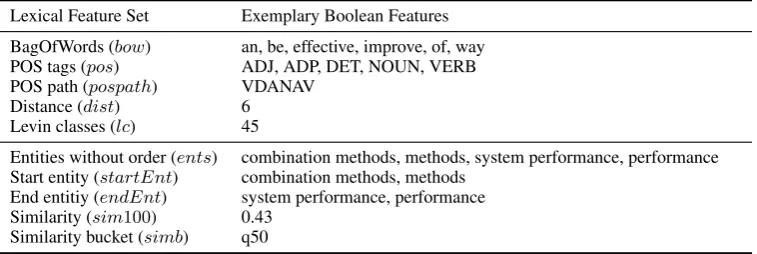
Lexical We construct several lexical boolean features which are illustrated in Table 1. First we apply a bag of words (bow) approach where each lemmatized word forms one boolean feature, which for example takes 1 as value if the lemma
improveis present and 0 if it is not. Second we de-termine whether the context words contain certain part-of-speech (POS) tags (pos), such as VERB. POS-tagging was done with the help of SpaCy1 (v.2.0.2). To represent the structure of the con-text phrase we add a path of POS tags feature, which contains the order in which POS tags appear (pospath). The distance feature depicts whether the POS-path and therefore the context phrase has a certain length (dist).
Additionally we add background knowledge by extracting the top-level Levin classes of intermedi-ary verbs from VerbNet2(lc), a verb lexicon com-patible with WordNet. It contains explicitly stated syntactic and semantic information, using Levin verb classes to systematically construct lexical en-tries (Schuler, 2005). For example the verb im-prove belongs to class 45.4, which is described by Levin as consisting of “alternating change of state“ verbs.3
Embeddings Aside from lexical features we also use word embedding vectors to leverage in-formation from the context of entities (c). For each filtered context word we extract its word em-beddding from a pre-trained corpus, where out-of-vocabulary words (OOV) are represented by the zero vector. The individual word vectors are later applied to train a C-LSTM.
In contrast, for use in an SVM we found it ben-eficial to represent the context embedding features as the average over all context word embeddings.
2.3 Entity features
In the second set of features, we model the relation entities themselves as they may be connected to a certain relation class. For example, the token
performanceor one form of it mostly appears as an end entity of aResultrelation, and in the rare
1https://spacy.io/
2http://verbs.colorado.edu/˜mpalmer/
projects/verbnet.html
3http://www-personal.umich.edu/
Example Sentence: Combination methodsare an effective way of improvingsystem performance. Lexical Feature Set Exemplary Boolean Features
BagOfWords (bow) an, be, effective, improve, of, way
POS tags (pos) ADJ, ADP, DET, NOUN, VERB
POS path (pospath) VDANAV Distance (dist) 6 Levin classes (lc) 45
Entities without order (ents) combination methods, methods, system performance, performance
Start entity (startEnt) combination methods, methods End entitiy (endEnt) system performance, performance Similarity (sim100) 0.43
[image:3.595.111.490.73.200.2]Similarity bucket (simb) q50
Table 1: Examples for lexical context and entity features.
case when it represents a start entity, it is almost always part of aComparerelation. Therefore we leverage information about entity position for the creation of lexical and embedding entity features.
Lexical For the creation of boolean lexical fea-tures, we first take the lowercased string of each entity and construct up to three distinct features from it. One feature which marks its general ap-pearance in the corpus without order (ents) and one each if it occurs as start (startEnt) or end (endEnt) entity of a relation, taking its direction into account. Additionally we add the head noun to the respective feature set if the entity consists of a nominal phrase to create greater overlap between instances.
Furthermore we measure the semantic similar-ity of the relation entities using the cosine of the corresponding word embedding vectors (sim100).
While the cosine takes every value from [-1, 1] in theory, we cut off after two digits to reduce the fea-ture space and get 99 boolean similarity feafea-tures for our corpus. To again enable learning across instances we additionally discretize the ity range and form another five boolean similar-ity features (simb) that capture into which of the following buckets the similarity score falls: q0 = [−1,0), q25 = [0,0.25), q50 = [0.25,0.5), q75 = [0.5,0.75), q100 = [0.75,1] (values below zero
are very rare in this corpus).
Embeddings Similar to the context features we also want to add word embeddings of entities to our entity feature set. This is not straighforward as more than 44% of all entities consist of nomi-nal phrases, while a word embedding usually cor-responds to a single word. By way of comparison, the proportion of nominals in the relation classifi-cation corpus of the SemEval-2010 challenge was
only 5%. Thus we tested different strategies to ob-tain a word embedding for nominal phrases and found that averaging over the individual word vec-tors of the phrase yielded the best results for this task. These word embeddings for start (es) and end (ee) entities of relations were then presented to our two classification methods, which will be described in detail in the following section.
3 Classification Methods
We utilize two different models for classifying se-mantic relations: an SVM which incorporates both the lexical and embedding features described in Section 2 and a Convolutional Long Short Term Memory (C-LSTM) neural network that only uses word embedding vectors
To fully exploit our hand-crafted lexical fea-tures we employ a traditional classifier. In compar-ison to Naive Bayes, Decision Trees and Random Forests we found a Support Vector Machine to per-form best for this task. Instead of utilizing the de-cision function of the SVM to predict test labels we decided to make use of the probability esti-mates according toWu et al.(2004) as this proved to be more successful. As mentioned before, the lexical features are fed into the SVM as boolean features whereas the word embeddings are nor-malized using MinMax-Scaling to the range[0,1]
to make it easier for the SVM to handle both fea-ture groups.
label subtask 1.1 subtask 1.2 total COMPARE 95 ( 8%) 41 ( 3%) 136 ( 5%) MODEL-F. 326 (27%) 174 (14%) 500 (20%) PART W. 234 (19%) 196 (16%) 430 (17%) RESULT 72 ( 6%) 123 (10%) 195 ( 8%) TOPIC 18 ( 1%) 243 (20%) 261 (11%) USAGE 483 (39%) 468 (38%) 951 (38%)
Table 2: Distribution of class labels for training data as absolute and relative values.
4 Evaluation
After describing the two models we employ for re-lation classification, we now portray the data set we use and present results for both SVM and C-LSTM as micro-F1 and macro-F1. The latter is the official evaluation score of the SemEval Chal-lenge. We describe the experimental setup for both models and compare different feature sets and pre-trained embeddings.
4.1 Data and Background Knowledge
We evaluate our approach on a set of scientific ab-stracts,Dtest. It consists of 355 semantic relations for each subtask which are similarly distributed as its respective training data set. As training data we received350abstracts of scientific articles per
sub-task, which resulted in1228labeled training
rela-tions for subtask 1.1 and1245 training instances
for subtask 1.2 (c.f. Table2). We combine data sets of both subtasks for training, resulting in2473
training examples in total (Dtrain).
Background Knowledge In our experiments, we compare different pre-trained word embed-dings as a source of background knowledge. As a baseline, we employ a publicly available set of 300-dimensional word embeddings trained with GloVe (Pennington et al., 2014) on the Common Crawl data4 (CC). To better reflect the semantics of scientific language, we trained our own scien-tific embeddings using word2vec (Mikolov et al.,
2013) on a large corpus of papers collected from arXiv.org5(arXiv).
In order to create the scientific embeddings, we downloaded LATEX sources for all papers published in 2016 on arXiv.org using the provided dumps.6 After originally trying to extract the plain text from the sources, we found that it was more fea-sible to first compile the sources to pdf
(exclud-4http://commoncrawl.org/ 5https://arxiv.org
6https://arxiv.org/help/bulk_data
context + entities
data macro F1 micro F1 macro F1 micro F1
1.1 44.35 58.87 50.30 65.63
+1.2 47.43 61.69 64.38 69.30
CC 51.79 65.07 72.47 74.93
arXiv 52.15 65.92 74.89 76.90
Table 3: SVM results for subtask 1.1.
context + entities
data macro F1 micro F1 macro F1 micro F1
1.2 67.25 69.75 72.48 80.39
+1.1 64.54 69.30 74.69 83.10
CC 62.64 70.70 75.87 84.79
arXiv 63.07 70.70 78.39 83.10
Table 4: SVM results for subtask 1.2.
ing all graphics etc.) and then use pdftotext7 to convert the documents to plain text. This resulted in a dataset of about 166 000papers. Using
gen-sim (ˇReh˚uˇrek and Sojka, 2010), for each docu-ment we extracted tokens of minimum length 1 with the wikicorpus tokenizer and used word2vec to train 300-dimensional word embeddings on the data. We kept most hyper-parameters at their de-fault values, but limited the vocabulary to words occurring at least 100 times in the dataset, reduc-ing for example the noise introduced by artifacts from equations.
4.2 Parameters and Results
After an extensive grid search per cross validation the best parameters for the SVM were found to be a rbf-kernel withC= 100andγ = 0.001for both
tasks.
Results of the SVM for subtask 1.1. are shown in Table 3. Adding entity features proves to be very beneficial compared to using only context features, as we could improve macro-F1 by 12 points on average. Results are further improved by enlarging the data set with the training samples of subtask 1.2 and by adding word embeddings to the feature set. While adding the CC embeddings enhances the micro-F1 by more than 4 points, our domain-adapted arXiv embeddings prove to per-form even better and deliver the best result with a macro-F1 score of 74.89 %and a micro-F1 of 76.90 %.
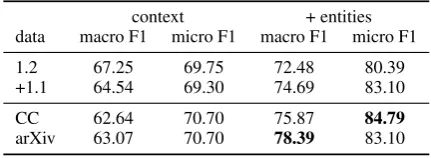
Similar observations can be made for subtask 1.2., as is pictured in Table4.
[image:4.595.308.524.170.249.2]details and elaborate results for the C-LSTM on arXiv.org (Hettinger et al.,2018). In comparison to the SVM, which additionally uses hand-crafted features, the C-LSTM achieves lower scores. For arXiv embeddings it reaches a macro-F1 of63.3 %
for the first subtask and68.0 %for the second.
5 Discussion
We briefly discuss our approach during the train-ing phase of the SemEval-Challenge and how label distribution and evaluation measure influences our results. Ahead of the final evaluation phase where the concealed test dataDtestwas presented to the participants we were given a preliminary test par-titionDpre as part of the training dataDtrain. To be able to estimate our performance we evaluated it onDpre as well as for a 10-fold stratified cross validation setting. We chose this procedure to be sure to pick the best system for submission at the challenge.
As some classes were strongly underrepre-sented in the training corpus and Dpre, we as-sumed that this is also true for the final test set Dtest. When in doubt we therefore chose to opti-mize according toDpreas cross validation is based on a slightly more balanced data set (of train data for subtask 1.1 + 1.2). The best system we sub-mitted for subtask 1.1 of the challenge achieved a macro-F1 of 75.05% onDpre during the training phase which shows that we were able to estimate our final result pretty closely.
During training we also noticed that for heavily skewed class distributions as in this case, macro-F1 as an evaluation measure strongly depends on a good prediction of very small classes. For exam-ple, macro-F1 of subtask 1.1 increases by 5 points if we correctly predict oneTopicinstance out of three instead of none. Thus we pick a configura-tion that optimizes the small classes.
We also omitted some lexical feature sets from our system as performance on the temporary and final test set showed that they did not improve re-sults. These features were hypernyms of context and entity tokens from WordNet and dependency paths between entities. Using tf-idf normalization instead of boolean for lexical features also wors-ened our results.
6 Conclusion
In this paper, we described our SemEval-2018 Task 7 system to classify semantic relations in
sci-entific literature for clean (subtask 1.1) and noisy (subtask 1.2) data. We constructed features based on relation entities and their context by means of hand-crafted lexical features as well as word em-beddings. To better adapt to the scientific do-main, we trained scientific word embeddings on a large corpus of scientific papers obtained from arXiv.org. We used an SVM to classify rela-tions and additionally contrasted these results with those obtained from training a C-LSTM model on the scientific embeddings. We were able to ob-tain a macro-F1 score of 74.89 % on clean data
and rank 4th out of 28 and78.39 %on noisy data,
which resulted in a 6th place out of 20.
In future work, we will improve the tokeniza-tion of the scientific word embeddings and also take noun compounds into account, as they make up a large part of the scientific vocabulary. We will also investigate more complex neural network based models, that can leverage additional infor-mation, for example relation direction and POS tags. Some minor changes we applied to the fea-ture generation during the post-evaluation phase and which further improved our results by more than2 %are published on arXiv.org together with
more detailed evaluation (Hettinger et al.,2018).
References
Danqi Chen, Adam Fisch, Jason Weston, and Antoine Bordes. 2017. Reading wikipedia to answer open-domain questions. In ACL (1), pages 1870–1879. Association for Computational Linguistics.
Dmitriy Dligach, Timothy Miller, Chen Lin, Steven Bethard, and Guergana Savova. 2017. Neural tem-poral relation extraction. InProceedings of the 15th Conference of the European Chapter of the Associa-tion for ComputaAssocia-tional Linguistics: Volume 2, Short Papers, volume 2, pages 746–751.
Kata G´abor, Davide Buscaldi, Anne-Kathrin Schu-mann, Behrang QasemiZadeh, Ha¨ıfa Zargayouna, and Thierry Charnois. 2018. Semeval-2018 Task 7: Semantic relation extraction and classification in scientific papers. In Proceedings of International Workshop on Semantic Evaluation (SemEval-2018), New Orleans, LA, USA.
Lena Hettinger, Alexander Dallmann, Albin Zehe, Thomas Niebler, and Andreas Hotho. 2018. Claire at semeval-2018 task 7 - extended version. Compu-tation and Language Repository, arXiv:1804.05825.
Yoon Kim. 2014. Convolutional neural networks for sentence classification. InProceedings of the 2014 Conference on Empirical Methods in Natural Lan-guage Processing, EMNLP 2014, October 25-29, 2014, Doha, Qatar, A meeting of SIGDAT, a Special Interest Group of the ACL, pages 1746–1751. Tomas Mikolov, Ilya Sutskever, Kai Chen, Greg S
Cor-rado, and Jeff Dean. 2013. Distributed representa-tions of words and phrases and their compositional-ity. InNIPS, pages 3111–3119. Curran Associates, Inc.
Makoto Miwa and Mohit Bansal. 2016.End-to-end re-lation extraction using lstms on sequences and tree structures. Cite arxiv:1601.00770Comment: Ac-cepted for publication at the Association for Compu-tational Linguistics (ACL), 2016. 13 pages, 1 figure, 6 tables.
Jeffrey Pennington, Richard Socher, and Christopher D Manning. 2014. Glove: Global vectors for word representation. InEMNLP, volume 14, pages 1532– 1543.
Radim ˇReh˚uˇrek and Petr Sojka. 2010. Software Frame-work for Topic Modelling with Large Corpora. In
Proceedings of the LREC 2010 Workshop on New Challenges for NLP Frameworks, pages 45–50, Val-letta, Malta. ELRA. http://is.muni.cz/ publication/884893/en.
Bryan Rink and Sanda Harabagiu. 2010. Utd: Clas-sifying semantic relations by combining lexical and semantic resources. InProceedings of the 5th Inter-national Workshop on Semantic Evaluation, pages 256–259. Association for Computational Linguis-tics.
Cicero Nogueira dos Santos, Bing Xiang, and Bowen Zhou. 2015. Classifying relations by ranking with convolutional neural networks. Proceedings of the 7th International Joint Conference on Natural Lan-guage Processing [IJCNLP].
Karin Kipper Schuler. 2005. Verbnet: A Broad-coverage, Comprehensive Verb Lexicon. Ph.D. the-sis, University of Pennsylvania, Philadelphia, PA, USA. AAI3179808.
Ting-Fan Wu, Chih-Jen Lin, and Ruby C. Weng. 2004. Probability estimates for multi-class classification by pairwise coupling. Journal of Machine Learning Research, 5(Aug):975–1005.
Kun Xu, Yansong Feng, Songfang Huang, and Dongyan Zhao. 2015. Semantic relation classifica-tion via convoluclassifica-tional neural networks with simple negative sampling. InProceedings of the 2015 Con-ference on Empirical Methods in Natural Language Processing [EMNLP], pages 536–540.