www.wjpr.net Vol 3, Issue 3, 2014. 3575
PRESCRIPTION ERRORS: PREVENTABLE MEDICATION ERRORS
Wajiha Gul*
Jinnah University for Women, Faculty of Pharmacy, Karachi, Pakistan.
ABTRACT
Prescription errors can cause failure in treating the patients but are
preventable. These can occur when the prescription either lacks any of
the important information regarding the patient or the drug and also
when incorrect information is present on the prescription. A four
months study was conducted in which out of 680 prescriptions, 312
were selected having altogether 846 errors. The errors were
categorized as errors of omission and errors of commission and also
were analyzed and calculated. The lacking in the prescription writing
process which should be overcome. For this the pharmacist and the
physician should work together to eliminate the errors. The causes of
prescription errors should be reduced and the prescriptions should be
monitored and the preventive steps should be taken to minimize them.
Key Words: prescription errors, errors of omission, errors of commission, causes, preventive measures.
INTRODUCTION
Prescription (Rx) is a medication order issued by the registered and licensed practitioner to
the pharmacist for the patient. The major requirement of the prescription is that it should be
clearly written, free form errors and fulfills all the legal requirements [1,2]. Failure in any of
these will directly cause resistance in achieving the therapeutic goal.
A prescription must bear the name, medical record number, age, sex and wt of the patient,
name and signature of the physician who has written the prescription, correct dosage form,
dose, strength, direction for use and refill time of the medication. The prescription should
also have printed on it the name, address and contact number of the hospital/ clinic.
Volume 3, Issue 3, 3575-3584. Research Article ISSN 2277 – 7105
Article Received on 08 February 2014,
Revised on 09 March 2014, Accepted on 28 March 2014,
*Correspondence for
Author
Dr. Wajiha Gul
Asst. Prof., Jinnah
University for Women,
Faculty of Pharmacy,
www.wjpr.net Vol 3, Issue 3, 2014. 3576 Errors may occur anywhere between prescribing to administration of drug. Therefore,
medication safety is considered as the top priority for the patient’s healthcare. Of all the
medication errors, prescription errors are more common although preventable [3]. These can
be life-threatening and costly too. Above all it gives negative impact to the patient [4].
The prescriptions not written clearly or which can be misunderstood, inappropriate and
irrational prescriptions, also over- and under-prescriptions all will lead to prescription error
(PE) [5]. Prescription errors can cause hindrance in the treatment of the patient. Therefore
identifying, solving and preventing such errors are supposed as the main functions of the
pharmaceutical care [6].
Prescription errors have been classified as error of omission and error of commission. The
error of omission means the prescription is incompletely filled, like missing of patient’s
information (which is essential to be present on the prescription), incomplete dosage, dosage
form, refill time and illegible prescriptions (the prescriptions which are difficult to read
because of bad handwriting). The error of commission includes wrong information regarding
the drug or patient like wrong drug, route, dosage form or strength, drug-drug interaction and
it may also include if the name of patient’s name is incorrect as it may cause dispensing the
medication to the wrong patient [7]. The error of omission will waste the time of the
pharmacist to contact the physician to complete the prescription because of certain
requirements missing from the prescription while the error of commission can lead to harmful
situations as the prescription may be having some legal requirements missing causing
problem for the patient and also for the pharmacist if he/she doesn’t call the physician for its
correction [8].
Studies have also been conducted to determine the reasons behind prescription errors
[1,9-13]. Every step related to prescribing is error-producing. A prescription error may occur by
mistake or ignorance, which may happen during calculation, writing, judgment or speech by a
physician while consulting the patient [14]. Error in selecting the correct drug, dose,
frequency and dosage form contributes to the prescription errors. Polypharmacy and
inappropriate dose calculation in elderly and children has also been observed [15]. Other
causes may include the physician not in good physical or mental condition, inadequate
training or lack of knowledge [1,8]. We also cannot neglect the poor legibility of handwriting
www.wjpr.net Vol 3, Issue 3, 2014. 3577 commonly in hospitals and clinics both in out-patient [17-23] and in-patient prescriptions
[7,8,24,18,25-30] including pediatrics [31,32].
Prescription errors are the major medication errors however they can be avoided. The
pharmacist should play his/her role in minimizing these errors. The pharmacist can be given
the responsibility of the error if he/she fails to detect it and if detected than unable to resolve
it by contacting the physician. However this study comprises the prescription errors related to
the physician.
Experimental
A four months study was conducted in which 680 out-patient prescriptions were analyzed
from surgery, medicine, ENT, dental, obstetrics, and gynecology, pediatrics and dermatology
departments all from the pharmacy of a tertiary care hospital located in the city. The
in-patient prescriptions were excluded from the study. Out of all the prescriptions 312
prescriptions were selected. The selected prescriptions were reviewed for the prescription
errors. The prescription errors like the errors of omission related to the physician (missing
information regarding the patient’s name, age, wt., sex, medical record number, physician’s
name and signature, name of the clinic, diagnosis and illegible handwriting), errors of
omission related to the drug (missing information regarding the drug, dose, dosage form,
strength, route and refill time of the medications) and the errors of commission (wrong drug,
wrong dose, wrong dosage form, wrong strength and drug-drug interactions) were detected.
The percentage of all the errors were calculated and then evaluated.
RESULT
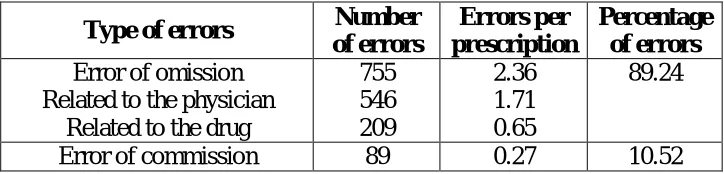
From 312 prescriptions altogether 846 prescription errors were observed which means 2.71
errors per prescription. Out of all the prescription errors 89 (10.52%) were the error of
commission while 755 (89.24%) were the error of omission (Table 1).
The error of omission related to the physician was 546 and those related to the drug were 209,
making 1.71 and 0.65 errors per prescription and 72.31% and 27.68% of the total errors of
omission respectively. The major errors of omission related to the drug were found to be due
to the failure to mention the age of the patient (24.72%), date when the prescription was
written (20.14) and the Name of physician (9.70%) (Table 2)., while among the error of
www.wjpr.net Vol 3, Issue 3, 2014. 3578 mentioning of the refill time (46.68%), strength (16.74%) and dosage form 13.39% of the
drug (Table 3).
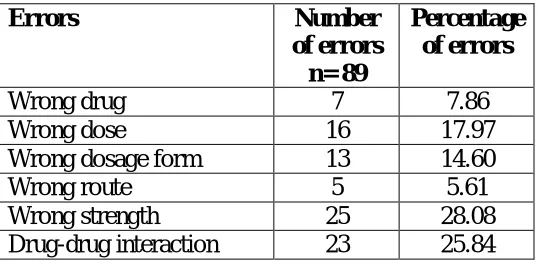
Errors of commission were found to be 0.27 errors per prescription. Prescribing wrong
strength (28.08%), dose (17.97%) and drug-drug interactions (25.84%) were found to be the
[image:4.595.117.479.223.310.2]leading errors among the Error of commission (Table 4).
Table 1: Prescription errors
Type of errors Number
of errors
Errors per prescription
Percentage of errors Error of omission
Related to the physician Related to the drug
755 546 209 2.36 1.71 0.65 89.24
Error of commission 89 0.27 10.52
Table 2: Errors of omission (related to the physician)
Type of errors
Number of errors n= 546
Percentage of errors
Patient’s name not mentioned 39 7.12
Patient’s age not mentioned 135 24.72
Patient’s M.R. # not mentioned 46 8.42
Patient’s wt. not mentioned 38 6.95
date not mentioned 110 20.14
Physician’s name not mentioned 53 9.70
Physician’s signature not mentioned 18 3.29
Clinic not mentioned 29 5.31
Diagnosis not mentioned 38 6.95
Illegible 40 7.32
Table 3: Error of omission (related to the drug)
Errors Number of
errors n= 209
Percentage of errors
Route not mentioned 23 11.00
Dose not mentioned 16 7.65
Dosage form not mentioned 28 13.39
Frequency not mentioned 9 4.30
Strength not mentioned 35 16.74
www.wjpr.net Vol 3, Issue 3, 2014. 3579 Table 4: Error of commission
Errors Number
of errors n= 89
Percentage of errors
Wrong drug 7 7.86
Wrong dose 16 17.97
Wrong dosage form 13 14.60
Wrong route 5 5.61
Wrong strength 25 28.08
Drug-drug interaction 23 25.84
DISCUSSION
Errors of commission are a serious threat to the patients health as compared to the errors of
omission which though looks to be harmless but can create a problem for the patient and
which occurs 3 to 4 folds more than the errors of commission [17,18,32,33]. Failure to
mention the patient’s important information like name, age, M.R number and weight can
create problem. If the patient age or weight is not mentioned than it can be problematic while
dispensing medicines like cardiac or those related to CNS. The name of physician must be
mentioned on the prescription along with his/her signature as in case of any query the
pharmacist can easily contact him/her. And above all the prescription should be written
clearly which can be read easily as bad handwriting can lead to dispensing of wrong
medication. Absences of information related to the drug like dose, route, dosage form,
strength and the refill time too should not be taken lightly as they can hinder in dispensing the
correct and required dose of medication to the patient. Errors of commission are more severe
than the errors of omission as the information is supplied but is incorrect. The wrong dose,
strength or frequency may be dangerous for the patient, as the dose more than required can be
toxic and below the therapeutic level will have provide effect.
Few important steps should be taken in order to avoid the prescription errors like the
introduction of automation, continuous educating the prescribers by improving their
knowledge through some on-line aids and monitoring of such errors [34].
Research has been done to find the preventive measures which can be taken to avoid them
[5,19,35-39]. In order to avoid the prescription errors the causes behind should be controlled.
For this not only the physician but also the pharmacist has to take certain measures. There
www.wjpr.net Vol 3, Issue 3, 2014. 3580 dispensed (emergency situations should be of coarse excluded from it). Every hospital should
have a proper documentation and error reporting system which should be confidential and
must be analyzed by the experts. The physicians should be made aware of their errors. The
implementation of such reporting system has helped in minimizing the prescription errors
[40,41]
All the sources of error (e.g. workload,) within the environment should be reduced. Verbal
prescription orders should be prohibited. If the physician forgets or want to add a medication
on the prescription he/she should ask for the prescription to enter that drug. Polypharmacy
should be discouraged. Drug-drug interactions should be evaluated carefully. Drugs having
too many adverse effects and those with narrow therapeutiv ranges should be avoided. Drug
information sources should be available and the computerized pharmacy system should be
developed. Stamp should be used by the physician who has illegible handwriting and
signature [32-45]. The physician should be well-aware of the medication ordering system.
Certain polices should be formulated by the PTC (Pharmacy and therapeutic committee)
members in accordance to the formulary system principles regarding the selection, evaluation
and therapeutic use of medications. Also the list of standard approved abbreviations should
be developed by the committee. A DUE (drug use evaluation) program should be developed
and conducted with respect to the safe use of medications [46].
The role of pharmacist is crucial in minimizing the prescription errors. After the prescription
is handed over to pharmacist, it is his/her duty to review it thoroughly. The pharmacist
dispensing the medication should have assess to the patient’s medication profile (for checking
allergies and other aspects) receiving services from the hospital [47].
CONCLUSION
Prescription errors occur commonly and in rare cases they can be life-threatening but are
preventable. Both the physician and the pharmacist have to play their role in minimizing such
errors. Prescriptions should be reviewed frequently and immediately so as to catch the error
before it gets too late. The implementation of certain policies within the hospital is also
www.wjpr.net Vol 3, Issue 3, 2014. 3581 REFERENCES
1. Lesar TS, Briceland L, Stein DS (1997). Factors related to errors in medication
prescribing, JAMA, 277:312–317.
2. Dean B, Vincent C, Schachter M, Barber N (2005). The incidence of prescribing errors in
hospital inpatients: an overview of the research methods, Drug Saf., 28:891–900.
3. Ansari
4. M, Neupane D (2009). Study on determination of errors in prescription writing: A semi
electronic perspective, Kathmandu Univ Med J.; 7(27):238-4.
5. Neville RG, Robertson F, Livingstone S, I K Crombie IK (1989). A classification of
prescription errors, J R Coll Gen Pract., 39(320): 110–112.
6. Nguyen PA, Syed-Abdul S, Iqbal U, Hsu MH, Huang CL, Li HC, Clinciu DL, Jian
WS, Li YC (2013). A probabilistic model for reducing medication errors, PLoS One.,
8(12):e82401.
7. Dean B, Schachter M, Vincent C, Barber N (2002). Causes of prescribing errors in
hospital inpatients: a prospective study, Lancet.;359:1373–8.
8. Ni KM, Siang CS, Ramli MN (2002). Noncompliance with prescription writing
requirements and prescribing errors in an outpatient department, Malay J Pharm Sci;
1(2):45-50.
9. Aronson JK (2009). Medication errors: Definition and classification, Brit J Clin
Pharmacol; 67(6):599-604.
10.Orün E, Polat A, Andan H, Cizmeci N, Tufan N (2013). Incorrect prescription of
intravenous paracetamol in a pediatric patient, Hippokratia.; 17(1):77-78.
11.Keers RN, Williams SD, Cooke J, Ashcroft DM (2013). Causes
of medication administration errors in hospitals: a systematic review of quantitative and
qualitative evidence, Drug Saf.; 36(11):1045-1067.
12.Slight SP, Howard R, Ghaleb M, Barber N, Franklin BD, Avery AJ (2013). The causes of
prescribing errors in English general practices: a qualitative study, Br J Gen Pract.;
63(615):713-720.
13.de Las Mercedes Martínez Sánchez A (2013). Medication errors in a Spanish community
pharmacy: nature, frequency and potential causes, Int J Clin Pharm.; 35(2):185-189.
14.Fernández-Llamazares CM, Pozas M, Feal B, Cabañas MJ, Villaronga M,
Hernández-Gago Y, Ruiz de Villegas M, Álvarez-del-Vayo C (2013). Profile of
prescribing errors detected by clinical pharmacists in paediatric hospitals in Spain, Int J
www.wjpr.net Vol 3, Issue 3, 2014. 3582 15.Spinewine A, Schmader KE, Barber N, Hughes C, Lapane KL, Swine C, Hanlon JT
(2007). Appropriate prescribing in elderly people: how well can it be measured and
optimised? Lancet.; 370:173–84.
16.American Society of Hospital Pharmacists (1988). ASHP guidelines on the pharmacist’s
role in drug-use evaluation, Am J Hosp Pharm.; 45:385–386.
17.Kuan Mun N, Chua Siew S, Mohamed Noor bin R (2002). Noncompliance with
prescription writing requirements and prescribing errors in an outpatient department,
Malay J Pharm; 1(2):45-50.
18.Mugoyela V, Mungongo S, Mwita S (2008). Extent of occurrence of prescribing errors in
a private tertiary – care hospital in Dar es salam, Tanzania Med J; 23(1):20-22.
19.Karthikeyan M, Lalitha D (2013). A prospective observational study
of medication errors in general medicine department in a tertiary care hospital,
Drug Metabol Drug Interact.; 28(1):13-21.
20.Barnett J, Rees R, Jani Y, George M (2013). Improving the quality of prescribing in the
emergency department, Br J Hosp Med (Lond).; 74(9):523-525.
21. Yeste-Gómez I, Durán-García ME, Muiño-Miguez A, Gómez-Antúnez M,
López-Berastegui O, Sanjurjo-Sáez M (2014). Potentially inappropriate prescriptions in
the ambulatory treatment of elderly patients, Rev Calid Asist.; 29(1):22-28.
22.Molitor R, Friedman S (2011). Electronic prescription errors in an ambulatory pharmacy,
J Manag Care Pharm.; 17(9):714-715.
23. Raebel MA, Charles J, Dugan J, Carroll NM, Korner EJ, Brand DW, Magid DJ (2007).
Randomized trial to improve prescribing safety in ambulatory elderly patients, J Am
Geriatr Soc.; 55(7):977-985.
24.Shaughnessy AF, Nickel RO (1989). Prescription-writing patterns and errors in a family
medicine residency program, The J fam pract; 29(3):290-5.
25. Brown CA, Bailey JH, Lee J, Garrett PK, Rudman WJ (2006). The pharmacist-physician
relationship in the detection of ambulatory medication errors, Am J Med Sci.; 331(1):22-24.
26.Abbasinazari M, Hajhossein Talasaz A, Eshraghi A, Sahraei Z (2013). Detection and
management of medication errors in internal wards of a teaching hospital by clinical
pharmacists, Acta Med Iran.; 51(7):482-486.
27.Jennane N, Madani N, Oulderrkhis R, Abidi K, Khoudri I, Belayachi J, Dendane
T, Zeggwagh AA, Abouqal R (2011). Incidence of medication errors in a Moroccan
www.wjpr.net Vol 3, Issue 3, 2014. 3583 28.Vessal G (2010). Detection of prescription errors by a unit-based clinical pharmacist in a
nephrology ward, Pharm World Sci.; 32(1):59-65.
29. Brokalaki H, Matziou V, Brokalaki E, Merkouris A, Fildissis G, Myrianthefs P (2008).
Antibiotic and O2 omissions and errors in hospitalized patients, J Nurs Care Qual.;
23(1):86-91.
30.Armada ER, Villamañán E, López-de-Sá E, Rosillo S, Rey-Blas JR, Testillano
ML, Alvarez-Sala R, López-Sendón J (2014). Computerized physician order entry in
the cardiac intensive care unit: Effects on prescriptionerrors and workflow conditions, J
Crit Care.;29(2):188-193.
31. Kandil M, Sayyed T, Emarh M, Ellakwa H, Masood A (2012). Medication errors in the
obstetrics emergency ward in a low resource setting. J Matern Fetal Neonatal Med.;
25(8):1379-1382.
32.Al Khaja KA, Ansari TM, Damanhori AH, Sequeria RP (2007). Evaluation of drug
utilization and prescribing errors in infants: a primary care prescription-based study,
Health Policy; 81(2): 350-357.
33.Ather A, Neelkantreddy P, Anand G, Manjunath G, Vishwanath J, Riyaz M (2013). A
Study on Determination of Prescription Writing Errors in out Patient Department of
Medicine in a Teaching Hospital, Ind. J. Pharm. Pract., 2: 21-24.
34.Aronson JK (2004). Medication errors resulting from the confusion of drug names, Expert
Opin Drug Saf.; 3:167–172.
35.Davis NM, Cohen MR (1981). Medication errors: causes and prevention. Huntingdon
Valley, PA: Neil M. Davis Associates.
36.Thomas AN, Boxall EM, Laha SK, Day AJ, Grundy D (2008). An educational and audit
tool to reduce prescribing error in intensive care, Qual Saf Health Care.; 17:360–363.
37.Barnett J, Rees R, Jani Y, George M (2013). Improving the quality of prescribing in the
emergency department, Br J Hosp Med (Lond).; 74(9):523-525.
38.Zellmer WA (1990). Preventing medication errors, Am J Hosp Pharm.; 47:1755–6.
39.Radley DC, Wasserman MR, Olsho LE, Shoemaker SJ, Spranca MD, Bradshaw B
(2013). Reduction in medication errors in hospitals due to adoption of computerized
provider order entry systems, J Am Med Inform Assoc.; 20(3):470-476.
40.Nolan TW (2000). System changes to improve patient safety, BMJ.; 320:771–773.
41.Kaldjian LC, Jones EW, Wu BJ, Forman-Hoffman VL, Levi BH, Rosenthal GE (2008).
Reporting medical errors to improve patient safety: a survey of physicians in teaching
www.wjpr.net Vol 3, Issue 3, 2014. 3584 42. Volmer D, Haavik S, Ekedahl A (2012). Use of a generic protocol in documentation
of prescription errors in Estonia, Norway and Sweden, Pharm Pract.; 10(2):72-77.
43.Lesar RS, Briceland LL, Delcoure K (1990). Medication prescribing errors in a teaching
hospital, JAMA.; 263:2329–2334.
44.Ingrim NB, Hokanson JA, Guernsey BG (1983). Physician noncompliance with
prescription-writing requirements, Am J Hosp Pharm.; 40:414–7.
45.Anderson RD (1971). The physician’s contribution to hospital medication errors. Am J
Hosp Pharm.; 28:18–25.
46.Betz RP, Levy HB (1985). An interdisciplinary method of classifying and monitoring
medication errors. Am J Hosp Pharm.; 42:1724–32.
47.Betz RP, Levy HB (1985). An interdisciplinary method of classifying and monitoring