www.wjpr.net Vol 6, Issue 16, 2017. 134
ANALYSIS OF THE EFFECT OF STEVIOL VS. NITROGEN BASES OF
RNA AND DNA USING QUANTUM METHODS
Erick Pedraza-Gress1, Karina García-Aguilar1,2, Iliana Herrera-Cantú1, Emmanuel
Vázquez - López1, Juan Jesús García-Mar1, Lillhian Arely Flores-González1, Manuel
Aparicio -Razo1,4, Oscar Sánchez-Parada3 and Manuel González-Pérez1*,5
1
Universidad Popular Autónoma Del Estado De Puebla A.C. (UPAEP). Centro Interdisciplinario De Posgrados (CIP). Posgrado En Ciencias De La Ingeniería Biomédica.
2
Instituto Tecnológico Superior De Coatzacoalcos. Academia De Ingeniería Bioquímica.
3
Escuela De Medicina Universidad Popular Autónoma Del Estado De Puebla.
4
Benemérita Universidad Autónoma De Puebla, Facultad De Ciencias De La Electrónica.
5
Sistema Nacional De Investigadores. Nivel 1.
ABSTRACT
The main component of the Stevia (STV) is steviol
[(5β,8α,9β,10α,13α)-13-Hydroxykaur-16-en-18-oic acid]. In recent years Stevia (STV) has aroused the interest of researchers due to high human consumption as an artificial sweetener. In this work, the general objective was to analyze the chemo-quantum interactions of Steviol and nitrogenous bases. As a result of the lowest interaction of Steviol:U2 is ETC =28,872 because of the high probability that Steviol causes a mutation in RNA. This alteration is similar to that caused by nicotine to RNA as well. Another important observation is that Steviol acts as a reducing agent (antioxidant) in all nitrogenous bases; but, it is not reliable; for its low cross-band ETC with U2. In this way, it can be said that not always that a substance is antioxidant, it is good for health.
KEYWORD: Stevia, Steviol, DNA, RNA, SE-PME, Quantum Chemistry.
INTRODUCTION
In recent years Stevia (STV) has aroused the interest of researchers due to high human consumption as an artificial sweetener. The STV is an herbaceous shrub about 80 cm high; its
Volume 6, Issue 16, 134-142. Research Article ISSN 2277–7105
Article Received on 14 October 2017,
Revised on 03 Nov. 2017, Accepted on 24 Nov. 2017
DOI: 10.20959/wjpr201716-10279
*Corresponding Author
Dr. Manuel
González-Pérez
Universidad Popular
Autónoma Del Estado De
Puebla A.C. (UPAEP).
Centro Interdisciplinario De
Posgrados (CIP). Posgrado
En Ciencias De La
www.wjpr.net Vol 6, Issue 16, 2017. 135
leaves accumulate the highest content of glycosides. The level of glycosides in the plant is very variable, with values of 2% and 18% depending on the variety. It used Hyper Chem molecular simulator for Windows Serial # 12-800-1501800080 SE-PM3 for Calculus of ETC.
The properties of STV reported in scientific articles are regulation of glycemic, hypertension, contraception, treatment of skin disorders and in caries prevention[1], stimulates alertness, facilitates digestion, gastrointestinal functions and maintains the feeling of vitality and wellbeing It has been reported that STV has bactericidal effects on Streptococcus mutans. This bacterium is responsible for tooth decay.[2] Consumers of STV report are decreasing consumption of tobacco and alcoholic beverages.[3]
Stevia rebaudiana (STVR) PMID: 14561506 is used as a natural sweetener or in dietary supplements for its content of active glycosides present in the leaves (Stevioside and rebaudioside A, B, C, D and E, Dulcoside A and Steviolbioside) with chemical and pharmacological characteristics for human consumption.[3-6]
The complete chemical composition of the STV species is not yet available. In the chemical products found are apigenin, austroinilin, avicularin, β-sitosterol, caffeic acid, campesterol, caryophyllene, centaureidin, chlorogenic acid, chlorophyll, kaempferol, luteolin, quercetin, stigmasterol, among others.[7]
Chronic consumption of STVR represents little risk based on human studies. In 1985 it was shown that oral consumption of STVR in high amounts as 550 mg/kg of body weight per day (i.e., 200 times the maximum probable intake of around 2 mg/kg/body weight/day for two years) had no toxic or carcinogenic effects in rats. The pharmacological effects are suggested by other studies, such as the reduction of blood pressure and blood glucose levels. The metabolite of aglycone, steviol, was reported to be mutagenic and bactericidal in Salmonella typhimurium TM677. Therefore, the biological effects and adverse drug interactions are confusing.[8]
We publish characteristics, properties and quantum interactions of nitrogenous bases through simulation methods of quantum chemistry.[9-13]
www.wjpr.net Vol 6, Issue 16, 2017. 136 MATERIALS AND METHODS
Software and simulation
It used HyperChem molecular simulator for Windows Serial # 12-800-1501800080 SE-PM3 for extracting the molecules.
General setting
SE-PM3 a total load of around 0. Multiplicity1. Pairing turns the RHF. State under the Convergent limit of 0.01. 50. Limit iteration accelerates convergence Yes. Polarizability. Geometry Optimization: Algorithms Polak-Ribiere (conjugate gradient). RMS termination condition gradient 0.1 kcal/Amol. Algorithm Polak-Ribiere (conjugate gradient), the termination condition or 1000 cycles Maximum. Algorithm Polak-Ribiere (conjugate gradient).
Parameters for the calculation of molecular orbitals HOMO and LUMO.
Orbitals Plot Orbitals Options Isosurface Rendering. Orbital Contour Value 0.05. Wire Isosurface Gird months. Gird Meshes size Coarse. Gird Layout Default. Gird Contour Default. Transparency Level Default.
Parameters for the calculation of Electrostatic Potential.
Plot Molecular Graphs. Plot Molecuar Options. Molecular Properties: Properties. Electrostatic Potential Yes. Representations 3D Mapped Isosurface. Gird Mesh Size Coarse. Gird Layout Default. Contour Gird Default. Isosurface Reading. Total Charge Density Contour Value 0.015. Rendering Wire Mesh. Transparency Level Default. Mapped Options Functions Default. [14]
RESULTS AND DISCUSSION
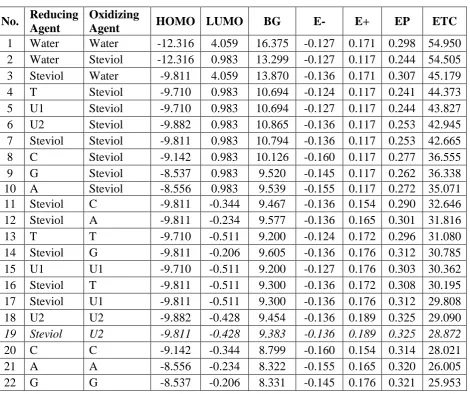
www.wjpr.net Vol 6, Issue 16, 2017. 137 Table 1: ETC pure substance and, cross-linked strains of amino acids with Steviol.
No. Reducing
Agent
Oxidizing
Agent HOMO LUMO BG E- E+ EP ETC
1 Water Water -12.316 4.059 16.375 -0.127 0.171 0.298 54.950
2 Water Steviol -12.316 0.983 13.299 -0.127 0.117 0.244 54.505
3 Steviol Water -9.811 4.059 13.870 -0.136 0.171 0.307 45.179
4 T Steviol -9.710 0.983 10.694 -0.124 0.117 0.241 44.373
5 U1 Steviol -9.710 0.983 10.694 -0.127 0.117 0.244 43.827
6 U2 Steviol -9.882 0.983 10.865 -0.136 0.117 0.253 42.945
7 Steviol Steviol -9.811 0.983 10.794 -0.136 0.117 0.253 42.665
8 C Steviol -9.142 0.983 10.126 -0.160 0.117 0.277 36.555
9 G Steviol -8.537 0.983 9.520 -0.145 0.117 0.262 36.338
10 A Steviol -8.556 0.983 9.539 -0.155 0.117 0.272 35.071
11 Steviol C -9.811 -0.344 9.467 -0.136 0.154 0.290 32.646
12 Steviol A -9.811 -0.234 9.577 -0.136 0.165 0.301 31.816
13 T T -9.710 -0.511 9.200 -0.124 0.172 0.296 31.080
14 Steviol G -9.811 -0.206 9.605 -0.136 0.176 0.312 30.785
15 U1 U1 -9.710 -0.511 9.200 -0.127 0.176 0.303 30.362
16 Steviol T -9.811 -0.511 9.300 -0.136 0.172 0.308 30.195
17 Steviol U1 -9.811 -0.511 9.300 -0.136 0.176 0.312 29.808
18 U2 U2 -9.882 -0.428 9.454 -0.136 0.189 0.325 29.090
19 Steviol U2 -9.811 -0.428 9.383 -0.136 0.189 0.325 28.872
20 C C -9.142 -0.344 8.799 -0.160 0.154 0.314 28.021
21 A A -8.556 -0.234 8.322 -0.155 0.165 0.320 26.005
22 G G -8.537 -0.206 8.331 -0.145 0.176 0.321 25.953
Solubility of commercials stevia vs. steviol in water
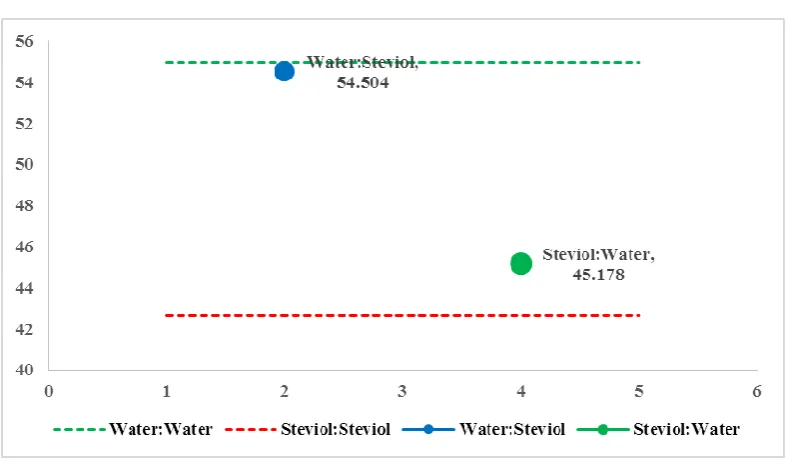
The Steviol-Water interaction has a lower ETC (Figure 1). Steviol has a medium solubility, due to its low ETC when combined with water.
www.wjpr.net Vol 6, Issue 16, 2017. 138 Figure 1: Electron transfer coefficient (quantum well) Steviol: Water.
Above the red line, the zone with the lowest probability of some interaction between these two compounds is located. Below the red line is the area most likely to have an electron transfer interaction between these two compounds. Between the two lines, there is the zone of average probability of the interaction between these two compounds.
Table 2: Experimental parameters and solubility; * slightly soluble ** moderately
soluble *** completely soluble; V: Steviol, W: Commercial Sweeny; M: Commercial
Mayan Sweet.
Sample Temperature
(oC)
Agitation (rpm)
Dilution
time (seg) Solubility
V 25 500 60 **
W 25 500 10 ***
M 25 500 350 *
V 35 500 60 **
W 35 500 5 ***
M 35 500 350 *
V 65 500 10 **
W 65 500 5 ***
M 65 500 350 *
www.wjpr.net Vol 6, Issue 16, 2017. 139
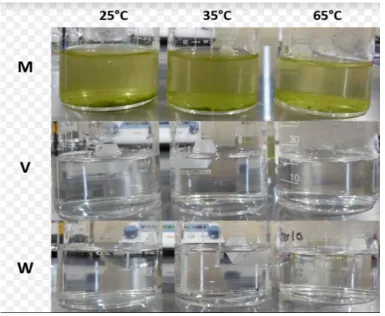
The commercial stevia showed different solubilities. These differences show us that commercial stevia has other compounds than steviol.
[image:6.595.107.493.180.496.2]As expected, steviol diluted faster with increasing temperature (Chatelier principle), but it retained its medium solubility in water.
Figure 2: Solubility tests of Steviol and Water.
Interactions of Steviol vs. Nitrogen Bases (DNA, RNA)
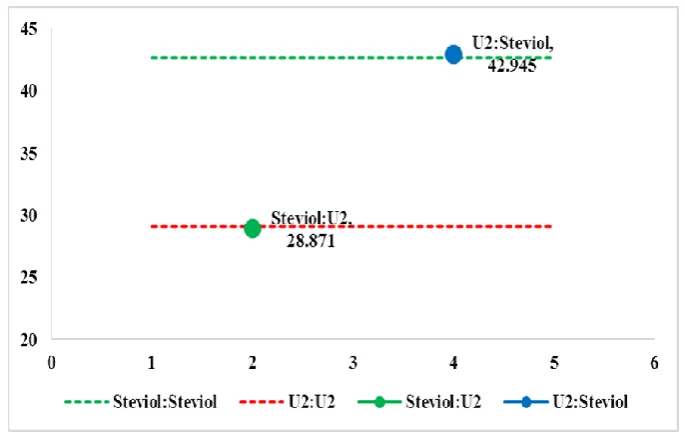
The lowest interaction of Steviol:U2 is ETC =28,872 (Table 1). The high probability that Steviol causes a mutation in RNA due to its interaction with U2 is shown.
www.wjpr.net Vol 6, Issue 16, 2017. 140 Figure 3: Electron transfer coefficient (quantum well) Steviol: Water.
Another important observation is that Steviol acts as a reducing agent (antioxidant) in all nitrogenous bases; but, it is not reliable; for its low cross-band ETC with U2.
CONCLUSION
Therefore, we conclude that not all antioxidant substances are good for health.
REFERENCES
1. Melis MS. Effects of chronic administration of Stevia rebaudiana on fertility in rats. J Ethnopharmacol, 1999; 67: 157–61.
2. Satishkumar J, Sarvanan MM, Seethalakshmi I. Invitro antimicrobial and antitumor activities of Stevia rebaudiana (Asteraceae) leaf extracts. Trop J Pharm Res, 2008; 7: 1143–9.
3. Misra, H., Soni, M., Silawat, N., Mehta, D., Mehta, B. K., & Jain, D. C. (2011). Antidiabetic activity of medium-polar extract from the leaves of Stevia rebaudiana Bert.(Bertoni) In alloxan-induced diabetic rats. Journal of Pharmacy and Bioallied Sciences, 3(2): 242.
4. Nguyen, T. T. H., Seo, C., Gu, B. C., Lim, H. J., Ha, J. M., Kim, S. B., & Kim, D. (2017). Production of steviol from steviol glucosides using β-glucosidase from a commercial pectinase, Sumizyme PX. Biotechnology Letters, 1-8.
www.wjpr.net Vol 6, Issue 16, 2017. 141
and Antioxidant Activities in Rat Cardiac Fibroblasts. Oxidative Medicine and Cellular Longevity, 2017.
6. Durán, S., Rodríguez, M. D. P., Cordón, K., & Record, J. (2012). Estevia (stevia rebaudiana), edulcorante natural y no calórico. Revista chilena de nutrición, 39(4): 203-206.
7. Sharma N, Kaushal N, Chawla A, Mohan M, Sethi A, Sharma Y. Stevia rebaudiana-A review. Agrobios Newslett, 2006; 5: 46–8.
8. Toskulkao C, Chaturat L, Temcharoen P, and Glinsukon T. Acute toxicity of stevioside, a
natural sweetener and its metabolite, steviol, in several animal species. Drug Chem Toxicol, 1997; 20: 31-44.
9. Gutiérrez-Ramírez, J. M., Flores-González, L. A., Toledo-Vázquez, A., Sánchez-González, L. C., Reyes-Solis, H., & González-Pérez, M. (2017). Quantum Analysis of the Effect of Cannabidiol on Neurotransmitters. World Journal of Pharmaceutical Research, October 2017; 6(13): 31-38. DOI: 10.20959/wjpr201713-9861.
10.Lillhian Arely Flores-González, José Miguel Gutiérrez-Ramírez, Lorian Constanza Sánchez-González, Horacio Reyes-Solis, Alex Toledo-Vázquez and Manuel González Pérez. Quantic analysis of the effect of nicotine on neurotransmitters. World Journal of Pharmaceutical Research, April 2017; 6(4): 317-326. DOI: 10.20959/wjpr20174-8243. 11.González-Pérez, M. (2017). Chemical-quantum Analysis of the Aggressiveness of
Glucose and its Appeasement with ATP Inside the Cell, and Water as an Excellent Antioxidant. World Journal of Pharmacy and Pharmaceutical Sciences, April 2017; 6(4): 95-99. DOI: 10.20959/wjpps20174-8940.
12.González-Perez, M., Pacheco-Bautista, D., Ramirez-Reyes-Montaño, H. A., Medel-Rojas, A., González-Murueta, J. W., & Sánchez, C. (2017). Analysis of the interactions of n-(l-α-aspartyl)-l-phenylalanine, 1-methyl ester (aspartame) and the nitrogen bases of DNA
and RNA using quantum methods. World Journal of Pharmacy and Pharmaceutical
Sciences, April 2017; 6(5): 40-49. DOI: 10.20959/wjpps201759046.
13.González-Perez, M. Interactions analysis of four chemotherapeutic drugs vs. nitrogenous
bases of DNA and RNA, using quantum methods. World Journal of Pharmaceutical Research, 2017; 5(6): 309-320. June 2016 DOI: 10.20959/wjpr20166-6363.
www.wjpr.net Vol 6, Issue 16, 2017. 142