PRELIMINARY PHYTOCHEMICAL SCREENING, ISOLATION AND
STRUCTURAL ELUCIDATION OF BIOACTIVE COMPOUND FROM
METHANOL BARK EXTRACTS OF
FICUS POLITA
Zannah Zakariya Goni* and Musa Maikudi Idriss
Bayero University Kano, Department of Pure and Industrial Chemistry, P.M.B. 3011 Kano,
Kano State, Nigeria.
ABSTRACT
The aim of this study was to screen the phytochemical constituents,
isolate and elucidate the structure of bioactive compound from
methanol extracts from the bark of Ficus polita. The qualitative
phytochemical analysis of the bark extract of Ficus polita was done
following standard procedures and the tests revealed the presence of
saponins, tannins, steroids, triterpenoids and lipids. The methanol
extract of the bark led to the isolation of one compound, E5. Structure
determination was accomplished by means of spectroscopic methods
(FT-IR, 13C, 1H, COSY, and HSQC NMR). The spectral data of the
isolated compound E5 is identical with spectral data of literature study,
the spectral interpretation of the compound E5 shows that it is a
cardiolipin derivative, is a kind of disphosphatidylglycerol lipid in which all four of the
phosphatidyl acyl groups are specified as oleoyl, it has two phosphatidic acid moieties
connected to glycerol backbone in the center and potentially carries two negative charges,
and is elucidated to be Tetraoleoylcardiolipin (C81H150O17P2) which is reported for the first
time from Ficus polita.
KEYWORDS: Ficus polita, Methanol extract, Bark, Cardiolipin, Tetraoleoylcardiolipin.
INTRODUCTION
Ficus polita belongs to the well-known family of edible plants, Moraceae, it is an edible plant
growing up to 15 and sometimes to 40 meters tall in coastal and dry forest (East and Southern
Africa), lowland rainforest and gallery forest (West and Central Africa). The edible fruits are
Volume 9, Issue 1, 129-138. Research Article ISSN 2277– 7105
*Corresponding Author Zannah Zakariya Goni
Bayero University Kano,
Department of Pure and
Industrial Chemistry,
P.M.B. 3011 Kano, Kano
State, Nigeria. Article Received on 27 Oct. 2019,
Revised on 17 Nov. 2019, Accepted on 08 Dec. 2019
chewed for dyspepsia, while leaves, bark and roots are used in the treatment of infectious
diseases, cough, abdominal pains and diarrhea.[1][2] The bark, leave and branch is used in
treatment of all pregnancy disorders and breast milk booster enhancing tonic.[3] The leaves,
roots and bark are used by traditional people in Kano for the management of diabetes.[4] The
methanol bark extract shows high antidiabetic activity, and effective use of the extract could
lead to the cure of the diabetic problems around the world.[5] In the previous studies,
researchers reported the isolation of euphol-3-O-cinnamate, lupeol, taraxar-14-ene, ursolic
acid, ß-sitosterol, betulinic acid, sitosterol 3-O-ß-D-glucopyranoside and
(E)-3,5,4’-trihydroxy-stilbene-3,5-O-b-D-diglucopyranoside and politamide from roots and stem bark
parts of plant.[2][6] In the present study, preliminary phytochemical analysis, isolation and
structural elucidation of methanol extract of the plant bark has been done.
MATERIALS AND METHODS
Collection of The Plant Samples And Preparation
The plant was identified and authenticated in herbarium of Bayero University Kano and a
voucher specimen was deposited BUKHAN 104. The branches of Ficus polita were
harvested and the barks peeled off while still fresh, cut into small portions, and dried at room
temperature under shade for one month. The dried plant barks were grounded, and the
powdered was kept at room temperature away from direct sunlight.[5]
Extraction and Isolation of Ficus Polita Bark
The powdered sample (500g) was macerated using Ethanol (2L) for 7 days with occasional
agitation. The solvent was evaporated using rotary evaporator at 400C. The crude ethanol
extract was macerated sequentially using n-hexane, chloroform, ethyl acetate (EtOAc) and
methanol (MeOH). The fractions of these solvents were dried by exposing them to air at
room temperature.[5] The methanol extract (5g) was subjected to column chromatography, the
column was eluted with n-hexane, EtOAc and MeOH.[7] This gave different fractions and
each fraction was analyzed on TLC and similar fractions were combined according to their
TLC patterns which were pooled together. Pooled fraction with single spot was subjected to
spectroscopic analysis. The structure of isolated pooled component (E5) was elucidated by
NMR (1H-NMR, 13C-NMR, COSY, HSQC) and IR techniques. The resulting spectral data
obtained for E5 was interpreted by comparing with identical literature spectral data, FIDs of
both the literature data and the experimental data were viewed, processed and compared
Phytochemical Screening
Ficus polita bark crude ethanol extract and fractions were screened for the presence of
phytochemicals such as alkaloids, flavonoids, tannins, saponins, triterpenoids, steroids,
carbohydrates, anthraquinones and lipids using standard phytochemical procedures.[9][10]
[image:3.595.87.501.227.414.2]RESULTS AND DISCUSSION RESULTS
Table 1: Phytochemical screening results of Ficus polita bark extracts. Phytochemical
constituent
Fractions Crude
Extract n-Hexane Chloroform
Ethyl
acetate Methanol
Alkaloids + - - - -
Flavonoids + - - + -
Tannins + + + + +
Triterpenoids + + + + +
Steroids + + + + +
Saponin + + + + +
Anthraquinones + + + + -
Carbohydrates + + + + -
Lipids + + + + +
Key: + = Presence - = Absence
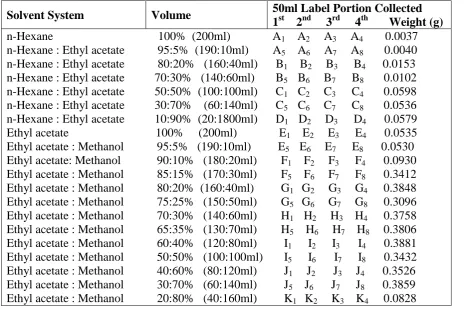
Table 2: Column Chromatography of Methanol Extract of Ficus Polita Bark.
Solvent System Volume 50ml Label Portion Collected 1st 2nd 3rd 4th Weight (g)
[image:3.595.71.538.457.767.2]Ethyl acetate : Methanol 15:85% (30:170ml) K5 K6 K7 K8 0.0271 Ethyl acetate : Methanol 10:90% (20:180ml) L1 L2 L3 L4 0.0125 Ethyl acetate : Methanol 5:95% (10:190ml) L5 L6 L7 L8 0.0121 Methanol 100% (200ml) M1 M2 M3 M4 0.0750
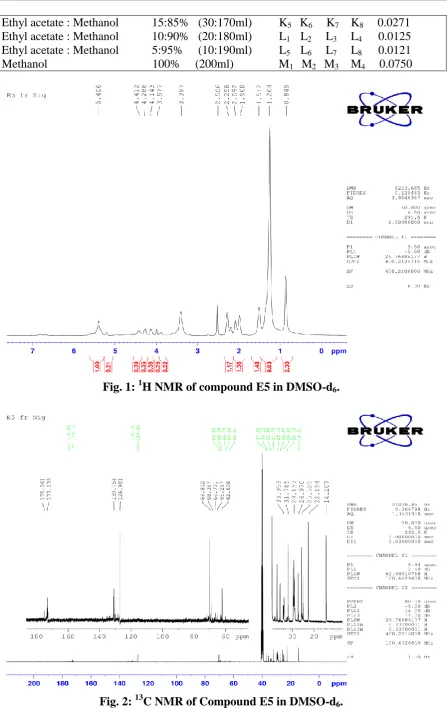
Fig. 1: 1H NMR of compound E5 in DMSO-d6.
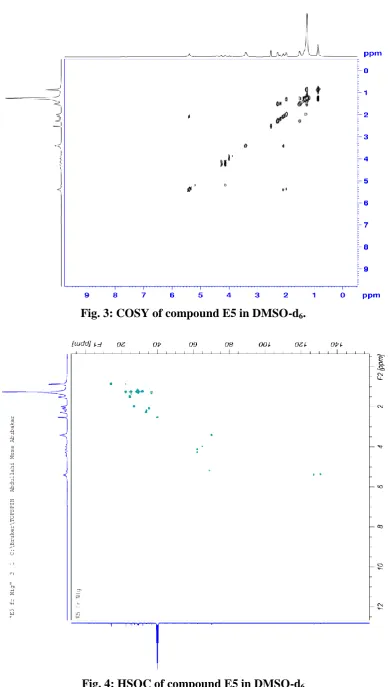
Fig. 3: COSY of compound E5 in DMSO-d6.
Sample ID: E5 Method Name: DATA COLLECT ONLY
Sample Scans: 32 User: FTIR
Background Scans: 32 Date/Time: 10/25/2018 3:00:01PM
Resolution: 8 cm-1 Range: 4,000.00 - 650.00
System Status: Good Apodization: Happ-Genzel
[image:6.595.77.513.71.460.2]Fig. 5: FT-IR of Compound E5.
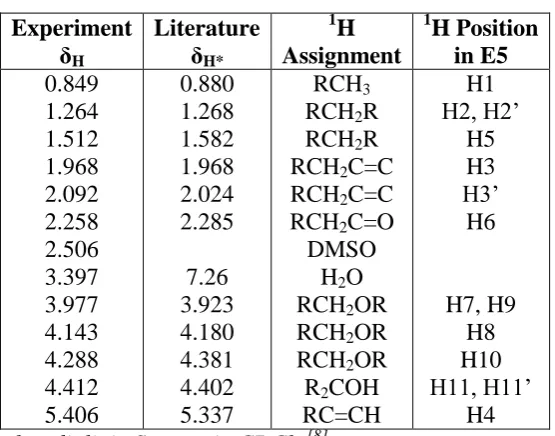
Table 3: 1H NMR chemical shift data of compound E5.
Key: δH* Tetraoleoylcardiolipin Spectra in CDCl3.[8]
Experiment δH Literature δH* 1 H Assignment 1 H Position in E5 0.849 1.264 1.512 1.968 2.092 2.258 2.506 3.397 3.977 4.143 4.288 4.412 5.406 0.880 1.268 1.582 1.968 2.024 2.285 7.26 3.923 4.180 4.381 4.402 5.337 RCH3 RCH2R RCH2R RCH2C=C RCH2C=C RCH2C=O DMSO
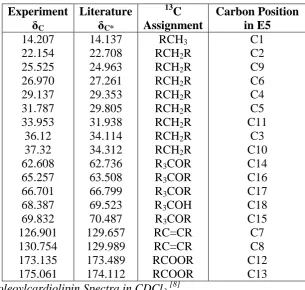
[image:6.595.160.438.513.731.2]Table 4: 13C NMR chemical shift data of compound E5. Experiment δC Literature δC* 13 C Assignment Carbon Position in E5 14.207 22.154 25.525 26.970 29.137 31.787 33.953 36.12 37.32 62.608 65.257 66.701 68.387 69.832 126.901 130.754 173.135 175.061 14.137 22.708 24.963 27.261 29.353 29.805 31.938 34.114 34.312 62.736 63.508 66.799 69.523 70.487 129.657 129.989 173.489 174.112 RCH3 RCH2R RCH2R RCH2R RCH2R RCH2R RCH2R RCH2R RCH2R R3COR R3COR R3COR R3COH R3COR RC=CR RC=CR RCOOR RCOOR C1 C2 C9 C6 C4 C5 C11 C3 C10 C14 C16 C17 C18 C15 C7 C8 C12 C13 Key: δC* Tetraoleoylcardiolipin Spectra in CDCl3.[8]
Table 5: COSY (1H- 1H) and HSQC (1H- 13C) data of compound E5. 1
H Assignment
1
H – 1H Correlation
1
H – 13C Correlation 13 C Assignment H1 H2, H2’ H5 H3 H3’ H6 DMSO
H2O H7, H9
H8 H10 H11, H11’
H4
H1 – H2 H2’ – H3 H2’– H5 H5– H6 H3 – H4 H3’ – H4
H7 – H8 H8 – H9 H10 – H11
H1 – C1 H2– C2 H2’–C4 H2’–C5 H2’– C10
H3 – C6 H3’– C6
H4– C7 H4 – C8 H5– C9 H6 – C11 H7– C14 H8 – C15 H9– C16 H10 – C17 H11 – C18
DISCUSSION
The phytochemical analysis carried out on the bark of Ficus polita plant shows the presence
of saponin, steroid, triterpenoid, tannin and lipids in all the fractions. Carbohydrate and
anthraquinone are present in all the fractions with exception of methanolic fraction.
Flavonoid however is present in crude ethanol extract and ethyl acetate fractions. However,
alkaloid is present only in crude ethanol extract. The result corresponds to the report in the
literature that different solvent extraction and geographical area may result in obtaining
different phytochemical constituents.[11][12][13]
The compound E5 spectral data is identical with the literature spectral data obtained. The
[image:8.595.104.489.297.690.2]compound E5 was elucidated to be Tetraoleoylcardiolipin (C81H150O17P2).
[image:8.595.115.483.480.679.2]Figure 6: Structure of Tetraoleoylcardiolipin (E5).
Figure 7: Proposed 1H and 13C assignment of Compound E5.
The characteristic 1H NMR shows overlapping around 1.264 ppm, proton that is bonded
proton and also proton adjacent to carbonyl carbon as shown in figure 1. The characteristics
of 13C peaks in the spectrum of E5 revealed that the carbons are mainly aliphatic, carbon
directly bonded to oxygen, alcoholic carbon, vinylic carbons, and esters as shown in figure 2.
The COSY and HSQC correlation correspond with the structure of the compound. The FT-IR
Spectrum of the compound shows a characteristic absorbance for OH (3435cm-1), C=C
(3007cm-1), C-H (2921cm-1 and 2854cm-1), and C=O (1741cm-1), CH2 and CH3 (1462cm-1),
CH3 (1380cm-1), C-O (1242cm-1), P=O (1167cm-1) and P-OR (1037cm-1) as shown in figure
5.
The compound E5 is cardiolipin derivatives, is a kind of disphosphatidylglycerol lipid in
which all four of the phosphatidyl acyl groups are specified as oleoyl. It has two phosphatidic
acid moieties connect with a glycerol backbone in the center and potentially carries two
negative charges with IUPAC name
[(2R)-3-[[3-[[(2R)-2,3-bis[[(Z)-octadec-9-
enoyl]oxy]propoxy]-hydroxyphosphoryl]oxy-2-hydroxypropoxy]-hydroxyphosphoryl]oxy-2-[(Z)-octadec-9-enoyl]oxypropyl](Z)-octadec-9-enoate.
CONCLUSION
The Ficus polita bark methanol extract shows presence saponins, tannins, steroids,
triterpenoids and lipids. Isolation and identification of bioactive compound indicates that the
compound isolated is a cardiolipin derivative, tetraoleoylcardiolipin (C81H150O17P2).
AKNOWLEDGEMENT
We acknowledged the support given to me by Alh. Goni Baba Gana’s family, Alh. Bulama
Lawan’s family, my colleagues, Umar Ya’u, Ali Ya’u Yusuf, Abdulsalam AS, M. Kaka
YSU, Abdullahi Firat, Dr. Fatih Briyan and the entire staff of Pure and Industrial Chemistry
Department, Bayero University Kano.
REFERENCES
1. Kuete V, Kamga J, Sandjo LP, Ngameni B, Poumale HMP, Ambassa P, Ngadjui BT.
(Antimicrobial activities of the methanol extract, fractions and compounds from Ficus
polita Vahl. (Moraceae)). BMC Complementary and Alternative Medicine, 2011; 11: 6.
2. Mustapha AA. (Ethnobotanical field survey of medicinal plants used by traditional
medicine practitioners to manage HIV/AIDS opportunistic infections and their
prophylaxis in Keffi Metropolis, Nigeria). Asian J Plant Science and Research, 2014;
3. Danjuma MN, Darda’u H. An Ethno-Survey of Medicinal Trees of Kabobi Village,
Northern Katsina, Nigeria. Academic Research International, 2013; 4(3): 174-183.
4. Negbenebor HE, Shehu K, Mairami FM, Adeiza ZO, Nura S, Fagwalawa LD.
(Ethnobotanical Survey of Medicinal Plants Used by Hausa People in the Management of
Diabetes Mellitus in Kano Metropolis, Northern Nigeria). European J Medicinal Plants,
2017; 18(2): 1-10.
5. Goni ZZ, Idriss MM. In-vivo Antidiabetic Activity of Ficus polita Bark Extracts. World J
Pharmaceutical Res., 2019; 8(13): 261-270.
6. Kamga J, Sandjo LP, Poumale HM, Ngameni B, Shiono Y, Yemloul M, Rincheval V,
Ngadjui BT, Kirsch G. Politamide, a new constituent from the stem bark of
FicuspolitaVahl (Moraceae). Arkivoc, 2010; (ii): 323-329.
7. Bajpai VK, Majumder R, Park JG. Isolation and purification of plant secondary
metabolites using column-chromatographic technique. Bangladesh Journal of
Pharmacology, 2016; 11: 844-848.
8. BMRD; Maria N, Lawrence JC, Christopher S, Mark EA, John LM.
Tetraoleoylcardiolipin bmse001105. Biological Magnetic Resonance Data Bank,
http;//www.bmrd.wisc.edu/metabolomics/mol_summary/show_data.php/id=bmse001105
&whichTab=1
9. Abubakar AS, Adoum OA, Hassan Y, Ibrahim B. Phytochemical Screening and
Anti-plasmodial Activity of Balsamodendron africanum (A. Rich) (Burseraceae). American
Journal of Bioscience and Bioengineering, 2016; 4(6): 65-69.
10.Marka R, Talari S, Penchala S, Rudroju S, Swamy RN. Preliminary Phytochemical
Analysis of Leaf, Stem, Root and Seed Extracts of Arachis Shypogaea L. Int. J. Pharm.
Sci. Rev Res., 2013; 20(1): 134-139.
11.Akesa TM. Phytotaxonomy and phytochemicals of Eight species of the Family Moraceae
in Benue State, Nigeria. International Journal of Scientific & Engineering Research,
2016; 7(2): 588-595.
12.Usman H, Kaigama AU, Ibisagba OO, Fulata AM, Ahmed IA. Phytoconstituents
evaluation and antimicrobial efficacy of the crude flavonoids and saponins rootbark
extracts of Terminalia avicennioides and Ficus polita. J Herbmed Pharmacology, 2018;
7(2): 106-111.
13.Sodipo OA, Akanmu AO, Mamza UT, Idriss MM, Wampana B. (Antidiabetic effect of
the aqueous stem bark extract of Ficus polita Vahl in Alloxan-Induced Diabetic Albino