METHOD DEVELOPMENT AND VALIDATION OF EVEROLIMUS BY
USING RP-HPLC
Devavath Renuka*1, Nalla Kumar P.2 and Bhagavan Raju M.3
1,2,3
Department of Pharmaceutical Analysis, Sri Venkateshwara College of Pharmacy, Hi-tech
City Rd, Madhapur, Hyderabad, Telangana 500081.
ABSTRACT
Objective: To develop and validate the RP-HPLC method for estimation of Everolimus in bulk and pharmaceutical formulation.
Materials and methods: Estimation of Everolimus were carried out by RP-HPLC using Mobile phase Buffer: Acetonitrile (40:60) and
column std ODS (250×4.6mm, 5µ) as a stationary phase and peak was
observed at 268nm which was selected as a wavelength for estimation.
Results: Method was developed and this method was validated as per ICH guidelines for specificity, linearity, precision, accuracy,
robustness studies. Conclusion: All the validated parameters were within the limits. The method was found to be suitable for the
estimation of Everolimus in bulk and pharmaceutical formulation.
KEYWORDS: HPLC Everolimus, Method development. ICH Guidelines.
Abbreviations
HPLC: High Performance Liquid Chromatography; R2 Correlation coefficient; RT Retention
time; LOD Limit of detection; LOQ Limit of quantification; RSD Relative Standard
deviation; ICH International Conference harmonization.
INTRODUCTION
Everolimus is a derivative of Rapamycin (sirolimus), and works similarly to Rapamycin as an
mTOR (mammalian target of rapamycin) inhibitor. It is currently used as an
immunosuppressant to prevent rejection of organ transplants. In a similar fashion to other
mTOR inhibitor of Everolimus’ effect is solely on the mTORC1 protein and not on the on the
mTORC2 protein. Everolimus have the therapeutic active for the treatment of various type of
*Corresponding Author Devavath Renuka
Department of
Pharmaceutical Analysis, Sri Venkateshwara College of Pharmacy, Hi-tech City Rd, Madhapur, Hyderabad, Telangana 500081.
Volume 8, Issue 13, 949-957. Research Article ISSN 2277– 7105
Article Received on 25 Sept. 2019,
Revised on 15 Oct. 2019, Accepted on 05 Nov. 2019
cancer including The breast carcinoma, renal cell carcinoma, non-small cell lung carcinoma
and mantle cell lymphocytes. The everolimus is mainly used for the treatment of kidney
cancer. The mode of the action of everolimus is a mTOR inhibitor that binds with high
affinity to the FK506 binding protein-12 (FKBP-12). The FK506 binding protein, is a family
of protein that have prolyl isomerase activity and are related to the cyclophilins in though not
in amino acid sequence. There by forming a drug complex that inhibits the activation of
mTOR. This inhibition reduces the activity of effectors downstream, which leads to a
blockage in the progression of cellsfrom G1 into S phase, and subsequently inducing cell
growth arrest and apoptosis. Everolimus also inhibits the expression of hypoxia-inducible
factor, leading to a decrease in the expression of vascular endothelial growth factor. The
result of everolimus inhibition of mTOR is a reduction in cell proliferation, angiogenesis, and
glucose uptake. The dose of everolimus is 10mg.
Chemically evorlimus is
(1S,9R,15R,16E,18R,19R,21S,23R,24E,26E,30S,32R,35S)-1,18-
dihydroxy-12-[(2S)-1-[(1S,3R,4R)-4-(2-hydroxyethoxy)-3-methoxycyclohexyl]propan-2-yl]-19,30-dimethoxy-15,17,21,23,29,35,-hexamethyl-11,36-dioxa-4-azatricyclo [30.3.1.04,9] hexatriaconta-16,24,26,28-tetraene-2,3,10,14,20-pentone and empirical formula is
C55H83NO14.
Literature survey suggests several methods for estimation of everolimus alone or in
combination with other drugs such as UV spectrophotometer HPLC and LC-MS. The present
investigation was undertaken to develop new, simple, accurate and precise high performance
liquid chromatographic method for the estimation of everolimus in pharmaceutical dosage
[image:2.595.160.438.567.724.2]forms.
MATERIAL AND METHODS
Everolimus pure drug was supplied as gift sample by Hetero Drug Limited, Hyderabad, India.
Acetonitrile HPLC Grade (RANKEM), Methanol HPLC Grade (RANKEM) HPLC Grade
Water, Glacial Acetic acid. High purity water was prepared using Millii Q water purification
system. The stock and working standard solution were prepared by using water: acetonitrile
(40:60).
Chromatographic separation was performed on a WATER HPLC 2965 SYSTEM with Auto
Injector and PDA Detector. Software used is Empower UV-VIS spectrophotometer PG
Instruments T60 with special bandwidth of 2mm and 10mm and matched quartz was be used
for measuring absorbance for Everolimus solutions.
A stdODS (250mm×4.6mm, 5µ). The elution is carried out at flow rate of 1ml/min using
Water: acetonitrile (40:60).
Preparation of standard stock and working standard solution
Accurately Weighed and transferred 10mg Everolimus working Standard into a 10ml clean
dry volumetric flask, add 5ml of diluent, sonicated for 30 minutes and make up to the final
volume with diluents. From the above stock solution, 1 ml was pipette out in to a 10ml
Volumetric flask and then make up to the final volume with diluents. Linearity range
solutions containing 25, 50, 75,100,125, and 150µ/ml of everolimus were prepared.
Optimization of mobile phase
Optimization of mobile phase was performed based on trial and error method. The different
trials with ammonium acetate buffer: acetonitrile (40:60 v/v) in this everolimus full filled all
criteria of optimized condition. The mobile phase consisting of ammonium acetate buffer:
acetonitrile (40:60v/v) was selected which gave sharp peak from everolimus peak (fig.2). The
Fig. 2: Typical standard chromatogram of everolimus.
Injection volume was 10µl and column was maintained at a temperature of 30°C.The column
was equilibrate by pumping the mobile phase the mobile phase the column for at least 30min
to the injection of the drug solution.The detection of the was at 268nm.The condition used for
chromatographic analysis was shown in Table 1.
Validation and system suitability parameters
A Standard solution of Everolimus working standard was prepared as per procedure was
injected five times into the HPLC system. The system suitability parameters were evaluated
from standard Chromatograms obtained by calculating the % RSD of retention time, tailing
factor, number of theoretical plates and relative standard deviation of peak area were
determined. The developed method was validated according to the International conference
on harmonization(ICH)guidelines for this different parameters are precision, accuracy,
linearity, Limit of detection(LOD) and limit of quantification(LOQ) and robustness.
Repeatability: In the repeatability six working solution of 100ppm are injected and the % Amount found was calculated and %RSD was found to be 0.83.The calibration curve was
plotted between concentration versus peak area over the concentration range of 25-150
µg/ml. The relative standard deviation (%RSD) was found to be less than 2%, which
Table 1: Condition Used For Chromatography Analysis.
Parameter Condition used for analysis
Mobile Phase Water : Acetonitrile (40:60 v/v)
Flow rate 1 ml/min
Detection wavelength PDA 268nm
Volume of sample inject 10µL
[image:5.595.113.482.348.506.2]Column Std ODS 250×4.6mm, 5µ
Table 2: Summary of Validation Parameters.
Parameter Everolimus
Linearity range(µg/ml) 25-150 Correlation coefficient 0.9997
LOD 0.061
LOQ 0.149
Retention time (min) 3.041
Repeatability 0.27
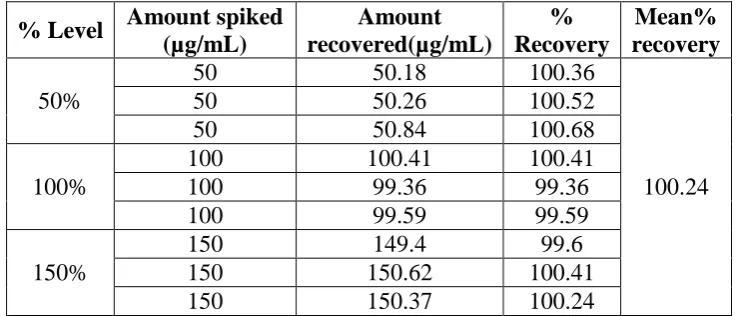
Table 3: Accuracy Data of Everolimus. % Level Amount spiked
(µg/mL) Amount recovered(µg/mL) % Recovery Mean% recovery 50%
50 50.18 100.36
100.24
50 50.26 100.52
50 50.84 100.68
100%
100 100.41 100.41
100 99.36 99.36
100 99.59 99.59
150%
150 149.4 99.6
150 150.62 100.41
150 150.37 100.24
Accuracy: The accuracy of the method was determined by calculating recovery of everolimus by the standard addition method. For the previously analyzed sample (100 μg/ml),
a known amount of standard drug was added at 50, 100 and 150% levels (50, 100 and 150
μg/ml). The contents were reanalyzed with the above described procedure. Each level was
repeated three times and the accuracy was indicated by percentage recovery. The accuracy
data of everolimus was shown in Table 3.
Linearity
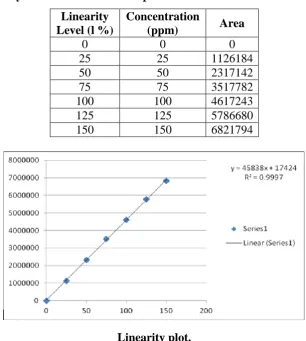
To demonstrate the linearity of assay method, inject 5 standard solutions with concentrations
of about 25ppm to 150ppm of Everolimus. Plot a graph to concentration versus peak area.
Slope obtained was 45698 Y-Intercept was 32527 and Correlation Co-efficient was found to
Table 4: Linearity Concentration and Response. Linearity
Level (l %)
Concentration
(ppm) Area
0 0 0
25 25 1126184
50 50 2317142
75 75 3517782
100 100 4617243
125 125 5786680
150 150 6821794
Linearity plot.
Limit of Detection, Limit of Quantification and Robustness
LOD were determined using the everolimus equation was found to be 0.061µg/ml and the
LOQ of the everolimus in the method was found to be 0.49µg/ml. The robustness of a
method is its ability to remain unaffected by small change in flow rate, mobile phase and also
changes in the wavelength.
Assay of marketed formulation
Twenty tablets were accurately weighed and finely powdered. A quantity of the powder
equivalent to 10 mg of everolimus was dissolved by shaking with 20 ml water: acetonitrile
(40:60v/v) as diluent, followed by another two dilutions each with 10 ml of diluent. It was
filtered through Whatmann filter paper no. 42 to remove insoluble materials. The volume of
filtrate was diluted to 10 ml with diluent (100μg/ml). It was further diluted according to the
need and then analyzed following the proposed procedures. From this solution 10 μl was
Table 5: Assay of Formulation. Name of
drug
Label claim
Final concentration
Concentration
found %assay
Everolimus 10mg 100µg/ml 9.982mg 100.31%
RESULTS AND DISCUSSION
Everolimus is a derivative of Rapamycin (sirolimus), and works similarly to Rapamycin as an
mTOR (mammalian target of rapamycin) inhibitor. It is currently used as an
immunosuppressant to prevent rejection of organ transplants.
Optimizations of chromatographic conditions were performed to obtain the good peak shape,
Resolution and peak parameter (tailing factor, theoretical plates).
Chromatographic conditions used are stationary phase Std ODS (250mm×4.6mm), Mobile
phase buffer: Acetonitrile in the ratio of 40:60 and flow rate was maintained at 1ml/min,
detection wave length was 268nm, column temperature was set to 30oC and diluent was mobile phase Conditions were finalized as optimized method.
System suitability parameters were studied by injecting the standard six times and results
were well under the acceptance criteria.
Linearity study was carried out between 25% to150% levels, the co-relation coefficient (R2) value was found to be as 0.9997.
Precision was found to be 0.83for repeatability and 0.27 for intermediate precision LOD and
LOQ are 0.061µg/ml and 0.149µg/ml respectively.
By using above method assay of marketed formulation was carried out 100.31% was present.
ACKNOWLEDGE
Authors are thankful to Principal Dr. Bhagavan Raju Sri Venkateshwara College Of
Pharmacy, for support, encouragement and providing facilities to carry out the work. Also,
REFERENCES
1. Sureshbabu Kapavarapu. Stability Indicating RP-HPLC Method for the Estimation of
Everolimus in Pharmaceutical Formulations in RESEARCH ARTICLE Am. J. Pharm
Tech Res., 2015; 5(2): ISSN: 2249-3387.
2. Kamberi Marika, Fu Katherine, Lu Jianmin, Chemaly G Mike, Feder Debra. A sensitive
high-throughput HPLC assay for simultaneous determination of everolimus and
clobetasol propionate. Journal of Chromatographic Science, Jan, 2008; 46(1): 23-9.
3. Taylor PJ, Franklin ME, Graham KS, Pillans PI. A HPLC-mass spectrometric method
suitable for the therapeutic drug monitoring of everolimus. Journal of Chromatography B
Analyt Technol Biomed Life Sci., Apr 1, 2007; 848(2): 208-14.
4. Sara Baldellia, b, Stefano Murgiaa. High-performance liquid chromatography with
ultraviolet detection for therapeutic drug monitoring of everolimus. Journal of
Chromatography B., 25 February 2005; 816(1–2): 99–105.
5. Shrmila D, Lakshmana Rao A, and kalyani L, Development and validation of stability-
indicating High performance Liquid chromatographic Method for the Estimation of
Everolimus in Tablets. Indian J pharm Sci., Sep-Oct, 2015; 77(5): 599-604.
6. Somana Siva Prasad, Krishna Mohan G. V. and Naga Babu A, Development of Simple
and Robust RP-HPLC Method for Determination of Everolimus and its Impurities in Oral
Solid Dosage Form. Asian J. Chem., 2019; 31(5): 1002-1008.
7. Baldelli S1, Murgia S, Merlini S, Zenoni S. High-performance liquid chromatography
with ultraviolet detection for therapeutic drug monitoring of everolimus. J Chromatogr B
Analyte Technol Biomed Life Sci., Feb 25, 2005; 81(1-2): 99-105.
8. R.S. Satoskar, S.D. Bhandarkar and S. S. Ainapure. “Pharmacology and
Pharmacotherapeutics”, 17th edition, Popular Prakashan, Mumbai, India, 2001.
9. “Burger’s Medicinal Chemistry and drug discovery”, 6th edition, Wiley Interscience, New Jersey, 2007.
10.“Wilson and Gisvold’s Textbook of Organic Medicinal and Pharmaceutical Chemistry”,
11th edition, Lippincott Williams & Wilkins, New york, 2004.
11.A. Korolkovas. “Essentials of Medicinal Chemistry”, 2nd edition, Wiley Interscience,
New Jersey, 1988.
12.“Goodman and Gilman’s The Pharmacological Basis of Therapeutics”, 9th edition,
McGraw-Hill health professions division, New york, 1996.
13.Foye’s “Principles of Medicinal Chemistry”, 6th edition, Lippincott Williams & Wilkins,
14.Drugs & Cosmetics Act, 1940 & Rules, 1945, 2nd edition, Susmit publishers, Mumbai, India, 2000.
15.Indian Pharmacopoeia, Ministry of Health & Family Welfare, Government of India, New
Delhi, 1996.
16.The United States Pharmacopoeia- the National Formulary, United States Pharmacopoeial
convention, Rockville, 2007.
17.British Pharmacopoeia, The Stationary Office, London, 2005.
18.“Martindale - The Extra Pharmacopoeia”, 33rd edition, The Pharmaceutical Press, London, 2002; 7.
19.A. H. Beckett and J. B. Stenlake. “Practical Pharmaceutical Chemistry”, Volume I and II,
CBS Publishers & Distributors, New Delhi, India, 2000.