SYNTHESIS, CHARACTERIZATION AND ANTIMICROBIAL
STUDIES OF NOVEL LIGAND(
DIETHYL 5-AMINO 4-METHYL
THIOPHENE 3,5-DICARBOXYLATE-2,6-DIAMINOPYRIDINE) AND
ITS METAL COMPLEXES
1*
Dr.Mohammed.Fakruddin Ali Ahamed,1Kassahun Desalegn Gebremariam
Department of chemistry, College of Natural Science , Jimma University, Post-Box No:378-Ethiopia.
ABSTRACT
Metal complexes of Cu (II) and Hg (II) with a new Schiff base derived from Diethyl 5-amino 4-methyl thiophene 3,5-dicarboxylate-2,6-Diaminopyridine(DAMTDDAP) in methanol are reported. The complexeshave been characterized using chemical analysis, (IR, UV-VIS, H1-NMR), conductometric data. According to these data, we propose an octahedral geometry for metal (II) complexes. The invitro antibacterial activities of the investigated complexes were evaluatedagainst few microorganisms by well diffusion technique. It was found that the metal complexes havehigher activity that the standard drugs. Antibacterial activity of the ligand and its complexes werestudied against to gram positive bacteria; Staphylococcus aureus
and bacteria Salmonella typhi , Pseudomonas aureginosa and
Escherichia coli.
KEY WORDS: Hexa-dentate Schiff base, Diethyl 5-amino 4-methyl thiophene 3,5-dicarboxylate-2,6-Diaminopyridine(DAMTDDAP), Biological activity.
INTRODUCTION
In view of broad applications of Schiff bases and their metal complexes the research work in the field of coordination chemistry is improved, but still there is a lot of challenging work has been carried out on Schiff base metal complexes along with their different industrial and chemotherapeutic studies. Schiff base complexes are considered to be among the most
Volume 3, Issue 7, 915-928. Research Article ISSN 2277 – 7105
Article Received on 20 July 2014,
Revised on14 August 2014, Accepted on 08 Sept 2014
*Correspondence for
Author
Dr.Mohammed.Fakruddi
n Ali Ahamed
important stereo chemical models in main group and transition metal coordination chemistry due to their preparative accessibility and structural variety[1]. However the incorporation of transition metal ions into these compounds have enormous wide applications in the field of the food industry, dye industry, analytical chemistry, catalysis, fungicidal, agrochemical along with biological activities and decrease in the cytotoxicity of both metal ion and Schiff base[2-3].
The Schiff base ligands also serve as a cation carrier in potentiometric sensors as they have shown excellent selectivity, sensitivity and stability towards specific metal ions such as Cu(II), and Hg(II)[4]. In general ortho-substituted with a hydroxyl group have primarily arouse the researchers' interest, Diethyl 5-amino 4-methyl thiophene 3,5-dicarboxylate and its Schiff base have shown significant attention with regard to their chelating ability with the transition metal ions[5]. On the other hand Schiff bases derived from 2,6-Diaminopyridine and its transition complexes also possess variety of applications including biological, clinical and analytical. In addition to that they have been reported to exhibit photo-luminescence and catalytic activity[6-7]. The 2,6-Diaminopyridine acts as a key intermediate used in the production of fungicides, corrosion inhibitors, various pigments, pharmaceuticals compounds. Furthermore it was also used to remove sulfur from ores and coloration by aldehydes in polymeric products[8].
development of inorganic biochemistry. Heterocyclic compounds such as pyridine related molecules are good ligands due to the presence of one or more ring nitrogen atoms with a localized pair of electrons. The application potential has led to the formation of series of novel Schiff base compounds with a wide range of reactivity and stability, physical, chemical and biological properties[15]. The frequency of life threatening infectious diseases such as tuberculosis, cancer, AIDS, etc., caused by pathogenic microorganisms are increasing day by day and becoming an important cause of morbidity and mortality in immune compromised patients. Synthetic chemical compounds constitute important sources of various bioactive compounds such as antibacterial, antifungal and anticancer compounds [16]. The synthesized chemical compounds, which are used for the treatment of infectious diseases, are known as chemotherapeutic agents. Every year thousands of compounds are synthesized with an aim to find potential chemotherapeutic agents to fight pathogenic microorganisms. But a very few compounds withstand as therapeutic agent by various methodological tests. Antimicrobial screening is one of these tests required to perform for primary selection of compounds as the therapeutic agents. The chemistry of metal-drug coordination compounds is more popular now than before in importance particularly in the design of more biologically active drugs [17] . Metal ions are known to affect the action of many drugs. The efficacies of the drugs on coordination with a metal are enhanced in many cases[18]. Metal ions play a vital role in a vast number of widely differing biological processes and depending on their concentration, they may either contribute towards the health of the organism or cause toxicity[19 , 20] . Several metal chelate are known to possess antibacterial, ant fungicidal, antiviral and anticancer activity. In several cases, the metal chelate has been found to be more antimicrobial than the chelating agent’s themselves[21]
Keeping the above facts in mind in the present paper we report the synthesis and characterization of Cu (II), and Hg (II) complexes of Schiff base derived from diethyl-2-amino-4-methyl thiophene-3, 5-dicarboxylate with 2, 6-diamino pyridine.
N
S C
CH3CH2OOC
CH3
NH2 N OC2H5
NH2
Proposed structure of ligand-fig-1
MATERIALS AND METHODS
The entire chemical used was of analytical grade. The solvents were dried and distilled before use according to standard procedures. Melting points were determined in a Electro thermal 9200.H1NMR spectra in CDCl3 and DMSO were recorded on NMR spectrophotometer. The
IR spectra (methanol/KBr) were recorded in the range400-4000 cm-1 by KBr pellet using Perkin-Elmer 457 spectrophotometer. Conductance was measured in DMF at room temperature using a Digital conductivity bridge. The UV-Visible spectra in CH3OH were
recorded on a shimadzu UV 1800 spectrophotometer. The metal contents were determined gravimetrically.
Preparation of DAMTDDAP
The reaction mixture containing Diethyl 5-amino 4-methyl thiophene 3,5-dicarboxylate, (2g,0.077mol in 20ml of methanol ) 2,6-Diaminopyridine (0.848g ,0.077 mol in 20ml of methanol dissolved in hot condition) was taken in 250‐ml round bottom flask and refluxed for 8h. On cooling the reaction mixture, deep-red coloured product was formed. Itwas collected by filtration and washed with hot water and 50 % cold methanol. This compound was recrystallised from methanol and dried in vacuo, yield -61% . g ; m .p . 80°C.
S
COOCH2CH3
CH3CH2OOC CH3
NH2
+ con HCl
reflux
N
NH2 NH
2
N
S
C
CH3CH2OOC CH3
NH2
N OC2H5
Scheme 1: Synthetic route for the preparation of ligand- DAMTDDAP Synthesis of metal complexes
To a methanolic solution of the Schiff base, equal moles of metal salts dissolved in the methanol was added followed by 1 ml of 1M NaOAc was added. This reaction mixture was stirred constantly with magnetic stirrer for 20 minutes. Coloured products were formed after allowing to stand for one hour. The solids were collected and washed with n-Hexane and dried.
OH2
N
S
C
CH3CH2OOC
CH3
NH2
N OC2H5
NH2
M
Proposed Structure of Ligand –Metal complexes (M=Cu2+, Hg2+)
Physical characteristics and analytical data of ligand and complexes Compound Color Mol.wt Yield (%) m.pt(0C)
Ligand (L) Deep-red 348.43 61 80
L-Cu com. Dark 598.43 56 216
L-Hg com. White 645.08 58 189
RESULTS AND DISCUSSION
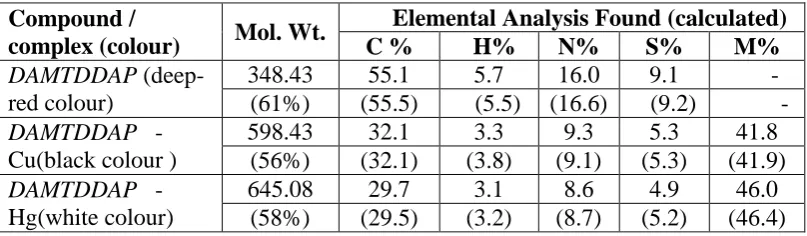
The analytical data for all the complexes are given in Table- 1. The molar conductivity data of the complexes are consistent with the non-electrolytic nature [24,25] of the complexes. The ligand and complexes were characterized by elemental analysis to determine percentage of C, N, S and H. The observed and calculated percentages of the elements are in good agreement and support one ligand to a metal ion. The number of coordinated ligands to metal determined by Job’s continuous method and Mole ratio method established 1: 1 metal to ligand ratio.
4.2. Infrared spectra
complex appeared in the range of 3300 cm-1, may be due to the presence of coordinated/ lattice water molecule of synthesized complex. The IR bands observed around 1600 cm-1 and 1550 cm-1 of the ligand and the complexes are assigned to νC=N vibration. The azomethine band is shifted to lower frequency in all metal complexes, suggesting that this group takes part in coordination [26] . The co-ordination of nitrogen to the metal atom would be expected to reduce the electron density on the azomethine link and thus cause a shift in the C=N band.
4000 3500 3000 2500 2000 1500 1000 500 0 10 20 30 40 50 60 70 3408 1661 1233 1103 758 T(% )
wave number(cm-1 ) O r i g i n P r o 8 E v a l u a t i o n O r i g i n P r o 8 E v a l u a t i o n
O r i g i n P r o 8 E v a l u a t i o n O r i g i n P r o 8 E v a l u a t i o n
O r i g i n P r o 8 E v a l u a t i o n O r i g i n P r o 8 E v a l u a t i o n
O r i g i n P r o 8 E v a l u a t i o n O r i g i n P r o 8 E v a l u a t i o n
O r i g i n P r o 8 E v a l u a t i o n O r i g i n P r o 8 E v a l u a t i o n
O r i g i n P r o 8 E v a l u a t i o n O r i g i n P r o 8 E v a l u a t i o n
[image:6.595.170.414.219.362.2]O r i g i n P r o 8 E v a l u a t i o n O r i g i n P r o 8 E v a l u a t i o n
Figure 2.IR spectra of Ligand (Schiff base)
4000 3500 3000 2500 2000 1500 1000 500
5 10 15 20 25 30 35 40 45 50 3318 1654 1115 618 T(% )
wave number(cm-1) 1479
1403 O r i g i n P r o 8 E v a l u a t i o n O r i g i n P r o 8 E v a l u a t i o n
O r i g i n P r o 8 E v a l u a t i o n O r i g i n P r o 8 E v a l u a t i o n
O r i g i n P r o 8 E v a l u a t i o n O r i g i n P r o 8 E v a l u a t i o n
O r i g i n P r o 8 E v a l u a t i o n O r i g i n P r o 8 E v a l u a t i o n
O r i g i n P r o 8 E v a l u a t i o n O r i g i n P r o 8 E v a l u a t i o n
O r i g i n P r o 8 E v a l u a t i o n O r i g i n P r o 8 E v a l u a t i o n
[image:6.595.172.415.435.562.2]O r i g i n P r o 8 E v a l u a t i o n O r i g i n P r o 8 E v a l u a t i o n
Figure 3.IR spectra of copper (II) complex
4000 3500 3000 2500 2000 1500 1000 500
10 20 30 40 50 60 70 80 3409 1656 1141 622 T(%)
wave number(cm-1
) O r i g i n P r o 8 E v a l u a t i o n O r i g i n P r o 8 E v a l u a t i o n
O r i g i n P r o 8 E v a l u a t i o n O r i g i n P r o 8 E v a l u a t i o n
O r i g i n P r o 8 E v a l u a t i o n O r i g i n P r o 8 E v a l u a t i o n
O r i g i n P r o 8 E v a l u a t i o n O r i g i n P r o 8 E v a l u a t i o n
O r i g i n P r o 8 E v a l u a t i o n O r i g i n P r o 8 E v a l u a t i o n
O r i g i n P r o 8 E v a l u a t i o n O r i g i n P r o 8 E v a l u a t i o n
Figure 4.IR-spectra of mercury (II) complex 4.3 NMR Spectra
1
H NMR
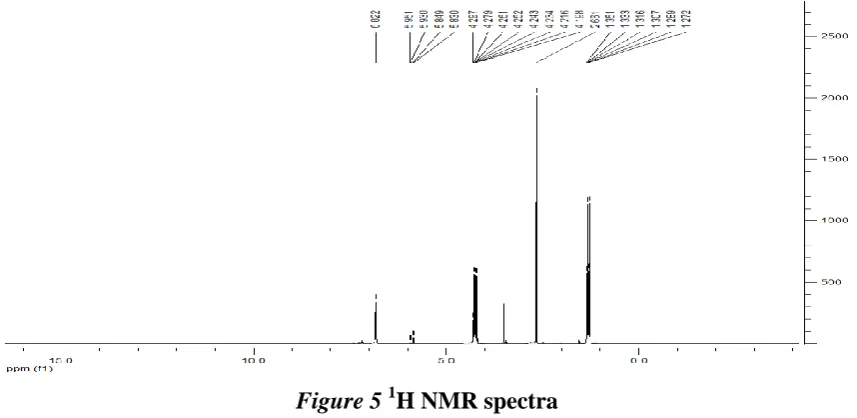
The 1H NMR spectrum of the ligand, recorded in CDCl3 showed the following signals:–CH3
proton at 1⋅33 ppm (s, 6H), O–CH2 at 4⋅3 ppm (s, 8H), phenyl as -CH at 5.9–6⋅8 ppm (mult.).
Furthermore, the peaks obtained are confirmed the disappearance of hydrogen atoms from starting reagents during Schiff base formation.
Figure 5 1H NMR spectra
13
C NMR spectra
The 13C NMR Spectra of the Schiff base ligand is recorded in CDCl3.The azomethine carbon
(C=N) gives a peak at 166 and 167 ppm, δ C–CH3 at 14 and 15 ppm, δ C=O at 163 ppm, δ CH of ring gives 77 and 78 ppm. δ CH2 gives 98-107 ppm, δ C-O at 60 ppm. Hence, 13C
[image:7.595.89.506.568.759.2]Figure 6 13C NMR spectra DAMTDDAP -1350 NMR spectra
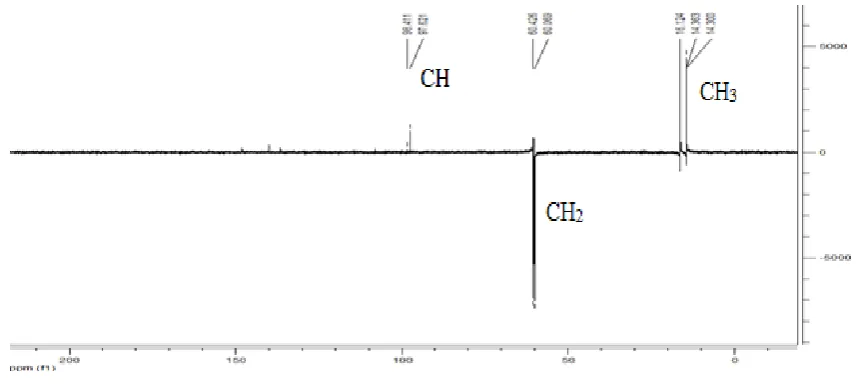
The Distortionless Enhancement by Polarization Transfer (DEPT) method is an instrumental mode that provides a way to acquire the information of distinguishing among 13C signals for CH3, CH2, CH, and quaternary carbons. 135° pulse: carbon signals show different phases,
signals for CH3 and CH carbons give positive signals, quaternary carbons give no signal and
[image:8.595.80.513.227.421.2]signals for CH2 carbons give negative signals.
Figure 7 DEPT-135o NMR spectra
4.4. Conductance
The molar conductivity measurements were carried out in DMSO at 10-3 molar concentration. The molar conductance indicates that the all complexes are electrolytes [27]. This is due to the presence of anion which is present in the outside of coordination sphere.
Table 3. Conductivity values of complexes
Complex Types of
solvent
Molar Conductance (Ω−1cm2 mol−1)
Types of electrolyte
Copper complex DMSO 198.1 Electrolyte Mercury complex DMSO 245 Electrolyte
DMSO = Dimethyl sulfoxide
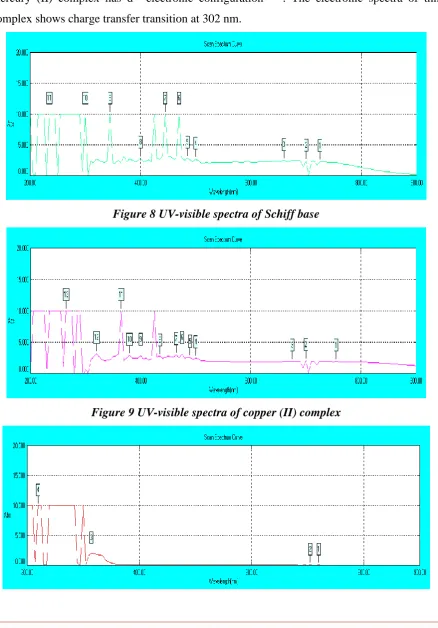
1.1. Electronic spectra
complexes were recorded at room temperature using DMSO as a solvent. The ligand shows band at 420nm to 440 nm were due to n→π* transition and also shows bands at 300 nm and 350 nm were due to C=O and N=C π→π* transition. But copper (II) complex shows bands at 410 nm and 370 nm for n→π* and π→π* transition respectively. The metal ion in the mercury (II) complex has d10 electronic configuration [28]. The electronic spectra of this complex shows charge transfer transition at 302 nm.
Figure 8 UV-visible spectra of Schiff base
[image:9.595.85.512.196.369.2]Figure 10 UV-visible spectra of mercury (II) complex Table-1: Analytical Data of DAMTDDAP and their metal complex:
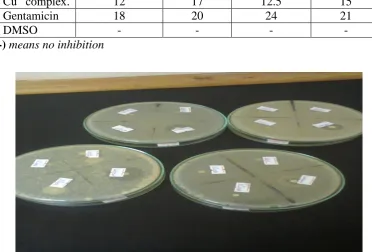
Antibacterial activity results of the ligands and complexes
The antibacterial activity of bidentated aromatic Schiff base ligands and their metal (II) complexes were tested against microorganism. The microorganisms used in the present investigations include bacteria: Staphylococcus aureus, Salmonella typhiand, Pseudomonas aureginosa E. coli. Minimum Inhibitory Concentrations (MICs) method was used to determine the antibacterial activity of the synthesized compounds.Thediffusion method is simple and routinely used inhospital laboratories; it requires commercial disks,the medium used is Mueller-Hinton agar with 2%of glucose and the diameter of inhibition zone isvisually read at 24 hr after incubation at 37°C.The antibacterial activity was estimated on thebasis of the size of the inhibition zone formedaround the paper disks on the seeded agar plates.Streptomycin was used as a standard .The resultsare presentated in Table 5. Percent inhibition values are relative to the inhibition zone (22 mm) of the most active compound with 100% inhibition. The Schiff base and the complexes exhibited varying degrees of inhibitory effects on the growth of the tested bacteria species. The values reveal that the Schiff base become more effective when coordinated to the metal ions. The biological activity of the complexes follows the order: Hg (II)> Cu (II) Furthermore, the data show that E. coli was inhibited to a greater degree by the Co (II) and Cu (II) complexes. In conclusion the complexes prepared with the new Schiff base could reasonable are used for the treatment of some common diseases caused by E.Coli. The abovestudy shows that all the complexes have hexahedral geometry.
Table -5 Antibacterial Activities of the Ligand and its Metal Complexes.
Compounds
Diameter of Zone of Inhibition in mm Staphylococcus
aureus
Salmonella typhi
Pseudomonas aureginosa
Escherichia coli
Ligand 8 - 6 -
Hg2+complex. 10 9.5 14 16
Compound /
complex (colour) Mol. Wt.
Elemental Analysis Found (calculated)
C % H% N% S% M%
DAMTDDAP (deep-red colour)
348.43 55.1 5.7 16.0 9.1 - (61%) (55.5) (5.5) (16.6) (9.2) -
DAMTDDAP -Cu(black colour )
598.43 32.1 3.3 9.3 5.3 41.8 (56%) (32.1) (3.8) (9.1) (5.3) (41.9)
DAMTDDAP -Hg(white colour)
Cu2+complex. 12 17 12.5 15 Gentamicin 18 20 24 21
DMSO - - - -
[image:11.595.108.481.78.330.2](-) means no inhibition
Figure 8. Ligand, Cu2+ complex, Hg2+ complex and Gentamicin on Petri dishes
CONCLUSION
Cu(II), and Hg(II) complexes of the Schiff base derived from Diethyl 5-amino 4-methyl thiophene 3,5-dicarboxylate and 2,6-Diaminopyridine(DAMTDDAP) were prepared and characterized. The structuralcharacterization of synthesized compound weremade by using the elemental analysis, spectroscopic methods, magnetic and conductance etc.The study reveal that [29] complexes are non-electrolytes [30] Schiff basebehaves as a neutral Bidentate ligand and is coordinated to the central metal ion through theazomethine N [31] . The metal (II) complexes have hexa hyderal geometry [32] . The biological activityof all the complexes is higher that of the free Schiffbase ligand and follows the order: Cu (II) >Hg (II).This means that metal chelation significantlyaffects the antimicrobial behavior of the organicligand. All the synthesized Schiff base metal complexes may prove useful as bactericidal, as fungicidal, as anticancer, antituberculosis. The information obtained from this study will contributesignificantly in the development of new drugs orelse may prove way for using combined therapythat could circumvent resistance problem and thus help in the improvement of health particularly in the poor section of the community.
1. Keypour H, Rezaeivala M, Valencia L, Lourido PP, Khavasi HR, Synthesis and characterization of some new Co(II) and Cd(II) macroacyclic Schiff-base complexes containing piperazine moiety, Polyhedron 2009; 28(17): 3755-3758.
2. Sonmez M, Berber I, Akbas E, Synthesis, antibacterial and antifungal activity of some new pyridazinone metal complexes, Eur. J. Med. Chem 2006; 41(1): 101–105.
3. Katwal R, Kaur H, Kapur B, Applications of Copper – Schiff’s base complexes: A Review, Sci. Rev. Chem. Commun 2013; 3(1): 1-15.
4. Ashraf MA, Wajid A, Mahmood K, Maah MJ, Yusoff I, Spectral Investigation of the Activities of Amino Substituted Bases, Int. J. Chem. Eng. Appl 2011; 2(4): 252-255. 5. Raman N, Pitchaikani YR, Kulandaisamy A, Synthesis and characterization of Cu(II),
Ni(II), Mn(II), Zn(II) and VO(II) Schiff base complexes derived from o-phenylenediamine and acetoacetanilide, Proc. Indian Acad. Sci. (ChemSci) 2001; 113(3): 183–189.
6. Fasina TM, Ogundele O, Ejiah FN, Dueke-Eze CU, Biological activity of Copper(II), Cobalt(II) and Nickel(II) Complexes of Schiff base Derived from o-phenylenediamine and 5-bromosalicylaldehyde, Int. J. Biol. Chem 2012; 6(1): 24-30.
7. Uhlig E, Non-innocent bidentate nitrogen-ligands in electron-rich complexes of 3d-elements, Pure. Appl. Chem 1988; 60(8) :1235-1240.
8. Mishra, Lallan and Sinha Ragini, Mononuclear and dinuclear ruthenium (III) (polypyridyl complexes containg 2, 6-bis (2-benzimidazolyl)-pyridine as co-ligand: Synthesis, spectroscopic and redox activity, Indian J. Chem., Sect. A. 2000; 29:1131.
9. Saritha P., Reddy B. Satyanarayan and Jayatyagaraju, Synthesis and structural studies on divalent transition metal complexes of 5-acetyl 2,4-dihydroxy acetophenone semicarbazone, J. Indian Chem. Soc. 2006; 83:1204.
10. Arora K., Sharma K.P., Complexes of Cobalt (II), Nickel (II) and Copper (II) with 3-Hydroxysalicyliden-p-aminoacetophenoneoxime. Inorg. Met.-Org. Chem. 2003; 32: 913. 11. Vigato, P. A., Tamburini, Functionalisation of silica gel with cyclic and acyclic Schiff
bases and related d- and/or f-metal complexes. Coord. Chem. Rev. 2004; 248: 1717. 12. Spinu C. and Kriza A. Co (II), Ni (II) and Cu (II) complexes of bidentate Schiff bases,
Acta Chim. Slov. 2000; 47:179.
14. Maurya RC, Mishra DD, Jain S, Jaiswal M, Synthesis and characterization of some mixed ligand complexs of copper (II) and cobalt (II) with Schiff bases and heterocyclic organic compounds, Synth. React. Inorg. Met-Org. Chem. 1993; 23:1335-1349.
15. Islam, M.A., Farooque, M.A., Bodruddoza, M.A.K. Mosadik, M.A. and Alam M.A. Antimicrobial and Toxological Studies of Mixed Ligand Transition Metal Complexes of Schiff bases, Bio. Sci. 2002; 2(12): 797-799.
16. Wasi N, Singh HB. Synthesis of metal complexes of anti-malaria drugs and in vitro evaluation of their activity against Plasmodium falciparum.Inorg ChimActa . 1987; 135:133-137.
17. Heater SJ, Carrano MW, Rains D. Interaction of Oxo-Bridged vanadium (III) Phenanthroline and Bipyridine Dimers with DNA. InorgChem. 2000; 39:3881- 3889. 18. Roos JT, Williams DR. Synthesis and evaluation of several compounds with potential
antiviral activity. J InorgNuclChem. 1977; 39:129-141.
19. Cole A, Goodfield J, Williams DR, Midley JM. The complexation of transition series metal ion by Nalidixic acid InorgChimActa. 1984;92:91-97.
20. Srivastava RS. Synthesis, characterization and fungitoxicity of Bidentate High-Spin six Coordinate 3rd metal complexes with N- (5 –Phenyl-3,4- thiadiazol-2-yl) aceta Benzamidines. Inorg. ChimActa. 1981; 55:L71-74.
21. Abdel-Rahman, R.M. Role of Uncondensed 1,2,4-triazine Compounds and Related Heterocyclic systems as Therapeutic Agents. Review. Part XV. Pharmazie. 2001; 56(1):18-22.
22. Pandy, J.K., Sengupta, S.K., Pandey, O.P. Synthesis and spectroscopic studies on oxo vanadium (IV) tetrazamacrocyclic complexes derived from substituted β-diketones and 2, 6-diaminopyridine. J. Indian.Chem. Soc. 2006;83:107- 109.
23. Geary M J, Coordchem Rev, 7 (1971): 81.
24. Raman, N.; Raja, Y.P.; Kulandaisamy, A. Indian Academy of sci., 2001; 113 (3): 183. 25. AP Mishra; M Khare. Synthesis, characterization and biological studies of cobalt
complexes with bidentate schiff bases J. Ind. Chem. Soc., 2000; 77:367.
26. S. R. Aswale, P. R. Mandlik, S. S. Aswale, A. S. Aswar, “Synthesis and characterization of Cr(III), Mn(III), Fe(III), Ti(III), VO(IV), Th(IV), Zr(IV) and UO2 (VI) polychelates
derived from bis-bidentate salicylaldimine Schiff base” Indian J. Chem. 2003; 42A:322-326.
28. SpinuC . and Kriza A., Co (II), Ni (II) andCu (II) complexes of bi-dentate schiff bases, ActaChim.Slov., 2000;47(1); 179.
29. Sun B., Chen J., Hu. J. Y. and Lix, Synthesisand characterization of some tetra-dentate Schiff base complexes and their heterolepticanalogues, J. Chin. Chem. Lett., 2001;12(II):1043.
30. Boghaei D. M. and Mohebi S., Synthesis andcharacterization of some tetra-dentate Schiff base complexes and their heterolepticanalogues, Tetrahedron., 2002;58(26): 5357.
31. Liu J., Wu B., Zhang B. and Liu Y., Synthesisand characterization of some tetra-dentate Schiff base complexes and their heterolepticanalogues, Turk. J. Chem.2006; 30(1): 41.
Corresponding Author’s Biography:
Dr. Mohammed. Fakruddin Ali Ahammed is post
graduated from University of Madras,
CHENNAI, and Master of philosophy from
University of Madras, Completed master Thesis
in “Spectrophotometric Determination From Environmental And Biological Samples” and
Antibacterial study of metal complexes. He
awarded from Srivenkateswara university,
Tirupati (A.P), Having 13 years of teaching
experience at UG and PG level. She has
published 7 research articles at national and
international repute.