PHYTOCHEMICAL ANALYSIS AND ANTIOXIDANT
POTENTIALITY OF
PREMNA SERRATIFOLIA
L. - AN AROMATIC
MEDICINAL PLANT
1
Lubaina A.S., 2Brijithlal N.D. and 3Murugan K.*
1
Department of Botany, Christian College, Kattakada, Thiruvananthapuram, Kerala.
2
Department of Botany, Bishop Moore College, Mavelikkara, Kerala – 690110.
3
Department of Botany, University College, Thiruvananthapuram.
ABSTRACT
Documenting and validating traditional and indigenous system of medicine in India has been continuously increasing from the last few decades. The current study was made to evaluate the phytochemical constituents and antioxidant potentiality of Premna serratifolia L. an aromatic medicinal plant known as ‘Agnimantha’ in Ayurvedic system
of medicine. It has immense ethno pharmacological importance in folk medicine for curing various human ailments. The qualitative phytochemical screening of the aqueous and ethanolic leaf extracts of P. Serratifolia revealed the presence of glycosides, flavonoids,
alkaloids, tannins, terpenoids and steroids. Subsequently, the quantification of major secondary metabolites revealed remarkable level of phenols followed by terpenoids and flavonoids. The in vitro antioxidant activity was determined by 2,2-diphenyl-2-picrylhydrazyl (DPPH), ferric reducing antioxidant potentiality (FRAP), hydroxyl radical scavenging activity, hydrogen peroxide scavenging, superoxide anion radicals quenching effect and metal chelating assay. The aqueous extracts showed positive correlation between concentrations of the extracts with DPPH radical scavenging capacity. Similarly the other antioxidant potentials also displayed remarkable activities when comparable with synthetic antioxidants such as ascorbate and BHA. The results suggest that the aqueous extract of P.serratifolia are potential source for natural antioxidants due to the presence of polyphenols
and that could have a protective role as well as prevention from life style diseases.
Volume 5, Issue 12, 841-852. Research Article ISSN 2277– 7105
*Corresponding Author Dr. Murugan K. Department of Botany,
University College,
Thiruvananthapuram. Article Received on 10 Oct. 2016,
Revised on 30 Oct. 2016, Accepted on 19 Nov. 2016
KEYWORDS: Antioxidant potentiality, Premna serratifolia, phenols, flavonoids, terpenoids, FRAP, DPPH.
INTRODUCTION
Herbals are treasure islands of potential drugs and in the recent years there has been an increasing awareness about the importance of medicinal plants. They are the richest bio-resource of drugs in traditional systems of medicine, allopathy, nutraceuticals food supplements, folk medicines, pharmaceutical intermediates and chemical templates for synthetic drugs.[1] Plant derived bioactive compounds have been the focus of recent research due to their health promoting effects. Drugs from the plants are easily available, less expensive, safe, efficient and having fewer side effects. The plants which have been selected for medicinal use contains several bioactive compounds constitute the most obvious choice of examining the current search for therapeutically effective new drugs. They are used for curing of various human diseases and also play an important role in healing because of the presence of phytochemical constituents such as alkaloids, steroids, tannins, glycosides, volatile oils, fixed oils, resins, phenols and flavonoids deposited in leaves, flowers, bark, seeds, fruits and root. The beneficial medicinal effect of plant materials wasdue to the synergistic action of these secondary metabolites.[2] Among them flavonoids are proven antioxidants constitute a wide range of molecules that play important role in protecting biological systems against the harmful effects of oxidative burst on macromolecules such as proteins, lipids and DNA.[3] In this juncture, the present study aims to analyse the major phytochemicals and their antioxidant potentiality from P. serratifolia of Verbenaceae to understand its medicinal potential and propose strategies for future utilization.
MATERIALS AND METHODS Plant material
Plant material of P. Serratifolia was collected from Malayinkeezhu, Trivandrum, Kerala was used for the present study. The specimen was taxonomically identified and confirmed by comparing with authenticated herbarium specimen at JNTBGRI, Palode, Trivandrum, Kerala. A voucher specimen of the plant is kept in the herbarium of Department of Botany (CCB 046).
Preparation of extracts
extraction method. The extracts were filtered and concentrated using rotary evaporator at 40°C.
Phytochemical screening
Alcoholic and aqueous extracts were subjected to various tests in order to identify the presence of different phytochemicals such as glycosides, tannins, coumarins, alkaloids, saponins, flavonoids, phenols, steroids, reducing sugar and terpenoids.[4]
Quantification of phenol, flavonoids and terpenoids
Total phenols of ethanolic and aqueous extracts were isolated and quantified by the method ofMayer.[5] the total flavonoid content determined by AlCl3 method[6] and total terpenoids by
the method of Van Beek et al.[7]
Antioxidant potentiality
Evaluation of DPPH radical scavenging activity
The free-radical scavenging activity of the different concentration of the extracts were measured with the stable radical 2,2-diphenyl-1-picrylhydrazyl in terms of hydrogen- donating or radical-scavenging activity following the method of Rajesh and Natvar.[8]
Ferric reducing antioxidant power (FRAP) assay
Antioxidant activity by FRAP assay estimated by the method of Benzie and Strain.[9]
Estimation of superoxide radical scavenging activity
Superoxide scavenging was determined by the nitrobluetetrazolium (NBT) reduction method.[10]
Hydroxyl radical scavenging activity
The effect of hydroxyl radicals of the extracts were assayed by using the deoxy ribose method.[11]
Hydrogen peroxide scavenging assay
Chelating activity of Fe2+
The different concentration of three extract were assessed for their ability to compete with ferrozine for iron (II) ions in free solution. The chelating ability of ferrous ions was estimated by the method of Koncicet al.[13]
Statistical analysis
The data was statistically analysed by one way analysis of variance (ANOVA) and t-test (p < 0.05). The results are mean of five replications and were represented as mean ± SD.
RESULTS AND DISCUSSION Phytochemical analysis
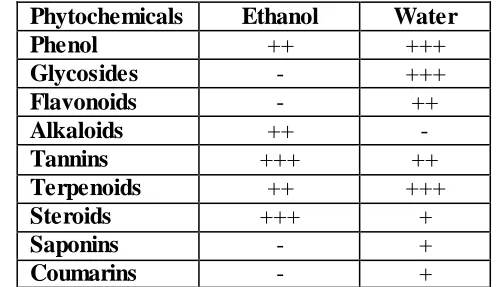
The preliminary phytochemical tests are helpful in finding therapeutic phytochemical constituents in the plant material and also in pinpointing the source of pharmacologically active chemical compounds. The therapeutic value of herbals lies in its principle component which play potential physiological role on humans. Phytochemical screening of aqueous and ethanolic extracts of P.serratifolia showed the presence of glycosides, flavonoids, alkaloids, tannins, terpenoids and steroids (Table 1). These bioactive compounds present in P. Serratifolia are proven antioxidants.
The yields of the ethanol and water extracts of P. serratifolia were 0.58% and 0.92% respectively. In the present study the significant yield of water extract revealed the higher efficiency of water as extracting solvent and that might be attributed to the high polarity of the solvent system. The present result was in close agreement to the findings of other researchers regarding the yield of extract prepared in different solventsystem.[14] Increasing trend in the yield of antioxidant extracts has been observed with increasing polarity of solvent suggesting the polar nature of antioxidants compounds.
phenolic concentrations observed in plants may contribute to its defence mechanism. Biosynthetic potentialities of plants are better illustrated by a group of natural products called terpenoids. Similar to phenols, terpenoids also showed significant amount in water extract (54.6 ± 0.24 mg/g tissue) followed by ethanolic extract (39.3 ± 0.68 mg/g tissue) (Table 2). The fragrance of plants is mainly due to the presence of terpenoid compounds present in them. Quantified data of terpenoids in many herbals revealed by Goto et al.[17] were at par with the present results. Terpenoids are generally lipid soluble compounds located in the cytoplasm which includes essential oils, carotenoids, derived sterols and saponins. Monoterpenes can also function as antigerminative phytotoxic allelopathic molecules.[18]
Like that of phenols and terpenoids P. serratifolia showed significant amount of flavonoid content in the water (46.5 ±0.14 mg/g tissue) andethanol extracts (31.2 ± 0.07 mg/g tissue). Thirumalai et al.,[19] estimated total flavonoids in P. herbaceaeand revealed similar results. Flavonoids possess multiple biological and pharmacological potentialities like radical scavengers, cellular signalling, anti-inflammatory, antiallergic, antiviral, antimetastatic and antimutagenic.[20] In addition flavonoids can act as free radical scavengers and terminates radical chain reaction that occurs during oxidation of triglycerides in the food system. The quantitative estimation of phenols, terpenoids and flavonoids in P. serratifolia gives an insight into their phytochemical repository which can provide a rich data in understanding the basic pattern of growth and metabolism. At the same time phenols, terpenoids and flavonoids can be used as chemical markers in taxonomic studies.[21]
Antioxidant potentiality
DPPH scavenging activity
DPPH method has been used to analyse the radical scavenging potentiality of the extracts of P. Serratifolia due to its simplicity, sensitivity and effectiveness. Aqueous and ethanolic plant extracts showed varying level of scavenging activities over DPPH free radicals (43.76 ± 0.17 and 86.58 ± 0.26 at 1000 µg/ml respectively) (Table 3). DPPH is one of the stable organic nitrogen free lipophilic radical which has been used to test the radical scavenging ability.[25] Antioxidants, on interacting with DPPH either transfer an electron or hydrogen atom to DPPH, thus neutralizing its free radical character.[26] There scavenging activities might be due to the presence of phenolic contents. Generally, the antioxidant activity of medicinal plants was not significant compared with synthetic antioxidants such as BHT and ascorbic acid but recommendable due to their natural source. The bleaching of DPPH absorption is representative of the capacity of tested compounds to scavenge the free radicals independently from any enzymatic activity. DPPH method provides a method to evaluate antioxidant activity in a relatively short time, compared to other methods. In the present study P.serratifolia ethanol extract showed high scavenging activity of DPPH radicals compared to
water extract. Which may attributable to its significant hydrogen donating ability (Table 3). It could be inferred from the results that increasing the concentration of extract reduce the level of free radical in the reaction mixture, that would ultimately raise the potential to scavenge or chelate free radicals by the plant extract hence an increase in the antioxidant properties. Alothmanet al.,[27] studied the antioxidant capacity and phenolic content of selected tropical fruits from Malaysia; using different solvent system the fruits studied were viz. Ananas squamosus, Musa paradisiaca and Psidium guajava. The DPPH results obtained by them (12.7- 93.7%) were similar to the results obtained in the present study.
Ferric reducing antioxidant power assay(FRAP)
FRAP assay measures the reducing potential of an antioxidant with ferric tripyridyltriazine (Fe3+-TPTZ) complex to its ferrous coloured form tripyridyltriazine (Fe2+-TPTZ) [9].Generally the reducing properties are associated with the presence of compounds, which exert their action by breaking the free radical chain by donating a hydrogen atom. Aqueous extract of P.serratifolia showed the highest ferric reducing power (442.3 ± 0.93 µM/g at 1000 µg/ml),
Superoxide radical scavenging activity
The superoxide anion scavenging ability of the extracts was determined using SOD assay kit-WST. Superoxide dismutase (SOD) is an enzymatic antioxidant that can scavenge superoxide anion radical (O2.-) by catalyzing the dismutation of the superoxide anion into hydrogen
peroxide and molecular oxygen. Superoxide (O2.-) radical is known to be harmful to cellular
components as a precursor of the more reactive oxygen species, contributing to the tissue damage and various diseases. This assay is based on the measurement of superoxide dismutase inhibition activity. In this assay the superoxide anion reduce WST-1 (2-(4-iodophenyl)-3-(4-nitrophenyl)-5-(2,4-disufophenyl)-2H-tetrazolium) to generate the water soluble formazan dye in the testing solution, which is measured using spectrophotometer at 450nm. In the presence of an enzymatic antioxidant, the reduction of WST-1 can be inhibited by neutralizing O2.-. Thus the SOD neutralizing activity can be quantified by measuring the
decrease in the colour development at 450nm. P.serratifolia aqueous extract exhibited the highest superoxide anion scavenging activity with inhibition rate of 90.32 ± 0.23% at 1000 µg/ml followed by ethanoicfraction, which is 81.54 ± 0.18% at 1000 µg/ml (Table 5).
Hydroxyl radical scavenging activity
Antioxidant activity of ethanol and aqueous extracts of P.serratifolia by hydroxyl radical scavenging activity is presented in table 6. Both the extracts exhibited strong hydroxyl radical scavenging activity which was dose dependent. The inhibition observed was found to be statistically significant with respect to the inhibition observed at all the dose levels tested. Ethanol and water extracts have moderate but statistically significant hydroxyl radical scavenging effects up to the doses in comparison to controls. The activity was found to increase at higher dose levels. P.serratifolia aqueous extract exhibited the highest hydroxyl radical scavenging activity with inhibition rate of 69.532 ± 0.78% at 1000 µg/ml followed by ethanolic fraction i.e., 42.023 ± 0.42% at 1000 µg/ml (Table 6).
Hydrogen peroxide scavenging assay
Hydrogen peroxide is a weak oxidizing agent and can inactivate a few enzymes directly, usually by oxidation of essential thiol (-SH) groups. Hydrogen peroxide can cross cell membrane rapidly. Once inside the cell, H2O2 can probably react with Fe2+ and possibly Cu2+
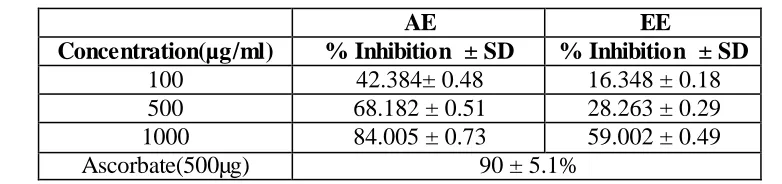
in table 7. Both the extracts exhibited strong ROS scavenging activity which was dose dependent. The inhibition observed was found to be statistically significant with respect to inhibition observed at all the dose levels tested. Aqueous extract have statistically significant hydrogen peroxide scavenging effects (84.005 ± 0.73% at 1000 µg/ml), followed by ethanol (59.002 ± 0.49% at 1000 µg/ml) (Table 7).
Metal chelating assay
Plant extracts have the ability to chelate or deactivate transition metals, which possess the ability to catalyse hydroperoxide decomposition and block Fenton-type reactions due to its antioxidant nature. Chelating agents serve as secondary antioxidants since they reduce redox potential, thereby stabilizing the oxidized forms of metal species. Reduction of the iron ion is an indicator of electron donating activity, which is an important mechanism of phenolic antioxidant action. Yellow colour of test solution changes in to various shades of green and blue depending upon the reducing power of the extract. The presence of antioxidants in P.serratfolia extracts causes the reduction of Fe3+/Ferric cyanide complex to ferrous form. Therefore, the Fe2+ complex can be monitored by measuring the formation of Perl’s Prussian blue. Results in Table 8 displayed that the aqueous extract showed highest iron reduction ability (55.61 ± 0.47 µg/ml) followed by ethanol (25.70 ± 0.19 µg/ml).
Table 1: Preliminary phytochemical analysis using aqueous and ethanol extracts of P. serratifolia L.
Phytochemicals Ethanol Water
Phenol ++ +++
Glycosides - +++
Flavonoids - ++
Alkaloids ++ -
Tannins +++ ++
Terpenoids ++ +++
Steroids +++ +
Saponins - +
Coumarins - +
Strong positive: + + +; moderately positive: + +; Low positive: +; negative test: -
Table 2: Total phenol, terpenoids and flavonoids of ethanol and water extracts of P. serratifolia. Values are mean ± SD of three independent replications.
Solvent Total phenol (mg/g tissue)
Terpenoids (mg/g tissue)
[image:8.596.171.419.493.637.2]Table 3: DPPH radical scavenging activity of water (AE) and ethanolic (EE) extracts of P. serratifolia. Values are mean ± SD of three independent replications.
AE EE
Concentration(µg/ml) % Inhibition ± SD % Inhibition ± SD
100 38.40±0.29 77.78±0.41
500 38.70±0.31 84.92±0.29
1000 43.76±0.17 86.58±0.26
Ascorbate (500µg) 96± 2.77%
BHT(500µg) 90±0.98%
Table 4: FRAP-potential of water (AE) and ethanol (EE) extracts of P. serratifolia. Values are mean ± SD of three independent replications .
AE EE
Concentration(µg/ml) µM/g µM/g
100 150.7 ±0.52 68.76 ± 0.18
500 229.4 ±0.58 170.50 ± 0.29
1000 442.3 ±0.93 366.53 ± 0.98
Ascorbate (500µg) 494.2 ±0.54%
BHT(500µg) 483.2 ±1.6%
Table 5: Superoxide anion (O2.-) radicals quenching effects of water (AE) and ethanol
(EE) extracts of P. serratifolia. Values are mean ± SD of three independent replication
Table 6: Hydroxyl radical scavenging activity of water (AE) and ethanol (EE) extracts of P. serratifolia. Values are mean ± SD of three independent replications.
AE EE
Concentration(µg/ml) % Inhibition ± SD % Inhibition ± SD
100 36.531 ± 0.41 23.243 ± 0.21
500 58.289 ± 0.39 30.319 ± 0.20
1000 69.532 ± 0.78 42.023 ± 0.42
Ascorbate(500µg) 71 ±0.98
BHT(500µg) 82 ±0.79
AE EE
Concentration(µg/ml) % Inhibition ± SD % Inhibition ± SD
100 73.97 ± 1.78 48.35 ± 0.84
500 85.27 ± 1.63 70.02 ± 0.31
1000 90.32 ± 0.23 81.54 ± 0.18
Ascorbate(500µg) 94 ± 0.54%
Table 7: Hydrogen peroxide scavenging activities of water (AE) and ethanol (EE) extracts of P. serratifolia. Values are mean ± SD of three independent replications.
AE EE
Concentration(µg/ml) % Inhibition ± SD % Inhibition ± SD
100 42.384± 0.48 16.348 ± 0.18
500 68.182 ± 0.51 28.263 ± 0.29
1000 84.005 ± 0.73 59.002 ± 0.49
Ascorbate(500µg) 90 ± 5.1%
Table 8: Metal chelating activities of water (AE) and ethanol (EE) extracts of P. serratifolia. Values are mean ± SD of three independent replications.
AE EE
Concentration(µg/ml) µg/ml µg/ml
100 26.18 ± 0.17 7.57 ± 0.05
500 43.95 ± 0.33 14.40 ± 0.09
1000 55.61 ± 0.47 25.70 ± 0.19
Ascorbate(500µg) 71 ± 0.98%
BHT(500µg) 82 ± 0.79%
CONCLUSION
Natural product antioxidants significantly contribute in preventions of pathological consequences caused by free radicals. Furthermore plant derived antioxidant are safer and cheaper than their synthetic counterparts. Total polyphenolic compounds were higher in the aqueous extract than alcoholic extract. Therefore, the plant P.serratfolia possesses strong antioxidant potential and it would be advantageous to use the plant antioxidant in therapeutic drugs for the implications of human health. Further studies are designed to isolate the lead molecule and to purify, characterize them in terms of their biological potentialities.
REFERENCES
1. Ncube NS, Afolayan AJ, Okoh AI(Assessment Techniques of Antimicrobial Properties of Natural Compounds of Plant Origin: Current Methods and Future Trends)Afr J Biotechnol, 2008; 7: 1797-1806.
2. Tonthubthimthong P, Chuaprasert S, Douglas P, Luewisuttichat W (Supercritical CO2
Extraction of Nimbin from Neem Seeds An Experimental Study) J Food Eng, 2001; 47: 289-293.
3. Halliwell B, Gutteridge JM, Grootveld M (Methods for the Measurements of Hydroxyl Radicals In Biomedical Systems, Deoxyribose Degradation and Aromatic Hydroxylation) Meth Biochem Anal, 1988; 3359-3390.
[image:10.596.98.489.110.202.2]5. Mayr V, Treutter D, Buelga SC, Baur H, Fuecht W (Developmental Changes in Phenol Concentration of Golden Delicious Apple Fruit and Leaves) Phytochem, 1995; 38: 1151-1155.
6. Mervat SM, Far EIM, Hanan AA, Tai (Antioxidant Activities, Total Anthocyanin, Phenolics, Flavonoid Content of Some Sweet Potato Genotype Under Stress of Different Concentrations Sucrose and Sorbitol) Aus J Basic Applied Sci, 2009; 3: 3609-3616. 7. Van Beek TA, Scheeren HA, Rantio T, Melger WC, Lelyveld GP(A Method for the
Extraction and Quantification of Terpenoids) JChromatogr, 1991; 543: 375-387.
8. Rajesh PM, Natvar P(In Vitro Antioxidant Activity of Coumarin Compounds by DPPH, Super Oxide and Nitric Oxide Free Radical Scavenging Methods) J Adv Pharm Technol Res, 2011; 1: 52-68.
9. Benzie FF, Strain JJ(The Ferric Reducing Ability of Plasma (FRAP) as a Measure of Antioxidant Power: The FRAP Assay)Anal Chem, 1996; 239: 70-76.
10.Patricia OA, Ganiyat OK, Folasade OF(Phytochemical, Cytotoxicity and Free Radical Scavenging Activities of Acalyphatorta Leaf Extracts (Euphorbiaceae) Arch Appl Sci Res, 2011; 3: 413-422.
11.Sunita P,(In Vitro Free Radical Scavenging Activity of Leaves Extracts of Withaniasomnifera) Recent ResSciTechnol, 2011; 3: 40-43.
12.Gulcin I, Beydemir S, Alici HA, Elmastus M, (In Vitro Antioxidant Properties of Morphine) Pharmacol Res, 2004; 49: 59-66.
13.Koncic MZ, Barbaric M, Perkovic I, Zorc B(Antiradical, Chelating and Antioxidant Activities of Hydroxamic Acids and Hydroxyureas) Molecules, 2011; 16: 6232-6242. 14.Sultana A, Smith CT, Cunningham D, Starling N, Neoptolemos JP(Metanalyses of
Chemotherapy for Locally Advanced and Metastatic Pancreatic Cancer)J Clin Oncol, 2007; 2607-2615.
15.Thaukur N, Chawla S, Pathak R, Pathak A(In Vitro Antioxidant Potential Studies of Plant Extracts of Tinosporacordifolia)Inter J App Microbiolsci, 2012; 1: 15-20.
16.Treutter D (Significance of Flavonoids in Plant Resistance, A Review) Environ Chemlett, 2006; 4: 147-157.
17.Goto T, Takahashi N, Hirai S, Kawada T (Various Terpenoids Derived from Herbal and Dietary Plants Function as PPAR Modulators and Regulate Carbohydrate and Lipid Metabolism) PPAR Res, 2010; 7: 216-226.
19.Thirumalai D, Paridhavi M, GowthamM (A Phytochemical Review on Premna species) Int J Res Phytochem Pharmacol, 2011; 1: 196-200.
20.Ghasemzadeh A, Ghasemzadeh N (Flavonoids and Phenolic Acids: Role and Biochemical Activity in Plants and Human)J Med Plants Res, 2011; 5: 6697-6703.
21.Agarwal M, Agarwal Y, Ltankar P, Patil A, Vyas J, Ketkar A(Phytochemical & HPTLC Studies of Various Extracts of Annonasquamosa (Annonaceae) Int pharm Tech Res, 2012; 4: 364-368.
22.Rahman M, Habib R, Hasan R, Islam MAT, Khan IN(Comparative Antioxidant Potential of Different Extracts of Flacoutiajangomas Lour Fruits)Asia J Pharma Clin Res, 2012; 5: 1-3.
23.Shelembe JS, Cromart D, Bester MJ, Duodu KG (Characterization of Phenolic Acids, Flavanoids, Pro-anthocyanidines and Antioxidant Activity of Water Extracts from Seed Coats of Marama Bean (Tylosemaesculentum) an Underutilized Food Legume) Inter J food Sci Tech, 2012; 47: 648-655.
24.Marcel KK, Bekro M, Akhanovna J, Yues B(Quantification of Total Phenols and Flavanoids of Desmodiumadscendens (Sw) DC. (Papillionaceae) and Projection of their Antioxidant Capacity) Alain J Appl Biosci, 2012; 3355-3362.
25.Sakanaka, Tachibana Y, Okada Y(Preparation and Antioxidant Properties of Extracts of Japnese Persimmon) Food Chem, 2005; 89: 569-575.
26.Pattanayak SP, Mazumder PM, Sunita P(Total Phenolic Content, Flavanoid Content and In Vitro Antioxidant Activities of Dendrophthoefalcata (L.F) Ettingsh)Res J Med Plant, 2012; 6: 136-148.
27.Alothman R, Bhat A, KarimA (Antioxidant Capacity and Phenolic Content of Selected Tropical Fruits from Malaysia, Extracted with Different Solvents) Food chem, 2009; 115: 785-788.