Transition-based Spinal Parsing
Miguel Ballesteros1,2 Xavier Carreras3
1NLP Group, Pompeu Fabra University 2Carnegie Mellon University 3Xerox Research Centre Europe
[email protected] [email protected]
Abstract
We present a transition-based arc-eager model to parse spinal trees, a dependency-based representation that includes phrase-structure information in the form of con-stituent spines assigned to tokens. As a main advantage, the arc-eager model can use a rich set of features combining depen-dency and constituent information, while parsing in linear time. We describe a set of conditions for the arc-eager system to produce valid spinal structures. In experi-ments using beam search we show that the model obtains a good trade-off between speed and accuracy, and yields state of the art performance for both dependency and constituent parsing measures.
1 Introduction
There are two main representations of the syntac-tic structure of sentences, namely constituent and dependency-based structures. In terms of statisti-cal modeling, an advantage of dependency repre-sentations is that they are naturally lexicalized, and this allows the statistical model to capture a rich set of lexico-syntactic features. The recent liter-ature has shown that such lexical feliter-atures greatly favor the accuracy of statistical models for pars-ing (Collins, 1999; Nivre, 2003; McDonald et al., 2005). Constituent structure, on the other hand, might still provide valuable syntactic information that is not captured by standard dependencies.
In this work we investigate transition-based sta-tistical models that produce spinal trees, a rep-resentation that combines dependency and con-stituent structures. Statistical models that use both representations jointly were pioneered by Collins (1999), who used constituent trees annotated with head-child information in order to define lexical-ized PCFG models, i.e. extensions of classic
constituent-based PCFG that make a central use of lexical dependencies.
An alternative approach is to view the com-bined representation as a dependency structure augmented with constituent information. This ap-proach was first explored by Collins (1996), who defined a dependency-based probabilistic model that associates a triple of constituents with each dependency. In our case, we follow the representa-tions proposed by Carreras et al. (2008), which we call spinal trees. In a spinal tree (see Figure 1 for an example), each token is associated with aspine of constituents, and head-modifier dependencies are attached to nodes in the spine, thus combin-ing the two sources of information in a tight man-ner. Since spinal trees are inherently dependency-based, it is possible to extend dependency mod-els for such representations, as shown by Carreras et al. (2008) using a so-called graph-based model. The main advantage of such models is that they allow a large family of rich features that include dependency features, constituent features and con-junctions of the two. However, the consequence is that the additional spinal structure greatly in-creases the number of dependency relations. Even though a graph-based model remains parseable in cubic time, it is impractical unless some pruning strategy is used (Carreras et al., 2008).
In this paper we propose a transition-based parser for spinal parsing, based on the arc-eager strategy by Nivre (2003). Since transition-based parsers run in linear time, our aim is to speed up spinal parsing while taking advantage of the rich representation it provides. Thus, the re-search question underlying this paper is whether we can accurately learn to take greedy parsing decisions for rich but complex structures such as spinal trees. To control the trade-off, we use beam search for transition-based parsing, which has been shown to be successful (Zhang and Clark, 2011b). The main contributions of this paper are
the following:
• We define an arc-eager statistical model for spinal parsing that is based on the triplet re-lations by Collins (1996). Such rere-lations, in conjunction with the partial spinal structure available in the stack of the parser, provide a very rich set of features.
• We describe a set of conditions that an arc-eager strategy must guarantee in order to pro-duce valid spinal structures.
• In experiments using beam search we show that our method obtains a good trade-off between speed and accuracy for both dependency-based attachment scores and constituent measures.
2 Background
2.1 Spinal Trees
A spinal tree is a generalization of a dependency tree that adds constituent structure to the depen-dencies in the form ofspines. In this section we describe the spinal trees used by Carreras et al. (2008). A spine is a sequence of constituent nodes associated with a word in the sentence. From a linguistic perspective, a spine corresponds to the projection of the word in the constituent tree. In other words, the spine of a word consists of the constituents whose head is the word. See Figure 1 for an example of a sentence and its constituent and spinal trees. In the example the spine of each token is the vertical sequence on top of it.
Formally a spinal tree for a sentence x1:n is a pair (V, E), where V is a sequence of n spinal nodes andEis a set ofnspinal dependencies. The
i-th node inV is a pair(xi, σi), wherexiis thei-th word of the sentence andσiis its spine.
A spineσ is a vertical sequence of constituent nodes. We denote by N the set of constituent nodes, and we use?6∈ N to denote a special ter-minal node. We denote by l(σ) the length of a spine. A spineσ is always non-empty,l(σ) ≥ 1, its first node is always?, and for any2≤j≤l(σ)
thej-th node of the spine is an element ofN. A spinal dependency is a tuplehh, d, pithat rep-resents a directed dependency from thep-th node of σh to thed-th node of V. Thus, a spinal de-pendency is a regular dede-pendency between a head tokenhand a dependent tokendaugmented with
a position p in the head spine. It must be that
1≤h, d≤nand that1< p≤l(σh).
The set of spinal dependencies E satisfies the standard conditions of forming a rooted directed projected tree (K¨ubler et al., 2009). Plus,E satis-fies that the dependencies are correctly nested with respect to the constituent structure that the spines represent. Formally, let(h, d1, p1)and(h, d2, p2) be two spinal dependencies associated with the same headh. For left dependencies, correct nest-ing means that ifd1 < d2 < hthenp1 ≥p2. For right dependents, ifh < d1< d2thenp1≤p2.
In practice, it is straightforward to obtain spinal trees from a treebank of constituent trees with head-child annotations in each constituent (Car-reras et al., 2008): starting from a token, its spine consists of the non-terminal labels of the con-stituents whose head is the token; the parent node of the top of the spine gives information about the lexical head (by following the head children of the parent) and the position where the spine attaches to. Given a spinal tree it is trivial to recover the constituent and dependency trees.
2.2 Arc-Eager Transition-Based Parsing The arc-eager transition-based parser (Nivre, 2003) parses a sentence from left to right in linear time. It makes use of a stack that stores tokens that are already processed (partially built dependency structures) and it chooses the highest-scoring pars-ing action at each point. The arc-eager algorithm adds every arc at the earliest possible opportunity and it can only parse projective trees.
(a) — Constituent Tree with head-children annotations
S
NP DT This
NN market
VP
VBN has
VP
VBN been
VP ADVP RB very
ADV badly
VBN damaged
. .
(b) — Spinal Tree
This? market? NP
has? VP S
been? VP
very? ADVP
badly? damaged? VP
.
?
Figure 1: (a) A constituent tree forThis market has been very badly damaged. For each constituent, the underlined child annotates the head child of the constituent. (b) The corresponding spinal tree.
In this paper, we took the already existent im-plementation of arc-eager from ZPar1(Zhang and
Clark, 2009) which is a beam-search parser imple-mented in C++ focused on efficiency. ZPar gives competitive accuracies, yielding state-of-the-art results, and very fast parsing speeds for depen-dency parsing. In the case of ZPar, the parsing process starts with a root node at the top of the stack (see Figure 3) and the buffer contains the words/tokens to be parsed.
3 Transition-based Spinal Parsing
In this section we describe an arc-eager transition system that produces spinal trees. Figure 3 shows a parsing example. In essence, the strategy we propose builds the spine of a token by pieces, by adding a piece of spine each time the parser pro-duces a dependency involving such token.
We first describe a labeling of dependencies that encodes a triplet of constituent labels, and it is the basis for defining an arc-eager statistical model. Then we describe a set of constraints that
guaran-1http://sourceforge.net/projects/zpar/
tees that the arc-eager derivations we produce cor-respond to spinal trees. Finally we discuss how to map arc-eager derivations to spinal trees.
3.1 Constituent Triplets
We follow Collins (1996) and define a labeling for dependencies based on constituent triplets.
Consider a spinal tree (V, E) for a sentence
x1:n. Aconstituent tripletof a spinal dependency
(h, d, p)∈Eis a tupleha, b, ciwhere:
• a∈ N is the node at positionpofσh(parent label)
• b∈ N ∪ {?}is the node at positionp−1of
σh(head label)
• c∈ N ∪{?}is the top node ofσd(dependent label)
For example, a dependency labeled with
hS,VP,NPiis a subject relation, while the triplet
[image:3.595.167.441.58.376.2]Initial configurationCi =h[ ],[x1. . . xn],∅,i Terminal configurationCf ∈ {C|C=hΣ,[ ], Ai}
SHIFT hΣ, i|B, Ai ⇒ hΣ|i, B, Ai
REDUCE hΣ|i, B, Ai ⇒ hΣ, B, Ai
if∃j, t:{j→t i} ∈A
LEFT-ARC(ha, b, ci) hΣ|i, j|B, Ai ⇒ hΣ, j|B, A∪ {jha,b,c→ii}i
if¬∃k, t:{i→t k} ∈A
(1) if(c6=?) ∨ ¬(∃k:{i→t k} ∈A)
(3) ifb=?⇒ ∀{iha0,b→0,c0ik} ∈A, a=a0 ∧ b=b0
RIGHT-ARC(ha, b, ci) hΣ|i, j|B, Ai ⇒ hΣ|i|j, B, A∪ {iha,b,c→ij}i
(1) if(c6=?) ∨ ¬(∃k:{j→t k} ∈A)
(2) if¬(∃k,ha0, b0, c0i:{kha0,b→0,c0ii} ∈A ∧ c0=?)
(4) ifb=?⇒ ∀{jha0→,b0,c0ik} ∈Asuch thatj < k, a=a0 ∧ b=b0
[image:4.595.103.496.65.358.2](5) ifb=?⇒ ∀{jha0→,b0,c0ik} ∈Asuch thatk < j ∧ b0=?, a=a0
Figure 2: Arc-eager transition system with spinal constraints. Σrepresents the stack,B represents the buffer, Arepresents the set of arcs, t represents a given triplet when its components are not relevant,
ha, b, cirepresents a given triplet when its components are relevant andi,jandkrepresent tokens of the sentence. The constraints labeled with (1) . . . (5) are described in Section 3.2. The constraints that are not labeled are standard constraints of the arc-eager parsing algorithm (Nivre, 2003).
In the literature, these triplets have been shown to provide very rich parameterizations of statistical models for parsing (Collins, 1996; Collins, 1999; Carreras et al., 2008).
For our purposes, we associate with each spinal dependency (h, d, p) ∈ E a triplet dependency
(h, d,ha, b, ci), where the triplet is defined as above. We then define a standard statistical model for arc-eager parsing that uses constituent triplets as dependency labels. An important advantage of this model is that left-arc and right-arc transitions can have feature descriptions that combine stan-dard dependency features with phrase-structure in-formation in the form of constituent triplets. As shown by Carreras et al. (2008), this rich set of features can obtain significant gains in parsing ac-curacy.
3.2 Spinal Arc-Eager Constraints
We now describe constraints that guarantee that any derivation produced by a triplet-based arc-eager model corresponds to a spinal structure.
Let us make explicit some properties that relate a derivationDwith a tokeni, the arcs inD involv-ingi, and its spineσi:
• D has at most a single arc (h, i,ha, b, ci)
whereiis in the dependent position. The de-pendent labelcof this triplet defines the top ofσi. If c = ?then σi = ?, andican not have dependants.
• Consider the subsequence of D of left arcs with headi, of the form(i, j,ha, b, ci). In an arc-eager derivation this subsequence follows a head-outwards order. Each of these arcs has in its triplet a pair of contiguous nodesb−aof
σi. We call such pairsspinal edges. The sub-sequence of spinal edges is ordered bottom-up, because arcs appear head-outwards. In addition, sibling arcs may attach to the same position inσi. Thus, the subsequence of left spinal edges ofiinDis a subsequence with repeats of the sequence of edges ofσi.
Transition Stack Buffer Added Arc
[Root] [This, market, has, been, very, badly, damaged, .]
SHIFT [Root, This] [market, has, been, very, badly, damaged, .]
L-A(hNP, ?, ?i) [Root] [market, has, been, very, badly, damaged, .] markethNP−→,?,?iThis
SHIFT [Root, market] [has, been, very, badly, damaged, .]
L-A(hS,VP,NPi) [Root] [has, been, very, badly, damaged, .] hashS,VP−→,NPimarket
R-A(hTOP, ?,Si) [Root, has] [been, very, badly, damaged, .] RoothTOP−→,?,Sihas
R-A(hVP, ?,VPi) [Root, has, been] [very, badly, damaged, .] hashVP−→,?,VPibeen
SHIFT [Root, has,been, very] [badly, damaged, .]
R-A(hADVP, ?, ?i) [Root, has, been, very, badly] [damaged, .] veryhADVP−→,?,?ibadly
REDUCE [Root, has, been, very] [damaged, .]
L-A(hVP, ?,ADVPi) [Root, has, been] [damaged, .] damagedhVP,?,−→ADVPivery
R-A(hVP, ?,VPi) [Root, has, been, damaged] [.] beenhVP−→,?,VPidamaged
REDUCE [Root, has, been] [.]
REDUCE [Root, has] [.]
R-A(hS,VP, ?i) [Root, has, .] [ ] hashS,−→VP,?i.
Figure 3: Transition sequence forThis market has been very badly damaged.
edges ofiinDis a subsequence with repeats of the edges ofσi. InD, right spinal edges appear after left spinal edges.
We constrain the arc-eager transition process such that these properties hold. Recall that a well-formed spine starts with a terminal node?, and so does the first edge of the spine and only the first. LetCbe a configuration, i.e. a partial derivation. The constraints are:
(1) An arc(h, i,ha, b, ?i)is not valid ifihas de-pendents inC.
(2) An arc (i, j,ha, b, ci) is not valid if
C contains a dependency of the form
(h, i,ha0, b0, ?i).
(3) A left arc (i, j,ha, ?, ci) is only valid if all sibling left arcs in C are of the form
(i, j0,ha, ?, c0i).
(4) Analogous to (3) for right arcs.
(5) IfChas a left arc(i, j,ha, ?, ci), then a right arc(i, j0,ha0, ?, ci)is not valid ifa6=a0.
In essence, constraints 1-2 relate the top of a spine with the existence of descendants, while constraints 3-5 enforce that the bottom of the spine is well formed. We enforce no further con-straints looking at edges in the middle of the spine. This means that left and right arc operations can add spinal edges in a free manner, without ex-plicitly encoding how these edges relate to each other. In other words, we rely on the statistical model to correctly build a spine by adding left and
right spinal edges along the transition process in a bottom-up fashion.
It is easy to see that these constraints do not pre-vent the transition process from ending. Specif-ically, even though the constraints invalidate arc operations, the arc-eager process can always finish by leaving tokens in the buffer without any head assigned, in which case the resulting derivation is a forest of several projective trees.
3.3 Mapping Derivations to Spinal Trees The constrained arc-eager derivations correspond to spinal structures, but not necessarily to sin-gle spinal trees, for two reasons. First, from the derivation we can extract two subsequences of left and right spinal edges, but the derivation does not encode how these sequences should merge into a spine. Second, as in the basic arc-eager process, the derivation might be a forest rather than a single tree. Next we describe processes to turn a spinal arc-eager derivation into a tree.
Forming spines. For each token i we depart from the top of the spine t, a sequenceL of left spinal edges, and a sequence R of right spinal edges. The goal is to form a spineσi, such that its top is t, and that L and R are subsequences with repeats of the edges ofσi. We look for the shortest spine satisfying these properties. For ex-ample, consider the derivation in Figure 3 and the third tokenhas:
• Topt:S
• Left edgesL:VP−S
In this case the shortest spine that is consistent with the edges and the top is ?−V P−S. Our method runs in two steps:
1. Collapse. Traverse each sequence of edges and replace any contiguous subsequence of identical edges by a single occurrence. The assumption is that identical contiguous edges correspond to sibling dependencies that at-tach to the same node in the spine.2
2. Merge the left L and right R sequences of edges overlapping them as much as possible, i.e. looking for the shortest spine. We do this inO(nm), wherenandmare the lengths of the two sequences. Whenever multiple short-est spines are compatible with the left and right edge sequences, we give preference to the spine that places left edges to the bottom.
The result of this process is a spineσiwith left and right dependents attached to positions of the spine. Note that this strategy has some limitations: (a) it can not recover non-terminal spinal nodes that do not participate in any triplet; and (b) it flattens spinal structures that involve contiguous identical spinal edges.3
Rooting Forests. The arc-eager transition sys-tem is not guaranteed to generate a single root in a derivation (though see (Nivre and Fern´andez-Gonz´alez, 2014) for a solution). Thus, after map-ping a derivation to a spinal structure, we might get a forest of projective spinal trees. In this case, to produce a constituent tree from the spinal for-est, we promote the last tree and place the rest of trees as children of its top node.
4 Experiments
In this section we describe the performance of the transition-based spinal parser by running it with different sizes of the beam and by comparing it
2However, this is not always the case. For example, in the Penn Treebank adjuncts create an additional constituent level in the verb-phrase structure, and this can result in a series of contiguous VP spinal nodes. The effect of flattening such structures is mild, see below.
3These limitations have relatively mild effects on recov-ering constituent trees in the style of the Penn Treebank. To measure the effect, we took the correct spinal trees of the development section and mapped them to the corresponding arc-eager derivation. Then we mapped the derivation back to a spinal tree using this process and recovered the constituent tree. This process obtained 98.4% of bracketing recall, 99.5% of bracketing precision, and 99.0 of F1measure.
with the state-of-the-art. We used the ZPar imple-mentation modified to incorporate the constraints for spinal arc-eager parsing. We used the exact same features as Zhang and Nivre (2011), which extract a rich set of features that encode higher-order interactions betwen the current action and elements of the stack. Since our dependency la-bels are constituent triplets, these features encode a mix of constituent and dependency structure.
4.1 Data
We use the WSJ portion of the Penn Treebank4,
augmented with head-dependant information us-ing the rules of Yamada and Matsumoto (2003). This results in a total of 974 different constituent triplets, which we use as dependency labels in the spinal arc-eager model. We use predicted part-of-speech tags5.
4.2 Results in the Development Set
In Table 1 we show the results of our parser for the dependency trees, the table shows unlabeled attachment score (UAS) , triplet accuracy (TA, which would be label accuracy, LA) and triplet at-tachment score (TAS), and spinal accuracy (SA) (the spinal accuracy is the percentage of complete spines that the parser correctly predicts). In or-der to be fully comparable, for the dependency-based metrics we report results including and ex-cluding punctuation symbols for evaluation. The table also shows the speed (sentences per second) in standard hardware. We trained the parser with different beam values, we run a number of itera-tions until the model converges and we report the results of the best iteration.
As it can be observed the best model is the one trained with beam size 64, and greater sizes of the beam help to improve the results. Nonetheless, it also makes the parser slower. This result is ex-pected since the number of dependency labels, i.e. triplets, is 974 so a higher size of the beam al-lows to test more of them when new actions are in-cluded in the agenda. This model already provides high results over 92.34% UAS and it can also pre-dict most of the triplets that label the dependency
4We use the standard partition: sections 02-21 for train-ing, section 22 for development, and section 23 for testing.
Dep. (incl punct) Dep. (excl punct) Const Speed Beam-size UAS TA TAS SA UAS TA TAS LR LP F1 Sent/Sec
[image:7.595.125.476.62.147.2]8 91.39 90.47 88.78 95.60 92.32 91.21 89.73 88.6 88.4 88.5 7.8 16 91.81 90.95 89.28 95.84 92.70 91.65 90.21 89.0 89.1 89.1 3.9 32 92.08 91.14 89.52 95.96 92.91 91.77 90.38 89.4 89.5 89.5 1.7 64 92.34 91.45 89.84 96.13 93.12 92.04 90.65 89.5 89.7 89.7 0.8
Table 1: UAS with predicted part-of-speech tags for the dev.set including and excluding punctuation symbols. Constituent results for the development set. Parsing speed in sentences per second (an estimate that varies depending on the machine). TA and TAS refer to label accuracy and labeled attachment score where the labels are the different constituent triplets described in Section 3. SA is the spinal accuracy.
arcs (91.45 TA and 89.84 TAS) (including punctu-ation symbols for evalupunctu-ation).
Table 1 also shows the results of the parser in the development set after transforming the depen-dency trees by following the method described in Section 3. The result even surpasses 89.5% F1 which is a competitive accuracy. As we can see, the parser also provides a good trade-off between parsing speed and accuracy.6
In order to test whether the number of depen-dency labels is an issue for the parser, we also trained a model on dependency trees labeled with Yamada and Matsumoto (2003) rules, and the re-sults are comparable to ours. For a beam of size 64, the best model with dependency labels pro-vides 92.3% UAS for the development set includ-ing punctuation and 93.0% excludinclud-ing punctuation, while our spinal parser for the same beam size provides 92.3% UAS including punctuation and 93.1% excluding punctuation. This means that the beam-search arc-eager parser is capable of coping with the dependency triplets, since it even pro-vides slightly better results for unlabeled attach-ment scores. However, unlike (Carreras et al., 2008), the arc-eager parser does not substantially benefit of using the triplets during training.
4.3 Final Results and State-of-the-art Comparison
Our best model (obtained with beam=64) provides 92.14 UAS, 90.91 TA and 89.32 TAS in the test set including punctuation and 92.78 UAS, 91.53
6However, in absolute terms, our running times are slower than typical shift-reduce parsers. Our purpose is to show a re-lation between speed and accuracy, and we opted for a simple implementation rather than an engineered one. As one exam-ple, our parser considers all dependency triplets (974) in all cases, which is somehow absurd since most of these can be ruled out given the parts-of-speech of the candidate depen-dency. Incorporating a filtering strategy of this kind would result in a speedup factor constant to all beam sizes.
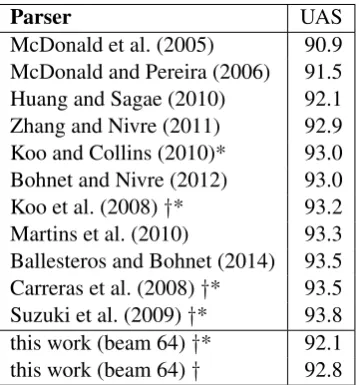
Parser UAS
McDonald et al. (2005) 90.9 McDonald and Pereira (2006) 91.5 Huang and Sagae (2010) 92.1 Zhang and Nivre (2011) 92.9 Koo and Collins (2010)* 93.0 Bohnet and Nivre (2012) 93.0 Koo et al. (2008)†* 93.2 Martins et al. (2010) 93.3 Ballesteros and Bohnet (2014) 93.5 Carreras et al. (2008)†* 93.5 Suzuki et al. (2009)†* 93.8 this work (beam 64)†* 92.1 this work (beam 64)† 92.8
Table 2: State-of-the-art comparison for unlabeled attachment score for WSJ-PTB with Y&M rules. Results marked with † use other kind of infor-mation, and are not directly comparable. Results marked with * include punctuation for evaluation.
TA and 90.11 TAS excluding punctuation. Table 2 compares our results with the state-of-the-art. Our model obtains comptetitive dependency accu-racies when compared to other systems.
In terms of constituent structure, our best model (beam=64) obtains 88.74 LR, 89.21 LP and 88.97 F1. Table 3 compares our model with other con-stituent parsers, including shift-reduce parsers as ours. Our best model is competitive compared with the rest.
5 Related Work
[image:7.595.328.508.225.418.2]Beam-size LR LP F1 Sagae and Lavie (2005)* 86.1 86.0 86.0
[image:8.595.73.291.62.279.2]Ratnaparkhi (1999) 86.3 87.5 86.9 Sagae and Lavie (2006)* 87.8 88.1 87.9 Collins (1999) 88.1 88.3 88.2 Charniak (2000) 89.5 89.9 89.5 Zhang and Clark (2009)* 90.0 89.9 89.9 Petrov and Klein (2007) 90.1 90.2 90.1 Zhu et al. (2013)-1* 90.2 90.7 90.4 Carreras et al. (2008) 90.7 91.4 91.1 Zhu et al. (2013)-2†* 91.1 91.5 91.3 Huang (2008) 91.2 91.8 91.5 Charniak (2000) 91.2 91.8 91.5 Huang et al. (2010) 91.2 91.8 91.5 McClosky et al. (2006) 91.2 91.8 91.5 this work (beam 64)* 88.7 89.2 89.0 Table 3: State-of-the-art comparison in the test set for phrase structure parsing. Results marked with † use additional information, such as semi-supervised models, and are not directly compara-ble to the others. Results marked with * are shift-reduce parsers.
Carreras et al. (2008) was the first to use spinal representations to define an arc-factored depen-dency parsing model based on the Eisner algo-rithm, that parses in cubic time. Our work can be seen as the transition-based counterpart of that, with a greedy parsing strategy that runs in linear time. Because of the extra complexity of spinal structures, they used three probabilistic non-spinal dependency models to prune the search space of the spinal model. In our work, we show that a sin-gle arc-eager model can obtain very competitive results, even though the accuracies of our model are lower than theirs.
In terms of parsing spinal structures, Rush et al. (2010) introduced a dual decomposition method that uses constituent and dependency parsing rou-tines to parse a combined spinal structure.
In a similar style to our method Hall et al. (2007), Hall and Nivre (2008) and Hall (2008) introduced an approach for parsing Swedish and German, in which MaltParser (Nivre et al., 2007) is used to predict dependency trees, whose depen-dency labels are enriched with constituency labels. They used tuples that encode dependency labels, constituent labels, head relations and the attach-ment. The last step is to make the inverse transfor-mation from a dependency graph to a constituent
structure.
Recently Kong et al. (2015) proposed a struc-tured prediction model for mapping dependency trees to constituent trees, using the CKY algo-rithm. They assume a fixed dependency tree used as a hard constraint. Also recently, Fern´andez-Gonz´alez and Martins (2015) proposed an arc-factored dependency model for constituent pars-ing. In that work dependency labels encode the constituent node where the dependency arises as well as the position index of that node in the head spine. In contrast, we use constituent triplets as dependency labels.
Our method is based on constraining a shift-reduce parser using the arc-eager strategy. Nivre (2003) and Nivre (2004) establish the basis for arc-eager algorithm and arc-standard parsing algo-rithms, which are central to most recent transition-based parsers (Zhang and Clark, 2011b; Zhang and Nivre, 2011; Bohnet and Nivre, 2012). These parsers are very fast, because the number of pars-ing actions is linear in the length of the sentence, and they obtain state-of-the-art-performance, as shown in Section 4.3.
For shift-reduce constituent parsing, Sagae and Lavie (2005; 2006) presented a shift-reduce phrase structure parser. The main difference to ours is that their models do not use lexical de-pendencies. Zhang and Clark (2011a) presented a shift-reduce parser based on CCG, and as such is lexicalized. Both spinal and CCG represen-tations are very expressive. One difference is that spinal trees can be directly obtained from constituent treebanks with head-child information, while CCG derivations are harder to obtain.
6 Conclusions and Future Work
There are several lessons to learn from this paper. First, we show that a simple modification to the arc-eager strategy results in a competitive greedy spinal parser which is capable of predicting depen-dency and constituent structure jointly. In order to make it work, we introduce simple constraints to the arc-eager strategy that ensure well-formed spinal derivations. Second, by doing this, we are providing a good trade-off between speed and ac-curacy, while at the same time we are providing a dependency structure which can be really useful for downstream applications. Even if the depen-dency model needs to cope with a huge amount of dependency labels (in the form of constituent triplets), the unlabeled attachment accuracy does not drop and the labeling accuracy (for the triplets) is good enough for getting a good phrase-structure parse. Overall, our work shows that greedy strate-gies to dependency parsing can be successfuly augmented to include constituent structure.
In the future, we plan to explore spinal deriva-tions in new transition-based dependency parsers (Chen and Manning, 2014; Dyer et al., 2015; Weiss et al., 2015; Zhou et al., 2015). This would allow to explore the spinal derivations in new ways and to test their potentialities.
Acknowledgements
We thank Noah A. Smith and the anonymous re-viewers for their very useful comments. Miguel Ballesteros is supported by the European Com-mission under the contract numbers FP7-ICT-610411 (project MULTISENSOR) and H2020-RIA-645012 (project KRISTINA).
References
Miguel Ballesteros and Bernd Bohnet. 2014. Au-tomatic feature selection for agenda-based depen-dency parsing. InProc. COLING.
Bernd Bohnet and Joakim Nivre. 2012. A transition-based system for joint part-of-speech tagging and la-beled non-projective dependency parsing. In Pro-ceedings of the 2012 Joint Conference on Empiri-cal Methods in Natural Language Processing and Computational Natural Language Learning, pages 1455–1465, Jeju Island, Korea, July. Association for Computational Linguistics.
Xavier Carreras, Michael Collins, and Terry Koo. 2008. TAG, Dynamic Programming, and the Per-ceptron for Efficient, Feature-Rich Parsing. In
CoNLL 2008: Proceedings of the Twelfth Confer-ence on Computational Natural Language Learning, pages 9–16, Manchester, England, August. Coling 2008 Organizing Committee.
Eugene Charniak. 2000. A maximum-entropy-inspired parser. In Proceedings of the 1st North American Chapter of the Association for Computa-tional Linguistics Conference, NAACL 2000, pages 132–139, Stroudsburg, PA, USA. Association for Computational Linguistics.
Danqi Chen and Christopher D. Manning. 2014. A fast and accurate dependency parser using neural net-works. InProc. EMNLP.
Michael John Collins. 1996. A new statistical parser based on bigram lexical dependencies. In Proceed-ings of the 34th Annual Meeting of the Associa-tion for ComputaAssocia-tional Linguistics, pages 184–191, Santa Cruz, California, USA, June. Association for Computational Linguistics.
Michael Collins. 1997. Three generative, lexicalised models for statistical parsing. InProceedings of the eighth conference on European chapter of the Asso-ciation for Computational Linguistics, pages 16–23. Association for Computational Linguistics.
Michael Collins. 1999. Head-Driven Statistical Mod-els for Natural Language Parsing. Ph.D. thesis, University of Pennsylvania.
Chris Dyer, Miguel Ballesteros, Wang Ling, Austin Matthews, and Noah A. Smith. 2015. Transition-based dependency parsing with stack long short-term memory. InProceedings of ACL.
Rich´ard Farkas and Bernd Bohnet. 2012. Stacking of dependency and phrase structure parsers. In COL-ING, pages 849–866.
Daniel Fern´andez-Gonz´alez and Andr´e F. T. Martins. 2015. Parsing as reduction.CoRR, abs/1503.00030. Johan Hall and Joakim Nivre. 2008. A dependency-driven parser for german dependency and con-stituency representations. In Proceedings of the Workshop on Parsing German, PaGe ’08, pages 47– 54, Stroudsburg, PA, USA. Association for Compu-tational Linguistics.
Johan Hall, Joakim Nivre, and Jens Nilsson. 2007. A Hybrid Constituency-Dependency Parser for Swedish. In Proceedings of the 16th Nordic Con-ference of Computational Linguistics (NODALIDA). Johan Hall. 2008. Transition-based natural language parsing with dependency and constituency represen-tations. Master’s thesis, V¨axj¨o University.
Liang Huang and Kenji Sagae. 2010. Dynamic pro-gramming for linear-time incremental parsing. In
Zhongqiang Huang, Mary Harper, and Slav Petrov. 2010. Self-training with products of latent vari-able grammars. In Proceedings of the 2010 Con-ference on Empirical Methods in Natural Language Processing, pages 12–22. Association for Computa-tional Linguistics.
Liang Huang. 2008. Forest reranking: Discriminative parsing with non-local features. InACL, pages 586– 594.
Lingpeng Kong, Alexander M. Rush, and Noah A. Smith. 2015. Transforming dependencies into phrase structures. InProceedings of the 2015 Con-ference of the North American Chapter of the Asso-ciation for Computational Linguistics – Human Lan-guage Technologies. Association for Computational Linguistics.
Terry Koo and Michael Collins. 2010. Efficient third-order dependency parsers. In Proceedings of the 48th Annual Meeting of the Association for Compu-tational Linguistics (ACL), pages 1–11.
Terry Koo, Xavier Carreras, and Michael Collins. 2008. Simple semi-supervised dependency parsing. In Proceedings of the 46th Annual Meeting of the Association for Computational Linguistics (ACL), pages 595–603.
Sandra K¨ubler, Ryan McDonald, and Joakim Nivre. 2009.Dependency Parsing. Morgan and Claypool.
Andre Martins, Noah Smith, Eric Xing, Pedro Aguiar, and Mario Figueiredo. 2010. Turbo parsers: De-pendency parsing by approximate variational infer-ence. In Proceedings of the Conference on Em-pirical Methods in Natural Language Processing (EMNLP), pages 34–44.
David McClosky, Eugene Charniak, and Mark John-son. 2006. Effective self-training for parsing. In Proceedings of the Main Conference on Hu-man Language Technology Conference of the North American Chapter of the Association of Computa-tional Linguistics, HLT-NAACL ’06, pages 152– 159, Stroudsburg, PA, USA. Association for Com-putational Linguistics.
Ryan McDonald and Fernando Pereira. 2006. Online learning of approximate dependency parsing algo-rithms. In Proceedings of the 11th Conference of the European Chapter of the Association for Com-putational Linguistics (EACL), pages 81–88.
Ryan McDonald, Koby Crammer, and Fernando Pereira. 2005. Online large-margin training of de-pendency parsers. In Proceedings of the 43rd An-nual Meeting of the Association for Computational Linguistics (ACL), pages 91–98.
Joakim Nivre and Daniel Fern´andez-Gonz´alez. 2014. Arc-eager parsing with the tree constraint. Compu-tational Linguistics, 40(2):259–267.
Joakim Nivre, Johan Hall, Jens Nilsson, Atanas Chanev, G¨uls¸en Eryiˇgit, Sandra K¨ubler, Svetoslav Marinov, and Erwin Marsi. 2007. Maltparser: A language-independent system for data-driven de-pendency parsing. Natural Language Engineering, 13:95–135.
Joakim Nivre, Yoav Goldberg, and Ryan T. McDon-ald. 2014. Constrained arc-eager dependency pars-ing.Computational Linguistics, 40(2):249–527. Joakim Nivre. 2003. An efficient algorithm for
pro-jective dependency parsing. In Proceedings of the 8th International Workshop on Parsing Technologies (IWPT), pages 149–160.
Joakim Nivre. 2004. Incrementality in deterministic dependency parsing. InProceedings of the Work-shop on Incremental Parsing: Bringing Engineering and Cognition Together (ACL), pages 50–57. Slav Petrov and Dan Klein. 2007. Improved
infer-ence for unlexicalized parsing. InHLT-NAACL, vol-ume 7, pages 404–411.
Adwait Ratnaparkhi. 1996. A maximum entropy part-of-speech tagger. InProceedings of the Conference on Empirical Methods in Natural Language Pro-cessing.
Adwait Ratnaparkhi. 1999. Learning to parse natural language with maximum entropy models. Machine Learning, 34(1-3):151–175.
Alexander M Rush, David Sontag, Michael Collins, and Tommi Jaakkola. 2010. On dual decomposition and linear programming relaxations for natural lan-guage processing. InProceedings of the 2010 Con-ference on Empirical Methods in Natural Language Processing, pages 1–11. Association for Computa-tional Linguistics.
Kenji Sagae and Alon Lavie. 2005. A classifier-based parser with linear run-time complexity. In Proceed-ings of the Ninth International Workshop on Parsing Technology, Parsing ’05, pages 125–132, Strouds-burg, PA, USA. Association for Computational Lin-guistics.
Kenji Sagae and Alon Lavie. 2006. Parser combi-nation by reparsing. In Proceedings of the Human Language Technology Conference of the NAACL, Companion Volume: Short Papers, NAACL-Short ’06, pages 129–132, Stroudsburg, PA, USA. Associ-ation for ComputAssoci-ational Linguistics.
Jun Suzuki, Hideki Isozaki, Xavier Carreras, and Michael Collins. 2009. An empirical study of semi-supervised structured conditional models for depen-dency parsing. In Proceedings of EMNLP, pages 551–560.
David Weiss, Christopher Alberti, Michael Collins, and Slav Petrov. 2015. Structured training for neural network transition-based parsing. InProc. ACL. Hiroyasu Yamada and Yuji Matsumoto. 2003.
Statis-tical dependency analysis with support vector ma-chines. In Proceedings of the 8th International Workshop on Parsing Technologies (IWPT), pages 195–206.
Yue Zhang and Stephen Clark. 2009. Transition-based parsing of the chinese treebank using a global dis-criminative model. InProceedings of the 11th Inter-national Conference on Parsing Technologies, pages 162–171. Association for Computational Linguis-tics.
Yue Zhang and Stephen Clark. 2011a. Shift-reduce ccg parsing. In Proceedings of the 49th Annual Meeting of the Association for Computational Lin-guistics: Human Language Technologies-Volume 1, pages 683–692. Association for Computational Lin-guistics.
Yue Zhang and Stephen Clark. 2011b. Syntactic pro-cessing using the generalized perceptron and beam search. Computational Linguistics, 37(1):105–151. Yue Zhang and Joakim Nivre. 2011. Transition-based
dependency parsing with rich non-local features. In
Proceedings of the 49th Annual Meeting of the Asso-ciation for Computational Linguistics (ACL), pages 188–193, Portland, Oregon, USA.
Hao Zhou, Yue Zhang, Shujian Huang, and Jiajun Chen. 2015. A Neural Probabilistic Structured-Prediction Model for Transition-Based Dependency Parsing. InACL.