Abstract—An Intelligent Recursive Algorithm (IRA) based on lifting filter that can efficiently remove noise is presented in this paper. The algorithm does not need any threshold parameters unlike the algorithms developed so far using PSM and median based filters. It is found from the results that the proposed IRA for noise removal demonstrates much better results with lesser computation time when compared to other existing algorithms. The proposed algorithm even works for binary images corrupted with impulse noise. The image restored using the proposed algorithm is compared with restoration using median based filters. It can be observed that the visual quality is much better and the finer details are very well maintained using the proposed algorithm for both binary and grayscale images
Index Terms- Image Restoration, Impulse Noise, Binary Images, Salt and Pepper Noise, Median Filter
I. INTRODUCTION
oise should be removed while keeping the fine details of the image intact. An intelligent recursive noise removal algorithm (IRA) based on the lifting filter that can efficiently remove noise is presented in this paper. The algorithm does not need any threshold parameters unlike the algorithms developed so far and it demonstrates superior results in lesser computation time.
Median filter is a well known method that can remove salt and pepper noise from images. Its disadvantage is the distortion of corners and thin lines in the image. Center Weighted Median (CWM) is a superior enhancement to Median filter [5]. The center is given more weight compared to the surrounding neighbours. This filter can retain fine details of the image. Progressive Switching Median Based Filter (PSMF) has been proposed by Zhou Wang and David Zhang in [3], for the removal of impulse noise from highly
Manuscript received May11, 2011; revised July 29, 2011
Rajesh Siddavatam is Assoicate Professor in the Department of Computer Science with Jaypee University of Information Technology, HP, India (phone:+91-9218624373; fax: +91-1792-245362; e-mail: [email protected]).
Anshul Sood is Research Scholar in the Department of Computer Science with Jaypee University of Information Technology, HP, India (e-mail: [email protected]).
Syamala Jayasree P is Research Scholar in the Department of Computer Science with Jaypee University of Information Technology, HP, India (e-mail: [email protected]).
S P Ghrera is Assoicate Professor in the Department of Computer Science with Jaypee University of Information Technology, HP, India (e-mail: [email protected]).
corrupted images. The Center Weighted Median filter gave more importance to current pixel, preserving good image details, but offered less noise suppression when the center pixel itself is corrupted [4]. Most of the recent impulse filters [5, 6] provide good outputs at smaller noise levels and find difficulty in restoring highly corrupted images. Total Variation regularization has been used in [9] for deconvolution with salt and pepper noise. The algorithms [12, 13] are new developments in the image restoration domain.
Second generation wavelets developed by Swelden [7] have been efficiently used for many applications of image processing. The lifting scheme has been earlier applied to the progressive image sampling as seen in [1]. Adaptive versions of the Lifting Scheme have been used in areas of image reconstruction and image compression as seen in [10-11].
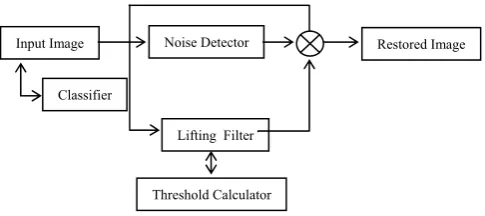
The idea of noise cancellation using lifting filters is not new, and recently, it has been investigated in [2]. This implementation involved numerous iterations bringing down the computational efficiency and had a shortcoming, that it needed a threshold parameter to be set every time it was run and moreover it could not work well for binary images. Similar shortcomings were observed in Progressive Switching Median Filter [3]. The threshold is determined by these algorithms by conducting numerous experimental runs. Hence, to solve these issues we propose our algorithm which intelligently determines the threshold parameter and works well for binary images as well. The Intelligent Recursive Algorithm first calculates the detail coefficients for the entire image and then intelligently determines the threshold to get the best possible results.
Moreover there is a difference in removing impulse noise in grayscale and binary images. The difficulty in removing salt and pepper noise from binary image is due to the fact that image data as well as the noise share the same small set of values (either 0 or 255) which complicates the process of detecting and removing the noise. This is different from grayscale images where salt and pepper noise could be distinguished as pixels having big difference in the amplitude compared with their neighbourhood pixels. A new method was proposed in [8] specifically for binary images of engineering drawing. Hence, we have incorporated a new method to classify such pixels as 'good but marked noisy' pixels.
This paper is organised as follows. Section II describes the model for Image Restoration. Section III deals with the proposed algorithm. The experimental results by using the proposed method are discussed in section IV. Section V gives the conclusion of the paper.
An Intelligent Recursive Algorithm for 95%
Impulse Noise Removal in Grayscale and
Binary Images using Lifting Scheme
Rajesh Siddavatam, Member IEEE , Anshul Sood, Syamala Jayasree P, and S P Ghrera
II. IMAGE MODEL
Consider an original image f and a noisy and degraded
image h. The image h is corrupted with homogeneous
impulse noise
n
which is spread equally throughput the image. So, in the usual sense any standard Image Restoration Model is:
h
(
i
,
j
)
f
(
i
,
j
)
n
(
i
,
j
)
(1) Data from images, are highly correlated, and contain redundancy. This structure is exploited by the wavelets to represent such data accurately with a few parameters. The computations involved in obtaining this representation are fast and efficient, and linear in complexity. Because of this property, wavelets find its application in geometric modelling, data transmission, data compression, as well as in numerical computationsSecond generation wavelets developed in [7] have been efficiently used for many applications of image processing. Generating set of most significant samples for image restoration and then using them to generate an image is a highly non-linear and computationally expensive task.
The lifting scheme [1] can be viewed as a process of taking an existing wavelet and modifying it by adding linear combinations of the scaling function at the same level of resolution. The scheme consists of three steps: Split, Predict and Update.
[image:2.595.50.293.460.568.2]III. PROPOSED INTELLIGENT RECURSIVE ALGORITHM
Fig. 1 General framework of the intelligent recursive algorithm based on lifting filter
Similar to other impulse detection algorithms [2] and [3], our impulse filter is developed by prior information on natural images, i.e., a noise-free image should be locally smoothly varying, and is separated by edges. The noise considered by this detection algorithm is only salt and pepper impulsive noise which means: 1) only a portion of the image pixels are corrupted while other pixels are noise-free and 2) a noise pixel takes either a very large value as a positive impulse or a very all value as a negative impulse.
To implement the PSM or the median filter method we need to set some parameters and a threshold value. This
threshold value. The algorithm is intelligent and determines the threshold automatically.
A. Intelligent Recursive Algorithm (IRA)
_____________________________________________ Input – Noisy Image h
_______________________________________________ Step 1: Compute X
for every pixel repeat steps from 2 to 7 Step 2: Initialize w = 3
Step 3: If X(i,j) ≠ Impulse pixel goto step 7
Step 4: ∆i,j = { h(i1,j1) | i-(w-1)/2 ≤ i1≤ i+(w-1)/2,
j-(w-1)/2 ≤ j1≤ j+(w-1)/2}
b=no. of black pixels in the window w=no. of white pixels in the window Step 5: If ∆i,j≠ NULL
p(i,j) = mean(∆i,j)
d(i,j) = | h(i,j) – p(i,j) | else if (w < wmax)
w=w+2 goto step 4 else
if (b>w) h(i,j)=0 else
h(i,j)=255 Step 7: Goto next pixel
Step 8: Calculate threshold t, from detailed coefficient matrix d
for every pixel Step 9: If (d(i,j)>t) h(i,j)=p(i,j)
________________________________________________ Output : Denoised Image
________________________________________________ The threshold parameter is calculated using the detailed coefficient matrix. The detailed coefficient d(i,j) is calculated by calculating the absolute difference between the current pixel h(i,j) value and the mean of good pixels (around the current pixel)
p(i,j). Now the algorithm intelligently decides that the threshold is:
j) ) (2) In the proposed algorithm a binary image is taken and for every pixel we count the number of good pixels around that pixel taking a window size of w=3. Now, if there are no good pixels found in this window, the algorithm because of being adaptive increases the window size to 5. Once again if no good pixels are found, then the algorithm counts the number of black (pixel value 0) and white (pixel value 255) pixels around the current pixel. The current pixel value h(i,j) is replaced by the value whichever is found greater which gives us the restored image.
IV. RESULTS AND DISCUSSIONS
Experimental results on the image of Lena have been Noise Detector
Classifier
Lifting Filter
Threshold Calculator
algorithm, the computed results are compared by visual quality subjectively and by improvement in PSNR.
The experimental results show the wide applicability of the method for de-noising grayscale and binary images corrupted with all levels of noise densities.
For 10%, 20% and 50% homogeneous salt and pepper noise a single iteration was found sufficient for the image restoration. The quality of the restored image at 50% is almost similar to the original image (as in fig. 2). In [2] and [3] more than one iteration was required to de-noise the image at 50% noise levels. Figure 3 shows that, for 80% homogeneous salt and pepper noise two iterations were sufficient for generating the results, while [2] required three iterations for the same level of noise. Even at highly corrupted image at 95% homogeneous salt and pepper noise four iterations were found sufficient for generating the results shown. At only 5% signal level the median based filters could not restore the image even after many iterations. In each case the threshold parameters were automatically calculated and the time complexity was found to be a lot lesser.
The proposed algorithm even works for binary images corrupted with impulse noise. Figure 5 shows a binary test image corrupted by 50% impulse noise. This image is restored using the proposed algorithm in one iteration and is compared with the restored image using the median filter method. It can be observed that the visual quality is much better in the image restored using the proposed algorithm.
(a) (b)
[image:3.595.310.544.48.333.2](c) (d)
Fig. 2 Image Restoration using proposed algorithm for 50% noise (a) Original Lena (b) Lena with 50% Salt and Pepper Noise (c) Restored Image by proposed algorithm – 1st Iteration
(d) Restored Image by Median Filter 1st Iteration
(a) (b)
[image:3.595.312.544.396.683.2]
(c) (d) Fig. 3 Image Restoration using proposed algorithm (a) Lena with 80% Salt and Pepper Noise
(b) Restored Image by proposed algorithm – 1st Iteration
(c) Restored Image by proposed algorithm – 2nd Iteration
(d) Restored Image by Median Filter 2nd Iteration.
(a) (b)
(c) (d) Fig. 4 Image Restoration for highly corrupted image (a) Lena with 95% Salt and Pepper Noise
(b) Restored Image by proposed algorithm – 1st Iteration
(c) Restored Image by proposed algorithm – 2nd Iteration
[image:3.595.53.286.400.673.2](a) (b)
(c) (d) Fig. 5 Image Restoration for Binary Images
(a) Original Binary Test Image
(b) Test Image with 50% Salt and Pepper Noise (c) Restored Image by Median Filter
(d) Restored Image by proposed algorithm
PSNR for an MxN image is defined as:
where RMSE is:
Here is the pixel position, is the original image and is the restored image.
Table I shows the performance of the proposed method with other algorithms. Our proposed algorithm shows higher PSNR values compared to the other median-based methods especially when noise ratios are high.
Table II shows the time complexity of the proposed method with other algorithms. Our proposed algorithm shows good time complexity compared to adaptive median-based and Edge Preservation Filter [14]
These measures hence show the superiority of our proposed algorithm using second generation wavelets and the lifting filter as compared to PSM Filter.
TABLEI
COMPARING PSNR AT DIFFERENT NOISE DENSITIES
Test Image
Noise Density
(%)
PSNR (in dB) for PSM
Filter
PSNR (in dB)
for Median
Filter
PSNR (in dB) for Proposed Algorithm
Lena (512 x
512)
10% 42.3 33.01 42.95
20% 38.36 30.98 39.51
50% 32.82 25.95 34.22
80% 27.48 12.13 29.28
TABLE II
TIME COMPLEXITY -COMPARISON OF CPU TIME (IN SECONDS)
Test Image Density Noise Adaptive MF Edge PF [14] Proposed Lena
512x 512
70% 23 6865 53
90% 311 >12000 91
95% 346 >12000 94
Bridge 512 x 512
70% 56 8003 54
90% 311 >12000 92
V. CONCLUSION
We have proposed a much improved impulse noise removal algorithm based on the lifting filter that can give us acceptable results for image restoration even at 95% degradation by noise. This algorithm also works well for binary images corrupted with impulse noise. The proposed algorithm yields better results at 10%, 20%, 50% and 80% noise densities. Moreover other median filters develop patches at very high noise densities such as 95%, but the proposed algorithm restores the image taking only 4 iterations. The increment in the PSNR values with the other filters quantifies the improvement in the algorithm. The time complexity shown in Table II proves that the algorithm is computationally takes very less time in comparison to other methods[14].
.
REFERENCES
[1] Siddavatam Rajesh, K Sandeep and R K Mittal, “A Fast Progressive Image Sampling Using Lifting Scheme and Non-Uniform B-Splines”, Proceedings of IEEE International Symposium on Industrial Electronics ISIE -07, June 4-7, pp. 1645- 1650, Vigo, Spain, 2007. [2] Siddavatam Rajesh and Tushar Jaiswal, “Image Noise Cancellation
by Lifting Filter using Second Generation Wavelets”, Accepted to
appear in the Proceedings of IEEE ARTcom 2009, Kottayam, Kerala, India, October 27-28, 2009.
[3] Zhou Wang and David Zhan, “Progressive Switching Median Filter for the Removal of Impulse Noise from Highly Corrupted Images”, IEEE Transactions on Circuits And Systems—II: Analog And Digital Signal Processing, Vol. 46, No. 1, January 1999.
[4] T. Chen and H.Wu, "Adaptive Impulse Detection using Center-Weighted Median Filters", Signal Processing Lett., vol. 8, no. 1, pp.
1-3, Jan. 2001.
highly Corrupted Images", IEEE Transactions on Image Processing,
Vol. 13, No. 2, February 2004
[7] W.Swelden., “The Lifting scheme : A custom design construction of biorthogonal wavelets”, Appl. Comput. Harmon. Anal., 3(2), pp. 186-200, 1996.
[8] Hasan S. M. Al-Khaffaf, Abdullah Z. Talib, Rosalina Abdul Salam,
“Removing Salt-and-Pepper Noise from Binary Images of Engineering Drawings”, in IEEE Signal Process. Lett., vol. 11, no. 2,
pp. 243–246, Feb. 2004.
[9] Brendt Wohlberg and Paul Rodriguez, “An l1-TV Algorithm for
Deconvolution with Salt and Pepper Noise”, IEEE International
Conference on Acoustics, Speech and Signal Processing, ICASSP 2009, 19-24 April 2009 Page(s):1257 - 1260
[10] Gemma Piella and Henk J.A.M. Heijmans, “An Adaptive Update Lifting Scheme With Perfect Reconstruction”, Proceedings of
International Conference on Image Processing 2001, Volume 3, 7-10 Oct. 2001 Page(s):190 - 193 vol.3
[11] Weisheng Dong, Guangming Shi, and Jizheng Xu, “Signal-Adapted Directional Lifting Scheme for Image Compression”, IEEE International Symposium on Circuits and Systems, ISCAS 2008, 18-21 May 2008 Page(s):1392 - 1395
[12] Bosco.A, Mancuso.M, Battiato.S, Spampinato. G, "Temporal noise reduction of Bayer matrixed video data", Multimedia and Expo, 2002. ICME '02. Proceedings. 2002 IEEE International Conference on Volume 1, 26-29 Aug. 2002 Page(s):681 - 684 vol.1
[13] Fujiki, A,Matsushita.J,Imai.T, Muneyasu.M, "Technique for mixed noise reduction based on support vector machine [image denoising]" Nonlinear Signal and Image Processing, 2005. NSIP 2005. Abstracts. IEEE-Eurasip 18-20 May 2005 Page(s):25