Anna Kazantseva
∗ University of OttawaStan Szpakowicz
∗∗ University of Ottawa Polish Academy of SciencesWe present an approach to the automatic creation of extractive summaries of literary short stories. The summaries are produced with a specific objective in mind: to help a reader decide whether she would be interested in reading the complete story. To this end, the summaries give the user relevant information about the setting of the story without revealing its plot. The system relies on assorted surface indicators about clauses in the short story, the most important of which are those related to the aspectual type of a clause and to the main entities in a story. Fifteen judges evaluated the summaries on a number of extrinsic and intrinsic measures. The outcome of this evaluation suggests that the summaries are helpful in achieving the original objective.
1. Introduction
In the last decade, automatic text summarization has become a popular research topic with a curiously restricted scope of applications.A few innovative research directions have emerged, including headline generation (Soricut and Marcu 2007), summarization of books (Mihalcea and Ceylan 2007), personalized summarization (D´ıaz and Gerv ´as 2007), generation of tables-of-contents (Branavan, Deshpande, and Barzilay 2007), sum-marization of speech (Fuentes et al.2005), dialogues (Zechner 2002), evaluative text (Carenini, Ng, and Pauls 2006), and biomedical documents (Reeve, Han, and Brooks 2007).In addition, more researchers have been venturing past purely extractive sum-marization (Krahmer, Marsi, and van Pelt 2008; Nomoto 2007; McDonald 2006).By and large, however, most research in text summarization still revolves around texts characterized by rigid structure.The better explored among such texts are news articles (Barzilay and McKeown 2005), medical documents (Elhadad et al.2005), legal docu-ments (Moens 2007), and papers in the area of computer science (Teufel and Moens 2002; Mei and Zhai 2008).Although summarizing these genres is a formidable challenge in itself, it excludes a continually increasing number of informal documents available electronically.Such documents, ranging from novels to personal Web pages, offer a wealth of information that merits the attention of the text summarization community.
∗School of Information Technology and Engineering, University of Ottawa, 800 King Edward Ave., Ottawa, Ontario K1N 6N5, Canada. E-mail: [email protected].
∗∗School of Information Technology and Engineering, University of Ottawa, 800 King Edward Ave., Ottawa, Ontario K1N 6N5, Canada. E-mail: [email protected].
We attempt to make a step in this direction by devising an approach to summarizing a relatively unexplored genre: literary short stories.
Well-structured documents, such as news articles, exhibit a number of character-istics that help identify some of the important passages without performing in-depth semantic analysis.These characteristics include predictable location of typical items in a document and in its well-delineated parts, cue words, and template-like structure that often characterizes a genre (e.g., scientific papers). This is not the case in literature. Quite the contrary—to write fiction in accordance with a template is a sure way to write poor prose.One also cannot expect to find portions of text that summarize the main idea behind a story, and even less so to find them in the same location.In addition, the variety of literary devices (the widespread use of metaphor and figurative language, leaving things unsaid and relying on the reader’s skill of reading between the lines, frequent use of dialogue, etc.) makes summarizing fiction a very distinct task. It is a contribution of this work to demonstrate that summarizing short fiction is feasible using state-of-the-art tools in natural language technology.In the case of our corpus, this is also done without deep semantic resources or knowledge bases, although such resources would be of great help.We leverage syntactic information and shallow se-mantics (provided by a gazetteer) to produce indicative summaries of short stories that people find helpful and that outperform naive baselines and two state-of-the-art generic summarizers.
We have restricted the scope of this potentially vast project in several ways.In the course of this work we concentrate on producing summaries of short stories suit-able for a particular purpose: to help a reader form adequate expectations about the complete story and decide whether she would be interested in reading it.To this end, the summary includes important elements of the setting of a story, such as the place and the main characters, presented as excerpts from the complete story.The assump-tion behind this definiassump-tion is this: If a reader knows when and where the story takes place and who its main characters are, she should be able to make informed decisions about it.
With such a definition of short story summaries, re-telling the plot in the summary is not among the objectives of this work; in fact, doing so is undesirable.We have introduced this limitation for two reasons.There is an “ideological” side of the decision: Not many people want to know what happens in a story before reading it, even if this may help them decide that the story is worth reading.There also is a practical side, namely the complexity of the problem: Summarizing the plot would be considerably more difficult (see Section 2 for a review of related work).We hope to tackle this issue in the future.For now, creating indicative summaries of short stories is challenge enough.
Figure 1
Example of a summary produced by the system.
of a gentleman or he wouldn’t ever of apologized.” Yet, the summary in Figure 1 does not reveal these facts.For comparison, Figure 2 shows a summary obtained by taking the same number of sentences from the beginning of the story.As the reader can see, such a trivial approach is not sufficient to create a useful summary.Figure 3 shows a manually created “ideal” summary.
We experimented with a corpus of 47 stories from the 19th and early 20th century written by renowned writers, including O.Henry, Jerome K.Jerome, Anton Chekhov, and Guy de Maupassant.The stories, with the exception of a few fairy tales, are clas-sical examples of short social fiction.The corpus was collected from Project Gutenberg (www.gutenberg.org) and only contains stories in English.The average length of a story is 3,333 tokens and the target compression rate expressed in the number of sentences is 94%.
In order to create summaries of short stories that satisfy our stated criteria (hence-forth indicative summaries), the system searches each story for sentences that focus on important entities and relate the background of the story (as opposed to events). Correspondingly, processing has two stages.Initially, the summarizer identifies two types of important entities: main characters and locations.This is achieved using a gazetteer, resolving anaphoric expressions and then identifying frequently mentioned
Figure 2
Figure 3
Example of a manual summary.
entities.Next, the system selects sentences that set out the background of the story and focus on one of the important entities.In order to separate the background of a story from the plot (i.e., events), we rely on the notion of aspect.1 We approximate the aspectual type of a clause using either machine learning or manually produced rules. This is achieved by relying on an array of verb-related features, such as tense, lexical aspect of the main verb, presence of temporal expressions, and so on.Finally, the system composes a summary out of the selected sentences.
Our task remains a significant challenge despite its limited scope.To produce such indicative summaries successfully, one needs to consider many facets of the problem. An informative data representation, computational complexity, and usability of the final product are only some of them.Because the project is at the stage of an advanced feasibility study, it has not been possible to do justice to all aspects of the problem. Therefore, we concentrated on several specific issues and left many more to future work and to fellow researchers.
Firstly, we sought to identify characteristics of short stories that could be helpful in creating summaries.We devised an informative and practical data representation that could be reproduced without too much cost or effort.Secondly, we restricted ourselves to identifying the most informative portions of the stories and paid much less attention to readability and coherence of the resulting summaries.Even though readability is an important property, we hypothesized that informativeness is yet more important.Once the task of identifying informative passages has been accomplished, one can work on achieving coherence and readability.In the end, the emphasis was on the creation of extractive summaries using established tools and methods and on the identification of genre-specific properties that can help summarization.
The novelty of the task and the absence of agreed-upon measures for evaluating summaries of literary prose call for a thorough evaluation using a variety of metrics. That is why we conduct three distinct evaluation experiments.The summaries are
evaluated both extrinsically and intrinsically.They are also compared with two naive baselines (lead and random) and two state-of-the-art summarization systems designed for summarizing newswire (henceforthbaseline summarizers).2
In the first experiment, 15 people read a mix of machine-made, random, and manual summaries, and answer questions about them.Some questions are factual in nature (e.g.,list the main characters of the story), and others are subjective (e.g.,rate the readability of the summary).The results show that the machine-made summaries are significantly better than the random baseline but they fall far short of the quality of the manual summaries.
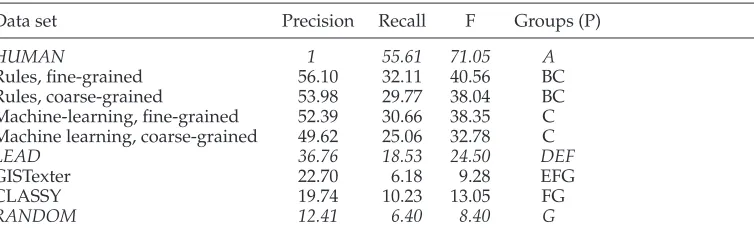
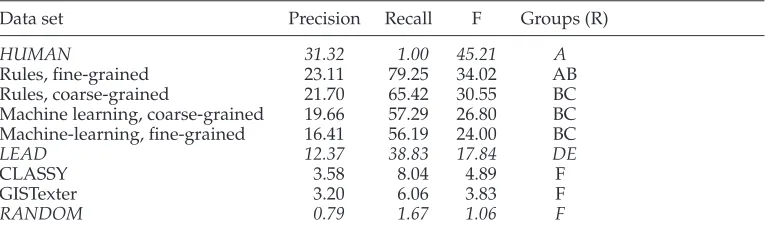
During the second evaluative experiment, the machine-made summaries are com-pared against extracts created by people using sentence co-selection measures (pre-cision, recall, and F-score).By sentence co-selection we mean measuring how many sentences found in manually created extracts are selected for inclusion in automatically produced summaries.The results suggest that our system outperforms all baselines, including state-of-the-art summarizers.
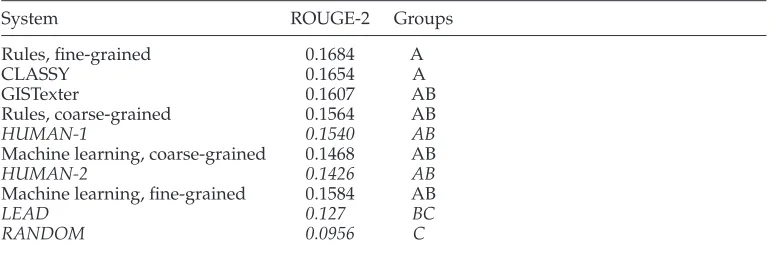
The third part of the evaluation uses two ROUGE metrics (Lin 2004) to compare the machine-made and the baseline summaries with the model abstracts.The results suggest that these measures are not well suited for evaluating extractive indicative summaries of short stories.
This paper is organized in the following manner.Section 2 gives a brief overview of the body of research in automatic story comprehension.Section 3 describes the process of identifying important entities in short stories.Section 4 introduces the notion of aspect, gives an overview of the system’s design, and discusses the linguistic motivation behind it.Section 5 describes the classification procedures (the use of machine learning and manual rule creation) that distinguish between the descriptive elements of a story and the passages that describe events.Section 6 reports on the evaluation of summaries which our system produces.Section 7 draws conclusions and outlines directions for future work.
2. Related Work
Summarization of literary prose is a relatively unexplored topic.There exists, however, a substantial body of research tackling the problem of story comprehension.During the 1970s and 1980s, a number of researchers in artificial intelligence built story-understanding systems that relied in one way or another on contemporary research in psychology and discourse processing.
Much of that line of research relied on an assumption that stories exhibit global cognitive structure (known asmacrostructure[van Dijk 1980] orschema[Bartlett 1932]) and that they can be decomposed into a finite number of cognitive units.According to this view, diversity in stories is not due to an infinite number of plots, but to an infinite number of combinations of a (relatively) small number of cognitive units.This direction was pioneered in 1928 by Vladimir Propp (1968) with his detailed analysis of 100 Russian folk tales.After a period of oblivion, these ideas regained popularity: van Dijk and Kintsch (1978) demonstrated the existence of macrostructures and their role in story comprehension and recall; Rumelhart (1975), Thorndyke (1975), and Mandler
(1987) developed sets of cognitive schemas (story grammars) that could be applied to certain types of stories; and Lehnert (1982) proposed to represent action-based stories in terms of a finite number of plot units—configurations of affect (or emotional) states of its characters.
The developments in psychology and discourse processing had gone hand in hand with those in artificial intelligence and resulted in a score of story-understanding and question-answering systems.Many of these relied on a set of manually encoded schemas and chose the most appropriate one for a given story (Cullingford 1978; Dyer 1983; Leake 1989).For example, a system called BORIS (Dyer 1983) processed stories word-by-word to create a very rich semantic representation of them using Memory Organization Packets (MOPs) and Thematic Affect Units (TAUs).These knowledge structures were activated by means of a very detailed lexicon where each lexeme was associated with MOPs and TAUs it could invoke.
Systems such as BORIS could not process stories that did not conform to schemas already at their disposal.Charniak and Goldman (1988) and Norvig (1989) at-tempted to circumvent this problem by learning to recognize more general structures. FAUSTUS (Norvig 1989) recognized six general classes of inferences by finding patterns of connectivity in a semantic network.It could be adapted to new kinds of documents by extending its knowledge base and not the underlying algorithm or patterns.Research in automatic story comprehension offered a number of important solutions for subsequent developments in artificial intelligence.No less important, it pointed out a number of challenges.All these systems required a formidable amount of semantic knowledge and a robust and efficient way of building a semantic representation of texts.In addition, systems such as BORIS or SAM (Cullingford 1978) also needed a set of schemas or schema-like scenarios.With such labor intensity, these requirements prohibit using schema-based approaches for real-life stories (e.g., fiction) and only allow the processing of artificially created examples.
In this historical context, our current approach to summarization of short fiction appears rather modest: Our system does not “understand” stories, nor does it retell their plot.Instead, it offers the reader hints—important information about the story’s setting—which should help her guess what type of story is to come.This assumption appears reasonable because it has been shown that comprehension and recall of dis-course are strongly influenced by the reader’s familiarity with the type of schema (van Dijk and Kintsch 1978).Because our system is tailored to work with classics of the genre, it was our expectation that the gist of the story’s setting offered to the reader in the wording of the original would give her an idea about the story’s themes and likely plot developments.The results of our experiments appear to back this assumption.
In addition, given the original objective, it seems reasonable that elements other than the plot would have a strong influence on the reader’s decision to read or not to read the story.The setting of the story, its characters, and style are some of the important factors.Many outstanding literary works differ not so much in plot as in their setting or moral.3Our system attempts to capture important elements of the setting explicitly and we expect that some elements of style may be captured implicitly due to the extractive nature of the summaries.
3. Identifying Important Entities
During the first stage of summary production the system identifies important entities in stories.Initially, we planned to identify three types of entities: people, locations, and time stamps.During a preliminary exploration of the corpus, we analyzed 14 stories for the presence of surface indicators of characters, locations, and temporal anchors.4 We employed the GATE Gazetteer (Cunningham et al.2002), and only considered entities it recognized automatically.
The experiment revealed that the stories in the corpus contained multiple mentions of characters (on average, 64 mentions per story, excluding pronouns).On the other hand, the 14 stories contained only 22 location markers, mostly street names.Four stories had no identifiable location markers.Finally, merely four temporal anchors were identified in all 14 stories: two absolute (such as year) and two relative (e.g., Christmas).These findings support the intuitive idea that short stories revolve around their characters, even if the ultimate goal is to show a larger social phenomenon.They also suggest that looking for time stamps in short stories is unlikely to prove productive, because such information is not included in these texts explicitly.That is why our system does not attempt to identify them.
Because characters appear to be central to short stories, we designed our system to maximize the amount of information available about them.It contains an anaphora resolution module that resolves pronominal and noun phrase anaphoric references to animate entities.The termanaphora, as used in this work, can be explained as a way of mentioning a previously encountered entity without naming it explicitly.Consider Examples 1a, 1b, and 1c from “A Matter of Mean Elevation” by O.Henry.The noun phraseMlle. Giraudfrom Example 1a is anantecedentand the pronounsherandshefrom Example 1c areanaphoric expressionsorreferents.Example 1c illustratespronominal anaphora, and Example 1b illustrates noun phrase anaphora.Here the noun phrase
the womanis the anaphoric expression which refers to the antecedentMlle. Giraudfrom Example 1a.
(1a) John Armstrongent1andMlle. Giraudent2rode among the Andean peaks, enveloped in their greatness and sublimity.
(1b) ToArmstrongent1the womanent2seemed almost a holy thing. (1c) Never yet sinceherent2rescue hadsheent2smiled.
The anaphora resolution module only handles first and third person singular per-sonal pronouns (I, me, my, he, his...) and singular definite noun phrases that denote animate entities (e.g.,the man, but notmen).It is implemented in Java, within the GATE framework, using the Connexor Machinese Syntax parser (Tapanainen and J ¨arvinen 1997).
The system resolves anaphoric expressions in the following manner.Initially, the documents are parsed with the Connexor Machinese Syntax parser.The parsed data are then forwarded to the Gazetteer in GATE, which recognizes nouns denoting locations and persons.The original version of the Gazetteer only recognizes named entities and professions, but we extended it to include 137 common animate nouns such as man, woman, soldier, orbaby.During the next stage, pronominal anaphoric expressions are
Table 1
Results of anaphora resolution.
Type of anaphora All Correct Incorrect Error rate, %
Pronominal 597 507 90 15.07
Nominal 152 96 56 36.84
Both 749 603 146 19.49
resolved using an implementation of the algorithm proposed by Lappin and Leass (1994).5Subsequently, anaphoric noun phrases are identified using the rules outlined by Vieira and Poesio (2000).Finally, anaphoric noun phrases are resolved using a modified version of the Lappin and Leass algorithm, adjusted to finding antecedents of nouns. The implementation is described in detail in Kazantseva (2006).
A thorough evaluation of the anaphora resolution module would be prohibitively labor-intensive.We estimated the performance of the module by manually verifying the results it achieved on two short stories of the training set (Table 1).The error rates for pronominal anaphora resolution are significantly lower than those for noun phrase anaphora resolution (15.07% vs. 36.84%). This is not unexpected because resolving noun phrase anaphora is known to be a very challenging task (Vieira and Poesio 2000).The results also reveal that referring to characters by pronouns is much more frequent than by noun phrases—in our case, the ratio of pronominal to nominal expressions is almost 4:1.This suggests that resolving pronominal anaphoric expressions is crucial to summarizing short stories.
The GATE Gazetteer, part of this module, also annotates the stories for the pres-ence of expressions denoting locations.After resolving anaphoric expressions, char-acters central to each story are selected based on normalized frequency counts taking anaphoric expressions into account.The output of this module consists of short stories annotated for the presence of location markers and main character mentions.
4. Selecting Descriptive Sentences Using Aspectual Information 4.1 Linguistic Definition of Aspect
We rely on aspect to select salient sentences that set out the background of a story.In this paper, the termaspectdenotes the same concept as what Huddleston and Pullum (2002, page 118) call thesituation type.The term refers to “different ways of viewing the internal temporal consistency of a situation” (Comrie 1976, page 3).Informally, the aspect of a clause suggests the temporal flow of an event or a state and the speaker’s position with respect to it.
A general aspectual classification based on Huddleston and Pullum (2002) appears in Figure 4, with examples for each type.
5 Lappin and Leass (1994) present a rule-based algorithm for resolving pronominal anaphora.The algorithm suggests the most likely antecedent after taking into account the candidates’ syntactic function, recency, and absence or presence of parallelism and cataphora with the referent.It also enforces
Figure 4
Aspectual hierarchy after Huddleston and Pullum (2002).
The first distinction is betweenstatesandevents.Events are processes that go on in time and consist of successive phases (Vendler 1967, page 99).For instance, an event of writing an essay consists of writing separate words, correcting, pausing between words, and so on.A state of understanding each other, on the other hand, does not imply such compositionality: It remains unchanged throughout the whole period when it is true. In other words, the meaning of events exhibits a dynamic component, whereas that of states does not.
Events are further categorized by whether a particular situation lasts for some time or occurs momentarily.The latter type of events are referred to asachievements, and events that imply duration are known asprocesses.For example, the nature of events such as dropping, stumbling, or recognizing is that they occur instantaneously and, therefore, are achievements.On the other hand, events such as playing golf or writing an essay last for some time, so they are processes.
Processes are classified intoaccomplishmentsandactivitiesdepending on whether a situation implies an ending (Vendler 1967, page 100).This property is known as
telicity.Reading a book in the context of Example 2a implies that the person finished reading it: the overall situation istelic.We cannot say that she has read the book in the first 15 minutes of doing so because the implied ending was not achieved (i.e., the book has not been read).Such situations are referred to as accomplishments.On the other hand, playing golf or talking on the phone does not imply that the process must end with a specific conclusion and the situation isatelic.Such situations are calledactivities. In addition, the aspectual type of a clause may be altered by multiplicity, for exam-ple, repetitions.Consider Examples 2a and 2b.
(2a) She read a book. (2b) She read a book a day.
Intuitively, stative—and especially serial—situations are more likely to be associ-ated with descriptions, that is to say, with things that are, or things that were happening for an extended period (consider He was a tall man vs. He opened the window).The remainder of Section 4 describes how we identify single and serial stative clauses and use them to construct summaries.
4.2 Overall System Design
Several system components are responsible for selecting salient background sentences. A story, annotated for the presence of important entities (as outlined in Section 3), is parsed with the Connexor Machinese Syntax parser.The sentences are then recursively split into clauses based on the results of parsing.For the purposes of this project, a
clauseis defined as a main verb as identified by the parser (whether finite or non-finite) with all its complements, including subject, modifiers, and their constituents.
Next, each clause is represented as a vector of features describing its characteristics. The system offers a choice: a fine-grained or coarse-grained representation.The main difference between the two is in the level of detail at which each clause is represented. For instance, a fine-grained feature vector has three different features with seven possi-ble values to carry tense-related information:tense,is progressive, andis perfect, whereas a coarse-grained vector carries only one binary feature,is simple past or present.6
Finally, the system selects salient descriptive sentences.Regardless of the granular-ity of the representation, one may choose between two different procedures for sentence selection.The first procedure employs machine learning techniques, namely the C5.0 decision tree induction (Quinlan 1992).The second procedure applies a set of manually created rules that guide the classification process.Section 4.3 gives a motivation for fea-tures used in each data set. Sections 5.1–5.3 describe the experimental setting. Section 6 presents the results.
The part of the system that selects descriptive sentences is implemented in Python.
4.3 Feature Selection: Description and Motivation
There are two criteria for the selection of features for both representations:
(Criterion 1) a clause should “talk” about important things, such as characters or locations
(Criterion 2) a clause should contain background descriptions rather then events We hypothesize that sentences which satisfy both criteria are good candidates for inclu-sion in indicative summaries.In other words, a summary that consists of such sentences would familiarize the reader with important elements of the setting of the story, but would not reveal the plot.
The features that contribute towards Criterion 1 can be divided into character-related and location-character-related.We have designed character-character-related features to help iden-tify sentences that focus on characters, not just mention them in passing.These features are modeled so as to help identify sentences that contain at least one mention of an important character with a salient grammatical function (e.g., subject). Location-related
Table 2
Description of the features in both data sets.
Fine-grained data set Coarse-grained data set
Type of Number of Number of Number of Number of
features features values features values
Character-related 10 18 4 6
Aspect-related 14 48 6 15
Location-related 2 4 2 4
Other 3 7 3 4
All 29 77 15 29
features are intended to help identify sentences where named entities tagged as loca-tions by the Gazetteer indeed refer to location names.
Criterion 2 has been introduced to ensure that the selected sentences are back-ground sentences (as opposed to those relating events) and are therefore suitable for inclusion in indicative summaries.To this end, the features that contribute towards Criterion 2 are designed to identify stative clauses and clauses that describe serial situa-tions.A single unambiguous indicator of aspectual type does not exist, but a number of verb-related characteristics of the clause may signal or limit its possible aspectual type. These characteristics include the lexical aspect of the main verb, tense, the presence of temporal expressions, voice, and certain properties of the direct object.The verb-related features capture this information in our representation.7
The remainder of this section contains a detailed description of the various types of features and motivates their inclusion.Table 2 shows how many features contribute to each criterion, and how many discrete values they have.Appendix A contains a complete list of features used in both representations, explains how they are computed, and shows the cardinality of the sets of possible values.
Character-related features.Character-related features help ensure that selected sen-tences are about one of the important characters in the story.So, this group of features describes whether a clause contains a character mention and what its grammatical function is (subject, object, indirect object, or other).Mentions of characters early in the text tend to contain more salient background information.That is why character-related features reflect the position of a parent sentence8 relative to the sentence where the character is introduced.In addition, these features capture the presence of a character mention that is premodified by a noun phrase.The interest in such mentions is inspired by the fact that these constructions—appositions—often introduce new entities into the discourse (Vieira and Poesio 2000).For the same reasons, the system also establishes whether a character mention is nominal or pronominal (e.g., Jackvs.he), whether it is used in the genitive case (e.g.,Jack’s) and, for common nouns, whether the mention is accompanied by an indefinite article.
7 It must be mentioned that several researchers have looked into automatically determining various semantic properties of verbs (Siegel 1998b; Merlo et al.2002).These approaches, however, attempt to determine properties of verbs viewed in isolation and do not deal with particular usages in the context of concrete sentences.That is why we cannot directly re-apply that research in determining the aspectual type of clauses.
Table 3
Privative featural identification of aspectual classes after Dorr and Olsen (1997).
Aspectual class Telic Dynamic Durative Examples
State + know, believe
Activity + + paint, walk
Accomplishment + + + destroy
Achievement + + notice, win
Location-related features. In discourse such as fiction, not all tokens that the Gazetteer recognizes as markers of location denote locations.Location-related features help identify mentions of locations in each clause and verify that these mentions indeed denote a place.These features describe whether a clause contains a mention of a location and whether it is embedded in a prepositional phrase.The rationale for these features is that true location mentions are more likely to occur inside prepositional phrases, such asfrom Chicagoorto China.
Verb-related features. Verb-related features model the characteristics of a clause that help determine its aspectual type.
Lexical aspect of a verb.Lexical aspect refers to a property of a verb when viewed in isolation, without regard to the context provided by a particular clause.Just as for clauses, a verb may be a state (or stative) verb (e.g.,believe), or an event verb (e.g.,run). Event verbs are further subdivided into verbs of activity (e.g., read), accomplishment (e.g.,take a test), and achievement (e.g.,drop).
The relation between the lexical aspect of a verb and the aspect of a clause has been discussed by Vendler (1967), Dorr and Olsen (1997), and Huddleston and Pullum (2002, pages 118–123).Dorr and Olsen have proposed a privative model of this relation—see Table 3.The model states that verbs are categorized into aspectual classes based on whether they exhibit one or more of the following properties: dynamicity, durativity, and telicity.Dorr and Olsen speculate that, depending on the context of usage, verbs may form clauses that have more of these properties than the main verb viewed in isolation, but that it is impossible for a verb to “shed” one of its properties.We illustrate this in Examples 3a and 3b.In Example 3a the state verb know participates in an accomplishment clause; the clause is telic, although the verb by itself is not.On the other hand, an attempt to deprive the accomplishment verbdestroyof its telic meaning when constructing a clause of typeactivityfails to create an acceptable clause (Example 3b). (3a) He knew it that very moment.(accomplishment)
(3b) *He was destroying it for an hour.(activity)9
The lexical aspect of a verb influences the aspect of a clause.Several features in our system capture this information.The fine-grained data set contains three features with six possible values that show whether the main verb of a clause is durative, dynamic, or telic.The coarse-grained data set contains a single feature with four possible values (the lexical aspect of a verb according to the model in Table 3).We derive this information from a manually compiled database of Lexical Conceptual Structures (Dorr and Olsen 1997), which contains these properties for 4,432 English verbs.
Grammatical tense. The grammatical tense used in a particular clause places a number of constraints on its aspectual type.For instance, simple tenses are more likely to be used in stative or habitual situations than progressive or perfect tenses. It is also commonly accepted (Dowty 1979; Huddleston and Pullum 2002, page 119) that stative clauses cannot be realized using progressive tenses (see Examples 4a and 4b).Huddleston and Pullum (2002, page 121) stipulate that it is also the case with achievement clauses (see Example 4c).
(4a) John is running.(event, activity) (4b) *John is knowing the answer.(state)
(4c) *John was recognizing her.(event, accomplishment)
Among the constraints that grammatical tense imposes there is the special relation between simple present tense and event clauses.As a rule, clauses realized in simple present tense cannot denote events, but only states (Huddleston and Pullum 2002, page 119).The matter is illustrated in Examples 5a through 7b.
(5a) She knew history well.(state) (5b) She knows history well.(state) (6a) She fell off a chair.(event) (6b) *She falls off a chair.(event) (7a) She danced (last night).(event) (7b) She dances.(state)
In the fine-grained data set the information related to tense is expressed using three features with seven possible values (whether a clause is in present, past, or future tense; whether it is progressive; and whether it is perfective).In the coarse-grained data set, this information is expressed using one binary feature: whether a clause is in simple, past, or present tense.
Temporal expressions.Temporal markers (often referred to as temporal adverbials), such asusually, never, suddenly, at that moment, and many others, are widely employed to mark the aspectual type of a sentence (Dowty 1979; Harkness 1987; By 2002).Such markers provide a wealth of information and often unambiguously signal aspectual type.For example:
(8a) She read a lot tonight.
(8b) She always read a lot.(or She used to read a lot.)
Such expressions are not easy to capture automatically, however.In order to use the information expressed in temporal adverbials, we analyzed the training part of the corpus for the presence of such expressions.There were 295 occurrences in 10 stories. It turns out that this set can be reduced to 95 templates.For example, the expressions
year) and then attempts to find the boundaries of the expression.The complete list of regular expressions used appears in Kazantseva (2006).
Three features characterize each template: the type of the temporal expression (location, duration, frequency, or enactment) (Harkness 1987); magnitude (year, day, etc.); and plurality (year vs. years). The fine-grained data set contains three such fea-tures with 14 possible values (type of expression, its magnitude, and plurality).The coarse-grained data set contains one binary feature (whether a clause contains an ex-pression that denotes a long period of time).
Voice. Usually, clauses in passive voice only occur with events (Siegel 1998b, page 51).Both data sets contain one binary feature that describes this information.
Properties of the direct object. For some verbs, properties of the direct object help determine whether a given clause is stative or dynamic.
(9a) She wrote a book.(event) (9b) She wrote books.(state)
It is of particular interest whether the direct object follows a definite or indefinite determiner and whether it is used in a singular or plural form.Two binary features that describe this information are included in the fine-grained data set.
Several additional features in both data sets describe the overall characteristics of a clause and its parent sentence, such as whether these were affirmative statements, exclamations, or questions; their index in the text; and a few others.The fine-grained data set contains three such features with seven possible values.The coarse-grained data set contains three features with four values.
4.4 Handling Clauses with the VerbHave
The preceding section notes that the same verb may form clauses of different aspectual types depending on its context.A verb with a particularly ambiguous aspect is the verbhave(when used as the main verb and not an auxiliary).Its meaning is strongly influenced by what kind of direct object it takes.That is why determining its aspectual type is a very challenging task.This issue is illustrated in Examples 10a–10c.
(10a) She had lunch.(event). (10b) She had a friend.(state). (10c) She had an accident.(event).
Due to the high degree of ambiguity, our system handles clauses with have as the main verb in a manner different from all other clauses.This machinery remains the same regardless of what options are used for the granularity of representation and for sentence selection procedures.
Figure 5
Pseudo-code for determining the type ofhave-clauses based on the WordNet category of direct object (Siegel 1998b).
this newer ontology is different from that of version 1.6. For this reason, we consider all parent categories in the hypernym tree, not only the top category.For the sake of completeness, Figure 5 shows the pseudo-code for this procedure.The system judges a
have-clause to be summary-worthy if two conditions are fulfilled: the clause contains a mention of one or more important characters and it is a state clause.
5. Experiments
5.1 Experimental Setting
The final version of the summarizer proceeds as follows.First of all, the stories are parsed with the Connexor parser and named entities are recognized using the GATE Gazetteer.Then the system resolves anaphoric references and identifies important char-acters and locations.During the next stage, the summarizer splits all source sentences into clauses and creates coarse- and fine-grained representations for each clause.A clause is modeled as a vector of character-, location- and verb-related features.Finally, the system employs two alternative procedures to select summary-worthy sentences: manually designed rules and machine learning.
We performed a number of experiments to find out how successful our system is in creating summaries of short stories.The experimental corpus consisted of 47 short stories split into a training set of 27 stories and a test set of 20 stories.The average length of a story in the corpus was 3,333 tokens, 244 sentences, or approximately 4.5 U.S.-letter-sized pages.The corpus contains stories written by 17 different authors.It was split manually so that its training and test portions contained approximately an equal num-ber of stories by the same writer.The first author of this paper annotated each clause of every story for summary-worthiness and achieved the compression rate of 6%, counted in sentences.This rate was the target compression rate in all further experiments.
The training data set consisted of 10,525 clauses, 506 of which were annotated as summary-worthy and all others as not summary-worthy.The test data set contained 7,890 clauses, 406 of them summary-worthy.
Figure 6
Examples of manually designed rules.
extractive summaries produced by three people.Section 6 discusses the evaluation procedures in detail and reports the results.
5.2 Experiments with Manually Designed Rules
The first classification procedure applies manually designed rules to a clause-level representation of the original stories to produce descriptive summaries.The rules are designed using the same features as those used for machine learning and described in Section 4.3 and in Appendix A.
The first author created two sets of rules to guide the sentence classification process: one for the coarse-grained and another for the fine-grained representation.The rules operate at clause level.If a clause is deemed summary-worthy, the complete parent sentence is included in the summary.Figure 6 displays a few examples of rules for the fine-grained data set (a clause is considered to be summary-worthy if a rule returns
True).The first rule attempts to select clauses that talk about one of the main characters and contain temporal expressions of typeenactment. The rationale for this rule is that such clauses are likely to describe habitual activities of protagonists (e.g., He always smoked.) The second rule follows the same rationale but the stativity of the situation is signaled by the main stative verb.The third rule rejects clauses in progressive tense because such clauses are unlikely to contain background information.
The set of rules for the fine-grained representation has a tree-like structure.It processes the features of a clause and outputs a binary prediction.The rules for the coarse-grained representation function differently.Each clause is assigned a score based on the values of its features.The system then selects 6% of sentences that contain clauses with the highest scores.The scores attributed to the particular feature values were assigned and fine-tuned manually using linguistic knowledge described in Section 4.3. The reasons why the procedures for the two data sets differ are as follows.Assigning and fine-tuning the scores is a more flexible process and it is easier to perform manu-ally.Ideally, we would apply score-based rules to both representations, but assigning and fine-tuning the scores manually for the fine-grained data set is excessively labor-intensive: there are too many features with too many values.For instance, one may want to reward clauses in simple past or present tenses, reflecting the fact that such clauses are more likely to be descriptive than those in perfect or progressive tenses. This information is expressed in the coarse-grained data set using one binary feature
Figure 7
High-level overview of the rules for the fine-grained data set.
information in the fine-grained data set is distributed over three features with a total of seven values: is perf (yes, no),is progressive (yes, no), and tense (past, present. future). Distributing the “reward” among three independent features is far less obvious.
The rules in both data sets, as well as the set of weights used for the coarse-grained representation, were selected and fine-tuned empirically using the training portion of the corpus as a guide.Once the parameters had been adjusted, the system produced two sets of summaries for the test portion of the corpus (one for each representation).
The detailed algorithms for both data sets are too long for inclusion in this article. Figures 7 and 8 show the rationale for the algorithms.The interested reader is referred to Kazantseva (2006) for pseudo-code.
5.3 Experiments with Machine Learning
As an alternative to rule construction, in the second set of experiments we performed decision tree induction with C5.0 (Quinlan 1992) to select salient descriptive sentences. C5.0 was our choice mainly because of the readability of its output.
The training and test data sets exhibited an almost 1:17 class imbalance (i.e., only 6% of all annotated clauses belonged to the positive class).Because the corpus was rather small, we applied a number of techniques to correct class imbalance in the training data set.These techniques included classification costs, undersampling (randomly removing instances of the majority class), oversampling (randomly duplicating instances of the minority class), and synthetic example generation (Chawlar et al.2002).Using tenfold cross-validation on the training data set and original annotations by the first author,
Figure 8
we selected the best class-imbalance correction techniques for each representation and also fine-tuned the learning parameters available in C5.0. These experiments brought the best results when using classification costs for the coarse-grained data set and undersampling for the fine-grained data set.
In order to see what features were most informative in each data set, we conducted a small experiment.We removed one feature at a time from the training set and used the decrease in F-score as a measure of informativeness.The experiment showed that in the coarse-grained data set the following features were the most informative: the presence of a character in a clause, the difference between the index of the current sentence and the sentence where the character was first mentioned, syntactic function of a character mention, index of the sentence, and tense.In the fine-grained data set the findings are similar: the index of the sentence, whether a character mention is a subject, the presence of a character mention in the clause, and whether the character mention is a pronoun are more important than the other features.
After selecting the best parameters on the training data set using tenfold cross-validation, the system produced two sets of summaries for the test data set.
6. Evaluation 6.1 Overview
We are not aware of any agreed-upon metrics for evaluating summaries of short fiction. In fact, it is not wholly clear what makes one summary better than another even for manual ones.That is why we evaluate our summaries using a variety of metrics and baselines, hoping to obtain a stereoscopic view of their quality.
The first evaluation experiment aims to measure the informativeness and the use-fulness of the summaries.It is designed so as to compare the machine-made summaries with a random baseline and also with a “ceiling”— manual abstracts (henceforthmodel summaries).To achieve this, we engaged 15 evaluators to read the summaries and the stories of the test set and to answer two types of questions about them: factual (e.g.,list main characters of the story) and subjective (e.g.,rankreadability of the summary). Such experimental design allowed us to evaluate extrinsically the informativeness of the summaries and intrinsically their usefulness.Both types of questions were asked first after reading the summary alone and then after reading the complete story.The summaries are an anonymous mix of random, machine-made, and model ones (i.e., the evaluators did not know whether the summaries were produced by programs or by people).Section 6.2 describes the experiment in detail.
The second round of evaluation aimed to evaluate the summaries by measuring sentence co-selection with the manually created extracts.It was designed to allow the comparison of machine-made summaries with two naive baselines and with two state-of-the-art generic summarizers (baseline summarizers).Section 6.3 contains the description of this experiment.
The third evaluation experiment compared the machine-made and the baseline summaries with the manually created abstracts using ROUGE (Lin 2004)—a package for automatically evaluating summaries.This experiment is described in Section 6.4.
6.2 Evaluating Informativeness and Usefulness of the Summaries
produces.The informativeness is measured indirectly—by asking people factual questions about the story.The linguistic quality and the usefulness are evaluated intrinsically—by asking people to rank specific characteristics of the summaries. Fifteen unbiased evaluators answer both types of questions twice, first after reading the summary alone and then again after reading the complete story—repeating the procedure for all 20 test stories.Asking the questions after reading the summary alone measures the informativeness and the usefulness of the summaries in a realistic situation: To an evaluator, the summary is the only source of information about the original story.Repeating the procedure after reading the complete story evaluates the summaries in a situation where the evaluator has the complete information about the source.Each evaluator works with a mix of machine-made, random, and model summaries with six or seven summaries of each kind.This allows comparing the performance of our summarizer with a baseline and a ceiling.
Our summarizer produces four different flavors of summaries.10The labor intensity of the process prohibits asking the subjects to evaluate all four summary types.That is also why it is not possible to use more than one baseline or the summaries created by the baseline systems.11Restricted to evaluating only one type of the machine-made summaries, we opt for the grained rule-based ones, mainly because the coarse-grained representation and the rules make it easier to trace why the system selects specific sentences.
Conditions to be tested.We evaluate three factual and four subjective characteristics of the summaries.
Factual
How well the reader can name
r
the main charactersr
the locationr
the timewhen the summary is the only source of information about the story.
Subjective
r
How readable the summaries are.r
How much irrelevant information they contain.r
How complete they are.r
How useful they are for deciding whether to read the complete story.Evaluating these facets of the summaries reveals whether we achieve the objective of producing informative summaries.The focus of the system was not on readability.Still, we evaluate how readable the summaries are, because severe lack of coherence may prevent people from correctly interpreting the available information.We have provided
10 The options are as follows: either the coarse-grained or the fine-grained representation, and selecting sentences using either rules or machine learning.
no definitions or criteria to the subjects apart from the questions shown in Tables 4 and 5.
Baselines.We compare the machine-made summaries with a baseline and a ceiling. The baseline consists of randomly selected sentences.Both the machine-made and the random summaries contain the same number of sentences.The ceiling consists of the summaries written by two human subjects.The summary writers were instructed to write 20 summaries of short stories in a way that does not reveal all of the plot.They received one example summary and were allowed to reuse sentences from the stories, to employ metaphor and any other literary devices they found useful.
Metrics.The evaluators answered the factual questions about the main characters and the location of the story in their own words.The first author rated the answers on the scale of −1 to 3.A score of 3 means that the answer is complete and correct, 2 =slightly incomplete, 1=very incomplete, 0=the subject cannot find the answer in the text, and−1=the answer is incorrect.The question asking to identify the time frame of the story is a multiple-choice one: select the century when the story takes place. The answers to this question are rated on a binary scale (1 if the answer is correct, 0 if it is not or if the subject cannot infer time from the text).We calculate the mean answers for each question and compare them across summary types using the Kruskal– Wallis test and the Mann–Whitney test (also known as the Wilcoxon Rank–Sum test). The tests are appropriate when the response variable is ordinal and the dependent variable is categorical.Both tests are based on assigning ranks to the available data points.
The Kruskal–Wallis test is a nonparametric test used to determine whether several samples come from the same population.It is based on calculating theKstatistic which follows χ2 distribution for sample sizes of five or larger.Given isamples containing
ti data points each withRibeing the sum of ranks of all data points in sampleti,Kis
calculated as follows (Leach 1979, page 150):
K= 12
n(n+1)
ti( Ri
ti − n+1
2 )
2
(1)
In order to make pairwise comparisons between samples and to establish the locus of the difference, we rely on the Mann–Whitney test.The test is based on calculating the
Sstatistic.For large sample sizes the distribution of Scan be approximated using the normal distribution.
S=2R−t2(n+1) (2)
wheret2is the size of the smaller sample,nis the size of both samples together, andR is the sum of ranks in the smaller sample.We use the Kruskal–Wallis test with 0.01 con-fidence level.In order to avoid increasing the chance of Type I error when performing pairwise comparisons, we set per-comparison confidence level for the Mann–Whitney test at β=γ/c where γ is the desired per-experiment confidence level and c is the number of comparisons (Leach 1979, page 161).In our caseβ=0.0033.
using Krippendorff’s α (Krippendorff 2004, pp.221–236) (henceforth α).α measures disagreement between annotators corrected for chance disagreement.
α=1−Disagreementobserved
Disagreementexpected =1−
Average metric δ2 within all categories
Average metric δ2 within all items (3)
Unlike other coefficients of inter-coder agreement, α allows taking into account the magnitude of disagreement by specifying a distance metricδ2.This property is crucial in our case: a situation when raters disagree whether to give a summary a rank of 1 or 6 should be penalized more heavily than a situation when they do not agree between the ranks of 5 and 6.When computing α, we use the distance metric suggested by Krippendorff for ordinal data (Krippendorff 2004, page 223):
ordinal δ2 =(nc
2 +
g<k
g>c ng+
nk
2 ) 2
(4)
wherecandk,c<k, are the two ranks.
For all questions, the computation ofαis based on the following parameters:N= 300,n= 15, andc= 6, whereNis the total number of items (i.e., summary–story pairs ranked),nis the number of raters, andcis the number of available categories.
Subjects.The participants for the experiment were recruited by the means of adver-tising at the Department of Linguistics at the University of Ottawa.Most of them are third- and fourth-year undergraduate students of linguistics.The only requirement for participation was to be a native speaker of English.We hired two people to create model summaries for the 20 stories of the test set.The summary writers worked approximately 15–20 hours each. Fifteen people were hired to evaluate the summaries (i.e., to read the summary–story pairs and answer the questions).The task of evaluating a sum-mary required approximately 12–15 hours of labor per person.All participants were paid.The instructions for summary writers are available at www.site.uottawa.ca/ ∼ankazant/instructions-writers.zip.The instructions for evaluators can be found
atwww.site.uottawa.ca/∼ankazant/instructions eval.zip.
Material.Each evaluator received 20 summary–story pairs.Because some questions sought to measure the informativeness of the summary, every evaluator worked on 20 distinct stories of the test set and no one worked with the same story more than once. The summaries were a randomly selected mix of random, machine-made, and model summaries.
Procedure.The experiment was conducted remotely.The summary writers received the test set of stories and the instructions and had seven working days to submit their abstracts.A week later, we sent randomly generated packages of summary–story pairs to the evaluators.The packages contained between six and seven summaries of each kind (random, machine-made, and model).Each evaluator worked with exactly one summary for each story, reading a total of 20 pairs.Every summary was evaluated by five subjects.The evaluators had seven working days to complete the task.
Table 4
Answers to factual questions.
Summary type After reading the summaries only After reading the stories
Mean rank Groups Std.Dev Mean rank Groups Std.Dev
Question: Name three main characters in the order of importance.
Model 2.24 A 0.73 2.73 A 0.49
Machine 2.21 A 0.69 2.71 A 0.56
Random 1.42 B 1.04 2.67 A 0.62
Question: Name the location of the story.
Model 2.1 A 1.25 2.62 A 0.93
Machine 1.39 B 1.33 2.79 A 0.62
Random 0.71 C 1.18 2.43 A 0.98
Question: Select the century when the story takes place.
Model 0.5 A 0.5 0.69 A 0.46
Machine 0.29 B 0.46 0.76 A 0.43
Random 0.19 B 0.39 0.7 A 0.54
The differences between the machine-made summaries and the random ones are significant for the questions about characters and the location of the story.This shows that in these respects the machine-made summaries are—rather predictably— consistently more informative than the random ones.The difference between the machine-made and the random summaries is not statistically significant for the question asking to name the time of the story.Keeping in mind how rare absolute temporal anchors are in short stories, this is not surprising.The manual summaries, however, are ranked higher with statistical significance.This may suggest that the machine-made summaries are not as coherent as the model ones, which prevents the reader from finding implicit cues about timeframe available in the summaries.
The differences between the machine-made and the model summaries are signifi-cant for the questions about the time and the place of the story, but not for the questions about the main characters.This suggests that the machine-made summaries are almost as informative as the model ones when it comes to informing the reader whom the story is about.They cannot, however, give the reader as good an idea about the time and the place of the story as the model summaries can.
All summary types are less informative than the complete story; that is, the differ-ences between answers obtained after reading the summary alone and after reading the complete story are significant in all cases.
Usefulness and linguistic quality.Table 5 shows mean ranks for the three summary types, along with the homogeneous groups identified using the Mann–Whitney test, with 99.67% confidence. The request to rank readability was made only once—after reading the summary; the request to evaluate the completeness was made only after reading the complete story.(The corresponding cells in Table 5 are empty.)
The results reveal that the evaluators consistently rank the model summaries as best, the machine-made summaries as second-best, and the random ones as worst.The differences between summary types are significant in all cases.
Table 5
Subjective rankings.
Summary type After reading the summaries only After reading the stories
Mean rank Groups Alpha Mean rank Groups Alpha
Question: How readable do you find the summary?
(Is it coherent and easy to read, or confusing and does not make sense?) (scale: 1 to 6)
Model 5.44 A 0.74
Machine 3.28 B
Random 1.89 C
Question: How much irrelevant information does the summary contain? (useless, confusing information, fragments that do not make sense) (scale: 1 to 6)
Model 5.10 A 0.61 5.24 A 0.62
Machine 2.83 B 2.82 B
Random 1.93 C 1.85 C
Having read the story, do you find that a lot of important information is missing? Rate how complete you find the summary. (scale: 1 to 6)
Model 5.18 A 0.69
Machine 2.81 B
Random 1.65 C
Imagine that this summary should help you decide whether you would like to read the complete story. How helpful was the summary for this purpose? (scale: 1 to 6)
Model 5.22 A 0.60 5.11 A 0.63
Machine 2.81 B 2.81 B
Random 1.88 C 1.65 C
usefulness), the machine-made summaries are ranked as slightly worse than average (around 2.81). This shows that even though the summaries are somewhat useful and consistently outperform the random baseline, they fall short of the quality of the manual abstracts.This is hardly surprising given the inherent difficulty of summarizing fiction and the exploratory nature of this work.It is worth remarking that even the model summaries do not appear to be perfect: The evaluators ranked them around 5.20, even though they had significantly worse summaries to compare against.This may suggest that the task is not easy even for people, let alone for a computer program.
The column labelledAlphain Table 5 shows the results of measuring the extent to which the evaluators agree when answering the subjective questions.12The agreement is measured using Krippendorff’s α.The results show substantial agreement but fall short of the reliability cut-off point of 0.8 suggested by Krippendorff. The failure to reach such high agreement is hardly surprising: the task of ranking the quality of the summaries is highly subjective.Instead of asking the subjects to bin items into a predefined number of categories, the task calls for discretizing a concept which is
continuous in nature: the quality of a summary.That is why we interpret the level of agreement as sufficient for the purpose of evaluating the quality of the summaries.
6.3 Comparing the Machine-Made Summaries and the Manually Created Extracts
Measuring sentence co-selection between extractive summaries created by humans and those created by automatic summarizers has a long tradition in the text summarization community (Lin and Hovy 2000; Marcu 2000), but this family of measures has a number of well-known shortcomings.As many have remarked on previous occasions (Mani 2001; Radev et al.2003), co-selection measures do not provide a complete assessment of the quality of a summary.First of all, when a summary in question contains sentences that do not appear in any of the model extracts, one may not be sure that those sentences are uninformative or inappropriate for inclusion in a summary.In addition, documents have internal discourse structure and sentences are often inter-dependent.Therefore, even if a summary contains sentences found in one or more reference summaries, it does not always mean that it is advisable to include those sentences in the summary in question.
Sentence co-selection does not explicitly measure the quality of a summary.It does, however, measure a quality that is objective and easy to pin down: how many sentences that humans judge summary-worthy are included in the machine-made summary. Such a metric is a useful complement to the results reported in Section 6.2. It has the advantage of being easy to interpret and comprehend.It also has a long tradition of usage which allows us to compare our summarizer—on a familiar scale—with other summarization systems.That is why we chose co-selection as the basis for comparing the summaries that our system produces with manually created extracts.13
Overview.The experiment involves six annotators divided into two groups of three. Each annotator is asked to read 10 short stories and to select 6% of sentences that, in their opinion, constitute a good indicative summary.In this manner three people annotate each story of the test set for summary-worthy sentences.We used their annotations as a gold standard and compared the machine-made summaries against them.In addition, we used the same gold standard and metrics to evaluate the quality of two baseline summaries and of two summaries produced by state-of-the art summarization systems.
Conditions to be tested.The purpose of the experiment is defined as measuring how many sentences found in our system’s summaries and the baseline summaries occur in the extractive summaries created by the human annotators.We are also interested in finding out whether our summarizer outperforms the trivial baseline algorithms and the existing state-of-the-art summarizers fine-tuned to summarizing newswire.
Baselines.In order to evaluate our summarizer comparatively, we defined two naive baselines and a ceiling.Intuitively, when a person wishes to decide whether to read a book, she opens it and flips through several pages at the beginning.Imitating this process, we computed a simple lead baseline consisting of the first 6% of the sentences in a story.The second baseline consists of 6% of sentences of the story selected at random. The ceiling consists of all sentences deemed summary-worthy by one of the human annotators.
13 We decided against using deeper approaches, such as the Pyramid method (Nenkova and Passonneau 2004), factoids (van Halteren and Teufel 2003), and relative utility (Radev and Tam 2003).The reason is practical: These approaches have an unfortunate disadvantage of being considerably more
It is also necessary to see whether our genre-specific approach shows any improve-ments over the existing generic state-of-the-art systems put to work on fiction.To this end, we compared our summarizer with two systems that were top performers in the Document Understanding Conference (henceforth DUC) 2007, the annual “competi-tion” for automatic summarizers.In DUC competitions the summarization systems are evaluated on a variety of metrics: manually assigned scores (ranking readability, grammaticality, non-redundancy, referential clarity, focus, and coherence), the pyramid method (Nenkova and Passonneau 2004), and ROUGE scores (Lin 2004).There is no unified ranking of the systems’ performance, and selecting the best summarizer is not straightforward.We chose two systems among the top performers in DUC 2007— GISTexter (Harabagiu, Hickl, and Lacatusu 2007) and CLASSY (Schlesinger, O’Leary, and Conroy 2008; Conroy, Schlesinger, and O’Leary 2007).GISTexter appears to be the best summarizer according to the scores assigned by the human judges.Apart from baselines, it is consistently ranked as the best or the second-best system on most characteristics evaluated by the judges (the only exception is non-redundancy where GISTexter is ranked eighth).CLASSY, on the other hand, is one of the four top systems according to ROUGE scores.The scores it received from the human judges are also quite good.
The main task in DUC 2007 called for creating 250-word summaries from a collec-tion of newswire articles on a specific topic.Each input colleccollec-tion was accompanied by a topic statement that briefly explained what the summaries should cover.Therefore, both CLASSY and GISTexter are geared towards multi-document query-based sum-marization of newswire—a task dramatically different from that of summarizing short fiction.14 No adjustments were made to either system to make them more suitable for summarizing stories.Therefore, the comparison is not wholly fair, but—in the absence of systems similar to ours—it was the only possibility to compare our summarizer with the state-of-the-art in the community and to verify whether genre-specific methods are useful in summarizing fiction.
Evaluation metrics. By combining summaries created by the annotators in several ways we create three distinct gold-standard summaries.The majority gold-standard summary contains all sentences selected by at least two judges.It is best suited to give an overall picture of how similar the machine-made summaries are to the man-made ones.Theuniongold standard is obtained by considering all sentences that are judged summary-worthy by at least one judge.Union summaries provide a more relaxed measurement.Precision computed on the basis of the union gold standard gives an idea of how many irrelevant sentences a given summary contains (sentences not selected by any of the three judges are more likely to prove irrelevant).Theintersectionsummaries are obtained by combining sentences that all three judges deemed to be important. Recall measured on the basis of the intersection gold standard says how many of the most important sentences are included in summaries produced by the system (sentences selected by all three judges are likely to be the most important ones).All summaries are compared against each gold-standard summary using precision (P), recall (R), and equally-weighted F-score (F).
Recall= TP
TP+FN (5)
Precision= TP
TP+FP (6)
F= 2TP
2TP+FP+FN (7)
TP denotes true positives, FP =false positives, TN=true negatives, and FN=false negatives.
The statistical significance of the differences between various types of summaries is established using the one-way Analysis Of Variance test (ANOVA) and the Tukey Honestly Significant Differences test (henceforthTukey HSD).
ANOVA tests whether the differences between sample means are significant by comparing variance between samples with total variance within samples:
f=
S 2
between/(p−1)
S 2
within/(n−1)
(8)
wherepis the number of samples,nis the total number of observations,Sbetweenis the sum of squared deviations between sample means and the total mean, andSwithin is the total sum of squared deviations within samples.Thef statistic is distributed as F
when the null hypothesis is true (i.e., the differences between sample means are not significant).
The power of ANOVA extends as far as verifying whether the differences between sample means are significant overall, but the test does not say anything about differ-ences between particular pairs of sample means.Tukey HSD is a test that does just that. It measuresq, the studentized range statistic:
q= Ml−Ms
SE (9)
whereMlis the larger of the sample means,Msis the smaller one, andSEis the standard error of the data in question.In accordance with our interpretation of the three types of gold standards, we use the most meaningful measurement for each standard: F-score for the majority, precision for the union, and recall for the intersection.We also use the same measurement to set the ceiling for each standard (i.e., by choosing the manually created extract that compares best on that scale).
Before combining the extracts created by the annotators into gold-standard sum-maries, we measure how well these people agree among themselves.We estimate the agreement using Scott’s π (Scott 1955).15 This coefficient measures the observed agreement between judges corrected for chance agreement.
π=
Agreementobserved−Agreementexpected
1−Agreementexpected (10)