Abstract—In the military and civil training simulators, and entertainment industries, movements of armies involve large number of units: vehicles, drivers and pilots, individual combatants, moving in coordinated hierarchies, in air, sea and ground. The units are trying to reach their goal while following a long chain of commands, trying to keep on with the multi-level hierarchy and adapting to changing formation topology orders in accordance to the situation state, by transforming from regular movement formations, to opening and spreading, to engagement or flee or any other. In this paper we present a real-time simulation model, capable of moving a complete brigade of tanks during the combat with different formations, based on a new approach using multi-agent complex behavior to maintain autonomous reaction of the individual units while coordinating with the whole brigade formation. Using intelligent path finding and dynamic obstacle avoidance, each unit autonomously must design its local path segments, avoiding obstacles and impassable terrain, through dynamic path refinement and realistic steering behavior, while preserving minimal safety distances according to tactical and safety regulations, and staying in coherence with its local formation and coordinated with whole hierarchy. This activity is propagated, following the chain of command, from the supreme commander down to the single unit.
Index Terms—Multi-agent systems, hierarchical behavior, crowd simulation, formation keeping.
I. INTRODUCTION
RMIES consist of huge numbers of units that are formed into multi-level hierarchical structures that follow the military rules for formations and movements. We can consider the army as a large group comprised of groups, and every group is a collection of other sub-groups, until we reached the end of the hierarchy which is the individual unit that can be a soldier, an armored vehicle, a fighter, or a battleship. The brigade is made up of a group
Manuscript received December 8, 2011; revised January 18, 2012. Abdulla M. Mamdouh is with Department of Computer Science, College of Computing and Information Technology, Arab Academy for Science, Technology & Maritime Transport (AASTMT), Misr El-Gadida, Cairo, Egypt (Phone: +21227214675, +224934315; e-mail: [email protected], [email protected]).
Ahmed Kaboudan is Lecturer Doctor at Department of Computer Science, High Institute of Computer and Information Technology (HICIT), Shorouk Academy, Cairo, Egypt, (Phone: +21002114631; e-mail:[email protected], [email protected]).
Ibrahim F. Imam is Professor of computer science at Department of Computer Science, College of Computing and Information Technology, Arab Academy for Science, Technology & Maritime Transport (AASTMT), Misr El-Gadida, Cairo, Egypt (Phone: +21222242929; e-mail: [email protected] , [email protected]).
of battalions, and the battalion is made up of a group of companies, the company is made up of a group of platoons, finally, the platoon is made of a number of individual units. Commands are transferred to each group and sub-group through the chain of commands sent from the group’s leaders. Those commands propagate through a network that connects the leaders with their units. At every level of the hierarchy, the group at this level tries to keep coherent to his behavior.
It is a big challenge to model a 3D virtual environment that simulate in real-time the movements of armies with the previous mentioned complex structures and constraints, as this type of models has a strong relation to many fields of computer science like artificial intelligence, computer graphics and robotics. In this paper we model a system that simulates the movements of complete brigade of tanks in different regular and combat situation on arbitrary terrain topologies, while designing our algorithms and techniques to cope with real-time applications requirements. We deal with the following problems in this paper:
• Modeling multi-level hierarchical autonomous steering behavior for group of tanks with target seeking, avoiding obstacles and neighbors.
• Compounding formations distributed on the groups and sub-groups to the leaves units while keeping coherent with each other group during the movement. The formations follow a set of arbitrary military rules.
The crowd simulation is a topic that was investigated since the 1980s when the Reynolds introduce the boid system to model the motion of flock of birds, herds and land animals or a schools of fishes[3].Many problems are encountered when simulating a group of moving entities. For instance, predicting the future collision with obstacles and trying to avoid them, avoiding collision with moving neighbor units, also passing through narrow corridors is a very important issue. These problems should be dealt with while taking into consideration the alignment, velocity and keeping the coherence of the group. We will be using the vehicle as the individual unit.
The formation conservation is a very interesting topic for crowd simulation and multi-robot system. It has wide usages in the military applications as almost all movements are restricted with special formations rules that are designed to increase the probability of hitting the targets and enemies and it also reduces the rate of destruction of the formatted forces. In addition it is used to increase the range of vision of the group in tactical movements. Many issues should be considered with moving formation groups like the effect of
Real-time, Multi-agent Simulation of
Coordinated Hierarchical Movements for
Military Vehicles with Formation Conservation
Abdulla M. Mamdouh, Ahmed Kaboudan, and Ibrahim F. Imam
TABLE I
COMPARISON BETWEEN DIFFERENT TECHNIQUES [17] Formation Coherence Narrow
passages Performance
Hierarchical
behavior Individual type in crowd Pottinger [12], [13] Always No Natural Excellent No Character
Balch [14] Always No Not informed Excellent No Virtual robot (motor-based) Li [9] Always No Not-natural Excellent No Virtual robot
(humanoid) Kamphuis [10] No Always Not-natural Excellent No Character
Berg [21] No No Not-natural Good No Character Silveira [17] Yes
(configurable)
Yes
(configurable) Natural Good No Character Our Technique
Yes (configurable)a
(multi-level)
Yes Natural Goodb Yes
(multi-level) Vehicle
aConfigurable formation in our techniques means that the group can follow the new formation presented by its commander while moving and also the
formation can be changed at every time the group decides to move with or without any constraints.
bParallel implementation is planned for future work.
obstacles that distort the group formations. Dynamic switching, which mean changing the formation styles during the movements, also increases the complexity of the problem.
In our model we are mixing the crowd simulation with a formation that is composed of sub-formations distributed among a multi-level of hierarchy of brigade structure. The brigade hierarchy, is composed of battalion, companies, platoons sub-groups respectively and end with tanks, which represent the virtual autonomous agents. These virtual agents have different level of autonomy. They behave according to the distributed orders and organized with standard formation which is distributed among the multi-level tree structure of the groups while trying to follow the internal behaviors that are fed to the agents through their own sensors.
The rest of this paper is organized as follow. Section II gives an overview of the related work for group movement, coordinated movement with formation structure and keeping, vehicles motion simulation and military movement, including our contribution. The next section III discusses our model to simulate a group of tanks movement with all applied constraints like formation and coherence, hierarchical structure and collision avoidance. In section IV we present the group movement and the types of movement of group of tanks to achieve its tactical mission, also present our techniques and approaches to implement that movement. Section V discusses our techniques to implement the multi-level hierarchical formation. Finally, in section VI we conclude the paper and talk about future work.
II. RELATED WORK AND CONTRIBUTION
Reynolds [3] introduced one of the most common approaches to simulate the group movements. He proposed a boid-model that simulates the non-colliding aggregate motion which is created by distributing the three basic behaviors (coherence, alignment, and separation) to his flock, herds, and schools. Reynolds inspires his approach form the particle system [6]. This model use local rules for individual to make the flock be together and avoid collision with each other and with other objects. In 1999 Reynolds [4] extended his technique to simulate in real-time the steering behavior of autonomous agent and combining the basic steering behavior to achieve more complex behavior for movements. Then he implemented the crowd simulation of
thousands of agents moving on the PS3® platform using the new parallel architecture where he used the spatial hashing for space partitioning and for optimizing the performance and accelerating the crowd simulation.
Another approach used for modeling crowd simulation is based on continuum perspective rather than per agent-dynamics. This approach proposed by Hughes [7] for modeling crowd motion using a potential field function. Treuille [8] developed the Hughes model to integrate the global planning and local collision avoidance to simulate the motion of large crowds without needing for explicit collision avoidance.
In robotics, there are many multi-robot system researches for modeling the motion of groups of robots. Li [9] proposed a centralized path planner based on spherical tree hierarchy structure that supports dynamically grouping of robots. However, this approach just reduces the inter-robot collision and does not guarantee the coherence of the group of all robots.
Kamphuis [10] created a method to keep the coherence of groups during movements. This approach is designed to generate a single path as a backbone to a corridor using the clearance algorithm along the path. This guarantees the coherence of the group as all the units can move inside the corridor without splitting by the cluttered environment. Although this technique keeps the coherence but lacks formation, collision avoidance, and it is not applicable for large number of units.
Almost all group motion animations are modeled for organics like humans, animals, birds and fishes and for multi-robot systems. Jared [11] present a method for autonomous interactive vehicles moving in 2D and 3D environments such as air, water, and land. This system combines the steering behavior including seek, pursue, avoid collision, and flee with real-time path planning.
Pottinger [12], [13] proposed a coordinated movement model with predefined formation supporting collision avoidance of a group of units to be used in real-time strategy (RTS) games. However, his technique does not support dynamics switching, or scalable formations. Balch [14] designed a new approach to arrange multiple robots in geometrical formations using a new class of potential function while moving toward a goal position and avoiding collision with obstacles. The potential function generates many types of forces; one is used to force the robots to
move toward the attachment sites that are located around the robot while other one is used as repulsion force from the center of obstacle to make a robot go away from obstacle during the movement toward the goal.
Musse and Thalmann [1] proposed the ViCrowd model to simulate a hierarchical crowd structure and distributed the behaviors through three levels of the crowd, composed of groups and agents with different degree of autonomy. Boccardo [2] developed a framework called Massive Battle that simulate the coordinated movement of the soldiers grouped in the platoons that are marching along a path and engaging in a combat. The system also presents the courage factor of the soldier during fighting.
Trevisan and Dapper [15], [16] using the boundary value problem (BVP) which is a class of potential differential equation (PDE). Trevisan used this technique to allow robots to navigate and explore the unknown environment, Dapper used the technique to steer synthetic actors to move while avoiding the collisions and attaining goals. Silveira [17] extended the Dapper (BVP) approach to manage the movement of a group while keeping the formation with any desirable shape and preserve the configurable coherence of the group that can handle the collision avoidance with obstacles. They implemented this approach to work on multi-core CPU and GPU. We use the new approach to handle these previous problems while applying the formation and the coherence of the coordinated groups on multi-level hierarchical structure following arbitrary organization of armies. The system is modeled using a rule-based multi-agent system to achieve the required intelligence of the final movement of individual units.
Table I was modified form the original version [17] to show our techniques. It compares between previously presented techniques with ours considering the formation conservation, coherence keeping, crossing from narrow
areas, hierarchical behavior distribution, and the type of individual unit used by group.
III.
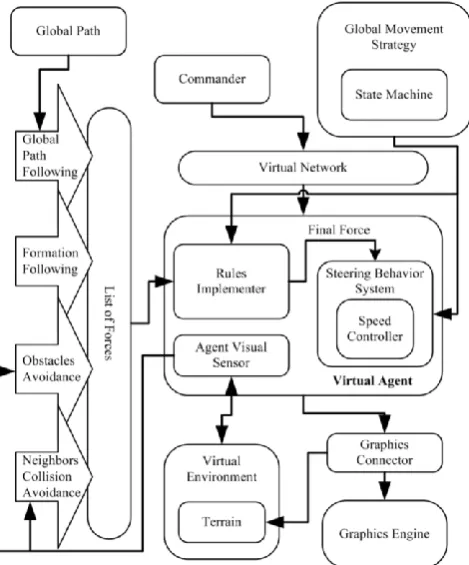
SIMULATION MODELINGAs we show in Fig. 1, which presents the flow of data that is used to simulate the group of tanks formed into hierarchical structure of the military standard. In real-life as well as in our system, the commander of operations inter the
global path on the passable area on the presented map while
he neglect the small detail like any obstacles that can be trees, buildings, big stones and rocks. The global path is created by selecting a sequence of multiple points on the grid-based map by commander. The line segments that connect these points will form the global path. We will call these connection points as checkpoints. These checkpoints are a 3D positions plotted on the terrain. The group of tanks will consider the sequence of these checkpoints as targets that will be reached sequentially one after the other. So the group will consider the first checkpoint in the global path as a current target that should be reached. When the group reaches the current target checkpoint, the next checkpoint will be the new target position that must be followed by the group. And that done until reached to the final checkpoint.
[image:3.595.51.286.488.771.2]There are many forces that applied on the group to achieve the desired intelligent movement of group. Global path following forces coordinate the group to move on the path while the multi-level hierarchy formation forces applied to make the group keeping its formation and be coherent, for more details about the formation see section [Formation]. Obstacle avoidance forces make the individual tank in the group move away from the obstacles that were not included during the global path creation. Obstacles are detected by virtual vision sensors that are attached to each tank agent. Tanks avoid the collision with each other by using the neighbor collision avoidance forces generated by using the virtual vision sensors. The virtual agents that coordinate the movements of tanks use a pre-defined rule-based approach to select or mix the appropriate forces according to the current situation to pass forces to vehicle steering system to generate the tanks motions.
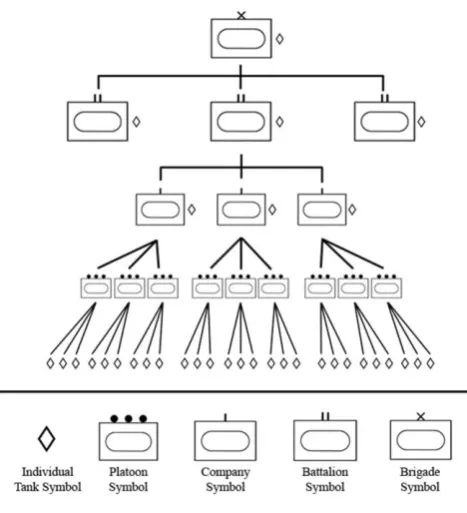
Commander tank agents can send orders to individual tanks through a virtualized network that is structured in a hierarchical topology that follows the structure in Fig. 2. This topology forces the flow of commands to be directed to specific agent(s). Also it allow individual tank agent to communicate with its leader without conflicting with other leaders.
The group of tanks is coordinated by the global
movement strategy which controls the type of the current
movement methodology. This global movement strategy describes the behavior of the group movement by changing the formation and the style of movement which is achieved by converting the global goals and internal targets for each agent. These movement strategies are controlled by a finite state machine [18]. Vehicle steering behavior system receives the final force vector after applying the rules of intelligent movement like following formation and avoiding collision with obstacles and neighbors. This vector is used to generate the final velocity of the tank using the steering behavior introduced by Reynolds [4], [19], [20]. We choose
to use and adapt the steering behavior as it has a good performance for computing physically-based model of a simple moving vehicle. Finally this approach generates the new orientation of the tank which is used to update the position in real-time loop. At the last stage in our simulation we adapt the orientation of the tanks on the terrain topography and then link the result data with the 3D graphics engine to visualize the result.
A. Hierarchical Structure
To map the hierarchical structure of the military to be as shown in figure we create a tree data structure called ternary tree. The ternary tree contains exactly three child nodes for all nodes in the tree. This tree helps us to map the presented military model which involves three subordinates for each commander at each level. We use nodes to encapsulate the adjacent individual tank in the brigade, the formation of the subordinates and the target position that should be followed by the tank to achieve its goal and following the formation, see section [Formation]. The edges in the tree force the group to be organized and subdivided into sub-groups to follow the hierarchical structure while determining the virtualized network topology to be used to carry the order messages from leaders to the subordinates. This model allows controlling the sub-groups behaviors directly by sending a direct message to node which encapsulate the sub-group leader and then broadcast the order message to subordinates respectively.
B. Hierarchical Behavior
Our model supports multi-level of group controlling by using a group controlling agent to control the whole group,
multi-level sub-groups, and the individual tanks. Whole group is controlled by distributing the global movement
strategy to all tanks. The sub-groups are controlled to
change the movement direction, speed, and status from moving to stopping. It also can split to move as a separate group following another specific goal while keeping the group coherent. That is done after receiving an order from its commander. At the end, the individual tanks execute the
global movement strategy by using the steering behavior [4]
with individual goal that form the global movement strategy. Also individual tank use the attached rules to automatically avoid the collision with obstacle and neighbor tanks while keeping the formation and coherent.
IV.
GROUP MOVEMENTWe define the group based on Musse and Thalmann definition [1] as a collection of similar entities that behave coherently to achieve a common goal in the same virtualized environment. We consider the army as a large group composed of a hierarchical tree structure as shown in Fig. 2. In our model we simulate the movements of group of tanks collected as a full brigade. The movement of the tanks can be split into three types. The first type of tank movements is for transportation, used when a group of tanks needs to move from current position to another target position without any enemy engagement. In this case the group moves in queue formation following his leader. The second type of movements occurs when the group change its status from queue formation to opening by spreading and each tank tries to move toward specific direction to become in a fighting formation and this is done down through each level within the hierarchy in the group through many sup-phases. The last movement type is the movement for engagement. In this situation the group moves in a multi-level hierarchical formation that allows individual tanks to better engage with the enemy in different formations according to the combat situation.
A. Transportation Movement
As we mentioned before, we need the transportation movement to move a group from one place to another. That happens without engagement at any combat. In this type of
global movement strategy the tanks are queued into line
formation to move on the global path. Each tank in the platoon group considers the front unit as a target to follow, while keeping a pre-configured distance between them. At the next level of the hierarchy, the first tank in the company group tries to keep the specific distance from the last front tank in the front company. This is repeated in each level in the battalion and brigade.
Each agent in the group uses the following rule to keep the fixed distance between each other. This rule forces the agent to slow down its speed when the distance between the tank and front tank is less than the pre-defined specific distance and increase the speed when the distance becomes larger than the specific distance.
B. Opening and Spreading Movement
[image:4.595.55.289.77.334.2]This type of movement represents the transition phase between the transportation movements and the engagement movements. In these strategic movements the hierarchical
Fig. 2 Hierarchy structure of brigade.
A Platoon is composed of three tanks, a Company is composed of three platoons plus the company’s leader (10 Tanks), a Battalion is composed of three companies plus the battalion’s leader (31 Tanks), finally a Brigade is composed of three battalions plus the brigade’s leader (94 Tanks).based on NATO symbols [22].
sub-groups will split and change their directions through many phases to achieve the final desired formation and be ready to engage in combat according to specific situation. Each stage bounded by two opening lines: lines perpendicular to the global path. The first opening line determines the position and the group level in the hierarchy that should be starting to split, changing the direction of its sub-groups. The second opening line contains the target positions that should be followed by the divided groups. These target positions follow the desired final formation of the brigade. This formation leads to setting the target positions to the final opening line. Group splitting follows the following strategy: the brigade is divided into three battalions while each battalion moves toward a specific direction. The same operation occurs sequentially with each sub-group starting form battalions, companies, platoons and ending with individual tanks. To achieve this movement behavior, each tank leader starts to change his direction by following the new target on the second opening line in his stage. The rest of the tanks belonging to its group follow their leader in the queue formation with the same movement behavior as described in the transportation movement section.
C. Engaging Movement
In this strategic movement, the group of tanks is moving in a specific formation that is distributed through multi-level hierarchy structure. Tanks try to follow the global path while it keeps its formations. In all three types of movements the individual units rely on internal rules to avoid collision with obstacles and neighbors while following
the global path and keep the coherence of the group.
V. FORMATIONS
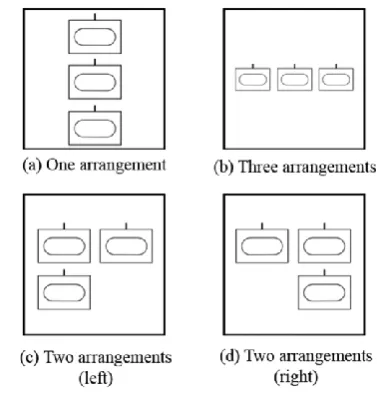
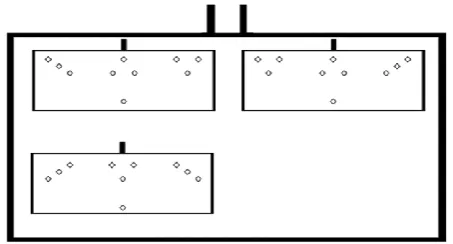
As mentioned earlier, the formation of the units is crucial for military movements. It is used for achieving tactical goals during engagement by increasing the effectiveness of fighting units. Our model supports the formation through the hierarchical multi-level structure. This means that formation is composed of sub-formations, and the sub-formations are composed of other sub-formation as shown in Fig. 5.There are many types of formation at every level in the hierarchy of military structure. The platoon formation can be arranged in six types of formations, as shown in Fig. 3. At the
battalion level there are three types as we can see in Fig. 4. Fig. 5, shows a battalion formation composed of two arrangement types while each company in the battalion is composed of three platoons. The top left company in Fig. 5, shows the three platoons formed from left to right into right flank, wedge, and vee formations.
Our approach to keep the formation during movement is inspired from the carrot and stick principle. In our model there are target formation points organized into the form of desired formations of the whole group and sub-groups. All of this target formation points will move along the global path and the tanks will try to follow this points. Every tank will be attached to specific target point within its group formation.
This technique supports the dynamic switching between any types of formation without the need of extra logic, e.g. as when we change the formation of any group which leads to changing the corresponding target formation points which in turn leads the tanks to follow the new position of target
formation points.
We solved the problem of crossing through narrow area by adding two wing sensors for detecting the obstacles at the left and right edges of the platoon. When both sensors detect forward obstacles at the same time, the platoon will change its formation to line formation and use the same technique in the transportation movement to be queued while moving, as shown in Fig. 6. After the platoon passes from the narrow area it returns back to its original formation again. This technique ensures the passing between any obstacles and avoids neighbors from collision while the motion is very natural.
A. Formation Creation
[image:5.595.324.513.572.770.2]To create the desired formation the user must provide the target formation for each group at each level through the hierarchy. Then each tank at each group will be assigned to only one target formation point. We use a ternary tree data structure to set the target formation point positions. That is done by traversing the tree breadth first and at each node the algorithm reads the current node formation and assigns the relative positions for target formation points to the children nodes.
Fig. 3 Some platoon formations.
B. Formation and Coherence keeping
Every tank has a three speed state (normal speed, maximum speed, and minimum speed).We use a rule-based behavior that is built in our code to maintain the cohesion and formation of the group during movements, and forcing each tank to follow its target formation point. Then using the following rules is that if the tank becomes too close or too far from its target formation point, due to imposed situation, the rules tries to decrease or increase the speed, using variable threshold acceleration, but always respecting the minimum and maximum defined speeds of the specific tank type.
VI. CONCLUSION AND FUTURE WORK
We presented a model to simulate in real-time the movements of group of military vehicles (tanks) using rule-based multi-agent system, which is suited to model the behavior of the group and make the movements more natural in 3D virtual environment. Our model is mixing the
global path following with local steering behavior to
achieve final group movement. Another contribution of our work is the modeling of multi-level hierarchical structure and the distribution of intelligent movement behavior and formation conservation through this structure while keeping the coherence of groups. Our model supports dynamic switching between formations according to strategic situations, while avoiding collision with neighbor units and obstacles. We investigate the simulation of group movement through three types of global movement strategies: transporting, spreading, and engaging movements of the
group.
For future work, we plan to enhance the performance through parallel implementation of our algorithms.
ACKNOWLEDGMENT
The authors are grateful to Mohammed Mamdouh and Eid Samy for valuable help and to the anonymous reviewers for constructive criticism.
REFERENCES
[1] S. R. Musse, and D. Thalmann, “Hierarchical model for real time simulation of virtual human crowds”, IEEE Trans. Visual Comput. Graphics, vol. 7, no. 2, pp. 152 – 164, Apr. 2001.
[2] A. Boccardo, R. D. Chiara, and V. Scarano, “Massive battle: coordinated movement of autonomous agents”, CASA Workshop on
3D Advanced Media in Gaming and Simulation, Amsterdam and
Netherlands, Jun. 2009, pp. 40–47.
[3] C. W. Reynolds, “Flocks, herds and schools - a distributed behavioral model”, Proc. 14th annu. Conf. on Computer graphics and interactive
techniques, New York, USA, Jul. 1987, pp. 25–34.
[4] C. W. Reynolds, “Steering behaviors for autonomous characters”,
Proc. of Game Developers Conference, California, USA, 1999, pp.
763–782.
[5] C. W. Reynolds, “Big fast crowds on PS3”, Proc. 2006 ACM
SIGGRAPH symposium on Videogames, New York, USA, pp. 113–
121.
[6] W. T. Reeves, “Particle Systems-A Technique for Modeling a Class of Fuzzy Objects”, ACM Trans. on Graph. (TOG) Proc. ACM
SIGGRAPH 1983, vol. 2, no. 2, pp. 359-376.
[7] R. L. Hughes, “The flow of human crowds”, Annu. Rev. Fluid Mech., vol. 35, pp. 169–182, Jan. 2003.
[8] A. Treuille, S. Cooper, and Z. Popovi´c, “Continuum crowds”, ACM
Trans. on Graph. (TOG) Proc. ACM SIGGRAPH 2006, vol. 25, no. 3,
pp. 1160–1168.
[9] T. Li, and H. Chou, “Motion planning for a crowd of robots”, IEEE
Trans. Robot. Autom. , vol. 3, pp. 4215–4221, Nov. 2003.
[10] A. Kamphuis, and M. H. Overmars, “Finding paths for coherent groups using clearance”, Proc. 2004 ACM SIGGRAPH/Eurographics
Symp. on Comput. Animation, Aire-la-Ville, Switzerland, pp. 19–28.
[11] J. Go, T. Vu, and J. J. Kuffner, “Autonomous behaviors for interactive vehicle animations”, Proc. 2004 ACM
SIGGRAPH/Eurographics Symp .on Comput. Animation,
Aire-la-Ville, Switzerland, pp. 9–18.
[12] D. Pottinger, (1999, Jan.), Coordinated unit movement, Game Developer Magazine, pp. 42–51.
[13] D. Pottinger, (1999, Feb.), Implementing Coordinated Movement, Game Developer Magazine, pp. 48–58.
[14] T. Balch, and M. Hybinette, “social potentials for scalable multi-robot formations”, IEEE Int. Conf. Robotics and Automation, 2000 Proc. ICRA '00. , vol.1, pp. 73 – 80.
[15] M. Trevisan, M. A. P. Idiart, E. Prestes, and P. M. Engel, “Exploratory navigation based on dynamical boundary value problems”, J. Intell. Robot. Syst., vol.45, no. 2, Feb. 2006, pp. 101– 114.
[16] F. Dapper, E. Prestes, and L. P. Nedel, “Generating steering behaviors for virtual humanoids using BVP control”, Proc. Comput. Graph. Int.
(CGI), 2007, pp. 105-114.
[17] R. Silveira, E. Prestes, and L. P. Nedel, “Managing coherent groups”,
Comp. Anim. Virtual Worlds, vol. 19, no. 3-4, Aug. 2008, pp. 295-305.
[18] I. Millington, and J. Funge, “State machines”, in Artificial intelligence for games, 2nd ed. M, Burlington, Morgan Kaufmann, 2009, ch. 5, sec. 3, pp. 309–331.
[19] OpenSteer, [Online]. Available: http://opensteer.sourceforge.net/ [Accessed: Oct. 25, 2011].
[20] Opensteerdotnet. [Online]. Available: http://code.google.com/p/opensteerdotnet/ [Accessed: Oct. 25, 2011]. [21] J. Berg, S. Patil, J. Sewall, D. Manocha, and M. Lin, “Interactive
navigation of multiple agents in crowded environments”, SI3D’08
Proc. Symp. Interactive 3D Graph. and Games ACM, New York,
USA,2008, pp. 139-147,
[22] D.U. Thibault. (2005, Sep.). Commented APP-6A - Military symbols for land based systems NATO’s current military symbology standard. Defence R&D Canada – Valcartier. Canada. [Online]. Available:
[image:6.595.56.283.54.176.2]http://www.mapsymbs.com/APP-6ADRDCValcartierEdition121(Mod).pdf Fig. 5 Battalion multi-level hierarchical formations.
Fig. 6 Platoon passing through narrow area.