Ambiguous Noun Phrases in Logical Form
Mary P. Harper"
Purdue UniversityIn this paper, logical form representations for pronouns, singular definite noun phrases (NPs),
and singular indefinite NPs are developed. These representations allow decisions about the precise
meaning of a sentence to be postponed until the required information becomes available. Three
computational constraints for this logical form are proposed: compactness, modularity, and formal
consistency. Initially, NPs are represented using a composite representation for all allowable
meanings, conforming with the compactness constraint. This representation is provided using
only syntactic and sentence level information, consistent with the modularity constraint. When
an ambiguity can be resolved, the precise behavior is specified in a way compatible with the initial
representation, conforming with the formal consistency constraint. The scope of this approach is
demonstrated by using a wide variety of examples, and a computer implementation is described.
Related approaches are also discussed.
1. Introduction
A goal of natural language research is to provide a computer model capable of gen- erating an internal representation for the meaning of each sentence processed. The building of this representation can be approached in two ways.
The first approach requires the generation of an unambiguous internal representa- tion for each sentence before attempting to represent subsequent sentences. There are, however, several problems with this approach. First, the enumeration and testing of each possible reading of an ambiguous sentence to determine which is correct can re- quire significant computational resources. Second, an application may not require the precise meaning for a sentence; hence, determining a single meaning would be a waste of resources. Third, many times an ambiguous sentence cannot be disambiguated until information contained in subsequent sentences has been processed.
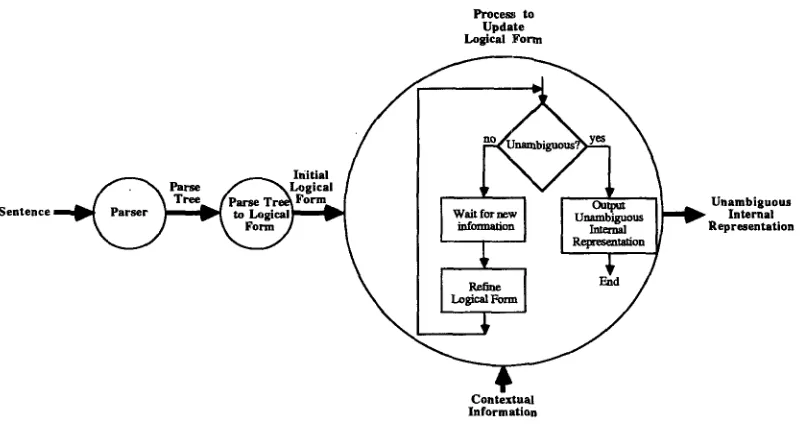
Another approach, the one adopted in this paper, is to use an intermediate rep- resentation called logical form (LF) (Schubert and Pelletier 1984; Allen 1987; Harper 1988) to avoid immediately committing to a single meaning of an ambiguous sentence. LF partially specifies the meaning of a sentence based on syntactic and sentence-level information, without considering the effects of pragmatics and context. This partial specification of meaning allows us to process additional sentences before further lim- iting the meaning of an ambiguous sentence. Later, as relevant information becomes available (from a context processing module), the intermediate representation of the ambiguous sentence can be incrementally updated. This process can continue until all of the ambiguities are resolved and an unambiguous internal representation of the sen- tence is generated (although this is not a requirement of the approach). The process of mapping a sentence to an unambiguous internal representation is shown in Figure 1. Because LF is a component of a computer model for language comprehension, it must be designed with two goals in mind. First, it should accurately model the
Computational Linguistics Volume 18, Number 4
/
SentenceProcet~ to
Update
Logical Forlm
d
Contextual
[image:2.468.41.441.53.268.2]Information
Figure 1
An architecture for language processing.
linguistic behavior of language. Second, it should be computationally tractable. In fact, we have defined three constraints for using LF in a computational framework (Harper 1988, 1990).
1. Compactness Constraint: The compactness constraint, which captures the spirit of LF as presented by Allen (1987), is important in a computer model of language comprehension because of the need to postpone decisions about ambiguity without large storage requirements. LF should compactly represent the underdetermined meaning of a
sentence--underdetermined in that ambiguities and anaphora are not resolved. Ideally, LF should only require polynomial (in the number of words in a sentence) space.
2, Modularity Constraint: The modularity constraint requires LF to be initially computable from syntax and local (sentence-level) semantics only. In particular, it should not be initially dependent on contextual information, which requires significantly more computational resources to extract.
Mary P. Harper Ambiguous Noun Phrases in Logical Form
In the next section, we describe how LF has been used to represent quantifier scope ambiguity and how this representation conforms to our computational constraints. Then, we introduce our LF representations for pronouns, singular definite NPs, and singular indefinite NPs, considering how to update each representation when new in- formation becomes available (though not how to determine that information). We also discuss an implementation that uses our representations and compare our approach with related work.
2. Quantifier Scope Ambiguity in Logical Form
Quantifier scope ambiguity has been handled by some researchers by using an inter- mediate scope-neutral LF (e.g., Hobbs 1983; Schubert and Pelletier 1984; Allen 1987) for the initial representation of sentences. Hence, sentences like
Someone loves everyone
are initially represented without committing to one particular meaning, as shown in Example 1.Example 1
Someone loves everyone.
Possible Meanings: 1. ~x VY (love x y) 2. Vy 3x (love x y) Scope-neutral Form: (love [3x x] [Vy y])
Initially, in scope-neutral LF, the quantifiers are stored in the predicate argument- structure with no scoping preference indicated, hence the representation does not commit to a specific meaning for the sentence; it is simply a compact w a y of express- ing the set of all possible readings. Another type of scope-neutral form initially gives universal quantifiers scope over all existentials. This solution provides a general read- ing that in many cases subsumes readings where the existential is outside of the scope of the universal. However, if we are to handle NPs containing pronouns and sentences with verb phrase ellipsis, this solution is inadequate.
An LF that avoids committing to a single meaning must be capable of being up- dated once information is available to limit the scoping possibilities. There are a variety of mechanisms for expressing scoping decisions. For example, Schubert and Pelletier (1984) indicate quantifier scoping by extracting and linearly ordering the quantifiers to the left of the predicate-argument structure. Allen (1987) indicates for each pair of quantifiers which one has scope over the other; a method that is not limited to a linear sequence of operators. Finally, Creaney and McTear (1990) use constraints to limit scope possibilities. Hintikka (1979) has noted that the linear ordering of quan- tifiers is not sufficient to capture all possible meanings of a sentence when four or more quantifiers occur in the sentence. Consider a sentence with four quantifiers, two universals and two existentials:
Every boyi wanted every girlj to introduce a friend of hisi
to a friend of hersj.
It should be possible forevery boy
to have scope overa friend of his,
without having scope overa friend of hers.
Similarly,every girl
could have scope over afriend of hers,
but nota friend of his.
There is no w a y to express this with a linear quan- tifier scoping string, but Allen and Creaney and McTear have no trouble indicating nonlinear scoping using their approaches.Computational Linguistics Volume 18, Number 4
a single meaning by separating the process of making a scoping decision from the pro- cess of constructing the initial representation for a sentence and its constituents (this separation is consistent with the modularity constraint). Later, when enough informa- tion becomes available to make a scoping decision, there are several different methods for indicating which quantifier has scope over the other. These modifications commit to one of the meanings encoded in the scope-neutral form and so are compatible with the formal consistency constraint.
There are other types of semantic ambiguities in addition to quantifier scope am- biguity that can be handled by using LE For example, the meanings of pronouns, sin- gular definite NPs, and singular indefinite NPs often cannot be determined without additional contextual information. Postponing decisions about the precise meanings of sentences containing these types of constituents could be extremely useful, as the following example illustrates: Every man showed a boy a picture of his mother. The precise meaning of the sentence cannot be specified until information is available to select the pronoun's antecedent and to determine the quantifier scoping. The pronoun his can have many different antecedents, including: every man, a boy, some entity introduced in other sentences, or some individual in the environment of the speaker or hearer. The meaning of his mother is ambiguous because it depends on the pronoun's antecedent. Also, a picture of his mother is ambiguous; its meaning cannot be determined until we determine the meaning of his mother and decide whether the universally quantified NP has scope over the indefinite. Notice that quantifier scoping decisions are affected by the choice of antecedent for his. If every man is the antecedent then it must have scope over a picture of his.
3. Pronouns in Logical Form
Pronouns are a source of underspecification in a sentence: the antecedent of a pronoun cannot be determined using syntactic information alone, but requires a combination of syntactic, semantic, and contextual information. We divide the process of determin- ing the meaning of a pronoun into two phases. First, we provide the pronoun's LF, using only syntactic and sentence-level information. This LF constrains the possible antecedents to be those NPs that are consistent with this local information. The LF is also a flag indicating that the sentence is underspecified because more than one antecedent for the pronoun is possible. Later, when the antecedent is determined, a task that often requires contextual information found in surrounding sentences, we provide a w a y to update our LF to include this information.
In the rest of this section, we discuss the linguistic behaviors of pronouns we want to model, introduce their LF representation, discuss how that representation is updated once contextual information isolates antecedents for the pronouns, and describe how the approach models verb phrase ellipsis (VPE).
3.1 Pronouns: Linguistic Behavior
Pronouns either have linguistic antecedents or refer to salient objects in the environ- ment of the speaker or hearer (deictic use). Pronouns with linguistic antecedents can be categorized in two ways: either their antecedents occur in the same sentence (in- trasentential reference 1) or in other sentences (intersentential reference).
Mary P. Harper Ambiguous Noun Phrases in Logical Form
W h e n a p r o n o u n ' s intrasentential a n t e c e d e n t is a u n i v e r s a l NP, that p r o n o u n takes on the b e h a v i o r of the u n i v e r s a l ' s variable. C o n s i d e r the sentence Fred showed every girl her picture. G i v e n that the a n t e c e d e n t for her is every girl, the p r o n o u n a d o p t s the b e h a v i o r of a variable b o u n d b y the u n i v e r s a l quantifier of its antecedent, as s h o w n in E x a m p l e 2.
Example 2
F r e d / s h o w e d e v e r y girly herj picture. Vx (if (girl x) ( s h o w Fred (x's picture) x))
In contrast, if a p r o n o u n h a s an intersentential antecedent, t h e n that p r o n o u n c a n n o t act like a b o u n d variable, since quantifiers do not h a v e s c o p e across sentences in English. C o n s i d e r the following t w o sentences: Fred likes everyone. But, he doesn't return the sentiment. The p r o n o u n in the second sentence c a n n o t be b o u n d b y the quantifier c o r r e s p o n d i n g to everyone in the first sentence. H o w e v e r , a quantified N P in one sentence can be the a n t e c e d e n t for a p r o n o u n in a n o t h e r sentence, as in Fred likes everyone. But, they don't return the sentiment. In this case, they a d o p t s the discourse entity for the g r o u p of i n d i v i d u a l s that everyone quantifies over. W e b b e r (1978) discusses h o w to construct discourse entities for n o n a n a p h o r i c N P s in a sentence (both for quantified N P s a n d definite N P s that are quantified over) once that sentence h a s b e e n d i s a m b i g u a t e d . A discourse entity is a d e s i g n a t o r for the entity or set of entities the N P e v o k e s in the discourse m o d e l of the s p e a k e r or hearer. If an N P in o n e sentence is the a n t e c e d e n t for a p r o n o u n in another, the p r o n o u n is replaced w i t h the a n t e c e d e n t ' s discourse entity.
P r o n o u n s h a v e also b e e n classified as b o u n d v a r i a b l e p r o n o u n s or referential pro- nouns. The a n t e c e d e n t for a b o u n d variable p r o n o u n occurs in the s a m e sentence as the p r o n o u n a n d the m e a n i n g of the p r o n o u n is r e p r e s e n t e d as a variable b o u n d b y the o p e r a t o r associated w i t h its antecedent. In contrast, the m e a n i n g of a ref- erential p r o n o u n is the discourse entity e v o k e d b y its antecedent. The b o u n d ver- sus referential d i c h o t o m y d i v i d e s the w o r l d of p r o n o u n s differently t h a n d o e s the i n t r a s e n t e n t i a l - i n t e r s e n t e n t i a l dichotomy. P r o n o u n s w i t h intersentential a n t e c e d e n t s are typically referential. 2 H o w e v e r , p r o n o u n s w i t h intrasentential a n t e c e d e n t s can be b o u n d or referential (Webber 1978; Reinhart 1983).
The b o u n d - r e f e r e n t i a l d i c h o t o m y d o e s n ' t c o v e r the entire r a n g e of b e h a v i o r s possi- ble for p r o n o u n s . There is a n o t h e r c a t e g o r y of p r o n o u n that E v a n s (1980) d u b s E-type pronouns a n d that a p p e a r s to be a b o u n d variable, b u t on closer inspection is not. D o n k e y sentences (originally noticed b y G e a c h [1962]) can be u s e d to d e m o n s t r a t e this difficulty, for example: Every miner who owns a donkey beats it. G i v e n that every miner
has scope o v e r a donkey, the indefinite c a n n o t be referential a n d the existential o p e r a - tor is b l o c k e d f r o m b i n d i n g the p r o n o u n b e c a u s e of the scope island; quantified N P s e m b e d d e d in a relative clause a t t a c h e d to an N P c a n n o t b i n d p r o n o u n s outside of the relative clause e n v i r o n m e n t . 3 H o w e v e r , a donkey can be the a n t e c e d e n t for the p r o n o u n .
2 The only exception are pronouns like those in paycheck sentences (first noticed by Kartunnen [1969]). Consider the sentence Fred gave his paycheck to his wife. George gave it to his mistress. The pronoun it is not referential. For that matter, it is not bound. The pronoun seems to take his paycheck as its antecedent where the pronoun is instantiated to a different individual than in the original sentence.
Computational Linguistics Volume 18, Number 4
Donkey sentences provide evidence that all of the following cannot be simultaneously true (adapted from Heim [1982, p. 102]).
1. Indefinites should be represented using existential quantifiers.
2. Indefinites obey the same scope-island restriction as universals.
3. Pronouns are either bound variables or referential.
Many researchers have attacked one or more of these assumptions, but we prefer to modify the third by adding an additional type of pronoun: pronouns that adopt the functional behavior of their antecedents. The first two assumptions, together with our modification of the third, allows us to build a simpler LF for a sentence and also handle donkey sentences (as described in Section 5.2).
Pronouns are a source of ambiguity in verb phrase ellipsis (VPE). To signal a VPE, a full verb phrase (VP) is replaced with an auxiliary, as in the second sentence of Example 3. A sentence with VPE is called an elided sentence. The index on Fred and
his indicates that they are co-referential.
Example 3 Trigger Sentence: Elided Sentence: Possible Meanings:
Fred/loves his/wife. Georgej does too.
1. George loves Fred's wife. (strict meaning) 2. George loves George's wife. (sloppy meaning)
The elided sentence has little meaning independent of the first sentence, called a trigger sentence. Hence, before determining the meaning of the elided sentence, the meaning of the trigger sentence must be completely determined. Even though the antecedent of the pronoun in the trigger sentence is Fred, the meaning of that pronoun is still ambiguous because pronouns in a trigger VP can refer to a subject NP either directly or indirectly. This example indicates that care is needed to design a pronoun representation capable of handling VPE since the representation must be compatible with the two behaviors of a pronoun whose antecedent is the syntactic subject of a trigger sentence. It also demonstrates how the meaning assigned to the trigger VP limits the possible meanings of the elided sentence. Though the meaning of the elided sentence is ambiguous, it cannot mean George loves some other person's wife (other than Fred's or George's).
3.2 Pronouns: The Initial Representation
Mary P. Harper Ambiguous Noun Phrases in Logical Form
Example 4
a. Sentence: Every man is happy. Representation: Vx: (man x) (happy x) Meaning: Vx (if (man x) (happy x)) b. Sentence: A man is happy.
Representation: 3x: (man x) (happy x) Meaning: 3x (and (man x) (happy x))
Quantifier scoping is handled in the same w a y as in Section 2. Initially, quantifiers are placed in the predicate-argument structure for the sentence, except for subjects, which are necessarily abstracted. Abstraction of a quantified subject does not imply that it must have scope over quantifiers placed in the lambda function corresponding to the VP. Later, when information becomes available for making scoping decisions, quantifier scoping is indicated using a method similar to Allen's (1987) (described in Section 5.2). Possessive NPs are represented as functions of the possessive nouns (fol- lowing Webber [1978]) and proper nouns as skolem constants (i.e., skolem functions without arguments). These representations will be replaced with a general represen- tation for definite NPs in Section 4.
The LF representation for a pronoun must be compatible with our computational constraints. To be consistent with the modularity constraint, a pronoun's representation must be generated without utilizing the contextual information needed to select its antecedent. To obey the compactness and formal consistency constraints, a pronoun must be represented using a single representation that is consistent with the ways the pronoun can act given its position in a sentence. To conform with these constraints, we represent a pronoun as a pronoun function in LE This representation of pronouns is similar in spirit to the representation of pronouns as unique skolem constants in Charniak and McDermott (1985). Their representation allows the construction of basic logical structure of the sentence to precede pronoun resolution, a division consistent with our compactness and modularity constraints. However, because a constant is incompatible with a variable, their pronoun representation is incompatible with a bound variable meaning.
A pronoun function is a composite representation reminiscent of a skolem function. Its role is to limit the range of possible antecedents for the pronoun without committing to one in particular. Each pronoun function is assigned a unique name (supplied by adding a unique number to the pronoun to distinguish it from other pronouns), and its argument list is specified using only syntax and sentence-level semantics to avoid violating the modularity constraint.
A pronoun should be represented as a function of all the variables corresponding to quantified NPs that can affect its meaning (because they are representations for pos- sible antecedents or can affect the meanings of other nonquantified antecedents such as definite NPs). By concentrating on variables of possible antecedents, we automatically include those variables that affect potential nonquantified antecedents. The argument list should also contain the variables of lambda operators that have scope over the position that the pronoun function fills in LF (in order to allow sloppy readings of elided sentences).
To provide an algorithm for automatically generating the LF for a pronoun, we must develop a mechanism for specifying its argument list. This mechanism should not automatically assign all of the variables associated with quantified NPs in the sentence to the argument list of a pronoun function because, in English, some quantified NPs are syntactically incompatible antecedents for the pronoun. Consider, for example,
Computational Linguistics Volume 18, Number 4
S1
NP1
Det
I
EveryNoun $2
man NP2 VP
I
who Verb N'P'3
A
I
F",.
saw Det Noun
I
1
every boy VP
V~rb NP4
kicked Det Noun
I
I
his dog
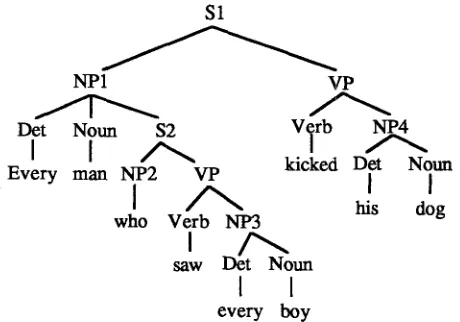
Figure 2
Parse tree for Every man who saw every boy kicked his dog.
w h i c h N P s can bind a p r o n o u n in a sentence, w e a d a p t Reinhart's (1983) c - c o m m a n d (or constituent-command), w h i c h is a relation o n n o d e s in the sentence's parse tree.
N o d e A c(constituent)-commands n o d e B iff the b r a n c h i n g n o d e ~1 most i m m e d i a t e l y d o m i n a t i n g A either d o m i n a t e s B or is i m m e d i a t e l y d o m i n a t e d b y a n o d e a2 w h i c h d o m i n a t e s B, and a2 is of the same category type as al. (Reinhart 1983, p. 23)
To illustrate the concept of c - c o m m a n d , consider the parse tree for the sentence in Example 5, s h o w n in Figure 2.
Example 5
E v e r y m a n w h o saw e v e r y b o y kicked his dog.
In Figure 2, NP1 c - c o m m a n d s his, b u t NP2 a n d NP3 d o not. Reinhart claims that a p r o n o u n can be b o u n d b y an N P if a n d only if the N P c - c o m m a n d s the p r o n o u n . Hence, every man who saw every boy can b i n d his, b u t every boy cannot.
C - c o m m a n d is v e r y useful for ruling out incorrect antecedents for p r o n o u n s , as illustrated b y E x a m p l e 5. Unfortunately, it also m a k e s some incorrect predictions. For example, it does not allow every man's to bind him in Every man's mother loves him or each candidate to bind him in A friend of each candidate supported him, e v e n t h o u g h the universal variables p r o v i d e reasonable m e a n i n g s for the p r o n o u n s . The difference b e t w e e n Example 5 a n d the p r e v i o u s two sentences is that in 5 the quantified N P in question is contained in a relative clause attached to an NP, w h e r e a s in the o t h e r two sentences they are not. A quantified N P is p r e v e n t e d f r o m b i n d i n g a n y p r o n o u n outside of the clause e v e n t h o u g h the N P containing it c - c o m m a n d s the p r o n o u n . Hence, w e a d a p t Reinhart's b i n d i n g rule 4 to allow quantified N P s to bind a p r o n o u n if they c - c o m m a n d the p r o n o u n or are e m b e d d e d in a n o t h e r c - c o m m a n d i n g N P b u t not contained in a relative clause.
[image:8.468.127.357.57.218.2]Mary P. Harper Ambiguous Noun Phrases in Logical Form
Armed with this syntactic rule for determining which quantified NPs can have an impact on the meaning of a pronoun, we can now specify a pronoun's representation. A pronoun is represented as a uniquely named function of all the variables corresponding to operators that can have scope over it. These operators include:
• any lambda operator that has scope over the pronoun function in LF,
• any nonsubject quantified variable corresponding to an NP that can bind the pronoun given our modification of Reinhart's binding rule.
Because a quantified subject's variable is abstracted by the sentence's lambda opera- tor, the lambda variable subsumes the quantified variable as the only subject-related variable required in the argument list. The lambda variable makes available both the direct quantified variable meaning as well as the indirect lambda variable meaning since we can choose to apply the quantified variable or not, depending on our need.
Now that the initial representation for pronouns has been specified, consider a series of examples, beginning with Example 6 :
Example 6
Fred loves himself.
Fred22, A(x)(love x (himselfl x))
The subject
Fred
is represented as the skolem constantFred22
and the VP as the lambda function,&(x)(love x (himself1 x)).
To create a representation for the entire sentence, we apply the subject to the lambda function; this is indicated by placing the subject to the left of the function. Though it is more traditional to apply the term to the right of the function, we chose this method to make it easier to see the correspondence between the sentence and its representation (following Sag [1976]). The logical subject fills the first slot after the predicate in the VP and the logical object fills the second. Since the sentence in Example 6 contains no universal or indefinite NPs,himself
is represented simply as a pronoun function of the lambda variable x. And as we mentioned previ- ously, the name of this function is created by concatenating a unique integer onto the end of the pronoun string (i.e.,himselfl).
In the next example, the representation of the pronoun is affected by universal and indefinite NPs in the sentence.
Example 7
Every man showed a boy his picture.
Vx: (man x) x, My)(show y (picture-of (his2 y z)) [3z: (boy z) z])
The syntactic subject of the sentence is universally quantified, the indirect object is existentially quantified, and the logical direct object
his picture
is represented as a function of the pronoun. As discussed above, the subject's lambda variable subsumes the universal variable; hencehis
is represented as a function of the subject's lambda variable plus the existential variable fora boy.
The reader should note that there is no order implied by quantifiers in our LF (following Allen [1987]) and so the quantifiers can be ordered in two different ways to provide two possible final meanings for the sentence.Computational Linguistics Volume 18, Number 4
Example 8
Fred believes he must speak to every woman.
Fred22, )~(x)(believe x [(he1 x), )~(z)(speak z (to [Vy: (woman y) y]))])
Although this sentence contains a universal NP, he is represented as a p r o n o u n function of the lambda variable x alone. The p r o n o u n function's a r g u m e n t list does not include the variable y because every woman neither c-commands nor is e m b e d d e d in an NP that c-commands the pronoun.
Finally, consider a sentence containing only p r o n o u n s a n d definite NPs.
Example 9
Fred s h o w e d his mother her picture.
Fred22, Mx)(show x (picture-of (her1 x)) (mother-of (his2 x)))
Both of the pronouns are represented as functions of the lambda variable x.
3.3 Pronouns: Updating Logical Form
W h e n a p r o n o u n ' s antecedent is k n o w n , 5 the LF containing it m u s t be u p d a t e d in a w a y compatible with its initial representation (to conform with the formal consistency constraint). To a u g m e n t LF with antecedent information w i t h o u t creating an ill-formed LF (i.e., a LF with u n b o u n d variables), we assert equality statements in the lambda environment containing the p r o n o u n function and limit the types of updates allowed. A p r o n o u n function constrains its possible antecedents, a n d d e p e n d i n g on the type a n d location of its antecedent, the p r o n o u n function is equated with four different values.
Pronoun Update Cases:
1. If a universal or indefinite NP is the intrasentential antecedent for the pronoun, a n d its variable is an a r g u m e n t of the p r o n o u n function (or is abstracted by a lambda operator whose variable is an a r g u m e n t of the function), then equate the p r o n o u n function with that quantified variable.
2. If an N P represented as a function (i.e., a p r o n o u n or definite) is the intrasentential antecedent for a pronoun, a n d its a r g u m e n t list is compatible with that of the p r o n o u n function (either immediately or after more is k n o w n about its meaning), then equate the p r o n o u n function with that function.
3. If a syntactic subject of a sentence is the intrasentential antecedent for the pronoun, and the lambda variable is an a r g u m e n t of the p r o n o u n function, then equate the p r o n o u n function with either the subject's lambda variable or some other value d e p e n d i n g on the subject's type.
4. If an NP in a different sentence or some nonlinguistic entity is the antecedent for the p r o n o u n (and it is compatible in n u m b e r and gender with the pronoun), then equate the p r o n o u n function with the discourse entity created for the antecedent.
Mary P. Harper Ambiguous Noun Phrases in Logical Form
Some updates to logical form must be postponed until more is known about the meaning of a possible antecedent (as we will show in Section 4.3.2).
Consider some examples of how LF is refined following pronoun resolution. Sup- pose, for example, that we decide that the antecedent for his, in Example 7, is a boy,
then the LF for the sentence is modified as follows:
Example 10
Every mani showed a boyj hisj picture.
Vx: (man x) x, A(y)(and (show y (picture-of (his2 y z)) [3z: (boy z) z]) (= (his2 y z) z))
Simplification:
Vx: (man x) x, A(y)(show y (picture-of z) [3z: (boy z) z])
To indicate that the antecedent for his is a boy, the pronoun function (his2 yz) is equated with the existentially quantified variable z (by pronoun update case 1). Notice that the equality statement is placed in the environment of the A(y) operator. If we had placed it outside of this environment, the variable y would have been unbound. The variable z is compatible with the pronoun's initial representation because we are limiting the function of y and z to be the identity function on z. Once the equality statement is asserted, we can simplify the LF as shown above. Notice that the meaning of the sentence is still underspecified since quantifier scoping has not been determined.
Next, consider how the representation in Example 6 is augmented, given that the antecedent for himself is the subject Fred.
Example
11Fred/loves himself/.
Fred22, A(x)(and (love x (himselh x))
(ora (= (himself1 x) x) (= (himself1 x) Fred22)))
The pronoun can refer to the subject either directly or indirectly, so its function is equated with Fred22 (by pronoun update case 2) or x (by case 3), respectively. Notice that we use Ora as a meta-or to annotate our logical form with multiple possible mean- ings for the pronoun (outside of the logical system for mapping to truth value, see Appendix A). No simplification of the LF is possible until one of the alternatives is chosen, but by using this device we can at least compactly represent the ambiguous ways that pronouns refer to syntactic subjects. In fact, if there are n pronouns whose antecedents are subjects, we can specify this ambiguity with O(n) updates, compared with providing 2 n different representations for the sentence. This allows us to more easily put off decisions about the pronoun's intended meaning until we process the required information, in contrast to an approach that uses an exponential amount of memory.
Finally, consider how the LF in Example 9 is updated given that Fred is the an- tecedent of his and his mother is the antecedent for her.
Example 12
Fred/showed (his/mother)j herj picture.
Fred22, A(x)(and (show x (picture-of (her1 x)) (mother-of (his2 x))) (ora (= (his2 x) x) (= (his2 x) Fred22))
Computational Linguistics Volume 18, Number 4
Possible Meanings:
1. Fred22, )~(x) (show x (picture-of (mother-of x)) (mother-of x))
2. Fred22, )~(x) (show x (picture-of (mother-of Fred22)) (mother-of Fred22))
Note that
(his2 x)
is equated withFred22
(by case 2) or x (by case 3) since it is compatible with those values. Also(her1 x)
is equated with(mother-of (his2 x))
(by case 2) since the functions are compatible.3.4 Pronouns and Verb Phrase Ellipsis
In this section, we discuss how to handle VPE, using Example 3 to illustrate our approach.
Example 3 Trigger Sentence: Elided Sentence: Possible Meanings:
Fred/loves his/wife. Georgej does too.
1. George loves Fred's wife. 2. George loves George's wife.
(strict meaning) (sloppy meaning)
The trigger sentence in Example 3 is initially represented as shown below.
Example 13
Fred loves his wife.
Fred22, ~(x)(love x (wife-of (his1 x)))
Because the meaning of an elided VP is constrained by the meaning of the trigger VP, the trigger's meaning must be fixed before we provide the meaning of the elided VP. In particular, we must locate the antecedent for
his;
otherwise, the final meaning of the pronoun function in the trigger cannot limit the meaning of the pronoun in the elided sentence. Given that the antecedent forhis
isFred,
we augment the LF as shown in 14.Example 14
Fred/loves hisi wife.
Fred22, )~(x)(and (love x (wife-of (his1 x)))
(ora (-- (his1 x) x) (= (his1 x) Fred22)))
The initial representation for the elided sentence from Example 3 contains a place holder for the missing VP, as shown below.
Example 15 George does too.
George35, )~(y)(Dummy2 y)
To determine the intended meaning of the elided sentence, we must locate the trigger sentence, select a single meaning for that sentence, and replace the d u m m y lambda function with the lambda function representing the trigger VP. The trigger sentence's VP, shown in Example 14, contains a meta-or of equality statements signalling an ambiguity in the pronoun's meaning; hence, before providing the meaning of the elided VP, we must select a single meaning for the pronoun.
Mary P. Harper Ambiguous Noun Phrases in Logical Form
subject of the trigger sentence, the first disjunct in 14 is selected. This choice provides the sloppy reading of the elided sentence, as shown below.
Example 16
Trigger Sentence Representation:
Fred22, ;~(x)(and (love x (wife-of (his1 x))) (= (his1 x) x)) Elided Sentence Representation:
George35, ~(x)(and (love x (wife-of (his1 x))) (= (his1 x) x))
On the other hand, if the pronoun his refers directly to Fred, the second disjunct is chosen, giving the strict reading of the elided sentence.
Example 17
Trigger Sentence Representation:
Fred22, ;~(x)(and (love x (wife-of (hiSl x))) (= (his1 x) Fred22)) Elided Sentence Representation:
George35, ;~(x)(and (love x (wife-of (his1 x))) (-- (his1 x) Fred22))
There is no way to determine whether a particular sentence will be a trigger sentence until an elided sentence is processed, so all sentences are treated as poten- tial trigger sentences. Later, when an elided sentence is detected, its trigger sentence must be located and disambiguated. Contextual information is needed to select trigger sentences, to choose antecedents for pronouns, and to select a single meaning for a pronoun function whose antecedent is a syntactic subject.
We have described our LF representation of pronouns, which allows us to model pronoun behaviors both in normal use and in VPE and is compatible with our com- putational constraints. Next, we discuss the LF for singular definite NPs, which is slightly more complex than the logical form for pronouns.
4. Singular Definite NPs in LF
In this section, we develop an LF representation for singular definite NPs. As with pronouns, we wish to obey our computational constraints while providing a model of definite behavior. First, we discuss the behaviors we wish to model.
4.1 Definites: Linguistic Behavior
Like pronouns, definite NPs can be anaphoric. Anaphoric definites either depend on linguistic antecedents or denote salient individuals in the environment of the speaker/hearer. An anaphoric definite's antecedent can be found in previous sentences as in Fredi saw (hisi cat)j. The catj was chasing a mouse, or within the same sentence as in Every boyi who loves (hisi cat)j takes care of the animalj. In the first example, the antecedent for the cat is his cat, found in the previous sentence, hence, the cat adopts the discourse entity assigned to his cat. In the second, the animal cannot take a discourse entity as its meaning because its antecedent is his cat, which does not denote a particular cat.
Computational Linguistics Volume 18, Number 4
boy
is the a n t e c e d e n t forhis,
then the universal quantifier c o r r e s p o n d i n g toevery boy
distributes o v e r
his mother.
W h e n a quantifier distributes o v e r a definite, the definite d e n o t e s different entities d e p e n d i n g on the values assigned to the quantified variable. A n y p r o n o u n e m b e d d e d in a definite N P can affect the definite's meaning: a possessive p r o n o u n , one contained in a prepositional p h r a s e (PP), or one contained in a relative clause attached to the definite.A quantified possessive in a definite N P always distributes o v e r the NP, p r e v e n t i n g it from acting like a constant, as in
Every man's mother loves him.
It can also bind a n y p r o n o u n s the definite N P c-commands. Quantified NPs contained in a PP attached to a definite N P can also distribute o v e r the definite, as inThe head of every public authority in
New York is rich,
t h o u g h the m e a n i n g of the definite N P is ambiguous. If the universal distributes o v e rthe head of every public authority in New York,
then its d e n o t a t i o n d e p e n d s on w h i c h public a u t h o r i t y is considered. But if the universal does not distribute o v e r the definite, then there is one particular p e r s o n w h o heads all of the public authorities. O u r initial representation m u s t be compatible w i t h either possibility.N o t all e m b e d d e d quantified N P s can distribute o v e r a definite. Quantified NPs e m b e d d e d in relative clauses attached to a definite N P are unable to distribute o v e r the definite. This constraint prevents
every boy
from quantifying overthe child who cares
for every man,
so the definite can only d e n o t e one particular child. Universal NPs that cannot distribute o v e r a definite N P are also unable to bind a p r o n o u n outside that phrase, as n o t e d b y M a y (1985) and Roberts (1987).We m u s t also consider the b e h a v i o r of definite N P s in VPE. The m e a n i n g of a definite N P is a m b i g u o u s w h e n e v e r it contains a p r o n o u n w h o s e a n t e c e d e n t is the subject of the sentence, 6 as in the following example.
Example 18
The p o s t m a n / s a w hisi dog. The policemanj did too.
Possible Meanings: 1. The policeman saw the p o s t m a n ' s dog. 2. The p o l i c e m a n saw his o w n dog.
(strict reading) (sloppy reading)
We m u s t also p r o v i d e a g o o d representation for a definite subject, one that will ac- c o u n t for the differences b e t w e e n universal and definite subjects in VPE (compare Example 19 with 18).
Example 19
E v e r y p o s t m a n / s a w hisi dog. E v e r y policemanj did too.
Possible Meanings: E v e r y policeman saw his o w n dog. (sloppy r e a d i n g only)
Universal quantifiers cannot bind across sentences, so the only possible m e a n i n g for the elided sentence in 19 is the s l o p p y one. H o w e v e r , definite subjects s u p p o r t b o t h s l o p p y a n d strict m e a n i n g s (as s h o w n in 18). If w e choose a quantified variable to represent a definite subject, w e w o u l d have to allow its quantifier to bind across sentences.
The m e a n i n g of a definite N P is affected b y its structure a n d the m e a n i n g s of e m b e d d e d NPs, as well as its potential a n a p h o r i c use. In the r e m a i n d e r of this sec- tion, w e introduce o u r LF representation for definites, describe w a y s to u p d a t e this
Mary P. Harper Ambiguous Noun Phrases in Logical Form
representation once a m b i g u i t y is resolved, and discuss h o w the representation is used in VPE.
4.2 Definite NPs: An Initial Representation
We represent definite N P s as functions of all of the variables that can affect their meanings. This representation satisfies o u r constraints b y combining the a d v a n t a g e s of definite descriptions (Russell 1971) (discussed in Section 7.2.1) with the functional no- tation w e i n t r o d u c e d to represent pronouns. A definite function is assigned a u n i q u e n a m e (i.e., def with a u n i q u e integer subscript) to distinguish two occurrences of the same definite NP, has a restriction consisting of a single predicate or a conjunction of predicates d e r i v e d from information contained in the NP, and has a (possibly e m p t y ) list of a r g u m e n t s containing:
• a n y variables associated with l a m b d a operators that have scope over it,
• a n y variables associated with nonsubject quantified NPs that could bind a p r o n o u n in that position,
• a n y quantified variables associated with e m b e d d e d quantified N P s that are not also e m b e d d e d in a relative clause. 7
To illustrate o u r representation for definite NPs, consider the initial representation of the following sentence.
Example 20
E v e r y m a n s h o w e d a b o y his picture.
Vx: (man x) x, My)(show y ((defl y z) I (and (picture (defl y z))
(possess (his2 y z) (defl y z)))) [3z: (boy z) z])
This representation is v e r y similar to Example 7 except for the definite NP, his picture,
which is represented as the function (defl y z). The definite function's a r g u m e n t list consists of the variables y and z, just like the p r o n o u n his. As in the representation of p r o n o u n s , w e omit the variable x from the a r g u m e n t list because the l a m b d a o p e r a t o r for y abstracts x, so y is the m o r e general argument. A n y t h i n g that affects the m e a n i n g of the p r o n o u n also affects the m e a n i n g of the definite. The function's restriction is the conjunction of statements following the vertical bar. The vertical bar in the function serves two purposes: it is used to distinguish the function's definition (on the left) from references to it (on the right), a n d it indicates that the function's restriction should be e x p a n d e d just like the restriction on an existential operator.
This representation for definite N P s accounts for quantified N P s e m b e d d e d in a definite. There are three cases to consider. The first is exemplified b y Every man's mother loves him. The N P every man's mother does not d e n o t e a single mother; every man
distributes o v e r the definite n o u n phrase. A possessive quantified N P e m b e d d e d in a definite N P always distributes over the definite. Hence, its variable m u s t be included in the a r g u m e n t list of the definite function plus a n y other functions that the quantifier can affect (e.g., the p r o n o u n function for him). Additionally, its quantifier m u s t be m o v e d to indicate that it has scope over the function, as s h o w n below.
Computational Linguistics Volume 18, Number 4
Example 21
Every man's mother loves him.
Vx: (man x) ((defl x) I (and (mother (defl x)) (possess x'(defl x)))), &(y)(love y (him2 x y))
The second case concerns quantified NPs contained in a relative clause attached to a definite NP. T h e y cannot have scope o v e r the definite so their variables are auto- matically excluded from the definite's a r g u m e n t list. F u r t h e r m o r e , they c a n n o t affect the m e a n i n g of a n y other N P outside of the relative clause. The following e x a m p l e uses these facts to represent The child who cares for every man visits him. s
Example 22
The child who cares for every man visits him.
((defl) I (and (child (defl)) ((defl), &(x)(care x (for [Vy: (man y) y]))))), &(z)(visit z (him2 z))
The third case concerns quantified objects of PPs attached to a definite NPo These quantified N P s optionally have scope o v e r the definite, a n d so o u r representation m u s t be consistent with b o t h possibilities. To a v o i d m a k i n g decisions a b o u t w h e t h e r a quantified object of a PP attached to a definite distributes o v e r the definite, w e include its variable in the function's a r g u m e n t list b u t leave the quantifier inside the function's restriction. This representation is s h o w n below:
Example 23
The head of every public authority in New York is rich.
((defl x) I (head-of [Vx: (and (public-authority x) (in x New York)) x] (defl x))), ,\(y)(rich y) Possible Meanings:
1. ((defl) I (head-of Vx: (and (public-authority x) (in x New York)) x (defl x))), )~(y)(rich y) 2. Vx: (and (public-authority x) (in x New York)) ((defl x) I (head-of x (defl x))), )~(y)(rich y))
Notice that the quantifier is placed inside the restriction of defl, a n d the variable x is placed in the a r g u m e n t list (for the semantics of such a function, see A p p e n d i x A). Later, after w e decide w h e t h e r or not the quantifier distributes o v e r the definite, the initial representation will be u p d a t e d , as discussed in the next section.
The decision a b o u t w h e t h e r a quantified object of a PP attached to a definite dis- tributes o v e r it c a n n o t be m a d e at the level of LF, t h o u g h it has an impact o n the quantifier's ability to bind p r o n o u n s (or a n a p h o r i c definites) in the sentence. Quanti- fied objects of prepositions attached to a definite N P can b i n d p r o n o u n s in the sentence o n l y w h e n they distribute o v e r the definite (Roberts 19879; M a y 1985). For example, in
The secretary of every spy keeps an eye on him, the N P every spy can bind the p r o n o u n him
only w h e n it has scope o v e r the definite NP, giving it a distributive reading. H o w e v e r , w e c a n n o t m a k e o u r representation of the p r o n o u n him contingent on quantifier scop- ing decisions. Hence, w e m u s t include the variable in the a r g u m e n t list of the p r o n o u n , a n d a d d a constraint to the p r o n o u n resolution m o d u l e p r e v e n t i n g a p r o n o u n function f r o m being b o u n d b y a quantifier unless it distributes o v e r the N P containing it.
Because a definite function is initially a composite representation for all possible m e a n i n g s of a definite NP, as a p p r o p r i a t e i n f o r m a t i o n b e c o m e s available, w e repeat-
8 We do not provide an explicit representation for who; instead we represent it by borrowing the relative head's representation. In 22, who is represented as a definite function. If the relative head was quantified, we would have represented the relative pronoun using the quantified variable. 9 Roberts modifies the definition of c-command to allow a PP-attached quantified NP to optionally
Mary P. Harper Ambiguous Noun Phrases in Logical Form
edly update the function, refining its range of possible meanings. This process contin- ues until there is no longer any ambiguity in the intended meaning of the definite. In the next section, we will discuss two methods for achieving this.
4.3 Definite NPs: Two Ways to Update the Initial Representation
4.3.1 Updating
Anaphoric Definites.
If a definite is used anaphorically, it is equated with some value depending on its antecedent (as in the case of the pronoun function). For example, if the antecedent for a definite noun phrase occurs in another sentence and they are compatible in number and gender, then we would equate the definite function with the antecedent's discourse entity. Otherwise, the update is not allowed. Antecedents for definite NPs can also be found in the same sentence. For example, consider the initial representation of the following sentence.Example
24The owner of every dog is afraid of the animal.
((defl x) [ (and (owner (defl x)) (of (defl x) [Vx: (dog x) x]))), A(y)(afraid y (of ((def2 x y) [ (animal (def2 x y)))))
Because the representation of
every dog
is formally consistent with the definite function and additional definite constraints hold (e.g., number and gender agreement holds, the antecedent does not c-command the anaphoric definite, and the universal quantifier distributes over the subject so it can bind the anaphoric definite), the definite function can be equated with the antecedent's representation, as shown in 25.Example 25
(The owner of every dog/)/is afraid of the animal/
Vx: (dog x) ((defl x) [ (and (owner (defl x)) (of (defl x) x))),
A(y)(and (afraid y (of ((def2 x y) [ (animal (def2 x y)))) (= (def2 x y) x)))
This example would be problematic for approaches using either definite descriptions or definite quantifiers, which provide no mechanism for handling bound variable, anaphoric definites.
4.3.2
Updating Structurally Complex
Definites. To determine the meaning of a struc- turally complex definite NP (i.e., an NP containing embedded pronouns and quanti- fied NPs), we must: 1) determine the meanings for all embedded NPs and 2) decide whether quantifiers corresponding to embedded quantified NPs not contained in rel- ative clauses distribute over the definite. Given this information, we can refine the meaning of a definite function using the behavior of definite descriptions (Russell 1971) as our model. Any definite description that does not contain variables bound by outside quantifiers acts like a constant because of the uniqueness assumption (see Section 7.2.1 for a discussion of definite descriptions). On the other hand, if a quan- tifier has scope over the definite description (either because an embedded quantified NP distributes over it or the antecedent for an embedded pronoun is quantified), it denotes different individuals depending on the instantiation of that variable.Computational Linguistics Volume 18, Number 4
contain any necessary arguments. Hence, if a definite function contains no necessary arguments and is anaphoric, then it is equated with its antecedent (as in the previous section). However, if the definite function contains any necessary arguments or if it contains no necessary arguments but is nonanaphoric, then we limit the a r g u m e n t list to precisely the necessary arguments. By equating the original function with a n e w function over the necessary arguments, a process which we call a r g u m e n t simplifica- tion, we limit the initial composite representation of a nonanaphoric definite N P to its final meaning.
For example, consider the initial representation of the sentence in Example 20. Notice that
defl
is defined as a function of all of the variables that could potentially cause it to change. Given that the antecedent forhis
isa boy,
the LF is u p d a t e d as follows.Example 26
Every man showed a boyi hisi picture.
Vx: (man x) x, My) (show y ((defl y z) I (and (picture (defl y))
(possess (his2 y z) (def~ y z)) (= (his2 y z) z)))
[~z: (boy z) z])
After
(his2 y z)
is replaced with the variable z, the only necessary a r g u m e n t for(defl y z)
is z. Since the restriction of the function is b o u n d by an outside operator, the definite cannot be anaphoric. Hence, to provide the final m e a n i n g of the definite, we a p p l y a r g u m e n t simplification to replace the function
(defl y z)
with a more precise function of z, as s h o w n in Example 27. Because of the meanings of equality and the vertical bar in the restriction of the function, this representation is simplified, as s h o w n below.Example 27
Every man showed a boy/hisi picture.
Vx: (man x) x, )~(y)(and (show y ((defl y z) I (and (picture (defl y z))
(possess (his2 y z) (defl y z)) (= (his2 y z) z)))
[~z: (boy z) zl) (= (defl y z) (def3 z))) Simplification:
Vx: (man x) x, ),(y)(and (show y (def3 z) [3z: (boy z) z]) (picture (def3 z)) (possess z (def3 z)))
Also consider h o w we u p d a t e the initial representation of the sentence in Exam- ple 23. If
every public authority in New York
distributes over the definite function, then the universal quantifier Vx is extracted from the restriction prior to applying a r g u m e n t simplification, as s h o w n below.Example 28
The head of every public authority in New York is rich.
Vx: (and (public-authority x) (in x New York)) ((defl x) I (head-of x (defl x))), ,~(y)(rich y)
Mary E Harper Ambiguous Noun Phrases in Logical Form
Example 29
The head of every public authority in New York is rich.
((defl x) I (head-of [Vx: (and (public-authority x) (in x New York)) x] (deh x))), A(y)(rich y)
Because the restriction of (defl x) contains no free variables, we m u s t decide w h e t h e r the definite is a n a p h o r i c or not. A s s u m i n g it is not, a r g u m e n t simplification is applied as s h o w n below.
Example 30
The head of every public authority in New York is rich.
(and ((defl x) [ (head-of [Vx: (and (public-authority x) (in x New York)) x] (defl x))), ,~(y)(rich y)
(-- (defl x) (def2))) Simplification:
((def2) I (head-of [Vx: (and (public-authority x) (in x New York)) x] (def2))), A(y)(rich y)
Hence, w e can systematically derive both of the possible m e a n i n g s for the definite N P the head of every public authority.
The availability of a definite N P as an a n t e c e d e n t for a p r o n o u n d e p e n d s on its i n t e n d e d meaning, w h i c h cannot be d e t e r m i n e d using only syntactic information. Hence, c - c o m m a n d does not always correctly predict w h e n definites are accessible as antecedents for anaphoric expressions. To d e t e r m i n e the i n t e n d e d m e a n i n g of a definite, we m u s t d e t e r m i n e the m e a n i n g s of all e m b e d d e d NPs and decide w h e t h e r a n y e m b e d d e d quantified NPs distribute over the definite. Consider Example 31.
Example 31
Fred told the teacher who discussed every student with his mother to examine her educational history.
((defl) I (name (defl) Fred)),
A(x)(tell x ((def2 x) I (and (teacher (def2 x))
(def2 x), ,k(y)(discuss y [V(z): (student z) z] (with ((def3 x y z) I
(and (mother (def3 x y z)) (possess (his4 x y z)
(def3 x y z)))))))) [(def2 x), ,k(w)(examine w ((defs x w) ] (and (ed-history (defs x w))
(possess (her6 x w) (defs x w)))))])
What are the legal antecedents for her in this sentence? Certainly, the teacher is a can- didate, but consider his mother. We cannot i m m e d i a t e l y d e t e r m i n e w h e t h e r his mother is a legal a n t e c e d e n t for her because (her6 x w) is not i m m e d i a t e l y compatible with the representation for his mother (i.e., (def3 x y z)). We m u s t first d e t e r m i n e the m e a n i n g of his mother b y selecting the a n t e c e d e n t for his. D e p e n d i n g on the outcome, the final m e a n i n g of his mother m a y or m a y not be accessible to the p r o n o u n . If the a n t e c e d e n t for his is Fred or the teacher, then his mother can be the a n t e c e d e n t for her (following a r g u m e n t simplification). H o w e v e r , if the a n t e c e d e n t is every student, then his mother cannot be the a n t e c e d e n t for her.
4.4 Definites and Verb Phrase Ellipsis
Computational Linguistics Volume 18, Number 4
Example 32
Fred saw the dog. George did too.Possible Meanings: George saw the same dog that Fred saw.
The initial representation of the trigger sentence is as follows.
Example 33
Fred saw the dog.((defl) I (name (defl) Fred)), &(x)(see x ((def2 x) I (dog (def2 x)))
Before deriving the meaning of the elided sentence from this representation of the trig- ger, we must apply argument simplification to the definite function
(def2 x)
(assuming that it is nonanaphoric).Example 34
Fred saw the dog.((defl) I (name (defl) Fred)), )~(x)(and (see x ((def2 x) I (dog (def2 x)))) (-- (def2 x) (def3))) Simplification:
((defl) I (name (defl) Fred)), &(x)(and (see x (def3)) (dog (def3)))
Once the meaning of the definite function is determined, we derive the meaning of the elided sentence by using the VP representation from 34.
Example 35
George did too. (George saw the same dog as Fred did.)
((def4) I (name (def4) George)), Mx)(and (see x ((def2 x) I (dog (def2 x)))) (= (def2 x) (def3)))
Simplification:
((def4) I (name (def4) George)), Mx)(and (see x (def3)) (dog (def3)))
Because the final meaning for
the dog
is(def3)
in 34 and 35, it denotes the same dog. Consider h o w we can use definite functions to handle Example 3, discussed in Section 3.4. The initial representation of the trigger sentence is shown in 36.Example 36
Fred loves his wife.
((defl) [ (name (defl) Fred)), )4x)(love x ((def2 x) I (and (wife (def2 x))
(possess (his3 x)(def2 x)))))
If the pronoun resolution module determines that the antecedent for
his
isFred,
then the trigger LF form is modified as follows.Example 37
Fred/loves hisl wife.
((defl) (name (defl) Fred)), ;~(x)(love x ((def2 x) I (and (wife (def2 x))
(possess (his3 x) (def2 x)) (ora (= (his3 x) (defl))
Mary P. Harper Ambiguous Noun Phrases in Logical Form
Depending on the meaning selected for the pronoun
his,
there are two different read- ings for the elided sentence.If
his
refers indirectly toFred,
the intended meaning for the trigger sentence is shown in 38.Example 38
Fred/loves his/wife.
((defl) I (name (defl) Fred)), A(x)(love x ((def2 x) [ (and (wife (def2 x))
(possess (his3 x) (def2 x)) (= (his3 x) x))))
Simplification:
((defl) I (name (defl) Fred)), ,~(x)(love x ((def2 x) I (and (wife (def2 x)) (possess x (def2 x)))))
Notice that
def2"s
restriction contains a free variable x and so its argument list is unchanged by argument simplification. Hence, the representation of the VP in 38 is used to derive the sloppy reading of the elided sentence shown in 39.Example 39
George does too. (George loves George's wife.)
((defs) [ (name (defs) George)), A(x)(love x ((def2 x) [ (and (wife (def2 x))
(possess (his3 x) (def2 x)) (= (his3 x) x))))
Simplification:
((defs) I (name (def5) George)), Mx)(love x ((def2 x) I (and (wife (def2 x)) (possess x (def2 x)))))
Notice that the function
def2
denotes a different individual in the trigger and elided sentences, depending on the value of x.On the other hand, suppose that
his
refers directly toFred.
Then the intended meaning of the trigger sentence is shown in 40.Example 40
Fred/loves hisi wife.
((defl) I (name (defl) Fred)), A(x)(love x ((def2 x) [ (and (wife (def2 x))
(possess (his3 x) (def2 x)) (= (his3 x) (defl))))) Simplification:
((defl) I (name (defl) Fred)), A(x)(love x ((def2 x) I (and (wife (def2 x))
(possess (defl) (def2 x)))))
Notice that once the pronoun function is replaced by
(defl),
the restriction of(def2 x)
Computational Linguistics Volume 18, Number 4
Example 41
Fred/loves hisi wife.
((defl) I (name (defl) Fred)), )ffx)(and (love x ((def2 x) I (and (wife (def2 x))
(possess (his3 x) (def2 x)) (= (his3 x) (defl))))) (= (def2 x) (def4)))
Simplification:
((deh) I (name (defl) Fred)), )ffx)(and (love x (def4)) (wife (def4)) (possess (defO (def4))
Using this representation of the VP, we derive the strict reading of the elided sentence.
Example 42
George does too. (George loves Fred's wife.)
((def5) I (name (defs) George)), ;~(x)(and (love x ((def2 x) I (and (wife (def2 x))
(possess (his3 x) (def2 x)) (= (his3 x) (defl))))) (= (def2 x) (def4)))
Simplification:
((defs) I (name (def5) George)), ,~(x)(and (love x (def4)) (wife (def4)) (possess (defl) (def4))
Notice that
(def4)
denotes the same individual in the trigger and elided sentences. Hence, our general LF representation of definite NPs allows us to derive both the sloppy a n d strict readings of the elided sentence.We have introduced a composite representation for definite NPs along with a w a y to u p d a t e its m e a n i n g as more information becomes available. Our approach has several strengths: It is consistent with the three computational constraints discussed in Section 1; it handles a variety of definite behaviors w i t h one mechanism; a n d it provides useful constraints on intrasentential antecedents for definites (in addition to traditional constraints like n u m b e r a n d gender agreement) a n d a more flexible mechanism than c-command for determining w h e t h e r a definite n o u n phrase is a possible antecedent for an anaphoric expression.
5. Indefinites in Logical Form
In this section, we develop an initial LF representation for singular indefinite NPs a n d provide a mechanism for u p d a t i n g it once additional information is processed.
5.1 Indefinites: Linguistic Behavior and Initial Representation
Singular indefinite NPs share m a n y behaviors with singular definites, including the fact that the final meanings of both are affected b y the meanings of e m b e d d e d NPs. However, unlike definites, the meanings of indefinites are affected b y negation, a n d so they cannot be initially represented as functions in LE For example:
Example 43
Fred did not see a w o m a n . Possible Meanings:
a. ~x: ( w o m a n x) Not(see Fred x)
b. Not 3x: (woman x) (see Fred x) = Vx: ( w o m a n x) Not(see Fred x)