Continuity and Intrasentential Anaphora
Eleni Miltsakaki
∗ University of PennsylvaniaThe problem of proposing referents for anaphoric expressions has been extensively researched in the literature and significant insights have been gained through the various approaches. However, no single model is capable of handling all the cases. We argue that this is due to a failure of the models to identify two distinct processes. Drawing on current insights and empirical data from
various languages we propose an aposynthetic1 model of discourse in which topic continuity,
computed across units, and focusing preferences internal to these units are subject to different mechanisms. The observed focusing preferences across the units (i.e., intersententially) are best modeled structurally, along the lines suggested in centering theory. The focusing mechanism within the unit is subject to preferences projected by the semantics of the verbs and the connectives in the unit as suggested in semantic/pragmatic focusing accounts. We show that this distinction not only overcomes important problems in anaphora resolution but also reconciles seemingly contradictory experimental results reported in the literature. We specify a model of anaphora resolution that interleaves the two mechanisms. We test the central hypotheses of the proposed model with an experimental study in English and a corpus-based study in Greek.
1. The Problem
Extensive research reported in the anaphora resolution literature has focused on the problem of proposing referents for pronominals.2 First, centering, formulated as a
model of the relationship between attentional state and form of referring expressions, was utilized as the basis of an algorithm for binding pronominals on the intersen-tential level (Brennan, Walker-Friedman, and Pollard 1987). The proposed algorithm (henceforth the BFP algorithm) gives the correct interpretation for the pronominal he in example (1), stating a preference to resolve the pronominal toMaxrather thanFred.
(1) a. Max is waiting for Fred. b. He invited him for dinner.
It was soon observed, however, that the BFP algorithm was not capable of handling cases of intrasentential anaphora such as in (2) (adapted from Suri, McCoy, and De-Cristofaro [1999]).
∗Institute of Research in Cognitive Science, Philadelphia, PA 19104. E-mail: [email protected] 1 “Aposynthesis” is a Greek word that means “decomposition,” that is, pulling apart the components
that constitute what appears to be a uniform entity.
(2) a. Dodge was robbed by an ex-convict. b. The ex-convict tied him up
c. because he wasn’t cooperating. d. Then he took all the money and ran.
The centering-based BFP algorithm would have a preference to resolve he in (2d) to
Dodgeand not to theex-convict, based on a preference for a Continue transition.
Alternative approaches to anaphora resolution have sought to account for the re-solution facts by proposing a semantic/pragmatic rather than structural mechanism. Stevenson et al. (2000) argue that both verbs and connectives have focusing proper-ties affecting the preferred interpretation of pronominals. So in (3), the verb focusing highlightsBill, sinceBillis the person associated with the endpoint of the event of crit-icizing. The connective, so, directs attention to the consequences and hence reinforces the focus onBill.
(3) a. John criticized Bill,
b. so he tried to correct the fault.
The semantic/pragmatic focusing account runs into the type of problem demon-strated in (4), where the preferred interpretation forhe is John, that is, the structural subject, independent of semantic/pragmatic factors.3 In such discourses it seems that
a structural account is at play (in the sense of Grosz and Sidner [1986]).
(4) a. John criticized Bill. b. Next, he insulted Susan.
This article sets out to explicate the behavior of pronominals demonstrated in the above examples. Gaining significant insights from current research in anaphora reso-lution, we reconcile what seem to be contradictory findings in a model according to which inter- and intrasentential anaphora are not subject to the same mechanism. We argue that the shortcomings of the proposed algorithms are due to confounding two distinct processes, namely, topic continuity and the internal structure of the sentence.4
We conclude that intersentential anaphora is subject to structural constraints, whereas intrasentential anaphora is subject to grammatical as well as semantic/pragmatic con-straints. We define the notion of discourse unit and propose a two-level approach to anaphora resolution. Within the unit, anaphora resolution is performed locally and is constrained by the grammar and semantic properties of the predicates and the subor-dinate conjunctions. This process outputs unresolved anaphoric expressions for which potential referents are picked from a centering-style ranked list of entities constructed in the previous unit.
3 Experimental results regarding these cases are reported in Stevenson et al. (2000).
The article is organized as follows. In Section 2 we give a brief overview of centering-based models of anaphora resolution, discuss their shortcomings, and con-trast them with the semantic-focusing account suggested in Stevenson et al. (2000). In Section 3, we present the discourse model we adopt and the specifications we propose for anaphora resolution across and within centering update units. In Section 4, we test the central hypotheses of the proposed model in two studies: an experimental study in English and a corpus-based study in Greek. We conclude with a general discussion in Section 5.
2. Issues and Insights in Anaphora Resolution
2.1 The BFP Algorithm
Brennan, Walker-Friedman, and Pollard (1987) were the first to use the centering model as the basis for an anaphora resolution algorithm. The centering model (Grosz and Sidner 1986; Grosz, Joshi, and Weinstein 1983) makes the following assumptions:
1. A discourse segment consists of a sequence of utterances,U1,. . .,Un.
2. For each utterance, a ranked list of evoked discourse entities is constructed, designated as the Cf list.
3. The highest-ranked element of the Cf list is called the preferred center (Cp).
4. The highest-ranked entity in the Cf list ofUi−1 realized inUi is the
backward-looking center (Cb).
There are several types of topic transitions from one utterance to the next depending on whether the Cb is retained over two consecutive utterances Un−1 and Un and whether this Cb is also the Cp ofUn(see Table 1). The distinction between a Smooth Shift and a Rough Shift is due to Brennan, Walker-Friedman, and Pollard (1987), who observed that the centering model generates ambiguity in cases such as (5):
(5) a. Brennan drives an Alfa Romeo. b. She drives too fast.
c. Friedman races her on weekends. d. She often beats her.
Adding weight to the status of the Cp in (5c) makes it possible to resolve the pronom-inal she in (5d) successfully to Friedman. We will return to the issue of ambiguity shortly.
The BFP algorithm consists of three basic steps:
1. Generate possible Cb-Cf combinations.
2. Filter by constraints (e.g., contra-indexing, sortal predicates, centering rules and constraints).
Table 1
Centering transitions.
Cb(Ui) = Cb(Ui−1) Cb(Ui)=Cb(Ui−1)
Cb(Ui) = Cp(Ui) Continue Smooth Shift
Cb(Ui)=Cp(Ui) Retain Rough Shift
Some of the shortcomings of the BFP algorithm are discussed by Prasad and Strube (2000), who observe that it makes two strategic errors. Prasad and Strube’s observa-tions are made with respect to Hindi but hold in English and Modern Greek, as shown in (6) and (7), respectively.
The first of these errors occurs in cases in which Cb(Ui−1) is different from
Cp(Ui−1). In such cases, the preference for a Continue transition is responsible for
the pronominal in Ui being resolved to the Cb(Ui−1) and not to the Cp(Ui−1).
(6) a. Elleni saw Maryj at school.
b. Maryj didn’t talk to heri.
c. Shej took herj friends and walked away.
(7) a. I Elenii ide ti Mariaj sto sholio.
the Eleni saw the Maria at-the school. Elenii saw Mariaj at school.
b. I Mariaj den tisi milise.
the Maria not to-her talked. Mariaj didn’t talk to heri.
c. NULLj pire tis files tisj ki NULLj efige.
NULL took the friends her and NULL left. Shej took herj friends and left.
There is an important observation to be made here, which we present as the first indication for the distinction between topic continuity and anaphora resolution. On the one hand, the BFP centering-based algorithm makes a resolution error opting for a Continue transition in (6c) and (7c). On the other hand, anaphora aside, the topic transition identified by centering is intuitively correct. In (6) and (7), the discourse is initiated withEllenas the current topic,Mariais introduced as an entity related to the current topic, and then the discourse shifts to Maria to elaborate on her doings. The shift is in fact anticipated by the promotion of Maria from the object position in (6a) and (7a) to the subject position in (6b) and (7b).
The second error observed by Prasad and Strube (2000) is that the BFP algorithm generates ambiguity whenUi−1 is discourse initial. Example (8) is given as illustration.
(8) a. John gave a lot of his property to George.
b. His current salary exceeded the average salary by a lot.
The solution we propose for the two problems is simple: the preferred antecedent for the pronominal inUi is the highest-ranked entity inUi−1 that is compatible with
the anaphoric expression. Compatibility is defined in terms of agreement features (number and gender in the case of English). The proposed solution is consistent with the centering model. The most relevant centering notion for anaphora resolution is the pronoun rule, which stipulates that if an entity is realized as a pronoun, then so is the Cb. Opting for resolution to the highest-ranked entity in the previous entity is precisely supported by the pronoun rule because the highest-ranked entity realized in the following utterance is the Cb. On the other hand, using centering transitions for anaphora resolution does not necessarily follow from the original formulation of centering. Centering transitions, as originally formulated and as confirmed by the data discussed above, are best at identifying degrees of topic continuity. There is no a pri-ori reason to expect that they will perform equally well in identifying pronominal referents. This is because assuming maximal coherence (preference for Continue tran-sitions) overlooks properties of attention structure in discourse: strategies that hearers use to signal attention shifts to new centers while maintaining coherence. A Smooth Shift may be intended and signaled appropriately by, for example, promoting a proper name from object to subject position. Interpreting pronominals in accordance with the pronoun rule as suggested here exploits precisely such strategies.
We conclude from this section that although centering transitions successfully identify topic continuity in discourse, in anaphora resolution the most useful centering notion is not the transitions themselves but the Cf list ranking in combination with the pronoun rule.
2.2 Functional Centering
Strube and Hahn (1996, 1999) elaborate on the nature of the Cf list and propose a centering-based model of anaphora resolution in which the Cf ranking is based not on grammatical function but on functional information status. They recast centering notions in terms of Daneˆs’s (1974) trichotomy between given information, theme, and new information. The Cb(Ui), the most highly ranked element of Cf(Ui−1) realized in
Ui, corresponds to the element that represents given information. The Cp(Ui) corre-sponds to the theme of Ui. The rhematic elements of Ui are the ones not contained in Ui−1. Although the original motivation for the functional recast of centering was
due to German, a free-word-order language, Strube and Hahn (1996) claim that the functional framework is superior because fixed- and free-word-order languages can be accounted for using the same principles. They argue against Walker, Iida, and Cote (1994), in which the Cf ranking is viewed as a language-specific parameter that needs to be set.
In what follows we will remain agnostic to the suitability of the functional center-ing framework for German. We will show, however, that functional centercenter-ing is not the appropriate framework for all free-word-order languages, much less for languages universally. We bring in evidence from Modern Greek, a free-word-order language.
To identify the factors determining Cf ranking in Greek, we employ Rambow’s (1993) diagnostic5 to test whether surface word order or grammatical function is the
most reliable indicator of salience. The relevant examples for the Greek version of
Rambow’s diagnostic are shown in (9) and (10). The null pronominal in (9b) and (10b) resolves to the subject irrespective of its surface position.6 The relevant indicator of
salience in the Cf list appears to be grammatical function, at least subjecthood.7
(9) a. I prosfati diefthetisii veltioni tin ikonomiki politikij?
the recent arrangement improve the economic policy? Does the recent arrangementi improve the economic policyj?
b. Ohi, (nulli) ine aneparkis.
No, (it) is inadequate. No, itiis inadequate.
(10) a. Tin ikonomiki politikij tij veltioni i prosfati diefthetisii?
the economic policy it-(clitic) improve the recent arrangement? Does the recent arrangementi improve the economic policyj?
b. Ohi, (nulli) ine aneparkis.
No, (it) is inadequate. No, itiis inadequate.
Further evidence for the role of grammatical function in Greek comes from syntac-tic objects.8 In Greek (and also in Turkish), a strong pronominal or a full noun phrase
(NP) must be used to promote the object ofUi−1 to the subject position ofUi.9 As the infelicitous interpretations (indicated by the pound sign) show in (11b), reference to the object Yorgo becomes felicitous only with the use of name repetition or a strong
(1) a. Glauben Sie, dass [eine solche Massnahme]i [der russischen Wirtshaft]j helfen kann?
think you that a such measure-Fem the Russian economy-Fem help can? Do you think that such a measure can help the Russian economy?
b. Nein, siei ist viel zu primitiv.
no, she is much too primitive. No, it’s much too primitive.
6 Gender and lexical considerations are controlled. Botheconomical policyandarrangementare feminine and they can both beinadequate. Also, we have presented the diagnostic test and confirmed the judgment with a sizable group of native speakers of Greek attending the 15th International Symposium on Theoretical and Applied Linguistics (Miltsakaki 2001).
7 It is interesting that in Turkish, another free-word-order language, it has also been shown (Turan 1998) that the strongest indicator of salience is subjecthood.
8 Greek has two pronominal systems: weak pronouns that must cliticize to the verb and strong pronouns that are syntactically similar to full NPs. Dropped subjects are considered part of the system of weak pronouns. In Miltsakaki (2000), we argue that speakers of various languages use available nominal and pronominal forms and prosodic features in spoken language to signal attention structure in discourse. Greek speakers with a three-way distinction in their nominal system (i.e., full noun phrases and weak and strong pronominals) use strong pronominals to signal reference to an entity previously evoked in discourse that is not, however, the most salient entity. This use of strong pronominals is equivalent to certain prosodic effects in English. As noted by an anonymous reviewer, there is extensive literature on the effects of prosody in pronominal interpretation. For example, it has been observed that prominent stress on the pronominals in (1) yields cospecification ofhewithBillandhimwithJohn.
(1) John criticized Bill. Then, HE criticized HIM.
The need to recruit special prosody to achieve resolution toBillindicates that structural focusing is indeed at work projecting strong “default” focusing preferences. In (1), there is sufficient semantic information to help the hearer arrive at the intended interpretation. If there was no default
interpretation available at hand there would be no need to evoke prosodic effects. Once the linguistic encoding of speakers’ strategies for building attention structure in discourse are identified,
incorporating them in the centering framework should be trivial.
pronominal, shown in (11c) and (11d).10 We take this as further evidence that objects
rank lower than subjects in Greek.
(11) O Yannisi proskalese ton Yorgoj.
the John invited the Yorgo. Johniinvited Georgej.
a. nulli tuj prosfere ena poto.
he him offered a drink. Hei offered himj a drink.
b. #nullj #tui prosfere ena poto.
he him offered a drink. Hej offered himi a drink.
c. O Yorgosi tui prosfere ena poto.
the George him offered a drink. George offered himi a drink.
d. Ekinosj tui prosfere ena poto.
he-strong him offered a drink. HEj offered himi a drink.
Finally, to test the current results against the functional centering alternative, we replace the definite subject in (9) with an indefinite noun phrase. As shown in (12), the subject is an indefinite noun phrase representing new (or hearer-new) information and the object is a definite phrase, encoding old (or hearer-old) information. The null pronominal in (12b) resolves to the subject of (12a), and the information status of the potential antecedents is disregarded.
(12) a. Mia kainourgia diefthetisii tha veltiosi tin ikonomiki politikij?
a new arrangement will improve the economic policy? Will a new arrangementi improve the economic policyj?
b. Ohi, (nulli) tha ine aneparkis.
No, (it) will be inadequate. No, it will be inadequate.
That the information status is not the relevant factor in discourse salience, at least not cross-linguistically, is also confirmed in Turan (1998) for Turkish and in Prasad and Strube (2000) for Hindi. In both of these languages, the relevant factor for the ranking of elements in the Cf list is grammatical function.
We conclude that information status (or hearer status) is not universally the most important factor determining discourse salience (in Cf ranking). Given the facts of pronominalization, we maintain that, at least for English, Greek, Hindi, and Turkish, grammatical function can most reliably determine the relative salience of entities.
2.3 The S-list Algorithm
A further modification of the centering model is proposed by Strube (1998), who re-places the functions of the backward-looking center and the centering transitions with the ordering among elements of what he calls the S-list, that is, the list of salient discourse entities. The S-list ranking criteria define a preference for hearer-old over hearer-new discourse entities and are intended to reflect the attentional state of the hearer at any given point in discourse processing. The S-list is generated incremen-tally and is updated every time an anaphoric element is resolved. Anaphoric elements are resolved with a lookup in the S-list. The elements of the S-list are looked up for compatibility in the order determined by their information status ranking (hearer-old entities are looked up before hearer-new entities). When the analysis of the utterance is finished (processed left to right), the discourse entities that are not realized in the utterance are removed. Strube (1998) claims that the incremental generation and pro-cessing of the S-list enables his system to handle inter- and intrasentential anaphora without any further specifications.
Although the S-list has the merit of avoiding ambiguities caused by the way the Cb and the centering transitions interact, it is not capable of handling intrasentential anaphora without any further specifications, as claimed in Strube (1998). Stevenson et al. (2000) report experimental results pointing out cases in which focus preferences are projected by verbs and connectives. Neither a grammatical function ordering nor an information-based ordering is adequate to handle such cases. To illustrate the point, we quote an example, shown in (13), from Stevenson et al. (2000). We construct the S-list ranking the elements according to grammatical function (information status would not distinguish between the two proper names).11
(13) a. Keni admired Geoffj because hej won the prize.
b. Geoffj impressed Kenibecause hej won the prize.
In both (13a) and (13b) the pronominal resolves toGeoff, the verb argument with
the stimulusrole. The ordering in the S-list in (13a), however, isKen >Geoff, so the
S-list algorithm will resolve the subsequent pronominal to the higher-ranked element at the time of processing, in this case, Ken. In fairness to the S-list algorithm, this is a problem for any centering-based algorithm that attempts to handle intrasentential anaphora according to a fixed ranking of entities in a salience list.12
Apparently, certain discourse algorithms relying on a fixed ordering of potential antecedents are not capable of resolving anaphora successfully. In sections 4 and 5, we argue that such cases are most commonly identified intrasententially.
2.4 Revised Algorithms for Focus Tracking/Revised Algorithms for Pronoun
Resolution
Based on previous work (Suri and McCoy 1994), Suri, McCoy, and DeCristofaro (1999) propose a methodology of extending their Revised Algorithms for Focus Tracking/ Revised Algorithms for Pronoun Resolution (RAFT/RAPR) to handle focusing prop-erties of complex sentences. To determine how their framework should be extended to handle complex sentences, they develop a methodology specifically designed to
11 This strategy was also adopted by Prasad and Strube (2000) in the implementation of the S-list algorithm for Hindi.
determine how people process complex sentences. The central question they pose is whether a complex sentence should be processed as a multiple sentence or as a single sentence. They specifically investigated the “SX because SY” type of complex sentence as well as its interaction with the sentences occurring in the immediately previous and subsequent discourse.
(14) (S1) Dodge was robbed by an ex-convict the other night. (15) (S2) The ex-convict tied him up because he wasn’t cooperating. (16) (S3) Then he took all the money and ran.
Suri, McCoy, and DeCristofaro’s findings indicate that the pronoun resolution facts within S2 are consistent with the expectations of both centering and RAFT/RAPR. On completing the processing of the SY clause, however, the most salient entity for the following discourse is not picked from SY. Based on these findings, they propose the prefer-SX hypothesis to extend RAFT/RAPR.
Although the prefer-SX hypothesis repairs the algorithm with respect to the con-struction in question, it seems to be missing a generalization regarding inconsistencies observed within versus across sentences. We return to this issue in Section 4.
2.5 Stevenson et al.’s Semantic/Pragmatic Focusing
Stevenson et al. (2000) investigate the interaction between structural, thematic, and re-lational preferences in interpreting pronouns and connectives in discourse. Stevenson, Crawley, and Kleinman (1994) have argued that the crucial factors underlying fo-cusing mechanisms in discourse are semantic/pragmatic factors. Semantic/pragmatic focusing assumes that verbs and connectives project their own focusing preferences. Verbs project focus preferences to the entities associated with the endpoint or con-sequence of the described event. The focusing preferences of the connective depend on its meaning. For example, connectives like becausedirect attention to the cause of the previously described event, and connectives like so direct attention to the conse-quences of the event. Thus in a sentence like (17), the verb projects a focus preference
for Bill, because Billis the person associated with the endpoint of the event of
criti-cizing. The connective,so, directs attention to the consequences, reinforcing the focus
on Bill, which is then picked as the most preferred antecedent for the interpretation
of the subsequent pronominal.
(17) John criticized Bill so he tried to correct the fault.
By way of demonstration, let us turn our attention to action and state verbs. The semantic/pragmatic focusing account predicts that sentences with action verbs focus on the entity associated with the endpoint of the event, namely, the patient, independent of its structural position. This focus is maintained when the connective
is so. In one of Stevenson et al.’s (2000) experiments, it is shown that in cases such
as (18a) the pronominal hepicks the patient as its referent both when it is introduced in the previous clause as a subject and when it is introduced there as an object, as in (18b).
(18) a. Patricki was hit by Josephj so hei cried.
A similar pattern is observed with state verbs, shown in (19), where he in the con-tinuation is interpreted as the experiencer of the event independent of its structural position.
(19) a. Keni admired Geoffj so heigave him the prize.
b. Keniimpressed Geoffj so hej gave him the prize.
So the experimental evidence supports Stevenson et al.’s view that the focusing prop-erties of verbs affect the interpretation of pronominals.
Hudson-D’Zmura and Tanenhaus (1998), however, report experimental results that, at first blush, contradict this view. They conducted a similar experiment to test whether subject-object or stimulus-experiencer is the crucial distinction for pronom-inal interpretation. Subjects were given sentence (20) followed by the continuations (20a)–(20b) and were asked to judge the continuations for naturalness.
(20) Max despises Ross.
a. He always gives Ross a hard time. b. He always gives Max a hard time.
Hudson-D’Zmura and Tanenhaus’s results show that there is a strong preference for the subject interpretation independent of the thematic role.
What are we to conclude from these inconsistent results? The results show that the same type of verb (i.e., a state verb) in some cases projects its own focus preference (e.g., experiencer), but in other cases it does not. In order to account for the facts, one option would be to continue stretching structural focusing to account for the facts. Another option would be to continue stretching semantic focusing. In the following section, we propose an aposynthetic model for anaphora resolution in which we divide the labor of anaphoric interpretation between the two mechanisms and define the domains of their applicability.
3. The Proposal: Aposynthesis
3.1 Outline of the Discourse Model
We assume that the discourse is organized hierarchically in linear and embedded segments as specified in Grosz and Sidner (1986). We also adopt the centering view of local-discourse coherence to model topic continuity in discourse. According to the centering model each segment consists of a sequence ofutterances. The size of an utter-ance, however, is left unspecified. Because transitions are computed for each utterutter-ance, we will rename utterances ascentering update unitsand argue that a centering update unit consists of a matrix clause and all the dependent clauses associated with it. For each update unit a list of forward-looking centers is constructed and ranked according to the salience of each. Consistent with the proposed definition of unit, we argue that entities evoked in subordinate clauses are of lower salience than entities evoked in the matrix clause and are ranked accordingly. The proposed centering specifications have the following corollaries:
2. Entities evoked in subordinate clauses are available as potential links between the current and previous or subsequent discourse.
3. Topic shifts must be established in matrix clauses.
4. Backward anaphora in subordinate clauses is no longer “backward,” as anaphors in subordinate clauses are processed before main clauses independent of their linear order.
Finally, we assume that anaphora across units obeys centering’s pronoun rule. How-ever, we do not adopt the BFP algorithm for anaphora resolution across units. Instead, as suggested in Section 2.1, the preferred antecedent for a pronominal in Ui is the highest-ranked entity in Ui−1 modulo agreement features.
The remainder of this section is organized as follows. First, we briefly review Kameyama’s tensed adjunct hypothesis, which states that subordinate clauses are in-dependent processing units and argue that on the basis of new empirical evidence the hypothesis cannot be maintained. Next, we present evidence in support of a new def-inition of the update unit. Data from English, Greek, and Japanese show that treating subordinate clauses as independent units yields counterintuitive centering transitions and violations of the pronoun rule.
3.1.1 The Centering Update Unit. Defining the update unit within the framework
of the centering model became central in very early work, because centering was adopted and modified mainly to account for anaphora resolution. Given that anaphoric elements occur in all types of clauses, it was crucial that the size of the update unit be constrained to enable the handling of intrasentential anaphora. To a large extent, efforts to identify the appropriate size for the unit were often dictated by needs specific to anaphora resolution algorithms.
Centering was not originally formulated, however, as a model of anaphora resolu-tion. For purposes of testing the suitability of the relevant unit in centering, it would be desirable to derive a model that yields transitions that reflect our intuitions about perceived discourse coherence, as well as the degree of the processing load required by the hearer/reader at any given time in discourse processing. Reflecting degrees of continuity is not a concern for anaphora resolution algorithms.
Kameyama (1993, 1998) was concerned with the problem of intrasentential cen-tering and, in particular, the definition of the appropriate update unit when complex sentences are processed. Kameyama suggested breaking up complex sentences accord-ing to the followaccord-ing hypotheses:
1. Conjoined and adjoined tensed clauses form independent units.
2. Tenseless subordinate clauses, report complements, and relative clauses belong to the update unit containing the matrix clause.
main clause to which it is attached:
(21) a. Kernibegan reading a lot about the history and philosophy of Communism
b. but never 0i felt there was anything he as an individual could do about it.
c. When hei attended the Christina Anti-Communist Crusade school here about six months ago
d. Jimi became convinced that an individual can do something constructive in the ideological battle
e. and 0iset out to do it.
This view of backward anaphora, in fact, was strongly professed by Kuno (1972), who asserted that there was no genuine backward anaphora: the referent of an ap-parent cataphoric pronoun must appear in the previous discourse. Kameyama’s (also Kuno’s) argument is weak in two respects. First, it is not empirically tested that in cases of backward anaphora the antecedent is found in the immediate discourse. Carden (1982) and van Hoek (1997) provide empirical evidence of pronouns that are the first mention of their referent in discourse. Most recently, Tanaka (2000) re-ported that in the cataphora data retrieved from the Anaphoric Treebank, out of 133 total occurrences of personal pronouns encoded as “cataphoric,” 47 (35.3%) were “first mentioned.” Among the 47 cases of first-mention cataphora, 6 instances were discourse initial.13
Secondly, this account leaves the use of a full NP in Kameyama’s main clause (21d) unexplained (KernandJimhave the same referent). Full NPs and proper names occurring in Continue transitions have been observed to signify a segment bound-ary. Assuming that segment boundaries do not occur between a main clause and a subordinate clause associated with it, the use of a full NP in (21d) remains puzzling.
Empirical evidence in support of Kameyama’s hypothesis that tensed subordinate clauses should be treated as independent processing units was brought forth by Di Eugenio (1990, 1998), who carried out centering studies in Italian. Di Eugenio (1990) proposed that the alternation of null and overt pronominal subjects in Italian could be explained in terms of centering transitions. Typically, a null subject signals a Continue and a strong pronoun a Retain or a Shift.14
Following Kameyama (1993), Di Eugenio treats subordinate clauses as indepen-dent update units. Her motivation for doing so comes from the following example, in which the use of a strong pronoun in the main clause cannot be explained if the preceding adjunct is not treated as an independent update unit. The translation (taken from Di Eugenio [1998]) is literal but not word for word. For the utterance preceding (22) the Cb(Ui−1) =vicinaj (neighbor-fem) and Cf(Ui−1) =vicinaj.
13 The Anaphoric Treebank is a corpus of a collection of news reports, annotated with, among other things, type of anaphoric relations. It was developed by UCREL (Unit for Computer Research on the English Language) at Lancaster University, collaborating with the IBM T.J. Watson Research Center. 14 Di Eugenio collapsed the distinction between Smooth and Rough Shifts. The reader is referred,
(22) a. Prima che i pigronii siano seduti a tavola a far colazione,
Before the lazy onesi sit down to have breakfast,
b. leij e via col suoj calessino alle altre cascine della tenuta.
shej has left with herj buggy for the other farmhouses on the
property.
In Miltsakaki (2001), we report the results of a centering study in Greek. One of the surprising findings in this study was that a few strong pronouns appeared in Continue transitions. The result was surprising because the overall distribution of nominal and pronominal forms revealed that weak pronouns were most common in Continue transitions, whereas strong pronouns, full noun phrases, and proper nouns were associated with Rough Shift transitions. On closer inspection, we observed that in six out of the eight instances of strong pronouns in Continue transitions, the referent of the strong pronoun was contrasted on some property with some other entity belonging to a previously evoked set of entities.15Although the sample is too small to draw any
definitive conclusions, we can at least entertain the hypothesis that strong pronouns in Italian serve a similar function. If this is true, then an alternative explanation is available for Di Eugenio’s data: in (22b), she, the most salient entity in the current discourse, is contrasted with the lazy ones, in (22a), on the property of “laziness.” It turns out that the hypothesis that the strong pronoun does not signal a Rough Shift transition is confirmed by the preceding discourse, in which the “vicina” appears as the most salient entity, realized with multiple dropped subjects. The discourse immediately preceding (22) is shown in (23).16
(23) a. NULLje’ una donna non solo graziosa ma anche energica e dotata di spirito pratico;
and not only is shejpretty but also energetic and endowed with a pragmatic spirit;
b. NULLj e la combinazione di tutto cio’ e’, a dir poco, efficace.
and the combination of all these qualities is effective, to say the least. c. NULLjsi alza all’alba per sovrintendere a che si dia da mangiare alle bestie, si faccia il burro, si mandi via il latte che deve essere venduto; una quantita’ di cose fatte mentre il piu’ della gente se la dorme della grossa.
Shej gets up at dawn to supervise that the cows are fed, that the butter is made, that the milk to be sold is sent away; a lot of things done while most people sleep soundly.
We now turn to English and Greek to show that treating subordinate clauses as independent centering units yields counterintuitive topic transitions. First, consider the constructed example from English shown in (24).
15 We ignored one further instance of a strong pronominal in a Continue transition, as in that case the strong pronominal headed a relative clause and its use was forced by the grammar.
(24) Sequence:
main-subordinate-main
a. John had a terrible headache. Cb=?
Cf=John>headache Transition=none
b. When the meeting was over, Cb=none
Cf=meeting
Transition=Rough Shift c. he rushed to the pharmacy
store. Cb=none Cf=John
Transition=Rough Shift
(25) Sequence:
main-main-subordinate
a. John had a terrible headache. Cb=?
Cf=John>headache Transition=none
b. He rushed to the pharmacy store
Cb=John
Cf=John>pharmacy store Transition=Continue c. when the meeting was over.
Cb=none Cf=meeting
Transition=Rough Shift
Allowing the subordinate clause to function as a single update unit yields a sequence of two Rough Shifts, which is diagnostic of a highly discontinuous discourse. Fur-ther, if indeed there are two Rough Shift transitions in this discourse, the use of the pronominal in the third unit is puzzling. A sequence of two Rough Shift transitions in this short discourse is counterintuitive and unexpected given that of all centering transitions, Rough Shifts in particular have been shown to (a) disfavor pronominal reference (Walker, Iida, and Cote 1994; Di Eugenio 1998; and Miltsakaki 1999, among others), (b) be rare in corpora, to the extent that the transition has been ignored by some researchers (Di Eugenio 1998 and Hurewitz 1998, among others), and (c) be re-liable measures of low coherence in student essays (Miltsakaki and Kukich 2000a). In addition, simply reversing the order of the clauses, shown in (25), causes an unex-pected improvement, with one Rough Shift transition being replaced with a Continue. Assuming that the two discourses demonstrate a similar degree of continuity in the topic structure (they are bothabout“John”), we would expect the transitions to reflect this similarity when, in fact, they do not.
Presumably, the introduction of a new discourse entity, “meeting,” in the time-clause does not interfere with discourse continuity, nor does it project a preference for a shift of topic, as the Cp normally does when it instantiates an entity different from the current Cb. Notice that if we process the subordinate clause in the same unit as the relevant main clause, we compute a Continue transition independent of the linear position of the subordinate clause, as the entities introduced in the main clause rank higher than the entities introduced in the subordinate clause. The computation is shown in (26).
(26) a. John had a terrible headache. Cb=?
Cf=John>headache Transition=none
b. When the meeting was over, he rushed to the pharmacy store. Cb=John
Similar examples were identified in data collected from a short story in Greek (Miltsakaki 2001, 1999). Example (27), shown below, is indicative.
(27) a. Ki epeza me tis bukles mu. and I-was-playing with the curls my And I was playing with my hair. Cb=I, Cp=I, Tr=Continue
b. Eno ekini pethenan apo to krio, while they were-dying from the cold While they were dying from the cold, Cb=none, Cp=THEY, Tr=Rough Shift c. ego voltariza stin paralia,
I was-strolling on-the beach I was strolling on the beach,
Cb=NONE, Cp=I, Tr=Rough Shift
d. ki i eforia pu esthanomun den ihe to teri tis
and the euphoria that I-was feeling not have the partner its and the euphoria that I was feeling was unequaled.
Cb=I, Cp=EUPHORIA, Tr=Rough Shift
Again, processing the while clause in (27b) as an independent unit yields three Rough Shift transitions in the subsequent discourse, reflecting a highly discontinuous dis-course. When (27b) and (27c) are processed as a single unit, the resulting sequence of transitions for the entire discourse is a much improved Continue-Continue-Retain.
Further evidence in support of the proposed definition of the update unit comes from cross-linguistic observations on anaphora resolution. The most striking examples come from Japanese.17 In Japanese, topics and subjects are lexically marked (wa and
ga, respectively), and null subjects are allowed. Note that subordinate clauses must precede the main clause. Consider the Japanese discourse (28). Crucially, the referent of the null subject in the second main clause resolves to the topic-marked subject of the first main clause, ignoring the subject-marked subject of the intermediate subordinate clause.
(28) a. Taroo wa tyotto okotteiru youdesu Taroo TOP a-little upset look Taroo looks a little upset.
b. Jiroo ga rippana osiro o tukutteiru node Jiroo SUB great castle OBJ is-making because Since Jiroo is making a great castle,
c. ZERO urayamasiino desu ZERO jealous is (he-Taroo) is jealous.
In section 2.4, a similar case was also identified in English. It is repeated here as (29d). Again, the referent ofhein (29d) is cospecified withex-convict, the subject of the previous main clause. If the because clause were processed independently, then the most salient referent available for the interpretation of the anaphoric in (29d) should
beDodge. Manipulating the semantics in the second main clause to make resolution to
Dodgethe most plausible choice does not seem sufficient to warrant felicitous
pronomi-nalization, as has been shown experimentally in Suri, McCoy, and DeCristofaro (1999), demonstrated here in (30). In (30),heis not the preferred form for reference to Dodge despite the fact thatDodgeis the most natural referent for the argument of the predicate
screaming for help in this context.
(29) a. Dodge was robbed by an ex-convict. b. The ex-convict tied him up
c. because he wasn’t cooperating. d. Then he took all the money and ran.
(30) a. Dodge was robbed by an ex-convict the other night. b. The ex-convict tied him up because he wasn’t cooperating. c. #Then he started screaming for help.
The low salience of subordinate clause entities is further confirmed in the experi-mental results reported in Suri, McCoy, and DeCristofaro (1999). In their experiment, participants judge that a natural way to refer toDodgein (31c) is by name repetition.
(31) a. Dodge was robbed by an ex-convict the other night. b. The ex-convict tied him up because he wasn’t cooperating. c. Then Dodge started screaming for help.
Finally, defining the main clause and its associated subordinate clauses as a single unit points to interesting new directions in understanding backward anaphora. With the exception of a few modal contexts shown in (34),18 backward anaphora is most
commonly found in preposed subordinate clauses (32) and not in sequences of main clauses (33). From the unit definition we propose, it follows that surface backward anaphora is no longer “backward” once the Cf list is constructed and ranked. The referent of the pronoun in such cases appears lower in the Cf list ranking and, in fact, looks backward for an antecedent, as any other normal pronoun would. To illus-trate the point, the Cf list for (32) contains John >shower >he-referent. The pronoun looks back for an antecedent, intrasententially, and resolves to the only compatible antecedent available,John.
(32) As soon as he arrived, John jumped into the shower. (33) #He arrived and John jumped into the shower.
(34) He-i couldn’t have imagined it at the time but John Smith-i turned out to be elected President in less than three years.
3.1.2 Discourse Salience versus Information Structure. In the previous section, we argued that the linear position of the subordinate clause does not affect topic continuity. This position leads to another question: if the linear position of subordinate clauses does not improve topic continuity, then what is the function of clause order variation? Let us briefly turn our attention to surface word order within a single clause. It is commonly assumed that for each language there is an underlying canonical order of the basic constituents. In an SVO language like Greek, the canonical order of the verb and its arguments is subject-verb-object. This, of course, is not always the attested surface order. In syntactic theories, it is commonly assumed that surface word order is derived by various movement operations. Some movement operations are dictated by the syntax of each language and are necessary to yield grammatical sentences. It is also common, however, especially in free-word-order languages, that movement is syntactically optional and the surface word order is used to satisfy information-packaging needs (for example, to arrange the information into old-new or ground-focus or mark open propositions). Note that when this happens, it is only the surface word order that is altered and not the basic relation of the arguments to the predicate. To give an example from English, in (35) the internal argument of the verb (the object) has been fronted, but its original relation to the verb has remained the same.
(35) Chocolate Mary hates.
Moving to the sentential level, we entertain the hypothesis that the same principle dictates the position of the clauses relative to each other. Each dependent clause stands in a specific relation to the main clause, and this relation is not altered by the order in which the clause appears on the surface. In discourse grammars, this insight is captured in the discourse Lexicalized Tree Adjoining Grammar (LTAG) treatment of subordinate conjunctions. In discourse LTAGs, subordinate conjunctions are treated as predicates, anchoring initial trees containing the main and the subordinate clause as arguments. Each subordinate conjunction may anchor a family of trees to reflect variations in the surface order of the substituted argument clauses, but the predicate-argument relation remains the same (Webber and Joshi 1998; Webber et al., 1999a, 1999b).
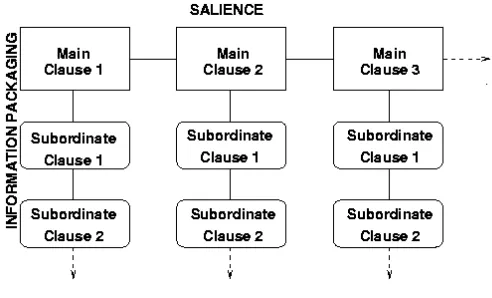
The above discussion relates to the definition of the centering update unit in the following way. The centering model keeps track of center continuations and center shifts. In other words, it keeps track of discourse salience. If we dissociate salience from information structure, the relevant unit for computing salience is at the sentence level, which we can visualize as a horizontal level (see Figure 1). The relative order of independent/dependent clauses is determined by information structuring, a process possibly orthogonal to the computing of salience. Subordinate links are not relevant to the salience mechanism. Salience is computed paratactically.
A natural consequence of this model is that one can introduce referents on the vertical level without affecting the status of the salient entity on the horizontal level. It follows that changes of topic must be established at the horizontal level. Such a conception of the salience structure suggests that text processing is not strictly incre-mental, as commonly assumed. Although it is possible that the Cf list is constructed incrementally, the final ranking is determined only after the sentence is complete.
Figure 1 Salience model.
necessarily relate to the salience of the participating entities. Although a great deal of additional work is required to understand the precise nature of the interaction between salience and information structure, we believe that we obtain a significant gain in keeping the two processes distinct.
3.2 Outline of the Anaphora Resolution Model
In Sections 2 and 3, we discussed a number of challenging cases for anaphora res-olution, including some puzzling experimental data. We raised the question of how the data are to be reconciled. We are now able to offer an explanation. The basic idea is that topic continuity and intrasentential anaphora are handled by two distinct mechanisms. Topic continuity is computed across centering update units. Anaphoric reference spanning across update units relates to topic continuity and is therefore de-termined structurally in accordance with centering rules and constraints. Within the unit, anaphora is constrained by focusing preferences projected by the matrix predi-cate and the extended arguments of the predipredi-cate that can be locally realized through subordination.
This basic outline is sufficient to explain (most of) the data we have seen so far. The experiments reported in Stevenson et al. (2000), which show a main effect of thematic focusing, involve the interpretation of anaphoric expressions in subordinate clauses. On the other hand, Hudson-D’Zmura and Tanenhaus’s (1998) experiments on similar types of verbs show a main effect of structural focusing. The difference between the two sets of experiments is that Hudson-D’Zmura and Tanenhaus’s (1998) experiments involve sequences of main clauses, whereas in Stevenson et al. (2000) the relevant experiments involve subordinate clauses. Furthermore, Stevenson et al. (2000) report results on a different set of experiments showing a main effect of structural focusing, and these are precisely the experiments containing sequences of main clauses. Further, Suri, McCoy, and DeCristofaro’s (1999) “SX because SY” construction indicates that the referent appearing in the subordinate clause is not the preferred focus in the subsequent discourse, whereas resolution to the subject of the main SX clause yields the desired interpretation.
discuss some remaining issues raised by the English connective so and certain types of preposed subordinate clauses.
3.2.1 Algorithm and Model Specifications. Discourse consists of a sequence of
seg-ments. Each segment consists of a sequence of centering update units. A single center-ing update unit consists of one main clause and all its associated dependent clauses. Dependent clauses are of three types: sentential complements of verbs, relative clauses, and subordinate clauses. Sentential complements of verbs and relative clauses are iden-tified syntactically. Subordinate clauses are introduced with subordinate conjunctions. To identify subordinate conjunctions, we apply the reversibility test: a tensed clause is introduced by a subordinator when the clause it introduces can be preposed.19
For example, in (36), although is classified as a subordinator and the although clause is classified as a subordinate clause because placing the although clause before the main clause retains grammaticality. Conversely, howeverin (38) is not classified as a subordinator, because preposing the clause with which it is associated yields ungram-maticality.
(36) John traveled by air although he is afraid of flying. (37) Although he is afraid of flying, John traveled by air. (38) John traveled by air. However, he is afraid of flying. (39) #However, he is afraid of flying. John traveled by air.
Update units are identified and numbered. For each identified update unit the list of forward-looking centers is constructed and its members are ranked according to
the ranking rule for English. The “M” prefix stands for “main clause,” and the “S”
prefix stands for “subordinate clause.” The relevant ranking of the various types of dependent clauses is currently left unspecified.
Ranking Rule for English
M-Subject > M-indirect object> M-direct object> M-other > S1-subject> S1-indirect object >S1-direct object >S1-other > S2-subject> . . .
For complex NPs, we assume left-to-right ranking of entities, as suggested in Walker and Prince (1996).20
Given the above input for N units, Ui=1...N, the anaphora resolution algorithm starts at the last identified unit. The basic steps are specified below. Some of the steps require information that is obtainable by currently available natural language systems: syntactic parsers, morphological analyzers, automated proper name identification, and electronic lexical databases such as WordNet (to check animacy, for example, as would be necessary for the ranking of entities in Greek). Others, such as understanding the focusing preferences of verbs and connectives as well as identifying thematic roles will, of course, await further research.
0. Start at the last identified unitUi withi=N.
1. Identify pronominal expressions in the rightmost subordinate clause.
2. Input antecedents from the Cf list.
3. Apply grammar-driven constraints (number and gender agreement, contra-indexing, etc.) to reduce list of potential antecedents.
4. Resolve from right to left to the first available antecedent inside the subordinate clause. Output unresolved pronominals. 5. Using the Cf list resolve pronominals according to semantic
fo-cusing constraints. Output unresolved pronominals.
6. If there is another subordinate clause to process go to step 1. 7. Identify pronominals in the main clause. Apply grammar-driven
constraints (number and gender agreement, contra-indexing, etc.) to reduce list of potential antecedents. Resolve from right to left to the first available antecedent inside the current clause. Output unresolved pronominals.
8. Input Cf list of potential antecedents from previous unit. 9. Apply grammar-driven constraints to reduce list of potential
antecedents.
10. Resolve pronominals starting from the leftmost to the highest-ranked element of the list of available antecedents.
11. If an antecedent is found go to step 13.
12. If the list of potential antecedents is empty and there is a unit to process go to step 8, else mark unknown.
13. If Ui is the first unit U1 terminate, else start processing Ui−1
and go to step 1.
By way of demonstration, we apply the algorithm to resolve the anaphoric ex-pressions in discourse (2), repeated here in (40)–(42).
(40) Dodge was robbed by an ex-convict.
(41) The ex-convict tied him-3 up because he-2 wasn’t cooperating. (42) Then he-1 took all the money and ran.
• Step 0 applies. Move to step 1.
• No subordinate clause is identified. Jump to step 7.
• Step 7 applies. The pronoun HE-1 is identified. There is no potential antecedent in the current clause. Move to step 8.
• Step 8 applies. The Cf list from the previous unit contains EX-CONVICT>DODGE.
• Step 9 applies. Grammar constraints do not reduce the list of potential antecedents.
• Step 10 applies. HE-1 resolves to the EX-CONVICT.
• Step 13 applies. Move to step 1.
• Step 2 applies. The Cf list is empty (it contains only the unresolved pronoun HE-2).
• Steps 3 and 4 apply vacuously. There are no potential antecedents in the current clause.
• Step 5 applies. The Cf list contains HIM-3>EX-CONVICT because of semantic focusing. HE-2 resolves to HIM-3.
• Step 7 applies. HIM-3 is identified. Grammar constraints apply and contra-index EX-CONVICT with HIM-3.
• Step 8 applies. The Cf list from the previous unit contains DODGE>EX-CONVICT.
• Step 9 applies. Grammar constraints do not reduce the list of potential antecedents.
• Step 10 applies. HIM-3 resolves to DODGE.
• Steps 11–13 apply. The algorithm terminates.
3.3 Comparison with Related Algorithms
The crucial difference between our approach and related anaphora resolution algo-rithms is in the treatment of subordinate clauses. Whereas steps 7–10 are similar to other approaches that opt to resolve a pronoun to the highest-ranked element of the Cf list of the previous clause, the resolution process described in steps 0–7 and the Cf ranking assumptions described earlier are not. As indicated in the ranking rule for English set forth in Section 3.2.1, (a) subordinate clauses are part of the same unit containing the main clause with which they are associated, and (b) there is a single Cf ranking list for both the main and the subordinate clauses. Because the entities in the subordinate clauses rank lower than the entities in the main clause, the linear position of the subordinate clause does not affect the resolution process. We have seen that this “restoring” of a basic clause order results in virtually eliminating backward anaphora, which in other approaches requires special treatment.21 Also, intrasentential anaphora
is preferred in the cases of anaphoric elements occurring in subordinate clauses but not in main clauses (assuming grammatical filtering), again irrespective of their linear order.
We will now demonstrate these differences with respect to Lappin and Leass’s (1994) and Hobbs’s (1978) algorithms, which are conceptually the closest to our proach. Lappin and Leass’s RAP (Resolution of Anaphora Procedure) algorithm ap-plies to the output of McCord’s (1990) Slot Grammar parser and utilizes measures of salience derived from syntactic structure and a simple model of attentional state. Po-tential anaphor antecedents receive a salience score on which they are evaluated. The scoring system penalizes backward anaphora and rewards parallel syntactic positions and intrasentential antecedents (sentence recency).
As we have already mentioned, backward anaphora need not receive any special treatment in our approach. Lappin and Leass penalize cases of backward anaphora severely, which seems to work well on empirical grounds, presumably because back-ward anaphora is rather rare. In absence of an explicit method of identifying real cases of backward anaphora, however, the system is likely to miss such cases. In our
approach, this is not a problem, because the Cf ranking of the processing unit im-plicitly identifies all real cases of backward anaphora and converts them into forward anaphora.
Further, some of the limitations of the system discussed by Lappin and Leass involve cases of intersentential anaphora such as the following:
(43) a. This green indicator is lit when the controller is on.
b. It shows that the DC power supply voltages are at the correct levels. The RAP algorithm resolves the pronoun it in (43b) to the controller in (43a). This is because, in RAP, the subject of the main as well as the when clause in (43a) are of equal salience. In this case, the controller wins because it is more recent. In our approach,it would resolve to the highest-ranked entity of the previous unit, which in this case is correctly identified as thegreen indicator. This is because the when clause is not treated as an independent unit. The entities evoked in the when clause are linearly but not
structurallymore recent.
Hobbs’s (1978) syntactic algorithm is based on a well-defined search procedure (left-to-right in most cases, breadth-first) applied on the surface parse tree. The al-gorithm has three main components. The first component treats reflexive pronouns by constraining the search procedure with special configurational requirements. The second component takes over when the antecedent of an anaphor is to be found in previous sentences, and the third component searches subparts of the parse tree in cycles until the highest clause is reached.
Intersententially, Hobbs’s syntactic algorithm favors subjects over objects, as sub-jects are higher up in the parse tree than obsub-jects. Intersententially, our approach and Hobbs’s algorithm would opt for the same type of antecedent. As Lappin and Le-ass (1994) have pointed out, however, the syntactic search procedure seems to work pretty well in English because grammatical order corresponds to phrase order. For other languages, either free-word-order languages like Greek or languages in which salience is determined by other factors (e.g., information status, as has been argued for German [Strube 1998]), Hobbs’s search procedure would fail, because it is too rigid to accommodate linguistic variation in marking salience. Even for languages like English, the relevant salience of entities may be undermined by nonsyntactic factors. As has already been suggested by Turan (1998), among others, certain types of NPs are less salient than others independent of their grammatical function (e.g., indefinite quan-tified expressions and impersonal pronouns). The flexibility of constructing lists of entities according to salience both optimizes the capabilities of an anaphora resolution algorithm and is best suited to accommodate the multiplicity of factors that may have to be taken into account in determining reference salience.
(44) After she phoned Barbara, Susan went out for dinner. (45) Susan criticized Barbara because she was lazy.
3.4 Some Remaining Issues
As mentioned above, the proposed model for anaphora resolution accounts comfort-ably for the results reported in Stevenson et al. (2000) except, however, for the exper-iment involving the connectiveso.
According to the reversibility test, so is classified as a subordinate conjunction depending on its interpretation. In English,sodenotes two relations: consequence and purpose. The examples below indicate that only purpose-sobehaves as a subordinate conjunction.22
(46) I had to give up my job so I could be happy again. (47) So I could be happy again, I had to give up my job. (48) I had just been to the bank, so I had money.
(49) #So I had money, I had just been to the bank.
The anaphora resolution model we propose predicts that the interpretation of pronouns in consequence-sosentences is determined structurally. This prediction was not borne out. Stevenson et al. (2000) report a main effect of semantic focusing in consequence-so continuations.
There are two options available to explain the data. First, we may hypothesize that subordination is determined on structural grounds, in which case it is likely that lan-guages may arbitrarily characterize their set of subordinate conjunctions. Under this option, we may hypothesize thatsoin English is uniformly a subordinate conjunction and then set out to investigate the implications of such a hypothesis on empirical grounds. Alternatively, we may hypothesize that the crucial factor in characterizing subordination is by its semantic properties, that is, the type of relation it establishes with the proposition denoted in the main clause. This second option seems intuitively appealing and more promising in explaining this otherwise puzzling linguistic phe-nomenon, namely, the structural distinction between main and subordinate clauses. It runs into the following problem, however.
In Modern Greek, the equivalent conjunction for the English soisetsiorki etsi(=
‘and so’), which is not polysemous and is not a subordinate conjunction. Greek etsi links clauses paratactically (i.e., links sequences of main clauses). The examples below show that Greek behaves differently from English in thesocases.
(50) #I Mariai htipise tin Elenij, ki etsi NULLj evale ta klamata.
the Maria hit the Eleni and so she put the tears. Mariai hit Elenij and so shej started crying.
(51) I Mariai xilokopithike apo tin Elenij ki etsi NULLi evale ta klamata.
the Maria was-hit by the Eleni and so she put the tears. Mariai was hit by Elenij and so sheistarted crying.
The Modern Greek data show that the null subject in the so clause cannot be inter-preted as the object of the previous clause. If subordination was to be defined on semantic grounds, then we should not expect focusing differences between the two languages, but in fact we do.
Finally, we notice that Greek is much like English when the second clause is linked through other types of subordination, as shown in (52)–(53):
(52) I Mariai htipise tin Elenij giati NULLj ekane ataxies.
the Maria hit the Eleni because she did naughty-things Mariai hit Elenij because shej was being naughty
(53) I Elenij xilokopithike apo ti Mariai giati NULLj ekane ataxies.
the Eleni was-hit by the Maria because she did naughty-things. Elenij was hit by Mariai because shej was being naughty.
The reason for the difference between the two languages with respect to soclauses is hard to explain. This difficulty in understanding the cross-linguistic variation is also telling of our fundamental lack of understanding subordination in languages. In this article, we do not claim to understand the intricacies of subordination any better. In the next section, it is shown that the distinction between main and subordinate clauses is in the right direction. It is not yet clear, however, what property of subordination— structural, semantic or other—is responsible for the pattern we observe. We will leave this issue open for future work.
Another issue that requires special attention in the proposed account pertains to some special cases of preposed subordinate clauses. Example (54) presents a problem for the proposed model because the antecedent of the subject pronoun in the matrix clause is the subject of the preposed subordinate clause.
(54) After Susan phoned Barbara, she went out for dinner.
The ranking in the Cf list for (54) is she-referent>Susan >Barbara. In effect, what we are faced with here is analogous to backward anaphora. In its current form, how-ever, the proposed algorithm would process the subordinate clause first and would then move to the matrix clause. The matrix clause contains a pronoun and no pos-sible antecedent, so on completing the processing of the unit, the algorithm would output the unresolved pronoun from the matrix clause and would continue searching for an antecedent in the previous unit. Such cases can be identified easily by even shallow parsing and be fixed locally by forcing resolution to the highest entity in the current unit (i.e., Susan). Also, as a reviewer has suggested, the algorithm presented in Section 3.2.1 could be modified so that in step 2 the Cf list includes all possible antecedents from the current utteranceUi. With this modification, (54) would be pro-cessed correctly, but as the same reviewer points out, this does not explain the contrast in (55):
(55) a. Susan phoned Barbara. Then, she went out for dinner. b. Susan phoned Barbara before she went out for dinner. c. After Susan phoned Barbara, she went out for dinner.
anaphora, and there is no clear subject reference. Example (55c) is another instance of intrasentential anaphora, but in this case the subject preference is clearly on a par with the intersentential case in (55a). Whatever required modification to the algorithm will prove to be more useful, the fact remains that the similarity between (55a) and (55c) remains unexplained in purely structural terms. We suspect that the difference between (55b) and (55c) and the similarity between (55a) and (55c) is the result of an interaction with a discourse function of subordinate clauses. Subordinate clauses normally convey background information and do not by themselves move the nar-rative forward. They also have the property of enabling information to appear in a “nonnatural order” with respect to the event(s) of the main clause. A “natural order” for temporal connections would be to express events in the order in which they hap-pened. For causal connections, a natural order would be to express the cause before the effect. So it seems plausible to hypothesize that subordinate structures can be used to introduce background (or presupposed) information and even discourse-new char-acters without disturbing the narrative structure of the discourse and the salience of the centers of attention already established in the narrative. If this line of thinking is on the right track, then it is possible that the similarity between (55a) and (55c) is due to the fact that both sequences of clauses reflect the linear succession of events. The preposed after-clause does not disturb the natural temporal order of events both of which are predicated of the same center, which in this case is introduced in the subordinate clause. Further empirical work is clearly needed to evaluate this line of explanation.
4. Empirical Studies
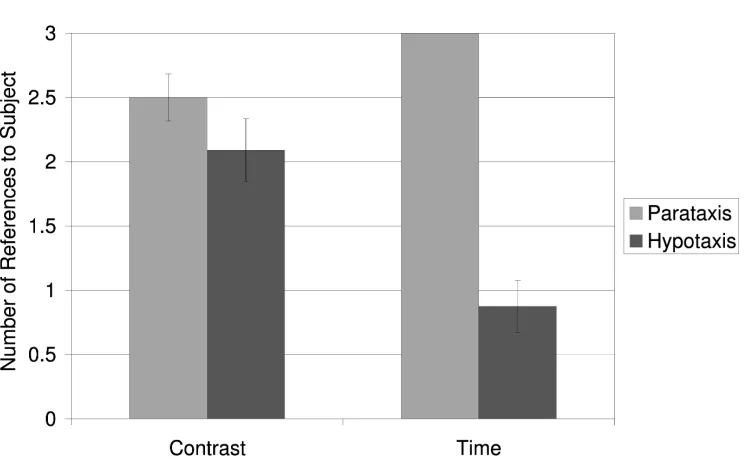
In this section we report the results of two empirical studies designed specifically to test the central hypotheses of the proposed model: (a) that anaphoric reference that spans across centering update units is determined structurally (as specified in Section 3.2.1) and (b) that subordinate clauses do not form independent processing units. In the first study, in Section 4.1, we report the results of a sentence completion experiment in English. We quantify over the interpretation of a subject pronoun to one of two ambiguous antecedents evoked in the preceding clause. Two factors were analyzed, type of clause and semantic type of connection, in four conditions. The re-sults show a strong main effect for type of clause. In the main-clause conditions, the subject pronoun resolved to the subject antecedent of the previous sentence. In the subordinate-clause conditions, the interpretation of the subject pronoun was varied. In the second study, we tested the same hypotheses on a Greek corpus. We selected three types of subordinate clauses under conditions similar to the ones set in the ex-perimental study. We contrasted anaphoric interpretation in subordinate clauses with anaphoric interpretation in main clauses. The results provide strong evidence for the accuracy of the centering-based algorithm proposed for anaphora resolution across units. The results also confirm that anaphoric interpretation in subordinate clauses is not determined structurally.
4.1 Experimental Data
clause introduced two individuals of the same gender. The second clause contained a subject pronoun of the same gender as the individuals introduced in the first main clause. Participants were asked to complete the second clause. We were interested in the interpretation of the subject pronominal in the second clause.
For this experiment, two subordinate conjunctions were selected from two se-mantic classes, namely, timeand contrast. Also, two adverbial conjunctions,then and however, were selected from the same semantic classes to introduce the second clause in the main-main conditions.
We predicted that the pronominal in the main clause would consistently be inter-preted as the subject of the preceding main clause. We also predicted that the interpre-tation of the subject pronoun in the subordinate clause would vary. In all critical items the verb of the main clause belonged to the same category (see below), so any varia-tion pattern observed across the two subordinate conjuncvaria-tions would be attributed to the focusing preferences projected by the semantics of the subordinate conjunctions.
The grouping of connectives into semantic types, namely,then, whenfor time and
however, althoughfor contrast and structural types, then, however for main clauses and
when, althoughfor subordinate clauses, enables us to compare and contrast the effect of
two factors: semantic type and type of clause. A main effect of semantic type would mean that the interpretation of the subject pronoun is primarily determined by the semantics of the connectives. Conversely, a main effect of type of clause would mean that the interpretation of the subject pronominal is primarily determined by the type of clause.
4.1.1 Study and Results. Sixteen adults, native speakers of English, participated in
the experiment. They were asked to perform a sentence completion task as described in the previous section. Each participant received a form containing 36 fillers and 12 critical items, 6 per type of clause and 6 per semantic type. The example below demon-strates a complete set of conditions; each form contained three such sets interspersed with fillers. Each main clause appeared in all conditions across participants, and each condition appeared three times within participants. The order of appearance of critical items was varied in two LISTS (two variations in the order of appearance of critical items).
a. The groom hit the best man violently. However, he. . . (contrast, main-main) b. The groom hit the best man violently
although he. . . (contrast, main-subordinate)
c. The groom hit the best man violently. Then, he. . . (time, main-main) d. The groom hit the best man violently when he. . . (time, main-subordinate)
All main clauses contained an action verb with two human arguments of the same gender. An adverbial phrase was added at the end of the main clause to achieve nat-uralness. The arguments of the verbs were always realized as role NPs to minimize referential ambiguity in the continuations. In general, sentence continuation involv-ing role NPs tends to disambiguate the intended reference. Nevertheless, an average of two ambiguous continuations were identified per participant. On completing the experiment, the participants were asked to identify explicitly the intended referent of the ambiguous continuations.