University of Warwick institutional repository: http://go.warwick.ac.uk/wrap
This paper is made available online in accordance with publisher policies. Please scroll down to view the document itself. Please refer to the repository record for this item and our policy information available from the repository home page for further information.
To see the final version of this paper please visit the publisher’s website. Access to the published version may require a subscription.
Author(s): Leslie J. Francis, Dan Ispas, Mandy Robbins, Alexandra Ilie and Dragos Iliescu
Article Title: The Romanian Translation of the Francis Scale of Attitude Toward Christianity: Internal Consistency Reliability, Re-test Reliability and Construct Validity Among Undergraduate Students Within a Greek Orthodox Culture
Year of publication: 2008 Link to published version:
http://dx.doi.org/ 10.1007/s11089-008-0174-6
Running head: The Romanian translation of the FSAC
The Romanian translation of the Francis Scale of Attitude toward Christianity:
Internal consistency reliability, re-test reliability and construct validity among
undergraduate students within a Greek Orthodox culture
Leslie J. Francis*
The University of Warwick, UK
Dan Ispas
University of South Florida, USA
Mandy Robbins
The University of Warwick, UK
Alexandra Ilie
University of South Florida, USA
Dragos Iliescu
National School of Political and Administrative Studies, Romania
*corresponding author, e-mail: [email protected] telephone: 024 7652 2539
Summary
In order to contribute to a growing international research programme concerned with the
correlates, antecedents and consequences of individual differences in attitude toward religion,
the Francis Scale of Attitude toward Christianity was translated into Romanian and applied
within a cultural context shaped by the Greek Orthodox tradition. Data provided by a sample
of 158 students (mainly in their late teens and early twenties) supported the internal
consistency reliability, re-test reliability and construct validity of this instrument and
The Romanian translation of the Francis Scale of Attitude toward Christianity:
Internal consistency reliability, re-test reliability and construct validity among
undergraduate students within a Greek Orthodox culture
The refinement and application of psychometric tools within the individual
differences tradition of psychology have made a crucial contribution to advances in
knowledge within an empirically-based psychology of religion (see for example, Spilka,
Hood, Hunsberger, & Gorsuch, 2003). However, the authoritative review of available tools
in this field undertaken by Hill and Hood (1999) illustrates two major weaknesses in the
literature. The first weakness concerns the multiplicity of available tools, many of which
have been applied in limited numbers of studies. Given the way in which scientific findings
are closely related to the precise empirical operationalisation of underlying constructs, it is
not always easy to integrate and to interpret findings generated by a range of different
instruments. The second weakness concerns the way in which there is often a paucity of
information regarding the psychometric properties of the instruments applied. Given the
premium on space in the scientific literature, more attention is often (and appropriately) given
to reporting the outcome of the application of certain tools than to the scrutiny of the tools
themselves.
Recognising the significance of both of these problems in the late 1970s, Francis
(1978a, 1978b) introduced the psychometric properties of the Francis Scale of Attitude
toward Christianity and invited colleagues to collaborate with him in building up a series of
independent but interrelated studies examining the correlates, antecedents and consequences
of individual differences in scores recorded on this measure. By the mid 1990s over a
hundred studies had responded to this invitation (Kay & Francis, 1996) and many more have
with examining the psychometric properties of the scale within different parts of the
English-speaking world, including Australia and Canada (Francis, Lewis, Philipchalk, Brown, &
Lester, 1995), England (Francis & Stubbs, 1987; Francis, 1992), Kenya (Fulljames &
Francis, 1987), Nigeria (Francis & McCarron, 1989), Northern Ireland (Francis & Greer,
1990; Greer & Francis, 1991), Republic of Ireland (Maltby, 1994), Scotland (Gibson, 1989;
Gibson & Francis, 1989), South Africa (Francis, Kerr, & Lewis, 2005), and the United States
of America (Lewis & Maltby, 1995).
In order to extend this research tradition within other linguistic communities the
Francis Scale of Attitude toward Christianity has been translated into a number of different
languages. Given the sensitivity of psychometric measurement to the precise formulation of
each constituent item within a scale, translation from one language to another is a complex
and sensitive matter, best achieved by a process of translation and back-translation in order to
ensure comparability. Translations of the Francis Scale of Attitude toward Christianity are
currently available in Arabic (Munayer, 2000), Chinese (Francis, Lewis, & Ng, 2002), Dutch
(Francis & Hermans, 2000), French (Lewis & Francis, 2003), German (Francis & Kwiran,
1999; Francis, Ziebertz, & Lewis, 2002), Greek (Youtika, Joseph, & Diduca, 1999),
Norwegian (Francis & Enger, 2002), Portugese (Ferreira & Neto, 2002), Spanish
(Campo-Arias, Oviedo, Dtaz, & Cogollo, 2006), Swedish (Eek, 2001), and Welsh (Evans & Francis,
1996; Francis & Thomas, 2003).
Against this background, the aim of the present study is to extend previous research
regarding the Francis Scale of Attitude toward Christianity in two years. First, since previous
studies concerned with examining the psychometric properties of the instrument have been
conducted largely within cultures shaped by Catholic or by Protestant and Reformed
tradition, the present study focuses on a cultural context shaped by the Greek Orthodox
psychometric properties of a Romanian translation of the Francis Scale of Attitude toward
Christianity.
Method
Sample
A sample of 158 students attending a university in the Western part of Romania
completed a short questionnaire within the context of regular coursework. They were assured
of complete confidentiality and anonymity and given the option not to participate in the
project. All students attending the coursework session willingly participated. The sample
comprised 53 males and 105 females; 87 were under the age of twenty, 53 were in their
twenties, and the remaining 18 were aged thirty or over. A subgroup of these students (N =
41) were also invited to complete the same instrument after a period of four weeks in order to
examine the re-test reliability of the instrument.
Instrument
The Francis Scale of Attitude toward Christianity is a 24-item Likert type instrument
concerned with affective response toward God, Jesus, bible, prayer and church. The items
had been translated into Romanian two independent translators and then back-translated into
English in order to test for inaccuracies and ambiguities. The minor differences in translations
were solved in a group meeting. Each item is assessed on a five-point scale: agree strongly,
agree, not certain, disagree and disagree strongly.
Church attendance was assessed on a five-point scale: never, once or twice a year,
sometimes, at least once a month and nearly every week.
Personal prayer was assessed on a five-point scale: never, once or twice a year,
Data analysis
The data were analysed by the SPSS statistical package using the frequency,
reliability, factor and correlation routines.
Results
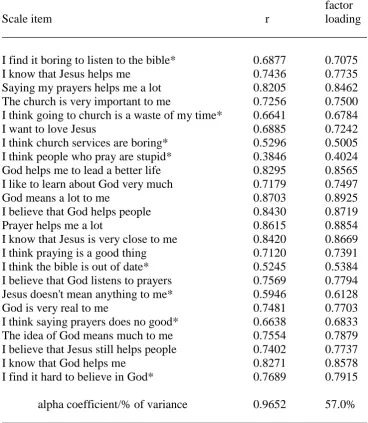
In the first column of statistics, table one presents the item rest of test correlation
- insert table 1 about here -
coefficients in respect of all 24 items, together with the alpha coefficient. In the second
column of statistics, table one presents the loadings on the first factor of the unrotated
solution proposed by principal component analysis, together with the percentage of variance
explained. Both sets of statistics support the conclusion that the scale is characterised by
homogeneity, unidimensionality and internal consistency reliability within the sample. The
alpha coefficient is established as 0.97, while the proportion of variance accounted for by the
first factor is established as 57%.
While the formal statistics of reliability are relatively easy to calculate for an attitude
scale (Livingston, 1988), the question of assessing validity is more problematic (Ebel, 1961;
Zeller, 1988). Steps towards assessing the construct validity of this scale can be made by
assessing the extent to which certain predictions about the theoretical variations in attitude
scores are reflected empirically (Cronbach & Meehl, 1955; Orton, 1987). While attitudes
alone may not be simple or direct predictors of behaviour (Ajzen, 1988; Eiser & van der
Pligt, 1988), substantial evidence suggests a fairly close relationship between attitude towards
religion and religious behaviour, as demonstrated by repeated studies using the Francis scale
of attitude toward Christianity among children and adolescents (Francis, 1989). In the
+0.6219 (p<.001) with personal prayer. These statistics support the construct validity of the
attitude scale within the sample.
Considerable evidence exists in the empirical study of religious differences to indicate
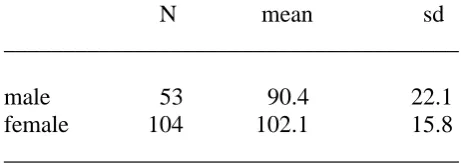
that females record higher scores on indices of religiosity than males (Francis, 1997). Table
two, which presents the mean scale scores for males and females separately, demonstrates
that this finding also holds true for the present sample of Romanian students (t = 3.8, p< .
001, Cohen’s d = .61).
- insert table 2 about here -
Data provided by the 41 students who completed the same instruments after a period
of four weeks generated an alpha coefficient of .9485 and a Pearson product movement
correlation of .9825 with the scores recorded on the first administration. These data support
the re-test reliability of the scale of attitude toward Christianity among Romanian students.
Conclusion
The present study has explored the scale properties of the Romanian translation of the
Francis Scale of Attitude toward Christianity among a sample of 158 university students.
Two main conclusions can be drawn from the findings. First, the data support the
unidimensionality, internal consistency reliability, re-test reliability and construct validity of
the Romanian translation of this instrument. The scale can, therefore, be recommended for
further use within Romania and should lead to valuable cross-cultural comparisons in the
empirical psychology of religion conducted within that country. Second, the data support the
view that the instrument, developed originally within cultures shaped by Catholic or by
Protestant and Reformed traditions, is also appropriate within a culture shaped by the Greek
References
Ajzen, I. (1988). Attitudes, personality and behaviour. Milton Keynes: Open University
Press.
Campo-Arias, A., Oviedo, H. C., Dtaz, C. F., & Cogollo, Z. (2006). Internal consistency of a
Spanish translation of the Francis Scale of Attitude toward Christianity short form.
Psychological Reports, 99, 1008-1010.
Cronbach, L. J., & Meehl, P. (1955). Construct validity in psychological tests. Psychological
Bulletin, 52, 281-302.
Ebel, R. L. (1961). Must all tests be valid? American Psychologist, 16, 640-647.
Eek, J. (2001), Religious facilitation through intense liturgical participation: A
quasi-experimental study of Swedish pilgrims to Taizé. Lund: University of Lund Studies in Psychology of Religion.
Eiser, J. R., & van der Pligt, J. (1988). Attitudes and decisions. London: Routledge.
Evans, T. E., & Francis, L. J. (1996). Measuring attitude toward Christianity through the
medium of Welsh. In L. J. Francis, W. K. Kay, & W. S. Campbell (Eds.), Research in
religious education (pp. 279-294). Leominster: Fowler Wright Books.
Ferreira, V., & Neto, F. (2002). Psychometric properties of the Francis Scale of Attitude
toward Christianity among Portugese university students. Psychological Reports, 91,
995-998.
Francis, L. J. (1978a). Attitude and longitude: A study in measurement. Character Potential,
8, 119-130.
Francis, L. J. (1978b). Measurement reapplied: Research into the child's attitude towards
religion. British Journal of Religious Education, 1, 45-51.
Francis, L. J. (1989). Measuring attitude towards Christianity during childhood and
Francis, L. J. (1992). Reliability and validity of the Francis Scale of Attitude towards
Christianity (adult). Panorama, 4(1), 17-19.
Francis, L. J. (1997). The psychology of gender differences in religion: A review of empirical
research. Religion, 27, 81-96.
Francis, L. J., & Enger, T. (2002). The Norwegian translation of the Francis Scale of Attitude
toward Christianity. Scandinavian Journal of Psychology, 43, 363-367.
Francis, L. J., & Greer, J. E. (1990). Measuring attitudes towards Christianity among pupils
in Protestant secondary schools in Northern Ireland. Personality and Individual
Differences, 11, 853-856.
Francis, L. J., & Hermans, C. A. M. (2000). Internal consistency reliability and construct
validity of the Dutch translation of the Francis scale of Attitude toward Christianity
among adolescents. Psychological Reports, 86, 301-307.
Francis, L. J., Kerr, S., & Lewis, C.A. (2005). Assessing attitude toward Christianity among
adolescents in South Africa: The Francis scale. South African Journal of Psychology,
35, 147-155.
Francis, L. J., & Kwiran, M. (1999). Werthaltungen (einstellungen) gegenüber dem
christentum bei deutschen heranwachsenden: Die francis-skala. Braunschweiger
Beiträge, 89(3), 50-54.
Francis, L. J., Lewis, C. A., & Ng, P. (2002). Assessing attitude toward Christianity among
Chinese speaking adolescents in Hong Kong: The Francis scale. North American
Journal of Psychology, 4, 431-440.
Francis, L. J., Lewis, J. M., Philipchalk, R., Brown, L. B., & Lester, D. (1995). The internal
consistency reliability and construct validity of the Francis scale of attitude towards
Christianity (adult) among undergraduate students in the UK, USA, Australia and
Francis, L. J., & McCarron, M. M. (1989). The measurement of attitudes towards Christianity
among Nigerian secondary school students. Journal of Social Psychology, 129,
569-571.
Francis, L. J., & Stubbs, M. T. (1987). Measuring attitudes towards Christianity: From
childhood to adulthood. Personality and Individual Differences, 8, 741-743.
Francis, L. J., & Thomas, E. M. (2003). The reliability and validity of the Francis Scale of
Attitude toward Christianity among Welsh speaking 9-11 year olds. The Psychologist
in Wales, 16, 9-14.
Francis, L. J., Ziebertz, H. - G., & Lewis, C. A. (2002). The psychometric properties of the
Francis Scale of Attitude toward Christianity among German students. Panorama, 14,
153-162.
Fulljames, P., & Francis, L. J. (1987). The measurement of attitudes towards Christianity
among Kenyan secondary school students. Journal of Social Psychology, 127, 407-409.
Gibson, H. M. (1989). Measuring attitudes towards Christianity among 11-16 year old pupils
in non-denominational schools in Scotland. Educational Research, 31, 221-227.
Gibson, H. M., & Francis, L. J. (1989). Measuring attitudes towards Christianity among 11-
to 16- year old pupils in Catholic schools in Scotland. Educational Research, 31,
65-69.
Greer, J. E., & Francis, L. J. (1991). Measuring attitudes towards Christianity among pupils
in Catholic Secondary schools in Northern Ireland. Educational Research, 33, 70-73.
Hill, P. C., & Hood, R. W. (Eds.) (1999). Measures of religiosity. Birmingham, Alabama:
Religious Education Press.
Kay, W. K., & Francis, L. J. (1996). Drift from the churches: Attitude toward Christianity
Lewis, C. A., & Francis, L. J. (2003). Evaluer l’attitude d’étudiantes universitaires françaises
à l’égard du Christianisme: L’Echelle de Francis. Sciences Pastorals, 22, 179-190.
Lewis, C. A., & Maltby, J. (1995). The reliability and validity of the Francis scale of attitude
towards Christianity among US adults. Psychological Reports, 76, 1243-1247.
Livingston, S. A. (1988). Reliability of test results. In J. P. Keeves (Ed.), Educational
research, methodology and measurement: An international handbook (pp. 386-392). Oxford: Pergamon Press.
Maltby, J. (1994). The reliability and validity of the Francis scale of attitude towards
Christianity among Republic of Ireland adults. Irish Journal of Psychology, 15,
595-598.
Munayer, S. J. (2000). The ethic identity of Palestinian Arab Christian adolescents in Israel.
Unpublished doctoral dissertation, University of Wales: Oxford Centre for Mission
Studies.
Orton, R. E. (1987). The foundations of construct validity: Towards an update. Journal of
Research and Development in Education, 21, 22-35.
Spilka, B., Hood, R. W., Hunsberger, B., & Gorsuch, R. L. (2003). The psychology of
religion: An empirical approach (third edition). New York: Guilford Press.
Youtika, A., Joseph, S., & Diduca, D. (1999). Personality and religiosity in a Greek Christian
Orthodox sample. Mental Health, Religion and Culture, 2, 71-74.
Zeller, R. A. (1988). Validity. In J. P. Keeves (Ed.), Educational research, methodology, and
Table 1
Item rest of test correlations and factor loadings
_____________________________________________________________ factor Scale item r loading _____________________________________________________________
I find it boring to listen to the bible* 0.6877 0.7075 I know that Jesus helps me 0.7436 0.7735 Saying my prayers helps me a lot 0.8205 0.8462 The church is very important to me 0.7256 0.7500 I think going to church is a waste of my time* 0.6641 0.6784 I want to love Jesus 0.6885 0.7242 I think church services are boring* 0.5296 0.5005 I think people who pray are stupid* 0.3846 0.4024 God helps me to lead a better life 0.8295 0.8565 I like to learn about God very much 0.7179 0.7497 God means a lot to me 0.8703 0.8925 I believe that God helps people 0.8430 0.8719 Prayer helps me a lot 0.8615 0.8854 I know that Jesus is very close to me 0.8420 0.8669 I think praying is a good thing 0.7120 0.7391 I think the bible is out of date* 0.5245 0.5384 I believe that God listens to prayers 0.7569 0.7794 Jesus doesn't mean anything to me* 0.5946 0.6128 God is very real to me 0.7481 0.7703 I think saying prayers does no good* 0.6638 0.6833 The idea of God means much to me 0.7554 0.7879 I believe that Jesus still helps people 0.7402 0.7737 I know that God helps me 0.8271 0.8578 I find it hard to believe in God* 0.7689 0.7915
alpha coefficient/% of variance 0.9652 57.0% _____________________________________________________________
Table 2
Mean attitude scores by gender
______________________________________ N mean sd ______________________________________
male 53 90.4 22.1
female 104 102.1 15.8 ______________________________________
Author’s note
Portions of this research were conducted while the second author was at the “A.D.
Xenopol” Public Library, Arad, Romania. Partial financial support was provided to the
second author by the Arad County Council through the Arad County Cultural Centre. We