Centre for the Study of Globalisation and Regionalisation (CSGR), University of Warwick, Coventry CV4 7AL, United-Kingdom. URL: http://www.warwick.ac.uk/fac/soc/CSGR
A Forward Looking View
John Whalley
CSGR Working Paper No. 36/98
John Whalley
1University of Warwick, Western Ontario and NBER
CSGR Working Paper No. 36/99July 1999
Abstract:
This paper discusses what the next few decades could bring for the developing countries in terms of the size
and composition of their trade and inward investment flows, as well as a possibly changing policy framework within
the global economy in which they have to operate. Both the prospects and implications are clearly different from
country to country, but given the breadth of the paper the focus is more on impacts on groups of countries rather than
on specific countries.
The bottom line of the paper, is a cautious one. Three nagging questions are repeatedly re-emphasized. Can trade
growth really be high enough on the import side in the OECD if now 100 or more developing countries see
globalization and increased exports as their primary route to growth, industrialization, and development. Can barrier
reductions in OECD markets and future WTO negotiations be relied on to fuel this, as in the past; and is there a more
sinister scenario that new barrier increases could even choke off some of the trade growth? And what is to happen to
development strategies if this course fails, as it seemingly has done so already for the low income countries? Having
posed these questions, there are bright spots; the more rapid growth of South-South trade, even more rapid growth of
least-developed to mid-developed country trade; higher growth rates of FDI than trade, and more and more developing
country trade being investment driven. The papers’ overriding message is perhaps that the world is not static, and
country strategies toward the global economy need to reflect this.
Keywords: Developing Countries, global Economy, Trade, Globalization
Address for correspondence:
John Whalley
Centre for the Study of Globalisation and Regionalisation, University of Warwick,
Coventry CV4 7AL, United-Kingdom
1
This is a revised draft of a paper prepared for a workshop November 16th and 17th 1998 in New York on
This paper discusses what the next few decades could bring for the developing countries in terms
of the size and composition of their trade and inward investment flows, as well as a possibly
changing policy framework within the global economy in which they have to operate. Both the
prospects and implications are clearly different from country to country, but given the breadth of
the paper the focus is more on impacts on groups of countries rather than on specific countries.
Assuming a recovery from the current financial turbulence over a period of three to five years,
however, questions will still remain about how developing country participation in the global
economy in the decade beyond will develop. Can developing country involvement in the global
economy accelerate further; can their trade shares in developed country markets grow yet more,
and for each exporter? Is there a fallacy of composition involved, that with initially only a few
countries being able to successfully pursue an outward oriented strategy as against the 100 or
some countries now that are attempting to do so, the increases in aggregate import volumes into
the OECD markets cannot support success for all these countries? Can the growth of their trade
perhaps be fuelled by more rapidly growing south-south trade as more and more developing
countries achieve higher levels of income in a recovery phase, or for now does this remain too
small? Equally, while investment flows into developing country markets have accelerated in the
pre-crisis period they remain concentrated, being particularly in Asia and heavily so in China. Is
breaking away from this concentration is a further key element in a strategy for broadening trade
emphasized. Can trade growth really be high enough on the import side in the OECD if now 100
or more developing countries see globalization and increased exports as their primary route to
growth, industrialization, and development. Can barrier reductions in OECD markets and future
WTO negotiations be relied on to fuel this, as in the past; and is there a more sinister scenario that
new barrier increases could even choke off some of the trade growth? And what is to happen to
development strategies if this course fails, as it seemingly has done so already for the low income
countries? Having posed these questions, there are bright spots; the more rapid growth of
South-South trade, even more rapid growth of least-developed to mid-developed country trade; higher
growth rates of FDI than trade, and more and more developing country trade being investment
driven. The papers’ overriding message is perhaps that the world is not static, and country
strategies toward the global economy need to reflect this.
The paper first discusses developing country trade performance in recent years, highlighting its
rapidly changing size and composition. It then moves to a discussion of the policy framework for
future trade growth, including the prospects for a WTO Millennium Round. It concludes with a
discussion of developmental strategies for developing countries that rely on their increasing
1. Introduction and Background
This paper discusses what the next few decades could bring for the developing countries in terms
of the size and composition of their trade and inward investment flows, as well as a possibly
changing policy framework within the global economy in which they have to operate. Both the
prospects and implications are clearly different from country to country, but given the breadth of
the paper the focus is more on impacts on groups of countries rather than on specific countries.
In the shorter term the influence of the current financial crises on previous strong trade
performance is a concern, especially in Asia, although the positive exchange rate effects on the
export side should eventually lead to even more elevated trade performance, assuming no major
recession in the OECD. On the other hand countries concerned by the large adjustments costs
they face when excess volatility in global financial markets also affects their own economy,1 and
typified by Malaysia, are tightening their foreign exchange and investment regimes and this may
limit their capital inflows and slow trade growth, which, for several key countries over the last
decade, has been closely linked to direct inward foreign investment.
Assuming a recovery from the current financial turbulence over a period of three to five years,
however, questions will still remain about how developing country participation in the global
economy in the decade beyond will develop. Can developing country involvement in the global
1
economy accelerate further; can their trade shares in developed country markets grow yet more,
and for each exporter? Is there a fallacy of composition involved, that with initially only a few
countries being able to successfully pursue an outward oriented strategy as against the 100 or
some countries now that are attempting to do so, the increases in aggregate import volumes into
the OECD markets cannot support success for all these countries? Can the growth of their trade
perhaps be fuelled by more rapidly growing south-south trade as more and more developing
countries achieve higher levels of income in a recovery phase, or for now does this remain too
small? Equally, while investment flows into developing country markets have accelerated in the
pre-crisis period they remain concentrated, being particularly in Asia and heavily so in China. Is
breaking away from this concentration is a further key element in a strategy for broadening trade
and income growth in the developing world.
Independently of whether this accelerating trade performance can continue the unevenness of
impact of global developments on individual developing countries and the marginalization which
has affected the lower income countries, and particularly the poorer and smaller countries in Sub
Saharan Africa is an issue.2 These countries remain almost exclusively as commodity exporters;
some have export revenues equal to only a small fraction of import costs, with the balance
financed by aid flows (Mozambique is such an example). While many of these countries have
been affected by political problems, civil unrest, and macro economic mismanagement, as
2
commodity prices have fallen they have experienced sharp declines in their trade shares as a
fraction of overall world trade, with in some cases, absolute declines in trade in value terms. To
these countries the outward oriented strategies pursued in Korea and Taiwan since the 1960's
seems to be so far removed from their current situation as to be seemingly irrelevant.
Diversification of trade is sometimes held out as the way forward, but how is this to be achieved?
Is it really so simple as establishing a stable pro investment policy regime, and foreign investment
will flow into these countries and trade will grow. At present, the core development strategy
being offered by the World Bank and the IMF to such countries is policy reform, linked to
opening of the external sector. But for the least developed countries, to place such a large bet on
trade as the engine of their future growth seems extreme given their current situation. How to
deal with the performance of the lowest income countries within the global framework of the next
two decades is thus also a central concern.
The global policy environment which developing countries are likely to face in the global
economy may also see sharp change from the past over the next twenty or thirty years. A
potential new round of WTO trade negotiations, the Millennium Round, is widely mooted.
Regional trade agreements may continue their spread across the globe, but regional conflict (as
presently between the US and the EU over bananas) may grow. Particularly critical is that the
reductions in trade barriers on manufactured products which have taken place in the OECD
countries over the post-war years have, in the tariff area, reached levels for which significant
concentrated tariffs, such as in textiles and apparel. The odds seem to be that trade barriers on
manufactured goods against developing countries, with little further downside potential, may
begin to go up rather than down; while barriers on agricultural products, long thought poor
prospects for developing country exports may fall.
Key are also proposals which link increased trade barriers (sanctions) to developing country
compliance with developed country policy objectives (including in environment and labour
standards), and antidumping actions. The threat of increased trade barriers if compliance does not
occur may increasingly be used to force countries to modify their domestic policies as Mexico
experienced in their 1990 tuna dispute with the US. Thus, after fifty years of ever falling tariff
barriers in developed country markets, the next thirty to forty years may well see pressures to
raise barriers, fuelled in part by developed country political interests wanting protection against
competing imports. These could be likely key issues in a future Trade Round that developing
countries will have to deal with.
In addition to possible barrier increases, the developing countries may also face ever broadening
WTO negotiations within the global trade policy framework. These will likely come on top of
WTO Uruguay Round negotiations which have only just concluded, and with a complexity on
which few countries are on top. Developing countries have been somewhat passive in their
approach to the prospect of such negotiations, usually attempting to resist broadening, and trying
to mitigate potential negative effects of any broadening that might occur. Broadening of this type
over the next ten years in a new Millennium Trade Round into such areas as competition policy,
environment, labour standards and investment.
But this changing policy framework is one which also offers opportunities for many countries.
For instance, broadening the discussion of intellectual property rights negotiations to cover all
forms of property rights, including those involved with environmental concerns (such as rights to
emit carbon into the upper atmosphere) could yield significant gains for developing countries. If
the argument were accepted that developed countries had largely used up their emission rights
cumulatively over their period of industrialization and hence had to buy rights from individual
developing countries, significant new flows of development assistance could result. In the
environment area, one in which developing countries have long resisted trade linkage, it seems
clear that countries with significant environmental assets (Indonesia, Malaysia, Thailand,
Democratic Congo, Cameroon, Brazil for instance; countries with significant forest cover) have
the capability to make significant concessions in order to achieve benefits in other areas such as
trade and investment if they choose to use it. This is because they are the custodians of major
environmental assets and globally have significant leverage in this area. Broadened negotiations is
thus something that offers countries opportunities as well as threats. And countries without the
environmental endowments to make larger concessions, if they are to be beneficiaries of a trade
and environment bargain, may want to support such a bargain by making concessions to other
Finally, there are the finance related issues of a global exchange rate regime in turmoil following
the onset of financial crises, and the clear weakening of the position of the IMF on these matters.
Formulating a developing country strategy for international financial arrangements over the next
two decades would seem to be paramount. And more broadly, the Bretton Woods institutions
themselves which were designed to deal with the problems of the 1940's are now coming under
increasing stress and even re-examination as discussion of new global arrangements into the next
century gets under way. Developing country participation in these discussions will be central, and
prior to that a clear sense of what the developing country interests are in different options needs
to be formulated.
The bottom line of the paper, however, is a cautious one. Three nagging questions are repeatedly
re-emphasized. Can trade growth really be high enough on the import side in the OECD if now
100 or more developing countries see globalization and increased exports as their primary route
to growth, industrialization, and development. Can barrier reductions in OECD markets and
future WTO negotiations be relied on to fuel this, as in the past; and is there a more sinister
scenario that new barrier increases could even choke off some of the trade growth? And what is
to happen to development strategies if this course fails, as it seemingly has done so already for the
low income countries? Having posed these questions, there are bright spots; the more rapid
growth of South-South trade, even more rapid growth of least-developed to mid-developed
country trade; higher growth rates of FDI than trade, and more and more developing country
trade being investment driven. The papers’ overriding message is perhaps that the world is not
The paper first discusses developing country trade performance in recent years, highlighting its
rapidly changing size and composition. It then moves to a discussion of the policy framework for
future trade growth, including the prospects for a WTO Millennium Round. It concludes with a
discussion of developmental strategies for developing countries that rely on their increasing
integration into the global economy
II Developing Country Trade Performance In The Global Economy
Trade-Led Development Strategies
Over the last ten to fifteen years, more and more developing countries have placed a larger and
larger bet on a development strategy of evermore integration by them into the global economy; a
so called outward oriented strategy. In the 1950's the two countries which made this bet, Hong
Kong and Taiwan (and a little later Korea), achieved spectacular results and their very success
was influential from the mid 1980's on in persuading perhaps 100 or more other developing
countries around the world that their future also lay in opening up their economies to trade and
exploiting the opportunities which they saw as emanating from more involvement in with global
economy. The late 1980's and early 1990's saw the most extensive and far reaching trade
liberalization ever achieved globally, and it was undertaken unilaterally (not negotiated
multilaterally) and by the developing countries.
However, not only have the financial crises of the last year raised the obvious question as to
whether this strategy has proved to be a little naive in terms of the excess weight which it places
of success by the high growth, larger and middle income developing countries (in Asia and Latin
America) and the seeming poor trade and growth record and even marginalization of many low
income countries, has also compounded such concerns. In the 1930's there was an active debate
on whether trade was the engine or hand maiden of growth; a debate which in the 1990's has
seemingly been lost in the assertion that it clearly is the engine. The experience of financial
turbulence, and negative growth in marginalized low income countries revives that debate.
Accepting that in reality the developing countries are a heterogenous group of countries, they
have gone through many several twists and turns over the last forty years in trying to decide upon
their approach to trade related issues. And outside of Sub Saharan Africa and a smaller number
of lower income non African countries, they have, in the main, been successful in raising the level
of their participation in the global economy. Their exports of industrial products (especially from
Asia) have soared, the higher GDP growth countries have been the rapidly growing exporters, and
over 30 years the more successful of those adopting this strategy have seen a five fold increase in
real income per capita.
In the 1950's they argued that their balance of payments problems made it impossible for them to
liberalize their trade regimes, and facing ever declining terms of trade they argued that they should
jointly seek preferential access to developed country markets without liberalizing in their own
markets. This strategy, which was initially pursued as a common approach by all developing
with the slogan of “special and differential treatment”.3 Through the middle of the 1980's most
countries supported a bloc wide trade and development negotiating strategy, jointly emphasizing
their need both to protect their own domestic markets and for preferential access to developed
country markets.
In essence, the argument was that to grow developing countries needed both special treatment
and insulation from the forces of globalization. In the 1970's, coincident with these lines of
argumentation, developing country exports began to surge.
Beginning in the mid 1980's and reflecting growth generally in manufactured exports from Latin
America and Asia, a number of developing countries began to change course and adopt a more
open trade approach, focussing now on the need to liberalize to harness gains from trade and the
long run welfare benefits from unilateral trade liberalization. These developments were driven by
North America trained meritocrats first in Latin American countries and subsequently elsewhere,
and were strongly supported by the World Bank and the IMF. Country after country in the
mid-late 1980's moved to deep unimid-lateral liberalization, not only in trade, but in policies towards
foreign investment. The result was a dramatic reduction in barriers to trade and inward capital
flows in developing countries. Accompanying these changes were also clear movements away
from a common blocwide negotiating position on global trade issues among developing countries,
and towards pursuit of individual country interest even where this conflicted with other
developing countries. Argentina, for instance, argued for global liberalization in grains and beef,
and Thailand in rice, even if other net food importing countries, such as Egypt, were opposed on
3
the grounds of wanting to remain as beneficiaries agricultural export subsidies from Europe.
The idea that a common blockwide position of special and differential treatment should be
pursued as the pivotal developing country trade and development strategy has continued to
weaken since the mid 1980's, and the strength of trade performance of developing countries has if
anything, accelerated; at least up to the onset of the current financial crises. Thus putting on one
side the marginalized lower income countries, developing country trade on the whole has showed
remarkable gains over the last 40 years, even though the developing countries have vacillated in
their approach to both trade negotiations and their own trade policies.
Trade Performance
Table 1 sets out the 1995 export, import, and FDI (foreign direct investment) performance of the
group of developing countries as classified by UNCTAD, reporting imports and exports in 1995
dollars and as a percentage of all trade.
The term ‘developing country’ implies a uniformity across countries which in practice can be a
little misleading. Income per capita levels range from highs in Asia of $20,000 in the case of
Singapore, to levels of $100 in the case of Somalia and some of the lower income African
economies. And as emphasized in Whalley (1989) these differences in income levels are also
accompanied by diversity in growth performance, trade patterns, degrees of industrialization,
in reality a heterogenous group of countries which it is often difficult to discuss as if they were
one single group.
The data in Table 1, despite this heterogeneity, indicate that developing countries now play a large
and (until recently) growing role in the global economy, accounting for a little under 30% of
world trade on both the import and export sides. Since exports of affiliated companies of foreign
parents account for nearly 50% of developing country exports4, it follows that inward foreign
investment flow to these countries are now a key factor underlying this trade. Foreign direct
investment flows into the developing countries were perhaps 100 billion dollars in 1995, around
30% of worldwide direct foreign investment, although only small if not negligible flows (1 billion
dollars) went to the least developed countries.
Table 1
Trade and Investment Flows of the Developing Countries
$bill 95 as % of World
Imports 1,493 29.1%
Exports 1,406 27.7%
FDI 96.3 30.4%
FDI Least Developed 1.02 0.3%
Sources: UNCTAD (1997a) Tables 1.1, 1.2. UNCTAD (1997b) Table B.1.
4
Trade in Industrial Products
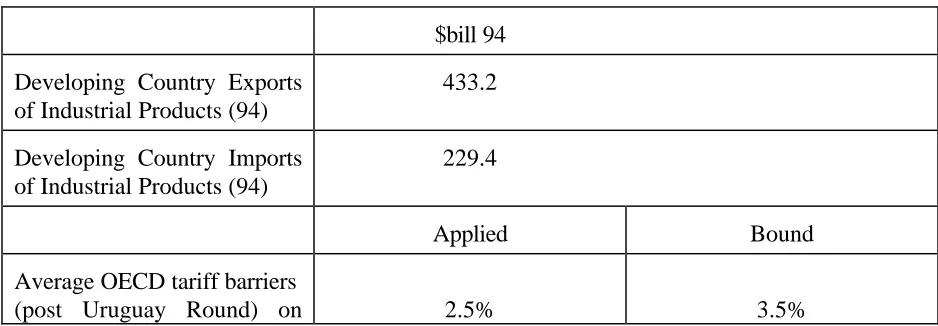
Table 2 indicates developing country trade in industrial products, rather than in all products, of
around 400 billion dollars on the export side, and a little over 200 billion dollars on the import
side. Unlike two decades earlier, developing countries are now significant net exporters of
industrial products, and it is these exports which have surged in recent years. Key to this
performance have been low tariff barriers in OECD export markets, which now average around
2½% markets (with higher rates on some products such as textiles and apparel). Barriers remain
on the import side in developing countries, although there has been substantial unilateral
liberalization in these regions in the last few years. Average developing country trade barriers on
industrial products post Uruguay Round average around 13 to 14%, of which barriers at 20 to
[image:16.612.74.543.546.709.2]25% levels apply to textiles and apparel, and around 20% to imports of transportation equipment.
Table 2
Developing Country Trade in Industrial Products and Tariff Barriers
$bill 94
Developing Country Exports of Industrial Products (94)
433.2
Developing Country Imports of Industrial Products (94)
229.4
Applied Bound
Average OECD tariff barriers
industrial products: of which Textiles/apparel Transport equipment 8.4% 4.6% 11.0% 5.6%
Average developing country tariff barriers (post Uruguay Round) on industrial products: of which
Textiles/apparel Transport equipment 13.3% 21.2% 19.9% 13.3% 25.5% 13.2%
Sources: UNCTAD (1997a) Tables 3-1, A, 13 Laird (1998)
Commodity Trade
In contrast to industrial product trade, commodity based exports have been sharply falling as a
share of overall developing country trade. In the 1950's developing countries’ exports were
largely of commodities such as rubber, coffee, cocoa, and metallic ores and other products for
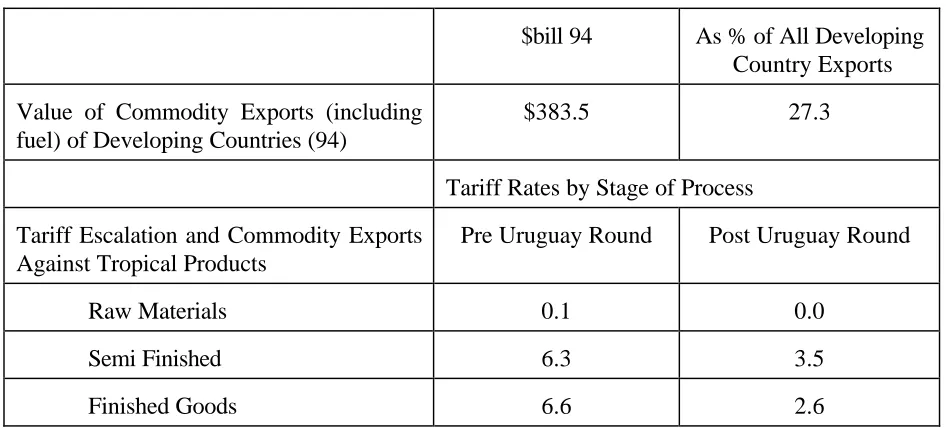
which there was no immediate competitor in developed country markets. As Table 3 indicates, as
a fraction of all developing country exports, these accounted for perhaps 30% of the total in the
1990's, whereas in the 1960's this figure was closer to 80%.
Most commodity exports also continue to enter developed country markets free of barriers,
because of the absence of immediately competing products. This is one reason lower income
countries often see themselves as having little to gain from WTO trade negotiations. A central
issue which has been repeatedly raised by them in this area over the last 30 years is that of tariff
upgrade their production through higher levels of fabrication, they have faced ever higher tariff
barriers on final products. Even if there are low barriers against raw commodity exports, they
argue that any attempt to export products produced from them encounters higher barriers.
Table 3 reports WTO estimates of tariff escalation in OECD markets against developing country
commodity exports, showing effective barriers as high as 6% for higher stages of production, but
also showing that Uruguay Round tariff barrier reductions have considerably reduced their
quantitative impact. As a working hypothesis, the assumption that developing country exports of
both commodities and their immediate fabricated products are restrained more by supply factors
and bottlenecks rather than by trade barriers thus seems appropriate, and if this is the case
domestic infrastructure and global prices are more important issues for exporting countries than
global negotiations on trade barriers.
Commodity exports is also an area where there has been profound pessimism as to the pricing
prospects for developing countries, which continues until today. The original Singer/Prebisch
thesis of the 1950's argued that developing countries would always face a secular decline in their
terms of trade for their commodity based exports. The argument was that commodities are basic
items with low income elasticities in trade (necessities), while developing countries tend to import
equipment and machinery (luxuries) based on high income elasticities. As a result, growth in the
world economy with both rich and poor countries trying to simultaneously grow would depress
emphasized in the recent Trade and Development Report from UNCTAD, the pricing prospects
for commodities are widely regarded as poorer than ever; again elevating concerns over
Table 3
Commodity Based Trade of Developing Countries
$bill 94 As % of All Developing Country Exports
Value of Commodity Exports (including fuel) of Developing Countries (94)
$383.5 27.3
Tariff Rates by Stage of Process
Tariff Escalation and Commodity Exports Against Tropical Products
Pre Uruguay Round Post Uruguay Round
Raw Materials 0.1 0.0
Semi Finished 6.3 3.5
Finished Goods 6.6 2.6
Source: UNCTAD (1997a) Table A.12. GATT (1994)
Agricultural Trade
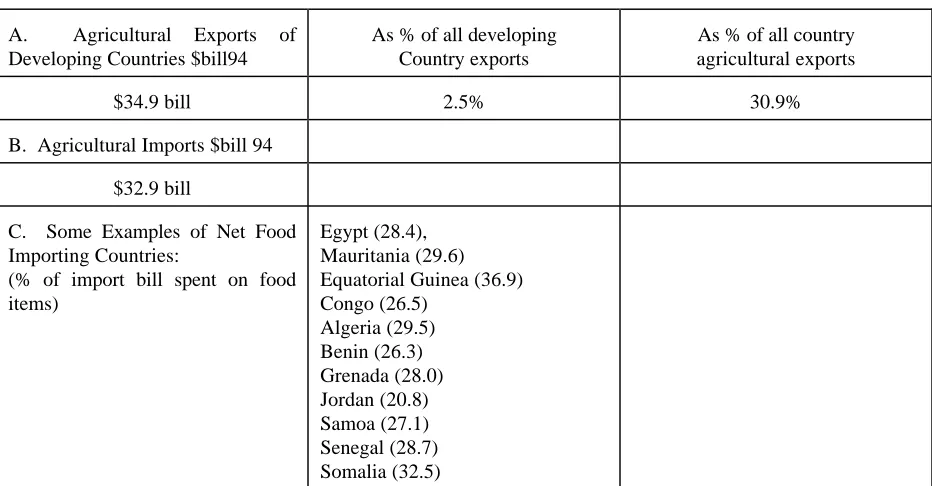
A further component of developing country trade is agricultural products for which data is set out
in Table 4. Agricultural products are generally regarded as being the closest to autarchy in trade
(a situation where countries consume largely what they produce), in part because of the barrier
structure in global agricultural trade which precludes significant amounts of trade. As a result,
potential exports of agricultural products by developing countries are large, particularly for
countries such as Argentina and Brazil. But as Table 4 indicates, actual exports are extremely
small, around 2½% of developing country exports. The potential gains for both developing
agricultural trade in the OECD are probably larger than for another trade category, suggesting
high priority in this area from a global trade negotiations point of view.
There is, however, a divide among the developing countries in this area, since along with (actual
or potential) agricultural exporting countries, there are large net food importers some of whom
are indicated in Table 4 and most of whom are least developed poor economies. These net food
importers were concerned during the Uruguay Round over the potential implications of
liberalization in agriculture since they thought that with restraints on agricultural export subsidies
agricultural world prices would rise; this would impact on their low income populations, and slow
[image:21.612.77.543.458.701.2]their development.
Table 4
Agricultural Trade of Developing Countries
A. Agricultural Exports of Developing Countries $bill94
As % of all developing Country exports
As % of all country agricultural exports
$34.9 bill 2.5% 30.9%
B. Agricultural Imports $bill 94
$32.9 bill
C. Some Examples of Net Food Importing Countries:
(% of import bill spent on food items)
Egypt (28.4), Mauritania (29.6) Equatorial Guinea (36.9) Congo (26.5) Algeria (29.5) Benin (26.3) Grenada (28.0) Jordan (20.8) Samoa (27.1) Senegal (28.7) Somalia (32.5)
Trade in Textiles and Apparel
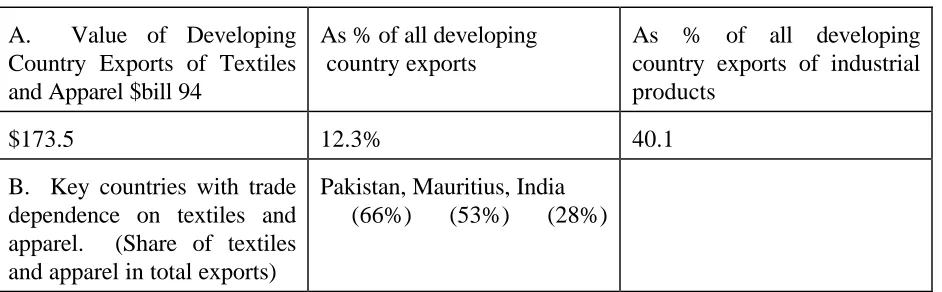
A further key important component of developing country trade involves trade in textiles and
apparel, discussed in Table 5. While only 12% of all developing country exports, textiles and
apparel typically provide the first labour intensive manufactured product which developing
countries produce as they surge in their trade and move ever more heavily into production of low
wage industrial products. Thus, countries such as Korea had export performance in their early
stages of industrialization in the 1960's with 50% or more of their exports being in textiles and
apparel. Even today, as Table 5 indicates, countries such as Pakistan have over 60% of their
exports in textiles and apparel, and similar high numbers for Bangladesh. Hence, textiles and
apparel are an important trade item for a number of developing countries. Some have also noted
that they also represented the first stage of successful industrialization that OECD countries such
as the UK went through in the 1850's.
Textiles and apparel exports, however, have been restricted as a result of the GATT Multifibre
Arrangement(MFA), a system of bilateral quotas between developed and developing countries
designed to slow adjustments in importing countries because of the low wage and regionally
concentrated use of labour involved. As a result, global liberalization in textiles and apparel has
become a central issue for the developing countries, especially since this system of bilateral quotas
has made it more difficult for new entrants (or potential new entrants) to textiles and apparel trade
to obtain market share. Some have even suggested that the presence of the Multifibre
Arrangement has been a major impediment to the integration of Africa into the global economy,
generated by inward foreign investment) would eventually provoke new trade quotas.
Table 5
Developing Country Trade in Textiles and Apparel
A. Value of Developing Country Exports of Textiles and Apparel $bill 94
As % of all developing country exports
As % of all developing country exports of industrial products
$173.5 12.3% 40.1
B. Key countries with trade dependence on textiles and apparel. (Share of textiles and apparel in total exports)
Pakistan, Mauritius, India (66%) (53%) (28%)
Source: UNCTAD (1997a) Table A.11.
Outsourcing and Trade
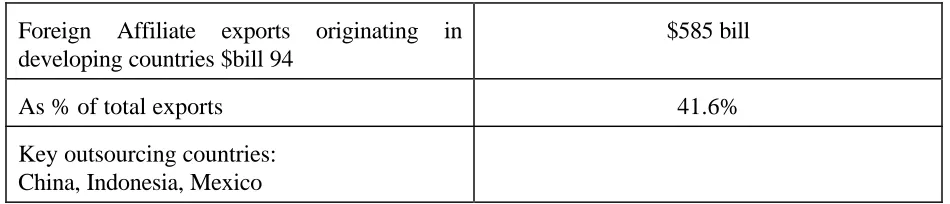
Outsourcing exports, a further important feature of developing country trade, are highlighted in
Table 6.5 These data indicate that over 40% of developing country exports are produced by
domestic affiliates of foreign parent companies. Outsourcing, the more extreme form of this
activity, refers to the relocation of production from developed to developing countries, to take
advantage of low wage labour, improving infrastructure, and increased openness within the
developing world. In the case of the United States, over a period of twenty years significant
amounts of outsourcing have gone to Mexico, concentrated in the Maquiladora zone twenty miles
to the south of the United States. In this zone, components initially produced in the US are
5
assembled using designs from parent establishments, before being re-exported to the US. In some
cases complete assembly occurs (as in the case of autos).
Outsourcing has been strongly promoted by a number of developing countries through export
processing zones, and outsourcing activity is often claimed to account for nearly 80% of China’s
manufactured exports. As outsourcing has grown, so has the importance of this trade to the
developing countries has become ever more crucial, and both its form and treatment in any future
global trade strategy is key to individual countries. However, in this area of trade the commercial
interest of large OECD companies in keeping export markets open and barrier free is a key asset
to the developing countries. This form of trade is not only growing rapidly, but is virtually barrier
free and will likely stay so given the policy influence in OECD countries of parent countries. In
such cases, the policy issue for host countries may be more their terms for receiving FDI (tax and
[image:24.612.72.547.536.638.2]regulatory treatment), than the trade treatment of exports.
Table 6
Outsourcing Exports and Developing Country Trade Performance
Foreign Affiliate exports originating in developing countries $bill 94
$585 bill
As % of total exports 41.6%
Key outsourcing countries: China, Indonesia, Mexico
Services
Table 7 summarizes the developing country situation in a further key and growing element of
global trade, namely trade in services. Services cover banking, insurance, transportation,
telecomms, tourism and other trade in non-tangible items. These non-tangible items are thought
to account for around 30% of global trade of both goods and services. Table 7 indicates both that
these numbers are smaller for the developing countries, and that the developing countries are net
importers of services.
The developing countries often see themselves as having significant export opportunities in key
segments of service trade. One example is the success enjoyed by India in exports of software.
However, there are still many service areas where significant impediments to trade remain in both
the developed and the developing world, through domestic regulation, such as in financial
institutions, transportation and other areas. There is also concern in the developing world that full
global liberalization in these areas could eliminate domestic capacity for some of these service
related items (such as banking). For the lower income countries tourism is the most significant
component of this trade. Generally, services are more rapidly growing than other areas of trade
and more heavily restricted. Barrier removal began in a small way in the Uruguay Round, but will
Table 7
Growth of Services Trade and the Developing Countries
$bill 96 As % of merchandise trade
Service Exports1 $227 bill. 15.2%
Service Imports1 $282 bill. 20.1%
Tourism as a % of service exports
$94 bill. 33%
1
of Latin America, Africa, and now Japan, Asia Source: WTO (1998), Table III.4
World Tourism Organization (1996).
South-South Trade
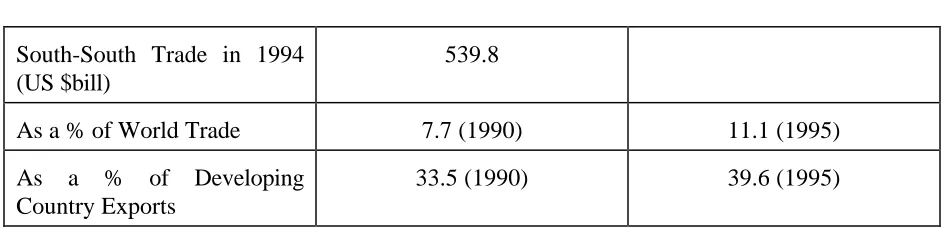
Finally, Table 8 reports data on South-South trade; trade between the developing countries. This
was at low levels in the 1970's, but in recent years has been more rapidly growing than
developed-developing country trade. It now accounts for around 11% of world trade, but importantly
around 40% of developing country exports. As Table 8 indicates, both these trade shares have
increased substantially over the five year period 1990-1995. Least developed countries now
source over one half of their imports from other developing countries.
Over the years it has often been suggested that increased South-South trade could ultimately
its seeming small size, this source has been frequently discounted. The issue is, therefore, at what
point does South-South trade represent a large enough trading opportunity for the developing
countries to become a motor for growth, and how important could it be over the next two
decades. Given the current share of developing country exports that go to other developing
countries, and the significantly higher growth rate of South-South trade compared to world trade
in recent years, the indication is that this is an important source of opportunity for developing
[image:27.612.73.544.376.490.2]countries in their trade.
Table 8
South-South Trade
South-South Trade in 1994 (US $bill)
539.8
As a % of World Trade 7.7 (1990) 11.1 (1995)
As a % of Developing Country Exports
33.5 (1990) 39.6 (1995)
III The Policy Framework For Globally Based Economic Development
A Future WTO Millennium Round?
A central global trade policy issue for individual developing countries is their stance towards a
future trade negotiating Round under the WTO. This is now widely believed to be likely to be
initiated in the year 2000 to coincide with the Millennium (hence the title the Millennium Round),
although there are still major issues to be resolved before such a Round can be launched. A
central unresolved issue concerns negotiating authority in the United States, and the lack of
appetite for new trade negotiations within the Congress. But despite this in many parts of the
world, and particularly so in Europe, there is now a substantial gearing up underway for a new
Round.6
Since the creation of the GATT in 1947 (subsumed into the WTO in 1994) there have been eight
negotiating rounds,7 even though there is no inevitability which leads from one Round to the next.
These Rounds through negotiated exchanges and concessions reducing tariff barriers on
manufactured products are widely thought to have lowered tariff barriers between OECD
countries to the point that they are now relatively insignificant barriers to trade, with other trade
barriers now more important; including for developing country exporters, textiles and apparel
6
See the discussion of the possible content of a new Trade Round in the recent Institute of International Economics volume edited by Jeffrey Schott (1998).
7
restrictions as well as anti-dumping duties and actions, and restrictions in agriculture.
Understanding what a Millennium Round might imply involves prior understanding of the trade
policy problem it is designed to solve. One feature of the Uruguay Round decisions was that they
specified substantial detail as to their implementation over a long period of time (as much as 20
years). The Uruguay Round mandated a mini negotiation in agriculture within five years of the
conclusion of the Round, and granted special delays to developing countries (and especially the
least developed) for implementation in such areas as intellectual property and agriculture. The
Round also saw agreement by developed countries to terminate trade restrictions against textiles
and apparel under the Multi-Fibre Arrangement by 2004, although the initial phase in of these
arrangements has caused disquiet among developing countries as to what may replace the MFA.
Thus some have suggested that the core of a new Millennium Round could be to concentrate on
implementation issues stemming from the Uruguay Round. As such this would be a distinct
departure from previous WTO Rounds which have had a strong focus initially on tariff reduction
and then on other barrier reduction. Moreover, the decisions from the Round also created a new
permanent forum of bi-annual ministerial meetings which some argued at the time could serve to
replace Rounds through ongoing permanent negotiation, and so the rationale for a separate and
new Round is even questioned in come circles.
Others have suggested that a Millennium Round could instead be dominated by discussion of
so-called new-new issues ( issues which go beyond the new issues discussed in the Uruguay Round;
policy (with its trade implications), trade and investment, and trade and labour standards.
Developing countries have been concerned about these developments in global policy discussion
because they see them as issues on which developing countries will likely be pressured to
undertake measures which could slow their growth and development (such as in environment and
labour standards) under a threat of increased trade barriers if they do not comply. Their fear is
that a new Millennium Round rather than focussing on further reductions in trade barriers, as in
the past, may become embroiled in discussion of conditional increases in trade barriers which
could close export markets.
A third view of the Millennium Round focusses on it as an opportunity, created in large part by
the Uruguay Round, for large new market opening globally through yet more bargaining of
reciprocal exchanges and concessions in similar vein to previous Rounds. The argument is that
following the Uruguay Round, in a number of areas there are now negotiable trade instruments
which were not there before. In agriculture, for instance, tariffication of existing agricultural trade
restrictions, including the recent tariffication of rice restrictions in Japan (at levels of over
1000%), has created transparent negotiable tariff instruments which can now be the subject of an
exchange of concessions. The elimination of quota restrictions under the Multifibre Arrangement
in 2004 will leave in place tariff barriers in the OECD countries which are the highest on
manufactured products, and once again represent a negotiable instrument for reciprocal exchange.
Developing countries greatly expanded the coverage of their tariff bindings in the Uruguay
exchange possibilities also arise here. There are also arguments that many more restrictions in
services could also become negotiable in a wide ranging reciprocal exchange in such a framework,
and in both developed and developing countries.
This third view of the architecture of a Millennium Round is thus as an opportunity for a major
expansion of the reciprocal exchanges and concessions beyond manufactures that have
characterized previous tariff cutting negotiations in the WTO (GATT) into agriculture and
services, and also into key residual manufacturing items such as textiles. In this case the
opportunities for the developing countries to generate fresh market opening become significant
because of the chance to reduce key trade barriers which they face, particularly in textiles and
apparel, but also in agriculture and some service items.
A future Millennium Round, if it comes to pass, may well contain all of these elements, and as
such present both opportunities and threats to the developing countries.8 The threats are that
they could be subject to increases in trade barriers unless they move towards compliance with
various forms of OECD driven domestic policy changes such as in environment and labour
standards. On the other hand, major opportunities may be present for market opening reciprocal
exchange in which the developing countries, continually increasing in relative size compared to
the developed countries, have significant leverage.
Regionalism
Another key element which will affect the future position of the developing countries in the global
8
trading system is regional trade agreements.9 Regional agreements have been an ever present
feature of the post war trading system, but in the last ten years they have grown substantially in
profile. The first round of post-war regional trade agreements came into the system in the 1960's,
particularly with the creation of the European community (later the EU), and also with regional
trade agreements in many parts of the developing world. These agreements, and especially the
1957 Treaty of Rome, created the precedent for coexistence of regional agreements with the
GATT, even though regional agreements were a clear violation of the spirit of non-discrimination
central to the GATT. Indeed, in the 1960's the Kennedy Round of GATT trade negotiations were
in large part a result of the creation of the EU, and the perceived need of the United States to deal
with their access problems to European markets through trade bargaining in the GATT system.
In the late 1980's, however, frustration over seeming slow progress in multilateral negotiation and
the exploitation of tactical linkage between multilateral and regional negotiation by some
countries produced a racheting up in regional trading agreements, and especially so with the 1987
Canada-US Agreement. Subsequently, trilateralized to include Mexico in NAFTA, the creation of
a regional entity in North America set off a series of further concerns. Smaller countries strongly
wanted to be part of one trade agreement or the other, and these regional entities in turn began to
pursue new options to expand their network of trade agreements before their rival did so. This
was particularly the case with the EU, who in recent years had been either negotiating or
discussing regional trade agreements with South Africa, India, and others, as well as association
9
or accession agreements with Eastern European countries and former Soviet Republics.
These developments have generated a series of further responses; some developing countries have
responded by forming their own regional entities, as a precursor to eventual negotiation with
larger OECD groups; this, for instance, has been true of MERCOSUR (Argentina, Brazil,
Paraguay, Uruguay). Others have hung back trying to avoid entanglements with developing
country regional trade agreements so as to make their potential accession to developed world
regional trade agreements cleaner. This was the Chilean approach, but the Chileans in turn found
that concerns in the US Congress have made it difficult for them to pursue this negotiation route,
and as a result have subsequently joined MERCOSUR. In Asia, there has been new regional
activity in the ASEAN, which has moved towards a regional trade agreement (AFTA, the
ASEAN Free Trade Area) in contrast to the framework for regional cooperation and the defence
alliance which it was at its creation. Even in Africa there have been new attempts to revive
regional trade agreements, based on the argument that regional trade grows more rapidly than
global trade.
Some of these new regional arrangements have also taken the form of smaller countries
approaching larger countries seeking safe-haven trade arrangements. In these, the smaller country
often pays what is akin to an insurance premium in the form of domestic policy restraints of
various kinds beneficial to the large country, in return for firmer guarantees of access to the larger
market. This characterization of the Canada-US Trade Agreement, for instance, has recently been
the concern is that they will increasingly need to pay such premia in order to join regional trade
agreements and that later entrants will be called on to pay larger premiums; a redistributive
element in these arrangements adverse to smaller countries. As a result, a continued spread of
regional arrangements is generally seen in the developing world as hostile to the interests of the
developing countries.
Out into the next decade, the continued speed of regionalism therefore presents dilemmas for the
developing countries. On the one hand, there is a fear that with the OECD countries moving
towards more clearly defined regional blocs, that unless individual developing countries become
part of one of these blocs they will eventually suffer, particularly if there is eventually trade
retaliation between these regional entities. On the other hand, these entities may finish up
retaliating against each other in ways, which could yield preferential access for developing
countries to their markets, and if they any way generate growth and trade developing countries
will share in this to some degree
Access Problems
A further set of issues for the developing countries are future access problems that they are likely
to encounter in OECD markets, independently of a WTO negotiating Round or developments on
the regional front. As mentioned above, tariffs in OECD countries on manufactured products, to
all intents and purposes, have been eliminated as a result of exchanges of concessions in the
problems that remain for developing countries tend to be product and instrument specific, but
these will still pose problems for the developing countries in the decades ahead.
In the instrument area, developing countries have increasingly found themselves to be subject to
anti-dumping duties.10 Anti-dumping actions are initiated where countries are deemed to be
dumping or selling below cost. They are a widely used protective device in the OECD countries,
but one which more recently has spread to the developing countries as part of the safeguards
offered to domestic producers when trade liberalization occurs. As part of the political consensus
underpinning trade liberalization in the OECD countries, if imports surge into domestic markets
there are various mechanisms which allow for controls over the flow of imports; anti-dumping is
one of the more important of these.
OECD anti-dumping practices over the last twenty years have slowly tightened in the ways they
are applied, particularly against smaller countries. There are rules such as cumulation, which
allow for the exports of one country to be added to those of another in determining injury; one of
the key criteria for the imposition of an anti-dumping duty. There are also rules which allow for
the construction of a cost basis for the dumping margin to be determined in the absence of data
supplied by individual countries, and repeatedly anti-dumping cases, successful in the initial
petitioning process, have resulted in high duties through the use of constructed cost.
10
In the product specific areas, there are also potential access difficulties to be faced. As noted
above, textiles and apparel is the most prominent of these, since while there is a commitment to
phase out MFA trade restrictions by the year 2004, it is also widely agreed that the three part
phase out procedure which was instituted in the Uruguay Round has to all intents and purposes
been tokenesque thus far.11 The commitment in the year 2004 to eliminate all MFA restrictions
on textiles and apparel in OECD countries has been compared by some developing country trade
negotiators as akin to walking off a cliff, which they assume is not going to happen. In another
area, agriculture, while the decisions in the Uruguay Round have included agriculture for the first
time since the signing of the GATT they have not substantially liberalized trade. Developing
countries remain subject to high tariffs on key agricultural exports (including rice and sugar), and
the issue for them is how to negotiate these tariffs down so as to improve access.
Non-trade Trade Issues
A further set of key trade issues for the developing countries out into the early decades of the next
century will be the so-called non-trade trade issues. These issues are likely to be part of a future
WTO negotiation (including a Millennium Round) and for which a non-trade objective such as
improving environmental quality or raising so-called labour standards is tied to possible use of
trade sanctions. The broad structure of the proposals made thus far for these areas follows the
agreement on intellectual property which emanated from the Uruguay Round. In the intellectual
property area, there was a negotiation on a common international standard, such that if countries
11
fail to meet the standard they are subject to dispute settlement and ultimately to trade sanctions.
The trade and environment area has been one which has been particularly contentious, and
especially so in the early 1990's.12 In this area, the activities of environmental NGO’s trying to
establish the principle that the use of trade restricting measures to improve environmental
compliance in exporting countries is legitimate under the GATT have lead to a series of precedent
setting trade conflicts. The 1990 dispute over exported tuna catches by Mexico to the US and
incidental dolphin kills was especially high profile. Environmental groups in the United States
were successful in using the courts to implement trade restrictions, appealing to the US Marine
Mammal Protection Act of 1988. These trade restrictions were, however, subsequently found to
be GATT incompatible in a preliminary ruling by a dispute settlement panel. This never went
beyond its preliminary stages, but its report crystallized the issues and focussed the subsequent
debate. To OECD environmental groups, the GATT was widely seen as environmentally
unfriendly and even incapable of allowing trade restraints in the name of what was viewed as
sensible environmental policy. But from the developing country point of view, trade restraints of
this form were seen as potentially harmful to their growth and environmental prospects, and
inconsistent with the general principles embodied in the GATT of helping developing countries
speed their growth and development through growing trade.
Conflicts over trade measures for environmental management continued through the 1990's. Thus
12
far, the developing countries have remained cautious of any proposals to negotiate a trade and
environment agreement, and in the 1996 Singapore WTO Ministerial Meeting were successful in
keeping further negotiation off the agenda. But the issue remains, and will likely surface again in
the Millennium Round agenda setting process.
Another related issue is labour standards.13 Labour standards involve restraints on various
production practices which use labour in ways which are seen in the OECD countries as infringing
either labour or human rights. These particularly involve the use of child labour, especially young
children working for long periods of time, with allegations made of adverse labour practices in
carpet factories in such countries as Pakistan, and also cover the use of prison labour, and in some
versions of labour standards advocacy, non union labour.
The proposal strongly advanced by the United States is to agree on a series of core standards, not
dissimilar to those already in ILO, with violations of labour standards being subject to dispute
settlement, and eventually, to retaliation. As with trade and environment, the developing
countries have been steadfast in resisting attempts to engage them in negotiation on these matters,
on the grounds, again, of the potential impairment of their growth and developmental prospects,
but as with trade and environment the issues remain.
There are also concerns that this approach of using trade sanctions as a form of policemen over
13
domestic policies could spread beyond environment and labour standards. The developing
country fear is that other issues could enter into this category, such as trade and human rights, and
trade and political rights. Concerns over trade and environment and labour standards, therefore,
also embody worries over the precedents involved. The effect of these developments could
ultimately be to raise trade barriers against developing countries, especially if fears of domestic
protectionist interests exploiting these opportunities for protective rather than genuinely held
environmental or other concerns were to be realized. The contrast relative to the earlier post-war
years where trade barriers generally came down is especially marked; the concern is now that
there may be circumstances under which trade barriers against developing countries go up.
New-new Issues
Beyond the non-trade trade issues discussed above, there are also a series of further issues which
are only now becoming central to the trade policy agenda but also form part of a new potential
trade Round.
One is the issue of electronic commerce, so-called E-commerce. In electronic commerce, the
issues reflect the rapid growth of the internet as a vehicle for the conduct of trade. The value of
trade conducted on the internet seems likely to explode in the next few years, but most of it poses
no immediate issues for trade policy since if goods are ordered on the internet but are physically
The immediate focal point of the e-commerce debate has been more on the impact of transactions
which are executed on the internet. This type of E-commerce includes financial services, and
delivery of various kinds of professional and other services (including entertainment materials)
which are wholly delivered over the internet. There are proposals from the United States that all
such transactions should remain free of all tariffs (indeed how to collect tariffs in such cases is
unclear), and further discussion has been devoted to the tax treatment of these items.
More generally with E-commerce there are debates as to how it affects the position of the
developing countries. A recent WTO (1998) report has suggested that developing countries
would benefit substantially from a general spread of E-commerce, because the internet represents
a significant reduction in the transactions costs of conducting trade and as the developing
countries face higher costs than other countries at present, they would benefit more than
proportionally from this new format for the conduct of trade. If this is correct, E-commerce may
offer new opportunities to the developing countries for their trade growth.
In the competition policy area, the issues are even more complex and it is less clear what the
interests of the developing countries are. On the one hand, there is talk of partial harmonization
of competition policy, but at the same time many developing countries have no competition policy
statutes. Some countries are fearful of the costs and complexity of instituting such regimes,
remembering the obligations they incurred to install intellectual property regimes in the Uruguay
negotiation that developing countries may wish to explore. One involves questions of price fixing
and collusive behaviour by supplying firms from large countries into small markets, where the
national government in the smaller market has no extra territorial reach. Here the issue is the
potential use of tariffs as a vehicle for offsetting the collusive practices involved. Another is
whether the institution of competition policies in the developing countries could lead to significant
gains because of the concentrated nature of their domestic markets, and a general opening up of
their markets through changes in competition policy.
Developing Country Interests in a New Post Bretton Woods Architecture
Besides the issues that fall under the general orbit of the WTO and the new Millennium Round,
there are also a set of issues concerning developing country participation in the trading system
which are part of the emerging debate on a new post Bretton Woods architecture. The Bretton
Woods system, as is well known, emerged from the 1940's with the tri-partite structure of the
World Bank, the GATT (now the WTO), and the IMF.
This structure is increasingly viewed as being ineffective, given the operation of the contemporary
global economy and the problems which it faces. This has been made evident to many by the
events surrounding the recent financial turbulence. As an example, this financial turbulence took
place within a regime of domestic banking regulation but no international regulation of banks, and
many of the practices of OECD banks in developing countries (such as in Indonesia) would
no set of global competition statutes which operate antitrust policies on a global basis rather than
a country basis, and neither will one result from a WTO negotiation on competition policy. In
area after area, it is clear that the arrangements which we have inherited from the 1940's are
designed to deal with the problems of the 1940's rather than the problems of the 1990's. The
Bretton Woods system, for instance, only treats interactions between countries as being based on
trade and finance; there is no recognition of physical interaction and recent calls for the formation
of the World Environmental Organization reflect these concerns.
On a broader plane then, beyond the WTO, there are and will continue to be ongoing discussions
about new global arrangements, with a reconfiguration of and restructuring in global institutional
forms, involving particularly the World Bank, the IMF and the WTO. The developing country
interest in these needs to be clearly articulated. On the one hand, developing countries have come
to rely on the World Bank and the IMF as much needed shorter (or longer term) sources of
cheaper developmental finance. On the other hand, these bodies are seen in some circles in these
countries as being driven by an OECD inspired policy agenda which doe not mesh with local
concerns. Strengthened agencies with even more powers will be viewed with caution and even
alarm in some countries; while more financing and strengthened rule regimes to deal with country
problems (as in the competition area) could prove beneficial.
Non-Trading System Trade Issues
countries, reflect ways in which non-trading system issues have implications for the evolution of
developing country trade. The trade implications of carbon emissions reductions arrangements are
a central element in this category.
These have been discussed recently as part of the debate on the Kyoto Protocol negotiated 18
months ago. Any attempt to reduce carbon emissions to meet the Kyoto target of a 7% reduction
in 1990 emissions by 2012 will have associated with it a substantial increase in energy prices.
Some modelling calculations suggest that induced increases in energy prices could have large
impacts on world trade; trade in manufactured products which are energy intensive could fall
sharply, perhaps by 20 to 50%.14 In addition, the revenue implications of emissions reductions
mechanisms could themselves also be substantial. Non WTO issues which affect the trade of the
developing countries may thus prove important for the developing countries in deciding whether
they focus on exports of manufactured products or are remain in commodity based exports. An
environment of shrinking global trade in manufactures obviously has substantial implications for
outward oriented developmental strategies.
Negotiability
Within this discussion of a global policy framework, it is also important for negotiating strategies
to emerge which build on the leverage of developing countries; recognizing how much they
actually have and how they can best use it. It has generally been believed that developing
14
countries are small in trade terms, and therefore have limited amounts of leverage they can use in
global trade negotiation. This, of course, is not true in terms of international trade volumes, since
developing countries account for over 30% of global trade, but developing countries are a
fractured group of countries (more than 100), even though within that group there are certain
countries which are large and significant. Brazil for instance, is the tenth largest economy in the
world.
In the past the developing countries have pursued a negotiating strategy under which they have
claimed to have problems which are similar across all developing countries but unique to
developing country status. This approach, identified by the phrase “special and differential
treatment” (S & D), defined their global negotiating strategy in the 1960's and the 1970's. The
argument is that they have common problems and they should negotiate globally as a group to
achieve improvements in their position, and jointly seek ways to first implement and then improve
their special and differential treatment. This was manifest in the generalized system of
preferences which resulted in the 1970's and which granted them special lower tariffs for their
exports to OECD.
In the 1980's, however, it became widely believed that developing countries had not in fact
received much in the way of substantive benefits from special and differential treatment, and in
turn their individual country interests were such that they criss-crossed one another and pursuit of
therefore, we saw developing countries on different sides of the same issue. Countries such as
Argentina were strongly arguing for liberalization in agriculture, while agriculture net importing
countries, such as Jamaica and Egypt, were arguing strongly against such liberalization. We also
had examples of coalitions being formed between developed and developing countries; in
agriculture the example was of the Cairns Group, a coalition involving both Argentina and
Australia and others, trying to pressure the European community for more liberalization in
agriculture.
The issue, then, of global negotiability for the developing countries in the Millennium Round and
beyond is how far they should act jointly to form negotiating coalitions, and how far they should
pursue individual country interest. In practice they did both in the Uruguay Round, and will likely
continue to do both, and so issues such as labour standards and trade and environment will tend
to move the developing countries to a common position, while other issues such as agriculture
will again fragment the developing countries.
In the longer term, their more rapid growth also means that they will have ever more leverage and
hence their ability to negotiate will become stronger. Crucial to this is the position of China.
China’s trade has been growing rapidly, and now accounts for more than 60% of developing
country exports of textiles and apparel. China’s leverage in trade negotiations is potentially large,
and the issue of Chinese accession to the WTO is therefore one which is central to other
developing countries. Some developing countries see Chinese WTO accession as positive for